In the summer of 1749, the inhabitants of Savannah, Georgia, looked out to see a terrifying sight approaching their town. A large body of Creek warriors, several hundred strong, marched toward the settlement, led not by an Indian chief, but by a woman calling herself an empress. Flanking her was her husband, an Anglican clergyman named Thomas Bosomworth, dressed in his canonical robes. The couple had come to demand that the colonial government recognize Mary Bosomworth’s claim to three of Georgia’s sea islands and acknowledge her as the rightful sovereign of the Creek nation.
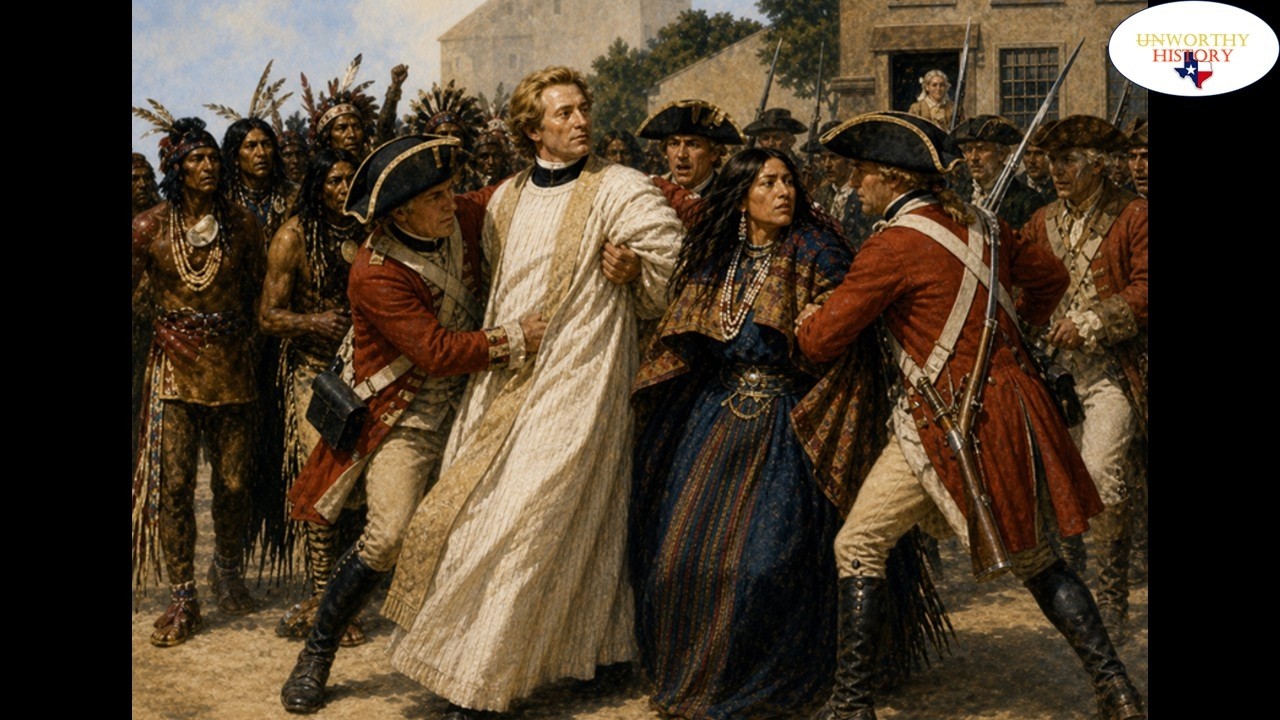
Behind them walked sixteen men who called themselves kings and chiefs of the various Creek towns, and behind them came the armed warriors of the tribe. Savannah’s entire defensive force amounted to no more than 170 men capable of bearing arms. The confrontation had been years in the making. Georgia had been founded in 1733 by James Oglethorpe, who established the colony with strict prohibitions against both slavery and the private ownership of large tracts of land.
To communicate with the Creek Indians, Oglethorpe employed a half-Creek woman named Mary Musgrove, whose first husband ran a trading post. Mary, who could speak both English and Creek, proved invaluable as an interpreter, and Oglethorpe paid her a generous salary. Her services gave her considerable influence among the neighboring tribes, a fact that would later prove dangerous to the colony. For years, the colony had struggled under the trustees’ restrictive policies.
The cultivation of wine grapes and mulberry trees for silk production, which the trustees had promoted, proved unprofitable and was abandoned despite bounties offered for silk. The colonists complained ceaselessly about the ban on slavery. The trustees resisted for a time, but the planters found ways around the law. They began hiring enslaved people from South Carolina, signing contracts for terms of a hundred years or for life, paying the full value of the person in advance.
The former owners in Carolina simply agreed to produce their claims if the Georgia authorities ever interfered. Eventually, purchases were made openly in Savannah. Some seizures occurred, but the magistrates and courts generally cooperated in evading the law. By 1747, the trustees, fearing that further resistance would endanger the peace and prosperity of the colony, yielded to the public demand and removed all restraints on the purchase of slaves.
Later that same year, Thomas Bosomworth, a former chaplain in Oglethorpe’s regiment, married Mary Musgrove after the death of her first husband. Bosomworth was described in the contemporary account as a scheming and enterprising clergyman, and he saw in his new wife a means to acquire a fortune greater than any in America. Because of Mary’s standing among the Creeks, Bosomworth believed he could use her to gain control of vast lands. An opportunity soon presented itself.
A Creek leader named Malatchi, along with sixteen other men who claimed to be kings and chiefs of their towns, was visiting Frederica. Bosomworth suggested to Malatchi that he should be crowned emperor of the Creek nation. A paper was drawn up declaring Malatchi the rightful natural prince and emperor of the Creek dominions, vesting him with the power to declare war, make laws, frame treaties, and convey lands. The chiefs present bound themselves to honor all his contracts and engagements.
The document was duly signed and witnessed. Bosomworth then obtained a deed in the name of Mary, his wife, from Malatchi, granting her all the islands and lands that the Indians had reserved in their first treaty with Oglethorpe. For two years, Bosomworth waited silently for the right moment to press the claim. In 1749, he decided that Mary should assert her ownership of the islands of Sapelo, Ossabaw, and Saint Catherine’s.
To strengthen her claim, he encouraged her to declare herself the eldest sister of Malatchi and to claim descent in the maternal line from an Indian king who had supposedly held the entire Creek territory by natural right. Mary assumed the title of an independent empress and disavowed all allegiance to the king of Great Britain, except by way of treaty and alliance. She summoned a meeting of the Creeks, told them of the great injury they had suffered by the loss of their territories, and urged them to defend their rights by force of arms. The assembled Indians pledged themselves to stand by her to the last drop of their blood.
Mary, escorted by a large body of warriors, then set out for Savannah to demand formal recognition of her claims from the colonial president and council. President Stephens and his council were alarmed. They understood Mary’s influence over the Indians and were uncertain how to protect the town. They decided to use soft and conciliatory measures while hoping for an opportunity to seize her quietly and ship her to England.
In the meantime, they ordered the militia to hold themselves ready and put the town in the best state of defense possible. A message was sent to Mary while she was still several miles from Savannah, asking whether she was serious in such wild pretensions and urging her to dismiss her followers. She was inflexible. The president resolved to receive the Indians with firmness.
As the procession entered town, Captain Noble Jones, at the head of a troop of horse, stopped them and demanded whether their visit was hostile or friendly. Receiving no satisfactory answer, he ordered them to ground their arms, declaring that he had orders not to allow a single armed Indian into the town and that he would enforce the order at the risk of his own life. The Indians reluctantly complied. On the twentieth of July, Bosomworth, in his clerical robes, with his queen at his side and the chiefs following according to rank, marched into Savannah.
The inhabitants were terrified by the sight of the warriors. When the procession reached the parade ground, the militia was drawn up under arms, and fifteen cannon fired a salute. Bosomworth was ordered to withdraw, and the chiefs were asked to declare their business in coming in such a body without being summoned. They had been instructed to say that Mary would speak for them and that they would abide by whatever she said.
They claimed they had heard she was to be sent captive across the sea and had come to learn why they were to lose their queen. They said they intended no harm and asked that their arms be returned. Their guns were given back, but no ammunition was allowed. The following day, after private conferences with Mary, the Indians marched through the streets in a disorderly and hostile manner.
The women and children of Savannah, terrified, expected to be murdered and scalped at any moment. A false rumor spread that the Indians had killed President Stephens with a tomahawk, so enraging the inhabitants that officers had difficulty restraining the troops from opening fire. The situation demanded the greatest prudence to prevent the town from being deluged in blood. Orders were given to seize Bosomworth, and it was made clear to him that he would be the first victim of vengeance if matters came to extremes.
He was confined. Mary became furious. She ordered all white persons to leave her territories immediately, cursed Oglethorpe and his fraudulent treaties, and stamped her foot on the earth, swearing that the whole globe should know that the ground she stood on was her own. She kept the chiefs constantly under her eye and allowed no one to speak on public affairs except in her presence.
Finding that no peaceful agreement could be reached while the Indians remained under her influence, the president ordered Mary seized and confined alongside her husband. With the two leaders secured, the president then turned to the warriors. Men who knew the Indian language were sent to entertain them and explain the wicked designs of Bosomworth and his wife. A feast was prepared for the chiefs and leading warriors.
They were told that Bosomworth had run up debts in Carolina that he could not pay, that he wanted their lands and a large share of the king’s presents intended for the Indians, and that his goal was to satisfy his creditors at their expense. They were told the three islands belonged to the whole nation, not to Mary, and that King George had ordered the president to defend their rights to them. The policy had a temporary effect. Many chiefs declared they would no longer follow Bosomworth’s advice.
Even Malatchi seemed satisfied, particularly when he heard that the king had sent valuable presents. When he was asked why he had acknowledged Mary as empress and resigned his power to a despised old woman when he was recognized as the great chief of the nation, he replied that the whole nation acknowledged her as queen and that none but she or her family could distribute the royal presents, as had always been done before. But Malatchi, whom the Indians compared to the winds for his fickleness, was again drawn over to the Bosomworth cause after meeting with them privately. When the Indians gathered to receive the royal presents, Malatchi stood up with a frowning countenance and delivered a speech full of threats.
He declared that Mary had possessed the country before Oglethorpe, that the English held their lands as her tenants, and that three thousand warriors would raise the hatchet in defense of her claim. He then pulled a paper from his pocket and handed it to the president. The document was clearly the work of Bosomworth. It was filled with the names of Indian kings from the upper and lower Creek towns, although none of them except two were present.
It styled Mary the rightful princess of the whole nation, with full power to settle all public affairs and causes relating to land with King George. Malatchi, perceiving the council’s astonishment, begged to have the paper back, saying he did not know it was a bad talk. The president decided to address the Indians directly. He reminded them that when Oglethorpe first arrived, Mary was living in a poor hut at Yamacraw, neglected and despised by the Creeks, until Oglethorpe hired her as an interpreter, clothed her, and made her a woman of consequence.
He told them she was not related to Malatchi at all, but was the daughter of an Indian woman of no note and a white man. The lands of Georgia had been surrendered voluntarily by the old and wise leaders of the Creek nation in a treaty with Oglethorpe. The present discontent, he said, had been artfully stirred up by Mary at the instigation of her husband, who demanded a third of the royal bounty and had filled the Indians’ heads with wild fantasies to ferment mischief. The Indians asked him to stop.
They declared that their eyes were now opened and that they saw through Bosomworth’s designs. They were determined to hold fast the chain of friendship and asked that they all smoke the pipe of peace. Pipes and rum were brought, and they joined hands, drank, and smoked together. The royal presents were distributed, with the largest shares given to the most disaffected and influential men.
Even Malatchi seemed satisfied. Then Mary, drunk with liquor and enraged at the failure of her plans, rushed among them like a fury. She told the president that these were her people and that he had no business with them. The president advised her calmly to retire to her lodgings, warning that otherwise he would order her back into confinement.
She turned to Malatchi in a rage and repeated the president’s words. Malatchi sprang up, seized his arms, called on the rest to follow him, and dared any man to touch the queen. In an instant, every Indian had his tomahawk in hand, and the president and council expected instant death. Captain Jones, commanding the guard, interposed and ordered the Indians to surrender their arms immediately.
With great reluctance, they submitted. Mary was taken to a private room under guard, and all communication with the Indians was cut off. Bosomworth was brought before the council to be reasoned with, but he became outrageously abusive and swore he would vindicate his wife’s rights to the last extremity. They removed him from the presence of the Indians until they had left town.
The warriors departed over the following days, and the inhabitants of Savannah, exhausted from constant guard duty and frequent alarms, were at last relieved. Malatchi, on his way home, killed several livestock belonging to a settler who had not supported the uprising, but no settlers were killed. Despite the danger they had caused, the provincial authorities did not dare to punish Bosomworth or his wife severely. The stated reasons for their pardon included the intercession of Bosomworth’s brother and a letter from Bosomworth himself admitting his wife’s title was groundless.
But the real cause was fear of retaliation. In 1751, Bosomworth revived his claim, and the matter was litigated in English courts for many years, eventually being decided partially in his favor. A man named Levy then claimed a portion of the lands by prior purchase, and a new suit was begun.
But Levy soon died, and the case was never legally settled.
