November 2024 had been cold even inside the National Archives in Washington, a chill that clung to the reading rooms despite the regulated climate. Dr. Emily Carter had spent fifteen years in these buildings, cataloging materials with the quiet patience the work demanded, and she believed nothing could surprise her anymore. Then she found the box.
It was a small metal container, brought in with a transfer from a closed federal building in Santa Fe, rusted at the edges and absent entirely from the inventory. Painted across its face in faded red letters were the words: FORBIDDEN. DO NOT OPEN. FEDERAL ORDER 1889.
Protocol dictated she report it immediately. Emily understood that. She also understood, in that moment, that the protocol existed for a reason she might never learn if she simply followed it. With a letter opener, she coaxed the corroded lock open.
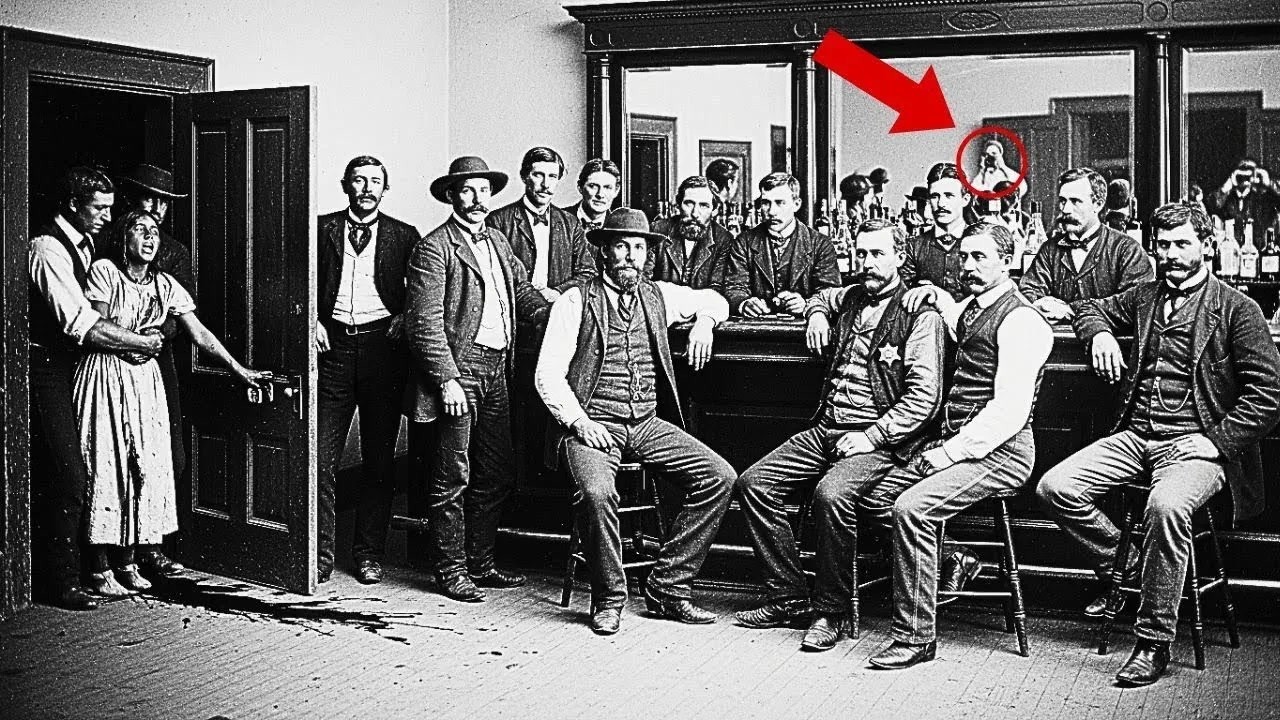
Inside, wrapped in yellowed cloth, lay a photograph on a glass plate and a leather journal. Her hands trembled as she lifted them out. The photograph showed the interior of a saloon in the Old West. Men in period dress stood around the bar, some playing cards, others drinking.
Ordinary enough at first glance. But something was deeply wrong with it. Emily raised the plate toward the gray light filtering through the windows. The image quality was extraordinary for 1889, far better than most photographs of that era.
And the men looked oddly tense despite their casual poses, bodies drawn with an unexplained strain. Two of them stared directly into the camera with expressions that sent a chill down her spine. There was something dark in their eyes. A look of threat.
She opened the journal with careful fingers, mindful of its age and fragility. The first page was written in an elegant hand: “Property of Katherine Wells, Photographer, Silver City, New Mexico Territory. ”
“If you are reading this,” the next line read, “I am most likely dead. What follows is the truth they tried to bury.
”
Her pulse quickened as she absorbed those words. She photographed every page of the journal with her phone, working methodically to document each entry before anyone could stop her. The handwriting was elegant but trembling, as if scribbled in panic. Katherine Wells had been one of the few women photographers working in the New Mexico Territory, documenting life in the mining town of Silver City.
Her final entry, dated March 20, 1889, was terrifying in its brevity. “They know what I captured. They are coming for me. I have hidden the photograph where they will never think to look.
If anyone finds this, please know that Maria deserves justice. Tell the truth I could not speak. ”
Emily understood immediately that she held something dangerous, something powerful men had wanted buried forever. She worked late that night, long after her colleagues had gone home.
The archive was eerily quiet, filled only with the hum of climate control systems preserving the perfect conditions for history to survive. She carried the glass plate to the archive’s photography lab, equipped with high-resolution scanners designed to digitize historical images without damaging them. The technology could reveal details invisible to the naked eye. She placed the plate on the scanner surface with extreme care and began the capture sequence.
The machine whirred softly as laser sensors mapped every microscopic detail of the image. When the scan completed several minutes later, Emily transferred the enormous file to her screen and began to zoom slowly, from the center outward. The men’s faces became clearer with magnification. She recognized expensive suits mixed with rough mining clothes, indicating a gathering of different social classes.
One man wore a sheriff’s badge that gleamed in the image, catching the light of the saloon’s oil lamps. Another had the posture of confident authority, a man used to being obeyed without question. These were not simple cowboys or drifters. They were men of influence, the power brokers of a frontier town.
Her gaze moved toward the left edge of the frame where she had noticed a shadow during her initial examination. She held her breath as she zoomed closer. There, partially obscured by a door frame and darkness, a young woman was being dragged through the entrance by two men. Her face was turned toward the camera, capturing a moment of absolute terror.
Even through more than a century, Emily could see the pure fear in her eyes. Her mouth was open as if screaming, though no sound could escape the silent image. Her right hand reached desperately toward the photographer, fingers stretching for help that would never come. Blood stained her dress in dark patches and left a visible trail across the wooden floor, telling a story of violence and struggle.
She was young, perhaps in her early twenties, with long black hair and features suggesting Native American heritage. Emily zoomed in further, and her professional detachment dissolved as the human tragedy became undeniable reality. Over the next week, Emily became completely obsessed with Katherine Wells. She searched every available database in the National Archives for any mention of the photographer who had risked everything to document a crime.
What she found was deeply disturbing and pointed to deliberate erasure. There was almost nothing in the official records, as if someone had systematically removed every trace of her existence. No census records listed her name. No death certificate could be found in any jurisdiction.
Newspaper references were limited to brief advertisements for photography services in Silver City during 1888 and early 1889. It was as if Katherine Wells had been deliberately erased from history. Emily returned to the journal for answers, reading and rereading Katherine’s elegant handwriting. Katherine had written extensively about her journey to becoming a photographer, a rare profession for women in that era.
She had learned the craft from her father, a traveling photographer who died in a carriage accident in 1885. Rather than selling his expensive equipment, Katherine had made the bold decision to take over his work despite social expectations. She wrote frankly about the resistance she faced in every town: men who refused to have their pictures taken by her, claiming it was improper or that she couldn’t understand the technical aspects of photography. Saloon owners who wouldn’t let her through the door, saying respectable women had no place in such establishments.
Miners who directed crude propositions at her, assuming any woman working alone must be available for other services. But Katherine had persevered with remarkable determination. She had a genuine talent for capturing honest moments, for seeing the truth behind carefully constructed facades. Her photographs revealed the real West, not the romanticized version that would later dominate popular culture.
By 1889, she had settled in Silver City, a booming mining town where fortunes were made and lost overnight. The journal entries from early 1889 took on a darker tone that deeply unsettled Emily. Katherine wrote about women disappearing without explanation or investigation, especially young Native American and Mexican women who worked in saloons or as domestic servants. These were people invisible to most of Silver City’s elite.
Their disappearances were barely noticed by those in power. When Katherine asked questions about the missing women, she was told to mind her own business. When she insisted, showing the same determination that had made her successful as a photographer, she received threatening letters slipped under her door in the dead of night. On February 10, 1889, an entry was particularly striking: “Another girl disappeared without a trace.
Rosa, who worked at the Silver Star Saloon, serving drinks and entertaining the miners. The sheriff says she probably ran off with a cowboy or went back to Mexico, but I saw her face the day before she vanished. She was terrified, looking over her shoulder constantly. No one will investigate properly.
No one cares about girls like Rosa. ”
One name appeared repeatedly in subsequent entries: Mr. Blackwell. Katherine described the man as one of the richest in Silver City, owner of several profitable silver mines employing hundreds of workers.
She suspected his involvement in the disappearances but had no definitive proof, only instincts honed by careful observation. Emily matched the name against historical databases. James Blackwell had indeed been a prominent figure in Silver City during the 1880s, a key face of the territory’s mining industry. Contemporary newspaper reports described him as a pillar of society, a generous philanthropist donating to churches and schools.
He died in 1903, wealthy and respected, his funeral attended by territorial officials and business leaders from across the Southwest. Katherine’s journal painted a very different portrait of the man. She described him as cold and calculating, a man who saw people as property to be used and discarded. She noticed how young women would appear to work in his house, then disappear after a few months, always replaced by others.
The pattern was too consistent to be coincidence. An entry dated March 15 provided crucial details that would change everything. Katherine had been hired to photograph the fifth anniversary celebration of the Silver Star Saloon, a major social event in Silver City. It was a big commission she couldn’t refuse, despite her growing suspicions about the establishment and its connections to the missing women.
She arrived with her equipment as the men gathered to celebrate. “They were drinking heavily,” Katherine wrote, “celebrating something beyond just an anniversary. ” An atmosphere of triumph pervaded, of men who believed they were above the law. Mr.
Blackwell was there, presiding over the place like a king. The sheriff stood beside him, along with several mine owners whose names appeared regularly in territorial newspapers. They barely noticed Katherine as she set up her camera, positioning her tripod and mixing flash powder. To them, she was just another servant, invisible and unimportant.
Then everything changed in a moment when a scream tore through the false celebration. Katherine had positioned her camera with professional precision, adjusted the lens to capture the gathering, prepared the flash powder for exposure. It was meticulous work requiring intense concentration and steady hands. Then the scream from the back room shattered the routine technical process, imposing chaos and horror.
Katherine’s journal entry continued with stark clarity. “They dragged Maria through the door like an animal. She was bleeding from her mouth and nose. Her dress was almost entirely torn.
She looked directly at me, and our eyes met across the smoky room. Her eyes were begging for the help I could not give. ”
In that moment, she made a decision that would change everything. She took the photograph, documenting the truth they wanted to hide.
The flash powder ignited in a bright blaze, flooding the room like lightning. The men froze in the sudden light, surprise and anger etched on their faces. They realized immediately what Katherine had done, understood that she had documented their crime and created evidence that could destroy them all. The photographer grabbed the glass plate, still hot from the flash, and ran for her life.
She knew that plate contained proof of a crime in progress, evidence that could topple influential men. Katherine returned to her photography studio through the dark streets, expecting pursuit at any moment. She immediately developed the plate using the chemicals and techniques her father had taught her years before. As the image emerged in the developing bath, she realized it showed not only the abduction of Maria but also clearly identified every man in that room, including Blackwell and Sheriff Coleman.
It was conclusive evidence of their crime and complicity. The following journal entries, written over subsequent days, described Katherine’s desperate attempts to reach safety and justice. She tried to send the photograph to newspapers in larger cities like Santa Fe and Albuquerque, thinking distance would protect her from Blackwell’s influence, but the stagecoach office was watched by men she recognized as Blackwell’s followers. She attempted to deliver it to a traveling U.
S. Marshal passing through Silver City, hoping federal authorities would be beyond Blackwell’s reach, but the marshal left town the next morning before she could arrange a meeting. She later heard rumors that he had been paid a substantial sum to look the other way. On March 20, 1889, the final entry was written in increasingly trembling handwriting.
“They are coming for me. I can hear horses outside my studio. Many riders, which means Blackwell sent his men. I have hidden the photograph and this journal where they will never think to look.
I have sealed them in a metal box with fake federal labels. If anyone finds this, please know that Maria deserved justice. She deserved to live. Tell the truth I could not speak.
”
Emily felt the weight of responsibility settle on her shoulders as she read those final words. Katherine had died protecting this evidence, making the ultimate sacrifice for the truth. Now, 135 years later, it was Emily’s turn to complete what that brave photographer had begun. She needed to identify Maria properly.
The journal provided only a first name, but the photograph offered more evidence for anyone willing to scrutinize it. Emily enhanced the image further using modern digital tools, focusing particularly on the young woman’s clothing and jewelry. Around her neck hung a distinctive silver necklace set with turquoise stones arranged in a traditional pattern that might indicate her tribal affiliation. Emily contacted Dr.
James Running Bear, a distinguished historian specializing in Native American history in the Southwest. His expertise covered various tribes and their cultural practices during the territorial period. When Emily sent him the enhanced image with precise descriptions of what she had found, his response came within hours. “The pattern of this necklace is specific to the Mescalero Apache tribe,” he wrote.
“It could have been worn by a person of significance within the community, perhaps a chief’s daughter or a woman of special standing. The turquoise arrangement indicates her family possessed considerable resources. This was not an ordinary piece of jewelry. ”
Emily began searching territorial records from 1889 with renewed purpose.
She looked specifically for missing person reports or court cases involving Native American women in Silver City and the surrounding areas. What she found was heartbreaking and infuriating in equal measure. There was nothing. No official report acknowledged the disappearance of these women.
Despite the journal documenting multiple disappearances over several months, there were no official investigations, no missing person reports filed with authorities, no recognition that these women had existed or mattered. Their lives and deaths had been simply erased from official records as if they had never existed. She changed her approach and searched church records instead. She knew that many Native Americans in the territory had been baptized by Catholic missions as part of broader colonization efforts.
In the records of Saint Vincent’s Church in Silver City, Emily found an entry that made her heart race. Dated February 3, 1889: “Maria Encino, 22 years old, baptized Mescalero Apache, works at the Silver Star Saloon. ”
Finally, after more than a century, the victim had a full name and an identity beyond a face in a photograph. Maria Encino, a young woman who had not yet reached twenty-two years of age, had been erased from history just as completely as Katherine Wells.
But now, after 135 years, both women had someone fighting for them. She continued digging through the church records with methodical persistence and found something that changed everything. Maria had a younger sister, Elena, also baptized at Saint Vincent’s during the same period. Unlike Maria, Elena’s records continued past March 1889, creating a thread linking past and present.
Elena married a man named Roberto Montoya in 1892, had six children between 1893 and 1905, and died in 1954 in Albuquerque at the age of eighty-five. This meant Maria had descendants, living people who might not even know their ancestor had disappeared under mysterious and violent circumstances all those years ago. Emily realized with growing excitement that this investigation was no longer just solving a historical mystery. It was about restoring history and truth to a family, perhaps giving them some measure of peace.
It was about connecting past and present, ensuring Maria’s life and death were finally acknowledged. She spent the next several days tracing Elena’s descendants through marriage records, birth certificates, census data, and genealogical resources. The family line continued through Elena’s daughter, Rosa, who had seven children. Tracking birth records, marriage certificates, and death certificates across multiple generations, Emily finally found a name representing the present: Thomas Nashoba, 47 years old, living in Albuquerque, New Mexico.
Emily wrote and rewrote her email twelve times, struggling to find the right words. How do you tell someone you’ve discovered evidence of their ancestor’s murder? How do you explain that the government covered up this crime for over a century? Finally, she sent a simple message, introducing herself as a historian at the National Archives who had discovered information about his ancestor, Maria Nashoba.
Thomas replied within two hours, his response full of emotion. “My great-grandmother Elena used to tell stories about her sister Maria, who disappeared when Elena was just a teenager. Our family always believed she was killed, but there was never any evidence. No one wanted to investigate.
Please, I need to know what you found. ”
Emily requested access to territorial federal records from 1889, specifically documents related to law enforcement in Silver City and territorial governance. What arrived two weeks later in three large archival boxes shocked her to the core. These materials had been classified and sealed shortly after New Mexico gained statehood in 1912, hidden for over a century.
Inside, she found extensive correspondence between Sheriff Thomas Coleman and territorial officials revealing a disturbing pattern of complicity and corruption. Coleman had initially reported the disappearances of local women, filing official reports to territorial authorities. His early letters showed genuine concern and frustration at his inability to protect these vulnerable women, but his reports were systematically rejected or ignored by higher authorities with other priorities. Then suddenly, in April 1889, just weeks after Maria’s disappearance and Katherine’s presumed death, the reports stopped entirely.
It was as if Coleman had given up or been silenced. One letter stood out from all the others, dated April 2, 1889. It was from Territorial Governor Edmund Ross to Sheriff Coleman, and its content was damning. “Your continuous reports regarding the Silver City matter have been received.
However, given Mr. Blackwell’s significant contributions to the development of the territory and the lack of substantive evidence, we must consider these matters closed. Further investigation would be detrimental to the economic interests of the territory and its prospects for future statehood. ”
Emily read the letter three times, growing angrier with each reading.
The governor had explicitly ordered Coleman to stop investigating the disappearances. The economic interests of one wealthy man were deemed more important than the lives of missing women. Justice had been sacrificed on the altar of economic development and political expediency. But there was more evidence buried in another box.
Emily found a confidential report from a U. S. Marshal named Robert Hayes, dated March 1890, a full year after Maria’s disappearance. Hayes had been sent to investigate rumors of corruption in Silver City, working undercover to gather information.
His report detailed everything with meticulous precision: the missing women, Blackwell’s involvement in their disappearances, Coleman’s initial investigation attempts and subsequent silence, and the territorial government’s deliberate cover-up. The report also mentioned Katherine Wells by name, providing the first official acknowledgment of her fate. “The photographer who attempted to provide evidence has not been seen since March 1889. Local sources indicate she fled the territory, but this investigator believes she came to harm.
Her photography studio was emptied days after her disappearance, her equipment sold to pay alleged debts, and all her business records destroyed. ”
The report concluded with a damning assessment that should have triggered federal intervention. “At least 17 young women, most of Native American and Mexican descent, disappeared from Silver City between 1887 and 1889. Evidence indicates they were held against their will on properties owned by James Blackwell and possibly transported to other locations.
Territorial officials actively suppressed the investigation to protect economic interests. We recommend immediate federal intervention and prosecution. ”
But there was one final document explaining why no action was taken despite this clear recommendation. A letter from the U.
S. Attorney General’s office, dated April 1890, stating that federal prosecution would not proceed due to lack of evidence and political complications. The cover-up had reached the federal level, where the nation’s highest law enforcement officials chose to protect powerful interests over vulnerable women. Emily sat back, overwhelmed by the scale of the injustice.
Katherine’s photograph had not been seized and buried by local authorities protecting their own, but by federal officials desperate to avoid a scandal that might threaten New Mexico’s path to statehood. Political ambitions had outweighed human lives. She arranged to meet Thomas at a café in Albuquerque, bringing copies of everything: the photograph, Katherine’s journal, the federal documents, Marshal Hayes’s report. She had prepared herself for this conversation, rehearsed what she would say.
But when Thomas arrived with his teenage daughter, Sophie, Emily realized this was no longer about historical facts or academic research. It was about a family’s pain passed down through generations, a wound that never healed because it was never properly acknowledged. Thomas looked at the photograph for a long time, his hands trembling as he held the printed image. Sophie gripped her father’s arm, tears streaming down her young face.
“That’s her,” Thomas whispered, his voice thick with emotion. “My grandmother showed me a small picture once when I was young, when she thought I was old enough to understand. She said Maria was beautiful and kind, and that powerful men took her because they could. ”
Emily shared everything she had discovered over weeks of research.
She explained Katherine’s courage in taking the photograph despite the obvious danger. She detailed the cover-up that extended from local authorities to the territorial government and up to federal officials. She explained how the murder of their ancestor had been systematically erased from history to protect economic and political interests. Thomas listened, his expression shifting from sadness to anger, then to something else entirely: determination.
“Our family always knew the truth,” he said quietly. “But we never had evidence, no way to make anyone listen to us. We carried this pain and injustice for generations. And now you’re telling me the evidence existed all along, hidden by the very government that was supposed to protect it.
”
Sophie spoke for the first time, her voice strong despite her tears. “What happened to the photographer, to Katherine? She tried to help Maria and document what happened. She deserves justice too.
”
Emily showed them the final journal entry, Katherine’s last words about hearing horses outside. “I’m still researching what happened to her,” she admitted. “But I won’t stop until I know the truth about Katherine’s fate as well. ”
Discovering what happened to Katherine Wells became Emily’s constant obsession over the following weeks.
If the photographer had managed to escape, there must be records somewhere of her starting a new life under a new name. If she had been killed, there might be evidence of that too, hidden in forgotten archives. Emily expanded her search beyond Silver City, looking for any trace of Katherine in neighboring towns and territories across the Southwest. She found nothing in official records, suspicious in itself, but she tried a different approach that had proven effective before.
She began searching collections of personal correspondence from that era: letters and diaries of ordinary people who might have encountered Katherine during her flight. In the archives of the Colorado Historical Society, she found a letter dated June 1889 from a woman named Margaret who ran a boarding house in Denver to her sister in Boston. “A strange woman arrived at my boarding house last month,” Margaret wrote. “She was traveling alone, unusual for a respectable woman, but she seemed terrified of something or someone.
She called herself Katherine, though I doubt that was her real name. She paid for two weeks in advance with good silver coins, but left after only three days, saying she had to keep moving. ”
Emily’s pulse quickened as she read. She searched for more of Margaret’s letters in the collection and found several written throughout the summer of 1889.
In another letter dated July 1889, Margaret mentioned something that made Emily’s blood run cold. “I read in the newspaper that a woman’s body was found beside the railroad tracks outside Denver. The description matched that frightened photographer who stayed here briefly. The authorities say it was an accident, that she fell from a moving train while trying to travel without paying her fare.
But I remember her fear, how she flinched at every sound. I don’t believe it was an accident at all. ”
Emily immediately requested Denver police records from July 1889. After weeks of bureaucratic delays and waiting, a file finally arrived.
“Unidentified female, approximately 30 years of age, found dead on July 18, 1889, near the railroad tracks five miles south of Denver. No identification papers on the body. Incident classified as accidental death. Body unclaimed, buried in a pauper’s grave.
” But there was a list of belongings attached to the brief report. Among the few items found on or near the body: a silver locket containing a photograph, and a worn leather bag containing photography chemicals and glass plates. Emily’s hands trembled as she read. This had to be Katherine.
She contacted the Denver Medical Examiner’s office, hoping against slim odds that case evidence might still exist after more than a century. They had nothing from 1889 in their current evidence storage, but they directed her to a local historical society that kept old police evidence for research purposes. Three weeks later, Emily received a package that would provide the final piece of the puzzle. Inside was the silver locket mentioned in the police report, carefully preserved in an evidence bag.
When she opened it with trembling fingers, her suspicions were confirmed. Inside was a small photograph of a young woman standing beside a camera on a tripod, the tools of her dangerous profession. On the back, in faded ink that had somehow survived, were the words: “Katherine Wells, 1888. ”
Emily now had evidence that Katherine had not escaped to start a new life somewhere safe.
The photographer had been murdered, her death disguised as an accident, her identity buried with her in an unmarked grave. Emily knew the photograph and all the evidence had to be made public, but she wanted to do it properly, to honor Maria and Katherine with the dignity they deserved. She contacted Dr. Margaret Chen, a distinguished historian specializing in crimes against Native American communities, whose work Emily had long admired.
She also reached out again to Dr. James Running Bear, who had helped identify Maria’s necklace. Together they began planning a comprehensive release that would honor Maria and Katherine and reveal the full scope of the conspiracy that had kept their stories hidden for 135 years. They also invited Thomas and Sophie to be part of the process from the beginning.
This was their ancestors’ story, and it was their right to help tell it. Thomas agreed immediately, his voice strong with determination. “For 135 years, our family was told we were wrong, that we were exaggerating or lying about what happened to Maria. People said we were overreacting, that she probably just ran away.
Now we can prove the truth. We can show the world what was done to her. ”
Emily coordinated with the National Archives to formally declassify all materials related to the case. She worked closely with journalists from major newspapers and historical publications, preparing them for what would be a major story.
She prepared a detailed report documenting everything: the photograph itself, Katherine’s journal, the federal cover-up, Marshal Hayes’s ignored investigation, Katherine’s murder. The work took months of careful preparation. Every fact had to be verified, every document authenticated, every claim supported by evidence. They could not give anyone an excuse to dismiss or distort their findings.
The stakes were too high, and powerful interests had already failed too many people. On March 15, 2025, exactly 136 years after Katherine took the photograph that cost her life, they held a press conference at the National Archives in Washington, D. C. The room was packed with journalists, historians, and Native American community leaders.
The photograph was shown publicly for the first time, projected onto a large screen where everyone could see the truth Katherine had risked everything to document. Thomas spoke about Maria, his voice strong despite the emotion evident on his face. He spoke about his great-grandmother Elena, who carried the pain of losing her sister for her entire life. He spoke about generations of his family who had been met with dismissal and rejection when they tried to tell the truth.
Sophie, more confident now than at their first meeting, read passages from Katherine’s journal, giving voice to the photographer’s words after more than a century of silence. Her young voice carried the weight of history as she shared Katherine’s notes about the missing women and her growing fear. Emily presented the evidence of the conspiracy with methodology and objectivity, letting the documents speak for themselves. She showed the correspondence between Sheriff Coleman and territorial officials.
She showed Governor Ross’s letter explicitly ordering the investigation halted. She revealed Marshal Hayes’s report and the Attorney General’s decision not to take action. The response was overwhelming and immediate. News outlets around the world covered the story, recognizing its enormous significance.
Major newspapers published front-page articles with headlines like “Hidden History,” “Federal Government Covered Up the Murders of Indigenous Women,” and “Photographer Who Died Defending Evidence of 19th-Century Crimes. ” Historians described it as one of the most important discoveries in decades, not just because of the photograph itself or even the specific crimes it documented, but for what it revealed about systematic injustice and institutional cover-up that protected powerful men at the expense of vulnerable women. It opened the door for discussions about how many other stories remained buried. Native American communities across the Southwest expressed profound gratitude that Maria’s story was finally being told, that the conspiracy meant to silence her had been exposed.
Tribal leaders spoke about how this justice, though late, meant so much to all the forgotten victims whose stories had never been heard. But there was more work to be done beyond simply revealing the truth. Emily, in close collaboration with Thomas’s family and tribal leaders, filed a petition with the Department of Justice demanding official recognition of the crimes and the government’s role in the cover-up. They demanded a formal apology and acknowledgment of all the women who had disappeared from Silver City during those years.
The petition gathered tens of thousands of signatures from across the country. Congressional representatives from New Mexico took up the cause, calling for hearings and investigations. The story had struck a nerve in the American consciousness, awakening awareness of grievances ignored for far too long. Six months later, the Attorney General issued a formal statement.
Though carefully worded by government lawyers, it constituted an unprecedented acknowledgment. The statement admitted that the federal government had failed in its fundamental duty to protect vulnerable citizens and deliver justice. It acknowledged that officials had actively suppressed evidence of serious crimes for political and economic reasons. Of course, the statement could not bring back Maria or Katherine.
No words could erase the violence they had suffered or the decades of silence that followed. But it was an official acknowledgment. It was the truth. And for Thomas’s family, it was vindication after generations of dismissal and neglect by those in power.
The photograph was placed on permanent display at the National Museum of American History with full context provided about Maria, Katherine, and the conspiracy that tried to erase their stories. The exhibition became one of the most visited displays in the museum. A year after the initial discovery, Emily stood in a cemetery in Albuquerque beside Thomas, Sophie, and dozens of members of the Nashoba family. They had collected donations from the community to erect a proper memorial for Maria, though her body had never been found and likely never would be.
The headstone they unveiled read: “Maria Nashoba, 1867 to 1889, beloved daughter and sister, member of the Mescalero Apache people. Her truth was silenced, but never forgotten. ”
Beside Maria’s memorial, they placed a second stone for the woman who had tried to save her. “Katherine Wells, 1859 to 1889, Photographer and Truth-Teller.
She risked everything to document injustice. Her courage echoes through time and reminds us that some truths cannot be erased. ”
Sophie, now sixteen, wrote a comprehensive school research paper about her ancestor that won a national history competition. She became an advocate for investigating other historical injustices, using her platform to speak about the importance of remembering forgotten victims.
At the memorial ceremony, she spoke with remarkable composure. “For generations, our family carried the pain of not being believed,” she said in a clear, strong voice. “We knew what happened to Maria, but we had no way to prove it. People dismissed our family stories as exaggerations or fabrications.
Katherine gave us that proof through her courage and her camera. She died protecting that evidence. Today, we honor them both. ”
Emily continued her research even after the press conference and official acknowledgments.
She discovered something remarkable that added another dimension to the story. Before fleeing Silver City in fear for her life, Katherine had hidden a large collection of her photographic work with a sympathetic family who had briefly sheltered her. These photographs, carefully preserved in a box in an attic for over a century, documented daily life in the New Mexico Territory with unprecedented intimacy. They included images of Native American and Mexican families, people rarely photographed by professionals of that era.
Katherine had captured their humanity, their dignity, their ordinary lives with the same skill she used to document extraordinary crimes. These photographs, along with the famous image of Maria, were published in a comprehensive book co-authored by Emily, Dr. Running Bear, and Thomas. The book told the complete story: Maria’s life before her murder, Katherine’s courageous work as a photographer, the crimes themselves, the conspiracy to cover them up, and the long journey toward justice.
It became required reading in American history courses across the country, used as a case study for understanding how power, privilege, and prejudice shape historical records. But perhaps the most significant legacy was simpler and more personal than any official acknowledgment or academic recognition. The story inspired other families to uncover their own hidden histories, stories of ancestors deliberately erased, excluded, or forgotten by those who wrote official history. Emily’s work proved these forgotten stories mattered, that they could be recovered through persistent research and dedication, and that bringing them into the light could achieve healing across generations.
Historians across the country began reexamining cases of missing women from the Old West with fresh eyes, applying modern investigative techniques to century-old mysteries. Many cases previously dismissed as women simply running away were reevaluated. Evidence that had been ignored or downplayed was examined from new perspectives. More stories emerged of suppressed violence, denied justice, and powerful men protected at the expense of vulnerable women.
Emily returned repeatedly to the National Archives, to that small metal box where it all began. She often thought of Katherine’s final words: “Tell the truth I could not speak. ” Those words had waited in the darkness for 135 years. But silence cannot last forever.
Truth has a way of eventually surfacing. Katherine’s photograph had been forbidden for over a century, hidden by people who believed they could bury the truth forever. They failed. The photograph now hung in one of America’s most prestigious museums, seen by millions of visitors who knew the story of Maria and Katherine and the injustice they suffered.
The truth had waited patiently in the darkness for someone like Emily to bring it into the light. And when it finally emerged after more than a century of suppression, it changed everything. Maria was no longer remembered as a nameless victim, but as a real person with family and community. Katherine was honored as a courageous woman who sacrificed everything for the truth.
Their story reminded the world that some voices, no matter how long suppressed, insist on being heard. The photograph remained on permanent display, a testament to courage, to justice delayed but not denied, and to two women who refused to let injustice remain hidden, even at the cost of everything. Visitors stood before it, contemplating the faces of the men who believed themselves above the law, and the terrified face of Maria reaching desperately toward the camera. And they remembered that truth matters, that justice matters, and that every life matters, regardless of power or privilege.
They remembered that the work of justice never ends, and that every generation must choose between confronting uncomfortable truths or allowing them to remain buried. Maria and Katherine made their choice 135 years ago. Emily made hers.
And every new visitor makes theirs.






