In March 1995, executives from United States Shoe Corporation sat in a Cincinnati boardroom and signed away the company’s entire footwear division to rival Nine West. The division that gave the corporation its name was now someone else’s property. Sixty-four years earlier, United States Shoe had been born from a merger, with its flagship brand, Red Cross Shoes, sold across nearly every corner of the country. The company that had spent six decades proving it could sell shoes to America had never imagined the thing that would end it would be a small eyewear chain it bought almost as an afterthought.
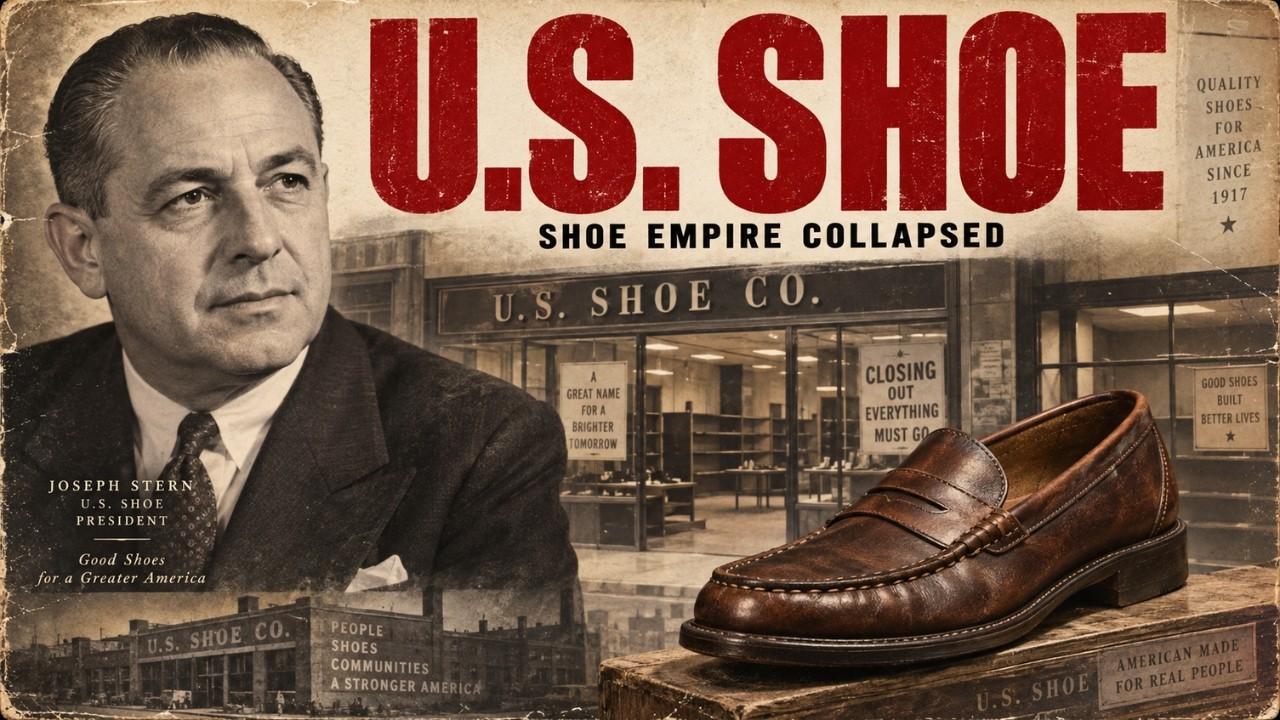
The story begins in 1879, in Cincinnati, a city thick with tanneries and leather works along the Ohio River. A shoe-making outfit called Stern-Auer Shoe Company opened its doors, one modest operation among dozens in the same trade. Four decades later, in 1921, eight separate Cincinnati shoe manufacturers decided to stop competing and merge into a single company called the United States Shoe Corporation, putting their weight behind one flagship brand, Red Cross Shoes. The bet failed.
By 1929, the merged company was near collapse. Watching from across town was Joseph Stern, still running Stern-Auer, which had stayed out of the original merger. Stern proposed folding the two companies together on one condition: his company would take over marketing for Red Cross Shoes. After two years of negotiation, a new United States Shoe Corporation was born, with Stern installed as president.
The timing could not have been worse. The country was sliding into the Great Depression, and the company’s answer was blunt: it cut the price of Red Cross shoes from ten dollars to six, keeping working Americans buying even as their wallets thinned. It was survival, and it worked. When the Second World War began, a different threat arrived.
The American Red Cross objected to a shoe company trading commercially on its name. Rather than fight, United States Shoe voluntarily dropped the name. It was not until 1948 that the Federal Trade Commission allowed the company to use it again, on the condition that it publicly state it had no connection to the American Red Cross. With its name secured in the postwar economy, United States Shoe began building outward.
In 1955, it bought Joyce Incorporated, a women’s shoemaker. Two years later, it secured the rights to Selby. It developed its own brands, including Cobbie’s and Socialites. In 1961, it acquired Vaisey Bristol Shoe Company, maker of the children’s brand Jumping Jacks.
By then, the company covered women, men, and children under one roof. But it no longer wanted to just make shoes. In 1963, it bought Wm. Hahn & Company, and the following year, Cutter Karcher Shoe Company.
For the first time, it was becoming a retailer, not merely a manufacturer supplying other people’s stores. Then the company reached past shoes entirely. In 1969, it bought Casual Corner, a women’s clothing chain. The following year, it built a menswear chain from scratch, J.
Riggings. In 1981, it added a discount clothing chain, T. H. Mandy.
By then, United States Shoe had quietly become a sprawling retail conglomerate that happened to have the word shoe in its name. Then, in 1984, almost as an afterthought, it bought a small optical retailer operating exactly three stores. It was called LensCrafters. Of every acquisition the company would ever make, the one that cost it the least attention in 1984 is the one that ended up deciding whether it existed at all.
In 1985, Bannister Hudson, an eighteen-year veteran of Procter & Gamble, joined LensCrafters. Under the leadership that followed, the chain expanded at a pace almost nobody inside the parent company had planned for. Through 1986, new stores opened at a rate of nearly two per week. By the end of 1989, LensCrafters had grown to more than 350 stores, generating $532 million in sales.
Its net income of $30 million accounted for nearly forty percent of the operating earnings of the entire parent corporation. Fewer than six years after being bought with three stores, it was worth more to the balance sheet than most of the shoe brands that gave the company its name combined. By the end of the 1980s, the child adopted almost as an afterthought had quietly grown larger than the parent. The older shoe brands were not collapsing outright.
They were simply standing still, and in retail, standing still was its own kind of decline. Sales in the core footwear division grew slowly, if at all, through the early 1990s, while the optical division kept adding stores and revenue at a pace the shoe business never matched. A corporation’s leadership only has so much attention to spend, and it had begun flowing toward the optical division. Trade press coverage increasingly framed United States Shoe as an eyewear retailer that happened to also sell shoes.
The center of gravity inside the boardroom had shifted, even though the name on the letterhead had not. The retreat began quietly, one division at a time. In 1987, the company sold J. Riggings to Edison Brothers Stores.
In 1991, T. H. Mandy shut down entirely. In 1993, the teen clothing chain Ups ’n Downs and the women’s clothing chain Karen Charles were both sold off.
Piece by piece, the conglomerate was being taken apart by its own leadership, one signature at a time. Amid the retreat, one footwear brand was thriving: Easy Spirit, launched in 1986, had found real traction with comfort-focused designs. It was proof the footwear formula still worked when the product was right. But one strong brand could not carry an entire division on its own.
The older names kept moving sideways at best. By the mid-1990s, what remained was a company built around two businesses only: footwear and optical retail. And they were no longer remotely equal. One was the past the company came from.
The other increasingly looked like its future. Whatever happened to United States Shoe for the rest of its existence was going to be decided in a handful of weeks in the first half of 1995, not by its own leadership, but by an Italian eyewear company that had never sold a single shoe. Luxottica launched a hostile takeover aimed squarely at the corporation. It did not want shoes.
It wanted LensCrafters, the most valuable thing the company owned. A hostile bid does not ask permission, and shareholders were being courted directly. The board could not simply refuse, nor could it easily defend two businesses at once. Holding on to both intact was quickly becoming the least realistic option.
What emerged instead was a controlled dismantling, negotiated under pressure. If the footwear division could be sold on the company’s own terms before the hostile bid forced a less favorable outcome, at least one piece could still be shaped by the company itself. In March 1995, United States Shoe agreed to sell its entire footwear division to Nine West Group for $600 million. The sale doubled Nine West’s size overnight and made it the third largest shoe manufacturer in the country.
The portfolio handed over included the older names, Red Cross Shoes, Joyce, Selby, Cobbie’s, as well as Amalfi, Evan Picone, Bandolino, and most valuable of all, Easy Spirit. In 1994, Easy Spirit alone generated $200 million in sales. Its profits accounted for the entirety of United States Shoe’s $35 million in total company profit that year. All of it.
Every other shoe brand the company owned was, in combined terms, contributing nothing to the bottom line. One month later, in April 1995, Luxottica announced it had reached an agreement to acquire what remained of United States Shoe Corporation for $1. 4 billion. What remained was no longer a shoe company.
The footwear division was gone. Luxottica was paying for LensCrafters and whatever else was still attached to the corporate shell. Two transactions, one month apart, had stripped away the business that gave the company its name and absorbed everything else into a foreign eyewear company. A corporation that had existed since 1879, survived the Great Depression, and fought off the American Red Cross was taken apart in about thirty days.
One piece remained: the apparel business, known as the Women’s Specialty Retailing Group, still built around Casual Corner, acquired back in 1969. Luxottica had never wanted it. In October 1995, it spun the group off and sold it to a separate company operated by Leonardo Del Vecchio, the founder of Luxottica itself, together with his family. The business Luxottica chose not to keep reported losses of $22 million that same quarter.
With that spin-off, the dismantling was complete. In about seven months, a company that once operated shoe factories, clothing chains, and an optical empire under a single name had been separated into three unrelated pieces, each owned by a different company, none of them called United States Shoe. The parent that had held it all together no longer existed. Not bankrupt, not liquidated.
Simply divided, cleanly and completely, until there was nothing left to carry the name. The first eyewear victory had not belonged to Luxottica at all. In 1992, while still owned by United States Shoe, LensCrafters surpassed Pearle Vision to become the largest chain of eyeglass retailers in the country, generating roughly $660 million in annual revenue. It suffered a sales decline at the start of the decade during the Gulf War and recession, but by 1993 it had launched a discount joint venture with Kmart and become Canada’s largest optical retailer.
Under Luxottica, the growth continued. By 1997, LensCrafters crossed $1 billion in annual sales. In 2004, Luxottica acquired Pearle Vision outright, the same chain LensCrafters had overtaken in 1992. Two rivals now sat side by side under one roof.
Meanwhile, the shoe brands that gave United States Shoe its name became lines within Nine West’s much larger catalog. Today they exist almost exclusively as vintage listings on second-hand marketplaces. Easy Spirit followed a different path. It stayed inside Nine West until 2016, when it was sold to Marc Fisher Footwear, founded by a man whose own father had co-founded Nine West decades earlier.
Under its new owner, Easy Spirit was relaunched in 2018 and is still active, sold through department stores and its own online storefront, one of the few names to survive intact from the wreckage of 1995. Nine West itself filed for bankruptcy in 2018, and its own namesake brand was later sold off. The buyer, in the end, did not fare so differently from what it had once bought. Today, a LensCrafters sign hangs over storefronts in malls across America.
Almost nobody walking past has any reason to know that this business once belonged to a shoe company. The company that built Red Cross Shoes, that survived the Great Depression by cutting its prices, that fought and won the right to keep its own name, is gone. It did not disappear because people stopped buying shoes.
It disappeared because one thing it bought almost by accident became too valuable for it to be allowed to keep.
