In a warehouse outside Orlando, a bear in overalls named Billy Bob sings to an empty room. There is no audience, no birthday party, no restaurant around him, only concrete, a few retired animatronic animals, and the man who built him, running the show for a camera. The bear’s mouth moves in perfect sync with the music. His eyebrows lift, his head tilts, his hands work the neck of a bass guitar.
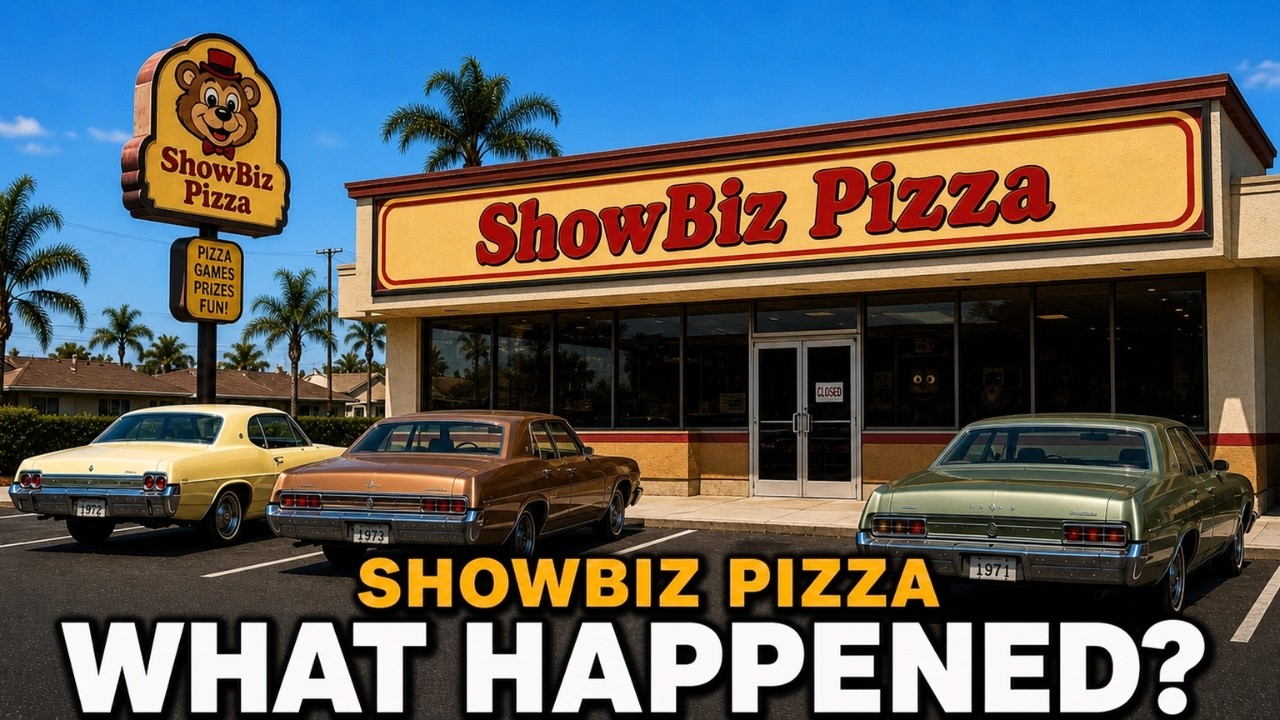
He is performing with the same warmth he had in 1983, when millions of American children watched him every weekend. The restaurants he lived in are gone, deliberately erased by the company that owned him. Showbiz Pizza Place did not go bankrupt. It did not lose to a competitor or get abandoned by its customers.
Showbiz Pizza vanished because it won a war, and then, having won, it decided to erase itself. It took the most beloved thing it had, a band of animatronic animals people loved with startling intensity, tore it out of every restaurant, and threw it away over a fight about who owned the copyright. The restaurant died. The band did not.
It went underground, became a cult, then a legend, and eventually the seed of one of the biggest horror franchises of the modern era. Billy Bob outlived the company. The man who started Showbiz Pizza was Robert Brock, a hotel magnate and founder of Residence Inns. In the late 1970s, Brock signed a deal to develop franchises for someone else’s concept: Chuck E.
Cheese. Nolan Bushnell, founder of Atari, had opened the first Chuck E. Cheese Pizza Time Theater in 1977, a sensation that combined pizza, arcade games, and a stage of animatronic characters, all built for children. Brock, an operator who knew how to build locations at scale, signed on to expand Chuck E.
Cheese across the country. Then he went to the restaurant, understood how it worked, and decided to build his own competing chain instead, the same fundamental idea: pizza, arcade games, animatronic animals on a stage. Showbiz Pizza was born from a kind of appropriation. Brock took the concept he had been trusted to franchise and made it his own.
The chain that would one day erase a creator’s work to seize control of it began by seizing a concept that belonged to someone else. Brock did not just copy Chuck E. Cheese’s robots. He found a better robot maker.
He partnered with a company in Orlando called Creative Engineering, run by a young inventor named Aaron Fector. Fector was a mechanical engineer and genuine tinkerer who had been involved in the early development of Whac-A-Mole. What he built for Showbiz was the most advanced animatronic entertainment ever put in a restaurant, a full band of life-sized characters he called the Rock-afire Explosion. There was Billy Bob Brockali, a bear in overalls on bass and vocals; Mitzi Mozzarella, a cheerleader mouse; Fatz Geronimo, a gorilla on keyboards who led the band; Duke LaRue, a dog on drums; Rolfe DeWolfe, a wisecracking wolf with his puppet sidekick Earl Schmerle; Looney Bird, who hung from the ceiling; and Beach Bear on guitar.
Each character had a distinct personality, voice, and role. Where most animatronics of the era used stiff fabric masks with limited movement, Fector used flexible latex faces stretched over the moving mechanisms underneath, which meant the characters could actually make facial expressions. They could smile, raise their eyebrows, emote. Children responded to that difference immediately.
Fector programmed some characters so precisely they could move in genuine rhythm with the music. He wrote the skits, voiced Billy Bob, Rolfe, and Looney Bird, and programmed the show tapes. He was not a contractor filling an order. He was an artist pouring himself into a creation.
For a child in the early 1980s, Showbiz Pizza was overwhelming in the best way. The room was dim, loud, packed with kids, smelling of pizza and the electronic chatter of arcade games. At the appointed time, the lights shifted, curtains opened, and the band came to life. Deluxe setups had three separate stages spread across the room, so the whole room became a theater.
These were not screens. They were huge, physical creatures, bigger than a child, right there looking at you and singing to you. For the length of a song, a child genuinely believed a band of animal musicians had gathered in a pizza restaurant specifically to celebrate them. The feeling lodged deep.
It is why grown adults still get emotional about a bear in overalls. For a while, Showbiz and Chuck E. Cheese were direct rivals, two nearly identical chains born from the same broken partnership, with lawsuits over how similar the concepts were, settled in the early eighties. Kids were often Showbiz kids or Chuck E.
Cheese kids depending on which chain their town had, and Showbiz kids will insist to this day the Rock-afire Explosion was better, not a little better, better in a way that stuck. Then the war took its strangest turn. In 1984, Bushnell’s Pizza Time Theater went bankrupt, hammered by the video game crash of the early eighties and aggressive overexpansion. Showbiz’s parent company bought it out of bankruptcy.
The imitator swallowed the original. The two merged into one company, Showbiz Pizza Time Inc. , which now owned both chains. If you had asked in 1985 which chain would survive, the almost inarguable answer was that Showbiz and its superior Rock-afire Explosion would be the future.
Showbiz was doing well as a business. Under new leadership after the merger, it modernized aggressively. A man named Richard Frank took over the restaurant division in the mid-eighties and made sensible changes based on customer research: brighter lighting, a redesigned menu, table service, self-serve fountain drinks, better rides, dedicated toddler areas. In 1989, Showbiz Pizza Time went public, a healthy, expanding, publicly traded company.
The erasure of the Rock-afire Explosion was not a desperate act of a dying business. It was a deliberate choice by a successful one. The reason was a fight over ownership. Showbiz owned the restaurants, but it did not own the Rock-afire Explosion.
Aaron Fector and Creative Engineering owned the characters, the copyrights, the licensing. Showbiz had the band in its restaurants, but it was Fector’s band. That arrangement became intolerable to Showbiz once it was a big public company that wanted total control. New management wanted to reprogram the characters, change the skits, produce new content, use the band however the company saw fit.
They could not fully do that because Fector owned the creative rights. There was constant friction. At one point in the mid-eighties, the company maneuvered to gain the ability to program the characters and replicate their voices itself. In 1986, after Creative Engineering produced a special Statue of Liberty centennial show, Showbiz returned the recording rights to Fector but kept the programming rights.
The tug-of-war was constant and granular, and both sides could feel it heading somewhere bad. In 1988, Showbiz made an offer: buy the Rock-afire Explosion outright, the characters, the rights, everything, so it could do whatever it wanted with the band forever. Aaron Fector said no. By his account, Showbiz was not offering real monetary compensation for what the creation was worth, and beyond the money, these were his characters.
Selling them meant handing his life’s work to a corporation that would reprogram and change them into whatever served the business. He held the line. Showbiz did not accept the refusal and move on. It decided that if it could not own the Rock-afire Explosion, it would eliminate it.
If Fector would not sell his characters, the company would remove them from every restaurant and replace them with characters it did own, the Chuck E. Cheese characters from the merger. It would retrofit the Rock-afire stages, physically rebuild the animatronics, and convert Fector’s band into a new band made of characters Showbiz controlled completely. The process had a name, chilling in its corporate blandness: Concept Unification.
Launched in 1990, it was the systematic erasure of the Rock-afire Explosion. To save money, the company did not build new animatronics. It retrofitted the existing ones. Billy Bob the bear was physically converted into Chuck E.
Cheese the mouse. The whole cast was cannibalized, mechanisms reused, latex faces replaced, identities overwritten. In place of the Rock-afire stood a new band called Munch’s Make-Believe Band, built partly from the bodies of the Rock-afire characters. This was not replacement with the old things put in storage.
It was conversion. The robot that children had hugged and talked to got its face peeled off and its body rebuilt on the same frame into a mouse. The skeleton stayed. The soul got overwritten.
The characters were eliminated from merchandise, branding, and marketing, and then the final step came: the Showbiz Pizza Place locations were renamed. They all became Chuck E. Cheese. By 1992, the conversion was essentially complete.
Showbiz Pizza Time Inc. renamed itself CEC Entertainment. The Showbiz name was gone. Showbiz did not lose.
It won every battle. It outbuilt its rival with better technology, survived the video game crash that killed its rival, and bought the bankrupt rival for parts. Then, having won completely, it destroyed its own trophy on purpose and took its dead rival’s name. It was a suicide disguised as a victory, all because of a licensing dispute.
When Aaron Fector saw his characters being physically converted, he was disgusted, and in September 1990, Creative Engineering severed all ties with Showbiz Pizza Time completely. The break was total, and it only accelerated Concept Unification. By 1992, the Rock-afire shows were all converted. In January 1993, it was over.
The Rock-afire Explosion was not removed because kids stopped loving it. It was removed for one reason: a company could not own the copyright and would rather destroy a beloved thing it did not own than keep paying the man who made it. Ownership beat quality. Control beat love.
But the thing Showbiz threw away refused to stay dead. Fector kept the characters, the rights, the original designs, and many of the actual animatronics that had not been converted. Some Rock-afire shows were sold off to smaller pizza and entertainment places like Circus Pizza and Pistol Pete, where they performed in obscurity for a while. Mostly the band went home to Creative Engineering in Orlando, back to Fector’s warehouse.
For years, a defunct animatronic band gathered dust. Then in 2007, someone posted a video online of a privately owned, restored Rock-afire show performing, and it went viral. People discovered the technology that had been ahead of its time in 1983 was still incredible, uncanny and wonderful, hitting people right in the nostalgia. And because Fector still owned everything and could still program the shows, fans started programming the Rock-afire Explosion to play modern songs and posting the results.
A whole online subculture bloomed. Fector’s decades-old refusal to sell finally paid off. If he had sold in 1988, the characters would have belonged to a corporation with every reason to bury them forever. The refusal that cost him his characters’ entire world in 1990 was the exact thing that let them have a second life in 2007.
Documentaries were made. The characters appeared in movies. And then came the strangest twist: the Rock-afire Explosion and the whole uncanny world of pizza restaurant animatronics became one of the acknowledged inspirations for Five Nights at Freddy’s, the horror game franchise about haunted animatronic characters in a pizza restaurant that come alive at night. Five Nights at Freddy’s became a global phenomenon of games, books, a hit movie, and merchandise, one of the biggest horror properties of the modern era, built on the eerie magic of pizza restaurant animatronics.
The company had manufactured something powerful enough to become both a generation’s favorite memory and its favorite nightmare, and then decided that powerful thing was not worth a licensing fee. Showbiz Pizza Place is gone utterly. There is no location anywhere on Earth. Every store became a Chuck E.
Cheese in 1992, and Chuck E. Cheese carried on through its own later troubles, its own bankruptcies, its own decline. The chain that won the war erased itself so thoroughly that most people today have never heard the name. The real story was never the restaurant.
It was a fight between two ways of valuing a creation: the corporation that saw the Rock-afire Explosion as an asset to be owned and controlled, and the inventor who saw it as a work of art to be protected and loved. The corporation had the money, the power, and the restaurants, and used all of it to destroy what it could not own. The inventor had nothing but the rights and the refusal, and he used those to save what he had made. In the very long run, the inventor won.
Fector never got rich. But the thing he refused to sell is still here, still his, still performing. Billy Bob still sings. The characters Showbiz cannibalized into Chuck E.
Cheese robots are corporate property, interchangeable, forgotten. The characters Fector held on to are cult legends, the acknowledged ancestors of a global horror franchise. The corporation owned everything and ended up with a forgotten name. The inventor owned almost nothing and ended up with an immortal creation.
The restaurant vanished. The bear did not.
