The auction ledger from New Orleans’s teeming slave district, preserved today in a temperature-controlled case at the Historic New Orleans Collection, contains an entry that scholars still whisper about. December 7th, 1859, lot 47. Male, approximately 33 years old. Origin unknown.
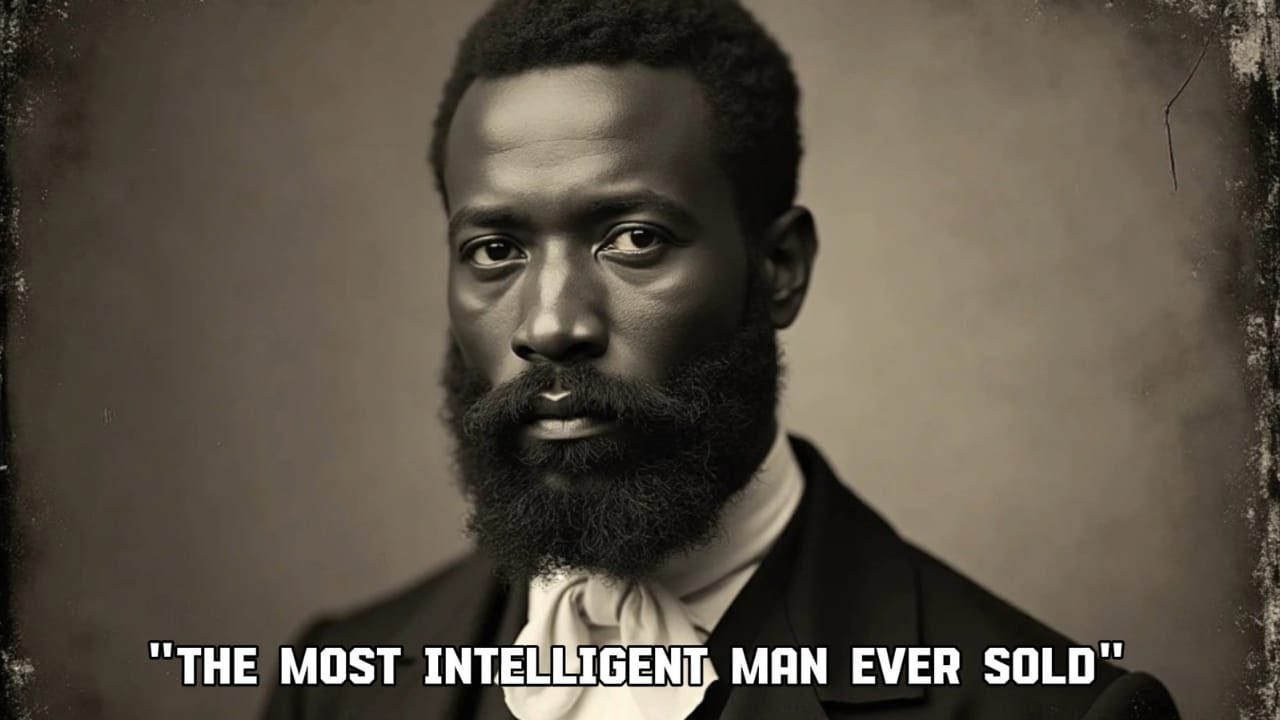
The note that follows, written in the hurried, slanted hand of senior auctioneer Henry Barrow, reads: “Highest bid withdrawn. Sale completed under protest. Buyer warned of documented anomalies. Price: $425.
Well below prime value for a man of this age and condition. ” But what made the entry infamous was not the price. It was the thick packet of attached testimonies. Seventeen pages of statements from former owners, two steamboat captains, a Methodist pastor, and even a Louisiana state marshal, all describing the same impossible phenomenon.
The man they were selling, listed only as Elias, could read and write in seven languages, perform advanced mathematics faster than trained engineers, recite entire chapters of books after glancing at a page once, diagnose illnesses more accurately than plantation physicians, and speak about astronomy, agricultural science, and navigation with the calm fluency of a university scholar. In 1859 Louisiana, such abilities in an enslaved man were not just unusual. They were unthinkable, impossible, dangerous. New Orleans slave merchants called this man the most terrifying purchase ever made—not because of his strength or defiance, but because of what lived inside his mind.
Henry Barrow had run slave auctions in New Orleans for nearly twelve years. The Crescent City’s slave market rivaled Charleston and Richmond in volume, a bustling human trade engine feeding the plantations that stretched along the Mississippi River like a spine. Barrow prided himself on his expertise. He could assess value at a glance, predict which buyers would compete, which would fold, who wanted brute labor, who sought domestic workers or skilled artisans.
He kept emotional distance as all auctioneers did, sharpening his instincts to treat human lives as commodities measured in dollars, potential, and physical endurance. But on the morning of December 7th, 1859, he stood in his back office staring at a stack of documents that made his fingertips tremble. The enslaved man scheduled for lot 47 had arrived three days earlier from Savannah aboard a river steamer, escorted by a broker who insisted on delivering him personally. With the man came paperwork unlike anything Barrow had encountered.
The seller, a cotton trader named Samuel Kincaid, had included written warnings from every person who had owned or transported this particular man over the previous five years. The testimonies were so extraordinary, so unnerving, that Barrow assumed at first they were a con—exaggerations meant to inflate a slave’s price. But then he met the man. His catalog name was Elias, though no one seemed certain if it was his first, fourth, or fifteenth assigned identity.
No surname, no clear birthplace. Estimated age thirty-two to thirty-four. He stood just under six feet tall with balanced musculature and steady posture—the calloused hands of a field worker and the calm, unreadable expression of someone who observed more than he revealed. But it was his eyes—sharp, aware, unsettlingly focused—that made Barrow uneasy.
There was no resignation, no vacant compliance, none of the careful emotional masking Barrow saw in almost every enslaved person who passed through his house. Instead, Elias looked at the world with a kind of measured clarity, as though everything he saw fit into some vast internal design only he understood. During the standard intake interview, Barrow sat with quill poised while Elias stood before him, hands loosely bound. “Where were you born?
” Barrow asked. “I don’t know, sir,” Elias replied in precise, polished English, enunciating each word with care. “My earliest memories are of a plantation in Virginia, but I was told I came from somewhere else. No one agreed on the details.
” “Can you read? ” A pause—not of hesitation, but consideration. “Yes, sir. ” “How did you learn?
” “I taught myself, sir. I observed letters, noted patterns, practiced when I could. ” Barrow’s quill stopped mid-stroke. The testimonies had mentioned literacy, but they also claimed far stranger things, and Barrow needed confirmation.
“Elias, the paperwork includes unusual statements about your abilities. I need to know what’s real before I present you to buyers. Can you explain these claims? ” “What do they say, sir?
” Elias asked calmly. “That you speak multiple languages, that you perform advanced mathematics mentally, that you recall entire books after a single reading, that you have predicted events accurately, diagnosed illnesses, corrected overseers, solved agricultural problems, even navigational ones. ” He leaned forward. “Are these things true?
” Elias met his gaze without flinching. “I speak English, French, Spanish, German, Latin, and some Greek. I can perform calculations involving algebra, geometry, and projections. I remember everything I see or hear.
As for predictions, I recognize patterns. I do not choose them. They simply reveal themselves. ” The way he said it—not boasting, not apologizing, simply reporting a fact of existence—made Barrow’s mouth go dry.
“How is that possible? ” Barrow whispered. “I don’t know, sir. My mind works like a ledger.
Everything I observe remains. ”
Barrow ended the interview early, shaken. For two nights, he read the testimonies, each confirming and expanding what Elias had stated. A Virginia tobacco planter named Samuel Prior had first described the strange efficiencies, the uncanny memory, the agricultural insights.
A cotton broker named Kincaid described how Elias corrected accounting errors after a glance. A steamboat captain, Alden Graves, wrote that Elias determined the vessel’s position during a storm more accurately than his trained navigator. By the third night, Barrow understood the truth. Elias would be nearly impossible to sell—not because he lacked value, but because he had too much.
Buyers on the New Orleans slave market wanted strength, obedience, predictability—not brilliance. Intelligence in an enslaved man wasn’t an asset. It was a threat, a disruption to the hierarchy on which their entire world depended. And extraordinary intelligence, the kind described in the testimonies attached to Elias, was something far more dangerous—something no buyer wanted to manage.
Barrow called in his longtime business partner, Silas Crowe, a shrewd, leathery trader who’d survived every economic cycle by being more cynical than the rest. Crowe skimmed the testimonies, his brows rising one by one as he read Prior’s claims, Kincaid’s warnings, and Captain Graves’s account of the storm navigation. “This isn’t a slave,” Crowe muttered finally. “This is a phenomenon.
” Barrow poured whiskey for them both. “What do I do with him, Silas? ” Crowe tapped the papers. “If you lie and sell him without disclosure, you’ll have every planter in Louisiana at your throat once they discover what he is.
And they will discover it. A man like this can’t hide his mind. Not for long. ” “And if I disclose everything?
” Crowe snorted. “Then no one will buy him. They don’t want a man who can outthink them. They want someone they can control.
” Barrow rubbed his face. “So, I’m damned either way. ” Crowe leaned back, eyes narrowing. “No, you’re just selling the wrong kind of merchandise.
You’re used to selling bodies. This one comes with a mind attached, and that mind is worth more than his muscles ever could be. But it also means he’s unstable merchandise—too valuable and too threatening at the same time. ” Barrow sighed.
“I’ll disclose everything. We’ll take the loss. ”
When auction day came, the usual crowd of buyers filled the wooden benches. Planters from Baton Rouge, Lafayette, and the Mississippi River parishes, cane growers from the bayou, cotton men from across the state line in Mississippi.
The air tasted of humidity and anticipation, and the auction house doors were thrown open to let sunlight fall across the platform. The first forty-six lots moved quickly. Families were torn apart. Children were sold.
Men were examined like livestock. Buyers jotted notes and negotiated with the casual cruelty of those for whom this was routine business. Then Barrow called for lot 47. Elias stepped onto the platform flanked by handlers.
He moved with deliberate grace, not resisting, not yielding, simply present in a way that made silence ripple across the room. His eyes swept the crowd—not pleading, not challenging, just seeing, observing, measuring. Barrow cleared his throat. “Lot 47, male, approximately 33, excellent physical condition, skilled in fieldwork.
But as you have all been informed, this man presents unusual attributes. ” Buyers shifted uncomfortably. Several had already left the room after reading the attached papers earlier that morning. Barrow continued, “Testimonies indicate the ability to read and write fluently in multiple languages, perform complex mathematical calculations mentally, recall information with perfect accuracy, and identify patterns in weather, navigation, agriculture, and business.
” A planter in the front row scoffed loudly. “We’re buying slaves, Barrow. Not professors. ” Barrow ignored him.
“Opening bid $600. ” Silence. “$500. ” Still nothing.
Two buyers rose and walked out. “$425. ” Barrow practically choked on the number. “That is below base value for a prime male of his age.
” A hand lifted at the back of the room. Barrow straightened. “$425 from Mr. Thomas Whitaker of Cypress Hollow Plantation.
” No one countered. No one even considered it. The fear in the room was palpable. Elias stood silently while destiny shifted beneath his feet.
“$425 going once, twice. ” The gavel fell. “Sold. ”
Within the hour the paperwork was completed.
Whitaker, a broad-shouldered, composed man in his early forties, signed the documents with steady, confident strokes. Unlike the frightened planters who’d fled, Whitaker seemed almost pleased, as though he’d deciphered a bargain others were too foolish to understand. When Barrow offered him the testimonies one last time, Whitaker waved them off. “I’ve read them.
I believe I know what I’m purchasing. ” Barrow swallowed. “Then you understand the risks. ” Whitaker smiled faintly.
“Mr. Barrow. I’ve built my entire estate on recognizing opportunity where weaker men see danger. Intelligence isn’t a liability.
It’s a tool. If this man is half as capable as these accounts suggest, I intend to use him. ” Barrow hesitated, wanting to say more, to warn Whitaker that this was no ordinary man, no ordinary risk, no ordinary sale. But Whitaker’s confidence was absolute—the kind of certainty only a rich, powerful Louisiana planter could afford.
Elias was placed into a wagon, chains secured loosely around his wrists. Whitaker climbed into the driver’s seat and guided the horses north toward the Mississippi River and the sprawling acreage of Cypress Hollow Plantation, thirty miles upriver. The road wound through dense groves of cypress and oak, the trees hanging heavy with Spanish moss that swayed like ghostly banners above the trail. Elias sat in the wagon bed, wrists chained loosely, posture controlled but unreadable.
Whitaker held the reins, casting occasional glances backward, studying the man he’d purchased for a fraction of his rumored worth. Whitaker was not like most planters. He valued precision, order, efficiency. He ran Cypress Hollow with an obsessive focus on productivity, keeping meticulous ledgers on everything from harvest yields to the daily output of each enslaved worker.
He believed in hierarchy—not simply because it benefited him, but because it echoed the universe as he understood it. There were those who led and those who followed, those who thought and those who labored under direction. But the testimonies he’d read about Elias unsettled him in ways he couldn’t fully articulate. They hinted at a man whose intelligence had no ceiling, a mind that did not fit inside the structures men like Whitaker relied on.
The wagon wheels crunched over gravel. The Mississippi shimmered through the trees. Elias stared out at the river, but Whitaker noticed he wasn’t simply looking. He was assessing, measuring the currents, reading invisible information.
It made Whitaker grip the reins tighter. Barrow watched them disappear into the sunlight, a heavy feeling settling in his stomach. He had sold thousands of human beings with professional detachment. But this one—this one felt different.
Felt like a hinge in history swinging open. Felt like the beginning of something no ledger entry could adequately contain. In his private journal he wrote later that night: “December 7th, 1859. Sold lot 47, Elias, to Thomas Whitaker for $425, lowest price for a man of his age in years.
Whitaker believes he purchased value. I believe he purchased a storm. ” What happened next would prove him right in ways neither man could have imagined. They arrived at Cypress Hollow near dusk.
The plantation unfolded across thousands of acres—whitewashed cabins, endless cotton fields. The main house perched atop a gentle rise like a judge overseeing its domain. The enslaved workers paused in their tasks to watch the wagon approach. They saw the chains around Elias’s wrists.
Saw Whitaker seated above him. Saw the calm, steady posture of the new man. A quiet tension spread among them, subtle as a change in wind direction. Whitaker’s head overseer, Caleb Ror, emerged from the shadows of the barn.
Ror was a tall, angular man from Georgia, with the cold, assessing demeanor of someone who’d learned long ago to extinguish empathy for the sake of efficiency. “New purchase? ” Ror asked. Whitaker nodded.
“Name’s Elias. Place him with the main house work crew for now. I want him close. ” Ror studied Elias with thinly veiled suspicion.
“Any special instructions? ” Whitaker narrowed his eyes. “They may prove useful or dangerous. Time will tell.
” Ror nodded, though his expression betrayed a flicker of unease. He motioned for two men to unchain Elias and lead him toward the quarters reserved for house laborers. Workers watched from a distance, some curious, others wary. Elias did not look back at Whitaker, but Whitaker felt watched all the same, as though something in the air between them had shifted.
For the first week, Elias worked quietly. He hauled firewood, repaired shutters, assisted in the smokehouse. He performed each task with measured precision, never rushing, never faltering, never drawing unnecessary attention. And yet he was noticed—not by what he did, but by how he did it.
He moved like a man who understood more than he revealed. Ror reported to Whitaker late one evening. “He works efficiently, sir. Too efficiently, perhaps.
He studies everything—the buildings, the workers, even me. ” “He studies because he’s intelligent,” Whitaker replied. “That’s why I bought him. ” “Intelligence is one thing,” Ror said quietly, “seeing the world like a puzzle is another.
Makes the others uneasy. Makes me uneasy. ” Whitaker dismissed Ror with a wave, but the overseer’s words lingered. Elias’s presence altered the atmosphere at Cypress Hollow in ways Whitaker hadn’t anticipated.
Something invisible but potent—a tremor beneath the surface. On the eighth day, Whitaker decided to begin testing the rumors. He summoned Elias to his study—a room lined with shelves of agricultural manuals, law books, mathematical tables, and volumes on commerce. Candlelight flickered across polished mahogany.
The shutters rattled softly in the river wind. Elias entered silently. Whitaker motioned him closer. “The men who previously owned you made remarkable claims.
I intend to see the truth of them for myself. ” “Yes, sir,” Elias said, watching him with that unnerving clarity. Whitaker pulled a set of figures from his desk. “This calculation projects this year’s cotton yield.
It took me an hour to compute. ” He read the numbers aloud, pausing deliberately, waiting for Elias to falter. Elias answered the final total before Whitaker finished exhaling. “Estimated profit $8,942, assuming labor continuity and no weather disruptions.
” Whitaker froze. The number was exact. “How did you—? ” Elias replied calmly.
“You gave the necessary variables. Once I hear them, I do not lose them. ” Whitaker leaned back slowly, pulse throbbing in his neck. “And the languages?
” Elias switched to French immediately, speaking with flawless fluency—his accent refined, his vocabulary elevated. Whitaker, who prided himself on his education, struggled to match him. In Spanish, the gap widened further. Whitaker felt heat in his chest, embarrassment mixed with fascination.
He pulled a medical text from the shelf, opened to a dense diagram of arterial networks. “Study this for thirty seconds. ” Elias looked. Only thirty seconds.
Whitaker closed the book. “Now explain it. ” Elias recited everything—the diagram labels, the footnotes, the page number, even the publisher’s imprint. Then he expanded, describing circulatory functions in ways more detailed than the text itself.
Whitaker’s hands trembled. He masked it by leaning forward, elbows on the desk, fingers interlaced tightly enough to whiten his knuckles. “You remember everything,” Whitaker whispered. “Yes, sir.
” Elias nodded. “And you understand what you remember. ” “Understanding is simply recognition of patterns. The world is full of them.
” Whitaker swallowed. The room suddenly felt small, the air too thin. He had purchased a slave, but standing before him was something that did not fit inside the word slave at all. Something that made the categories of master and servant feel flimsy, artificial.
For the first time since acquiring his vast estate, Thomas Whitaker—a man who commanded over a hundred lives without blinking—felt himself on unstable ground. And Elias, his face remained calm, unreadable. But in his silence lay something deeper than obedience. Something that felt like the beginning of a reckoning.
Over the next several weeks, a strange transformation began inside Cypress Hollow. Not sudden, not loud, but creeping like water seeping under a door. It started with Whitaker’s fascination. The tests he’d given Elias had not satisfied him.
They’d ignited him. Whitaker found himself summoning Elias to the study more and more often under the pretense of plantation business. But in truth, he sought something deeper—the sensation of witnessing brilliance up close. Every morning Whitaker woke with a question waiting in his mind.
Every night he ended his day with the same unease: he was becoming dependent on a man he legally owned. “Tell me what the market will look like after this season,” he’d ask. Elias would glance at the numbers—just glance. Then project market shifts, steamboat freight fluctuations, cotton demand trends in New York and Liverpool, and predicted price drops based on weather and river transport.
His answers were precise. Always precise. Whitaker began recording them in a separate ledger—a private ledger, a ledger he hid from everyone. Yet something else was growing, too.
Elias’s presence had begun reshaping the behavior of the enslaved community. They watched him move through the yard, silently, steadily, detached from social circles, yet drawing quiet attention. Word had spread that he spent hours with the master every day, that Whitaker consulted him, that Ror observed him with a fear he refused to voice. Late at night, whispers fluttered between the cabins like moths around lanterns.
What kind of man knows everything? What kind of slave gets called to the master’s study each day? What does it mean if he knows more than the master? These were dangerous questions, the kind that could crack foundations.
Ror confronted Whitaker one evening. “Sir, the people are unsettled. ” Whitaker tensed. “Explain.
” “You see how often you call Elias into the house. You see you speak with him privately. You see you listening. ” Whitaker bristled.
“Are you suggesting my authority is diminished because I value intelligence? ” Ror looked pained. “I’m suggesting your authority depends on the assumption that they are inferior. All of them.
If they see one of their own advising you, you erode the distance you require. ” Whitaker’s voice sharpened. “That distance is intact. ” “With respect, sir, I don’t think it is.
” Whitaker dismissed him angrily, but the words sank like stones in his stomach. Was distance intact? Could it be intact when the strongest mind on his plantation belonged to the man he kept in chains? That night, Whitaker sat alone in his study, staring at the books he’d spent his life collecting.
He’d once believed knowledge was something a man earned through education, discipline, effort. But Elias unraveled that belief. Elias took a book, opened it briefly, closed it, and knew more than Whitaker did after twenty years of study. Whitaker poured whiskey.
His hands weren’t steady. In February, Whitaker attempted to reassert control—not through violence, but through conversation. He summoned Elias and asked, “Do you understand the position your intelligence puts me in? ” Elias stood silently for a moment before answering.
“I understand that my existence challenges assumptions, sir. ” “Assumptions? ” Whitaker asked, voice tightening. “You mean slavery?
” “I mean the justifications required to sustain it,” Elias replied calmly. “Justifications that cannot coexist with what you’ve seen. ” Whitaker felt heat rise in his chest—anger, fear, shame. “And do you believe,” he pressed, “that you deserve freedom?
” “I believe everyone does. But belief has no weight against law. ” The honesty in that answer—the quiet acceptance of reality, not submission—rattled Whitaker more than a thousand shouted rebellions could have. Then came March 15th.
Before dawn, Ror approached the main house carrying a smudged pamphlet. His face was tight with unease. “Found this in Elias’s hands this morning. An abolitionist tract.
” Whitaker snatched it. The pamphlet laid out moral, legal, and economic arguments against slavery—arguments Whitaker had once scoffed at, but which now echoed the thoughts gnawing at him each night. He called Elias immediately. When Elias entered, Whitaker held the pamphlet like a burning coal.
“Do you understand the danger of possessing this? ” “Yes, sir. ” “Then why read it? ” Elias met his gaze.
“Because I read everything. Because knowledge is not dangerous. Ignorance is. ” Whitaker’s voice cracked.
“Do you agree with what it says? ” Elias hesitated—a rare gesture—then answered with devastating clarity. “Yes, sir. And so do you.
” Whitaker staggered back as if struck. Elias continued, his tone calm but his words sharp as a blade. “Slavery requires beliefs that cannot withstand scrutiny. You have seen too much.
That is why my presence burdens you. I have not changed the system. I have only removed your blindfold. ” Whitaker sank into his chair, breathing raggedly.
He felt exposed, dissected. Elias spoke without malice, without triumph—simply truth. Truth Whitaker had avoided all his life, truth that now cornered him. He dismissed Elias, but the damage was done.
A crack in his worldview had widened into a fault line. By late March, Whitaker could no longer sleep. He paced through the night. He attempted to bury himself in work, but every ledger, every field report, every household account felt like an indictment.
His plantation thrived on labor from people whose humanity he now saw too clearly—because Elias’s presence made ignorance impossible. And so the decision—the impossible decision—formed in his mind. His lawyer arrived on March 28th. Paperwork was drafted.
Elias was freed. Whitaker handed him manumission papers with trembling hands and whispered, “I cannot own a man who forces me to see what I’ve spent my life refusing to see. ” Elias accepted the papers. For the first time since Whitaker had known him, something flickered across his face—not joy, not triumph, but sorrow.
“Freedom for one,” Elias said quietly, “does not repair the chains on the many. ” Whitaker had no answer. Elias walked down the long drive of Cypress Hollow, past the workers who watched with wide, silent eyes, past the gates, toward New Orleans—and toward a future neither he nor Whitaker could foresee. Word of Elias’s freedom moved through Cypress Hollow like fire traveling through dry cane.
At first, the enslaved workers did not believe it. Freedom did not simply appear. It was run toward, fought for, prayed over, bargained through. It did not come in the form of a pale sheet of paper written in a master’s hand.
But they had seen him walk out the front gates alone, unchained. No patrol escort, no wagon, no overseer shadow trailing behind him. Just walked away. Sarah, the cook, who often worked inside the main house, was the first to say aloud what everyone else whispered.
“If Mr. Whitaker freed Elias because of his mind,” she murmured in the dim glow of the kitchen hearth, “then he knows what that means. He knows we ain’t what he says we are. He knows the truth.
” The others exchanged uneasy glances. Truth was dangerous. Truth changed people. Truth toppled things.
And truth once glimpsed refused to be forgotten. Over the next days, something imperceptible yet undeniable shifted across the plantation. Workers paused a heartbeat longer when Ror barked instructions. Old men spoke quietly with young ones during evening chores.
Women who had spent their lives suppressing dreams allowed themselves for the first time to imagine something beyond the fields. Freedom had walked past them—not escaped, not stolen, given. If it could happen once, then the world was not as immovable as they had been forced to believe. Whitaker felt the shift, too.
The tension in the air, the quiet questioning, the subtle but unmistakable erosion of hierarchy. Ror came to him three days after Elias’s departure, jaw clenched tight. “Sir, things ain’t holding steady. ” Whitaker didn’t look up from his desk.
“Explain. ” “They’re unsettled,” Ror said. “They talk more, watch more. There’s a feeling in the quarters, like they’re waiting—” “For what?
” “—for you to do again what you done once. ” Whitaker felt a rush of heat in his chest—anger, shame, fear. He wasn’t sure anymore. “I freed Elias because—” “Because he troubled your mind,” Ror cut in.
“But they don’t know that. They see a man they worked beside walk out free because of the thoughts in his head. And now they wonder what thoughts are worth. ” Whitaker stood upright, desk chair scraping the floor.
“I will not tolerate disobedience. ” “I ain’t talking about rebellion,” Ror said. “Not yet. I’m talking about belief.
” He paused. “And belief is a dangerous thing to allow on a plantation. ” Whitaker dismissed him, but his hands trembled. He poured whiskey he didn’t need, telling himself it was to calm his nerves.
Elias’s absence haunted him more than his presence ever had. He had taken something intangible with him—a kind of mirror that forced Whitaker to see himself. And now that mirror reflected absence, failure, fracture. He had freed one man, but left himself imprisoned.
In New Orleans, Elias moved quietly. He used the manumission papers Whitaker had given him sparingly, knowing too well that a free black man with unusual intelligence was a threat many white men would not tolerate. But he had one advantage no patrolman or bounty hunter could counter. He understood people.
He understood patterns. He understood invisibility. And he had begun writing. In a cramped room above a riverfront shop, he filled pages with observations about slavery, memory, fear, contradiction.
His handwriting was precise, elegant, unhurried. He wrote as though preserving a world inside his mind wasn’t enough—the world needed to see itself through his eyes. One entry read: “A system that depends on ignorance collapses when truth becomes visible. I was visible at Cypress Hollow—not physically, intellectually.
My existence showed the cracks in the foundation. Mr. Whitaker freed me because he could not endure looking at those cracks. He freed me to save himself.
” He paused, then wrote: “I fear the cracks will widen. Back at Cypress Hollow, they already have. ”
Whitaker’s plantation began to suffer in ways he couldn’t control. His overseers grew uneasy.
His neighboring planters avoided him. Rumors spread through the parish that he’d gone soft, that he’d let a slave outthink him, that he’d lost the discipline required of a southern gentleman. Banks hesitated to extend credit. Merchants inflated prices.
Buyers whispered. Social invitations stopped arriving. Whitaker was no longer seen as a man of reason, but a man of instability—someone who had allowed ideology to infect business, someone who had crossed an invisible line. He felt the pressure tightening around him like a noose.
One evening, three planters arrived unannounced. Whitaker’s peers—wealthy men with more land and deeper roots in the southern hierarchy. They carried themselves with polite hostility, the kind that cloaks a warning beneath gentility. The eldest, Horus Bowmont, spoke first.
“Thomas, we are here because your actions have caused disruptions. ” Whitaker stiffened. “I freed one man. ” “You freed a precedent,” Bowmont snapped.
The second visitor, a younger planter named Collingsworth, leaned forward. “Our workers heard about Elias. So did those on neighboring plantations. And now they whisper.
You’ve opened a door that cannot be closed. ” Whitaker felt heat rise in his throat. “My decisions are my own. ” “No,” Bowmont snapped.
“Your decisions affect all of us. You think freeing one slave is noble. It is reckless. Dangerous.
You weaken the social fabric. You weaken the foundation we all stand on. ” Collingsworth added, “You freed one man and enslaved yourself to conscience, and conscience is not a luxury any of us can afford. ” The third man, a cold-eyed sugar baron named Prescott, spoke with quiet finality.
“Do it again, Thomas, and we will shut you out completely. ” Whitaker felt his chest constrict. The threat was unmistakable. In the South, social death preceded financial death, and financial death preceded real death.
When the men left, Whitaker sat in darkness, staring at the empty chair Elias used to occupy. He realized something horrifying. The world he had always belonged to—the world of power, certainty, hierarchy—no longer wanted him, because he had glimpsed truth. And truth demanded a price.
By the end of April, Cypress Hollow no longer felt like a kingdom. It felt like a ship taking in water. Workers hesitated before following orders. Overseers questioned whether Whitaker still possessed the authority required to maintain control.
The plantation structure had bent, shifted, warped under the weight of one man’s liberation. And Whitaker—exhausted, haunted, sleepless—began to wonder if the act he thought was mercy had actually been the spark of something much larger. Something rising. Something irreversible.
Something he could not stop. Meanwhile, Elias moved northward with purpose—through Memphis, then Louisville. He took temporary work while avoiding attention: calculating cargo distributions, correcting shipping manifests, interpreting weather patterns for riverboat captains. Word spread quietly among merchants.
There was a black man with a mind sharper than any engineer they’d hired. A man who could do in minutes what accountants took hours. A man who saw danger in a vessel’s tilt, profit in a bundle of figures, opportunity in chaos. One merchant, a pragmatic man named Wallace, hired Elias as a discreet consultant.
Not officially—that would raise questions—but behind closed doors with locked ledgers and coded notes. Elias accepted, not for money, but for mobility. He was traveling toward something bigger: the possibility of true autonomy, far from the southern laws that threatened to swallow him again. And at night, in cramped boarding houses lit with flickering lamps, he filled pages with observations.
“A free mind in an unfree world is a burden,” he wrote. “Every truth I perceive reveals another chain. Those who fear my knowledge fear themselves. Those who value it try to hide me.
Both attempt control. Neither understands that the mind they fear does not seek domination, only understanding. ” He wrote to preserve memory, because forgetting was impossible. He wrote to understand freedom, because freedom was complicated.
He wrote about Whitaker. “His struggle was not against me. It was against the lie he needed to live inside. When the lie collapsed, so did he.
”
In July, Cypress Hollow collapsed in ways Whitaker could no longer deny. First, Ror resigned. He arrived in Whitaker’s study with hat in hand, face drawn tight. “Sir, I’ve been offered work elsewhere.
A plantation where things are steadier. ” Whitaker stiffened. “You’re abandoning your post? ” Ror hesitated.
“No, sir. I’m leaving a sinking ship. ” Whitaker’s jaw clenched. “Sinking?
” “Yes, sir. ” Ror swallowed. “Sir, I’ve worked for many planters. Most keep their order through force or fear.
You kept yours through discipline, through certainty. But certainty left this place when Elias did. Now the workers sense weakness. Your peers sense disloyalty.
And the structure that held everything together is breaking. ” Whitaker’s pulse surged. “Are you saying I caused this? ” “I’m saying,” Ror said softly, “that the moment you saw them as human, you stopped being their master.
” It was the cruelest truth Whitaker had ever heard, and it was the one he could not refute. After Ror left, the two remaining overseers resigned within a week. By mid-July, Whitaker was effectively running Cypress Hollow alone. He tried to maintain control, but without overseers and reliable labor, fields went untended.
Equipment fell into disrepair. Harvest projections shrank. Workers slipped away at night, sometimes returning, sometimes not. Whitaker no longer had the will to chase them.
He sat in his office, surrounded by maps, manifests, and letters he didn’t open. The room smelled of dust and stale whiskey. He aged visibly—shoulders stooped, eyes hollow, voice cracking when he spoke aloud. He reread Elias’s last words to him daily: “Freedom for one does not repair the chains on the many.
” He knew they were true, and he knew he had done nothing to repair them. In late July, a letter arrived. The envelope bore a Cincinnati postmark. Whitaker recognized the handwriting instantly—precise, elegant, unmistakably Elias.
He opened it with trembling fingers. “Mr. Whitaker. I imagine you face repercussions for your actions.
I imagine the world you once trusted is refusing you. Perhaps your peers have turned cold. Perhaps the order you depended on is unraveling. I suspected as much when I left.
” Whitaker exhaled shakily, eyes burning. “You freed me not because you rejected slavery, but because slavery became unbearable when seen clearly. Your moral awakening was not complete, but it was honest. That matters.
” The next line struck him like a blow. “You may lose everything. That too is part of truth. ” Whitaker sank into his chair, the letter trembling in his hands.
“I do not hate you, sir. I pity the world that shaped you. I pity all systems built on fragile lies. I pity myself for seeing clearly a world that punishes clarity.
Whatever becomes of Cypress Hollow, know this: your crack in the system will not vanish. Truth spreads. You loosened a stone in a wall that may yet fall. Respectfully, Elias Calder.
” Whitaker let the letter fall to the desk. He knew then Cypress Hollow was already lost. But what frightened him more than ruin was the faint, impossible hope that Elias might be right—that the wall might fall. Then came the final blow.
The creditors arrived. Whitaker sat in the parlor as the men—bankers, merchants, land brokers—delivered the verdict in clipped professional voices. His accounts were frozen, his debts overdue, his collateral worthless without reliable labor. Cypress Hollow would be seized, sold, and whatever remained of Whitaker’s fortune would be consumed in the settlement.
He listened in silence, not arguing, not resisting. He simply watched the men, understanding that they saw him not as a tragic figure, but as a fool—a man who had let sentiment compromise an empire, a man who had freed a slave and enslaved himself to conscience. When they left, Whitaker stood alone in the quiet parlor, staring at the empty space where his reflection wavered in the glass of the cabinet door. He whispered into the silence, “Elias, what have you done to me?
” But he knew. Elias had not destroyed him. Truth had. By August, Cypress Hollow was no longer a plantation.
It was a carcass—a hollowed-out monument to a system that required blindness to function and had begun collapsing the moment Whitaker let himself see. Fields lay partially harvested. Cotton rotted in the sun. Tools rusted against fence posts.
Wagons sat with broken wheels, never repaired. The once-bustling yard had grown silent, except for distant murmurs and the restless shuffle of workers who no longer feared punishment. Their caution had turned into confidence. Their confidence into expectation.
And that expectation into something like inevitability. Whitaker felt it every time he walked through the rows—a quiet, suffocating pressure. Not hatred. Not rebellion.
Judgment. The judgment of over a hundred lives whose freedom he had refused to imagine until one man’s brilliance forced imagination upon him. He no longer bothered giving orders. Few were followed.
Fewer still made sense to him now. He wandered the property at dusk, staring at the horizon, wondering how long he had been living in a world built on lies he had willingly swallowed. His peers had ostracized him completely. No letters, no invitations, no business.
He was a disease—a planter infected with moral clarity—and there was no quarantine strong enough to contain the infection if others caught it. So Cypress Hollow was abandoned piece by piece. Workers left in the night, some following the river north, others heading west toward the bayous, others simply vanishing into the dense woods where patrols rarely ventured. Whitaker did nothing to stop them.
How could he? After freeing Elias, any attempt to stop another man from seeking freedom felt grotesque. By September, fewer than half the enslaved workers remained. Those who stayed did so because they had nowhere to go.
Not because they respected Whitaker’s authority. Authority had become a suggestion, a fragile remnant. The plantation changed hands within weeks. The new owners—a consortium of wealthy planters—reinstated strict discipline, tore up Whitaker’s emancipation documents, and folded the remaining enslaved workers into neighboring properties.
Elias’s freedom had not ignited a mass emancipation. It had not toppled the institution. It had not rewritten the South. It had simply rewritten Whitaker.
But that was enough to threaten a system built on men like him staying asleep. Whitaker moved to New Orleans, renting a room above a warehouse along the river. He found work as a low-paid clerk—the only position his former peers would not sabotage. He lived quietly, alone, writing in a private journal that would not be discovered for more than a century.
He wrote: “I once believed greatness came from land, power, lineage. I believed I was master of a vast domain. But one man’s mind—one enslaved man’s mind—showed me the absurdity of that belief. Intelligence is not the property of any race.
Power is not the measure of any man’s worth. I freed him to silence my conscience, but conscience does not silence. It grows louder. ” He paused before adding: “If the South falls, it will not be from armies alone.
It will be from truth cutting through the lies maintaining it. ”
And Elias—his life took a trajectory more extraordinary than any fiction. By autumn of 1860, he had reached Cincinnati. There, abolitionists quietly recognized him not just as a freed man, but as a phenomenon.
He was never given formal titles. The world was not ready for that. But his abilities became whispered legend among Union officers, river merchants, and educators who valued brilliance wherever it appeared. A colonel once wrote privately: “The man possesses a mind like no scholar I’ve seen, capable of pattern recognition beyond training.
He solved a logistical problem in minutes that my staff struggled with for three days. He should be a professor. The world allows him to be only a shadow. ” Elias did not seek fame.
He sought understanding. And he wrote: “Freedom requires space to think, and thought requires courage. I was denied courage for years because courage is impossible in chains. Whitaker gave me a beginning—not freedom itself, but the ability to imagine what it might become.
”
His journals, discovered in the 1970s, became some of the most remarkable firsthand documents of pre-war black intellectual history. They revealed not just the cruelty of the institution that confined him, but the vastness of his perception. A single line from his 1861 entries reads: “Memory is my blessing and my torment. I remember every chain, but I also remember every truth.
”
Whitaker did not see Elias again. But in 1862, as the Civil War raged, Whitaker wrote: “If I am remembered at all, it will be for a failure. But perhaps in that failure lies something worth remembering. I looked at one man and saw the truth of many.
And though it cost me everything, I do not wish it undone. ” He died that same year—penniless, unknown, but not blind. Elias lived far longer. And the truth he embodied—the truth that intelligence, humanity, and brilliance were never bound to race or status—spread slowly, quietly, inevitably.
The story might have been lost forever. But in the dusty ledgers of New Orleans, in the journals of a fallen planter, in the writings of a freed genius whose mind refused to forget, it remained waiting.
