On the afternoon of June 25th, 1876, along a winding river the Lakota called the Greasy Grass, 210 men under Lieutenant Colonel George Armstrong Custer rode down from a ridge and vanished into history. Within less than an hour, every single one of them was dead. Not one man from Custer’s immediate command survived to tell what actually happened on that hillside, and that single fact, the complete and total silence of the dead, is precisely what allowed one of the most catastrophic military blunders in American history to be rewritten within a single generation into a heroic legend. For a century and a half, Custer’s Last Stand has been remembered as a tale of doomed gallantry, of a small band of brave soldiers fighting to the last bullet against overwhelming odds.
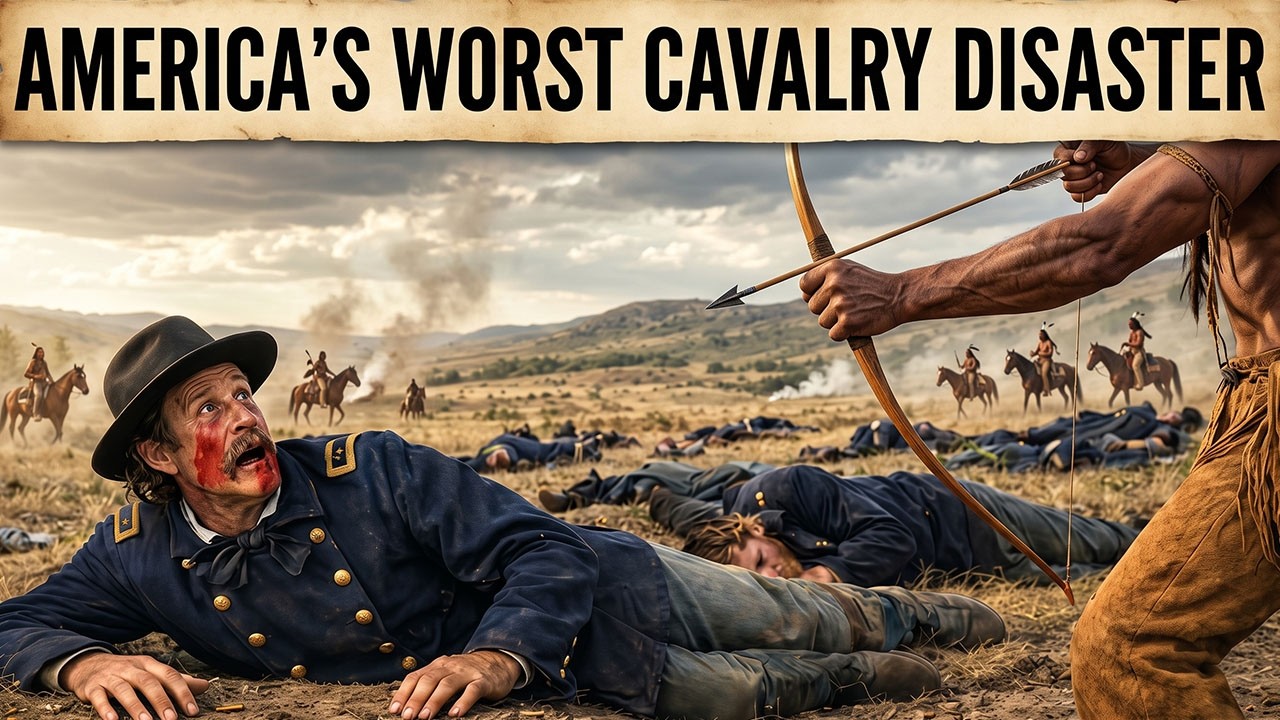
But strip away the paintings, the dime novels, and the carefully managed grief of a widow determined to protect her husband’s name, and what remains is something far uglier. A story of arrogance, miscalculation, and a collapse so fast and so total that modern forensic archaeologists digging through the grass more than a century later would find a battlefield that looked less like a stand and more like a slaughter. How did a decorated Civil War officer, a man who had built his entire career on speed and daring, lead 210 soldiers directly into an encampment of roughly 2,500 warriors? And how did the United States government spend the next 150 years making sure the American public never asked that question too closely?
To understand that, we have to go back to the summer of 1876, to a campaign built on faulty intelligence, wounded pride, and a commander who could not imagine losing. By the mid-1870s, the United States government had already spent more than a decade trying to force the Northern Plains tribes onto reservations using a mixture of treaties it had no intention of honoring and military campaigns designed to break any resistance that remained. The Treaty of Fort Laramie, signed in 1868, had promised the Lakota the Black Hills in perpetuity, land considered sacred, the heart of their spiritual world. That promise lasted exactly as long as it took prospectors to find gold.
When rumors of gold in the Black Hills reached Washington in 1874, confirmed in no small part by an expedition led by Custer himself, the flood of miners into supposedly protected land became unstoppable, and the government’s commitment to the treaty evaporated almost overnight. Rather than enforce the law and remove the trespassers, Washington instead issued an ultimatum to the Lakota, the Northern Cheyenne, and their allies: report to the reservation agencies by January 31st, 1876, or be considered hostile and subject to military action. It was an impossible demand delivered in the dead of a Plains winter when moving entire villages of women, children, and elders across hundreds of miles of frozen ground was simply not physically possible for many bands, and it was rejected outright by those who had never agreed to live confined to a reservation in the first place. Among those who refused were the followers of Sitting Bull, a Hunkpapa Lakota holy man whose authority came not from any single battlefield victory, but from decades of spiritual leadership, and Crazy Horse, an Oglala war leader already legendary for his tactical brilliance against US forces years earlier.
By the time the deadline passed unmet, the United States Army had its pretext for war. The campaign that followed was intended to be simple. Three columns of soldiers would converge on the Lakota and Cheyenne bands believed to be gathering somewhere along the Yellowstone River drainage, trapping them between coordinated forces advancing from different directions. General Alfred Terry would command one column moving west, General Crook another advancing north from Wyoming, and Colonel John Gibbon a third moving east.
Custer, commanding the 7th Cavalry, rode as part of Terry’s column, and it was Terry who gave Custer his orders on June 22nd, orders that granted him considerable discretion in how he approached the enemy, discretion that history suggests Custer badly abused. What none of the three converging columns fully appreciated was the sheer scale of what they were actually marching toward. Army intelligence estimated perhaps 800 to 1,500 warriors might be gathered along the river. The actual number, swollen by bands who had left their reservation agencies for the traditional summer buffalo hunt, and by warriors drawn to Sitting Bull’s growing camp after a massive Sun Dance ceremony weeks earlier, was closer to 2,500 fighting men protecting a village of perhaps 8 to 10,000 people total.
It was, by a wide margin, the largest gathering of Plains Indian warriors ever assembled in one place, and Custer, riding ahead of Terry’s main column with his own regiment of roughly 600 men, had almost no accurate idea of what he was actually approaching. George Armstrong Custer was 36 years old in the summer of 1876, and his entire adult identity had been built around one singular idea: that boldness and speed could overcome any obstacle, any odds, any danger. He had graduated dead last in his class at West Point, a record of academic failure that would have ended most military careers before they began. But the outbreak of the Civil War gave him an opportunity that his classroom performance never suggested he deserved, and he seized it with a recklessness that, in the chaos of large-scale cavalry warfare, occasionally produced spectacular results.
By 23, he had become the youngest general in the Union Army, a rank earned through a series of aggressive, headlong cavalry charges that made him famous, celebrated in northern newspapers as the boy general, his long blonde hair and flamboyant uniforms turning him into one of the war’s most recognizable public figures. That same reckless aggression, however, had also produced serious failures along the way. There were moments where Custer’s willingness to charge without adequate reconnaissance had gotten his own men killed for no strategic gain. In the years after the Civil War, transferred to the frontier and given command of the newly formed 7th Cavalry, Custer built a reputation as an Indian fighter, most notably through a controversial dawn attack on a peaceful Cheyenne village at the Washita River in 1868, an engagement still debated by historians as either a legitimate military strike or something closer to a massacre.
What mattered most for the events of June 1876 was not any single previous battle, but the deep and unshakable self-image Custer carried into that summer’s campaign. He believed, with what can only be described as absolute certainty, that no force of Native American warriors could withstand a determined cavalry assault, that speed and audacity would once again deliver him the kind of decisive, headline-making victory that had defined his entire public career. He had also, not incidentally, recently testified before Congress about corruption in the Grant administration’s Indian policy. Testimony that had angered President Grant personally and briefly cost Custer his command of the expedition before political pressure restored it.
Custer needed a victory. His reputation, his political standing, and by some accounts, his own ambitions toward higher office, all depended on this campaign producing exactly the kind of triumph he had built his entire identity around. On the opposite side of the ridge that Custer was riding toward stood a coalition unlike anything the US Army had previously faced on the plains. Sitting Bull provided the spiritual authority that had drawn so many bands together in the first place, having conducted a Sun Dance weeks earlier in which he reportedly experienced a vision of soldiers falling into the Lakota camp like grasshoppers from the sky, a vision his people took as a powerful sign of coming victory.
Crazy Horse, meanwhile, brought a proven tactical mind, having already outmaneuvered General Crook’s forces just days earlier at the Battle of the Rosebud, a fight that forced Crook’s entire column to withdraw and effectively removed one third of the army’s three-pronged pincer movement from the campaign entirely. Though neither Terry nor Custer would learn of this crucial development in time. And critically, many of the warriors gathered along the Little Bighorn that June were far better armed than army intelligence had assumed. Trade networks and earlier battlefield captures had put a significant number of Winchester and Henry repeating rifles into native hands, weapons capable of firing multiple rounds without reloading.
Facing off against army-issued single-shot Springfield carbines that required a soldier to manually eject and reload after every single shot, it was a mismatch in firepower that would prove devastating once the fighting actually began. A detail almost entirely absent from the heroic paintings that would later define the battle in the American popular imagination. On the morning of June 25th, Custer’s Crow scouts, watching from a high point that would come to be called the Crow’s Nest, reported back with alarm bordering on panic. The village below, they insisted, was larger than any encampment they had ever personally witnessed, so vast that their combined pony herd alone stretched for what looked like miles along the valley floor.
Custer, peering through field glasses at a distance that made precise judgment genuinely difficult, dismissed their concerns. He believed, based on limited and ultimately catastrophic information, that the village was smaller than his scouts described, and that his greatest danger was not being overwhelmed by numbers, but rather the village scattering into the surrounding hills before he could strike it, robbing him of the decisive engagement he desperately wanted. This single misjudgment, choosing speed over caution, attack over reconnaissance, would define everything that followed. Rather than wait for Terry and Gibbon’s columns to arrive and combine forces as originally planned, rather than even rest his own exhausted men and scout the ground more carefully, Custer made the decision that would kill him.
He would attack immediately, that same afternoon, and to maximize his chances of trapping the village before it could flee, he divided his already modest force of roughly 600 men into four separate detachments. Captain Frederick Benteen was sent with roughly 125 men on a scouting sweep to the south and west, ordered to search for any warriors attempting to escape in that direction, a mission that effectively removed a fifth of Custer’s total force from the coming battle before it even began. Major Marcus Reno was given roughly 140 men and ordered to cross the river and attack the southern end of the village directly, a frontal assault meant to draw the warriors’ attention while Custer maneuvered his own remaining battalion of roughly 210 men around to strike the village from another direction entirely. A classic pincer maneuver that depended entirely on accurate information about the size and layout of an enemy force Custer had never actually seen up close.
A small detachment was left behind to guard the slow-moving pack train carrying extra ammunition, a decision that would prove agonizing once the ammunition ran desperately short. On paper, in the mind of a commander utterly convinced his greatest danger was a fleeing enemy rather than an overwhelming one, this division of forces made a certain aggressive sense. In practice, it meant that within hours roughly 600 cavalrymen operating with no real understanding of what actually lay ahead would be split into isolated fragments, none large enough to withstand what was actually waiting for them along the river below. Reno’s attack, launched first, collapsed with brutal speed.
His roughly 140 troopers crossed the river and began advancing on the southern edge of the village exactly as ordered, only to find themselves facing a far larger and more immediate response than anyone had anticipated. Warriors poured out from the camp in overwhelming numbers within minutes, and Reno, watching his own flank crumble under pressure, made the decision to halt his advance and form a skirmish line rather than continue the charge, a hesitation that itself likely cost precious time and momentum. As Native warriors began working around his exposed flanks, Reno’s already faltering attack disintegrated into a chaotic retreat, first into a stand of timber along the riverbank, and then, as that position too became untenable, into a disorganized and increasingly panicked flight back across the river toward high ground that would come to be known as Reno Hill. The retreat cost Reno’s command dearly, roughly a third of his men killed, wounded, or simply left behind in the confusion, and it effectively removed his entire battalion from any further role in supporting Custer, who was, at that very moment, moving further north along the bluffs above the river with his own isolated force of 210 men, entirely unaware of just how badly Reno’s attack had already failed, and entirely unaware of how many warriors were now free to turn their full attention toward him.
What happened next along the ridgeline that would come to be known as Custer’s Last Battlefield has been reconstructed not primarily from written accounts, since no soldier from Custer’s own immediate command lived to describe it, but from more than a century of archaeological work, forensic ballistics, and careful cross-referencing with Native American oral testimony that was, for generations, simply dismissed or ignored by an American public more interested in myth than accuracy. A devastating grass fire in 1983 stripped away decades of overgrowth from the battlefield, and the systematic archaeological survey that followed, cataloging thousands of spent cartridge cases and analyzing their exact positions using modern forensic techniques, produced a picture of the battle’s final hour that bore almost no resemblance to the romantic paintings hanging in American parlors for the previous century. Rather than a coordinated defensive stand, a disciplined circle of soldiers fighting shoulder to shoulder to the last man, the physical evidence suggests something far more chaotic and far faster. Custer’s battalion did not die as a single unified group making a heroic last stand on a single hilltop.
It appears instead to have fragmented almost immediately upon serious contact. Different companies were overwhelmed in different locations across the ridge within minutes of each other. Some positions apparently collapsed so quickly that organized defensive fire barely had time to develop at all. The firepower disparity that army intelligence had failed to account for proved immediately and catastrophically decisive.
Cartridge case analysis across the battlefield reveals that a significant number of warriors were firing repeating rifles capable of multiple shots without reloading, while Custer’s troopers were largely limited to single-shot Springfield carbines that additionally suffered from a well-documented mechanical flaw, a tendency for spent copper cartridges to jam in the breech after firing, particularly when the weapon overheated during sustained combat, effectively turning a soldier’s rifle into a useless piece of metal at the exact moment he needed it most. Archaeologists have recovered numerous carbine cartridges from the battlefield bearing the telltale scarring left behind when a trooper, weapon jammed and useless, attempted to pry the stuck casing free with a knife blade under what must have been unimaginable pressure. Precious seconds ticking away while warriors closed in from multiple directions at once. Combined with warriors who through years of hunting buffalo from horseback were simply superior individual marksmen and horsemen compared to many of the army’s own troopers, a substantial number of whom were recent recruits with limited combat experience and in some cases barely any formal training with their weapons at all, the tactical mismatch on that ridge was far more severe than anything Custer had prepared for or apparently even imagined possible.
The pattern of skeletal remains and spent cartridges recovered by archaeologists suggests a battle that moved with terrifying speed across the landscape. Troopers apparently attempting to establish defensive positions only to be forced to abandon them within minutes as warriors pressed in from higher ground and multiple directions simultaneously, using the natural terrain, ravines and coulees cutting through the ridge, to approach largely unseen until they were already dangerously close. Rather than a single dramatic last stand atop the hill that today bears Custer’s name, evidence increasingly suggests panic spreading through the ranks in stages. Soldiers breaking away from their units in small desperate groups, some attempting to flee toward the river on foot after apparently losing or abandoning their horses in the chaos, only to be run down in the open ground below.
Native accounts gathered by researchers in the decades that followed, but for generations largely dismissed by an American public unwilling to hear that version of events, consistently describe a battle that felt from the winning side remarkably brief and one-sided. Warriors later expressed genuine surprise at how quickly the soldiers’ resistance had crumbled when serious fighting began. From first contact to the death of the last soldier in Custer’s immediate command, the entire engagement, according to most modern reconstructions, lasted less than an hour, and quite possibly closer to 20 or 30 minutes of truly organized combat before it dissolved entirely into a rout. Amid the chaos of that final collapse, one detail has survived that captures in miniature the unimaginable totality of the destruction.
When soldiers from Terry and Gibbon’s approaching column finally reached the battlefield two days later, they found the ridge littered with the bodies of men and horses, stripped, mutilated according to traditional practices meant to affect the fate of an enemy in the afterlife, and already badly decomposed in the summer heat. Among the wreckage, one living creature was discovered still breathing: a badly wounded cavalry horse named Comanche, belonging to Captain Myles Keogh, found standing amid the carnage with multiple bullet wounds, but somehow still alive. Comanche would be nursed back to health, declared the sole survivor of Custer’s final stand, and treated for the rest of his life as a kind of living relic, paraded at military ceremonies and formally retired from all future duty by official army order, forbidden from ever being ridden again. It is a strange and telling detail that the only surviving witness the army could actually parade before the public was a horse, since every human being who might have described the battle’s true chaos and speed from the American side was already dead on the ridge behind him.
The scale of the disaster, once it reached telegraph wires and newspaper offices across the country, arrived at the worst possible moment imaginable for the government trying to process it. News of the defeat reached the East Coast in early July, just as the nation was celebrating its centennial, 100 years of independence, with parades, speeches, and an overwhelming mood of patriotic triumph. Instead, headlines carried word of the single worst defeat the United States Army would ever suffer in its long history of conflict with Native American nations. 268 soldiers dead across the entire battle, including every single man who had ridden with Custer’s immediate battalion.
The psychological shock to a nation celebrating its own manifest destiny was immediate and profound, and it created enormous political pressure to explain how such a thing could possibly have happened. Pressure that crucially could be resolved in one of two very different directions. The government could admit that Custer, one of the most celebrated cavalry officers in American history, had made a series of catastrophic personal misjudgments, dividing his force against a vastly larger enemy, attacking without adequate reconnaissance, refusing to wait for reinforcements that might have changed everything. Or it could construct a different story entirely, one in which Custer remained a martyred hero and someone else absorbed the blame instead.
The second option proved almost immediately to be the far more popular choice. Major Marcus Reno, whose battalion had survived the battle precisely because their attack had collapsed and retreated rather than pressing forward into annihilation, became a convenient and largely defenseless scapegoat, accused in the press and eventually in a formal military court of inquiry of cowardice, of failing to adequately support Custer’s advance, even though the geography and timeline of the battle make it exceedingly unlikely that any reinforcement from Reno’s position could have reached Custer’s men in time to change the outcome. Reno spent much of the rest of his life fighting, largely unsuccessfully, to clear his name, eventually court-martialed and dismissed from the army years later on unrelated charges, dying in relative disgrace and obscurity, his reputation never fully rehabilitated within his own lifetime. Captain Benteen, whose scouting detachment had likewise been separated from Custer’s fatal advance, faced similar, though somewhat less severe, accusations of insufficient urgency in coming to Custer’s aid.
The pattern was unmistakable. Rather than examine the decisions of the one officer who had actually chosen to divide an already outnumbered force and attack a village roughly ten times larger than his own information suggested, without waiting for reinforcement, official and public attention turned overwhelmingly toward blaming the subordinates who had survived, since the dead, conveniently, could offer no testimony in their own defense and needed none in the court of public opinion, where they had already been transformed into martyrs before the last body was even properly buried. No single figure did more to cement Custer’s heroic legacy than his own widow, Elizabeth Bacon Custer, who outlived her husband by 57 years and devoted an extraordinary portion of that long life to protecting and burnishing his reputation with something approaching relentless, single-minded determination. Elizabeth wrote three separate books about her life with Custer, each one presenting him as a devoted, chivalrous, almost saintly figure, brave to the point of self-sacrifice, a loving husband tragically cut down defending American civilization on the frontier.
She actively and aggressively campaigned against any public criticism of her husband’s military judgment for decades, using her considerable social connections and her genuine talent for public sympathy to discourage publishers, historians, and even fellow army officers from voicing doubts about the wisdom of Custer’s final decisions. Contemporary critics who dared suggest that Custer’s own recklessness might bear significant responsibility for the disaster found themselves facing public backlash, sometimes orchestrated quite deliberately by Elizabeth herself, who understood better than almost anyone else alive just how much the family’s social standing and her own late husband’s historical legacy depended on the story remaining one of tragic heroism rather than avoidable catastrophe. She lived long enough to see Custer transformed into a genuine American folk hero, commemorated in paintings, dime novels, and eventually early films before finally passing away in 1933, having spent well over half a century ensuring that the myth of a valiant last stand would permanently overshadow the far messier and more troubling truth buried beneath it. The mythologizing extended well beyond Elizabeth’s personal campaign, feeding into a broader and deeply convenient national narrative about the American frontier that the country was eager to embrace regardless of the actual facts on the ground.
Paintings like Cassilly Adams’ famous depiction of Custer’s Last Fight, later mass-produced and distributed to thousands of American saloons as advertising for Anheuser-Busch beer, portrayed a heroic, defiant last circle of soldiers fighting valiantly to the very end, an image that would come to define popular imagination of the battle for generations of Americans who had never read a single archaeological report or serious historical account. The story served a useful and comfortable political purpose as well, transforming an embarrassing military defeat, one that raised uncomfortable questions about the competence of army leadership and the broader morality of the government’s Indian policy, into instead a rallying cry for the very policies that had provoked the conflict in the first place. Within the year, public outrage over Custer’s death provided exactly the political momentum the government needed to dramatically escalate its military campaign against the Lakota and their allies, stripping away previous treaty protections entirely and seizing the Black Hills outright through legislation that many legal scholars still consider a clear violation of prior agreements. Sitting Bull was eventually forced into exile in Canada before finally surrendering years later.
Crazy Horse was killed under disputed and still debated circumstances at Fort Robinson in 1877, less than a year after his tactical brilliance had helped produce the army’s worst single defeat of the entire era. And barely 14 years after Custer’s death, in December of 1890, the same broader campaign of forced subjugation that Little Bighorn had accelerated would culminate in the massacre of hundreds of Lakota men, women, and children at Wounded Knee, an atrocity often described by historians as the final and most brutal chapter of the very military campaign that Custer’s death had helped inflame. It would take more than a century for the more accurate, more troubling version of events at Little Bighorn to begin seriously displacing the comfortable heroic myth in mainstream American memory. The 1983 grass fire that exposed the battlefield to systematic archaeological survey played a crucial role, providing hard forensic evidence, spent cartridges, bullet trajectories, patterns of skeletal trauma that simply could not be reconciled with the old paintings of a defiant, organized last circle of brave soldiers.
Equally important was the slow and long overdue process of American historians finally taking Native American oral testimony seriously as legitimate historical evidence rather than dismissing it as unreliable or embellished. Testimony that had in many cases described the battle’s true chaos and speed accurately for more than a hundred years before anyone in mainstream academic circles was willing to properly listen. In 1991, the site itself was officially renamed from Custer Battlefield National Monument to the Little Bighorn Battlefield National Monument. A small but symbolically significant shift in emphasis away from a single celebrated American officer and toward a more complete accounting of everyone who fought and died there, including for the first time official monuments honoring the Native American warriors who had defended their homes and families that day rather than merely the soldiers who had attacked them.
What actually happened along the Little Bighorn River on June 25th, 1876 was not a heroic last stand in any meaningful sense of that phrase. It was the direct and largely foreseeable consequence of a single commander’s overconfidence, a man who had built his entire identity and career around the conviction that boldness alone could overcome any obstacle, riding directly into a battle he fundamentally did not understand against an enemy he had badly underestimated with a force he had needlessly and fatally divided. The soldiers who died with him were not participants in some noble, drawn-out defensive stand against impossible odds. Forensic and archaeological evidence increasingly suggests they were in the most literal sense simply overwhelmed within minutes, their weapons jamming, their formations collapsing, their retreat cut off by superior numbers and superior firepower they had never been properly warned to expect.
And for a hundred and fifty years afterward, the American public was handed a far more comfortable version of that story instead, one of gallantry and tragic sacrifice, carefully constructed and relentlessly defended by a grieving widow, a government eager to justify further conquest, and a popular culture that simply preferred a beautiful lie to an ugly, complicated truth. The true story of Little Bighorn was never really about a last stand at all. It was about the speed and totality with which arrogance, when finally tested against reality, can collapse into complete and irreversible disaster.
And about just how long a nation can keep telling itself a comforting story once it has decided, for reasons of its own pride, that the truth is simply too uncomfortable to hear.
