By the summer of 1839, Nathaniel Roads had become a familiar, if puzzling, figure in the archives of Charleston, and it was there, hunched over documents he was not supposed to have seen, that the course of his life—and that of Clara Bowmont—turned toward its end. On a night in early September, the two of them were digging in the marshlands of Sullivan’s Island, and they had just uncovered something the city had spent seventeen years trying to bury. The discovery came too late. The following morning, September 7th, dawned gray and threatening, a storm approaching from the southeast.
The harbor pilot advised delaying the departure of the packet ship Carolina, on which Clara Bowmont was scheduled to travel north to relatives in Philadelphia. She never arrived at the dock. When servants went to her room, they found the door locked. Dr.
Bowmont ordered it forced open. Clara’s room was empty, the window open, the curtains billowing in the wind. On her desk lay a notebook open to a page filled with names, dates, and cryptic annotations, and a note in her own handwriting: “Father, I must know the truth about what happened on Sullivan’s Island. Forgive me.
”
Dr. Bowmont immediately contacted the city watch. Messengers sent to Nathaniel Roads’ home on Trad Street found it empty as well. Neighbors reported seeing Roads leave shortly after midnight, carrying a lantern and a small traveling case.
A small boat was missing from the city dock, and a fisherman claimed to have seen a craft matching its description heading toward the island despite the worsening weather. By nightfall the storm had become a full gale, and the search party that crossed to Sullivan’s Island was forced to take shelter in the abandoned quarantine hospital—the very building they had come to search. By lantern light, they found evidence that someone had been using the old records room. Papers lay spread across a table, and a map of the island hung on the wall, several locations marked in red ink.
When the storm subsided the following morning, the search resumed. Footprints led from the small dock on the island’s western shore toward marshland north of the quarantine building, ending at what appeared to be an old burial ground marked on no official map. The ground had been recently disturbed. Someone had been digging.
What they found in that freshly excavated pit became the subject of hushed conversation and official denial for decades. According to the written statement of Captain Thomas Reynolds of the Charleston Watch, the pit was a mass grave containing the remains of at least twenty individuals. Based on the remnants of clothing and personal effects, they appeared to be enslaved people. But the condition of the remains horrified the search party.
Dr. Joseph Johnson, the medical examiner who accompanied them, refused to include certain details in his official report. In a private letter to a colleague at the University of Pennsylvania, he wrote that the condition of the remains suggested “a medical procedure of the most grotesque and unconscionable nature,” with evidence of “surgical interventions that go beyond any legitimate medical practice. ” He concluded that these individuals were likely subjects of experimentation rather than victims of disease.
Nathaniel Roads and Clara Bowmont were never found. The small boat they presumably took to the island was discovered smashed against the rocks on the eastern shore. The official report concluded that they had likely perished in the storm. Dr.
Bowmont fell into a deep melancholy. His practice languished, he became reclusive, and in a final letter to his brother-in-law in Philadelphia, dated November 1839, he wrote: “I fear Clara discovered something that was never meant to be known. The Harmony and its human cargo, the quarantine, the epidemic that followed, all connected by hands that still have power in this city. I have been advised, in terms that permit no misunderstanding, to cease my inquiries.
” Three weeks after writing that letter, he was found dead in his study. The coroner ruled it apoplexy, though rumors persisted that he had taken his own life. The question of how Nathaniel Roads came to be standing in that marsh at midnight begins earlier, with his arrival in Charleston in 1839. He was a man of thirty-two, arrived from Boston with impeccable credentials and letters of introduction to several of the city’s most prominent families.
His manner was reserved but pleasant, his clothes finely tailored without ostentation. He purchased a modest but respectable home on Trad Street, two blocks from the harbor, paying in full in cash. No mortgage was ever recorded. He arrived alone, without wife, children, or household staff, an unusual state of affairs in a society where position was partly determined by one’s household.
More unusual still was his stated occupation: he had come to research and document Charleston’s shipping records from 1790 to 1820, a scholarly pursuit that raised eyebrows among the mercantile class. Within three weeks, Roads had secured permission to access the harbor master’s archives. The curator, a Mr. William Pinkney, noted in his personal journal that Roads spent hours meticulously examining manifests, particularly those from ships arriving from West Africa and the West Indies.
“His diligence would be admirable,” Pinkney wrote, “were it not for the unsettling intensity with which he scrutinizes certain entries, sometimes returning to the same document day after day. ”
It was in the early days of June that Roads first encountered Clara Bowmont, at a small literary gathering hosted by the Middleton family. Clara, twenty-six and unmarried, was something of an anomaly in Charleston society. The daughter of a respected physician, she had been educated in Philadelphia and had returned with ideas and interests that marked her as different.
Her father indulged her intellectual pursuits, perhaps out of guilt, following her mother’s death during a cholera outbreak twelve years prior. At the gathering, several social diaries of the time recorded that Roads and Miss Bowmont spent an unusual amount of time in conversation about historical matters. Judge Harrison Grimke observed that their discussion seemed to grow quite intense, with Miss Bowmont appearing visibly disturbed before excusing herself entirely. The household staff at the Bowmont residence reported that Clara returned home in a state of agitation, immediately requesting her father’s medical journals from the years 1815 through 1820, and remained sequestered with them until dawn.
As the summer heat descended on Charleston, Roads intensified his research. He was granted access to the records of St. Philip’s Church, one of the oldest in the city, and the parish secretary noted his particular interest in the burial records from the section of the churchyard reserved for strangers to the city. Clara Bowmont began making regular visits to the Charleston Library Society, where the librarian, Miss Sarah Frost, kept a careful log of patron requests.
Clara’s requests took a decidedly macabre turn: medical texts on tropical diseases, slave ship conditions, and several volumes on Charleston’s history of quarantine procedures during yellow fever outbreaks. In mid-July, the Charleston Mercury printed a brief item, tucked between reports of cotton prices and shipping schedules, noting that someone had attempted to access the sealed records from the 1822 yellow fever epidemic. The article speculated it was likely the work of medical students, but emphasized that the records had been sealed by order of the governor at that time. On July 23rd, Roads and Bowmont were seen walking together along the Battery at sunrise.
At least three residents later provided statements. Mrs. Catherine Huger recalled that the pair appeared to be in serious discussion, Roads occasionally consulting what appeared to be notes. Clara seemed pale, even accounting for the parasol she carried.
At one point they stopped, and Clara appeared to sway, as though overcome by the heat or by some disturbing revelation. The following day, Clara did not appear at the weekly gathering of the Charleston Ladies Botanical Interest Group, of which she was a founding member. A servant dispatched to the Bowmont home was told that Miss Bowmont was not receiving visitors due to a nervous complaint. Dr.
Bowmont grew increasingly concerned. In private correspondence with a colleague in Philadelphia, he described finding his daughter one night in his study, surrounded by his medical journals, making notes about patients who had died under unusual circumstances during the 1822 epidemic. “She seems convinced,” he wrote, “that there is a pattern to these deaths that has been deliberately obscured. ”
August brought storms to the Carolina coast.
The streets of Charleston flooded repeatedly, the air heavy with moisture and the scent of decay. Roads expanded his research to the records of the South Carolina Medical Society. His request to review the minutes of meetings from 1821 through 1823 was initially denied, as those records were restricted to members of the medical profession. A letter of introduction from Dr.
Bowmont eventually secured him access, a fact that raised eyebrows among the society’s leadership. On August 12th, an incident was recorded in the daily log of the Charleston Watch. Shortly after midnight, a watchman patrolling near the old quarantine hospital on Sullivan’s Island reported seeing lights moving within the abandoned building. The door was ajar, but no one was inside.
He found fresh footprints in the dust and recently disturbed papers in what had once been the hospital’s administrative office. The watchman secured the building and made note of the intrusion, but no formal investigation was launched. Three days later, Dr. Bowmont sent for Dr.
James Moultrie, a colleague and friend, to examine Clara. Moultrie’s notes from that consultation, discovered decades later among his papers, described Clara as showing signs of acute nervous exhaustion and “fixed ideas of a conspiratorial nature. ” She spoke repeatedly, he wrote, about “what was brought on the Harmony and those who were never accounted for. ” Moultrie recommended rest, seclusion, and laudanum to calm her agitated state.
As August drew to a close, Roads made an unexpected request to the city authorities: permission to exhume a grave in the strangers section of St. Philip’s Churchyard. The request, preserved in municipal records, cited historical research of significant public interest but gave no specific details. It was denied by the church vestry, who expressed their shock at such an unusual and disturbing proposal.
Clara’s condition continued to deteriorate. The household staff reported hearing her pacing at night, sometimes speaking in urgent whispers, as though conversing with an unseen companion. Dr. Bowmont made the difficult decision to send her north to relatives in Philadelphia, and arrangements were made for her to travel on the Carolina, scheduled to depart September 7th.
The evening before her planned departure, Roads appeared at the Bowmont residence on Meeting Street. The butler, who later gave a statement, said Roads seemed unusually agitated, insisting he needed to speak with Miss Bowmont on a matter of grave importance. Dr. Bowmont reluctantly allowed the meeting but insisted on being present.
According to the butler, who admittedly listened at the door, Roads urged Clara to reconsider her departure: “We are close to the truth. The connections are unmistakable. ” Dr. Bowmont eventually asked Roads to leave, but not before Roads pressed a small leather notebook into Clara’s hands, whispering something the butler could not hear.
After Roads departed, Clara locked herself in her room with the notebook and refused to speak even to her father. The answers to what they found were compiled into a leather-bound journal—Nathaniel Roads’ journal—discovered nearly a century later in 1962, during renovations to an old building on Meeting Street that had once housed the offices of the Harbor Commission. Workers found a hidden compartment in the wall containing a waterproof tin box with the journal inside. Its early pages detailed Roads’ research into the fate of a slave ship called the Harmony, which had arrived in Charleston Harbor in June 1822 carrying an unusual cargo.
According to Roads’ notes, the Harmony had been chartered not by a slave trader, but by a consortium of doctors from Charleston, Philadelphia, and Boston. The enslaved people aboard were not intended for sale, but for another purpose entirely. Roads had traced connections between the Harmony’s arrival, the establishment of a special quarantine on Sullivan’s Island, and the yellow fever epidemic that swept Charleston later that summer. His notes suggested the epidemic may have been not merely a natural disaster, but the result of what he termed “medical procedures of an experimental nature performed upon unwilling subjects.
”
The journal’s final entries, dated September 6th, 1839, were more disturbing still. Roads wrote of having made contact with a man who claimed to have worked as an orderly at the quarantine hospital. This man, elderly and near death, had provided Roads with the location of the mass grave on Sullivan’s Island, and had spoken of doctors who sought to understand the disease by introducing it to healthy bodies, measuring its progress, testing treatments “that killed more surely than the fever itself. ” The final entry, written in a hurried hand, stated: “Miss Bowmont has made the connection through her father’s records.
Several of the physicians involved in the Harmony affair later rose to positions of great influence in Charleston. Their descendants now sit on the boards that govern this city. She is in grave danger for having discovered this. We leave tonight for Sullivan’s Island to document the evidence before confronting the authorities in Columbia.
”
The journal was quietly acquired by a private collector and was not made public until 1968, when it was donated to the South Carolina Historical Society by an anonymous benefactor. By then, most of the families implicated were either extinct or had left Charleston, their influence diminished by time and changing fortunes. Corroborating evidence existed: the Harmony did arrive in Charleston in 1822, just before the yellow fever outbreak; there was a quarantine facility on Sullivan’s Island that operated with unusual secrecy that summer; and several prominent Charleston physicians published papers on yellow fever treatments in the following years, papers that hinted at detailed observations of the disease’s progression that would have been difficult to document in the ordinary course of treatment. But historians remain divided on the journal’s authenticity.
Some suggest it is an elaborate hoax, created decades after the events it purports to describe. The mass grave itself has never been conclusively relocated. The landscape of Sullivan’s Island has changed dramatically due to erosion and development. Archaeological surveys conducted in the 1950s identified several potential sites, but permission for excavation was consistently denied by local authorities, citing concerns about disturbing historically significant ground.
In 1965, a retired history professor named Dr. Margaret Hullbrook began researching the Roads-Bowmont disappearance, her interest piqued after reading Roads’ journal at the South Carolina Historical Society. She spent nearly three years tracking down descendants of the families mentioned in Roads’ notes, searching for private papers that might have escaped the systematic removal of official records. Her most significant discovery came from the attic of a summer home in Aiken, where the great-granddaughter of Dr.
James Moultrie had preserved a collection of her ancestor’s correspondence. One letter, dated October 1839, addressed to a colleague in London, expressed deep unease about “the Bowmont girl’s discoveries and the subsequent disappearance of both her and Roads. ”
“I fear that what transpired on Sullivan’s Island in ’22 has claimed yet more victims,” Moultrie wrote. “The experiment was ill-conceived from its inception, born of scientific arrogance and a disregard for the humanity of those deemed lesser.
That we sought to understand the fever’s mechanism by deliberate infection was itself unconscionable. That we selected subjects based on their status as property rather than persons compounds the moral failure. And now to silence those who would expose this dark chapter—I cannot reconcile this with the oath I took as a physician. ”
The letter suggested Moultrie had not been directly involved in the original experiments but had learned of them later through professional connections.
His distress seemed genuine, yet he had never spoken publicly about what he knew, perhaps out of fear or a misguided sense of professional loyalty. Hullbrook’s research also led her to property records showing that three of the physicians implicated in Roads’ journal had purchased adjacent plots of land on Sullivan’s Island in early 1822, just months before the Harmony’s arrival, including the area where the quarantine facility was later established. All three properties were sold within two years of the epidemic, and all three doctors relocated from Charleston shortly thereafter—one to Europe, one to New Orleans, and one to the newly established Medical College of Georgia. In the spring of 1967, Hullbrook applied for permission to conduct archaeological investigations at the suspected site of the mass grave.
Her application included copies of historical maps, excerpts from Roads’ journal, and supporting documentation. The Charleston Historical Commission delayed their decision for several months before denying the request outright, citing concerns about private property rights and the potential disruption of historically significant terrain. Frustrated but undeterred, Hullbrook approached the investigation from another angle. She traveled to Liverpool, England, where the Harmony had reportedly been registered, to search the maritime records there.
What she found was unexpected. According to the official registry, the Harmony had indeed sailed for Charleston in 1822, but its stated purpose was to transport medical supplies and personnel to assist with fever outbreaks “in the southern colonies. ” The ship’s owner was listed not as an individual or trading company, but as the Atlantic Medical Research Society, an organization about which the archives contain no other information. The record of the Harmony’s return voyage was more curious still: the ship left Charleston in September 1822 bound for Liverpool, but never arrived.
Maritime insurance records indicated that the Harmony was presumed lost at sea with all hands and cargo. Hullbrook’s notes, found among her papers after her death, speculated that the ship’s disappearance may not have been accidental. “If the ship carried not only human cargo on its outbound journey,” she wrote, “but also detailed records of the experiments conducted at the quarantine facility, its disappearance would have been convenient for those wishing to erase all evidence of what transpired. ”
By 1968, Hullbrook’s health was failing, but she made one final effort.
She placed advertisements in newspapers in Boston, Philadelphia, and Charleston, seeking information about Nathaniel Roads or Clara Bowmont. Most responses were dead ends. But one letter, postmarked from a small town in Maine, caught her attention. The writer, an elderly woman named Elizabeth Harding, claimed to be the great-niece of Clara Bowmont through Clara’s maternal line.
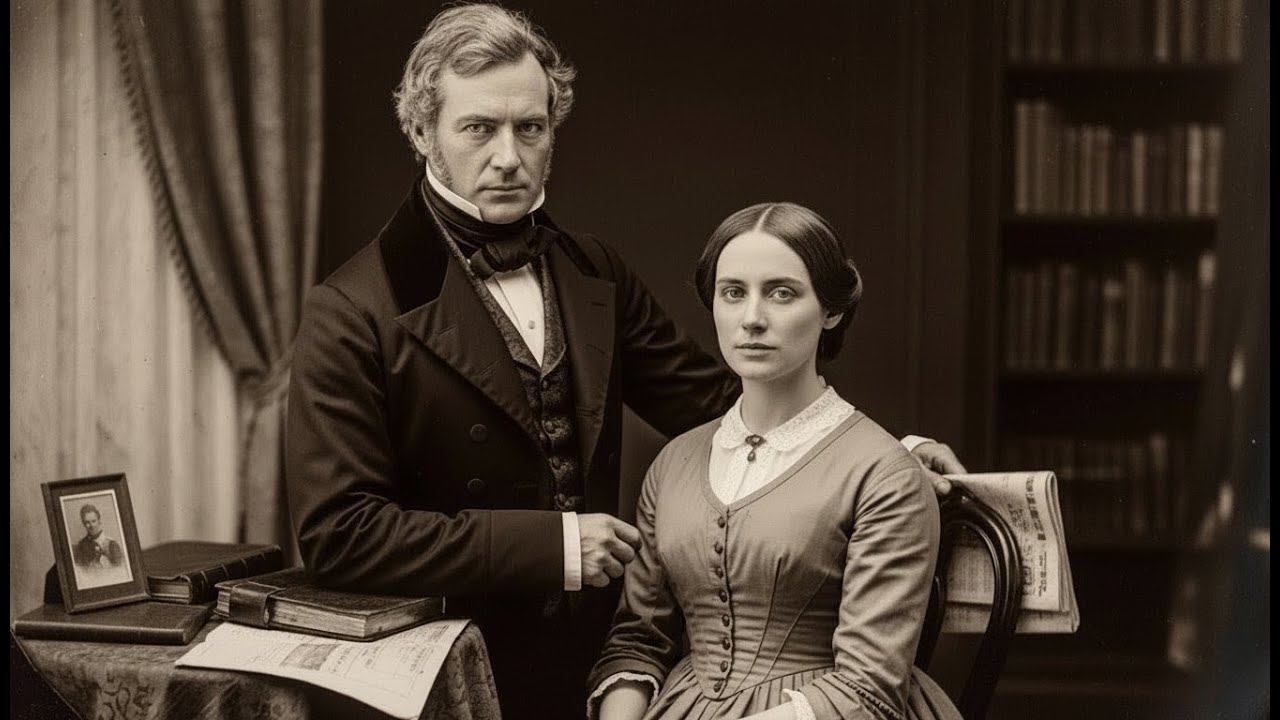
According to Harding’s letter, her grandmother had always maintained that Clara had not died on Sullivan’s Island, but had escaped Charleston with Roads. They had fled north, assuming new identities and settling in a small fishing village on the coast of Maine, living quiet, reclusive lives, never returning to the South and never publishing their findings. Harding enclosed what she described as the only surviving photograph of the couple, supposedly taken in 1862 on the occasion of their twentieth wedding anniversary: an austere middle-aged couple standing in front of a modest coastal home, the man’s face partially obscured by a beard, the woman’s hair pulled back severely from a face marked by hard years. Hullbrook was initially skeptical.
The story seemed too convenient, too much like the happy ending one might wish for. She arranged to visit Harding in Maine to examine any additional evidence, but she never made the journey. She suffered a stroke in December 1968 and died three weeks later. Her research notes, correspondence, and the letter from Elizabeth Harding were donated to the South Carolina Historical Society by her niece, but remained uncatalogued for several years.
When a new archivist finally processed Hullbrook’s papers in 1974, the letter from Harding was missing, as was the photograph it had allegedly contained. A note in the file written by the previous archivist stated simply: “Items removed by request of the Charleston Historical Commission for review. Never returned. ”
The most tantalizing piece of evidence to emerge in recent decades came not from formal research but from an unexpected source.
In 1982, during renovation of an old sea captain’s house in Rockport, Maine, workers discovered a hidden compartment beneath a window seat on the second floor. Inside was a small tin box containing a journal, a locket containing two locks of hair—one dark, one fair—and a hand-drawn map of Sullivan’s Island with several locations marked with small crosses. The journal was water damaged and largely illegible, but several pages remained readable. The handwriting appeared to match surviving examples of Clara Bowmont’s script from letters in her father’s papers.
One passage, dated April 1843, read: “N believes we are still at risk even after all these years. He starts at every unexpected sound, watches every stranger who comes to the village with suspicion. Perhaps he is right to do so. What we uncovered in Charleston was not merely a crime, but a conspiracy reaching into the highest levels of society and medicine.
Those responsible would still have much to lose should the truth become known. And so we maintain our silence, our false names, our fabricated past. Sometimes I wonder if this half-life, this perpetual hiding, is truly preferable to whatever fate might have awaited us had we stayed to bring the truth to light. ”
Another fragment continued the theme: “The temptation to send my findings to medical journals grows stronger as I age.
The experiments conducted on those 23 souls, their systematic infection, the detailed documentation of their suffering, the variations in treatment that were never intended to cure but merely to observe different paths to death. These constitute one of the most profound violations of medical ethics in our nation’s history. That this was done specifically to people purchased for this purpose, with no regard for their humanity, compounds the horror. Yet N reminds me that those who orchestrated this atrocity went on to illustrious careers, trained generations of new physicians, and established medical institutions that still stand today.
Their names are carved in marble on hospital facades. Who would believe our account against the weight of their legacies? ”
The owner of the Rockport house contacted a local historical society, and the director recognized the potential significance of the find, reaching out to colleagues at the University of Maine’s history department. A preliminary analysis suggested the journal was authentic as a nineteenth-century document, but further research was needed to verify the identity of its author.
Before this research could proceed, the tin box and its contents were stolen from the historical society’s office during a break-in. Local police found no leads. The case was eventually classified as an ordinary theft, despite the fact that nothing else of obvious value was taken. In 2001, a marine archaeology team surveying the seabed off the coast of Sullivan’s Island discovered the remains of what appeared to be a small nineteenth-century boat.
Initial excitement that this might be the missing craft used by Roads and Bowmont was tempered when further examination revealed that the boat had been deliberately scuttled—holes had been drilled in its hull before it sank. No human remains were found in or near the wreck. The most recent development came in 2008, when a construction project on Sullivan’s Island was temporarily halted after workers uncovered what appeared to be human remains. Archaeological experts from the University of South Carolina identified the remains as dating from the early nineteenth century and noted that they appeared to be of African origin.
Several of the bones showed evidence of surgical procedures performed before death. Before a full excavation could be completed, however, the construction company obtained a court order allowing them to resume work, with the stipulation that any additional remains discovered would be respectfully reinterred in a designated cemetery. The archaeological team was given forty-eight hours to complete their examination and remove any artifacts of historical significance. The abbreviated investigation yielded little additional information.
The site has since been developed into luxury condominiums. Today, the story of Nathaniel Roads and Clara Bowmont exists in a liminal space between established history and legend. Walking tours occasionally mention them as part of the city’s ghost lore. The house on Trad Street where Roads once lived has been renovated multiple times and currently serves as an upscale vacation rental, marketed with no mention of its former occupant.
Yet traces remain. Roads’ journal sits in acid-free storage at the South Carolina Historical Society, its pages yellowed but its accusations still legible. In the old graveyard at St. Philip’s Church, there is a section where the headstones are weathered beyond reading—the strangers section that so interested Roads.
And on Sullivan’s Island at low tide, the marshlands sometimes reveal glints of glass or metal, perhaps remnants of medical implements, perhaps merely modern debris. In her final notes, Dr. Margaret Hullbrook wrote: “History is not merely what happened, but what we allow ourselves to remember. The systematic amnesia surrounding the Roads-Bowmont case speaks to more than just the protection of reputations.
It reveals our national unwillingness to confront the most disturbing aspects of our medical and racial history. Until we are ready to acknowledge such chapters honestly, we remain vulnerable to repeating them in new forms. ”
What became of Nathaniel Roads and Clara Bowmont remains unknown. No bodies matching their descriptions were ever recovered from the shores of Sullivan’s Island or the harbor.
Some local legends suggest they fled Charleston and died elsewhere under assumed names. Others propose a more sinister fate—that they were intercepted before they could bring their discoveries to light, their bodies disposed of where they would never be found. Whether they perished in the storm, were silenced by those who wished to protect a terrible secret, or escaped to Maine to live out their days in anonymity, the full truth remains elusive. The story survives primarily in academic footnotes on medical ethics and the history of yellow fever, acknowledged as a possibility but not established as historical fact.
The marshlands of Sullivan’s Island continue to shift with each tide and storm, alternately concealing and revealing their secrets.
