On June 6, 1944, armored bulldozers rolled onto Omaha Beach alongside the infantry. Their job was to push through the concrete seawalls and clear the obstacle belts so that tanks and trucks could move inland. Several operators from the 37th Engineer Combat Battalion were killed by German fire that morning. The ones who survived opened the roads that the entire invasion depended on.
Those bulldozer blades came from one manufacturer. So did the scrapers that built the airfields across the Pacific, the equipment that carved the Alaska Highway through frozen wilderness in eight months, the machines that graded every runway, flattened every beachhead, and moved every ton of earth the Allied forces needed from North Africa to Normandy to Okinawa. Seventy percent of all earth-moving equipment used by the Allies in World War II came from the factories of one man, a sixth-grade dropout from Vermont named R. G.
LeTourneau. He held 299 patents. Caterpillar called his greatest invention impossible. And the machines he built between 1920 and 1969 did not just help win a war; they invented modern earth-moving as we know it.
To understand what LeTourneau changed, you first need to understand what earth-moving looked like before he arrived. In the early 1920s, moving dirt on a construction site was slow, expensive, and brutal work. The Fresno Scraper, invented in 1883, was still the primary earth-moving tool on most jobs. It was a simple C-shaped metal bowl dragged through the soil by mule teams, typically four to eight animals per scraper.
A driver walked behind the team. A second man operated the dump lever. Output was measured in cubic yards per day, and on a good day a Fresno team might move a few hundred yards of material. Larger jobs used cable-operated shovels mounted on crawler tractors.
These were faster than mule-drawn scrapers, but they were slow, expensive to maintain, and required dedicated crews of two to four men per machine. The cables that controlled the shovel boom, the bucket, and the swing mechanism needed constant adjustment. If a cable snapped, which happened regularly, the entire operation stopped until it was repaired. Everything changed because a young welder in Stockton, California, needed to make money faster than his competitors.
Robert Gilmore LeTourneau had dropped out of school at 14 and learned to weld while rebuilding San Francisco after the 1906 earthquake. In January 1920, at age 32, he walked into a bank, borrowed $1,000, and bought a used 1915 Holt 75 Caterpillar tractor. He rented a Schmeiser scraper and started land-leveling work in San Joaquin County. His business model was simple and almost suicidal: he underbid every competitor on every job.
Then he scrambled to build better machines in his welding shop so he could actually complete the work without going broke on the margins. In May 1921, LeTourneau set up his shop on Moss Avenue in South Stockton, roughly a mile and a half south of the Caterpillar factory. From that shop came his first scraper. It was all-welded steel, a technique that was rare in heavy equipment manufacturing at the time.
Most competitors built their machines by riveting plates and castings together. Riveted joints were heavier because they required overlapping material at every connection point. They were also weaker under stress because the rivet holes weakened the surrounding metal. And they were expensive to produce because every rivet had to be heated, placed, and hammered individually by skilled laborers.
LeTourneau’s welded construction eliminated all three problems. A welded joint was stronger than the base metal around it. It weighed less because there was no overlap needed. And a skilled welder could join two pieces of steel faster and cheaper than a riveting crew could do the same work.
The result was a scraper that was lighter, stronger, and cheaper to build than anything on the market. And it could be operated by one man instead of two. That single change, eliminating one crew member per scraper, meant LeTourneau could run a job site with half the labor cost of anyone else in the business. On October 16, 1923, the United States Patent Office granted LeTourneau patent number 1,470,853.
It was the first of 299 patents he would file over the next 42 years. But the invention that truly separated LeTourneau from every other equipment maker in the country came five years later. In 1928, LeTourneau invented the power control unit. The PCU was a double-drum cable winch that mounted directly to a crawler tractor’s power take-off.
The concept was mechanically straightforward, but no one had done it before. The tractor’s PTO shaft spun two cable drums. Those cables ran through a system of sheaves and fairleads to whatever attachment was on the front or rear of the tractor, whether it was a scraper bowl, a bulldozer blade, or a rooter. By engaging or releasing the drums, the operator could raise, lower, tilt, and dump the attachment without leaving the tractor seat.
One man sitting on one machine could now do the work that previously required a tractor driver and a separate cable crew standing alongside the machine. The PCU did not just make jobs faster. It changed the economics of earth-moving completely. A contractor who used to need three men and a crawler to operate a single cable scraper now needed one man and a tractor with a LeTourneau PCU.
Labor was the biggest single cost on any construction job. Cutting it by two-thirds on every piece of equipment meant the entire cost structure of earth-moving dropped overnight. The genius of the PCU was its versatility. The same winch system could control completely different attachments depending on how the cables were routed.
Hook up a scraper bowl and the PCU raised and lowered the cutting edge to control dig depth and dumped the load at the fill site. Hook up a bulldozer blade and the same drums controlled blade height and tilt angle. Hook up a rooter and the cables pulled the teeth into the ground and lifted them back out. A single tractor with a LeTourneau PCU could switch between three or four different attachments in the same work day, turning one machine into an entire equipment fleet.
Before the PCU, changing the function of a crawler tractor on a job site meant unhooking one piece of equipment and hiring a separate crew to operate the next one. After the PCU, one operator could switch from scraping to dozing to ripping without leaving the seat. Contractors who understood this bought LeTourneau equipment and never looked back. Contractors who did not understand it lost bids to those who did and never recovered.
Through the late 1920s and early 1930s, LeTourneau machines showed up on some of the biggest construction projects in the American West, including the Boulder Highway leading to Hoover Dam, the Marysville levees along the Feather River, and the Santiago Dam in Orange County, California, which at the time was the largest earth-filled dam ever built. On every project, the pattern was the same. LeTourneau underbid everyone, showed up with fewer men and better machines, and finished faster than anyone thought possible. In 1927, a job went badly wrong, and LeTourneau ended up $100,000 in debt, a staggering sum in the late 1920s.
He nearly lost everything, but he fought his way back by doing what he always did: building a better machine than the last one, and underbidding the competition again. In August 1932, LeTourneau made a change that seems obvious now, but was considered ridiculous at the time. He put rubber tires on a carryall scraper. A customer working in the Imperial Valley of California had complained that his steel-wheeled scraper kept sinking in the sandy soil.
The narrow steel wheels concentrated the machine’s entire weight onto a thin contact patch that cut into soft ground like a knife. LeTourneau’s solution was to replace the steel wheels with pneumatic rubber tires. The wider tires spread the machine’s weight over a much larger surface area, and they floated on soft ground instead of cutting through it. The tires worked, but the real benefit went far beyond soft soil.
Rubber tires meant a scraper could now travel on paved public roads between job sites. A steel-wheeled machine crawled along at 4 mph and tore up any surface it crossed. A rubber-tired machine could drive to the next job at highway speed. Contractors no longer needed to hire flatbed trailers to move their equipment from one project to the next.
That single change cut mobilization costs in half. The industry’s reaction was predictable. Other manufacturers mocked the idea. Rubber tires on machines weighing tens of thousands of pounds would burst, they said.
The rims would buckle. No tire company would bother building them at that scale. They were wrong on every count. Within two decades, rubber tires became the universal standard on construction equipment worldwide.
And it started because one customer in the Imperial Valley was tired of sinking in sand. In 1935, Caterpillar convinced LeTourneau to relocate from Stockton to Peoria, Illinois, near their East Peoria headquarters. He bought 23 acres, built a factory, and entered a 10-year marketing agreement to sell his equipment through Caterpillar’s dealer network. The deal made sense for both sides.
LeTourneau got access to the largest equipment distribution network in the world. Caterpillar got a constant stream of innovative attachments that made their tractors more valuable. But then LeTourneau designed a machine that Caterpillar did not want to exist. In 1937, after a severe car accident that left him in a full-body cast, LeTourneau conceived the Tournapull while lying flat on his back in a hospital bed.
The idea was straightforward. Instead of a crawler tractor pulling a separate scraper behind it at 8 mph, why not build a single self-propelled machine on rubber tires that could carry its own load at 15 or 20 mph? He brought the concept to Caterpillar management. Their answer was that the motorized scraper was not feasible.
The engineering objection was weak. The real problem was economic. Caterpillar sold crawler tractors. Contractors bought a Cat tractor and then bought a LeTourneau scraper to tow behind it.
Two sales. If LeTourneau built a single self-propelled scraper that did not need a tractor at all, Caterpillar would lose half the revenue on every earth-moving setup they sold. The Tournapull was not an engineering impossibility. It was a threat to Caterpillar’s business model.
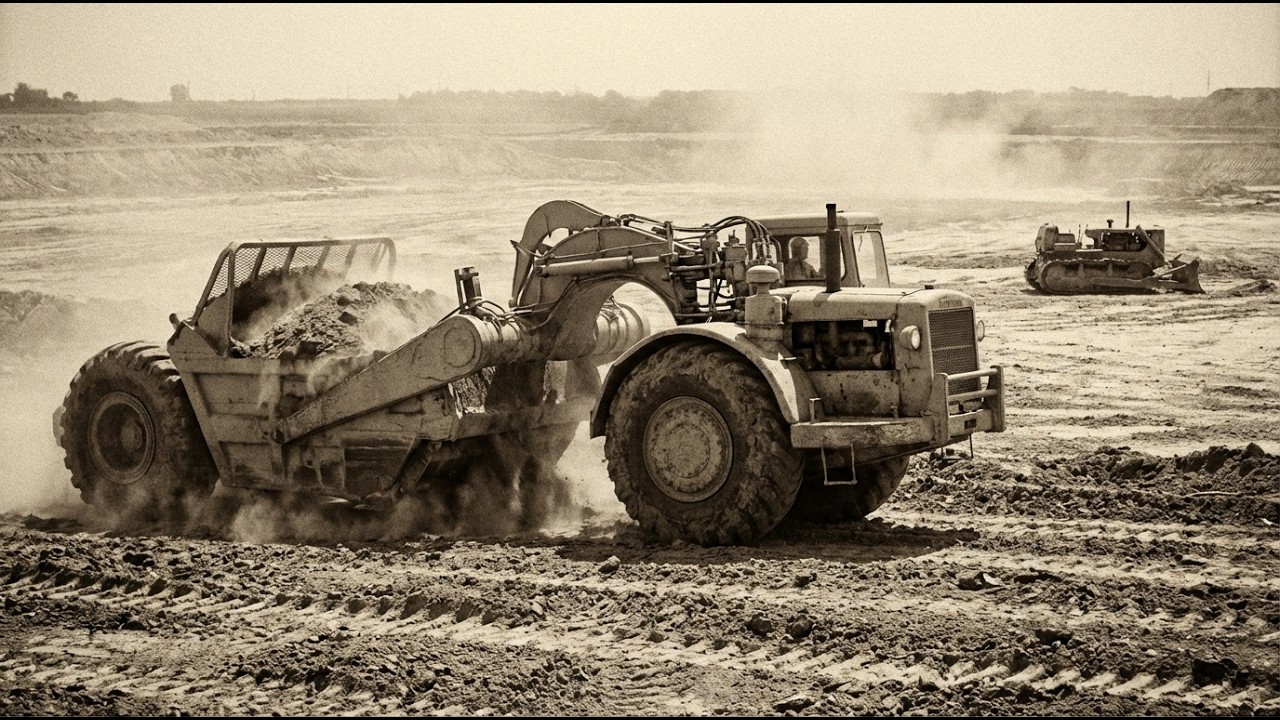
LeTourneau built it anyway. The model a Tournapull rolled out in 1937 with 160 horsepower and the ability to travel at 20 mph unloaded. It was the first true self-propelled rubber-tired motor scraper ever manufactured. The machine’s layout was unlike anything in the industry.
The engine and drive axle sat at the front in a separate two-wheeled tractor unit. The scraper bowl was mounted on a single axle at the rear. The two halves connected through a gooseneck hitch that allowed them to articulate independently over rough terrain. This configuration put the engine weight directly over the drive wheels for maximum traction during loading, while the rear axle carried the weight of the loaded bowl.
The improved model C followed in April 1940 with better reliability, a stronger hitch, and more pulling power. And then the Super C appeared in 1941, arriving at precisely the right moment as American industry mobilized for World War II. The Super C could haul a 12 cubic yard bowl at speeds that made crawler scraper combinations look like they were standing still. The performance difference was not marginal.
It was devastating. A conventional crawler-towed setup could move a loaded scraper at roughly 8 mph. The Tournapull carried a full load at 15 and returned empty at 20. On a typical earth-moving job where scrapers cycled between a cut and a fill, that speed advantage meant a single Tournapull could move nearly twice the volume of material per hour as a crawler scraper combination.
And it did it with one operator instead of two. The Tournapull earned the nickname widowmaker because its clutch and brake steering system made it dangerously easy to jackknife at speed, especially downhill. Operators respected the machine and feared it in equal measure. But they kept climbing into the cab because nothing else on the market could move earth that fast.
Within 20 years of Caterpillar calling the Tournapull not feasible, every major manufacturer in the industry was building rubber-tired self-propelled scrapers. The 10-year marketing partnership between LeTourneau and Caterpillar expired in 1945. By 1948, Caterpillar was manufacturing its own version of the exact machine they had rejected. International Harvester followed.
Allis-Chalmers followed. John Deere followed. The entire industry pivoted to self-propelled earth-moving equipment within a single generation. And every one of those machines traced its lineage directly back to the design that one man sketched on hospital napkins while lying in a body cast.
And then the war came. And LeTourneau’s machines went everywhere. The production numbers from World War II are difficult to comprehend for a single manufacturer. LeTourneau’s plants produced what industry sources consistently estimate at 70% of all earth-moving equipment used by the Allied Forces.
Some estimates place the figure as high as 75%. His factories turned out 14,000 bulldozer blades, 10,000 carryall scrapers, 1,800 Tournapulls, 1,600 sheepsfoot rollers, and 1,200 rooters and rippers. Between 1942 and 1945 alone, LeTourneau filed 78 new patents while simultaneously running wartime production at maximum capacity. He operated five plants across two continents: Stockton, California; Peoria, Illinois; Toccoa, Georgia; Vicksburg, Mississippi, which came online in 1942; and Rydalmere, Australia, which opened in 1941 to supply the Pacific Theater.
A sixth plant in Longview, Texas, began operations as the war ended. The Peoria and Toccoa factories won a combined nine Army-Navy E awards for production excellence, a recognition given only to manufacturers who consistently exceeded the military’s production expectations. But the numbers alone do not capture what LeTourneau’s machines actually did in the field. On the beaches of Normandy, armored bulldozers from the 37th Engineer Combat Battalion pushed through concrete seawalls and cleared hedgehog obstacles so that trucks and tanks could move off the beach and into France.
These were standard Caterpillar D7 tractors fitted with LeTourneau bulldozer blades and wrapped in improvised steel armor plating to protect the operator from small arms fire. The armor added thousands of pounds to each machine and slowed them to a crawl in the soft sand. Of the 16 armored bulldozers scheduled to land in the first wave on Omaha Beach, only six made it to shore. Three were knocked out almost immediately.
The surviving machines and their operators opened the first exits off the beach. Without those gaps in the seawall, the tanks and trucks stacked up behind the infantry would have had nowhere to go. The roads those bulldozers opened in the first hours of June 6th determined whether the invasion succeeded or stalled. In the Pacific, the pattern was different, but the machines were equally critical.
When Marines or Army engineers secured a beachhead on a coral island, the first priority after eliminating enemy resistance was building an airfield. Coral had to be scraped flat, compacted, and graded in days rather than weeks, so that fighter planes and bombers could begin operating from forward positions. LeTourneau scrapers and bulldozer blades did that work on Guadalcanal, Tarawa, Saipan, and Iwo Jima. The conditions in the Pacific tested every machine beyond its design limits.
Coral was harder than most rock, but fractured unpredictably. Tropical heat cooked engines and boiled coolant. Salt air corroded every exposed metal surface. Torrential rain turned cleared ground back into mud overnight.
And the nearest replacement parts were often sitting on a supply ship a thousand miles away. The Navy Seabees, the construction battalions that built the infrastructure of the Pacific campaign, became some of the most demanding and creative operators of LeTourneau equipment. They adapted machines designed for California farmland to work on volcanic rock, coral reef, and tropical mud. When something broke and they could not get a replacement, they welded one from scrap metal and kept working.
CB ingenuity combined with LeTourneau durability built over 100 airstrips across the Pacific in less than three years. Every B-29 that took off from Tinian to bomb the Japanese mainland rolled down a runway that had been scraped flat by LeTourneau blades weeks or months earlier. The Alaska Highway was another proving ground. Fifteen hundred miles of two-lane road from Dawson Creek, British Columbia, to Fairbanks, Alaska, carved through some of the most unforgiving terrain in North America in just eight months during 1942.
Temperatures dropped to 40 below zero. Diesel fuel thickened to gel. Hydraulic lines on competing equipment froze solid and cracked. The ground was frozen solid in winter, which was actually the best time to work because crawlers and scrapers could travel on the hard surface.
In summer, the permafrost thawed and the ground turned to bottomless muskeg that swallowed machines whole. Entire tractors sank up to their engine decks and had to be winched out by other machines. LeTourneau scrapers, blades, and rooters pushed through all of it on a timeline that the War Department had initially considered impossible. Cable-operated machines actually had an advantage in extreme cold because cables do not freeze the way hydraulic fluid does.
A steel cable at 40 below is stiff but functional. A hydraulic hose at 40 below is a brittle tube waiting to burst. This was not something LeTourneau had planned, but it meant his equipment kept running while newer hydraulic machines sat dead on the roadside waiting for temperatures to rise. Among the more specialized machines was the D4 airborne Tournapull.
Only 567 of these were ever manufactured. Each one was designed to fit inside a Waco CG-4A glider or a C-47 transport aircraft, which meant the entire machine had to be compact enough to fold into a cargo bay roughly 15 feet wide and 48 feet long. Airborne engineers could touch down on a primitive dirt strip and immediately begin expanding it into a functional airfield using a machine they had brought with them through the sky. Tournacranes, another LeTourneau design, were installed on every American fleet aircraft carrier as mobile crash cranes.
When a damaged plane blocked the flight deck during combat operations, a Tournacrane cleared the wreckage so that flight operations could continue. General Dwight D. Eisenhower ranked the bulldozer among the four most vital pieces of equipment in the entire European theater, alongside the Jeep, the two-and-a-half-ton truck, and the C-47 airplane. Admiral William Halsey ranked it the fourth most important weapon in the Pacific campaign.
And 70% of those bulldozer blades came from LeTourneau’s factories. The man himself had a sixth-grade education. He gave away 90% of everything he earned during the war years to his charitable foundation. And he was just getting started.
On May 1, 1953, at the age of 64, LeTourneau sold his entire earthmoving equipment line to the Westinghouse Air Brake Company for $31 million, roughly $350 million in today’s money. The sale included the Peoria and Toccoa plants, the land, the machinery, the full product line, and every distributor relationship he had built over 30 years. Westinghouse imposed a five-year non-compete clause barring him from manufacturing any earthmoving equipment until 1958. He kept the Vicksburg and Longview plants.
He used the non-compete years to build things that had nothing to do with scrapers, but everything to do with the fact that he could not stop engineering. For George H. W. Bush’s Zapata Offshore Company, LeTourneau designed and built the Scorpion, the world’s first practical jack-up drilling rig.
Nine million pounds standing on three legs that extended 140 feet to the ocean floor. When the jacking system failed during testing, the 66-year-old LeTourneau walked onto the steel deck and sketched corrections directly in chalk on the metal. No blueprints, no calculations on paper, just chalk on steel. And it worked.
Bush ordered a second rig, the Vinegaroon, which became the only platform in the Gulf of Mexico to survive Hurricane Audrey undamaged. By 1970, more than half of all drilling platforms operating worldwide were LeTourneau designs. In 1958, the non-compete clause expired. LeTourneau was 70 years old.
He had already built more earthmoving equipment than any manufacturer in history. He went right back to work. From his Longview, Texas headquarters, LeTourneau launched a new generation of machines built around an idea he had been developing since 1950, the electric wheel. The concept eliminated the mechanical drivetrain entirely.
In a conventional machine, power travels from the engine through a gearbox, down a drive shaft, through a differential, and out to the wheels through axles. Every one of those components adds weight, requires maintenance, and loses energy to friction. LeTourneau replaced all of it. The diesel engine drove a generator.
The generator powered planetary traction motors mounted directly inside each wheel hub. No gearbox, no drive shaft, no differential. Each wheel received its own independent power supply and could be controlled separately. The advantages were enormous.
An electric wheel machine could put full torque to every wheel simultaneously at any speed, something that was mechanically impossible with a conventional drivetrain. If one wheel lost traction in mud or loose soil, the others compensated automatically without the operator doing anything. Steering could be achieved by varying power between left and right wheels instead of relying on mechanical linkages that wore out under heavy loads. Maintenance was perhaps the biggest practical advantage.
A conventional drivetrain on a large earthmover had hundreds of moving parts between the engine and the wheels. Universal joints, splined shafts, gear teeth, bearings, seals, and differential gears all wore against each other under extreme torque loads. When something broke, and it always did, the entire machine was down until a mechanic could pull apart the drivetrain and replace the failed component. On a remote job site, that could mean days of downtime.
The electric wheel had far fewer moving parts exposed to dirt and vibration. The motors were sealed inside the wheel hubs, protected from dust, mud, and rock impacts. If a single wheel motor failed, the machine could still operate on the remaining wheels while the damaged unit was swapped out. On large machines with eight or more wheels, losing one motor barely affected productivity.
Try that with a broken drive shaft on a conventional scraper, and the entire machine is a paperweight until the shaft is replaced. LeTourneau had filed the foundational patent on August 23, 1950, and it was granted as patent number 2,726,726 on December 13, 1955. During the non-compete years, he could not apply it to earthmoving. When the clause expired, he applied it to everything.
The machines that came out of the Longview factory in the late 1950s and the 1960s were not incremental improvements on existing designs. They were engineered from a completely different philosophy. Where every other manufacturer made existing machines bigger, LeTourneau reimagined what a machine could be if you removed every mechanical limitation and started with electric drive. The most extreme result was the LT-360 electric digger.
It remains the largest self-loading scraper ever built. Two hundred feet long, three separate bowls, each holding 72 cubic yards for a combined capacity of 360 tons of material. The power plant consisted of eight 16-cylinder Detroit diesel engines producing a combined 5,080 horsepower. The machine rode on eight tires, each standing over 10 feet tall.
The LT-360 could load itself with 360 tons of earth in 80 seconds, then drive to the dump site at 15 to 20 mph and empty the bowls without stopping. Only one LT-360 was ever built. No commercial mining or construction operation on Earth was large enough to keep it busy. Before his death, LeTourneau had already drawn plans for the LT-500, an even larger version that would have carried 500 tons on 9,600 horsepower.
It was never constructed. The LT-360 stood alone as a monument to what was technically possible when engineering had no budget constraints and no committee to answer to. But electric wheel drive was not just about building the biggest machine. LeTourneau applied the technology across his entire product line.
The tree crushers were machines weighing over 60 tons, fitted with massive steel rollers covered in six-inch grousers that could drive straight through a standing forest and snap full-grown trees at ground level. The G175 variant weighed 175 tons and was powered by twin V12 Cummins diesel engines producing a combined 1,400 horsepower, all delivered through electric wheel motors. In 1967, tree crushers were shipped to Vietnam for jungle clearing operations, where they flattened vegetation to eliminate cover for enemy forces. Other units were deployed to British Columbia for commercial land clearing.
One of them stands today as a tourist attraction in the town of Mackenzie: a 60-ton monument to a machine that was designed to destroy forests and now serves as a roadside curiosity. The Overland Train TC-497 Mark II remains the longest off-road vehicle ever built. It measured 572 feet long, nearly two full football fields. Four gas turbine engines produced a combined 4,680 horsepower.
Fifty-four independently powered electric wheels rolled on tires 10 feet in diameter. The Overland Train could haul 150 tons of cargo across Arctic terrain at 20 mph, carrying enough fuel and supplies to sustain remote military outposts that no road could reach. The Army paid $3. 7 million for it.
The vehicle was tested extensively at Yuma Proving Ground in Arizona before Sikorsky’s heavy lift helicopters made it obsolete. It still sits at Yuma today, the largest land vehicle ever constructed, quietly rusting in the desert. LeTourneau hated hydraulics. One of his associates recalled that if anyone mentioned the word in his presence, he knocked the table.
He believed electric drive was the superior technology for heavy equipment, and the decades since his death have proven him right in ways he could not have predicted. Every large mining truck operating today, the 200-ton, 300-ton, and 400-ton haulers that work in open pit mines around the world, uses diesel-electric drive. The engine powers a generator and the generator powers wheel motors. It is LeTourneau’s electric wheel concept scaled up for the 21st century.
The L-2350 wheel loader, manufactured by the company that still carries his name, holds the Guinness World Record as the largest front-end loader ever built: 258 tons operating weight, 80-ton payload capacity, tires standing 13 feet tall. It runs on diesel-electric drive. LeTourneau’s electric wheel, scaled up 60 years later, still moves more earth per hour than any other loader on the planet. In open pit copper mines in Chile, in iron ore operations across Western Australia, in coal mines in Wyoming, and gold mines in Nevada, the largest trucks on Earth haul 200, 300, even 400 tons of material per load.
Every one of them uses diesel-electric drive. The concept is identical to what LeTourneau patented in 1950. The scale has grown. The electronics have improved.
But the fundamental engineering principle, putting the motor inside the wheel and eliminating the mechanical drivetrain, is exactly what a 70-year-old man drew up in Longview, Texas after everyone assumed he was retired. And then there is the strangest footnote of all. Four of his 10-foot-tall snow buggy tires, originally built for an Arctic military vehicle powered by a World War II P-38 Lightning fighter engine running on butane, ended up in a Seattle junkyard. In the 1980s, a man named Bob Chandler bought them for $1,000 and bolted them onto a Ford F-250 pickup truck called Bigfoot 5.
It became the tallest monster truck in the world at 15 feet 6 inches. LeTourneau’s military surplus, decades after his death, accidentally created an American pop culture icon. Every cubic yard that the L-2350 scoops, every ton that a mining haul truck carries, and every scraper that loads itself and drives to the dump at 20 mph carries a direct engineering lineage back to a welding shop on Moss Avenue in Stockton, California, where a sixth-grade dropout with a borrowed Holt 75 started building scrapers in 1921. When Firestone told LeTourneau they could not manufacture the tire molds needed for his giant machines, he built the molds himself and delivered them to Firestone’s factory.
When Caterpillar told him his scraper was not feasible, he built it, proved them wrong, and forced the entire industry to follow. When the Army needed a vehicle that could cross the Arctic without roads, he built the longest off-road vehicle in history. His last patent was granted on July 13, 1965. He was 77 years old.
His company had operations on four continents with over 6,000 employees. He had given away 90% of his income for 30 years and still died wealthy. R. G.
LeTourneau suffered a severe stroke in March 1969 and died on June 1 of that year at age 80. He and his wife Evelyn are buried on the campus of LeTourneau University in Longview, Texas, the school he founded in an abandoned military hospital in 1946. Every self-propelled scraper working today exists because of the Tournapull. Every rubber tire on every piece of heavy equipment traces back to a test in the Imperial Valley in 1932.
Every diesel-electric mining truck uses a version of his electric wheel patent. On June 6, 1944, the roads off Omaha Beach were opened by bulldozer blades that came from his factories. Two hundred ninety-nine patents, a sixth-grade education, and machines that are still moving the earth now, more than half a century after the man who built them is gone.
