It was around nine in the evening when every adult in the farmhouse stood up, pulled on unnaturally lengthened leg coverings, gathered wooden stakes and coils of wire, and walked out into the open darkness. Their stride was so long that the visiting salesman, watching from the window, lost sight of even the slowest of them in under a minute. He spent the rest of the night at the kitchen table with the eldest woman of the house, who never once slept, her eyes fixed on the door. Just before dawn, he heard a sound out on the prairie that he could only describe as not quite a scream—something that had grown tired of trying to be one and given up partway through.
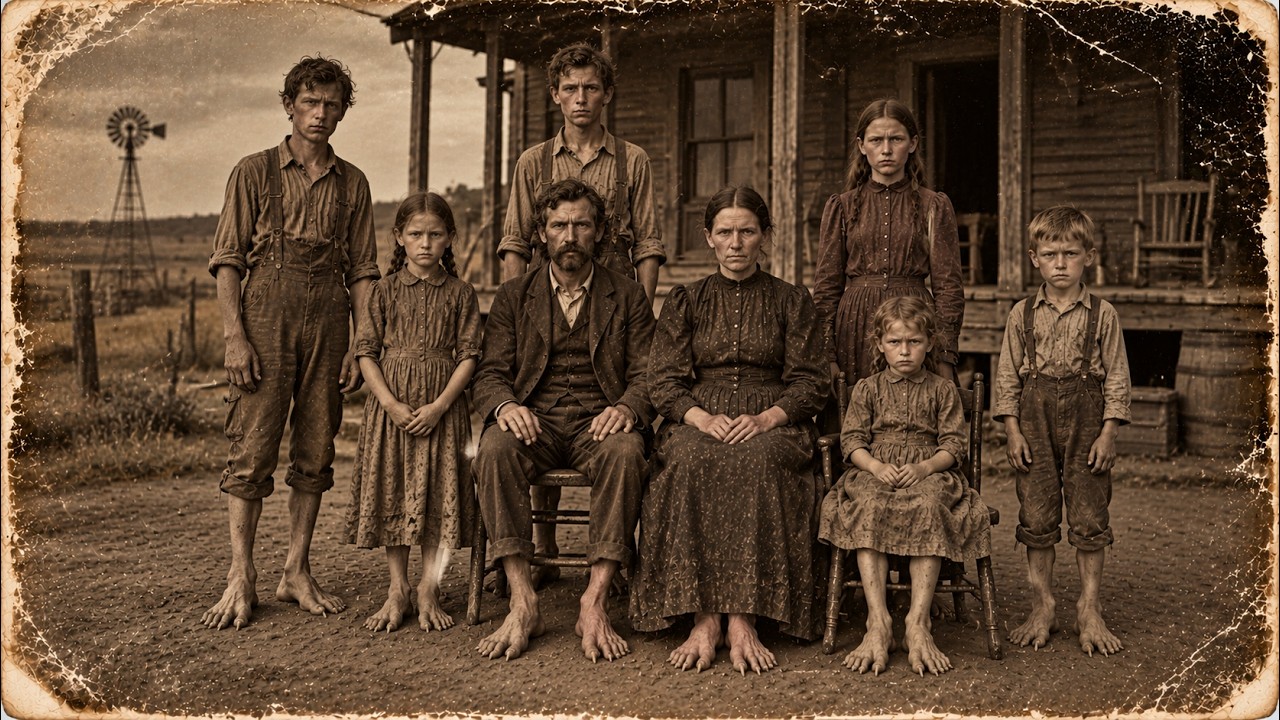
The traveling salesman was a 31-year-old named Ambrose Tilden Cray, who had worked fixed commercial routes across western Kansas for nearly a decade, selling kitchen implements and patent remedies from his own wagon. In the autumn of 1899, his horse refused to go further at dusk, roughly thirty kilometers from the nearest town, and he stopped for the night at an isolated farmstead in the middle of the open prairie. The family who took him in, the Millers, served him supper normally enough. Weeks later, Cray gave an account of the evening to a local newspaper man named W.
H. Dockery, editor of the local weekly, who wrote the conversation down. Dockery noted in an introductory paragraph that he had known Cray for years as a straightforward businessman, little inclined toward fancies, whose word he would have taken without hesitation on any other matter of ordinary life—which is exactly why the account stood out so sharply from the paper’s usual coverage, devoted mostly to grain prices and farm equipment advertisements. The farmstead itself does not appear under the Miller name on any modern map.
Current USGS topographic sheets list the area simply as an unincorporated rural section in what is now Gove County, Kansas, roughly 22 kilometers southwest of present-day Quinter. But county land records and at least one 1896 railroad survey refer to the property by a name that appears in no later official document: the walking section. The railroad survey uses the phrase without explanation, describing only in dry technical language an unusual pattern of exceptionally long stride human trails crossing the section in multiple directions, inconsistent with any documented agricultural or pastoral use by the crew. The geography of the region helps explain why this detail would come to matter.
The plains of western Kansas in this stretch of Gove County extend nearly flat for dozens of kilometers in every direction, without a single natural rise breaking the horizon line. A climatological and topographic report produced by the US Geological Survey in 1958 describes the area as producing, under specific nighttime temperature and humidity conditions, an unusually pronounced mirage and apparent distance distortion effect even by the already elevated standards of the Great Plains region—a phenomenon the report attributes to ordinary atmospheric refraction, but which, according to the same documentation, the region’s older residents historically described in considerably less technical terms. The Miller family had settled on the section in 1878, according to the earliest available land record, part of a wave of settlers drawn into western Kansas by the promise of cheap land under the Homestead Act. By around 1899, the family numbered eight across two generations, the only fixed habitation within several kilometers in any direction.
Every documented adult member of the family presented two unusual and apparently linked physical traits: legs disproportionately long relative to the torso, present from childhood, and hands bearing a variable number of extra fingers, generally between one and three beyond the standard count, distributed unevenly among family members. Cray, according to Dockery’s transcription, asked the eldest woman of the house, identified only as Mrs. Miller, why the family was running out across the prairie at that hour of night. She told him they go to plant the stakes before it gets too close to the house, because once it crosses the stake line, there’s no wire nor long leg that’ll push it back again.
Cray asked what it was. The next line of the transcript, according to Dockery’s own note, was delivered by Cray in a noticeably lower voice than the rest of the account: she didn’t answer with a single word, only looked at the dark window for a stretch of time that felt too long to be natural, and he didn’t ask again. Cray’s account was published in the local weekly in November 1899 but drew little attention outside the immediate community. The specific issue sat largely forgotten, preserved only on microfilm at the Kansas State Historical Society in Topeka, until a researcher studying agrarian folklore of the Great Plains located it in 2015, searching for references to unusual rural customs documented by the period’s local press.
The second source comes from inside the family itself: a household account and personal notebook kept by the family’s matriarch, Temperance Augusta Miller, covering roughly 1881 to 1903, donated to the Gove County Historical Society by a distant descendant in 1991. Most of the notebook consists of ordinary rural bookkeeping—flour sacks, a debt owed for a borrowed plow, notes on a lost wheat crop. But scattered among these ordinary entries are shorter, more direct records of the family’s actual nightly routine. In an 1883 entry, Temperance writes: “E and the boys out again tonight to the west line.
Third time this month. Back before the rooster crowed. All whole, thank God. But the youngest didn’t say a word at breakfast, just stared at his plate.
”
In another entry from 1887, she records: “The Puit family lost two more head of cattle this week on their side of the section where nobody plants a single stake. E says that’s exactly why. And I don’t argue with him about it anymore because arguing doesn’t bring the cattle back and only tires him out worse than he already is. ”
And on a page dated only autumn 1899—the same week as Cray’s visit, according to the chronology reconstructed by the researcher who rediscovered the notebook—Temperance writes in noticeably tighter handwriting than usual: “Had a visitor today, a businessman, saw us going out to the line, didn’t like him seeing it.
The more people see, the more people ask, and the more people ask, the closer we come to the day somebody wants to come along thinking it’s a joke, thinking it’s just country folk exaggerating. ”
Temperance Miller’s notebook never uses words like curse or pact. It records, in the same flat register used for flour and borrowed plows, that the adults of the family went out regularly at night to a line of stakes and wire strung along the property’s perimeter, and that the purpose of going out was to prevent something from crossing that line before the barrier was complete. What the notebook suggests—and what fragments of regional oral tradition collected decades later by a Federal Writers’ Project researcher in 1938 independently confirm—is that the family’s two physical traits, the long legs and the extra fingers, were not passive characteristics but active tools, maintained and used for a very specific purpose.
The legs let the Millers cover in a matter of minutes stretches of open prairie that would take any ordinary man considerably longer to cross on foot. The extra fingers let them tie the complex wire and stake knots along the entire length of the line before whatever was approaching across the plain had time to reach the property. A 1938 interview records an elderly neighbor of the region, with no blood relation to the family, recalling that the Millers ran their line every night of the waning moon and said it was to keep something on the outside—something that came walking across the prairie slow from far off on the darkest nights—and that it never reached their house because there was always a fresh stake planted before it got too close. The researcher’s own summary dismisses this as a colorful rural superstition, likely connected to a rare hereditary congenital condition affecting several members of the same family, missing entirely what the interviewee had actually described: not a quaint custom, but an exhausting and constant physical labor, repeated night after night, on which the safety of the entire family, and possibly the entire neighborhood, appeared to depend.
The cost of this labor, described in Temperance’s own notebook with growing candor over the years, was not small. An 1891 entry records that the eldest son, after one particularly long night on the line, couldn’t close his right hand properly for nearly a whole week—the extra fingers hurting worse than the usual ones—and he wouldn’t say anything beyond that, only that it hurt deep, not just in the skin. Another entry from 1896 describes a pattern repeating across nearly every adult member of the family after a night on the line: an exhaustion no rest seemed to fully relieve, a kind of stiffness in the legs lasting for days, and in at least two recorded cases over the years, long stretches of silence and emotional distance that Temperance herself describes as “not quite being fully themselves for a while after, as if they’d left a piece of themselves out on the prairie along with the stakes. ”
Seen this way, what salesman Cray witnessed that night in 1899 was not a family of eccentric farmers running through the dark on a whim.
It was a group of people in the middle of an exhausting and dangerous physical labor, repeated for decades, maintaining alone—and without any recognition from the surrounding community—a barrier that kept something from reaching not only their own house but possibly the neighboring farms as well. The mechanics of the line itself, as Temperance’s notebook across its later entries becomes increasingly specific, were exacting. An 1893 entry describes the stakes as needing to be driven at a fixed interval, no more than eleven paces apart, counted by the long stride and not the short one. The wires strung between them were wound in a particular pattern she calls, without further explanation, the “closed hand knot”—a phrase that corresponds, according to the researcher who examined the notebook, to a specific multi-loop knot visible in two surviving photographs of fence fragments recovered from the property decades later.
Temperance’s notebook insists in more than one entry that an ordinary four or five fingered hand could tie the same knot, but never fast enough across the full length of the line before whatever was approaching closed the remaining distance—which she describes plainly as the entire reason the family’s extra fingers mattered at all: not strength, not reach, but raw speed of hand across hundreds of repetitions in a single night. A separate entry from 1898 describes an attempt—apparently the only one the notebook records—to hire outside help for the work. Temperance writes that the family brought on a young hired hand from a neighboring town for the harvest season, a man with an ordinary hand of five fingers on each side, and that he was given a short stretch of the eastern line to help with one particularly difficult night. “He worked harder than any of ours and still fell behind by near on 60 paces before E had to leave his own section and finish the man’s for him,” she writes.
“And I do not think E will ask an outside hand again, whatever the cost of doing it all ourselves. Some kinds of help only slow a body down when the thing that matters most is speed nobody born with the ordinary hand can give. ” The hired man left the family’s employ before the season was out and did not return. At least one institution in the region understood enough of the arrangement to quietly benefit from it without ever investigating its nature.
The county land office, responsible for assessing and taxing rural properties, maintained, according to administrative records preserved in the county archive, an informally undocumented policy of partial tax exemption on the Miller section, justified internally only as “special consideration for atypical occupancy conditions of the property”—a classification no other document from the land office applies to any other property in the region during the same period. Internal correspondence from 1894 between the county assessor and his superior, also preserved in the same archive, mentions without further explanation that the Miller family “performs a service to the community whose exact nature I prefer not to detail in writing, but which the county board in closed session considered sufficient to justify differential tax treatment. ”
The local newspaper itself showed an even more direct pattern of silence following the initial publication of Cray’s account. No later issue of the weekly, according to the researcher who examined the full microfilm run of the period, ever mentioned the Miller family by name again, despite the region being small enough that practically any unusual event would normally merit at least a brief note.
A letter preserved among editor Dockery’s personal papers—donated to the state historical society by a descendant in 1988—suggests the reason. Written in 1901, addressed to a fellow editor in another town, it mentions receiving a visit not long after publishing that piece on the Millers from a man who identified himself only as “a representative of local community interests,” who advised him in polite but firm terms that certain stories, however true they may be, serve the common good best when told once and then left alone. The clearest first-person account of what this arrangement actually cost survives in the diary of one of the family’s younger daughters, Ada Lucinda Miller, born in 1884. Her diary remains in the possession of a distant descendant family and was partially transcribed and donated to the Gove County Historical Society in 2012.
Ada’s entries from 1901 and 1902, when she was seventeen and eighteen and had taken on her own regular turn on the stake line, offer the most complete first-person description that exists of what the work actually meant. She writes that running the line never got easier with practice—the legs learned the rhythm, but the mind never learned not to feel the weight of knowing that if she arrived too late at even one point on the fence, the failure wouldn’t be hers alone, but the whole family’s, who depended on every stretch of the line closing in time. In another entry, she describes the specific physical sensation of tying the wire knots with her extra fingers, as though those extra fingers knew how to do a kind of work the other five ordinary ones would never properly learn—a kind of knot that regular town folks’ fingers wouldn’t have the patience or the dexterity to tie fast enough. Ada’s diary also describes a specific and formative episode from the winter of 1902, when a particularly severe blizzard delayed the family in heading out to the line, and half the western fence was still incomplete when, according to Ada, “we heard it walking before we’d even finished the last stretch—closer than any of the other times, close enough that I felt the ground shake in a way no animal’s footsteps I know make it shake.
” The family finished the line in time by a margin Ada describes as “smaller than any of us will ever admit out loud again. ” Her entries after that winter grow noticeably shorter, recording little beyond dates and weather conditions. There is no record that any member of the Miller family died as a direct result of this work. But census records show the family left the region around 1908, with no forwarding address given in any surviving local document, and the property reverted to the county for unpaid taxes two years later, despite the previously granted tax exemption.
The area where the Miller farmstead once stood is today ordinary agricultural land, leased and farmed as part of a larger regional operation, with no visible indication of its earlier history. But the site has continued on occasion to produce reports that echo the old record. In 2006, a farm equipment operator working the land during a nighttime harvest reported having spotted at a distance across the flat and unobstructed prairie something that shouldn’t have been moving the way it was moving—too fast to be a man on foot, too slow to be a vehicle—before his tractor’s GPS equipment experienced a temporary and unexplained signal failure that lasted, by his own rough estimate, just under ten minutes. More recently, in 2021, a researcher conducting a surface archaeological survey of the area, as part of a broader study on nineteenth-century rural settlement patterns in western Kansas, documented a nearly continuous line of old post holes and rusted wire fragments forming an approximately rectangular perimeter around the farmstead’s former location—a pattern her report describes as unusual in scale and consistency for a conventional agricultural fence of the period, without finding, in her own words, any satisfactory agricultural explanation for why anyone would invest that much labor in a fence that doesn’t appear to have contained any livestock at all, given how irregularly spaced the stakes are for that purpose.
There is a phrase that appears twice independently in the records connected to the Miller family—once in Temperance Miller’s notebook, once in nearly identical wording in that 1938 Federal Writers’ Project interview with the elderly neighbor unrelated to the family. Both versions carry the same meaning: What walks the empty plain will keep walking until it finds an open door. And it’s better that the door stay closed every single time than to find out too late what happens when it isn’t.
