The photograph sat in a cardboard box labeled miscellaneous personal effects, 1918 to 1925, wrapped in tissue paper that had yellowed with the years. James Mitchell, a thirty-eight-year-old genealogist from Chicago, had spent the morning in the basement archive of the Greenwood County Historical Society, working through property transfers from 1920 Mississippi for a client. At 4:30, with the archive about to close, he reached for one last box and found a stack of photographs damaged by time and humidity. Then he saw it.
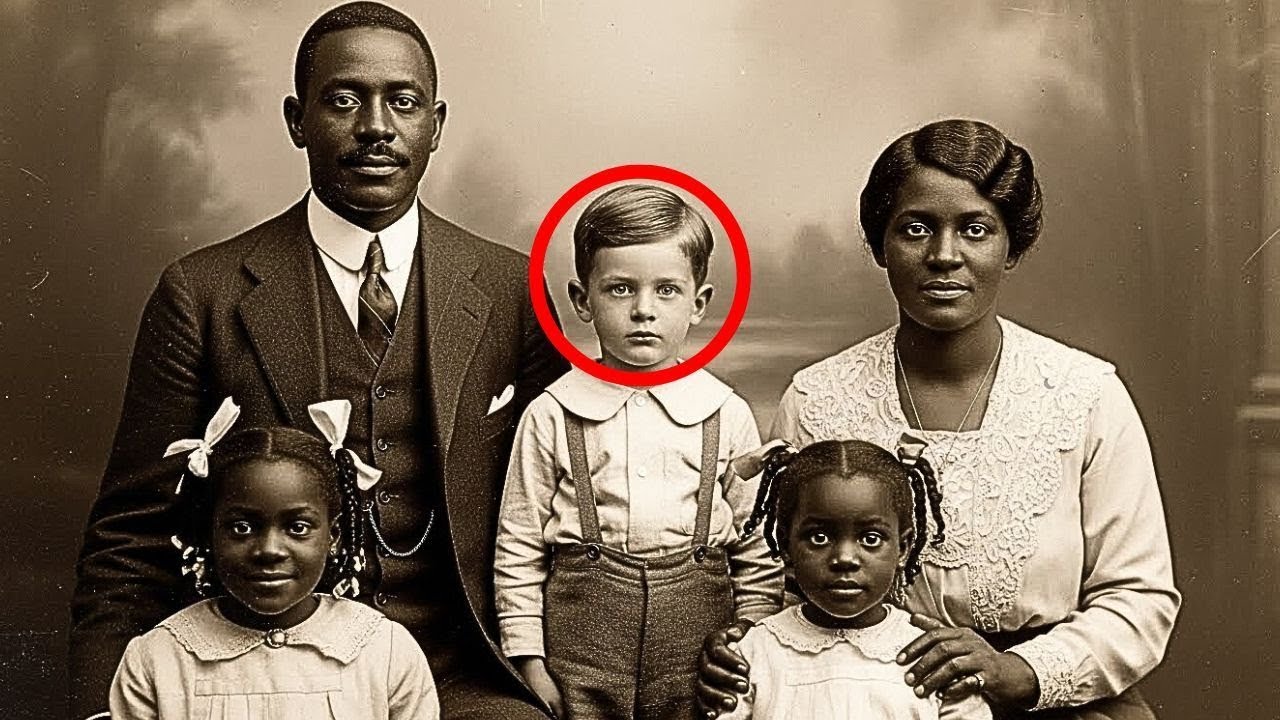
The photograph was surprisingly well kept, mounted on thick cardboard. The studio stamp read Crawford Photography, Greenwood, Mississippi, March 1920. It showed a formal family portrait. A Black couple sat in the center, dignified in their best clothes.
The man wore a pressed dark suit, his expression steady and proud. The woman’s hands rested gently in her lap, her dark dress spotless, her eyes meeting the camera with quiet strength. Three children stood with them. Two girls, about eight and ten, wore white dresses with ribbons in their neatly braided hair.
But it was the third child that made James freeze. Between the two girls stood a boy of about seven. His skin was pale. His hair was light brown and wavy.
Even in the sepia tones, his eyes were clearly light colored. The boy looked unmistakably white. James leaned closer, checking every detail. The boy stood naturally, the man’s hand resting protectively on his shoulder.
There was no awkwardness, no forced pose. He belonged there. James turned the photograph over. In faded pencil, it read: Samuel, Clara, Ruth, Dorothy, and Thomas.
March 14th, 1920. He snapped a picture with his phone and copied the names into his notebook. In 1920 Mississippi, during Jim Crow segregation, a Black family with a white child would have been impossible, dangerous, maybe deadly. James went to the archivist, an elderly woman named Mrs.
Patterson. “Do you know anything about this family? ” he asked, showing her the photo. Mrs.
Patterson studied it, something passing across her face—recognition, maybe a memory. “That would be Samuel and Clara Johnson,” she said softly. “Good people. He was a carpenter.
She took in sewing. ” She hesitated. “And the children. I’ve heard stories, old ones.
The kind people don’t talk about now. ” She glanced at the clock. “If you want to understand that picture, talk to Evelyn Price. She’s ninety-three, lives at Magnolia Gardens.
Her mother knew the Johnsons. ”
Mrs. Patterson let James keep the photograph. Nobody had claimed it in seventy years.
Maybe it was time someone figured out what it meant. Walking to his car, James looked at the five faces again. Four made sense. One seemed impossible.
Whatever happened in 1920, someone had gone to great lengths to hide it. The photograph was proof of something rare, something risky. That evening in his hotel room, James opened his laptop and began searching. He started with the 1920 census for Greenwood, Mississippi.
He quickly found Samuel Johnson, age thirty-two, Black carpenter, homeowner. Clara Johnson, age twenty-nine, seamstress. Two daughters: Ruth, age ten, and Dorothy, age eight. Two daughters, no son, no Thomas.
James tried birth records next, looking for any Thomas born in Leflore County between 1912 and 1914. He found several, but cross-checking showed they were all accounted for in their own families. None disappeared into a Black family’s photograph. He emailed his research assistant in Chicago: “Need death records for Leflore County, 1918 to 1920.
White couples dying within months of each other, especially with a young child. Also, check orphanage records. ”
Going back to newspaper archives, James scrolled through the Greenwood Commonwealth. Then, on February 3rd, 1920, he found it.
“Tragic accident claims local couple. ” Mr. Robert Hayes, thirty-four, and his wife Margaret, twenty-nine, died in a house fire on February 1st. The couple left behind one son, age six.
One son, age six, the right age for Thomas. James searched for more about the Hayes family but found almost nothing. No follow-up stories, no mention of what happened to their child. He searched orphanages, Mississippi, 1920.
The results were grim. A 1921 reform report described the Greenwood County Children’s Home as overcrowded and abusive, with children used as unpaid labor. Children as young as five were made to work ten hours daily. The report noted suspicious disappearances of children supposedly adopted, but records could not be confirmed.
His assistant emailed back: “Found it. Children’s home investigated in 1921. Multiple children unaccounted for. Director claimed adoptions, but no paperwork.
No charges filed. Facility shut down 1923. Records incomplete. Major gaps.
”
James drew a timeline. February 1st, 1920: Hayes couple dies. February 3rd, 1920: newspaper report, orphaned son. March 14th, 1920: Johnson family photo with white boy named Thomas.
Six weeks from the fire to the photograph. He studied the image again—Samuel’s protective hand on Thomas’s shoulder, Clara’s steady gaze. What did they risk? He found the Johnson property record: 412 Elm Street, purchased 1918.
Near midnight, James made a promise to those five faces. He would tell their story. He would find Thomas’s descendants and reveal the truth hidden for a century. Magnolia Gardens care home sat under old oak trees draped with Spanish moss.
James arrived at ten in the morning carrying the photograph and a voice recorder. Evelyn Price waited in the sunroom—a small woman with sharp eyes behind wire-rimmed glasses. At ninety-three, her memory was still clear. “You’re the genealogist,” she said.
“Sit down. My knees don’t work, but my memory does. ”
James showed her the photograph. Evelyn took it with trembling hands and studied it for a long time.
“Samuel and Clara Johnson,” she said softly. “I was five or six, but I remember them. My mother knew Clara from church, Mount Zion Baptist. ” “Do you remember this picture being taken?
” James asked. “I remember the talk. People were afraid. Having that boy in the picture was dangerous, but Samuel insisted.
He said if something happened, there needed to be proof the child existed. Proof someone cared. ”
James leaned in. “How did they end up with him?
” Evelyn looked out the window. “You have to understand. In 1920 Mississippi, a Black person could be killed for looking at a white person wrong. Touching a white child was asking for a rope in a tree.
But they did it anyway. The boy’s parents died in that fire. The Hayes family. Poor white folks.
When they died, nobody wanted him. He had no family. The orphanage, the Greenwood County Children’s Home—we all knew what that place was. Children went in broken.
If they came out at all, they worked them like slaves, beat them, starved them. Some just disappeared. ”
“How did the Johnsons get involved? ” James asked.
“Samuel was working near where the Hayes lived. The day after the fire, he saw the boy sitting on the burned house steps alone. The county was coming to take him to the children’s home. Samuel went home and told Clara.
My mother said Clara cried. They had two daughters and knew the danger. But Clara said she couldn’t let a child go to that place no matter what color. She said God would judge them if they turned away.
” Evelyn’s voice firmed. “So they took him. Middle of the night, before the county came, they just took him home. ”
“How did they hide him?
” “They told people he was Clara’s nephew from up north visiting. Mixed-race child passing for white. Hard to believe, but people didn’t look closely if you gave them a story. Our community knew the truth.
The Black community protected them. We all kept the secret. ” “For how long? ” “Almost two years.
They called him Thomas. He played with Ruth and Dorothy. Went to church. Learned carpentry from Samuel.
Sweet boy, my mother said. ”
James looked at the photograph with new understanding. “Why risk taking this picture? ” “Samuel wanted proof.
If they were caught, arrested, or killed, he wanted evidence the boy existed, that he was loved, part of a family. He saved money for months. The photographer, Albert Crawford, was white but fair-minded. Samuel told him the truth.
Crawford could have turned them in. Instead, he took the picture and charged half price. Said it was the bravest thing he’d ever seen. ”
“What happened to Thomas?
” Evelyn’s face saddened. “By 1922, it was too dangerous. He looked obviously white as he grew. The Klan was active that year.
Threats, violence. Clara had a cousin in Chicago named Diane Porter, married to a white man, a union organizer. They sent Thomas north in June 1922. Clara cried for days.
” “Did they keep in touch? ” “Secret letters for years. Thomas wrote when he was older, said he remembered them, was grateful. After Samuel died in 1935, the letters stopped.
Ruth burned them after Clara died in 1947. Thought it was safer. ”
Evelyn handed back the photograph. “It’s time the story was told.
Samuel and Clara risked everything to save a child who wasn’t theirs. Didn’t look like them, in a time when that could have gotten them killed. Find Thomas’s family. Tell them what happened.
Make sure people know that even in the darkest times, some chose love over fear. ” James promised he would. Mount Zion Baptist Church still stood on Elm Street—a modest brick building with a white steeple. James arrived Tuesday afternoon and met Patricia Lewis, the church secretary.
“I’m researching the Johnson family from the 1920s,” James explained. Patricia’s eyes widened. “Samuel and Clara—let me get Pastor Williams. ” Pastor Marcus Williams, a tall man in his fifties, studied the photograph.
His face grew serious when he noticed Thomas. He and Patricia shared a quick look. “Follow me,” the pastor said quietly. He led James to the church basement archive, shelves of record books and papers.
Pastor Williams pulled out a ledger marked 1918 to 1925. “We’ve kept detailed records since 1912. The reverend in the 1920s was Walter Thompson. Careful about paperwork.
He also kept private notes about sensitive matters. ” Williams opened the ledger, turning pages with care. “Here, March 1920. ” He pointed to an entry: “Samuel and Clara Johnson with daughters Ruth and Dorothy and ward Thomas, age six.
Family portrait commissioned. May God protect them in their righteous undertaking. ”
“A ward,” James said. “That matters.
Reverend Thompson knew. ” Williams nodded. “The whole church knew, it seems. Look at this.
” He flipped more pages, showing church meeting notes. Collections taken for the Johnson family. Prayers for their safety. April 1920: “Pray for the Johnson family’s protection.
” September 1920: “Collection for Johnson household needs. ” December 1921: “Pray for wisdom about the child’s future. ” The entire congregation had been part of it. Williams said the Black community there understood what Samuel and Clara had done and why they had built a wall of silence around it.
Patricia brought over another box. “The reverend’s personal journals. He wrote about it a lot. ” James read entries with growing emotion.
March 15th, 1920: “Samuel Johnson came to me troubled. He has taken in the Hayes child knowing the danger. I asked him why risk everything. He said, ‘Reverend, I looked in that boy’s eyes and saw my own daughters.
Could not send him to die slowly in that place. Clara agrees. ’ They ask only for the church’s prayers. I give them my blessing and my silence.
” June 1921: “The boy Thomas thrives with the Johnsons. He calls them mama and papa. He knows not the color of his skin matters to the world, only that he is loved. This is what Christianity truly means.
” May 1922: “Clara weeps. They must send Thomas north. Too dangerous now. The Klan marches openly.
I pray God protects this child and remembers this family’s sacrifice. ”
James photographed every page with permission. This was proof no one knew existed. “There’s one more thing,” Pastor Williams said.
He opened a small wooden box and took out a fragile envelope. Inside was a letter dated July 1922 from Chicago. The handwriting was childish but careful. “Dear Reverend Thompson, Mama Diane says I should write to say I arrived safe.
I miss Mama Clara and Papa Samuel and Ruth and Dorothy very much. Mama Diane is kind and Uncle James, too. They say I can go to school here. I will never forget my family in Greenwood.
Please tell them I love them. Thomas. ” James felt tears on his cheeks. Pastor Williams’s eyes were wet, too.
“This stays in our archive,” Williams said firmly. “But you have my permission to tell this story. The world needs to know what Samuel and Clara Johnson did. ”
Back in Chicago, James dived into city records, searching for Diane Porter.
He started with the 1920 census, looking for Black women named Diane married to white men on the South Side. He found her. Diane Porter, age twenty-six, married to James Porter, age twenty-nine, occupation union organizer, address 4732 South Indiana Avenue. The 1930 census showed them at the same address, now with two children of their own and a third child listed as nephew: Thomas Hayes, age sixteen.
There he was, hiding in plain sight, listed as a nephew. James searched for Thomas Hayes in Chicago through the years. The trail was faint; Thomas seemed to have lived quietly, avoiding attention. But James found a marriage license from 1935: Thomas Hayes married Anna Schmidt.
Occupation: carpenter, like Samuel had been. James looked for death records. Thomas Hayes died in 1987 in Evanston, Illinois, age seventy-three. Anna died in 1995.
They had three children: Robert Hayes, born 1937; Margaret Hayes, born 1939; and Elizabeth Hayes, born 1942. Three children who would now be in their eighties, possibly still alive, possibly with children and grandchildren who knew nothing about their true family history. James searched for Robert Hayes first. Property records showed Robert owned a home in Oak Park until 2015, when it was sold.
James found an obituary. Robert Hayes died peacefully at age seventy-eight, survived by his wife Susan, three children, and seven grandchildren. The obituary listed the children: Michael Hayes, Jennifer Hayes, and Thomas Hayes Jr. Another Thomas, named after his grandfather.
James searched social media and found Thomas Hayes Jr. , a middle-aged man living in Chicago. He worked as a high school history teacher. His profile was public, showing photos of his family, posts about social justice, pictures from a recent trip to Mississippi for civil rights sites.
James wrote a careful message. “Mr. Hayes, my name is James Mitchell. I’m a professional genealogist, and I found information about your grandfather, Thomas Hayes, that I believe you and your family don’t know.
It’s an extraordinary story involving great courage during a very hard time in American history. Would you be willing to talk with me? I can provide documents and proof of everything I found. ” He sent the message and waited.
Two days later, Thomas Hayes Jr. replied. “Mr. Mitchell, your message has me very interested.
My grandfather rarely spoke about his childhood. He said his parents died when he was young and he was raised by relatives in Chicago. We never knew much beyond that. I’d very much like to hear what you found.
Can we meet? ”
They set a meeting at a café in downtown Chicago. James arrived early, carrying a folder with copies of everything: the photograph, Evelyn’s testimony typed up, church records, census pages, newspaper articles about the Hayes fire. Thomas Hayes Jr.
arrived on time—a tall man in his late forties with graying hair, warm eyes, and an open, intelligent face. They shook hands and sat. “I’ll be honest, Mr. Mitchell,” Thomas said.
“I’m skeptical but curious. My family history has always been a puzzle. Grandpa Thomas died when I was ten. He was a quiet man, kind, but he never talked about his past.
He just said his childhood was hard and he preferred to look forward, not back. ”
James opened his folder and gently slid out the 1920 photograph. He placed it on the table. “This is your grandfather,” he said, pointing to the young white boy.
“Age six or seven. March 1920, Greenwood, Mississippi. ” Thomas stared at the photograph, his face shifting from confusion to shock. “That—these people are a Black family.
” “Samuel and Clara Johnson with their daughters Ruth and Dorothy and your grandfather Thomas Hayes. ” “I don’t understand. ”
James told him everything. He started with finding the photograph, moved through Evelyn’s story, showed him the church records, explained the fire that killed Robert and Margaret Hayes, described the orphanage and what likely would have happened to a six-year-old sent there.
Thomas listened, his face growing more emotional with each detail. When James finished, there was a long silence. “My grandfather was raised by a Black family,” Thomas said at last, his voice thick. “In Mississippi in 1920, for almost two years, Samuel and Clara Johnson risked their lives and their daughters’ lives to save him from that orphanage.
They hid him, protected him, loved him. Then, when it became too dangerous, they sent him to Clara’s cousin Diane in Chicago. That’s how he ended up here. ”
Thomas looked at the photograph, tears falling.
“He never told us. Why wouldn’t he tell us? ” “Maybe shame,” James said gently. “Or maybe protection.
Even decades later, in the sixties and seventies, when your grandfather was raising his family, racial tensions were high. Maybe he thought this story would bring trouble. Or maybe he was protecting Samuel and Clara’s memory. Or maybe it hurt too much to talk about.
He lost his birth parents in a fire, then lost his adoptive parents when he was eight. That’s a lot of loss for a child. ”
Thomas wiped his eyes. “Can I—may I?
” He reached for the photograph with shaking hands. James handed it to him. Thomas studied every detail: Samuel’s protective hand on young Thomas’s shoulder, Clara’s steady gaze, the two girls beside him. “They saved him,” Thomas whispered.
“They saved my grandfather, which means they saved all of us. My father, me, my children. None of us would exist if not for their courage. ” “That’s right.
” Thomas looked up. “Are there descendants from the Johnson family? ” “I think so. I haven’t traced them yet.
I wanted to find you first. But Ruth and Dorothy both had children. There’s a family tree out there that connects to yours, through 1920 to 1922, through love instead of blood. ”
Thomas put the photograph down carefully.
“Mr. Mitchell, I need to tell my family—my siblings, my cousins. We need to know this story. ” He took a deep breath.
“I want to find the Johnson descendants. I want to thank them somehow for what their ancestors did. ” “I was hoping you’d say that. ” They talked for two more hours.
James showed Thomas every document, every piece of proof. Thomas asked questions, took photos, made notes. As they got ready to leave, Thomas gripped James’s hand. “Thank you.
Thank you for finding this, for caring enough to track it down, for bringing it to me. This is the most important thing I’ve ever learned about my family. ”
“There’s one more thing,” James said. He took out the letter young Thomas had written to Reverend Thompson in 1922.
“Your grandfather wrote this two months after arriving in Chicago. He was seven. ” Thomas read it, and when he finished, he was crying again. “He loved them.
He called them mama and papa. He never forgot them. And we—we let this story disappear. ” Thomas folded the letter carefully.
“That changes now. Will you help me find the Johnson family? ” “Absolutely. ”
James went back to his research with new purpose.
He needed to find descendants of Ruth and Dorothy Johnson, the two girls in the photograph who had grown up knowing they briefly shared their home with a white boy their parents saved. He started with Ruth, the older daughter. In the 1930 census, Ruth Johnson, aged twenty, still lived with her parents in Greenwood. By 1940, she was gone, likely married.
James searched marriage records for Leflore County, 1930 to 1940. He found it: Ruth Johnson married William Crawford in 1933. Crawford—the same name as the photographer who had taken the 1920 portrait. James dug deeper and found the link.
William Crawford was Albert Crawford’s son. The photographer who had documented the Johnson family’s courage had a son who fell in love with Ruth Johnson and married her. They had four children: Albert Jr. , Clara, named after Ruth’s mother, Samuel, named after Ruth’s father, and Mary.
James traced them forward. Clara Crawford, born 1937, married Jerome Washington in 1958 and moved to Memphis. They had three children, including a daughter named Ruth Washington, born 1962. James found Ruth Washington on social media.
She was sixty-three, a retired teacher in Memphis, posting often about family, church, and civil rights history. He sent her a message like the one he had sent Thomas Hayes Jr. , saying he had found an extraordinary story about her great-grandparents. Ruth Washington replied within hours: “My grandmother Ruth told me stories when I was young about something secret my great-grandparents did, something brave.
She said I’d understand when I was older, but she died before she could tell me. Is this about that? ”
James set up a call. When they spoke, he told her everything and showed her the photographs and documents on a video call.
Ruth Washington listened with her hand over her mouth, tears falling. “They saved a white child,” she whispered. “In Mississippi in 1920. ” “Your grandmother Ruth knew him.
She was ten when he came to live with them. She would have remembered everything. ” “She never told us the details. Just said her parents did something dangerous and good, something that showed what real Christianity meant.
We always wondered. ”
James then told her about Thomas Hayes Jr. , about finding the grandson of the boy her great-grandparents had saved. “He wants to meet you.
He wants to thank your family for what Samuel and Clara did. ” Ruth Washington was silent a moment. “A hundred years later,” she said at last, “the family is coming back together after a hundred years. If you’re willing.
” “Of course I’m willing. This is everything my grandmother hoped for. I think she wanted this story told. She wanted people to know what her parents did.
”
James then searched for Dorothy’s descendants. Dorothy Johnson married Marcus Lewis in 1935 and moved to Chicago during the Great Migration in 1942. They had five children. One of them, Patricia Lewis, born 1945, still lived in Chicago.
James realized with a start that Patricia Lewis and Pastor Marcus Williams—the church secretary and pastor at Mount Zion Baptist Church who had helped him—were Johnson descendants. They already knew parts of the story. They had been protecting it, keeping it, waiting for the right time. James called Pastor Williams.
“You knew. You’re Dorothy Johnson’s grandson. ” “I am. My grandmother Dorothy told my mother everything before she died, and my mother told me.
We’ve been waiting for someone to put all the pieces together. Someone from outside who could tell this story right. ” “Why didn’t you tell me right away? ” “Because the story needed to be discovered, not handed over.
You found the photograph. You reached Evelyn. You linked the facts. That gives it weight.
Makes it real. If we just told you, it might have sounded like family legend. This way, you confirmed it yourself. ” Thomas Hayes Jr.
wanted to meet the family. So did Ruth Washington in Memphis. “Then we’ll make that happen,” Pastor Williams said. “We’ll bring everyone together—the descendants of Samuel and Clara Johnson and the descendants of the boy they saved.
This is what my great-grandparents would have wanted. ”
Three months later, on a warm Saturday in June, two families met at Mount Zion Baptist Church in Greenwood, Mississippi. Ruth Washington came from Memphis with her three children and two grandchildren. Pastor Marcus Williams was there with his large family, seven descendants of Dorothy Johnson.
Other Johnson relatives traveled from around the country—nearly thirty people. Thomas Hayes Jr. brought his whole family: his two sisters, his children, his cousins, nieces, and nephews. Twenty-three people who carried the blood of the boy Samuel and Clara had saved in 1920.
The church sanctuary was full. No media was invited. This was private, sacred. James Mitchell stood at the front with Pastor Williams.
Between them, on a large screen, was the 1920 photograph. Samuel, Clara, Ruth, Dorothy, and young Thomas. Thomas Hayes Jr. spoke first, his voice shaking with feeling.
“I’m standing here today because of an act of great courage and love. My grandfather, Thomas Hayes, lost his parents in a fire when he was six. He should have been sent to an orphanage where he likely would have died or been broken. Instead, two people, Samuel and Clara Johnson, risked everything to save him.
” He looked at the Johnson descendants. “They weren’t rich. They weren’t powerful. They were a Black family in Jim Crow Mississippi, which meant they lived every day under the threat of violence.
Taking in a white child could have gotten them killed. And they did it anyway. ”
Thomas paused, steadying himself. “My grandfather lived to be seventy-three years old.
He married my grandmother, raised my father and aunt and uncle, saw grandchildren born. He worked as a carpenter—a skill he learned from Samuel Johnson. He lived a good, quiet, decent life. All of that, all of us, exist because of what your ancestors did.
” He stepped down and went to Ruth Washington. “I don’t have words to thank you enough, but I want you to know we will never forget this. We will tell this story to our children and grandchildren. We will make sure Samuel and Clara Johnson’s courage is remembered.
” Ruth Washington hugged him, both of them crying. Around the sanctuary, there wasn’t a dry eye. Pastor Williams spoke next. “My great-grandparents Samuel and Clara Johnson were ordinary people who did an extraordinary thing.
They saw a child in danger and answered with love despite the risk. That is the simplest and deepest truth of this story. ” He gestured to the photograph on the screen. “This picture was taken as evidence, as proof that Thomas existed and was loved.
Samuel knew it was dangerous to record what they’d done, but he insisted. He wanted a record, even if it cost them. And now, a hundred years later, that photograph has brought our families together. ”
Ruth Washington then shared stories her grandmother Ruth had told her—memories of young Thomas playing with her and Dorothy, learning carpentry from Samuel, helping Clara in the garden.
“My grandmother said Thomas was shy at first, hurt by losing his parents, but slowly, over months, he started to smile again, to laugh. She said Clara would hold him and sing to him. And Samuel taught him how to measure wood and use tools. They loved him like their own.
” She paused. “And when they had to send him away, when it became too dangerous, my grandmother said her mother cried for weeks. Clara never stopped thinking about him, hoping he was safe and happy. She waited for letters, and she got some in secret for years.
Until the letters stopped. ”
Thomas Hayes Jr. stood again. “I have something to share.
” He lifted a box he had brought. “When my grandfather died, we found this in his attic. We never knew what it meant. But now we do.
” He opened the box. Inside was a small wooden toy—a carved horse, worn smooth by time and touch. “Samuel Johnson made this for my grandfather. We know because there’s a tiny ‘SJ’ carved under the base.
My grandfather kept it his whole life. Seventy-three years, he kept this toy. He kept this link to the family who saved him. ” He handed the toy to Pastor Williams.
“This belongs in your family’s history. It shows that he never forgot them. ” Just as they never forgot him. The two families talked, shared memories, hugged strangers by blood but connected by a bond stronger than genetics—the bond of sacrifice and love across the color line in one of America’s darkest times.
James watched, taking photos and notes, witnessing history setting itself right. After the gathering, Thomas Hayes Jr. and Pastor Marcus Williams held a press conference outside the church. The story had leaked; too many people knew about the reunion, and journalists from across the country had come to Greenwood.
Thomas spoke to the cameras. “In 1920, my grandfather, Thomas Hayes, lost his parents in a fire. He was six years old, alone, and about to be sent to an abusive orphanage. A Black family named Johnson took him in, hid him, protected him, and loved him at great risk to themselves.
Today, our families reunited to honor that bravery. ” He held up the 1920 photograph. “This picture was taken as proof that a child existed and mattered. Samuel and Clara Johnson wanted the world to know they had loved this boy, even if it cost them everything.
A hundred years later, their wish has come true. ”
The story went viral. Major newspapers ran it. TV networks featured it.
Social media exploded with shares and comments. The photograph of Samuel, Clara, and the children was seen by millions. People were moved, inspired, challenged. Some asked: why focus on a Black family saving a white child?
What about all the Black children who needed saving? Pastor Williams answered plainly in interviews. “This story doesn’t lessen other struggles. Samuel and Clara Johnson’s daughters, my grandmother and great-aunt, faced racism their whole lives.
The Johnson family knew oppression well. That’s what makes their choice so powerful. Despite everything they suffered, despite the danger, they chose love. They chose to save a child who would grow up with privileges they never had.
That’s not saying racism doesn’t matter. It proves their humanity rose above it. ”
Thomas Hayes Jr. added, “I grew up white in America with all the advantages that brings.
My grandfather grew up white. Our family has benefited from systemic racism for generations. But none of us would exist if not for a Black family’s courage. That’s a debt we can never fully repay.
But we can honor it by fighting the systems that made their act so dangerous in the first place. ”
The Hayes and Johnson families created a foundation in Samuel and Clara Johnson’s names, funding scholarships for foster children and supporting child welfare reform. The 1920 photograph was given to the National Museum of African American History and Culture in Washington, DC, where it was displayed with the full story. James Mitchell wrote a book about the discovery and the families, recording every detail; the money was shared between the Johnson and Hayes descendants.
Mount Zion Baptist Church became a place people visited. Folks came from across the country to see where Samuel and Clara had worshiped, to walk the streets they had walked, to honor their courage. The house at 412 Elm Street, long empty, was bought by the foundation and restored as a small museum and learning center, teaching visitors about Jim Crow racism and the people who resisted it with quiet acts of deep courage. Years later, James reflected on what the story meant.
“Samuel and Clara Johnson weren’t famous,” he told an interviewer. “They didn’t lead movements or give speeches. They were working people trying to survive in a cruel racist system. But when faced with a choice—ignore a child’s suffering or risk everything to help—they chose love.
That’s heroism. Not the loud kind, but the kind that changes the world one life at a time. ”
Thomas Hayes Jr. , now in his sixties, spoke at schools and churches, telling his grandfather’s story and the Johnsons’ sacrifice.
“My grandfather lived because two people cared more about a child’s life than their own safety. That’s the America I want to build. Where we see each other’s humanity first. Where we take risks for each other.
Where love beats fear. ”
The Johnson descendants carried their ancestors’ legacy with pride. Ruth Washington’s granddaughter, studying social work, said, “I’m not surprised Samuel and Clara did what they did. When I look at their photograph, I see it in their eyes.
Strength, kindness, determination. They raised their daughters to have those same traits. It’s in our family, passed down. ”
Five years after the reunion, the families gathered again—this time for a happy event.
Thomas Hayes Jr. ’s daughter Sarah was marrying Marcus Williams III, Pastor Williams’s grandson. The wedding was at Mount Zion Baptist Church, where Samuel and Clara had worshiped, where Reverend Thompson had written down their courage, where the families had reunited after a century. The church was decorated with photographs across generations: Samuel and Clara with young Thomas in 1920, Thomas Hayes as an adult with his wife and children, the Johnson descendants over the decades, and now this moment.
Two families joined not just by history but by love. During the ceremony, Sarah and Marcus honored their ancestors. They placed flowers before a portrait of Samuel and Clara Johnson, noting that without them, neither family would be here. “Love brought us together twice,” Marcus said in his vows.
“First in 1920, when my great-great-grandparents saved Sarah’s great-grandfather. And now, in 2025, when we choose each other. We carry their legacy forward. The legacy of love that crosses every barrier.
”
The reception was joyful. Hayes and Johnson descendants danced together, shared stories, and strengthened the bonds formed five years earlier. The racial divides that once made their connection impossible now felt far away, overcome by shared history and chosen family. James Mitchell attended as an honored guest.
Now in his mid-forties, he had built his career on this story. His greatest joy came from watching these families thrive together. “This is what I hoped for,” he told Ruth Washington, now seventy-one. “Not just finding the past, but healing it and bringing it forward.
” “You gave us back our history,” Ruth said. “We always knew Samuel and Clara were special. But we didn’t know the full story. Now we do.
Now the world does. ”
As the evening ended, the families gathered for a photograph. Dozens of descendants of both families stood together where Samuel and Clara had once stood, in front of the church that had sheltered their secret. Someone held up the original 1920 photograph.
Then and now—a century between them, but the bond unbroken. Thomas Hayes Jr. looked at the old picture one more time, at his grandfather’s young face, at Samuel’s protective hand on his shoulder. “Thank you,” he whispered to those long-gone faces.
“Thank you for everything. ”
Later that night, Sarah and Marcus visited Samuel and Clara’s graves in the church cemetery. The headstones, once neglected, had been cleaned and surrounded by flowers that descendants planted often. “We’re naming our first child after them,” Sarah said quietly.
“Samuel, if it’s a boy. Clara, if it’s a girl. So the names continue. So they’re never forgotten.
” Marcus took her hand. “They won’t be forgotten. Their story is part of history now. Part of the record.
” They stood in silence a moment, honoring the courage that had made everything possible. Above them, stars shone over Mississippi—the same stars that had shone on Samuel and Clara Johnson in 1920, when they made their hard choice. The same stars that shone on their descendants now, living the future those two brave souls had made possible. A photograph taken in 1920 had held a mystery no one could explain.
Now, a century later, the mystery had been solved, revealing a story of courage, sacrifice, and love that crossed the cruelest barriers ever built between people. Samuel and Clara Johnson risked everything to save a child who wasn’t theirs. They asked for nothing in return. They sought no fame, no reward, no praise.
They did it because it was right, because a child needed help, because love demanded it. And now their story would be told forever—a reminder that even in the darkest times, even in the most unjust systems, single acts of courage and care can change the world. The photograph remains in the Smithsonian, seen by thousands each year.
But its true legacy lives in the families Hayes and Johnson, white and black, forever linked by an act of love that refused to honor the color line.
