The cold that settles over the American interior between November and March is not the cold of a city street or the brief chill between a warm house and a waiting carriage. It comes from every direction at once, rising from ground frozen so deep the earth feels like iron, falling from a sky the color of a rifle barrel, and driving sideways on winds that have crossed three hundred miles of open country without meeting anything tall enough to slow them. It passes through wagon walls and sod-house boards. It passes through wool coats that were adequate in Ohio or Indiana or County Cork.
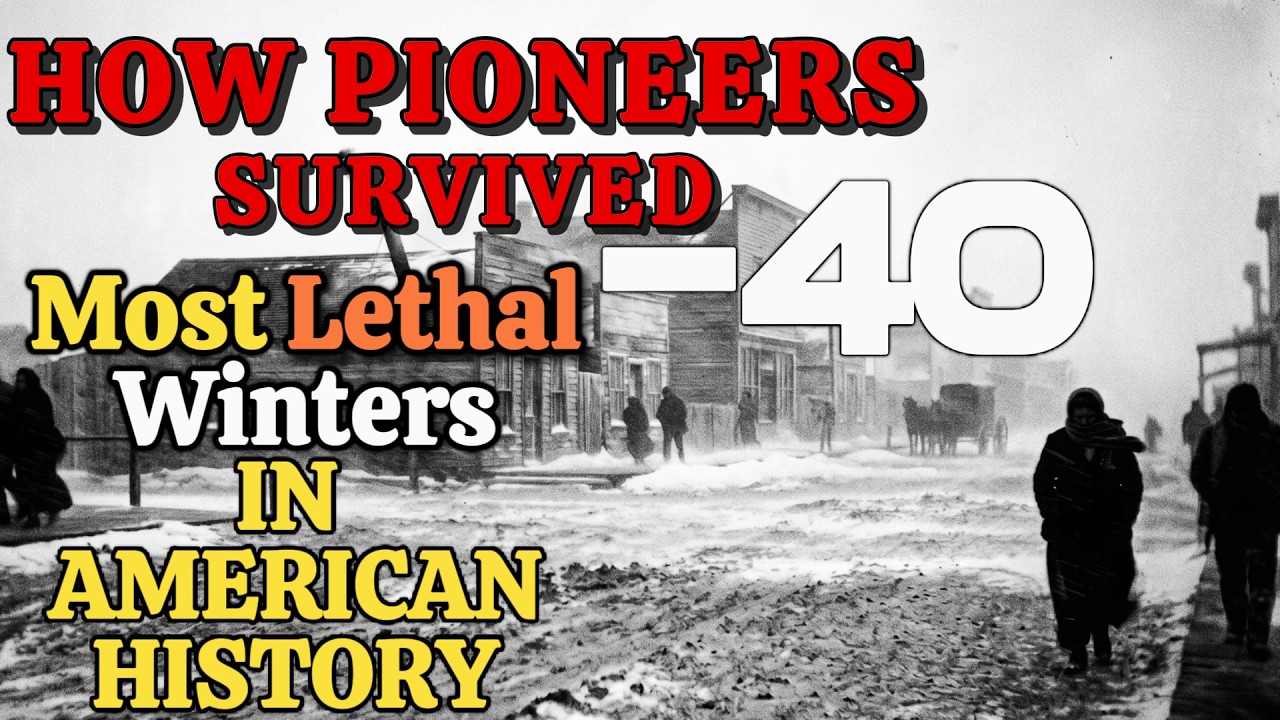
The pioneers who crossed this land in the 1840s and 1850s, and the homesteaders who claimed its soil in the decades that followed, learned this winter the way people learn things that have tried to kill them. Not abstractly. Physically, permanently, written into the body by experience. The mathematics of the overland crossing were simple and merciless.
The trails from Missouri to Oregon and California ran between two thousand and twenty-two hundred miles, with no resupply and no shelter beyond what travelers carried. The journey took four to six months under favorable conditions, and the window between the spring thaw that made river crossings passable and the autumn snows that sealed the mountain passes was narrow. A wagon train that started late, moved slowly, or lost days to sickness and delay could find itself approaching the Sierra Nevada with the calendar turning against it. George Donner did not recognize the danger until it was too late to matter.
A sixty-year-old Illinois farmer, he was not reckless, but he was committed, and he had chosen a route promoted by a guidebook author named Lansford Hastings. Hastings had advertised a shortcut south of the Great Salt Lake with the confidence of a man who had not actually traveled it with wagons and did not intend to disclose that fact. The shortcut added weeks. By late October 1846, the Donner party reached the eastern slope of the Sierra Nevada, and the mountains had already closed for the season.
The snow came on October 28th. It came fast, deep, and early, in quantities the families camped at the foot of the pass had no framework to process. They tried the pass and were turned back. They tried again and were turned back again.
They built crude shelters against a frozen lakeside and told themselves the wait would be short. The Sierra Nevada did not consult their timeline. Over the winter of 1846 into 1847, everything that sustains human life was systematically destroyed. Food went first, then warmth, then physical strength, then the will that strength makes possible.
The cattle died and disappeared beneath drifts too deep to locate. Supplies were rationed, then rationed again, then ceased to constitute nourishment. The cold pressed through the shelter walls and took up permanent residence in the bodies huddled inside. Eighty-seven people entered those mountains that October.
Forty-two came out. The thirty-nine who did not survive died of starvation, of cold, and of the accumulated destruction the two produced together. Tamsen Donner sent her children out with the earlier relief parties. She stayed.
Her husband George was dying, and she would not leave him. When the final relief party reached the lake camp in April 1847, George was dead and Tamsen told the rescuers she would not go. They left her. The camp found empty weeks later offered no explanation.
The Sierra Nevada kept what Tamsen Donner had given it and has never returned it. The Donner party became famous because the scale of the catastrophe made the story impossible to suppress. But it was not the only disaster the frontier winter produced, and not, by certain measures, the worst. In the summer of 1856, the leadership of the Latter-Day Saint migration organized two companies of European converts, the Willie Company and the Martin Company, to cross thirteen hundred miles of American interior pushing and pulling two-wheeled handcarts.
Earlier handcart companies that year had completed the journey without catastrophe. These two started late, for reasons historians have argued over for more than a century and a half without ever fully settling. What is not disputed is that a young man named Franklin Richards passed both companies on the trail in September 1856, moving east. He saw their condition.
He saw the calendar. He continued to Salt Lake City, delivered his report, and the decision about whether to send massive relief west was delayed. The consequences of that delay have never been mitigated. The first serious snowstorm struck the Willie Company at Ice Springs, Wyoming, on October 19th.
It carried winds the company journal described as impossible to face. On the night of October 23rd into October 24th, thirteen people died at the camp at Rock Creek. They were buried in a single grave in ground already frozen solid. The survivors rose the following morning and kept walking, because the alternative was to remain and die in larger numbers.
The Martin Company was further behind. Rescue parties from Salt Lake City did not reach them until November 8th, by which point the company had been pinned on the frozen banks of the Sweetwater River for days, the weakest members dying at a rate the company record documents with the sparse precision of people who have run out of the energy that grief requires. Two hundred and thirteen people died in those two companies that autumn and winter. They died pushing handcarts through Wyoming snowstorms because they were too poor to afford wagons and too far into the mountains by the time winter arrived.
The homestead era brought a different relationship with winter. Not the acute catastrophe of a trail crossing gone wrong, but the chronic, grinding, season-long endurance of people who had staked everything on ground the government had offered for free and that the northern plains climate was pricing at a rate the original offer had not disclosed. The sod houses built from prairie earth were remarkable structures in certain seasons. In winter, they were something else.
Sod walls transmitted cold with a thoroughness wood might have resisted. Sod roofs leaked when snow melted against the warmth inside. The wind found its way through regardless of the care taken in construction. Darkness arrived by four in the afternoon in December and stayed past seven in the morning, and the fire had to be maintained through those hours or the house became by morning as cold as the ground surrounding it.
Women endured the homestead winter in ways the telling of frontier history has consistently underreported. The isolation of a sod house on the Dakota plains in January was not an inconvenience but a physical and psychological condition of such severity that the journals women left behind constitute a record of endurance that the word does not fully honor. The nearest neighbor might be three miles away, three miles that in summer took twenty minutes to cross and in January blizzard conditions became genuinely, fatally impassable. Elinore Pruitt Stewart homesteaded in Wyoming in the early twentieth century and wrote about it in letters that remain among the most valuable accounts the era produced.
She described winters that settled on the land with a completeness that reshaped every dimension of existence, without complaint and without performed cheerfulness. Her winters were not exceptional by the standards of the northern plains. They were representative, which makes them more important to understand than the famous catastrophes, because the famous catastrophes happened to specific people in specific seasons. Elinore Pruitt Stewart’s winters happened to everyone who homesteaded that country, every year, without exception.
The winter of 1886 into 1887 ended an era. The preceding summer had been dry across the northern ranges, and the range was overstocked by the cattle boom of the early 1880s. The winter began in November with temperatures ranchers described as the worst in memory. A brief warm spell in January offered false hope.
Then January 9th, 1887 produced a blizzard the historical record calls the schoolchildren’s storm, because it arrived during the school day with such sudden violence that teachers across Dakota Territory, Montana, and Nebraska faced a decision with no good answer: release the children into conditions they could not survive, or hold them in unheated schoolhouses through a night whose length the storm would determine. Some teachers released their students. Some of those children did not reach home. The cattle that had survived until January died in their thousands.
They drifted before the wind the way cattle drift in blizzard conditions, moving away from the cold pressing at their backs until a fence or a riverbank stopped them, and there they stood until the cold finished what the drifting had not. When the spring thaw came, the rivers carried carcasses. Losses across the northern ranges ran between fifty and ninety percent of the animals on the ground. Theodore Roosevelt lost the majority of his Dakota Territory herd.
He rode out in the spring of 1887 and counted the dead, and wrote about it with the contained grief of a man accounting for a loss he had not prepared himself to sustain. The open-range cattle era did not survive that single season. On January 12th, 1888, a nineteen-year-old teacher named Minnie Freeman stood in her one-room schoolhouse in Mira Valley, Nebraska, and made a decision. The storm had arrived mid-afternoon, dropping the temperature forty degrees in an hour, reducing visibility to nothing within minutes.
Freeman’s schoolhouse was coming apart. The stovepipe had been torn from the roof. The walls were failing against a wind that had not asked the building’s permission before coming through it. She found a rope.
She tied her students together, every child in that schoolhouse tied in a line behind her, and walked them through the storm to the nearest house a quarter mile away. A quarter mile that was no longer a quarter mile but a passage through a white, directionless world the children could not have navigated alone, and that she navigated by instinct and by the specific clarity genuine emergency sometimes produces in people who prove equal to it. She brought every child through. She was nineteen years old.
She had a rope and the presence of mind to use it. What the frontier winter demanded of the people it enclosed was not heroism in the sense that repeated telling has polished that word smooth. It was something closer to the daily exercise of continuing when continuation is the hardest available option. The ones who survived carried the winter inside them for the rest of their lives, not as a story or a memory exactly, but as knowledge written into the body by the experience of having been cold enough, hungry enough, frightened enough, isolated enough, and having continued anyway.
Tamsen Donner stayed with her dying husband and did not come out. Thirteen people were buried in frozen ground at Rock Creek. Children were tied to a rope by a nineteen-year-old teacher and walked through a Nebraska blizzard to a house that was the difference between their lives continuing and their lives ending on a January afternoon in 1888. The frontier winter did not know any of their names.
It was simply winter. Cold, vast, patient beyond the capacity of human patience to outlast, indifferent to the specific human lives it pressed against with everything it had. The people pressed back, most of them, with rope and fire and the particular human refusal to accept that the cold was going to win, that the spring was not coming, that the ground they had chosen and the lives they were building on it were going to be taken by a season that did not know their names and would not have cared about them if it had. They pressed back.
And the ones who made it through carried something the comfortable world they had left behind had not required of them and could not have produced.
