The riderless horse came home in the fading light of February 3rd, 1889, along the Canadian River in Indian Territory. There was blood on the saddle. The horse belonged to Belle Starr, and her daughter Pearl knew it the moment she saw the animal approach without its rider. Pearl followed the trail back through the winter grass and found her mother on the ground.
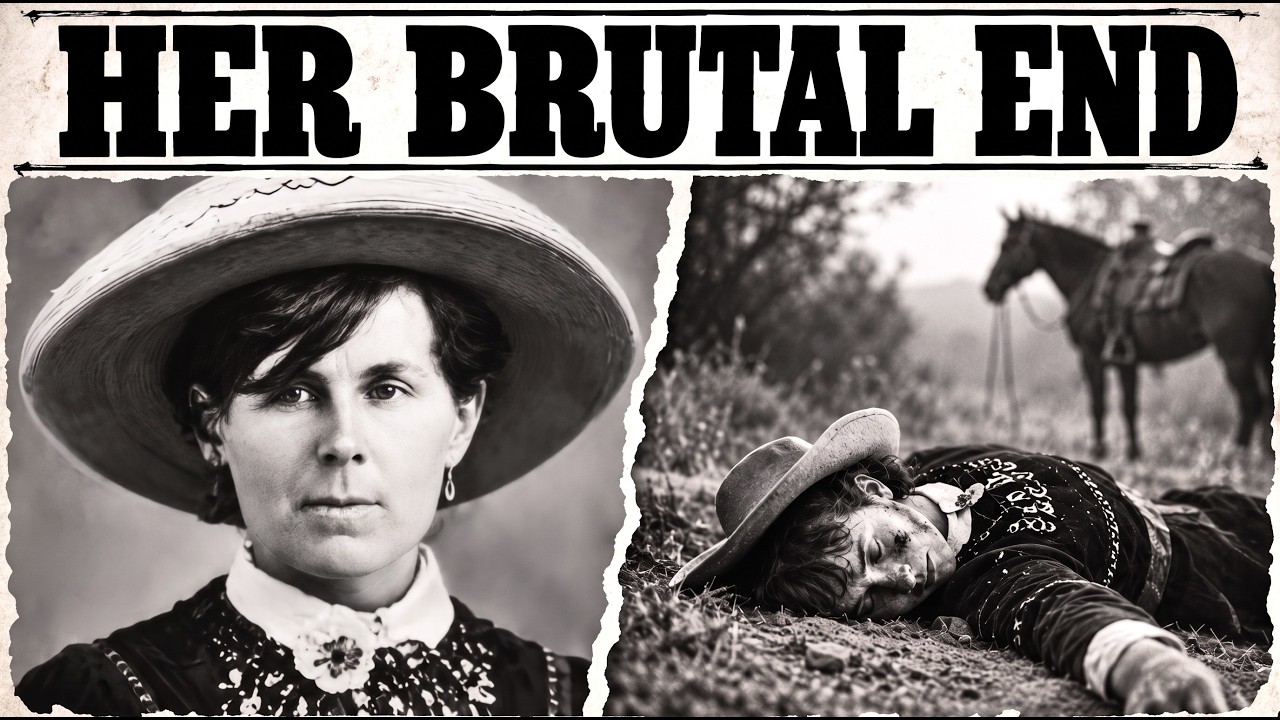
Belle had been hit from behind by a shotgun blast, knocked from the saddle, and then struck again after she fell. She was still alive when Pearl reached her, but not for long. There was one thing Pearl could not get from her. A name.
Belle Starr died without identifying the person who shot her. She was forty years old, two days short of her forty-first birthday. The newspapers already knew what to call her: Bandit Queen, Outlaw Queen, the female Jesse James. But there was a problem with the legend.
The woman lying in the grass was more complicated than the name attached to her. And the crime that ended her life was never solved. There were suspects. There were motives.
There was a man the family openly accused. There was even an arrest and a trial. No conviction. And the more closely you look at the case, the stranger the ending becomes.
Belle had spent years surrounded by men who robbed, rustled, killed, and disappeared into Indian Territory. She had enemies. She had family conflicts. She had a husband in legal trouble.
She had a tenant she was fighting with over land. Almost everyone around her gave history a reason to suspect them. Only one question survived all of them. Who actually pulled the trigger?
To answer that, you have to go back before the black riding clothes, before Younger’s Bend, before the newspapers turned her into a character. Her name was Myra Maybelle Shirley. She was born in Jasper County, Missouri, on February 5th, 1848. The version of Belle Starr that later sold dime novels makes it easy to imagine a child raised in an outlaw camp.
That is not what the early record shows. Her family had money by frontier standards. Her father, John Shirley, raised horses and operated businesses around Carthage. Belle received schooling.
She learned music. Later accounts describe her studying French and Latin and becoming a capable pianist. She also became an excellent writer. That matters because the first Belle Starr was not built around desperation.
She came from a family trying to live respectably in one of the worst places in America to be respectable. Southwestern Missouri sat directly beside the Kansas border. By the late 1850s and early 1860s, the region was tearing itself apart. Long before the Civil War officially began, guerillas, militias, anti-slavery fighters, pro-slavery fighters, thieves, and men using politics as cover for private revenge were already moving through the countryside.
Belle’s family was southern in sympathy. Her older brother, Bud, was pulled toward the Confederate guerilla world. And then the war arrived and destroyed the stable life around them. Carthage became a battlefield.
Businesses failed. Families fled. Men disappeared into armed bands where the line between soldier, guerilla, and criminal could become very thin, depending on who was writing the newspaper. Bud Shirley was eventually killed.
For Belle, the war did not create some instant outlaw queen. It did something more important. It erased the ordinary future her family had been building. That is the first thing to keep in mind.
The legend likes to begin with a woman who chose crime because crime was exciting. The evidence gives us a woman whose world was already full of armed men, broken institutions, and personal loss before she was twenty. After the war, the Shirley family moved south into Texas. There, Belle reconnected with James Reed, a man with his own links to former Confederate guerillas.
They married on November 1st, 1866. Belle was eighteen. Their daughter, Rosie Lee, better known as Pearl, was born in 1868. Their son, James Edwin, followed in 1871.
For a time, this could still have become a conventional family story. It did not. Jim Reed moved deeper into criminal activity. He became associated with robbery and outlaw networks.
Belle’s own exact role is harder to pin down than later legend claims. The surviving record does not support the idea that she rode beside him in every robbery later attributed to the couple. What it does show is that she was living inside the network. She knew the people.
She benefited from some of the protection. She moved through the same world. And eventually she separated from Reed as his life became more dangerous. In 1874, law officers killed Jim Reed while he was resisting arrest.
Belle was twenty-six years old with two children and a name increasingly connected to men wanted by the law. That was when biography began turning into reputation. The people around Belle mattered almost as much as anything Belle herself did. The Younger Brothers, the James Circle, men from the wartime guerilla world, cattle thieves, horse thieves, fugitives moving through Texas and Indian Territory.
Later writers would take association and convert it into participation. If Belle knew a robber, she must have planned robberies. If an outlaw stayed near her property, she must have commanded an outlaw gang. If she wore a pistol, she must have been a gunfighter.
That is how legends grow. They do not always invent from nothing. They take a real connection and remove every limit around it. Belle’s next major step placed her in exactly the kind of geography where that could happen.
On June 5th, 1880, she married Sam Starr. Sam was Cherokee, a member of the Starr family in Indian Territory. Belle and Sam settled at a place that became known as Younger’s Bend, near the Canadian River. This was not simply a romantic outlaw hideout on the edge of civilization.
Indian Territory had a complicated legal structure. Tribal governments exercised authority over their own citizens. Federal courts handled specific offenses and cases involving non-Indian defendants. Deputy marshals from Fort Smith rode huge distances trying to serve warrants in country where a suspect could disappear across jurisdictions, families, and communities that did not necessarily trust federal officers.
For fugitives, those gaps could be useful. For law officers, they were a nightmare. For Belle, Younger’s Bend became home. It also became part of the outlaw mythology.
The cabin was associated with men avoiding the law. Belle and Sam were accused of sheltering fugitives and handling stolen property. Some accusations were probably true in substance. Others expanded with every retelling.
But one fact is more useful than the legend. Belle Starr’s only clearly documented criminal conviction was for horse theft. In 1883, Belle and Sam came before the federal court at Fort Smith. Judge Isaac Parker is remembered as the hanging judge, but this case did not end at the gallows.
Belle and Sam were convicted of stealing horses. Belle received a sentence of one year in the Detroit House of Corrections. That conviction matters because it gives us solid ground. We do not need to pretend Belle was innocent of everything.
She was convicted. She served time. What we do need to reject is the leap from one documented conviction to the later image of a criminal mastermind running a frontier empire. The National Park Service, which preserves the Fort Smith court story, puts the point plainly.
Belle was later romanticized as a bandit queen or a female Robin Hood. But the reality was much less theatrical. That difference between record and legend is where this story gets interesting. The Detroit sentence also gives us something the outlaw stories rarely give Belle.
A period where the government could actually observe her closely. She was not disappearing into a canyon or hiding under another name. She was in custody inside an institution, living under rules made by people who had no reason to protect her mythology. Later accounts of her imprisonment describe a woman who adapted quickly.
She was older than the reckless girl imagined by the dime novels, and already a mother of two. She could present herself well. She could be disciplined when discipline served her. That matters because it shows the same quality that appears again and again in her life.
Belle could move between worlds. She could sit with people wanted by federal marshals and then stand in a federal courtroom. She could live at a place associated with fugitives and still maintain relationships with neighbors who did not see her only as a criminal. She could wear a pistol and ride hard, then present herself as a respectable woman when respectability was useful.
That flexibility may explain more about her survival than any story about commanding an outlaw army. When Belle left prison, the reputation followed her home. But notice what did not happen. There is no documented explosion into some larger criminal enterprise.
She did not emerge from Detroit and begin robbing banks across the territory. The image grew faster than the record. That gap would become permanent. It also changes how we should read Younger’s Bend.
The place is often described as if it were a frontier headquarters with Belle at the center, assigning jobs and hiding loot. The historical record supports something less cinematic and more plausible. Outlaws moved through the area. Belle knew them.
Some were relatives or friends. Some used the isolation of the territory to avoid officers. The Starr household could be useful to people who needed food, horses, information, or somewhere to sleep. That does not require Belle to be the queen of anything.
It requires a household embedded in a network. And networks are harder to prosecute than legends make them look. A federal marshal could arrest one man. He could not arrest every cousin, neighbor, rancher, trader, and relative who made movement through the territory possible.
That was the world Belle returned to. Then in 1886, another arrest brought Belle and Sam back under suspicion in a case involving robbery, horse theft, and harboring fugitives. The case did not produce another conviction. That distinction matters.
The woman, now famous for criminality, was being watched, accused, and written about, but accusations were still not proof. Then Sam died, and with his death, the structure holding Belle’s life together changed again. This time there was no prison sentence to serve and return from. There was a property problem, a family problem, and a future suddenly dependent on who could legally belong on the land where she had built her home.
The marriage had not been peaceful. The world around them was still violent, and Sam had enemies of his own. In 1886, Sam Starr was killed during a dispute in which he and another man shot each other. Belle was a widow again.
This death created a problem that does not fit neatly into outlaw mythology. Land. Belle was a white woman living on communal Cherokee land through her relationship with Sam. After his death, maintaining her place there became more complicated.
She eventually formed a relationship with another Cherokee man, Jim July Starr, sometimes called Bill July. He was younger than Belle. Later accounts portray the relationship in different ways. Some describe affection.
Others emphasize convenience, especially the legal and practical value of remaining connected to Cherokee land through a Cherokee husband. What matters for the murder case is that Jim July was part of Belle’s household by the final years of her life. And those years may have been quieter than the legend wants. The Encyclopedia of Arkansas notes that Belle increasingly presented herself as finished with fugitives.
Neighbors remembered acts of help. She traveled to Fort Smith. She posed for photographs. She talked about having seen a great deal of life.
That does not erase the outlaw associations. It complicates them. By her late thirties, Belle had already lost two husbands to violent deaths. She had served time in prison.
Her children were grown or nearly grown. Her name was known far beyond the amount of criminal evidence attached to it. She had every reason to want stability. Stability did not come.
Her household had tension. Her son Eddie had his own temper and his own future problems with the law. Later writers would make much of supposed bitterness between mother and son. Some went further and accused Eddie of murdering her.
The problem is that the strongest modern historical treatment does not support the dramatic version of an estranged son finally killing his mother. The same thing happens with Jim July. A suspicious husband is useful in any murder story, especially one involving a violent household. But on the day Belle died, Jim July was not hiding in the trees beside the Canadian River.
He was dealing with legal trouble of his own. And that is where the final weekend begins. In early February 1889, Jim July was expected to turn himself in at Fort Smith. Belle traveled part of the way with him.
Then she turned back toward Younger’s Bend. That decision placed her alone on the road home. She stopped along the way. Accounts differ on the exact nature of the gathering, with some describing a party or visit among neighbors.
One man linked to that gathering matters more than the others. Edgar Watson. Watson was connected to land Belle controlled. He wanted to farm property associated with her.
Their relationship had become hostile. According to later historical reconstructions, Belle learned enough about Watson’s violent background to want him gone. He resisted. Words were exchanged.
Threats were remembered. The exact details change depending on the source. The conflict itself is much harder to dismiss. Watson had motive.
He had proximity. And on February 3rd, he was close enough to become the central suspect after Belle was dead. Now the opening scene comes back into focus. Belle is riding toward home.
It is winter. The day is fading. She is close to Younger’s Bend. The first shotgun blast comes from behind.
It knocks her from the horse. This was not a face-to-face gunfight. She did not have time to square off with an attacker. Whoever fired had chosen concealment and surprise.
Then comes the second shot. Accounts describe the killer moving closer and firing again after Belle was down. That second blast is important. The first shot could be explained as an ambush meant to stop her.
The second looks like certainty. Whoever did this did not want Belle merely wounded. The horse breaks away and heads home. Pearl eventually follows the blood and finds her mother.
Belle is still alive. She cannot give Pearl the answer history wants. She dies there. The woman later sold as the terror of the plains is not killed in a bank robbery or a gunfight.
She dies on the road to her own house. And almost immediately, the suspect list begins expanding. Start with Jim July. A husband always attracts attention.
The relationship had complications. The household had arguments. Later, sensational accounts could easily turn those into motive. But the timing works against the accusation.
Jim July was in or around Fort Smith dealing with the legal matter that had taken him away from Younger’s Bend. Modern historians examining the case do not treat him as the strongest candidate. That does not make every minute of his whereabouts perfectly documented by modern standards. It makes the easy husband theory weaker than the legend suggests.
Then there is Eddie. Belle’s son had his own conflict with his mother. Stories developed about arguments, discipline, horses, and resentment. But again, later repetition gave the theory more confidence than the evidence deserves.
Oklahoma historians who have revisited the murder specifically reject the idea that Belle and Eddie were simply estranged in the dramatic way later stories require. The son theory survives because it is emotionally shocking. That is not the same as being evidentially strong. Other names have floated around the case.
Former lovers. Outlaws with grudges. Men Belle might have threatened to expose. People who had passed through Younger’s Bend and had reasons to fear what she knew.
This is one reason unsolved frontier murders become difficult to untangle. A famous person accumulates enemies in memory faster than investigators can prove enemies in documents. Every later story adds one more man who supposedly had a reason. But motive is cheap.
Opportunity is harder. Physical evidence is harder still. That brings us back to Edgar Watson. Watson was not just another famous outlaw name attached later because it sounded good.
He was a local conflict. He had been involved in a dispute with Belle over land. He had allegedly threatened her. He was near the social circle Belle had visited before the murder.
And later accounts say tracks near the scene were consistent with a shoe size associated with him. That last point sounds powerful. Treat it carefully. This was 1889.
There was no modern crime scene preservation, no DNA, no standardized footwear database, no controlled forensic chain turning a bootprint into an identification. A similar shoe size is evidence of possibility, not identity. But when you place it beside the dispute, proximity, and threats, Watson becomes much harder to ignore. The family did not ignore him.
At Belle’s funeral, Watson appeared. That is one of the strangest scenes in the entire case. Belle is buried near her home at Younger’s Bend. People gather around the grave, and the man some of them already suspect arrives.
Jim July confronts him. According to later accounts, the accusation is direct. You killed Belle. Watson is seized and taken toward Fort Smith.
For a moment, the case appears to have its ending. A dead woman, a hostile tenant, threats, possible tracks, a family accusation, a prisoner. But a suspect is not a conviction. And in the federal court system, the evidence had to become more than community certainty.
There was no reliable eyewitness who could stand up and say, I saw Edgar Watson behind that gun. The tracks did not identify him beyond dispute. Threats showed hostility, not the act itself. The case could tell a jury why Watson might have killed Belle.
It could not conclusively prove that he did. Watson got out from under the accusation. That is the hinge the legend usually skips. The strongest suspect did not vanish into the hills.
He was brought into the legal system. The system still could not prove the case. There is one more problem with the evidence against Watson. The crime scene did not wait for investigators.
People moved through it. Family members followed the horse. Neighbors gathered. The body had to be brought home.
Tracks that sound decisive in later retellings were not protected in the way a modern homicide investigator would expect. Nobody sealed off the ground and photographed every impression before another boot crossed it. That does not make the tracks meaningless. It changes their weight.
The same is true of threats. Frontier communities were full of remembered threats after a killing. Some had been heard directly. Others were repeated by people who had heard them from someone else.
Once a suspect’s name became common, every previous argument could suddenly look prophetic. The responsible question is not, did Watson ever say something threatening. The responsible question is, can the threat be tied closely enough to the murder to prove action? That is where the case fails.
And that failure helps explain why the family could feel certain while a court could remain unconvinced. A family does not need the same standard as a jury. Pearl did not have to ask whether every link in the chain would survive cross-examination. Jim July did not have to ask whether a bootprint had been preserved correctly.
They had buried Belle. They knew who she had been fighting with. They knew what Watson’s reputation was. They could reach a human conclusion long before a prosecutor could reach a legal one.
Those two kinds of certainty are not the same. The tragedy is that more than a century later, they are still often treated as if they were. Watson left the area. Years later, his name became attached to much darker violence in Florida.
He developed a notorious reputation there and died violently in 1910 after conflict with people in his own community. It is tempting to work backward from that ending. A violent man later accused of other killings seems like a perfect answer to Belle Starr’s murder. But that is exactly how bad history gets made.
A later crime does not retroactively prove an earlier one. Watson can be the strongest suspect without becoming the proven killer. Those two statements can exist together. And if we stop there, Belle’s murder remains unsolved for a very specific reason.
Not because there were no suspects. Because the gap between suspicion and proof never closed. That gap becomes even more important when you look at Belle’s reputation after death. In life, Belle was known.
In death, she became a product. The press had already been turning Western criminals into entertainment. Dime novels and sensational papers understood that a woman associated with famous outlaws sold better than a complicated ranch resident with one documented horse theft conviction. Her murder made the story irresistible.
An outlaw queen shot from ambush. No killer. A grave in Indian Territory. Every part of it invited invention.
Writers filled the empty spaces. They exaggerated robberies. They upgraded associations into gang leadership. They hardened costumes into a permanent persona.
They made her more beautiful, more dangerous, more romantic, or more cruel, depending on what the audience wanted. And the unsolved murder became proof of the legend. Surely, a woman murdered so dramatically must have lived dramatically enough to deserve it. That logic is backwards.
Her death helped create the version of her life people later assumed had always been true. The National Park Service calls the romantic bandit queen image inaccurate. The Oklahoma Historical Society notes that her only documented crime was horse theft. That does not mean Belle lived a lawful life surrounded by innocent people.
She did not. She associated with criminals for years. Her home was linked to fugitives. Her husbands lived in violent networks.
She was convicted and imprisoned. The correction is not that Belle Starr was secretly a saint. The correction is that history has to distinguish between what she did, what the people around her did, and what publishers later needed her to have done. Her murder is the perfect example.
Edgar Watson may have killed her. Her son may have had anger toward her. Jim July may have had a complicated marriage with her. Former associates may have feared her.
But one by one, the certainty disappears when you ask for proof. The same thing happens when you ask what Belle actually controlled in the outlaw world. Reputation expands. Evidence narrows.
There is another layer here that is easy to miss. Belle Starr’s story sits inside competing systems of law. Missouri border violence shaped her childhood. Texas outlaw networks shaped her first marriage.
Indian Territory gave fugitives jurisdictional opportunities. The federal court at Fort Smith reached into that world through deputy marshals. Cherokee land and marriage rules shaped where Belle could live after Sam Starr’s death. And when she herself was murdered, those overlapping institutions still could not produce a proven killer.
The law was not absent from Belle Starr’s life. It was everywhere. It convicted her. It imprisoned her.
It arrested people around her. It pursued her husbands. It summoned Jim July. And when Belle became the victim, it reached its limit.
That is a more interesting story than Bandit Queen. The person who had spent years on the wrong side of warrants became the subject of a homicide case, and the machinery that had successfully sent her to prison could not identify who killed her. After Belle’s death, her family did not settle into some clean epilogue. Jim July’s own life ended violently not long afterward.
Pearl survived and built a life that later became controversial in its own right. She worked in Fort Smith and became associated with a brothel, but she also maintained the memory of her mother. Eddie eventually wore a badge for a time, an irony in a family so closely linked to outlaws, and his own life ended violently. The people around Belle continued crossing the same lines between law, crime, family, and survival that had defined the frontier.
And Belle stayed at Younger’s Bend. Her grave became the physical center of the legend. The stone bears symbols associated with her name and her life. Visitors come because the bandit queen is easier to remember than Myra Maybelle Shirley.
But stand at the story from the other direction and something changes. The most important fact at that grave is not the nickname. It is the absence beside it. No convicted killer.
No final confession. No document that closes the case. More than a century later, modern historians can narrow the field. They can tell us which theories are weaker than they look.
They can point to Watson as the suspect who stands out. They can reconstruct the land dispute. They can place Jim July away from the scene. They can question the exaggerated story about Eddie.
They can explain how newspapers turned one conviction and a lifetime of outlaw associations into a criminal empire. What they cannot do is give Pearl the answer her mother could not give her in the grass. And that is where Belle Starr’s real story becomes more powerful than the legend. The legend says she was an outlaw queen because she lived above the law.
The record says she lived inside a world where law, politics, race, tribal jurisdiction, federal power, family loyalty, and crime overlapped so heavily that no one label could hold her. The legend says a woman like that must have died because of some grand outlaw feud. The record gives us a shotgun in the dark and a short list of people who might have fired it. The legend wants Edgar Watson guilty because a mystery feels better when it has a villain.
The record stops one step earlier. Strongest suspect, not proven killer. That difference is the whole point. There is a temptation with the Old West to think uncertainty is a weakness.
It is not. Sometimes uncertainty is the most honest surviving fact. Belle spent her life having other people turn her into what they needed. A Confederate girl.
An outlaw’s wife. A horse thief. A bandit queen. A frontier celebrity.
A warning. A fantasy. After her death, they tried to do the same thing to the murder. Every generation selected a suspect and made the story cleaner.
But the road home on February 3rd, 1889 never became clean. A horse arrived without its rider. Pearl followed the blood back. Belle was still alive, but the one name that could have ended the argument never came.
The horse found its way home. The answer did not.
