On May 15, 1911, the Supreme Court of the United States delivered a ruling that shattered the most powerful monopoly in American history. The Standard Oil Trust, the creation of John D. Rockefeller, was found to be in violation of the Sherman Antitrust Act of 1890. The court ordered the empire to be dissolved into 34 independent companies within six months.
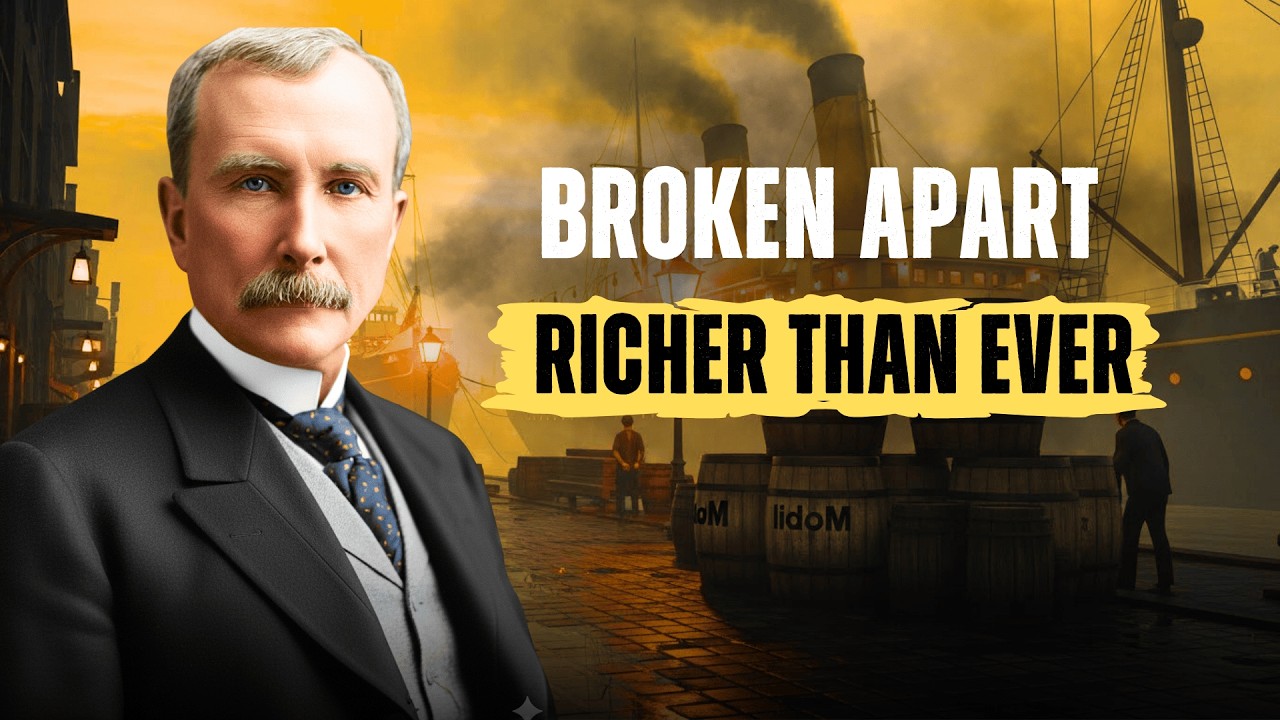
The decision was intended to dismantle a monopoly that controlled roughly 90 percent of America’s petroleum refining capacity. Yet the breakup did not destroy the Rockefeller fortune. Instead, it unleashed a constellation of successor firms—corporate ancestors of Exxon, Mobil, Chevron, and others—that continued to shape the global economy for generations. And the dissolution itself made the Rockefeller family richer than ever, catapulting John D.
Rockefeller to the status of the world’s first true billionaire. To understand this paradox, one must trace the forces that created Standard Oil and the man who built it. John Davidson Rockefeller was born on July 8, 1839, in the small hamlet of Richford, New York. His family traced its roots to early eighteenth-century German immigrants who arrived in North America around 1723.
His father, William Avery Rockefeller, was an itinerant salesman who posed as a botanic physician, peddling fake herbal remedies across the countryside. The primary ingredient in his miracle potions was raw petroleum—an irony of history, since the same liquid would later build his son’s empire. William was also a con artist who loaned money at usurious rates to desperate farmers and faced legal troubles, including an indictment for sexual assault. He taught his son harsh lessons, once encouraging the boy to jump into his arms only to step back and let him fall, telling him he wanted to make him sharp.
John’s mother, Eliza Davidson, was a devout Baptist who instilled in her son a strict religious faith and a disciplined, frugal approach to life. The family moved frequently, settling in Moravia and later in Strongsville, Ohio. John’s father was often absent, and the household was burdened by financial anxiety. By the early 1850s, William Rockefeller had taken up a bigamous marriage with a teenager in Canada while maintaining his first family in Ohio.
In May 1855, he abruptly ordered John to leave school and find work. After completing a commercial course, John began his job search. On September 26, 1855, he was hired as an assistant bookkeeper by the merchant firm of Hewitt and Tuttle in Cleveland. He celebrated that date as Job Day for the rest of his life.
Rockefeller quickly proved himself a meticulous, tireless worker. He arrived at the office at 6:30 each morning and often worked until late at night. He kept a personal ledger tracking every penny of income and expenditure, and he began tithing to charitable causes. He later established his own trading partnership with Maurice B.
Clark, dealing in commodities. During the American Civil War, Rockefeller avoided military service by paying substitutes to take his place, while his younger brother Frank enlisted and was wounded twice. The war disrupted traditional north-south trade but greatly benefited east-west commerce through Cleveland, and Rockefeller profited handsomely. By the early 1860s, the nascent petroleum industry was exploding.
In 1859, Edwin Drake had struck oil near Titusville, Pennsylvania, sparking a frenzied boom. Kerosene, refined from petroleum, was emerging as a cheap and reliable lamp fuel, replacing the dwindling supply of whale oil. In 1863, Rockefeller, Clark, and Clark’s brothers formed a partnership with Samuel Andrews, a skilled mechanic, to build an oil refinery. The Excelsior Oil Works, located near the newly constructed railroad line connecting Cleveland to the Pennsylvania oil fields, proved explosively profitable from its first year.
Rockefeller saw enormous potential where others saw a speculative gamble. The cautious Clarks resisted his plans for aggressive expansion, and in January 1865, the partnership was dissolved by auction. Rockefeller outbid his rivals by a slim margin of $500 and took control of the refinery with Andrews as his technical partner. Over the following years, Rockefeller pursued a strategy of ruthless efficiency and vertical integration.
He owned his own forests for barrel-making, built his own plants for sulfuric acid, and controlled his own transport. By 1869, his partnership was the largest oil refiner in the world, employing nine hundred workers and producing 1,500 barrels daily—about 10 percent of global output. In 1870, the business was incorporated as the Standard Oil Company of Ohio, with Rockefeller as president. His brother William managed operations, and Henry Flagler, an experienced merchant, handled negotiations with the railroads.
Transportation was the single largest cost in refining, and Rockefeller played the competing railroads against one another to secure secret rebates. He secured a deal with the Lakeshore Railroad, offering sixty carloads of oil per day in exchange for preferential rates. Even the legendary Cornelius Vanderbilt traveled to Cleveland to meet the young refiner rather than summon him. Rockefeller viewed competition as wasteful and destructive.
He famously believed that competition was a sin, and he set out to impose order on the chaotic oil industry through total control. In late 1871, he joined a secret alliance with the Pennsylvania, Erie, and New York Central railroads. The scheme, known as the South Improvement Company, proposed doubling freight rates for all shippers while offering rebates to favored refiners. More controversially, Rockefeller demanded drawbacks—a percentage of the freight charges paid by his competitors.
Every time a rival shipped a barrel of oil, it unknowingly subsidized its own destruction. When news of the scheme leaked in early 1872, it provoked outrage among independent producers. But Rockefeller responded by accelerating his consolidation campaign. Between December 1871 and March 1872, in what became known as the Cleveland Massacre, Standard Oil systematically purchased twenty-two of its twenty-six local rivals.
Rockefeller used his immense efficiency and financial leverage to force competitors to sell at rock-bottom prices. Many were ruined; some nursed bitter resentment for the rest of their lives. The collapse of the South Improvement Company did not stop Rockefeller’s expansion. He abandoned cooperative arrangements with producers after they repeatedly violated production quotas, concluding that only total control could stabilize the market.
The Panic of 1873 triggered a depression, but Standard Oil remained profitable, and Rockefeller used the crisis to acquire rival refineries in Pittsburgh, Philadelphia, and New York. By the late 1870s, Standard controlled virtually the entire national pipeline system and 90 percent of America’s refining capacity. Its tentacles reached into steel, copper, shipping, and politics. Critics nicknamed it the Octopus.
The legal structure of the empire was cumbersome. Since many states forbade companies from owning subsidiaries across state lines, Standard Oil operated as a network of 41 nominally separate companies. In 1882, the company’s lawyers devised the Standard Oil Trust, appointing nine trustees to centrally manage the interests of its 37 stockholders. This was a foundational innovation in American corporate history, providing a template for centralized control over decentralized assets.
Other industries quickly followed, and the word trust became synonymous with unchecked monopoly power. By the 1880s, Rockefeller had moved his family to New York City, and the corporate headquarters was established at 26 Broadway in lower Manhattan. Despite his enormous wealth, he maintained a low public profile, limiting his social activities largely to the Fifth Avenue Baptist Church. He gave generously to educational institutions, supporting schools for women, African Americans, and Native Americans.
In 1889, he pledged $600,000 for the establishment of the University of Chicago. He also faced mounting public criticism. Journalists like Henry Demarest Lloyd and later Ida Tarbell exposed Standard’s secret rebates, industrial espionage, and predatory pricing practices. Congress passed the Sherman Antitrust Act in 1890, and in 1892, the Ohio Supreme Court ordered the Trust dissolved.
Rockefeller simply restructured, establishing Standard Oil of New Jersey as a powerful holding company that maintained centralized control. In 1897, Rockefeller officially delegated command of Standard Oil to John D. Archbold, though he retained the title of president and a controlling stake. He devoted increasing attention to philanthropy, establishing the Rockefeller Institute for Medical Research in 1901 and pioneering the structure of modern charitable trusts.
His public image continued to suffer, particularly after Ida Tarbell’s damaging exposé was published in McClure’s magazine between 1902 and 1904. Federal and state governments filed a growing number of lawsuits against Standard Oil. In 1907, a federal judge levied a massive fine of over $29 million against the company for illegal railroad rebates, though the judgment was overturned on appeal. In 1909, a circuit court ordered Standard to break up for violating the Sherman Act, and the company appealed to the Supreme Court.
On May 15, 1911, the Court dismissed the final appeal, giving the trust six months to disband. At the time of dissolution, Standard Oil controlled roughly 14 percent of the crude oil supply and 70 percent of the refined oil market. Rockefeller resigned as president of Standard Oil of New Jersey, which remained the largest single entity retained by the family. Shareholders received proportional stakes in the 34 successor companies.
The breakup had an unexpected consequence: for the first time, the American public could buy Standard Oil stock, and shares skyrocketed. Rockefeller’s net worth soared, making him officially the world’s first billionaire by 1916. The dissolution did not end the Rockefeller dynasty. In 1913, Rockefeller proposed the creation of the Rockefeller Foundation, chartered by New York State, and contributed $183 million to it, focusing on public health and medical education worldwide.
His son, John D. Rockefeller Jr. , managed the family’s investments and devoted himself to philanthropy. He oversaw the construction of Rockefeller Center in the 1930s.
The family’s political influence expanded in later decades, with Nelson Rockefeller serving as governor of New York and vice president of the United States, and other family members holding governorships and Senate seats. The Rockefeller name became so powerful that it even attracted impostors; a German criminal posed as Clark Rockefeller for decades, infiltrating high society until his identity was exposed in 2008. John D. Rockefeller died on May 23, 1937, a few weeks short of his 98th birthday.
All the former Standard companies around the world halted work to observe five minutes of silence. He was buried in Cleveland beneath a seventy-foot obelisk, then the largest funeral monument in America. His legacy remains deeply contested. He built an empire so vast that the federal government intervened to break it apart, yet the family fortune survived and multiplied, transformed from a nineteenth-century monopoly into a blueprint for generational wealth.
In 2020, the Rockefeller Foundation, whose wealth was born from oil, announced it would divest its $5 billion endowment from all fossil fuel investments, citing a moral responsibility to the environment. The man who built the Octopus had, in the end, founded a dynasty that learned to evolve.
