The Cotton Club doorman, a large man everyone called Big Tiny, stood with his arms crossed and stared at a spot somewhere above Helen Lawrenson’s head. She had joked with this man a dozen times, smiled at him, slipped him folded bills so the best table would be waiting. Now he did not move. He did not blink.
“Hellooo, Tiny,” Helen said, flashing her brightest, most confident smile. Tiny did not look down. He acted as if she were a ghost, an invisible entity that occupied no space in his world. “I’m here to see Bumpy,” she said, her voice faltering slightly.
“Is he inside? ”
Finally, Tiny looked at her. There was no warmth in his eyes. There was no recognition.
“Private party tonight, miss,” he said, his voice flat, emptied of the friendly banter they used to share. But the sign said open. Helen pointed to a couple walking past them through the door. People were going in.
“Private party,” Tiny repeated, and stepped slightly to the left, physically blocking the entrance. It wasn’t a violent move. It was absolute. He was a wall, and walls don’t negotiate.
This was how the king of Harlem punished a woman who had insulted his wife. Not with a beating, not with a bullet. With a whisper that turned an entire neighborhood into a fortress she could never breach. To understand the magnitude of what was happening to Helen Lawrenson that night, you first had to understand the world she had walked into.
In the winter of 1932, Harlem was not just a neighborhood. It was a separate planet orbiting the rest of New York City. To the outside world, it was the black Mecca, a place of rhythm and soul and exotic danger. To the people living inside the red brick tenements, it was a hardscrabble battleground where dignity was the most expensive commodity on the shelf.
But if you looked past the poverty, past the breadlines of the Great Depression, and past the police patrols that treated the streets like occupied territory, you would find a royal court. There were kings in Harlem. There were dukes and earls of the underworld who wore tailored Italian suits instead of crowns and carried switchblades instead of scepters. Sitting at the very top of that hierarchy, casting a shadow that stretched from 110th Street to the horizon, was Ellsworth Bumpy Johnson.
They called him the professor because he read Nietzsche and played chess. They called him the godfather because he fed the hungry when the government wouldn’t. He didn’t just run the numbers racket. He curated the chaos of Harlem.
He understood that power wasn’t just about violence. It was about perception. It was about walking into a room and having the music stop, not because you told it to, but because the musicians were afraid to miss a word you might say. He had survived wars with Dutch Schultz.
He had outsmarted the NYPD. He had carved out an empire in a country that didn’t even want him to own property. But every emperor has a blind spot. Every fortress has a crack in the wall.
For Bumpy Johnson, that crack wasn’t a rival mobster or a snitch. It was a woman. And this is the story of how that woman almost brought the king of Harlem to his knees. Not with a gun, but with a whisper.
To understand the disrespect that was about to occur, you first had to understand the woman standing beside the throne. Mayme Hatcher Johnson. In the history books, she is often listed simply as the wife. But in the streets of 1930s Harlem, Mayme was an institution.
She wasn’t just a gangster’s moll who wore fur coats and looked the other way. She was the steel spine of the Johnson operation. She was the kind of woman who could host a dinner for the black elite on a Friday night, charming doctors and lawyers with her grace, and then help Bumpy count the illegal lottery profits on a Saturday morning without blinking an eye. She knew the game.
She knew her husband was a dangerous man who lived by the sword. She accepted that. She accepted the late nights. She accepted the danger.
But she had one rule, one unwritten covenant that held their marriage together: the streets stay in the streets, and the home stays sacred. You never bring the dirt to the doorstep. And you never, ever let an outsider look down on the family. For years, that covenant held strong.
Bumpy respected Mayme more than he respected any man with a badge or a gun. He knew she was the only person in the world who loved Ellsworth, the man, and not just Bumpy, the legend. But in 1932, the devil came to Harlem. And she didn’t come wearing horns.
She came wearing a silk dress, holding a cigarette holder, and carrying a press pass from Vanity Fair magazine. Her name was Helen Lawrenson. Helen Lawrenson was everything Mayme Johnson was not. She was white.
She was wealthy. She was a celebrated editor and writer from downtown Manhattan who treated life like a grand adventure. In the 1930s, there was a popular pastime among New York’s white elite called slumming. Rich folks from Fifth Avenue and the Upper East Side would take taxis uptown to Harlem late at night.
They wanted to see the real life. They wanted to drink bootleg whiskey in jazz clubs, watch the dancers at the Savoy, and rub elbows with the dangerous characters of the underworld. They treated Harlem like a human zoo, a place to visit for a thrill before retreating to the safety of their penthouses. Bumpy Johnson usually despised these tourists.
He saw them for what they were: voyeurs who looked at his people like exhibits. But he tolerated them because their money was green and their influence kept the police off his back. Helen Lawrenson, though, was different. She wasn’t just a tourist.
She was a predator of stories. She was intelligent, sharp-tongued, and sexually liberated in a way that was shocking for the era. She didn’t come to Harlem to gawk. She came to conquer.
She wanted to understand the mind of a criminal genius. And when she locked eyes with Bumpy Johnson across the smoke-filled room of the Alhambra Bar and Grill, she decided he would be her next subject. And perhaps her next conquest. The attraction between Bumpy and Helen was instantaneous and toxic.
It wasn’t just physical. It was intellectual. Bumpy was starved for conversation that went beyond gambling odds and turf wars. Helen could quote Shakespeare.
She could debate philosophy. She looked at him not as a thug, but as a fascinating specimen of raw power. For a black man in 1932, having a beautiful, high-society white woman hanging on his every word was a dangerous ego boost. It was a status symbol.
It was a way of flipping the script on a racist society. The white man runs the country, but I have the white man’s woman. It was a trap. And Bumpy walked right into it with his eyes open.
They began to be seen together everywhere. If Bumpy had kept the affair in the shadows, hidden away in downtown hotels or private apartments, it might have been just another secret in a city full of them. But Helen didn’t do secrets. She thrived on attention.
She wanted to be seen on the arm of the most dangerous man in New York. She started showing up at Bumpy’s favorite spots, the clubs where everyone knew his name and, more importantly, where everyone knew his wife. She would sit in his booth, drinking his liquor, laughing too loudly, acting as if she owned the place. She was marking her territory.
The whispers began immediately. In the beauty parlors on 125th Street, in the barbershops on Lenox Avenue, the talk was all the same. Have you seen Bumpy’s new girl? The white reporter?
She thinks she’s the queen of Harlem now. The disrespect was palpable. It wasn’t just that Bumpy was cheating. It was who he was cheating with.
He was parading an outsider, a woman who represented the very system that oppressed Harlem, right in front of the community that looked up to him. And by extension, he was publicly humiliating Mayme. Mayme heard the whispers. Nothing happened in Harlem that Mayme didn’t know about within an hour.
But Mayme was a strategist. She didn’t scream. She didn’t throw plates. She didn’t pack a bag and leave.
She knew a reaction was exactly what Helen wanted. Helen Lawrenson viewed life as a dramatic play, and she wanted a scene. She wanted the angry wife to storm in so she could play the role of the sophisticated modern muse who was above such petty jealousy. Mayme refused to give her the satisfaction.
She waited. She watched. She knew Bumpy was infatuated, and fighting him directly would only push him closer to the mistress. She needed Bumpy to see Helen for what she really was: a liability.
But Helen, mistaking Mayme’s silence for weakness, began to push the envelope. She got comfortable, too comfortable. She began to believe her own hype. She convinced herself she wasn’t just a mistress, but a partner.
She thought she understood Bumpy’s world because she wrote about it. She thought she was down. There is a famous story from this period that should have served as a warning to her. One night, Bumpy and Helen were dining at a club when a man named Rollins, a local hustler who had a beef with Bumpy, made the mistake of approaching their table.
He was drunk, and he said something foul. In a split second, the intellectual Bumpy vanished and the gangster appeared. Bumpy pulled his blade, the knife that gave him his reputation, and gutted the man right there on the floor in front of Helen. Blood splattered onto the tablecloth.
The music stopped. The room froze. Most women from Vanity Fair would have fainted. Most would have run screaming to the police.
Helen Lawrenson just watched. She later wrote that she found the violence hypnotic. She stayed and finished her drink while they dragged the body out. She thought this proved she was tough.
She thought this proved she belonged. But she missed the point entirely. She saw the violence as theater. She didn’t understand that for Bumpy and for Mayme, this wasn’t a show.
It was survival. Her detachment was a sign of her privilege. She could watch a man bleed and call it exciting because she knew that at the end of the night, she could take a taxi back to her safe doorman building downtown. She was a tourist in a war zone taking pictures of the wounded.
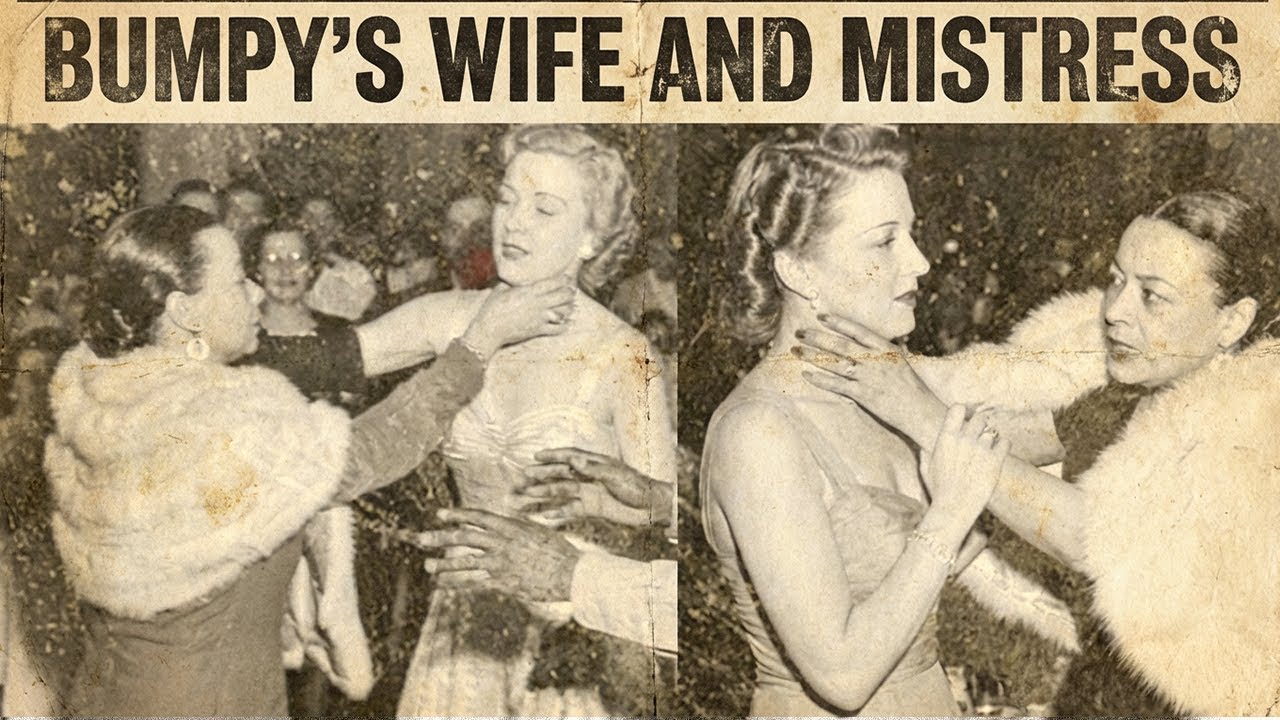
The tension finally reached its breaking point in the winter of 1933. The location was a high-society charity gala, one of those rare nights where the lines between the underworld and the upper crust blurred. Politicians shook hands with racketeers. Judges shared cigars with bootleggers.
Bumpy was there holding court. Helen was there surrounded by a gaggle of admirers telling stories about her adventures uptown. And Mayme Johnson was there. Mayme had decided it was time to make an appearance.
When she walked into the ballroom, the atmosphere shifted. She wore a gown that looked like it cost more than a politician’s salary, her head held high, radiating a quiet, terrifying dignity. She moved through the room not like a guest, but like she owned the building. Bumpy saw her, and for a moment, the infatuation with Helen flickered out.
He saw the difference between flash and substance. He saw the woman who had patched his wounds, hidden his guns, and lied to the police for him. He saw his equal. Helen Lawrenson saw her too.
And for the first time, the reporter felt a pang of insecurity. She realized she could write all the articles she wanted. She could be as modern and liberated as she pleased, but she would never have the natural, commanding presence of Mayme Johnson. Jealousy is a dangerous drug, and Helen took a massive dose of it that night.
She decided she needed to reassert her dominance. She needed to prove she was the one with the power. She needed to win the room. Helen detached herself from her group and walked straight toward the circle where Bumpy and Mayme were standing.
The conversation in the immediate vicinity died out. The band seemed to play a little softer. Everyone knew who these three people were. Everyone knew the triangle.
The air grew heavy with anticipation. People were expecting a catfight. They were expecting drama. Helen stopped in front of them, a glass of champagne in her hand, a smirk on her painted lips.
She looked at Bumpy, ignoring Mayme entirely at first, a deliberate, rude exclusion. Then she turned her eyes to Mayme. It wasn’t a look of hostility. It was worse.
It was a look of amusement, a look of pity. Helen Lawrenson, the Vanity Fair editor, looked at Mayme Johnson, the gangster’s wife, and decided to treat her like a child. She opened her mouth and delivered an insult so subtle, so wrapped in faux politeness, that only the sharpest ears caught the venom. She commented on Mayme’s dress, complimenting it in a way that suggested she was surprised Mayme had such good taste.
Then she dropped the hammer. She made a joke about how quaint Bumpy’s home life must be, implying that he came to her for intellectual stimulation because he couldn’t get it at home. She essentially called Mayme a boring, simple housewife in front of the most powerful people in New York. The silence that followed was deafening.
In the streets of Harlem, men had been killed for looking at Bumpy wrong. Here was a woman, an outsider, standing in his face and insulting his wife. Bumpy’s eyes went cold. His hand twitched toward his pocket, a reflex honed by years of violence.
But he didn’t move. He was paralyzed by the complexity of the situation. If he hit her, he was a brute attacking a white woman. If he did nothing, he was a coward allowing his wife to be disrespected.
He was trapped. But he had forgotten one thing. He had forgotten who was standing next to him. He had forgotten that Mayme Hatcher didn’t need a protector.
Mayme didn’t flinch. She didn’t blush. She didn’t look down. She looked Helen Lawrenson dead in the eye, and the temperature in the room seemed to drop ten degrees.
Mayme smiled. It wasn’t a nice smile. It was the smile of a predator who has just realized the prey has wandered into the cage and locked the door from the inside. Mayme took a slow step forward, invading Helen’s personal space, violating the social norms of the polite society Helen held so dear.
She leaned in close, so close that Helen could smell her perfume, a scent that was expensive, subtle, and lingering. Mayme didn’t shout. She didn’t make a scene that would get them thrown out. She knew that true power doesn’t need to raise its voice.
She whispered. The people standing nearby strained to hear what was said, but the words were meant for Helen alone. Mayme spoke with the precision of a surgeon. She dismantled Helen’s entire ego in three sentences.
She told her she was a tourist in a land of wolves. She told her Bumpy was a man who collected shiny things, but never kept them. And then she delivered the final blow. She told Helen something about the reality of their life, a dark, violent truth about what happens to loose ends in Harlem, that shattered Helen’s romanticized fantasy of the gangster life in an instant.
Helen’s smirk vanished. The color drained from her face. Her hand holding the champagne glass began to tremble. For months, she had viewed Bumpy as a dangerous pet she had tamed.
In that moment, staring into Mayme’s eyes, she realized she had been playing with a cobra, and she had just stepped on its tail. She wasn’t looking at a housewife. She was looking at the queen of the underworld, a woman who knew where the bodies were buried because she had helped dig the holes. Mayme pulled back, her expression returning to one of cool indifference.
She turned to Bumpy, who was watching her with a look of awe he usually reserved for winning a high-stakes bet. “Ellsworth,” she said, using his government name, reminding him of who he really was. “I’m ready to leave. The air in here is getting stale.
”
Bumpy didn’t hesitate. He didn’t say a word to Helen. He didn’t even look at her. He offered his arm to his wife, and they turned their backs on the reporter.
They walked out of the ballroom, leaving Helen Lawrenson standing alone in the middle of the floor, holding a glass of warm champagne, looking like a little girl who had gotten lost at the fair. The crowd parted for the Johnsons. As they exited, the whispers started again. But the tone had changed.
They weren’t whispering about the affair anymore. They were whispering about Mayme. Did you see that? Did you see the look she gave her?
Helen tried to laugh it off. She tried to turn to her friends and make a witty comment to regain control of the narrative. But her voice cracked. She felt a cold pit in her stomach, a primal instinct telling her she had made a catastrophic mistake.
She thought the confrontation was over. She thought she had just lost a social skirmish. She had no idea she had just signed a warrant for her own destruction. Because in Harlem, the punishment for disrespect isn’t always a physical attack.
Sometimes, it’s something far worse. Mayme Johnson hadn’t just embarrassed Helen. She had marked her. As Helen left the party that night, shaking off the encounter, telling herself she was untouchable because of her status and her press pass, she didn’t see the signal Bumpy gave to one of his lieutenants waiting by the car.
She didn’t know the gears of the Harlem machine were already turning. She went home, poured herself a drink, and sat down at her typewriter, planning to write a scathing piece that would expose Bumpy and humiliate Mayme in print. She typed the first sentence. She thought she still had the power of the pen.
She was wrong. The ink was about to run dry. The morning after the gala, Helen Lawrenson sat at her desk in the Vanity Fair offices, staring at a blank sheet of paper in her typewriter. The headache from the cheap champagne and the sleepless night pounded behind her eyes.
But it was nothing compared to the bruising on her ego. She was a woman who made her living with words. She destroyed politicians with adjectives and dismantled reputations with verbs. Her plan was simple.
She would write a piece that exposed the savage underbelly of Harlem. She would paint Bumpy Johnson not as a romantic anti-hero, but as a brute. She would paint Mayme not as a queen, but as a delusional, trapped housewife. She would burn their kingdom down with ink.
She typed a sentence. Then she ripped the page out and crumpled it. She typed another, ripped it out. For the first time in her career, Helen Lawrenson was afraid to write.
The memory of Mayme Johnson’s whisper was looping in her mind like a broken record. You are playing with a loaded gun. It wasn’t a metaphor. Helen knew, deep down in the places she tried to ignore, that these people didn’t play by the rules of the publishing world.
If she published a hit piece, she wouldn’t get a letter from a lawyer. She might not get anything at all. She might just disappear. The realization hit her with the force of a physical blow.
Her pen was not mightier than Bumpy Johnson’s sword. But pride is a stubborn thing. Helen wasn’t ready to surrender just yet. She convinced herself the fear was irrational.
She convinced herself Bumpy still cared for her, that the scene at the party was just him putting on a show for his wife. She told herself once she got him alone, once she got back into the smoky, seductive atmosphere of the jazz clubs where they had first connected, she could charm her way back in. She could reclaim her spot. So two nights later, she put on her best dress, applied her red lipstick like war paint, and hailed a taxi.
“The Cotton Club,” she told the driver. She was going back to the front lines. The ride uptown felt different this time. Usually, crossing 110th Street felt like entering an adventure.
Tonight, it felt like crossing a border into enemy territory. When the taxi pulled up to the club, the sidewalk was bustling. The music spilled out onto the street, the heavy bass of the double bass vibrating in the pavement. Helen stepped out, expecting the usual greeting.
Usually, the doorman would rush to open the door for her. They would smile, knowing she was with Bumpy. Tonight, the doorman, Big Tiny, didn’t move. Helen stood there on the sidewalk, the heat rising in her cheeks.
She was Helen Lawrenson. She was Vanity Fair. She didn’t get turned away from clubs. She was the one who made clubs famous.
She tried to push past the embarrassment. “Fine,” she said. “I’ll go to Small’s. ”
She got back in the taxi.
She went to Small’s Paradise. The same thing happened. The maître d’, a man who had practically kissed her ring a week ago, suddenly couldn’t find her reservation. We are fully booked, madam, he said, staring at an empty table right behind him.
She went to the Savoy. The manager was unavailable. She went to the Alhambra. The bartender turned his back to her and started polishing glasses the moment she sat down.
It was a coordinated freeze-out. A social execution. Bumpy hadn’t sent hitmen to break her legs. He had done something far more cruel to a woman of her social standing.
He had rendered her irrelevant. He had stripped her of her past. In the course of 48 hours, the word had gone out from 110th to 155th Street. Helen Lawrenson is persona non grata.
She is a ghost. Do not serve her. Do not speak to her. Do not acknowledge her.
The panic began to set in. Helen realized that her access to this world wasn’t based on her charm, her wit, or her writing talent. It was entirely borrowed. It was a loan from Bumpy Johnson, and the loan had been called in.
She wasn’t an explorer. She was a guest who had overstayed her welcome. She sat at the bar of a dive on the outskirts of Harlem, drinking a gin she hadn’t ordered, realizing the magnitude of Mayme’s victory. Mayme hadn’t just won the man.
She had won the territory. She had turned the entire neighborhood into a fortress that Helen could not breach. But the final blow hadn’t landed yet. Helen, desperate and drunk on a mixture of rejection and gin, decided to make one last, fatal error.
She decided to confront Bumpy directly. She knew a small, after-hours spot where he sometimes played poker in the back room. It was a place for the inner circle, not for tourists. If she could just see him, face to face, without Mayme hovering over his shoulder, she believed she could break the spell.
She stumbled into the place around three in the morning. The air was thick with cigar smoke. The room went silent the moment she entered. Bumpy was there.
He was sitting at a round table in the back, his suit jacket draped over his chair, his shirt sleeves rolled up. He was holding a hand of cards. He looked up when the room went quiet. His eyes met hers.
There was no love in them. There was no lust. There was only the cold, hard look of a businessman looking at a bad investment. Helen walked toward the table.
“Ellsworth,” she said, her voice shaking. “We need to talk. You can’t just shut me out like this. ”
The men around the table, killers, thieves, racketeers, looked at Bumpy.
They were waiting for a signal. A nod would mean they dragged her out. A word would mean they let her speak. Bumpy did neither.
He slowly laid his cards face down on the table. He reached into his pocket. Helen’s breath caught in her throat. Was this it?
Was he going to pull a gun? He pulled out a silver cigarette case. He tapped a cigarette on the metal, placed it in his mouth, and lit it. He took a long drag, exhaled a plume of blue smoke, and then turned his attention back to the cards.
He picked them up. “I raise fifty,” Bumpy said to the man on his left. He didn’t speak to her. He didn’t tell her to leave.
He simply deleted her from his reality. The message was louder than a scream. You do not exist. Helen stood there for a moment that felt like an eternity.
The humiliation was total. It burned through her skin. She realized then that the romance she had written about in her head was a delusion. She wasn’t the gangster’s equal.
She was a distraction that had become an annoyance. And in Bumpy Johnson’s world, annoyances were removed. She looked at the men around the table, and for the first time, she saw them not as characters for her stories, but as men who would kill her without a second thought if Bumpy gave the order. The glamour evaporated.
The fear took over. She turned and ran. She ran out of the club, out of the alley, and didn’t stop until she found a cab that would take her back to the safety of downtown. She locked the door of her apartment and cried until dawn.
She never went back to Harlem again. In the weeks that followed, Helen Lawrenson underwent a transformation. She stopped writing about the romance of the underworld. She turned her sharp wit toward other targets.
Years later, she would write her famous essay, “Latins Are Lousy Lovers,” a piece that solidified her reputation as a cynic. But she rarely wrote about Bumpy Johnson. She buried that chapter of her life. She realized she had flown too close to the sun, and Mayme Johnson had clipped her wings.
She learned a lesson that night that no university could teach. Intelligence is knowing what to say. Wisdom is knowing when to keep your mouth shut. Back in Harlem, the Johnson household was quiet.
The storm had passed. Mayme didn’t gloat. She didn’t bring it up. She didn’t need to ask where Bumpy had been, because she knew he was home.
The affair had tested the foundation of their marriage, and the foundation had held. In fact, it had hardened. Bumpy looked at his wife with a new level of reverence. He realized that while he fought wars with guns and knives, Mayme fought wars with psychology and influence.
And she was just as lethal as he was. This domestic victory had a profound effect on Bumpy’s mindset. He became more insular. He stopped trusting the outsiders who came uptown with their smiles and their money.
He realized that at the end of the day, the only people who would stand by him when the walls came down were his own people. His wife. His neighborhood. The illusion of acceptance by the white elite was shattered.
He refocused his energy on the business. He tightened his crew. He sharpened his strategy. And he needed to.
Because while the Helen Lawrenson affair had been a dangerous distraction, a far greater threat had been gathering strength while Bumpy was distracted. Dutch Schultz, the Dutchman, the beer baron of the Bronx. Dutch Schultz didn’t care about social etiquette. He didn’t care about magazine articles or high society parties.
He cared about one thing: the numbers. The illegal lottery in Harlem was generating millions of dollars a year, and Schultz wanted it all. He had been watching Bumpy. He had seen the distraction of the affair.
He had smelled blood in the water. He thought the king of Harlem was going soft, distracted by women and fame. Schultz began his move just weeks after Helen Lawrenson disappeared from the scene. It started with violence that made the knife incident look like a playground push.
Number runners were being beaten in the streets. Bumpy’s collection spots were being firebombed. The Italian mob, led by Lucky Luciano, was watching from the sidelines, waiting to see if Bumpy would crumble or if he would fight. Bumpy Johnson stood at the window of his apartment, looking down at the streets of Harlem, the same streets where he had exiled a mistress without lifting a finger.
He felt Mayme’s hand on his shoulder. He didn’t turn around. He just covered her hand with his own. “The Dutchman is coming,” Bumpy said quietly.
Mayme didn’t flinch. She squeezed his shoulder. “Let him come,” she said. “We handled the devil in a silk dress.
We can handle a thug in a cheap suit. ”
Bumpy smiled. It was the smile of the old Bumpy, the warrior. The affair with the reporter had been a weakness, a lapse in judgment.
But surviving it and seeing the strength of his queen had forged him into something harder. He wasn’t just fighting for money anymore. He was fighting for his home. He was fighting for the woman standing behind him.
The Helen Lawrenson chapter was closed. The book was shut. But the story of Bumpy Johnson was far from over. The real war was just beginning.
And this time, there would be no whispers. There would only be blood. The king and queen of Harlem were united, and God help anyone who tried to break the bond that had just survived the fire. As the sun set over 125th Street, casting long shadows over the empire, Bumpy turned away from the window.
He walked to the table, picked up his gun, and checked the chamber. It was full, and so was his heart. Harlem was his. Mayme was his.
And he was ready to remind the world exactly why they called him the Godfather.
