By the late months of 1546, the smell reached a visitor three rooms before the king himself came into view. In the corridors of Whitehall Palace, courtiers recognized it at once: rotting flesh, infection, something deeply wrong inside a living body. The servants pretended not to notice. Everyone pretended.
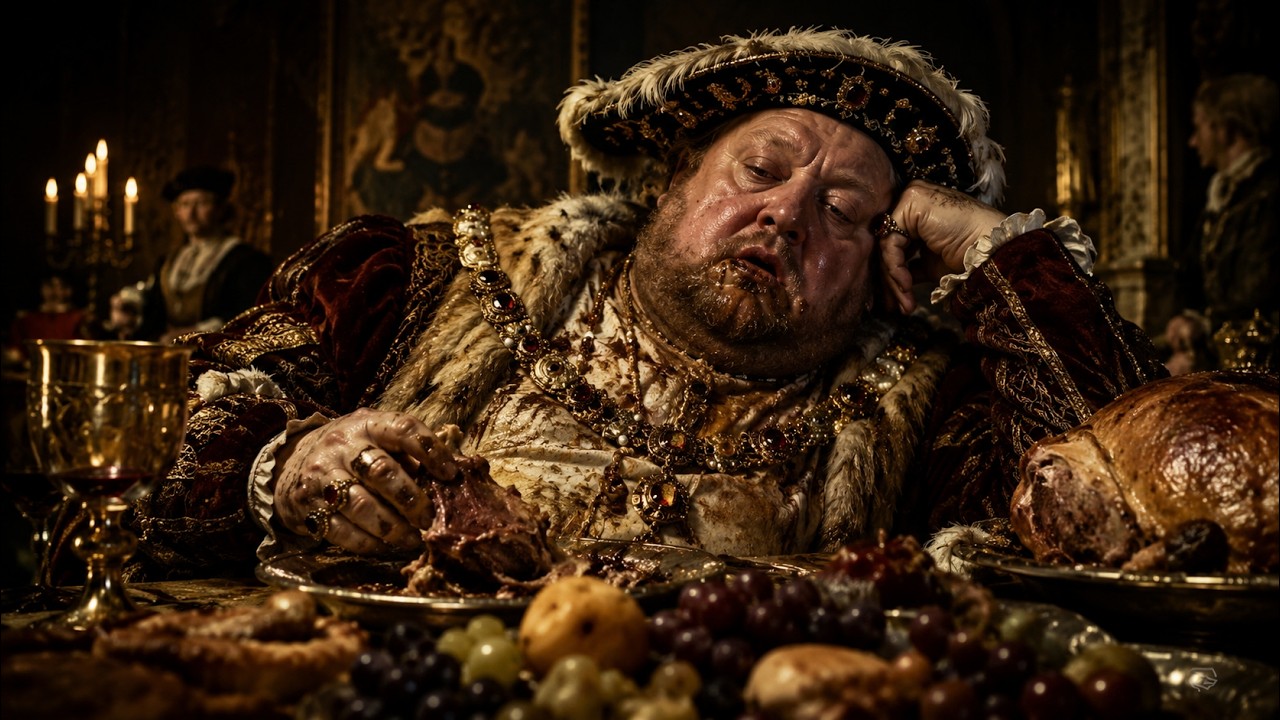
Inside his private chamber, Henry VIII sat at a table. He sat because he could no longer stand for long, and because he could not move without help. He was fifty-five years old and weighed roughly four hundred pounds. His legs were wrapped in bandages that required changing twice a day, weeping constantly from ulcers that had suppurated for a decade.
That morning, moving him from bed to chair had taken six men and a mechanical lift installed specifically for the purpose. And before him, because he was still king and still at dinner, lay twenty dishes: roasted swan, boiled mutton, venison in wine sauce, capons stuffed with oysters, beef ribs gleaming with fat, custards, jellies, and elaborate almond-and-sugar marchpane confections. Enough food to feed a small family. A raid on a body that was dying in every practical sense.
He was not eating because he was hungry. The body that had once burned enormous energy in jousting and hunting now burned almost nothing. No physician in Europe could identify the cause of his decline. But the food was certainly not healing him.
He ate because eating was one of the last things his body could still do. This is not a story about gluttony. It is a story about a king imprisoned inside his own flesh, and about the feasts that kept coming while everything else, power, movement, dignity, faded away. To understand what remained, it is necessary to understand what was lost.
In 1520, Henry VIII could leap onto a moving horse in full armor. He could joust for hours in summer heat, dance until courtiers collapsed from exhaustion, and hunt from dawn until torchlight without dismounting. He stood well over six feet in an era when most men were fortunate to reach five foot six. His shoulders were so broad that the armor made for him in 1514 measured forty-two inches across the chest.
He was an athlete, a warrior’s body. The Venetian ambassador described him as the handsomest ruler his eyes had ever seen. This was not flattery; it was documentation. Henry’s body was not vanity; it was proof of competent rule.
Physical dominance demonstrated divine favor and military readiness in a world where kings still led cavalry charges. When Henry mounted his horse in tournaments, when he wrestled ambassadors and threw them to the floor at formal occasions, when he led hunts that tore across the countryside, he was performing kingship through his body. Strength was embodied legitimacy. By 1540, the circumference of his custom-made armor had reached fifty-two inches at the waist.
By 1545, he could no longer climb stairs. The transformation took about ten years. Concentrated catastrophe, not gradual decline. The turning point came in 1536.
A jousting accident at Greenwich. Full armor, war saddle, a blunted lance, but real speed and real impact. Something went wrong. The horse fell, or Henry fell, or both fell together.
Contemporary accounts differ on the mechanism but agree on the result. The king struck the ground hard and lay unconscious for two hours. When he finally opened his eyes, the physicians gave thanks. The heir to the throne had nearly died of a head injury in a tournament yard.
But the head was not the problem. Or rather, it was not the only problem. The fall damaged his legs, aggravated old injuries from a decade of jousting accidents, created new ones, or both. Veins tore, tissue broke down, and in the weeks that followed, as Henry tried to resume his normal activity, the damage worsened and became ulcers on both thighs.
Open wounds. Weeping wounds. The kind that should have healed in weeks, scabbed over, and left nothing but scars. They never healed.
By the 1540s, the ulcers were a permanent feature of his body. Holes in the flesh of both legs, constantly suppurating, discharging what Tudor medicine called evil humors and what modern medicine calls pus, dead tissue, and infection. The physicians dressed the wounds twice daily, removing old bandages covered in discharge, cleaning with wine or herbal solutions, packing with cloth soaked in egg white or tar-based compounds, and wrapping them again in fresh linen. This was not occasional medical care.
It was daily maintenance of a chronic disease. The wounds fluctuated in size. Sometimes they partially closed, which terrified the physicians. Humoral theory held that blocked drainage would force poison toward the heart and cause death within days.
When healing threatened, doctors deliberately reopened the wounds with probes or lancets to keep them draining. At other times, the ulcers expanded, consuming more muscle and exposing deeper tissue. In the final years, witnesses indicated the wounds extended several inches and reached the bone. Which brings us to the smell.
Multiple sources noted it. The French ambassador observed that the king’s doctors feared the ulcer healing because the humors would be driven to the heart. Privy Council records indirectly referenced the king’s poor health requiring certain rooms to be avoided. Courtiers described in private letters knowing the king was coming before seeing him.
The stench preceded him through hallways and antechambers. This was not exaggeration or slander. It was the reality of chronic osteomyelitis, a bone infection that medical historians believe had settled in Henry’s legs by the 1540s. When bacteria colonize bone tissue, they produce a distinctive odor as they consume the skeleton from within.
It is a smell that cannot be forgotten, and no perfume could mask it, only mingle with it in ways that made things worse. Henry lived inside that smell. He slept in it, ate in it, conducted affairs of state in it. He could not escape it because it came from his own body.
It was a constant, inescapable reminder that he was decomposing while still alive. The wounds refused to heal because the body could not heal them. Modern analysis points to several interconnected problems: chronic venous insufficiency, damaged leg veins causing poor circulation and blood pooling, repeated infections preventing recovery, and likely undiagnosed diabetes. High blood sugar destroys small blood vessels, reduces immune response, and makes wound healing nearly impossible.
Henry’s diet of roasted meat and sugar sculptures fed the bacteria as effectively as it fed the king. Each infection cycle destroyed more tissue. Each attempt at healing failed faster. The wounds grew larger and deeper, becoming self-sustaining systems.
Dead zones in living flesh that the body’s repair mechanisms could not reach. Tudor medicine answered the ulcers with fire. The procedure began with preparation. Iron rods were placed in special furnaces and heated until the metal glowed red-orange.
Physicians called this controlled burning, heat applied to purge damaged tissue and restore proper drainage. Medical texts from the 1540s describe it as a necessary intervention for wounds threatening to close improperly, for tissue turning necrotic, for ulcers refusing to heal. The theory made sense within humoral medicine. The body contained four essential fluids: blood, phlegm, yellow bile, and black bile.
Disease resulted from their imbalance. Wounds provided outlets for corrupted humors that had accumulated internally. If an ulcer closed before the corruption was fully drained, the poison would rush inward toward the vital organs. Better an open wound that might heal than a closed one that would kill.
So when Henry’s leg ulcers threatened to close, his physicians kept them open deliberately. When dead tissue accumulated, they burned it away. The king was restrained, or rather held, by several strong servants while the physician pulled a glowing iron from the coals and pressed it directly onto exposed muscle and infected tissue. Hot metal against living flesh, burning surface tissue down to the affected depths.
The smell of burning skin and muscle mixed with the odor of rot. The pain was excruciating. There was no real anesthesia. Opiate tinctures existed but were limited in use and minimal in effect.
Alcohol might dull sensation slightly. For the most part, the patient endured. A king could not scream like a common man, so he did not. Or if he did, no one recorded it for history.
Afterward, the wounds were packed with cloth soaked in various substances believed to promote healing: egg white, tar, honey, rose oil, and complex compounds mixed according to classical recipes centuries old. Then the wounds were wrapped in clean linen, which soaked through within hours. The process repeated after two days, and again, and again. The goal was never complete healing.
The physicians knew they were managing a condition, not solving it. The hope was to stabilize it, prevent worsening, avoid sudden closure, watch for signs of fatal deterioration, and buy more time. By the 1540s, the physicians had been fighting Henry’s ulcers for nearly a decade with no meaningful progress. The wounds did not heal.
They did not even improve. The treatment simply prevented the looming catastrophe everyone feared: a closed wound leading to septic shock. This fear was not baseless. Trapped infection could kill with terrifying speed.
Blood poisoning, systemic infection spreading from a sealed wound. Tudor physicians could not identify these mechanisms, but they had watched them operate. A patient with an ulcer seemed stable. The wound healed.
Within three or four days, he was dead, feverish and delirious, his body swelling as toxins flooded inward. So the physicians burned and drained and packed the wounds, buying days and weeks while knowing they would never buy years. The tragedy is that they were partly right and catastrophically wrong. Right that wounds needed drainage.
Right that infected tissue required removal. Wrong about almost everything else: the cause, the mechanism, the correct treatment. They cut and burned without addressing the underlying vascular problems, the diabetes, the nutritional deficiencies that prevented healing. Every intervention treated symptoms while the disease advanced untouched within.
Henry endured it. He had to. Refusing treatment guaranteed a faster death. So he submitted to restraints and probes and the daily humiliation of exposing his ulcerated legs to physicians and servants.
His bandages were changed like an infant’s. His body was managed by others because it had stopped managing itself. The psychological weight is almost impossible to imagine. A man who had led armies now owned nothing, not even his own body.
The treatments meant to restore him only reminded him of his decline. And the doctors performing them knew, must have known whatever they claimed publicly, that nothing they did made a fundamental difference. They were trapped too. Bound to act, forbidden to admit helplessness, watching their patient deteriorate despite every traditional remedy they possessed.
The table was never empty. Not when he could no longer walk to it. Not when servants needed a lift to move him from bed to chair. Not when the bandages on his legs soaked through between meals.
The food kept coming. Thirteen, fourteen, fifteen dishes at dinner alone. Because the king’s table was never about hunger. It was about declared power.
And power does not stop at weakness. A single meal at Henry’s table in the 1540s might include venison roasted on spits with crisp, melting fat. Mutton boiled in wine sauce thickened with breadcrumbs. Beef ribs coated in butter.
A whole capon stuffed with oysters and herbs. Swan. Peacock re-feathered after roasting for display. Pork baked in pastry coffins sealed with lard.
Rabbit in cream. Heron. Pigeon pie. Eel in spiced broth.
And that was before the final course. The Tudors produced food on a scale difficult to comprehend. Hampton Court Palace employed over two hundred staff across six separate kitchen departments: meat, fish, pastry, boiling, roasting, and the private kitchen for the king’s personal dishes. They produced hundreds of meals daily for the court.
But the king’s portion was special. Richer, more elaborate, always abundant regardless of his condition. The result was a diet of seventy to eighty percent animal protein and fat, fifteen to twenty percent refined white bread and pastry, five to ten percent sugar, very little fiber, minimal vitamin C, and nothing resembling the micronutrients a body needs to heal wounds, fight infection, or maintain organ function under stress. Every dish arrived swimming in sauce.
Galantine made from bread, wine, and spices. Cameline enhanced with cinnamon and ginger. Thick gravies prepared with egg yolks and more butter. The sauces added flavor and caloric density while contributing almost nothing the body actually needed.
Wine flowed constantly. Not water; water was unsafe. Estimates suggest Henry consumed two to four quarts of wine daily in his final years. That meant six hundred to eight hundred calories of alcohol alone, adding to the food surplus, worsening gout, hindering healing, and likely deepening the depression that made food more psychologically necessary.
Foreign ambassadors observed Henry’s appetite with barely concealed shock. A man who could no longer walk twenty yards consumed food sufficient for someone riding ten miles daily. The mathematics were catastrophic. A four-hundred-pound body needs roughly twenty-five hundred calories.
Henry’s table delivered five thousand or more. The excess calories converted directly to fat, making movement harder, accelerating weight gain, and rendering healing impossible. No one suggested he eat less. The entire framework of Tudor medicine opposed dietary intervention.
Humoral theory did not connect obesity with disease. It considered body size constitutional, determined by the balance of humors, not by the quantity of food consumed. A large body was not sick; it was simply large. Moreover, suggesting reduction of the king’s table was politically unthinkable.
Feasting was propaganda. Foreign dignitaries judged England’s wealth by the magnificence of its royal meals. A modest table meant a weak kingdom. Abundance was duty.
So the food continued to flow even as his health deteriorated. Perhaps it increased as his health worsened, because eating was among the last pleasures left to a man who had lost almost everything. He could no longer hunt, joust, dance, or barely move without assistance. But he could still taste.
He could still order dishes. He could still feel the brief neurological thrill of fat, salt, and sugar touching his tongue. The tragedy is that food was killing him as surely as any assassin, but slowly, over years instead of seconds, accumulating plaque in arteries, glucose in blood, and fat around organs until multiple systems failed nearly at once. But without the ability to see the connection, the feasts seemed like mercy.
One of the few remaining kindnesses his exhausted body could still receive. Sugar arrived as sculpture. The final course, what Tudor caterers called the banquet dish, was not merely food. It was edible architecture.
Castles built of marchpane. Heraldic beasts molded from sugar paste. Entire symbolic scenes made from candied fruit and preserved quince. These subtleties could take days to complete.
Specialized confectioners shaped almond paste and sugar into towers with working drawbridges. Dragons with scales painted in gold leaf. Tableaux representing military victories or classical virtues. They were displayed in the hall before serving, admired and applauded, then consumed.
A single piece could contain several pounds of refined sugar, expensive, imported, and reserved almost exclusively for royalty and the highest nobility. Conservative estimates suggest Henry consumed one hundred to two hundred grams of added sugar daily in his final years. A common laborer of the same period might consume one or two grams. The difference was not preference.
It was availability. And availability was killing him. The clearest evidence appeared in his mouth. Contemporary accounts from the 1540s describe Henry’s teeth as black and decayed.
The Venetian ambassador noted simply that the king had lost many teeth and those remaining were in poor condition. Tooth decay on this scale causes constant low-grade pain, abscesses that spread infection throughout the body via the bloodstream, and difficulty chewing, which likely pushed Henry toward softer, fattier foods requiring less effort to eat. Tudor medicine did not connect sugar to tooth decay. The prevailing theory blamed worms burrowing into teeth or an imbalance of humors causing corruption in the mouth.
The idea that the sweet crystalline substance considered a symbol of wealth and refinement directly destroyed tooth enamel and fed bacteria was not considered. That connection would not be made for centuries. So sugar continued to flow, and the teeth continued to decay, until the image became the perfect metaphor. A glittering golden fortress of pain presented to a king whose mouth was a ruin of black stumps, sweetness eating him from within.
But the real damage was invisible. A body of this size, consuming this much refined sugar with so little movement, almost certainly developed insulin resistance and type 2 diabetes. Chronic high blood sugar destroys the small blood vessels throughout the body, especially in the extremities and wounds. It weakens the immune system, making infection harder to fight.
It impairs circulation, making healing nearly impossible. Every symptom that confounded Henry’s physicians fits here: wounds that would not heal, persistent infections, profound fatigue despite minimal activity, possible vision problems, and intense thirst noted in some accounts. And sugar made it worse with every meal. Each bite, each piece of candied fruit, each glass of sweetened wine sent glucose flowing through already damaged blood vessels, feeding the bacteria in infected wounds, driving the body into further metabolic chaos that sixteenth-century medicine had no framework to diagnose or treat.
There is evidence that sugar was nearly addictive. Neurologically, it stimulates dopamine release similarly to other rewarding stimuli. For a person suffering chronic pain and severe depression, that brief neurochemical reward becomes psychologically necessary. Henry may have been unconsciously self-medicating.
His body hurt constantly. Movement brought no pleasure. His political isolation deepened. But sugar still provided a few moments of good feeling.
A vicious cycle formed. Sugar provided comfort. Sugar worsened diabetes. Diabetes hindered healing.
Poor healing increased pain. Pain increased the need for comfort. Comfort came from sugar. And so the cycle continued, tightening the noose toward systemic failure.
The black teeth were not just symbolic. They were evidence. Visible proof that something was deeply wrong. The body was collapsing under an assault it could not resist.
But because no one understood the mechanism, the evidence went unexamined. Decayed teeth were simply bad luck, not a diagnostic indicator, not a sign of the metabolic catastrophe unfolding in the blood and organs and damaged tissues. The king kept eating sugar. The physicians kept cauterizing his wounds.
No one connected these two facts, sweetness and rot, as cause and effect. They were merely two separate misfortunes befalling the same exhausted body. The image persists: the bloated king, legs splayed, face grim beneath decayed teeth. Henry VIII as the tyrant whose body mirrored his cruelty.
Gluttony personified. A cautionary tale about excess punished by decay. But that interpretation is too simple and too cruel. What we observe is a tragedy of a different kind.
A man with treatable diseases dying because the knowledge needed to save him did not yet exist. Eating to fill voids that food could not fill. Trapped inside a body that had become his enemy while retaining full memory of who he had once been. The table was not merely the cause of his death.
It was one of the last places where he could still exercise his will in a life from which everything else, movement, healing, dignity, had been stripped away by a body he no longer controlled.
