The street light clicked on at the far end of the block, and without a word you were off the curb, leaving the game mid-play, running flat out for your own front door. Nobody checked a watch. Nobody had one. The rule was older than any of you and simpler than anything a parent ever had to say: when the lights come on, you go home.
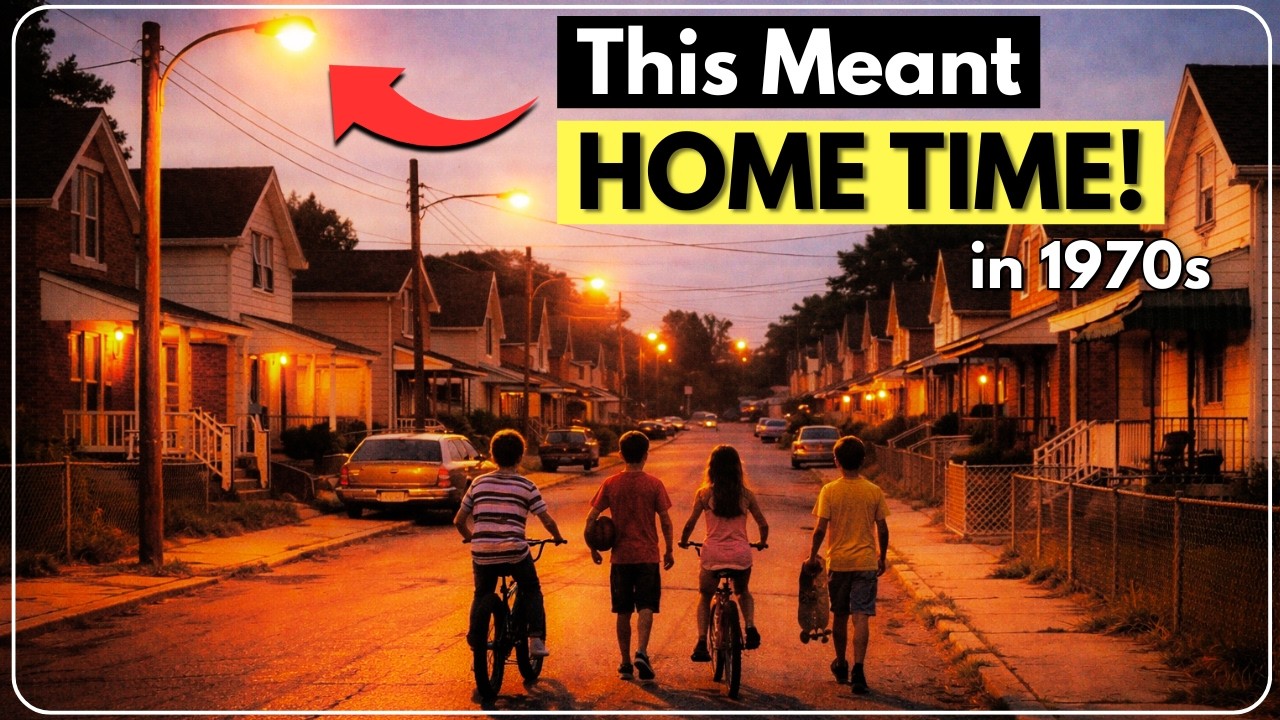
If you were late, the look on your mother’s face said everything there was to say. Every block, every working-class neighborhood in America, ran on that same silent clock. Try explaining any of that to someone born after 1995. They’d call a hotline.
This is for the people who grew up in houses where the heat never reached the bedrooms. Where dinner was whatever your mom could stretch a dollar into. Where the TV had three channels and somebody had to hold the antenna. Where the back door had a creak that every kid on the block could identify from two houses away.
Not everybody will get this, but if you grew up working class in 1970s America, you don’t need it explained. You just need someone to finally say it out loud. You had one TV. One phone on the wall with a cord that barely reached the hallway.
One car in the driveway if you were lucky. Nothing was duplicated because nothing was disposable. Every object in that house had a job and a lifespan measured in decades, not months. Your dad could fix all of it.
Didn’t matter what broke. He’d appear with duct tape, a pair of pliers, and an expression that said he’d done this before even when he clearly hadn’t. The toaster. The screen door.
The toilet handle. The lawn mower sounded like it was begging for mercy every time he started it, but it ran. The antenna on the roof had been adjusted, rebent, and duct-taped so many times it looked like modern art, but if it got a picture, nobody was touching it. Nothing got thrown away.
If it couldn’t be fixed today, it sat in the corner until it could. Your parents didn’t budget. They rationed. Payday was a real event.
You could feel the mood in the house lift when that check came in. Groceries appeared, maybe a bottle of pop. And then the mood shifted again by Thursday. Every house on the block ran on the same rhythm.
Flush on Friday, careful by Wednesday. Hand-me-downs weren’t a choice. They were the system. Clothes moved through the siblings like a conveyor belt: shirts, pants, shoes worn into someone else’s foot shape.
By the time the youngest got them, the knees were patched and the elastic was gone. If you wanted spending money, you went and found it. Every glass soda bottle had a deposit on it, a few cents each. You’d check the sides of the road, look behind the gas station, knock on doors asking if anyone had empties.
A bag of bottles meant enough for a candy bar or a few turns on the arcade machine at the bowling alley. You didn’t ask for an allowance. You built your own economy out of things other people threw away, and honestly, that felt like a superpower. Then there was the Sears catalog.
If you can still picture that thick book, you’re already smiling. The weight of it in your lap, the glossy pages, that ink smell. You’d sit on the carpet and flip through it for hours, circle what you wanted with a pen, knowing you’d get maybe one thing at Christmas. But the catalog became the toy.
Pick your house. Pick your bike. Pick your room. The pages you loved most in the toy section were soft and creased by October.
Dreaming on paper, and it didn’t cost a cent. But money was only part of the story. The way you lived inside that house, that’s where the real memories are. Every house had a room you weren’t allowed in.
The good room. The front room. Plastic covers on the couch that stuck to your legs in summer. That room was for company.
You were not company. If you can still hear the sound of that plastic peeling off the back of your thighs, you lived this. Winter mornings were not gentle. The heat came from one source, and it did not reach the bedrooms.
You’d wake up and the air was so cold you could see every breath. You’d pull the blankets up to your chin and lie there trying to talk yourself into moving. When you finally gave in, you grabbed your clothes and ran to whatever warm room existed in the house. Fought your brother for the spot next to the floor vent.
Hopped on the cold linoleum like it was hot coals. Nobody complained. Every house on the street was the same. The TV had three channels and an antenna you had to hold at exactly the right angle.
Somebody always got stuck being the human antenna. You’d stand there with your arm in the air while your dad called out directions from the couch. Left. No.
Back. Hold it right there. Don’t breathe. You were basically a piece of furniture at that point, and you didn’t move, because you wanted to watch that show, too.
Food was never wasted. Leftovers became tomorrow’s lunch. Bread heels became breadcrumbs. Grease got saved in a coffee can by the stove.
You ate what was put in front of you or you didn’t eat. When the fridge was nearly empty, you made do: ketchup sandwiches, butter and sugar on bread, cereal with water when the milk ran out. You didn’t think of it as poverty. You thought of it as Tuesday.
And every kid on the block was eating the same way. But here’s what you didn’t notice until years later. No matter how tight things got, the table was always set. Plates, forks, napkins folded.
Your mom’s meatloaf wasn’t fancy. Same recipe every week. But she served it like it mattered, because to her it did. She’d stand at the stove while everyone else sat down, eat last, eat least, and somehow the food was always warm and there was always enough.
You didn’t know the word for that then. You just called it dinner. If the house was your world, the street was your universe. Out there, the whole neighborhood was raising you whether you liked it or not.
Every adult on your street had permission to correct you. That was the deal. You acted up three houses down, and your mom knew about it before you got home. There was always somebody watching: Mrs.
Henderson, forever sweeping her porch; Mr. Brown, the retired guy who sat on his steps every evening without fail; the lady at the end of the block who never smiled but never missed a thing. The neighborhood ran on eyes and gossip, and it was more efficient than anything the police ever came up with. There was always one neighbor with the hose running all summer.
You’d run through that water barefoot until the grass turned to mud. The hose was the toy. Half the block’s kids were in that yard by two o’clock. You walked everywhere.
To school, to the store, to your friend’s house two blocks over. No play dates. Nobody called ahead. You knocked on the screen door.
If they were home, you played. If not, you tried the next house. And you kept going until somebody said yes. And if there was one day a year when the whole street became one big living room, it was the Fourth of July.
Somebody dragged a card table into the road. Somebody else brought a cooler. The grills came out by noon. Hot dogs and burgers and potato salad from the woman across the street who made the good kind.
Kids ran through sprinklers and chased each other with sparklers until they got yelled at, then did it again. When it got dark, everybody sat on the curb and watched whatever fireworks the town put on. For one evening, the whole block was one family. And there was a sound in summer that could make every kid on the block appear out of thin air in thirty seconds.
The ice cream truck. It didn’t matter where you were or what you were doing. Halfway up a tree, in the middle of a game, you heard that jingle and everything else stopped. You’d fly through the back door, already out of breath, hand out, hoping your mom had change.
She’d dig through the bottom of her bag, come up with a few coins, and you’d be back outside before the truck reached the corner. A creamsicle, a fudgesicle, a drumstick if the coins added up. You’d sit on the curb with it melting down your wrist in the heat, and nothing in the world tasted better. Because you’d earned it with speed.
But all those good times on the block didn’t come from nowhere. Somebody was working for every bit of it. Your parents worked. That’s the thing you understood without being told.
Two jobs, sometimes. Overtime. Doubles. They came home tired, and they got up and did it again.
Your dad could fall asleep in the recliner in under ninety seconds, still in his work boots. That was his superpower. You had a job by fourteen or fifteen. Paper routes, bagging groceries, mowing lawns.
The money wasn’t pocket money. It went to the house, or it bought your school clothes. There was no allowance. You wanted something, you worked for it.
And there was something satisfying about that, about turning your own sweat into something you could hold. But Friday made it all worth it. The week was done. In Catholic neighborhoods, it was fish: fish sticks, fried perch, maybe a fish sandwich from the church hall for a dollar fifty a plate.
In other homes, it was pizza night, the kind where the box was already translucent with grease by the time somebody carried it through the door and the slices hung off the sides of a paper plate. Either way, Friday was the night everyone relaxed. TV on, ate on your lap or at the coffee table. Nobody talked about school or work.
Friday was earned. You felt it. Summer was the kingdom. If your family went on vacation, it wasn’t Disney World, not yet.
It was a cabin by a lake somewhere, or six hours in the back of a wood-paneled wagon with your siblings’ elbows in your ribs and every window cranked down because that was the only cooling system. If you pulled into a Howard Johnson’s or a Friendly’s, it meant that year was a good one. Some families didn’t go anywhere, and summer meant the local pool and a cooler in the trunk. But on those summer evenings, you’d sit outside and watch the street lights come on one by one, and there wasn’t a single thing missing from that picture.
And that’s the part that sneaks up on you. Not what you didn’t have. What you did. Nobody’s saying it was perfect.
The money was tight. The houses were small. But the tables were full, the streets were loud, the neighbors knew your name. And there was a kind of closeness in that life that’s hard to explain to anyone who wasn’t in it.
You didn’t call it community. You just lived it every single day. On a good night, after the dishes were done and the TV was off, you could hear the whole street settling down. Screen doors closing one by one.
Porch lights clicking off. The neighborhood going to sleep the same way it woke up. Together. And if you close your eyes right now, you can probably still smell your mom’s kitchen on a Sunday morning.
That smell didn’t come from a recipe. It came from a life.
