In 1963, Burke’s Peerage, the document that functioned as the unofficial register of the British aristocracy, recorded a simple, uncontested fact. Queen Elizabeth II’s cousins, Nerissa and Katherine Bowes Lyon, were dead. The entry was clear. The public took no notice, and the royal bloodline was declared officially unblemished.
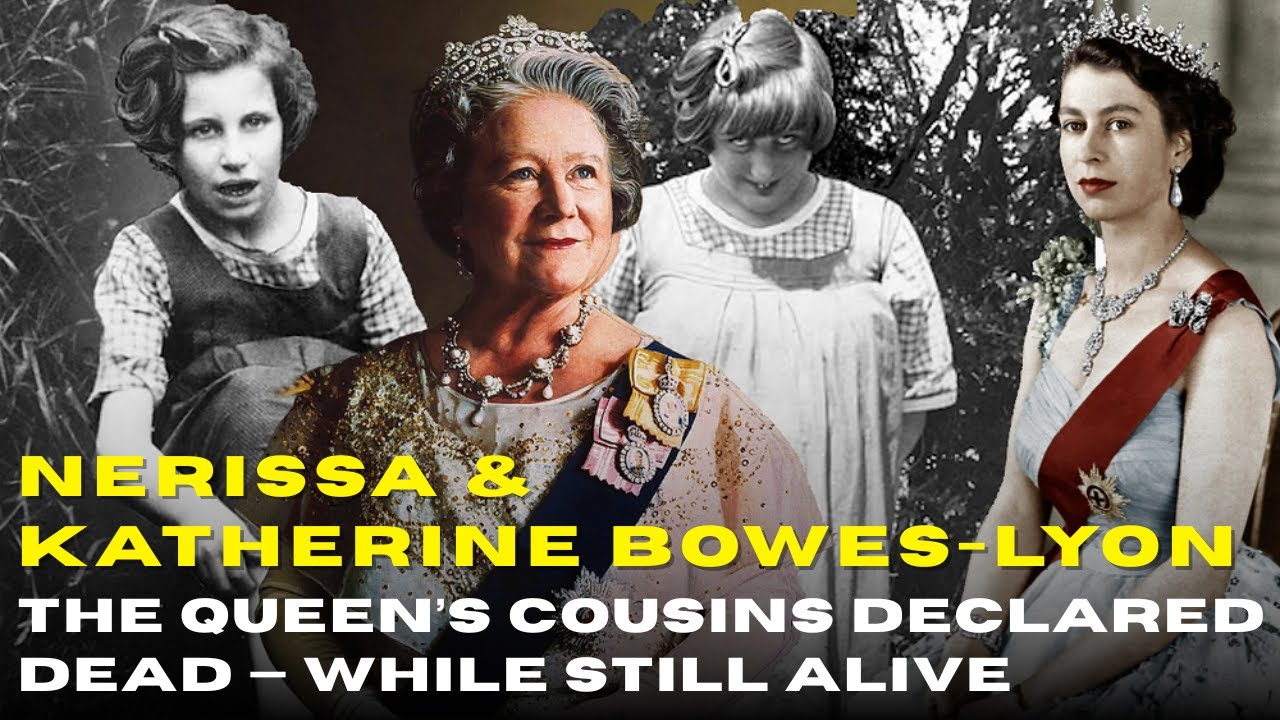
But it was a lie. At that very moment, forty miles south of Buckingham Palace, Nerissa and Katherine were not lying in a tomb. They were breathing, walking, and suffering behind the iron gates of a horrifying mental institution. They had been erased from history, not by death, but by a stroke of a pen.
While the Queen waved to millions from her balcony, her own flesh and blood were wasting away in plain dresses, staring at a flickering television screen, waiting for visitors who would never come. This is the grim, true story of how the Queen’s two cousins were hidden for decades and falsely declared dead in official records. The story begins not in a hospital, but in the nursery of one of Scotland’s finest homes. The Bowes Lyons were an ancient clan, the Earls of Strathmore and Kinghorne, owners of the vast, castle-like Glamis.
They were Scotland’s highest echelon of aristocracy: rich, influential, and steeped in tradition. In the early twentieth century, they embodied the British upper class—a world of hunting parties, debutante balls, and an unwritten code of conduct where outward appearance was prized above all else. At the center of this social whirl was the Honorable John Bowes Lyon, the second son of the fourteenth Earl. He was a handsome, affable man, educated at Eton and Oxford, and a war hero who had served with the Black Watch in the First World War, though the conflict had left him physically weakened and prone to illness.
But in the heady days of the 1920s, John was a figure of charm and status. He was the elder brother of Lady Elizabeth Bowes Lyon, a young woman whose radiance and steel-hard personality would soon capture the heart of the King’s second son, Prince Albert. In 1914, just as the old world was about to shatter in war, John married the Honorable Fenella Hepburn-Stuart-Forbes-Trefusis. It was a perfect match of lineage.
Fenella was the daughter of the twenty-first Baron Clinton, a family as ancient and noble as the Bowes Lyons. On paper, it was an ideal union, a merging of two great dynasties. They were the golden couple of their circles, moving between their London townhouse and the sprawling estates of their parents. But genetics is a lottery that ignores titles and bank accounts.
Deep within the Trefusis DNA was a recessive gene, a silent passenger waiting for the right, or unlucky, combination to express itself. This was not discussed in Mayfair drawing rooms. In those days, disability was not a medical condition to be managed; it was a moral failing, a stain on the lineage. Their first daughter, Patricia, was born in 1916 and died in infancy, a tragedy so common it raised little concern.
Then, in February 1919, Nerissa was born. She arrived into a world desperately trying to rebuild itself after the devastation of the First World War. She was a beautiful baby, and her mother clung to her with the desperate hope of a healthy child. But as months turned into years, the silence in the nursery grew heavy.
Nerissa did not babble like other children. She did not sit up when she was supposed to. Her eyes were sweet, but often failed to focus or follow with the sharpness expected of a young aristocrat. It was the nannies, the secret keepers of upper-class children, who noticed first.
Whispers began below stairs before reaching the master and mistress. The child is slow. Something is wrong with her. For John and Fenella, the realization must have been like a slow-motion car crash.
In the 1920s, there was no early intervention therapy, no sensory integration, no support groups. There was only the harsh binary of the age: you were either normal or you were an imbecile. The medical terminology of the time was brutal, stripping a child of dignity and reducing her to a clinical label of defectiveness. Still, Nerissa was kept at home.
The family was wealthy enough to manage the problem. She was kept out of sight under the care of nannies, but she was still a member of the family. Then, in 1926, the year her aunt Elizabeth gave birth to the future Queen Elizabeth II, Fenella gave birth to another daughter, Katherine. History repeated itself with devastating precision.
Katherine also failed to meet her developmental milestones. Like her older sister, she never learned to speak beyond simple sounds and grunts. She never learned to read or write. Her mental age would remain that of a small child, frozen in a state of perpetual innocence, while her body grew into womanhood.
By the late 1920s, John and Fenella Bowes Lyon were living a double life in public. They were the glittering in-laws of the royal family. John’s sister Elizabeth had married the Duke of York in 1923, becoming the Duchess of York and elevating the entire Bowes Lyon clan. They were now directly adjacent to the throne.
They attended garden parties. Their pictures appeared in glossy magazines. But privately, their home was a place of mounting anxiety. They had two daughters who could never be presented at court, who would never marry, who would never take their place in society.
It is crucial to understand the intellectual climate of this specific moment in history. This was the golden age of eugenics. It was not a fringe Nazi ideology; it was a mainstream scientific belief embraced by British, American, and Scandinavian elites. The idea was simple and seductive: humanity could be improved by encouraging the fit to breed and discouraging or removing the unfit.
In this worldview, high intelligence, physical beauty, and social grace were seen as proof of good breeding. Conversely, mental disability, poverty, and feeble-mindedness were seen as proof of bad blood. For the aristocracy, whose entire claim to power rested on the superiority of their bloodline, the existence of severe disability was not just a tragedy. It was a threat.
It suggested rot within the family tree. If John and Fenella had been a quiet country couple, perhaps none of this would have mattered so much. But the spotlight on them was growing. In 1930, tragedy struck the family patriarch.
John Bowes Lyon, who had never fully recovered from the war and was worn down by the pressures of life, died of pneumonia at the age of forty-four. His death was a catastrophe for Nerissa and Katherine. John had been the family’s protector, the patriarch with the resources and the will to keep his daughters at home. After his death, Fenella was left alone to manage the estate, the social obligations, and the care of five children, two of whom required round-the-clock attention.
Fenella was a woman of her class—vague, inexperienced in practical matters, and terrified of social humiliation. Without her husband, she began to unravel. But the real turning point, the event that sealed the sisters’ fate, came six years later, in 1936. It was a constitutional crisis that shook the British Empire to its foundations and changed the calculus of survival for the Bowes Lyon family.
King George V died, and his eldest son, David, became King Edward VIII. He was the people’s favorite, a star king. But he fell in love with Wallis Simpson, a twice-divorced American. The establishment objected.
The church refused. The government threatened to resign. In December 1936, Edward VIII chose love over duty and abdicated the throne. The crown passed to his younger brother, the shy and stuttering Duke of York, Albert, known to his family as Bertie.
Overnight, John Bowes Lyon’s sister Elizabeth became Queen Consort, and her ten-year-old daughter, Princess Elizabeth, became heir presumptive. This was the earthquake. The Bowes Lyons were no longer just aristocratic relatives; they were the Queen’s blood family. The royal pedigree was now a matter of national security and imperial pride.
The new King and Queen were presented as the antidote to Edward VIII’s instability. They were the family monarchy—solid, dependable, pure, and above all, healthy. The press began to scrutinize the new King and Queen’s lineage. They searched for stories, connections, anything that could explain who these people really were.
And hidden beneath the Bowes Lyon branch of the family tree was a problem. The eugenic anxieties of the time cannot be overstated. If it became known that the Queen’s brother had fathered two imbecile children, the whispers would be devastating. Was the bloodline corrupted?
Was little Princess Elizabeth carrying the same gene? Was the future of the monarchy mentally sound? These were questions the Palace could not afford to let be asked. The stability of the Crown depended on the display of perfect biological and moral fitness.
Nerissa was seventeen. Katherine was ten. They were growing up. Hiding them in the nursery was becoming increasingly difficult.
They were the visible reminders of a genetic flaw in a family that had just ascended to the pinnacle of the world stage. And then the world went to war. By 1941, the chaos of wartime made it easier to move people quietly, and harder for anyone outside the family to ask questions. Hitler had invaded Poland in 1939.
Britain was blacked out. The Blitz was on. London was being bombed. The nation’s attention was contracted to immediate survival.
War provided a terrible opportunity. The confusion of the conflict, the evacuation of children, the disarray of paperwork—it was all a smokescreen. Grand houses were being converted into hospitals and barracks. Staff were leaving to join the army.
The capacity to care for two severely disabled adult women at home was shrinking. But this was about more than logistics. It was about consolidation. The royal family was the symbol of British resistance.
The Queen, Nerissa and Katherine’s aunt, was walking through the rubble of the East End, becoming a national symbol of strength. There was no place for hidden sisters in that narrative. In 1941, in the darkest days of the war, a decision was made. It is not entirely clear who made the final call—whether it was Fenella alone, or pressure from senior members of the Bowes Lyon family, or even from the Palace itself.
But the result was final. A car was summoned to the family home. Suitcases were packed, not with the fine clothes of their station, but with practical essentials. Twenty-two-year-old Nerissa and fifteen-year-old Katherine were taken from the only home they had ever known.
Perhaps they did not understand where they were going. They may have looked to their mother for reassurance, but Fenella was sending them away. They were being exiled from their aristocratic life to the high brick walls of the Royal Earlswood Hospital. They were about to cross a threshold from which they would never return.
They were trading their identity as the Queen’s cousins for a new one: Patient Number 384 and Patient Number 385. As the heavy iron gates of the asylum opened to swallow them, the first chapter of their lives ended. They had been born into the light, and they were being pushed into the dark. And to ensure they stayed there, the outside world would need to be told an audacious lie that would take forty years to unravel.
The doors closed. Silence descended. For the next two decades, their lives did not progress by years, but by routine. The iron gates of Royal Earlswood Hospital kept out more than the outside world; they kept out time.
When Nerissa and Katherine Bowes Lyon crossed that threshold in 1941, they left behind debutante balls and country weekends for a static, gray purgatory. Founded in the mid-nineteenth century as an asylum for the feeble-minded, the institution was a red-brick Victorian edifice with high towers. Designed with the best paternalistic intentions, it functioned in reality as a warehouse for the unwanted. The air inside was different.
It smelled of boiled vegetables, floor wax, and the damp metallic tang of institutional neglect. For two young women raised in the perfumed environment of the upper classes, the sensory shock must have been terrible. Their fine wools and cottons, chosen by nannies, were taken away. They were replaced with the institution’s resident clothing: rough, ill-fitting garments that hung awkwardly, and underwear that was communal, washed in vast industrial vats until it was stiff and gray.
The first casualty of the asylum was personal identity. They were placed in a ward with dozens of other women, all suffering from varying degrees of intellectual disability. There was no privacy. Beds were arranged in strict rows, with nothing but empty air between them and the sound of strangers crying at night.
The war had left staff numbers dangerously low. The nurses who remained were harassed, exhausted, and unable to provide even basic care, let alone affection. Nerissa and Katherine, who had known only the devoted attention of private staff, were now just two more bodies to be fed, washed, and supervised. But they were not alone in this exile.
In a twist that reveals the full horror of the family’s hereditary anxiety, Nerissa and Katherine were soon joined by their own cousins. Later reports revealed that three other relatives with similar disabilities had also been committed to Royal Earlswood around the same time. They were the daughters of Fenella’s sister, Harriet. So on that bleak day in 1941, it was not two girls who were cast out.
It was five. Five close relatives of the Queen, all carrying the same stain from the Trefusis side of the family, all swept under the same rug in a coordinated purge. It was a genetic cleansing of the family tree, executed with ruthless efficiency. While the war raged outside, the sisters adapted to the crushing rhythm of institutional life.
Their days were regimented and empty. Wake at dawn, wash in communal ablutions with no doors. Breakfast of porridge. Hours spent sitting in a dayroom staring at walls or aimlessly walking corridors.
Lunch, more sitting, supper, then sleep. There was no therapy, no education, no stimulation. They were simply being kept alive. Meanwhile, in the world they had left behind, the House of Windsor was ascending to its ultimate peak.
In 1947, their cousin Princess Elizabeth married the handsome Philip Mountbatten. It was a flash of glamour in a gray post-war world. The Bowes Lyon family was at the center of the celebrations, basking in reflected glory. Then, in 1952, King George VI died, and Elizabeth became Queen.
The Coronation of 1953 was a global spectacle, a moment of almost religious significance. The monarchy had become a sacred institution, and the family on the balcony was the ultimate symbol of British stability. When their cousin was crowned, Nerissa and Katherine were thirty-four and twenty-seven years old. They were alive.
They were in Surrey. But in the minds of the ruling family, they were already fading into transparency. The contrast between Elizabeth, in her golden coronation coach, and Nerissa, sitting in a locked room in an old dress, was perhaps the most violent juxtaposition in modern royal history. One was the bearer of the nation’s hope.
The other was the bearer of its shame. But erasure is a process. It begins with physical removal, but it is completed with paperwork. The physical exile happened in 1941.
The bureaucratic death sentence was carried out twenty years later, in the quiet, dusty offices of a publishing house. By the early 1960s, the sisters were not just hidden in a hospital; they were being deleted from the public record of the family. In 1963, the editors of Burke’s Peerage, the definitive guide to the British aristocracy, were preparing a new edition. They sent their standard forms to all aristocratic families, requesting updates on births, marriages, and deaths.
When the form was returned from the Bowes Lyon family, it contained information that was both clear and false. Next to the name Nerissa Bowes Lyon, it read: “Died 1940. ” Next to the name Katherine Bowes Lyon, it read: “Died 1961. ”
With those few strokes of a pen, the sisters were officially erased.
They were no longer hidden. They were dead. The lie was printed, bound in leather, and placed on the shelves of libraries and palaces across the country. Why was it done?
The official explanation offered decades later was that their mother, Fenella, was an elderly, vague woman who was not adept at paperwork. We are asked to believe that a mother might have forgotten that her daughters were alive, or that she was so confused that she mistakenly declared them dead twice, with two specific, fabricated dates of death for two different girls. It is an excuse that strains credulity almost to the breaking point. A more skeptical, and perhaps more realistic, explanation is that Fenella, or someone guiding her, made a calculated decision.
By 1963, the Queen had become a global icon. A new, intrusive media culture was emerging in the 1960s. The risk of exposure was growing. If a journalist were to investigate and find two imbecile cousins in a state mental hospital, the scandal would be immense.
But if they were dead, the trail would go cold. Death was safe. Death closed the chapter. So Nerissa and Katherine became ghosts.
But ghosts still need to eat, sleep, and feel. And inside Earlswood, the dead women were living a poignant, heartbreaking existence of awareness. The nurses who cared for them in the 1960s and 1970s later told stories that are almost unbearable to hear. They spoke of two women who, despite the harshness of their surroundings, were gentle, childlike, and deeply affectionate.
They had the Bowes Lyon look—the same protuberant eyes, the same jawline seen on the Queen Mother in newspaper photographs, but without any jewelry or adornment. The resemblance was a grotesque distortion. The most crushing aspect of their existence revolved around the television set in the ward’s dayroom. It was their only window onto the world that had rejected them.
The nurses noticed a pattern. Whenever a royal event was broadcast—a wedding, a funeral, Trooping the Colour—Nerissa and Katherine would transform. Picture the scene. The flickering light of a cathode ray tube television in a room smelling of disinfectant.
The strains of “God Save the Queen” playing on the screen. Crowds cheering for Queen Elizabeth II. In the ward, while other patients might be rocking or staring blankly, Nerissa and Katherine would struggle to their feet. Deep within the fog of their developmental disability, they knew.
A faint spark of recognition remained. They would make excited, eager noises and point at the screen. And then, with a clumsiness that betrayed a lack of physical control, and a dignity that betrayed their breeding, they would curtsey. They were saluting the cousin who reigned in the palace, while they stood in an asylum wearing someone else’s underwear.
It was an act of deference to the very system that had crushed them, a display so painful it is almost impossible to contemplate. They were cheering for the symbol of the system that had discarded them. Did anyone ever visit? In the early days, Fenella came.
She was their mother, after all. But as she aged, the visits became irregular. Then they stopped altogether. By the mid-1960s, the sisters were effectively orphans among the living.
The estrangement was total. While the Queen Mother was riding around London in a luxury car, visiting hospitals and charities, shaking hands with strangers and receiving bouquets of flowers, her own nieces were forty miles away, looking down the driveway for a car that would never come. The hypocrisy was staggering. The Queen Mother was patron of the Royal Society for Mentally Handicapped Children and Adults.
She gave speeches about the need for compassion. She was the nation’s grandmother, the warm, gin-loving, jovial matriarch. Yet she allowed her own flesh and blood to rot in isolation. The financial neglect was as stark as the emotional neglect.
Despite the vast wealth of the Bowes and Windsor families, Nerissa and Katherine were largely dependent on state charity. There were no private quarters, no private nurses, no extra comforts. They lived at the expense of the National Health Service. In 1982, a small crack appeared in the wall of indifference, but it only made the cruelty more stark.
The Queen Mother, perhaps prompted by a sudden pang of conscience or a warning from a family trustee, sent a cheque to the hospital administrators. The amount was £125. It was intended to buy sweets and toys for their birthdays. At that time, the Queen Mother was known to have a fortune worth millions, and her lifestyle cost taxpayers a vast sum each year.
The cheque was insulting in its smallness. It was the kind of money one might give to a distant charity, not to the nieces whose lives had been taken to protect your honor. But more than the money, the cheque was proof. It was written evidence.
It proved that the royal family knew the sisters were alive. It proved that the entry in Burke’s, the fiction of the 1940 deaths, was a lie they were comfortable with, as long as the sisters accepted their £125 cheque in silence. But Nerissa’s time was running out. By the mid-1980s, she was in her late sixties.
Her life had been a long gray tunnel of emptiness. She had spent over forty years in the institution. Her body, worn down by inactivity and the side effects of the drugs given to patients in such places, began to fail. In 1986, Nerissa Bowes Lyon died.
She was sixty-six years old. If her life had been a tragedy, her funeral was a scandal. There was no family cortege. No member of the Bowes Lyon family stood by the grave.
The royal family sent no representative. This woman, the Queen of England’s cousin, was buried in a municipal plot at Redhill Cemetery. The grave was unmarked by any memorial stone. The family paid for nothing.
Instead, a small plastic tag, the kind used by gardeners to mark rows of vegetables, was pushed into the wet earth. It bore a serial number and her name: Nerissa Bowes Lyon. That was the final erasure. She was born an aristocrat, lived as a prisoner, and was buried as a pauper.
The earth closed over her, and the family breathed a sigh of relief. One problem gone. One secret buried. Katherine was still alive, but she was old and silent.
They thought they had gotten away with it. They thought the plastic tag would rot and the name would dissolve into the mud, forgotten forever. But the grave was not the end. It was the final proof.
Within months, journalists began to dig in the one place reputations cannot hide: paper records. In early 1987, a small entry in a local cemetery was enough to unravel the whole story. The weather in England in April 1987 was uncertain, but the chill in the air at Redhill Cemetery was persistent. It was a quiet, unremarkable suburban final resting place.
A world away from the marble vaults of St. George’s Chapel, where members of the royal family are interred. Here, the dead were middle-class tradesmen, war veterans, and forgotten residents of local institutions. It was here that a reporter from the Sun newspaper walked through the damp grass, looking for Plot 2061.
He was not looking for a celebrity. He was looking for a ghost. The tip had been vague but explosive. A suggestion that a member of the Queen’s family, long thought dead, had actually been buried in a secret grave just a year earlier.
When the reporter finally found the spot, the reality was harsher than any headline. There was no marble angel, no granite slab, no gold lettering. There was only a patch of dug earth and a plastic marker, the kind gardeners use to label rows of vegetables. In faded ink on that marker was the name: Nerissa Bowes Lyon.
The reporter checked his notes. According to Burke’s Peerage, the bible of the British aristocracy, Nerissa Bowes Lyon had died in 1940. Yet here was a fresh grave from 1987. And if Nerissa had been alive all this time, what about her sister, Katherine?
Burke’s said she had died in 1961. Was she a ghost too? The investigation that followed was swift and thorough. Journalists descended on Royal Earlswood Hospital.
They spoke to retired nurses, local residents, and insiders. The truth began to emerge, not in drips, but in a flood. The story that came out was so breathtakingly cruel it seemed to belong to the Victorian era, not to modern Britain under Margaret Thatcher and Princess Diana. On April 7, 1987, the story broke.
The headline screamed from the newsstands, hitting the British public like a physical blow: The Queen’s Cousin Locked in an Asylum. It was a scandal that eclipsed the usual gossip about royal romances and fashion. This was about something far darker. It was about blood, betrayal, and the terrifying coldness of the upper classes.
The article revealed everything. The lies in Burke’s, the decades of captivity, the withheld visits, the £125 charity cheque, and the plastic tag pushed into the mud. The reaction was immediate. The public was horrified.
For decades, the royal family had cultivated an image of a family monarchy—an uncomplicated, caring clan that represented the best of British values. The 87-year-old Queen Mother was the nation’s beloved grandmother, an icon of warmth and endurance. The revelation that she had allowed her own nieces to live in extreme deprivation and die out of sight was a contrast too stark for many to accept. The media laid siege to Buckingham Palace.
They demanded answers. How could this have happened? Did the Queen know? Did the Queen Mother know?
Why was a lie printed in the official record? The Palace’s response was a masterclass in aristocratic distance. They did not apologize. They did not explain.
They issued a terse statement that seemed designed to close the conversation, not open it. “This is a matter for the Bowes Lyon family. ” It was a brutal dismissal. By framing the issue as a private matter, the Palace was attempting to build a wall between the Queen and her cousins.
They were, in effect, saying: this is not a royal problem. This is an in-law problem. Technically, they were right. Nerissa and Katherine were not members of the royal family.
They were commoners who happened to be the Queen’s cousins. But morally, the distinction was meaningless. They were the daughters of the Queen Mother’s beloved brother. They were blood.
Behind the scenes, the spin machine was working overtime. A narrative was constructed to cover up the lie of the 1940 deaths. The blame was placed squarely on Fenella Bowes Lyon, the girls’ mother, who had died in 1966. The story that was put about was that Fenella was a vague, absent-minded woman who had simply made an error filling out the Burke’s form.
A family relative, Lord Clinton, gave a statement appealing for sympathy for Fenella. “She was a vague person who often did not fill in forms. Burke’s probably assumed they were dead. ” But the public and the press did not believe it.
Forgetting one daughter’s death is foolish. Reporting the deaths of two daughters, with specific dates, twenty years apart, is a tactic. Burke’s itself was scathing. The publishing director, Harold Brooks-Baker, came forward to express his astonishment.
“If the Bowes Lyon family told us this, we included it in the book. It is not customary to doubt what members of the royal family say. ” The implication was clear. The aristocracy operated on a system of honor, and the Bowes Lyons had abused that trust to erase their shameful secret.
The motive was obvious to all. In the eugenics-obsessed climate of the early twentieth century, the existence of two severely disabled sisters would have called into question the suitability of the Bowes Lyon line within the Windsor dynasty. They were hidden to protect the name. But while the media storm raged, a human tragedy was unfolding in Surrey.
Katherine Bowes Lyon was still alive. She was sixty-one years old. She sat in the same room she had been in for forty-six years. She had no idea her name was on the front page of every newspaper in the country.
She had no idea millions of people were suddenly talking about her existence. To her, that Tuesday was like any other: porridge, the window, the television. But the world outside her window had changed. The hospital was under siege.
Photographers were climbing trees and surrounding fences for a picture of the lost cousin of the Queen. The hospital administrators had to hire private security to guard the grounds. For the first time in her life, Katherine was the center of attention, but she was too disconnected to know it. The scandal forced a change, however small.
The embarrassment was too great for the family to ignore completely. Lady Elizabeth Shakerley, who organized royal events, admitted the family had not visited, but claimed the sisters did not recognize anyone. It was a convenient truth, and the nurses contradicted it. The nurses insisted that while the sisters could not speak, they recognized people.
They could feel love, and they could feel the pain of absence. The most visible result of the scandal was a headstone. Shamed by the photograph of the plastic tag, the family finally ordered a proper headstone for Nerissa. It was erected later that year.
It was respectful, clean, and made of stone. But it was as much a monument to guilt as it was to a life. Inside the Palace, the Queen Mother was silent. She never spoke publicly about the scandal.
She maintained the “never complain, never explain” mantra that served her generation so well. She continued her royal duties with a smile and a wave. But the damage was done. For the first time, the public saw a crack in the image of the nation’s grandmother.
They saw a coldness that was chilling. The controversy sparked a wider national conversation about how people with disabilities were treated. In the 1980s, the institutional era of “out of sight, out of mind” was beginning to crumble. Care in the community was becoming the new policy.
The story of the Bowes Lyon sisters became a symbol of all that was wrong with the old system: warehousing people, the shame, the secrecy. People began sending gifts to the hospital. Katherine, who had never received a birthday card from the public in her life, was suddenly inundated with flowers, toys, and letters. Strangers from America, Australia, and Japan wrote to her.
They embraced her, filling the void left by her own flesh and blood. But amid the clamor, one question remained. What about the genes? The Palace had always feared that the sisters’ condition hinted at hereditary madness in the dynasty.
The media, now unleashed, delved deep into the subject. Geneticists were consulted. The verdict was reassuring for the Windsors, but damning for the story. Experts confirmed that the disability came from the Trefusis side of the family, Fenella’s side, not the Bowes Lyon side.
It was a genetic accident, a specific recessive gene carried by the Clinton line. It was unrelated to the Queen Mother’s direct bloodline. And certainly unrelated to the Queen. This scientific truth made the cruelty even more pointless.
The sisters had been hidden to protect the dynasty from a stain that did not exist. They had been sacrificed for a fear that was scientifically unfounded. They were victims not of their biology, but of aristocratic ignorance and panic. As the eighties turned into the nineties, the frenzy subsided.
The news cycle moved on. Princess Diana’s marriage was beginning to implode, and the camera lenses turned back to the younger royals. Katherine Bowes Lyon remained at Earlswood, the last living relic of the purge, but the hospital itself was dying. The Victorian asylum system was being dismantled.
Earlswood, with its rattling corridors and communal wards, was slated for closure. The question was raised: what to do with Katherine? She was now an elderly, frail, institutionalized woman. She had known no other home since she was a teenager.
The outside world was a terrifying unknown. Plans were made to move her to a small group home, with carpets and curtains, a place that would look like a home rather than a prison. In 1996, the transfer was completed. Katherine was moved to a care home in Surrey.
For the first time in fifty-five years, she had a room of her own. She had a wardrobe for her clothes. It was a delayed dignity, a softness at the end of a hard life. But still, no royal visits came.
The Queen Mother lived until 2002, reaching the age of 101. Her funeral was a massive state occasion. Her coffin, draped in the royal standard and topped with her diamond crown, was processed through London. Her niece Katherine was seventy-six years old.
She was not present. Perhaps she watched it on television, just as she had watched the weddings and jubilees. One wonders if she stood up and curtseyed one last time to the coffin of the aunt who had abandoned her. The story of Nerissa and Katherine is often framed as a gothic horror tale, but at its core is a tragedy of disconnection.
It is a story about the walls we build to protect our egos and our status, and the human cost of maintaining those walls. At the dawn of the new millennium, Katherine was the last surviving ghost. She had outlived her sister. She had outlived her mother.
She had outlived the asylum system itself. She was the living testament to a cruel secret. A woman declared dead in 1961, who was still breathing, still feeling, still waiting. In 2010, her final years were peaceful.
The nurses at the care home spoke of her with genuine fondness. They spoke of a woman who, despite everything, found joy in small things. A cup of tea. A patch of sunlight in the garden.
The rhythm of a song. She was not the monster the family had feared. She was just a woman. But when she reached the end of her life, the story was not quite finished.
The legacy of the Bowes Lyon sisters refused to stay buried. It sat there, like an uncomfortable stone in the monarchy’s shoe, a reminder that beneath the gold of glory lurked a capacity for ice-cold pragmatism. And the story had one more twist. The three cousins—Idana, Ethel, Dreda, and Rosemary—who had been admitted on the same day in 1941, had also lived and died in the shadows.
The scope of the erasure was not limited to two women. It was a generation of women, swept away to erase a stain. When Katherine entered her final decline in 2014, the world had become unrecognizable. The monarchy was led by a younger generation who spoke openly about mental health.
Princes William and Harry had launched campaigns like Heads Together, urging people to break the stigma around mental illness. They spoke of compassion, openness, and the need to support the vulnerable. The irony was blinding. As the young princes were praised for their modern empathy, their distant relative was dying in a nursing home, a victim of the very stigma they were fighting against.
The past and the future coexisted in an uncomfortable silence. Katherine Bowes Lyon closed her eyes for the last time in February 2014. She was eighty-seven years old—the same age her aunt, the Queen Mother, had been when the scandal broke. Her death was quiet.
There was no funeral procession. But her passing marked the end of an era. The secret, finally, truly died with her. When the earth closed over Katherine Bowes Lyon in 2014, it felt like the final curtain had fallen.
But silence in history is rarely empty. It is often heavy with the unsaid. To fully appreciate the horror of what happened to the Bowes Lyon sisters, we must widen our lens. We must look beyond the personal tragedies of Nerissa and Katherine and face a startling, uncomfortable truth: this was not merely a family misfortune.
It was a coordinated campaign. Because Nerissa and Katherine were not alone. On that bone-chilling October day in 1941, when the car arrived to take the sisters to Royal Earlswood, it had not come for just two passengers. It was part of a larger movement.
Nerissa and Katherine’s cousins—three other young women—were committed to the mental hospital on that same day. Their names were Idana, Ethel, Dreda, and Rosemary Fane. They were the daughters of Fenella’s sister, Harriet. Like Nerissa and Katherine, they suffered from developmental disabilities.
Like Nerissa and Katherine, they were granddaughters of the twenty-first Baron Clinton. And like Nerissa and Katherine, they were taken from their homes and sent to a mental asylum in a coordinated purge. This reveals the terrifying magnitude of the family’s panic. It was not that the Bowes family couldn’t handle two difficult children.
It was that the larger family—the Trefusis bloodline—was deliberately purifying itself by removing five flawed women in one stroke. Five cousins were hidden on the same day, precisely when the King and Queen were cementing their positions as symbols of British endurance during the Blitz. It transforms the narrative from a story of maternal struggle to one of dynastic survival. They were erasing the evidence.
This leads us to the most painful irony of the entire story, a contrast that tears at the legacy of the twentieth century’s most beloved royal. For decades, Queen Elizabeth The Queen Mother was an untouchable national treasure. She was the smiling, pastel-wearing grandmother who remained steadfast while London burned. But she had another identity, one that sits uncomfortably next to the plastic tags of Redhill Cemetery.
In 1986, the Queen Mother became the royal patron of MENCAP. At that very moment, forty miles away, her niece Nerissa was sitting in a communal ward, possibly wearing an oversized institutional dress, staring at a wall. No one had visited her for years. She received no birthday gifts.
She had no champion. How do we reconcile these two women? Was the Queen Mother a Shakespearean hypocrite? Or was she herself a victim of her circumstances?
Defenders of the monarchy argue that we cannot judge the actions of 1941 by today’s standards. They say the Queen Mother was an Edwardian woman, raised in a world where institutionalization was considered the kindest option. They argue she may not have known the details of the asylum’s horror, and that she believed her brother’s family would handle the matter. They suggest she maintained her distance to avoid a scandal that could harm the monarchy, an institution she believed was divinely ordained and worth any personal sacrifice.
But the defense of ignorance is difficult to sustain. The Queen Mother was not a distant relative. She was their aunt. She grew up with John Bowes Lyon.
She knew these girls from childhood. And the £125 cheque of 1982 proves she knew exactly where they were and that they were alive. The more likely, and more tragic, truth is that the Queen Mother compartmentalized her life with a ruthlessness that was a defining characteristic of the royal family. In her world, duty was a cold deity.
Duty to the Crown came before duty to family. If these mad cousins threatened the image of the King, and later the Queen, then they had to be sacrificed. Her patronage of MENCAP may have been a form of penance, a public act of charity to balance out her private neglect. It was a moral antidote.
But what of the sisters themselves? What of their inner lives? We often deprive the intellectually disabled of complexity, assuming that because they cannot speak complex sentences, they do not feel complex emotions. But the testimony of the nurses at Earlswood paints a different picture, one of profound emotional intelligence.
Nerissa and Katherine were not mindless. They formed deep attachments to the staff and to each other. The nurses described them as deeply affectionate. They loved music.
They had a sense of humor. They knew when they were being treated with kindness, and they shrank from harshness. There is a heartbreaking detail about Katherine’s last years. After Nerissa’s death, Katherine became noticeably more withdrawn.
In a world of changing nurses and patients, the sisters’ bond was the only constant. Without Nerissa, Katherine was truly alone. When she was finally moved to the care home in 1996, the staff there noticed she often sat by the window, watching the birds. She could not express her grief in words, but her silence had a language of its own.
The tragedy here is not just that they were locked away. It is that they were underestimated. The family assumed that, being feeble-minded, they would not notice the abandonment. They thought they would not miss their mother, their home, their soft beds.
They were wrong. The sisters’ saluting of the television is proof that they remembered. They carried the memory of their lost life like a phantom limb, a pain that never fully went away. The debate over their treatment also forces us to confront a bitter question: why was the aristocracy so terrified?
We must remember the shadow of King George III. That mad king, who lost America, was a specter that haunted the House of Windsor. Mental illness was not seen as a medical issue; it was seen as dynastic weakness. In 1936, when King George VI ascended the throne, he was already viewed as physically inferior.
He had his stammer, his knock knees, his nervous disposition. The royal family was terrified that the public would perceive the Windsor line as a degenerate strain. If the press had discovered in 1941 that the Queen’s brother had fathered not one or two but five severely disabled children, the eugenicist frenzy would have been immense. The argument would have been made that the Bowes Lyon blood was rotten.
It might even have led to demands for the King to divorce Elizabeth in order to protect the future of Princess Elizabeth. So, in a distorted way, the Bowes Lyons and the royal family believed they were protecting the monarchy. They were amputating the gangrenous limb to save the body. Nerissa and Katherine were the price paid for the stability of Queen Elizabeth II’s reign.
But as the twenty-first century dawned, this excuse began to look more like barbarism than protection. The revelation of the sisters’ fate did not protect the monarchy. It damaged it. It presented the House of Windsor as cold, unfeeling, and divorced from reality.
It gave ammunition to the republicans who claimed the institution was outdated and cruel. When Katherine died in 2014, she left behind no diary, no letters, no verbal legacy. But her life and her erasure became a powerful mirror. It forced the British public to ask: What is the point of a perfect royal family if it lacks basic humanity?
Is a dynasty worth preserving if it requires the sacrifice of its most vulnerable members? After Katherine’s death, the silence from the Palace was deafening. There was no statement of regret, no acknowledgment of the difficult decisions of the past. Only silence.
But the story did not end with Katherine’s death, because stories like this, once discovered, have a peculiar power to take root. They change the way we see the past. Now, when we look at photographs of the balcony from the 1940s and 1950s, we see more than smiling kings and queens. We see the invisible gaps, the spaces where Nerissa and Katherine should have been.
We see ghosts. Consider the irony of the modern age. We live in an era of the empathetic monarchy. We have seen Prince Harry speak openly about his mental trauma and health.
We have seen the Prince and Princess of Wales adopt mental well-being as their primary focus. They visit treatment centers. They embrace sufferers. They campaign for open discussion and de-stigmatization.
They tell us it is okay not to be okay. Yet, in the background of every ribbon-cutting and every compassionate speech remains the unacknowledged truth of Nerissa and Katherine. How can the royal family speak out for mental health while never once publicly acknowledging the two members of their own family destroyed by its stigma? It is a cognitive dissonance that critics of the monarchy find impossible to ignore.
It suggests that compassion is a policy for the public, not a practice for the private sphere. This silence is strategic. To admit the wrong would be to indict the beloved Queen Mother. It would be to acknowledge that the nation’s grandmother was capable of a coldness that erased her own flesh and blood.
And so the Palace chooses the easiest path: let the story fade. Let the dates in the history books be the only record. But the story refuses to fade, because it speaks to a universal fear: the fear of being forgotten. Nerissa and Katherine are the nightmare of the vulnerable.
To be locked away, to have your name removed, to be unloved. Their story resonates because it is not just about the royals. It is about how society treats those it deems broken. Since the scandal broke, there has been a quiet, grassroots effort to restore the sisters’ dignity.
It has not come from the Palace, but from ordinary people. Visitors to Redhill Cemetery often leave flowers on Nerissa’s grave, which is now marked by a stone instead of a plastic tag. People come from far and wide to pay respects to the Queen’s cousins, giving them in death the honor they were denied in life. Historians and disability rights activists have joined the movement.
The sisters have become symbols of the dark history of institutionalization. Their story is now taught as a case study in the failure of care. They have been transformed from a shameful secret into martyrs for a brutal system. In a strange twist of fate, Nerissa and Katherine Bowes Lyon are now remembered more clearly than the polished aristocrats who cast them out.
They have achieved a kind of immortality their tormentors could not. We must remember the scene that underpins this entire narrative: the salute. Think of that day at Earlswood—the flickering TV, the national anthem, the two old women in gray wool struggling to rise and salute their relative on the screen. For decades, this has been seen as the ultimate tragedy, proof of their pathetic delusion.
But look deeper. Is it possible that this was, in fact, an act of ultimate resistance? In a world that had taken their clothes, their home, their name, and their freedom, they clung to the one thing that could not be taken: their identity. They knew who they were.
They were Bowes Lyons. By saluting, they were asserting their place in the royal bloodline. They were not submitting to the system that crushed them. They were establishing their place within it.
They were saying, “We are here. We are one of you. ” It was a claim of dignity that no locked door could silence. At the end of this dark journey through the secret history of the Windsors, what is the final verdict?
The story of Nerissa and Katherine Bowes Lyon is a scar on the face of the British monarchy. It reminds us that the sheen of the crown is often polished with a very rough cloth. It teaches us that tradition can be a cage and lineage a curse. But it is also a story of the endurance of the human spirit.
Despite the neglect and the erasure, Nerissa and Katherine lived. They laughed with their nurses. They held hands. They found joy in the small gray corners of their world.
They did not become monsters. They remained women. And in the end, the truth won. The plastic tag rotted, but the name survived.
The lie in Burke’s was corrected. The wall of silence was broken. Today, when we see the royal family in all its pomp—the weddings, the balcony waves—we must also see the invisible guests. We must see Nerissa and Katherine standing in the shadows, reminding us of the cost of perfection.
They are the silent dynasty, the keepers of conscience, the ones left behind so that others could fly. They were declared dead while alive. But now that they are dead, their story is more alive than ever. They are no longer ghosts.
They are history. In the quiet corner of Redhill Cemetery, the grass has grown tall over Plot 2061. It is a peaceful place now, far from the intrigue of the court and the cold corridors of the asylum. Legend has it that when Katherine died in 2014, the nurses sorting through her meager belongings—a few pictures, some cards sent by strangers—found a small, worn object tucked inside a drawer.
It was not a jewel or a medal. It was a small, cheap Union Jack, perhaps given to her by a kind staff member at some jubilee celebration many years ago. It was a simple piece of fabric, its edges frayed. But for Katherine, it was the only piece of her heritage she had been allowed to keep.
It was her connection to the cousins on the balcony, the aunt in the palace, the world that had exiled her. She had held onto it until the very end. It was a silent pledge of loyalty from the prisoner to the jailer. The monarchy moves on.
Kings and queens rise and fall. But the story of the Bowes Lyon sisters remains an eternal wake-up call. It poses a question that echoes across the ages: What is the true measure of nobility? Is it the blood that runs in the veins, or the love in the heart?
Nerissa and Katherine Bowes Lyon had the blood. But the love came from the strangers who sent flowers, the nurses who held their hands, and the ordinary people who remember them. In the final accounting, perhaps they were the only true royalty this world has ever known.
