On the second day of February 2022, in a quiet temple town in western Japan, a group of scientists gathered around a small wooden box. The box was old, older than any of them, passed from hand to hand for something like three hundred years, resting on a shelf behind sliding paper doors, wrapped and rewrapped, prayed to, feared, and mostly left alone. On that winter morning, with cameras rolling and gloved fingers trembling slightly in the cold air of the room, they lifted the lid. Inside was a creature that should not exist.
It was small, no longer than the distance from a man’s elbow to his fingertips, perhaps twelve inches from the crown of its skull to the tip of its curling tail. But size was not what stopped the breath in that room. What stopped them was its shape, because from the waist up it looked disturbingly, unmistakably like a person. It had a hunched torso, two small arms folded across its chest, and at the ends of those arms were hands with fingers curled as though it had died mid-scream.
Its face was a horror. The eyes were gone, hollowed into deep black sockets that seemed to follow a person around the room. The mouth hung open, and inside that mouth were teeth. Not the flat teeth of anything human.
Fangs. Small, sharp, needle-fine, set into a jaw that grinned up at the ceiling. And below all of that, where a pair of legs should have been, there was a tail. A long, tapering, scaled fish tail, the scales still catching the light after three centuries in the dark.
The scientists did not laugh. That is the detail that matters. These were not children at a carnival. They were paleontologists and researchers who had spent their careers with bone and fossil and the cold logic of anatomy.
And when they looked into that box, none of them could immediately say what they were looking at. A legend is attached to the object, and the legend is old. It says a fisherman pulled this creature from the Pacific Ocean sometime in the 1700s, hauled it up in his net still living or perhaps already dead. It was so strange, so far outside the boundary of anything a fishing village had ever seen that it was not sold, not eaten, not thrown back.
Someone dried it, treated it, mounted it, and handed it down like an heirloom, generation after generation, until it became a sacred thing, a relic. To understand why a village would keep a monster on a shelf and bow to it for three hundred years, you have to understand what they believed it was. They believed it was a ningyo. Japan has one of the oldest and richest traditions of merfolk anywhere on earth, and its mermaids are nothing like the singing beauties of Western storybooks.
There is no red-haired maiden combing her hair on a rock. The ningyo is a creature of dread. In the old accounts it is hideous, fish-scaled, and cold, with a body that gleams like a carp and a face described again and again across centuries of scrolls and sailors’ tales as something like a monkey. A small, wrinkled face with a sharp-toothed mouth and a row of razor teeth.
A voice, some said, like a child crying, or a flute played badly on a dark night. To see a ningyo was a warning. To catch one was a curse. But woven through the horror was another belief, and it is the reason this creature was never simply thrown away.
It was said that if you ate the flesh of a ningyo, you would not die for a very long time. The stories claim the meat granted centuries of life. Whole legends grew around women who tasted it by accident and then wandered the country for eight hundred years, watching everyone they loved grow old and vanish while they stayed young and could not die. So the ningyo was two things at once: a monster you feared and a fortune you could swallow.
Immortality wrapped in a fishtail with fangs. That raises the first question a good investigator should ask, and it is a question the experts themselves would raise later. If eating this thing meant three hundred extra years of life, why would anyone dry it out and hang it on a wall? Why preserve the very thing that legend told you to eat?
The ningyo is not the only mermaid Japan has feared and revered. There is another, and her story became strangely relevant not three hundred years ago, but in living memory. She is called the Amabie. Where the ningyo is a hunched little horror, the Amabie is described as something closer to graceful and eerie.
Long flowing hair, a body covered in shining scales, sometimes three legs, sometimes a beak, always glowing. According to the old telling, the Amabie rose from the sea off the coast one night, glowing with a green light, and spoke to a witness on the shore. She gave a prophecy. Good harvests were coming, she said, but so was something else: a sickness, a plague that would sweep across the land.
And she gave instructions. If disease came, the people were to draw her image and show it to others, and those who looked upon her likeness would be protected. For most of modern history, the Amabie was a footnote, a dusty piece of folklore. Then in 2020, when a pandemic actually swept across the entire planet, something remarkable happened.
People in Japan, and then people all over the world, began to draw her by the thousands, by the tens of thousands. Sketches of the glowing sea creature flooded the internet, shared as a hopeful charm, a way to reach back three hundred years and borrow a little protection from a monster who had apparently seen it all coming. A children’s ghost story turned into a global talisman almost overnight. This is the world into which those scientists opened that little wooden box.
A world where the sea has always been full of things that warn us, feed us, curse us, and outlive us. And now they had one of those things sitting on a table under bright laboratory lights, three centuries dead, staring up with hollow eyes, waiting to be understood. The obvious move, the modern move, was to look inside it without cutting it open. The researchers did something the fishermen of the 1700s could never have imagined.
They took the twelve-inch mummy, this fragile, sacred, monstrous little thing, and slid it into a CT scanner. They were going to look straight through the scales and skin and dried flesh down to whatever skeleton was hiding underneath. And what the scan began to show them was not at all what the legend promised. The first thing the machine looked for, and the first thing it failed to find, was bone.
Where a real creature should have had a spine, a rib cage, the delicate architecture of a skull, the scan showed mostly emptiness. There was structure in the head, yes, and structure in the jaw where those needle teeth sat rooted. But the body, the torso that swelled between the tiny human-like hands and the scaled fishtail, appeared to be built around almost nothing at all. No vertebrae marching down the back, no pelvis, no femurs.
Whatever held this thing upright and gave it its shape was not a living skeleton. It was something softer, packed and molded, wrapped in skin and cloth and prayer. Think about what that does to a room full of scientists. They had come expecting to solve a puzzle of biology, to identify which fish, which mammal, which unlucky animal had been sacrificed to make a monster.
Instead, they found a hollow. And a hollow raises a different question. Not what is this creature, but who made it, and what were they trying to say? Still, the scan gave them fragments to chase.
The teeth were real, sharp, fanged, and set in a small jaw that carried a faint suggestion of something mammalian, something with a mouth built to bite and tear. The lower half was covered in genuine fish scales, overlapping and hardened with age. The plan shifted from identifying a species to identifying a recipe. DNA samples were carefully taken, scrapings small enough to leave the relic almost untouched, and sent away to be read letter by letter.
If they could sequence what was in the scales, in the teeth, in the strange dried tissue of the upper body, they could at least say what animals had gone into the making of it. A fish here, a primate there. Perhaps a bird for the beak-like features some observers swore they could see. The mummy would not tell them what it was, but it might tell them what it was made of.
While those samples traveled and the machines hummed, the people who studied these things began to argue about what it all meant. The experts did not agree, and their disagreements are worth sitting with. There is a well-known researcher, a man who has spent a career examining supposed evidence of creatures that mainstream science says cannot exist. He looked at the ningyo mummy with the eye of someone who does not laugh reflexively.
His observation was quiet and precise. He noted that the traditional ningyo in the oldest descriptions was often said to be roughly the size of a seal, with a face that carried something apish about it: a monkey-like arrangement of features and that unsettling mouth of teeth. This mummy, small as it was, echoed those old descriptions in a way he found hard to dismiss out of hand. The proportions rhymed with the legend.
That did not make it real, but it made it faithful. Whoever built this thing, if it was built, knew exactly what a ningyo was supposed to look like and reproduced it with care. Then he circled back to the question we were told to hold on to. If eating a ningyo grants you centuries of life, if a single bite of its flesh is worth a mountain of gold in the currency of years, then why would anyone in their right mind preserve it?
Why mount it, wrap it, and pass it down through generations like an heirloom when the legend itself begs you to consume it? A person who truly believed the story would have eaten the creature the moment they caught it. The very existence of this preserved mummy is, in a strange way, an argument against belief, or an argument for a different kind of belief entirely. Perhaps its value was never in what it could do for the body, but in what it did for the soul of the temple that kept it.
A guardian. A relic. Proof that the sea had once given up one of its secrets and that this community had held on to it. A marine biologist entered the conversation from the opposite direction, and she was far less charitable.
Her focus went to the Amabie theory, the idea that the mummy might represent that gentler, glowing prophet of plague rather than the hideous ningyo. Here she shook her head. The Amabie, she pointed out, is described with legs, with strange appendages, sometimes three of them, sometimes ending in fins or claws. This mummy had a fishtail, clean and singular, with no legs at all.
On the simplest anatomical grounds, she said, it did not match the Amabie. Whatever it was meant to be, it was not the glowing green prophet from the shore. Her real skepticism cut deeper than folklore. She wanted to talk about biology itself, about whether a creature like this, human above and fish below, could ever have lived in the first place.
Her answer was a flat and confident no. Consider, she said, the problem of staying warm. A body with a human-shaped head and torso, all those flat planes and that narrow, defined neck, would be a disaster in cold water. Heat would pour out of it.
Real marine animals are not shaped like people. They are fusiform, streamlined, oval and tapered, wrapped in thick layers of blubber, with no pinched waist and no defined neck to bleed away precious warmth. A dolphin, a seal, a whale: they are all built like torpedoes for a reason. A mermaid, by that logic, would freeze to death before it ever learned to sing.
And she reminded everyone of a name that hangs over this entire subject like a warning. The Fiji Mermaid, a famous nineteenth-century hoax paraded before paying crowds as the genuine dried body of a mermaid. When it was finally examined, it turned out to be exactly what suspicion suggested: the tail of a fish, most likely a salmon, stitched with grotesque skill onto the head and torso of a young primate, probably a monkey, then dried and shriveled until the seams vanished into the horror of the whole. It fooled thousands.
It made money. And it set the template for every gaff mermaid that followed. So when a preserved merfolk turns up on a table anywhere in the world, the ghost of Fiji is always in the room, whispering that we have been here before and we have been fooled before. The investigators went looking for the telltale sign of exactly that kind of fraud: stitches, seams, the places where one animal ends and another begins.
If this ningyo mummy was a Fiji-style construction, there should be sutures somewhere, hidden lines where scale met skin, where tail met torso. On the surface they found nothing. No obvious thread, no crude line of stitching where a fish had been married to a monkey. To the naked eye, the little creature looked disturbingly whole, as if it had grown that way, as if it had always been one single thing that swam and screamed and died.
But that absence was not the victory believers wanted it to be. The experts were quick to point out a hard truth about the taxidermist’s art. A skilled hand does not leave its stitches showing. The whole point of a good gaff, the entire craft of it, is to make the seam disappear.
The finest hoaxers of the eighteenth and nineteenth centuries were masters of concealment. They sewed on the inside. They tucked their threads beneath scales, beneath fur, beneath layers of lacquer and resin and paint. They packed the joints with clay and fish glue and sawdust until the transition from one creature to another was smooth as a single skin.
So the fact that no sutures were visible on the outside told the investigators almost nothing at all. The real answer, the only answer that would settle it, lay on the inside, beneath the surface, in the layers the eye could not reach and the story could not touch. That is why they turned to the machine. That is why they slid the three-hundred-year-old relic into the pale mouth of a CT scanner, the same technology that maps tumors and reads broken bones, and asked it to look through the thing rather than at it.
What they hoped to see was the truth of its construction. Where did the tailbones end? Were there bones at all, or just wire and wadding? Was there a skull inside that grimacing little head, or a hollow shell of papier-mâché shaped by patient fingers three centuries ago?
Was there anything organic in the arms, in those tiny reaching hands, or were they built from something that never lived? While the scanner did its slow work, the scientists went further still. They took samples for DNA, because the machine could show them shape, but only the genetic code could tell them species. If there was fish in the tail, the DNA would name the fish.
If there was mammal in the torso, it would name the mammal. If a monkey’s jaw sat behind those fangs, the sequence would betray it, just as it had betrayed the salmon and the primate in the belly of the Fiji fraud. The molecules do not care about legend. They do not know about immortality, or plague prophecies, or the fishermen who supposedly hauled this thing from the Pacific in the 1700s.
They only remember what an animal was. And here the experts landed on something that neither the believers nor the debunkers seemed comfortable with. They refused to close the case. They would not stand up and declare it a monster, and they would not stand up and declare it a fraud.
They said instead the honest thing: that until the DNA came back, until the sequences were read and matched and named, the little mummy from the box remained exactly what it appeared to be. An unexplained object. A thing on a table that the tools of the twenty-first century had not yet fully explained. But they said something else as well, something that mattered more to the temple that had guarded it than any lab result ever could.
Whatever this creature was made of, whatever animals had given up their parts to build it, it had been treasured for generations. It had been prayed to, wrapped, boxed, passed from careful hand to careful hand across three hundred years of history. People had knelt before it. People had believed it could add years to their lives, could hold back sickness, could carry the weight of their fears and their hopes.
And that, the expert stressed, was real. The cultural truth of the object did not depend on the biological one. Even if the DNA came back tomorrow and named a monkey and a fish and nothing more, the ningyo mummy would still be a genuine artifact of belief. A fossil not of an animal, but of the human need to imagine one.
So the case of the Japanese mummy sits open, waiting on the slow patience of a laboratory. You can decide for yourself which possibility unsettles you more: that it is a masterpiece of ancient deception, a lie so well made it fooled everyone for three centuries, or that when the sequences finally come back, they will read something that no one on that team is prepared to explain. But this file is only one entry in a much larger folder. The little dried creature in its wooden box is the small story, the intimate one, the monster you could hold in two hands.
The next entry is the opposite in every way. It is not twelve inches long. It is not preserved and prayed over. It was found lying in the dark at the bottom of the sea, and it stretches for the length of a football field.
Move now from Japan to the Mediterranean, to 2017, and to the kind of work almost no one on the surface ever thinks about. Beneath the blue postcard of that ancient sea run pipelines, arteries of oil and gas and cable laid across the seabed, and those arteries have to be watched. Crews send down remotely operated vehicles, robots trailing lights and cameras to sweep the routes for debris, for damage, for anything that has come to rest where it should not be. It is patient, monotonous work.
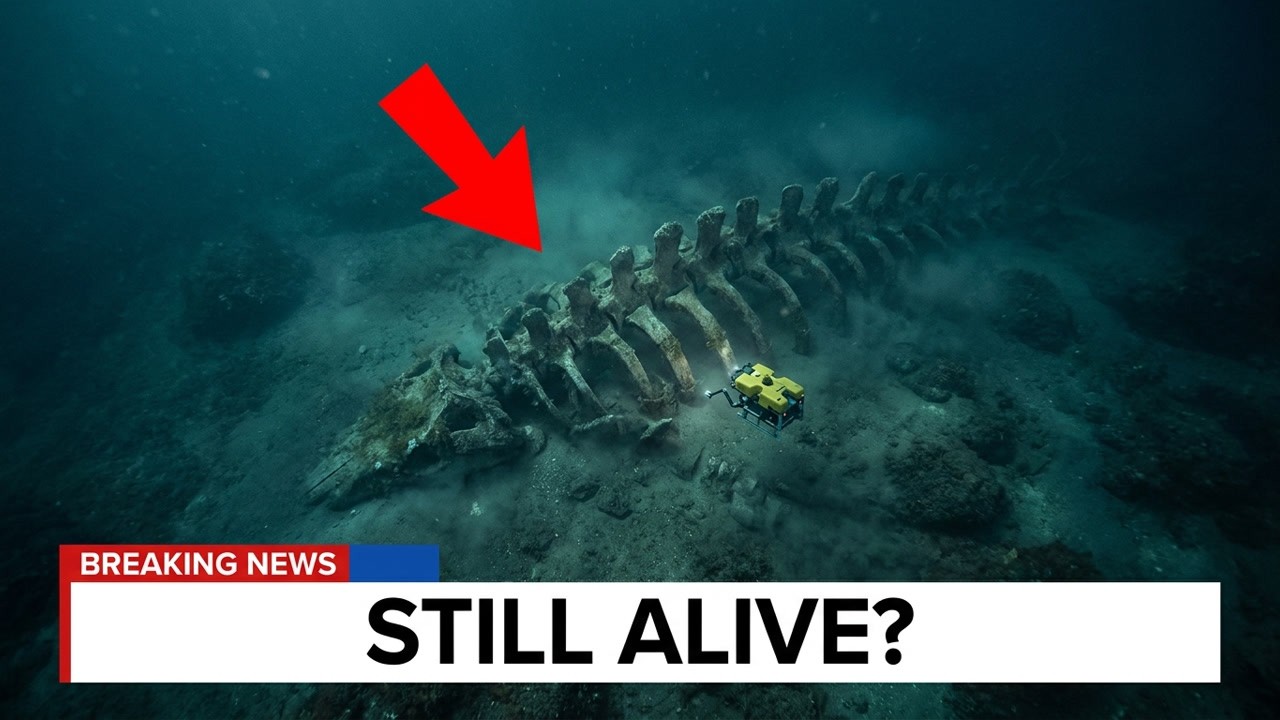
Hours of gray silt and empty water sliding past a camera lens in the cold and the pressure and the endless dark. The operators watch their screens the way night watchmen watch a hallway, waiting for nothing, expecting nothing. Then, on one of those sweeps, the nothing became something. The robot’s light swung across the seafloor and caught, resting in the sediment, a shape that did not belong.
At first it might have read as a ridge of rock, a natural fold in the seabed. But it was too regular, too rhythmic. Segment after segment after segment, marching away into the gloom in a line the camera could barely follow. It was a spine.
An enormous articulated spine, dusted gray with the slow snow of the deep, lying undisturbed on the ocean floor. When they measured it against the vehicle, the pipeline, the known scale of what they were looking at, the number came back staggering: ninety feet. A backbone ninety feet long stretched out in the dark like the keel of a sunken ship. Except no ship has vertebrae.
Think about what a thing like that does to the people watching the feed. These are not monster hunters. They are industrial technicians, engineers, survey specialists, people whose entire job is to identify objects on the seabed correctly and without drama. Here was a skeleton so large that their first instinct was not fear but disbelief, the simple refusal of the eye to accept the size of what the lights were showing.
Whatever had died here had been bigger than almost anything they knew still swam in that sea. And they wanted to know what it was. They brought down a crane and reached for one of the vertebrae, meaning to turn it, to lift it, to see it properly. The moment the steel touched it, the bone came apart.
It did not crack or chip the way old bone sometimes does. It disintegrated, dissolving into a cloud of pale sediment that bloomed up into the lights and then drifted slowly back down into the dark. Whatever had held that spine together had been gone for so long that only the shape of it remained. A ghost of an animal printed into the mud, and the touch of the modern world was enough to erase it.
They had found it and unmade it in the same moment. The footage went where footage like this always goes. It circulated among the small, serious community of people who study the anomalies of the deep. Among the first to see it was a field investigator named Debbie Hatzwell, someone who has spent years cataloging reports that do not fit the tidy boxes.
And to a certain kind of mind, ninety feet of spine on the floor of the Mediterranean pointed at one word: a word that fiction has worn smooth with overuse, but that science treats with genuine caution. Megalodon. Consider why that word even entered the room. In 2022, researchers at a shark institute in the Atlantic were tracking marine life by sonar when they logged a contact that stopped them cold: a single animal reading somewhere between fifty and sixty feet in length.
Nothing they could confidently name should have been that big. Megalodon, the largest shark that ever lived, a predator estimated to have weighed as much as fifty tons with a bite that could crush the rib cage of a whale, is supposed to have vanished from the oceans nearly three million years ago. Supposed to. And here was a sonar return, and a ninety-foot skeleton, and the oldest fear humans carry about the sea: the fear that something down there is still bigger than us.
The Mediterranean of all seas is soaked in that fear. The Greeks who sailed it filled it with monsters. Cetus, the sea beast sent to devour a chained princess. Charybdis, the whirlpool with a hunger that swallowed ships whole three times a day.
The Hydra coiling in its dark water. These were not idle bedtime stories to the people who rode those coasts. They were the shape their terror took when the water turned black beneath the hull. The stories did not stop with antiquity.
In October 1907, fishermen off the coast of Corsica came back to harbor with an account that their neighbors struggled to laugh off. They said a sea dragon, a creature they measured at some two hundred feet, had risen and attacked, thrashing the surface, driving them toward shore. And here is the detail that raises the hair on the back of the neck. The waters where those Corsican fishermen swore they met their dragon sit close to the same stretch of seabed where, a century later, the robot’s lights would find a ninety-foot spine lying in the silt.
The legend and the bones share a map. For a moment the case seems to be closing in one direction. But this is a case file, and the ordinary explanations are owed their day. When the experts weighed in, the dragon began to come apart as surely as that vertebra had.
A researcher named Steinas looked hard at the skeleton and found among the segments the unmistakable geometry of a pelvis. A pelvis is a small word that ends a large theory, because a serpent does not have hips. A sea dragon, a great coiling snake of the deep, has no pelvic girdle, no anchor for legs it never had. Whatever this was, it had the architecture of a limbed animal, not a serpent.
The megalodon idea fared no better. As a shark specialist named Manka pointed out, sharks are built of cartilage, not bone. And cartilage does not lie on the seafloor for ages in a neat articulated line of vertebrae. A dead megalodon does not leave a skeleton like this.
It leaves almost nothing at all. And that dramatic sonar contact, the fifty-to-sixty-foot monster in the Atlantic: on closer analysis, the most likely reading was not a single titan but a tight, dense school of Atlantic mackerel, thousands of small bodies moving as one, painting the shape of a giant across the screen. So the dragon is ruled out. The megalodon is ruled out.
And what stands quietly after the monsters are dismissed is the least cinematic answer and possibly the true one: a whale. A great whale fallen to the seabed at the end of its life, its long spine and its telltale pelvic remnants lying exactly where a whale’s would lie, slowly dissolving back into the sea that made it. The verdict here is not a monster and not a certainty. It is an unknown sea beast, most likely a whale.
And the honest note in the margin admits we cannot be sure, because the evidence turned to dust the moment we reached for it. That is the pattern this whole case file keeps circling. Every time the water offers up its shape in the dark, the shape is real, and the story we hang on it is the thing that dissolves. Consider the last of them, gathered fast, each one a smaller echo of the same lesson.
On the 10th of August 2019, a man standing on a pier at Tynemouth in England watched a dark, wire-like thing hovering just beneath the surface. Then it turned and showed a smooth serpentine body. One investigator, Ghard, half-joked about an underwater alien, something like a stingray or a manta gliding where it should not be. But another analyst, Shutler, noticed edges on the thing that met at ninety degrees, clean right angles that no living animal wears.
And the marine biologist Conger saw the one detail that settles it: there was no wake. Nothing living moves through water without pushing water. The Tynemouth creature drifted with the current, unpropelled. The verdict is floating debris.
One more fragment of the ten million tons of plastic poured into the oceans every year, dressed by the light and our longing into a monster. There is Bownessie, the shape reported in Lake Windermere, England’s largest lake, in roughly ten accounts since around 2010, close enough to a plesiosaur that people whisper the word, especially after 2022, when fossils of freshwater plesiosaurs turned up in ancient Moroccan riverbeds. And there is the creature a Brazilian fisherman filmed off Rio Grande do Sul in 2022, glowing-eyed, following his boat, blamed on everything from a burrowing marine worm to an Amazon River dolphin to a leopard seal, until a forensic analyst named Primo examined the footage and declared it simply fake. So here is where the case file rests: still open, refusing to close.
A twelve-inch mummy awaiting its DNA. A ninety-foot spine that crumbled at a touch. A wake that was not there. Every monster explained.
And yet the water keeps offering shapes, and something in us keeps reaching to name them.
