The photographer steadied his camera against the railing of the small boat bobbing just offshore, raised the telephoto lens, and waited. On the beach at Basil’s Bar, the woman in the swimsuit and the young man in Union Jack trunks were simply sitting together at a table near the water, talking, sometimes silent, comfortable in each other’s presence. It was a moment of pure domestic intimacy, the kind that passes unnoticed a thousand times a day between ordinary couples. Neither of them looked out to sea.
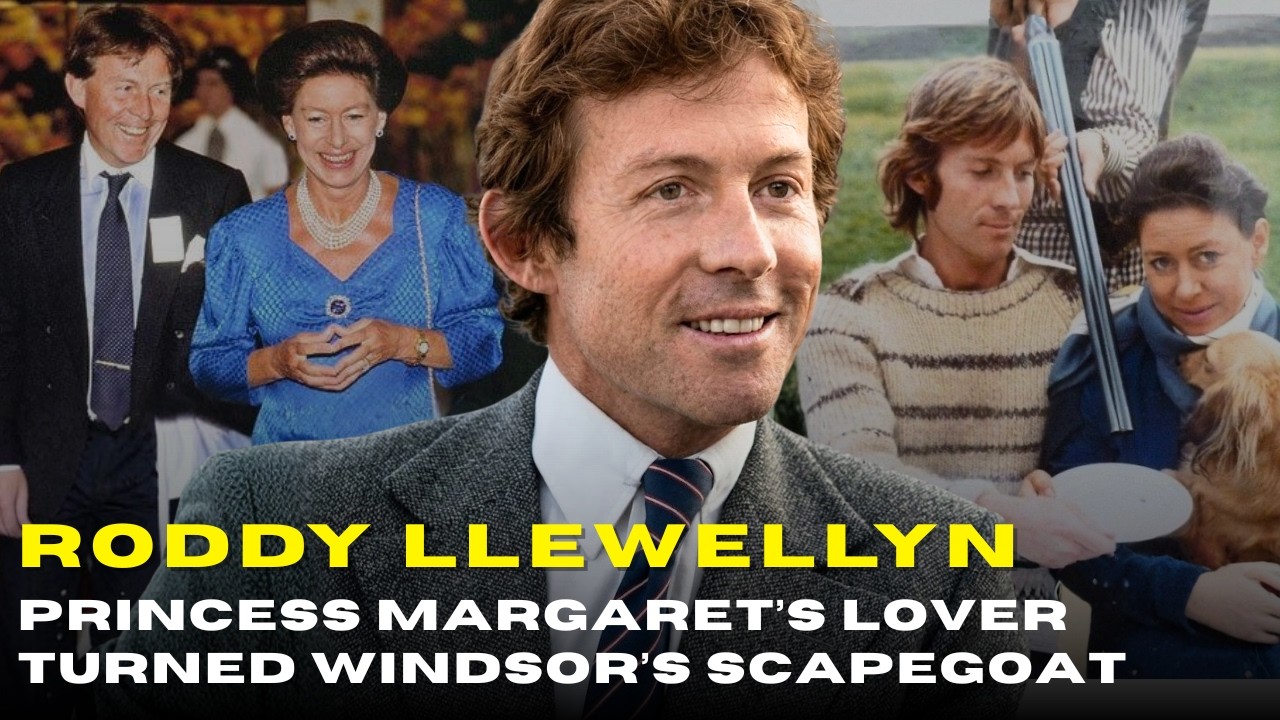
Neither heard the soft click of the shutter. But in that sound, captured on grainy film that would soon be developed in a London dark room, lay the destruction of a marriage, the ruin of a man’s reputation, and the beginning of the end of an era for the British monarchy. The man in the photograph was Rody Llewellyn, a gardener seventeen years younger than the woman beside him, Princess Margaret, the queen’s sister. When the image appeared on the front page of the News of the World on Sunday, February 1st, 1976, it would brand him the toy boy, the most hated man in Britain, the villain who had broken a royal marriage.
But the truth, buried beneath the headlines, was far more complicated. He was not a predator or a schemer. He was the only person in her life trying to keep her alive. By 1973, Britain was a nation buckling under strain.
Strikes and shortages were spreading, and by January 1974 the three-day week would begin, cementing a sense of national crisis. The country was gray, angry, and exhausted. Inside Apartment 1A at Kensington Palace, the atmosphere was even more toxic. Princess Margaret and her husband, Anthony Armstrong-Jones, Lord Snowdon, occupied the official residence, but their marriage had devolved into a domestic war zone of bitter, competitive hatred.
Love had not merely died there; it had curdled. Margaret, once the most desirable woman in the world, the Diana of her day, was now forty-three and staring into an abyss. The porcelain beauty that had captivated the world in the 1950s was beginning to thicken and coarsen under a relentless diet of Famous Grouse whiskey and Chesterfield cigarettes. She was haunted by the memory of Peter Townsend, the love she had been forced to give up for duty, and tormented by the reality of her present.
She had no constitutional role other than to be the queen’s sister, a job description that amounted to little more than cutting ribbons and smiling while bored. But the true source of her misery lay closer to home. Snowdon was a genius photographer, a man of immense charm and talent, but he possessed a streak of cruelty breathtaking in its precision. He knew exactly where Margaret was vulnerable, and he targeted those weak spots with the accuracy of a sniper.
He was bored by royal protocol, resentful of her demands, and openly contemptuous of her intellect. Palace staff walked on eggshells, terrified of the screaming matches that echoed down the long corridors. Snowdon played mind games designed to humiliate her. He arrived late for dinner parties, leaving her frantic with anxiety.
He disappeared for days without explanation. He openly flaunted his affairs. But his most devastating weapon was the notes he left for her to find, nasty, biting little messages tucked into books or drawers. The most infamous, found by Margaret in her glove box, read simply: “You look like a Jewish manicurist and I hate you.
” It was a sentence dripping with snobbery and malice, designed to crush her self-esteem. By 1973, Margaret was a woman flayed raw. She drank heavily to numb the pain. Her mood swings were violent.
She was sliding into a deep depression, a princess in a tower guarded by her own husband. Into this psychological minefield wandered Rody Llewellyn, almost by accident. Born in 1947, he was the younger son of Sir Harry Llewellyn, the Olympic gold medal showjumper who had won fame on his horse Foxhunter. But Rody had inherited none of his father’s competitive drive or military bearing.
He was the sensitive one, the disappointment. He had drifted through Shrewsbury School and a series of abandoned attempts at careers. By his mid-twenties he was living hand-to-mouth in a commune in Wiltshire and later in a squat in London, a gentle hippie who believed in peace, love, and the healing power of nature. He was undeniably handsome, with a slender frame, a curtain of floppy hair, and large, soulful eyes that seemed perpetually slightly sad.
He was aimless, a man without a map. His passion was gardening, not the grand structured landscape architecture of the royals, but the intimate, messy act of putting hands in the soil and making things grow. He was looking for something to nurture, and for someone to nurture him. The collision of these two worlds occurred in the autumn of 1973, through their shared social circle, including the mischievous Colin Tennant, who owned the island of Mustique.
Tennant knew Margaret was miserable and lonely, and he needed a spare man for the weekend to balance the numbers. He invited Rody, not because he foresaw a love match, but because Rody was polite, presentable, and available. Driving to the estate called Glen, Rody was terrified at the prospect of meeting the queen’s sister. Margaret, brittle and on edge, was dreading another weekend of forced jollity.
But when they met, something unexpected happened. It was not the lightning bolt of lust the tabloids would later invent. It was something quieter and far more dangerous. It was recognition.
Margaret looked at Rody and saw a young man devoid of agenda. In a life filled with courtiers who wanted favors, politicians who wanted influence, and a husband who wanted to hurt her, Rody wanted nothing. He was terrified of her title, yes, but he was open, and his gentleness was like a balm to her battered nerves. When Rody looked at Margaret, he did not see the haughty, difficult princess famous for her royal stares.
He saw a woman trembling behind a mask of makeup and jewels, desperate to be told she was beautiful, desperate to be listened to, desperate to be treated with basic human kindness. The defining moment of the weekend came not in a bedroom but over a piano. Margaret, a talented pianist who loved to sing, sat down to play. Usually her performances were endured by guests out of politeness.
But Rody, genuinely moved by the music and lacking the cynicism of the upper classes, sat beside her. He listened. He sang along. He looked at her with adoring eyes.
For the first time in years, Margaret felt seen. The seventeen-year age gap evaporated in that drawing room. In his youth she found a reflection of the girl she used to be, before the disappointments of life hardened her. In her grandeur he found a cause, a person who needed his specific brand of gentle devotion.
By the time the weekend at Glen was over, the dynamic was set. It was not yet a full-blown affair, but the emotional Rubicon had been crossed. Margaret returned to the misery of Kensington Palace with a secret spark of hope. Rody returned to his gardening jobs in London with the bewildering realization that he had connected with the queen’s sister.
They began to meet in London, a courtship conducted in the shadows. Rody would slip past the police sergeants into Apartment 1A, becoming her escape. While Snowdon was out with his mistresses or working in his studio, Rody would sit with Margaret, listening to her pour out her grievances, holding her hand, offering unconditional support. He was the anti-Snowdon.
Where Tony was sharp, Rody was soft. Where Tony was critical, Rody was complimentary. Where Tony was busy, Rody was available. He was a walker, a safe male companion, who evolved into a lover.
To the establishment, he was a terrifying anomaly. He was not an aristocrat. He had no money, no career. He wore velvet jackets and tight trousers.
He was unsuitable in every possible metric. As the relationship deepened into 1974, it began to change Rody. He was no longer just a gardener; he was the keeper of royal secrets. He witnessed the drinking, the tears, the despair, and felt a profound protective instinct toward Margaret.
He stayed, not for money, but because he felt she needed him to survive. Snowdon noticed the change in his wife, the new lightness in her step, the way she hummed to herself. He did not intervene. He watched with cold, calculating satisfaction.
He knew that if Margaret fell in love with this boy, she would be the one to destroy her reputation, not him. He was handing her the rope, and Rody Llewellyn was the knot. London was too dangerous, too watched. They needed a sanctuary, and Margaret knew exactly where to go: Mustique, the tiny speck of rock in the Grenadines owned by Colin Tennant, where she had built a villa on a headland given to her as a wedding present.
As the plane touched down on the humid airstrip in early 1974, Rody believed he was entering paradise, leaving the gray misery of Britain and the toxic atmosphere of Kensington Palace behind. He imagined a life of simple pleasures, swimming, gardening, and loving the woman who had chosen him. Mustique in the mid-1970s was not the manicured playground of billionaires it later became. It was wild, raw, governed by the eccentric whims of Colin Tennant, a place where the rule of law was loose and morals were looser.
The villa, called Les Jolies Eaux, was modest by royal standards, a simple open-plan structure designed to catch the trade winds. Here there were no courtiers whispering in corridors, no press photographers lurking in bushes, or so they naively thought. The rhythm of life slowed to a languid, hypnotic crawl. Rody did not treat the island as a holiday resort.
He treated it as a project. He was not a playboy lounging by the pool; he took up his tools, often working shirtless, sweating in the Caribbean sun, cultivating a garden around the villa. He planted hibiscus, bougainvillea, and oleander. He watered, he pruned, he nurtured, and in doing so, he was metaphorically tending to the princess herself.
Witnesses described a touching scene: the queen’s sister, often holding a cigarette and a drink, following her young lover around the garden, discussing soil pH and pruning schedules with intense seriousness. It was the most normal she had ever been. The dynamic was complex, a relationship of mutual rescue bordering on codependency. Rody, a man who had drifted through life without an anchor, found purpose in being Margaret’s necessary man.
He mixed the drinks, organized the beach picnics, drove the Mini Moke down bumpy tracks to the Cotton House Hotel. When her dark moods descended like sudden tropical storms, he was the only one who could coax her back into the light. He would play the piano, tell gentle jokes, simply sit and hold her hand until the rage subsided. To the outside world he was a kept man, but the reality was starkly different.
Rody had no money of his own. He was living entirely on Margaret’s allowance, which was notoriously tight. She expected him to be available twenty-four hours a day, ending any chance he had of building a career. He was trapped in a golden cage, dependent on her for his flight, his food, his shelter.
He was a prisoner of paradise. Yet he stayed, because he loved her and because he saw the vulnerable, frightened woman beneath the imperious facade, the woman who woke up screaming from nightmares about her father, the king, the woman terrified of losing her looks. He was her nursemaid as much as her lover. The island’s evenings were filled with parties hosted by Colin Tennant, wild affairs where aristocrats mixed with rock stars like Mick Jagger.
In this carnival, Margaret and Rody were the central attraction, performing duets at the piano, singing old music hall songs. There was a desperate quality to their happiness, a sense of dancing on the edge of a volcano. And the volcano was rumbling. Back in London, the year 1975 brought rampant inflation, rising unemployment, and a Labour government under pressure to cut costs.
The civil list, the money paid to the royal family, became a political target. Whispers of Margaret’s decadence were poison in this climate of austerity. Fleet Street knew something was happening, knew the marriage to Snowdon was a sham, knew about the young man in the background, but needed proof. Snowdon played a masterstroke of Machiavellian strategy.
He remained in London, portraying himself as the hardworking, long-suffering husband abandoned by his flighty wife. He knew exactly where Margaret was and who she was with. He did not file for divorce. He waited, giving her enough rope.
The mistake happened in February 1976. The exact mechanics of the setup remain a subject of debate, but the outcome is undisputed: a tip-off was sold, and a freelance photographer was dispatched to the Caribbean. Rody and Margaret had grown complacent. They believed Mustique was impregnable.
On a fateful afternoon, they sat together at a table near the water at Basil’s Bar, a bamboo shack on the sand that served as the island’s social hub. Margaret wore a swimsuit, her skin tanned, her hair loose. Rody wore his Union Jack trunks. They were not doing anything salacious.
They were simply sitting, enjoying the comfort of each other’s presence. Out at sea, a photographer focused his telephoto lens, framed the shot, and pressed the shutter. The image was grainy and unflattering, but it was proof, the smoking gun Fleet Street had hunted for three years. The photographer lowered his camera, knowing he held a stick of dynamite.
The photo made its way back to London, to the dark room of the News of the World, the Sunday tabloid that specialized in destroying reputations. The editors saw gold: the narrative of the princess and the toy boy, the contrast between grim gray Britain and the sun-drenched indulgence of a royal parasite. Oblivious to the machinery grinding into motion, Rody and Margaret remained on their island, savoring the final golden hours of a paradise that had already become a prison. On the morning of Sunday, February 1st, 1976, the News of the World hit the doormats of the nation with a front page that screamed scandal.
The headline was not subtle. The image was undeniable. There, in grainy black and white, was the queen’s sister lounging in the Caribbean sun with a man who was clearly not her husband. In the economically depressed Britain of the mid-seventies, where people were struggling to pay bills, the image of a privileged royal cavorting in paradise with a hippie lover was incendiary.
For Rody, the shock arrived a few days later via a crackling telephone line. The blood drained from his face. The sanctuary was breached. He was no longer Rody the gardener; he was Rody the toy boy, a caricature created for public consumption.
The most immediate and devastating reaction came from Kensington Palace. Snowdon was reportedly devastated when he saw the paper, a performance of Oscar-worthy caliber. In reality, he was liberated. The photograph gave him the moral high ground.
He could now play the victim, the cuckolded husband, without explaining his own serial adulteries. He moved swiftly, engaging his lawyers. Margaret had broken the marriage, not him. Within weeks, on March 19th, 1976, Buckingham Palace issued a cold, historic statement: Her Royal Highness the Princess Margaret, Countess of Snowdon, and the Earl of Snowdon had agreed to live apart.
There were no plans for divorce proceedings, a lie on the last point. Margaret was now officially a woman alone, a separated princess in an era that still viewed marital breakdown with deep suspicion. Rody returned to London to find himself the most hunted man in Britain. Reporters camped outside his home, dug through his trash, harassed his friends.
Because he lacked a proper job, because he was artistic and gentle, he was dismissed as a lightweight, a bit of fluff, a parasite and gold digger. Inside the eye of the storm, Margaret, publicly humiliated and privately devastated, clung to Rody like a drowning woman to a raft. He became her only ally, the default man of the house at Kensington Palace. From 1976 to 1978, they lived in intense, claustrophobic intimacy.
Rody was living in a royal palace, but he was a prisoner. He could not go out without being mobbed, could not work without being mocked. He was financially dependent on a woman facing her own financial crisis. He was twenty-eight, an age when a man should be building his own life, yet entirely subsumed by hers.
Perhaps driven by a need to earn his own money, or misguided by hangers-on, Rody decided to launch a pop music career. In 1978 he released an album simply titled Rody. The music was unfortunate, a collection of standard love songs sung in a thin, reedy voice that wavered between sincerity and parody. He appeared on television singing in French, looking terrified.
The press flayed the man, not just the music, treating the album as proof of his vanity and opportunism. “Don’t cry for me, Princess Margaret,” mocked the headlines. Margaret supported him publicly, but watching her lover become a national laughingstock was a bitter pill. Yet despite the mockery and pressure, they stayed together, because amidst the chaos they offered each other the one thing nobody else did: kindness.
The stress of the divorce, finalized in 1978, making Margaret the first senior royal to divorce since Henry VIII, took a terrible toll on her health. She smoked more, drank more, developed hepatitis and severe gastroenteritis. Her beauty began to fade rapidly. Rody became her nurse, sitting by her bedside for hours, reading to her, tolerating her temper tantrums.
He understood her rage was directed at a life that had disappointed her at every turn. In return, Margaret gave him a sense of belonging, loving him fiercely and defensively. By the late 1970s, the cracks were becoming canyons. Rody, now in his early thirties, wanted a life: a wife, children, a career that did not involve being Mr.
Margaret. Margaret, with a sharp intuition, saw it too, saw him looking at younger women, saw the longing when he talked about friends getting married. She knew she was holding him back, the glittering anchor drowning him. In 1980, Rody met Tanya Soskin, a fashion designer who was young, creative, age-appropriate, and not royal.
He fell in love, a healthy, uncomplicated love he had been starving for. The conversation where he told Margaret was arguably the bravest thing he ever did. He went to her, looked the woman who had dominated his life for eight years in the eye, and told her he had met someone else and wanted to marry Tanya. Margaret’s reaction defied every expectation.
The woman famous for her haughtiness did not scream or throw him out. She looked at him and saw the truth, that she had consumed enough of his life. “I am very happy for you, Rody,” she said, and she meant it. It was an act of supreme grace.
In letting him go, she proved she loved him more than she loved possessing him. She released him from the tower. Rody Llewellyn walked out of Kensington Palace a free man, battered and bruised but alive. He had survived the royal fire.
But as he would soon discover, you can leave the palace, but the palace never truly leaves you. The year 1981 is remembered for the wedding of Prince Charles and Lady Diana Spencer, a fever dream of carriage rides and silk taffeta. But while the world’s eyes were fixed on St. Paul’s Cathedral, a quieter, more successful union was taking place in the shadows.
Rody announced his engagement to Tanya, and the press treated it as the season finale of a soap opera, desperate for a sign that Margaret was furious. They did not get it. Margaret invited Rody and Tanya to lunch, charming and warm to the woman who was effectively replacing her. She stayed away from the wedding, her absence her wedding gift.
On July 11th, 1981, just weeks before Charles and Diana’s spectacle, Rody and Tanya were married. They moved to the countryside and started a family, three daughters. Rody reclaimed his identity, launching a successful landscape gardening business, writing books and columns about plants. He built a life of profound, beautiful normality.
Meanwhile, back at Kensington Palace, the lights were slowly dimming for Princess Margaret. Without Rody’s stabilizing presence, her demons returned. She smoked sixty cigarettes a day and drank Famous Grouse as if it were water. In 1985 she underwent surgery to remove part of her left lung, a terrifying echo of the cancer that had killed her father.
The public perception shifted; she ceased to be the glamorous rebel and became a figure of pity, a grumpy aunt in the corner, forgotten as the original Diana. But Rody did not forget. He and Tanya became regular visitors to Kensington Palace, a bizarre modern dynamic the courtiers could not comprehend: the ex-lover, his new wife, and the princess having tea together. Rody continued to be her confidant from a safe distance, watching the loneliness engulf her.
He offered her a window into the normal world, telling her about his daughters, his garden designs, the simple troubles of a mortgage and school fees. In the frenzied media market of the nineties, Rody was offered fortunes to tell his story, a tell-all book that would have been a bestseller. He never did. He never spoke a word.
In an era where James Hewitt sold his story about Diana and Sarah Ferguson was caught in stings, Rody kept his mouth shut, understanding that his silence was the only thing that protected the dignity of what they had shared. As the millennium approached, Margaret’s decline accelerated. In 1998 she suffered a mild stroke. Then, while holidaying on Mustique, the very island where she and Rody had been happiest, she stepped into a scalding bath and severely burned her feet.
The injury left her wheelchair-bound and in constant pain. Rody visited her. When he walked into the room, staff noticed the princess would brighten. He was a living link to her golden summer, proof that she had once been loved, not for her title, but for herself.
In 2001, further strokes left Margaret partially paralyzed and struggling to speak. She made her last public appearance at the Queen Mother’s 101st birthday in August 2001, seated in a wheelchair, tiny, frail, and infinitely sad. In February 2002, the phone rang in Rody Llewellyn’s home. Princess Margaret, Countess of Snowdon, was dead, passed away peacefully in her sleep at the age of seventy-one.
For Rody, it was the final severance of his youth. He was no longer the toy boy; he was the keeper of the memory. On February 15th, 2002, the great iron gates of Windsor Castle swung open for Princess Margaret’s funeral. Inside St.
George’s Chapel, the congregation was a roll call of the British establishment. Amidst the sea of black coats, one figure stood out not for his rank but for his quiet presence. Rody Llewellyn sat toward the back, away from the immediate royal circle, fifty-four years old, his once wild hair silvered and trimmed. He had faced the cameras, knowing the whispers.
There he is, the gardener, the man who ruined everything. But he stood with his head held high, singing the hymns she had loved, mourning not a princess but a person, Margo, the vulnerable, funny, difficult, deeply loving woman he had held while she cried. In the years that followed, royal gossip exploded into the internet age. Former butlers and bodyguards lined up to sell their stories.
Publishers approached Rody with blank checks. He refused them all, giving no interviews, appearing on no talk shows. When he spoke of her, which was rare, it was always with gentleness. “I didn’t think about the consequences of such a high-profile affair,” he once said to a journalist.
“I just followed my heart. ” His silence forced the public to re-evaluate the story. If he was not a gold digger or a fame seeker, then what was he? The answer, which slowly dawned on the British public, was uncomfortable: he was exactly what he appeared to be, a decent man.
This reassessment mirrored a broader reassessment of Margaret herself. People began to see her not as a villain but as a victim of a system that had no place for her, the spare heir with an artistic temperament trapped in a cage of duty. Her relationship with Rody took on a different hue, not a sordid fling but a desperate human attempt to find happiness. Rody’s legacy is quietly woven into the fabric of the modern monarchy.
By breaking Margaret’s marriage, he broke the taboo of royal divorce. When Charles divorced Diana, when Andrew divorced Sarah Ferguson, when Anne divorced Mark Phillips, they all walked through the door Rody and Margaret had kicked open in 1976. He proved it was possible to touch the fire of royalty and not be consumed by it. Peter Townsend died in exile, forever defined by what he lost.
Diana died chased by paparazzi. Rody survived. He remained happily married to Tanya, watched his daughters grow up, continued to garden, finding peace in the rhythm of the seasons. In 2002, shortly after Margaret’s death, Rody was asked if he had any regrets.
He paused for a long time. “No,” he said softly. “I regret nothing. She was a wonderful woman and I loved her.
” Today, that infamous photograph from 1976 looks different. It does not look scandalous anymore. It looks nostalgic, a moment of fleeting freedom. A woman relaxed, her shoulders dropped, a smile playing on her lips, and a young man looking at her with pure, uncomplicated adoration.
History will remember Rody Llewellyn as the toy boy. But those who know the truth remember him as the gardener, the man who found a wilting, neglected rose in the hothouse of Kensington Palace and, for eight turbulent, beautiful years, gave it enough light to bloom one last time. He did not break the princess.
He held her together for as long as he could, and when he could no longer hold her, he let her go with grace and kept her secrets until the end.
