In the autumn of 1931, a young doctor named Thomas Garrow sat in a city hospital, exhausted in a way that sleep could not touch. He was working wards that echoed day and night, and he had reached the kind of tiredness that makes a man reach for anything else. In a box of papers nobody wanted, he found an old staff list, and on it, a name. Edith Marrow.
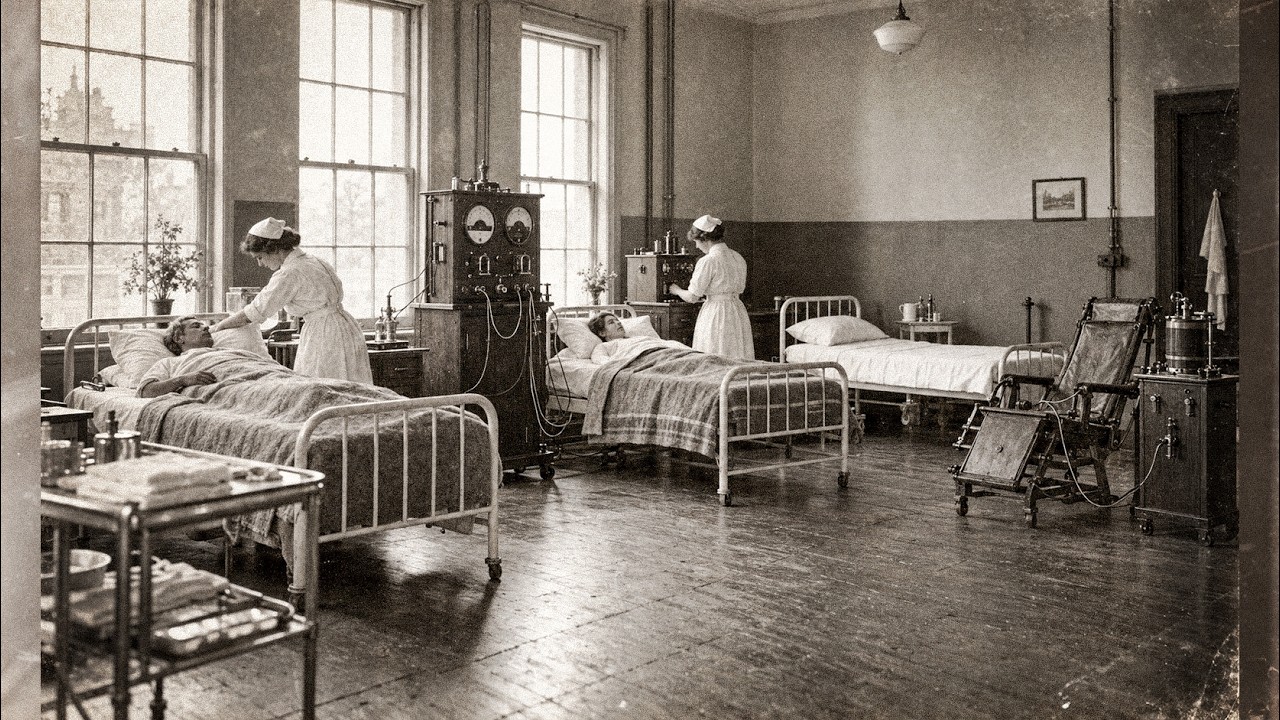
On a whim, he wrote to her. She was seventy-eight years old, and she wrote back six times. The last line of her first letter she underlined twice. “The building did the nursing.
We only kept it in tune. ”
The viewer who sent this story in was Garrow’s grandson. He found all six letters last spring in a cardboard folder in his grandfather’s desk, tied with surgical tape, and he photographed every page. The folder held something strange: six envelopes, but only five letters.
The fifth envelope carried Edith’s handwriting and a postmark from the summer of 1931, but no letter inside. In letter four, she had promised to explain the one room she had never described, the room the nurses called the low room. Letter five should have been that explanation. Instead, the envelope held something wrapped in a piece of gray flannel.
Edith Marrow was born in 1853 and trained as a nurse in the years just after Florence Nightingale’s reforms began changing the profession. In 1876, she took a post at a hospital called St. Cecilia’s, in the hills of Herefordshire close to the Welsh border. St.
Cecilia is the patron saint of music, and Edith insisted that was not an accident. A wealthy widow had paid for the hospital, her name kept off every plaque and document by the trustees. And it was designed, Edith wrote, by a man who knew more about bells than about drains. It did not look like any hospital you have seen.
The wards were round, each under a stone dome, beds arranged in a ring, heads toward the stone, feet toward the center. There were no corners anywhere. The walls were dressed stone, not brick, and the domes were built from a pale local sandstone that Edith said rang faintly if you tapped it with a knuckle. All six wards opened onto a long curved corridor that ran into a tall central hall.
In the center of that hall, hanging from a great oak frame, hung a bronze bowl as wide as a cartwheel. On her first day, the matron took Edith into an empty ward, closed the door, and told her to hum. Not a tune, just a note, low, held for as long as her breath would last. Edith did, and felt nothing.
The matron told her to go lower, then a little higher, then lower again. And then, Edith wrote, the room answered. The note she was humming suddenly swelled, as if the dome had joined in, until it seemed to come from the stone itself rather than from her. The matron nodded.
“That’s the room’s voice,” she said. “Every room has one. Find it and you’ll never need to raise your own voice in it again. ”
That was the first rule of St.
Cecilia’s. Every ward had its note, and the nurses learned it. When they spoke at night, they spoke on that note, low and steady, and the dome carried their voices softly to every bed without anyone having to whisper or shout. Every nurse carried a small steel tuning fork in her apron pocket, tuned to her own ward.
Before changing a dressing, or setting a broken bone, or sitting with a frightened patient, they struck the fork against their palm and held it near the bedhead where the stone would take up the hum. Every evening at dusk, the matron struck the great bowl in the central hall. Edith described the sound the way you might describe a sunset seen ten thousand times and never gotten used to. “The sound didn’t come at you,” she wrote.
“It came through you. ” It rolled down the curved corridor and into every ward, and each dome caught it and gave back its own note, so that for a minute or two the whole building seemed to breathe in one long chord. Patients who had not slept in days slept within the hour. Men who had been shaking stopped shaking.
The dying, she said, often asked to be moved closer to the hall. For the very last days, there was the low room. In letter four, Edith gave it only a paragraph, as if even writing about it made her careful. It sat at the end of the curved corridor, below the level of the other wards, down seven stone steps.
It was smaller and darker, and its dome was lower, close enough that a tall nurse could touch it. Only the matron and the two most senior nurses were allowed to take a patient there. “Nobody died afraid in the low room,” Edith wrote. “That’s all I’ll say until I can say it properly.
”
That was the promise for letter five. The envelope came with nothing inside but a piece of gray flannel. And here is the strangest part: the nurses who worked the low room did not carry ordinary forks. They carried one fork each, older than the others, that had come with the building, and they were never allowed to take them home.
Except, it seems, once. Then Edith wrote the sentence that may be the key to everything else in these letters. “We never cured anyone with it. That isn’t what it was for.
Medicine mends the body. The building was for the part of a person that medicine can’t reach. ”
She was not a crank selling miracles. She was a trained nurse who believed in the medicine of her day, in carbolic and clean linen and fresh air.
She said plainly that St. Cecilia’s had its doctors and its operating room like any other hospital. What she described sat alongside all of that. Not a cure.
A kind of care built into the stone. In all her letters, she never once claimed more for it than that. The building had a reputation far beyond the hospital. The people in the villages below called it the singing house.
Decades after it was gone, an old shepherd in that valley told a walker that on still evenings when he was a boy, you could hear the house sing from two miles away. In a different village, a different elder said almost the same thing years later. On a still night, you could hear the house put the sick to bed. The official history of medicine draws a line.
The modern hospital was built on germ theory, on light and air and clean water, on Florence Nightingale and Joseph Lister. Sound in medicine is a folk superstition at worst and a pleasant extra at best. Music therapy as a profession was invented in the 1940s, after the Second World War. Before that, nobody designed a hospital to be heard.
The first person to contradict that line is Florence Nightingale herself. In 1859, in Notes on Nursing, she gave noise a chapter of its own, and wrote that unnecessary noise is the most cruel absence of care which can be inflicted either on sick or well. The founder of modern nursing, in the founding text of modern nursing, put the sound of a sick room at the very top of her list of cruelties. Edith trained in the generation that read those words as scripture.
St. Cecilia’s was built in the same decade. Go back further. In ancient Greece, the sick traveled to the temples of Asclepius, the god of healing.
The greatest of them was at Epidaurus in the Peloponnese. Patients bathed, fasted, then slept in a sacred hall, waiting for the god to come to them in a dream. Music and hymns were part of the ritual. And inside that same sanctuary, a short walk from the hall where the sick slept, the Greeks built a theater.
The theater of Epidaurus still stands today, famous above all for its acoustics. Drop a coin on the stage and the sound carries to the back row, more than fifty meters away. A building designed with almost impossible precision for sound, standing in the grounds of a hospital. Thousands of years before Epidaurus, people in Ireland built Newgrange, a great stone passage tomb older than Stonehenge and older than the pyramids of Giza.
In Malta, people carved the Hypogeum of Hal Saflieni, a labyrinth of chambers cut deep into the rock. In the 1990s and since, acoustic researchers have taken equipment into chambers like these and found something odd. They resonate strongly and at low frequencies, often around 110 to 120 vibrations per second, roughly the range of a low adult male voice. Hum the right note inside them, and the stone hums back.
Every room has a voice. That is what the matron told Edith in 1876. And here were rooms built five thousand years earlier that seem to have been built around one. Nobody knows exactly what those chambers were for.
Tombs, temples, places of gathering. But the same thought keeps returning. If you wanted to build a room where the dying could be comforted, where grief could be held, where frightened people could be calmed by a sound that seemed to come from the earth itself, you would not build it any differently. In 1915, the hospital was asked to take soldiers.
Not the wounded, Edith says, but the other kind. The ones the army called shell-shocked. Men who had come back from the trenches unable to speak, or unable to stop shaking, or unable to sleep without waking up screaming. St.
Cecilia’s took them. And the building did for those men what it had always done for the dying. The evening sounding came down the corridor, the domes took it up, and men who had not slept since the Somme slept through the night. Slowly, over months, some of them began to talk again.
Edith was proud of that. And it was exactly what ended the hospital. The army was not interested in men who healed slowly. In those same years, the British authorities were under enormous pressure to get shell-shocked soldiers back to the front.
Some of the treatments used to do it are documented and brutal. At the National Hospital in London, a doctor named Lewis Yealland treated mute and paralyzed soldiers with powerful electric shocks applied for hours, until the men spoke or moved. He wrote up his own cases in a book. The aim was speed.
A soldier who could walk was a soldier who could be sent back. St. Cecilia’s was the opposite of that. Edith says an officer from the War Office came in 1917, walked the wards, listened to the evening sounding, and asked the matron how many of her men had been returned to duty.
She told him the truth. Very few. He left without a word. Within months, the hospital’s soldiers were transferred elsewhere.
In 1919, St. Cecilia’s was closed. Edith wrote down what the matron said on the day the letter came. “They don’t want men mended.
They want men sent back. ”
The official explanation is simple and on paper. After the war, a small private hospital in the hills with odd round wards was expensive to run and out of date. The trustees sold the land.
In 1923, the buildings were pulled down and the stone was sold to builders. But the great bronze bowl? Edith says it was the first thing taken, before the roof came off, and nobody would tell her where it went. “They took the bowl first,” she wrote.
“That’s how I knew they understood what it was. ”
The pattern repeats with unsettling precision. A healing sanctuary with a theater tuned so finely that a coin drop carries to the back row. Stone chambers five thousand years old that hum back at a human voice.
Florence Nightingale calling noise the cruellest absence of care. And a hospital in the Welsh hills that sang its patients to sleep, shut down by men who wanted soldiers returned. The same three steps every time. Call it superstition.
Pull it down. Invent it again later and call it new. That is exactly what happened next. In the 1940s, after the Second World War, musicians began playing in veterans’ hospitals in the United States, and doctors and nurses noticed that the men they played for slept better, spoke more, and needed less to settle them.
It was hailed as a discovery. In 1944, Michigan State College set up the first university degree in music therapy. The profession was born, and its history books start there, as if nobody had ever thought of it before. Thousands of years of tuned rooms.
Nightingale’s chapter on noise. Forty-three years of a hospital that sang. And the history begins in the 1940s. Think about what that would take.
Priests of Asclepius, Victorian trustees, the War Office, the founders of modern medicine, across different centuries and different countries, and every time the same result. Whatever the old builders knew about sound and care gets lost, or pulled down, or quietly left out of the textbooks, until someone rediscovers a small piece of it and calls it new. Who benefits from a hospital that doesn’t sing? A hospital like St.
Cecilia’s was slow. It was built around rest, around sleep, around time. Its whole purpose was to give people back the part of themselves that pain and fear had taken. But a war needs men returned, not rested.
An industry needs beds turned over, not slept in. And a new kind of medicine, the kind that measured everything it did, had no column in its ledgers for a sound that made people feel safe. You can’t bill for a chord. You can’t send a sleeping man back to the trenches.
Edith was a nurse. She believed in medicine her whole life. But a whole way of caring for people built into stone was pulled down at exactly the moment the people in charge had no use for it. Unless the forgetting was the point.
Edith knew what they took first. The bowl. At the end of her sixth and last letter, Edith asked Thomas Garrow something. Do they still teach you to listen to a room?
He was a doctor in a modern city hospital in 1931, with electric lights and steel beds and corridors that echoed day and night. He wrote the answer on the back of her envelope in pencil, and the viewer found it there. No, they don’t. But look at what has happened since.
Hospitals today measure noise. They have had to. Research over the last few decades has shown how badly noisy wards disrupt patients’ sleep, and the World Health Organization recommends hospital patient rooms be kept at around thirty to thirty-five decibels, about the level of a quiet whisper. Most hospitals are far louder.
And all over the world, music therapists now work on cancer wards, in intensive care, in hospices, sitting at bedsides with the dying, doing what Edith did with her tuning fork. The pattern repeats with unsettling precision, only now in reverse. Every time someone measures what a quiet, resonant room does to a frightened person, they find what Edith already knew. And the old rooms are still there.
Newgrange still hums. The theater at Epidaurus still carries a coin dropped on its stage to the back row. Cathedrals still have whispering galleries. Every one of them has a voice.
Now go back to the empty fifth envelope and the thing wrapped in gray flannel. It is a tuning fork. Small. Steel.
Worn smooth where a hand held it for years. It was Edith’s, from St. Cecilia’s. Stamped into the side, so faint you can only see it under a lamp, there is a number.
110. And wrapped around the stem of the fork, on a strip of paper no wider than a finger, there is one line in Edith’s handwriting. Strike it somewhere quiet. It will tell you the rest.
The viewer did exactly that. He drove to the valley in Herefordshire where the hospital used to stand. Nothing is left of St. Cecilia’s now, just a field and a line of old stones along one hedge.
But at the bottom of the valley there is a small stone chapel, much older than the hospital. He went inside, closed the door, struck the fork against his palm, and held it near the wall. He says the chapel answered. The note swelled until it seemed to come from the stone itself.
He stood there for a long time after it faded. 110. Roughly the note acoustic researchers keep finding when they measure those five-thousand-year-old chambers. The low room was never a room at all.
It was a note. And Edith didn’t describe it in letter five because she couldn’t. She could only send it. Do they still teach you to listen to a room?
Not in medical school. But the rooms are still listening. They have been waiting a very long time for someone to hum. There is no conclusion.
Only a question much bigger than one hospital in the hills. Who was the widow who paid for St. Cecilia’s? Why was her name kept off everything?
Where did the great bronze bowl go? Why was it the first thing taken? How did builders five thousand years ago find the same note Edith carried in her apron pocket? Why does the history of healing with sound begin in the 1940s when Nightingale was writing about it in 1859?
And how much of what we call new in medicine is really something old that somebody pulled down? A seventy-eight-year-old woman wrote at her kitchen table to a tired young doctor who couldn’t sleep, about a building that had been gone for eight years. The domes are rubble now, in the walls of barns and farmhouses across the border country. The bowl is lost.
The wards are a field. But somewhere in that valley, there are still stones that hum when you find their note. And a fork in a cardboard folder that still knows it. Edith always said she was never the one doing the healing.
The building did the nursing. We only kept it in tune.
