In April 1985, a Buckingham Palace spokesman stood before the British press and delivered two sentences that should not have been able to exist in the same statement. The first: Princess Michael confirmed tonight that it is true that her father was a member of the SS. The second, immediately following it: the news came as a total surprise to her and a total shock. Read them again.
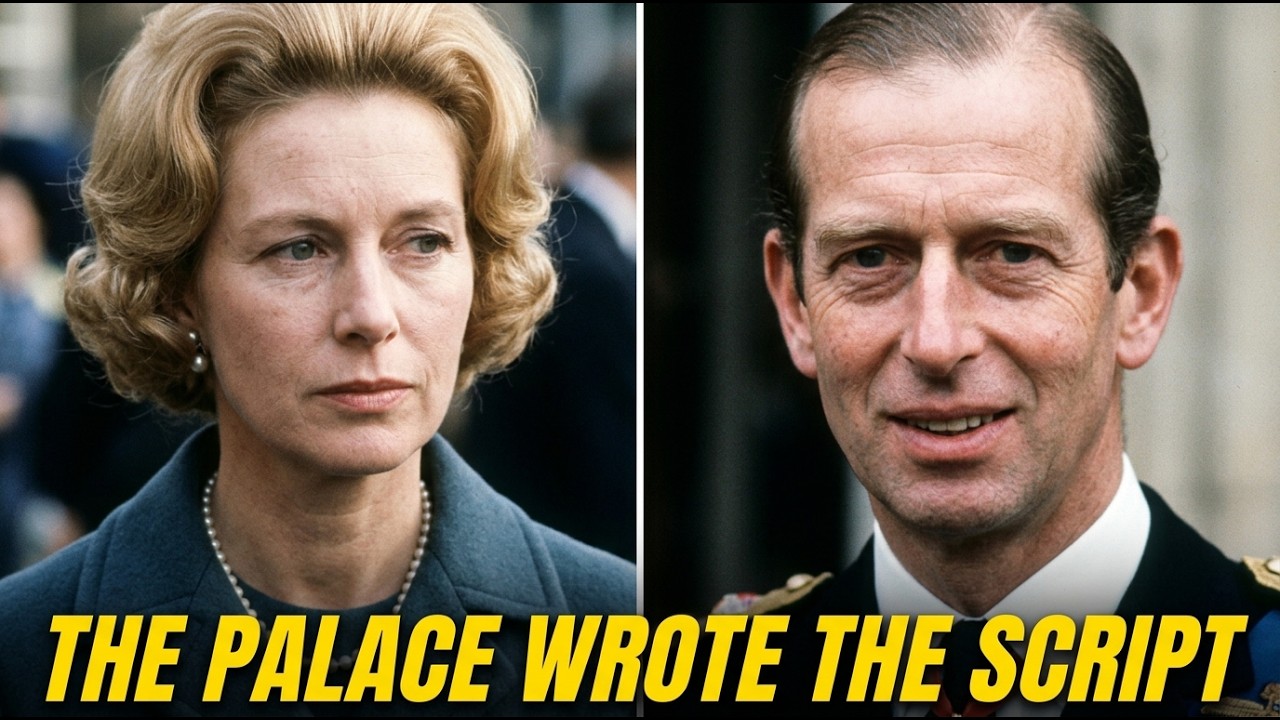
She confirmed it, and she was also totally surprised by it. She knew enough to confirm the story the Daily Mirror had just published, and she simultaneously had no idea the story was true. The Mirror called the statement unbelievable. They were being polite.
The historian Philip Hall had found the evidence at the Berlin Documentation Center years before the Mirror published anything. He found that Baron Günther von Reibnitz, Princess Michael’s father, had joined the Nazi Party in 1930 and the SS in 1933. He rose to the rank of major. He obtained his SS position on the recommendation of Hermann Göring, Adolf Hitler’s right-hand man.
Hall had found all of this while researching a book about the royal family. He said afterward: “It struck me that someone was covering something up. ”
The royal family had vetted Marie-Christine von Reibnitz before allowing Prince Michael to marry her in 1978. They vetted every potential spouse.
This was not optional. This was the institution. And genealogists who examined the process afterward were explicit: the royal family had almost certainly found what Hall found. They had found the SS files.
They had found the Nazi Party membership. They had found the Göring connection. And they had approved the marriage anyway. Seven years later, when the Mirror published the files, the palace produced the statement about the total surprise and the total shock.
In doing so, the palace produced the statement that the palace had been managing this marriage’s most dangerous secret since before the marriage began. That was one secret. There were others. There was the matter of the Kensington Palace apartment the couple lived in for decades.
The palace told the public they received no public funding. They were not working royals. They supported themselves. The House of Commons eventually discovered they were paying £69 per week in rent, while the Queen quietly covered the difference from her private funds—£120,000 per year—while the palace maintained the fiction of the independent couple managing without institutional support.
There was the matter of Prince Michael’s business operations. In 2021, Channel 4 and the Sunday Times sent undercover reporters posing as South Korean gold investors to meet him. He offered them his royal endorsement for $200,000 and his Kensington Palace home as a backdrop to impress clients. His business partner, the Marquis of Reading, explained the arrangement: “We wouldn’t want the world to know that he is seeing Putin purely for business reasons, if you follow me.
”
Princess Michael had her own contributions to the marriage’s public record. There was the 2004 incident in a New York restaurant, where she was accused of telling a group of black diners to “go back to the colonies. ” There was the 2017 Christmas lunch where she arrived to meet Meghan Markle wearing a blackamoor brooch—a stylized image of a black man’s head—and later apologized for causing offense. There were the two black sheep she kept at her country property, which she had named Venus and Serena.
She once told an interviewer: “I have more royal blood than any other bride or bridegroom who has married into the royal family since Prince Philip. ” Her nickname in the British press was Princess Pushy. This is the marriage that the palace approved. Prince Michael of Kent was born on the 4th of July 1942 at Coppins, the Kent family’s country house in Iver, Buckinghamshire.
He was the third child of Prince George, Duke of Kent, and Princess Marina of Greece and Denmark. The Duke of Kent was the fourth son of King George V, the younger brother of Kings Edward VIII and George VI, and the first cousin of the Duke of Windsor, who had abdicated in 1936 to marry Wallis Simpson. Prince George died in August 1942, six weeks after Michael’s birth, in an air crash near Dunbeath in Caithness, Scotland, when the Short Sunderland flying boat he was traveling in struck the hillside of Eagle’s Rock in conditions of low cloud and poor visibility. He was 39 years old.
The crash killed 14 of the 15 people aboard. Michael grew up at Coppins and at Kensington Palace, the younger brother of Edward, Duke of Kent, and Princess Alexandra. He was not in the line of succession in any practical sense—15th in 1978, when he married. He was educated at Eton and at the Royal Military Academy Sandhurst.
He served in the army for twenty years, in Germany, Hong Kong, and Cyprus. He spoke French, German, and Russian—the Russian learned in the military, in the context of the Cold War’s intelligence requirements. It was a language that would become the most consequential of his life. The military career ended in 1981, leaving him a former officer, a peripheral royal, and without institutional income.
He had to find another way. The finding of another way became the project of the subsequent decades: commercial consultancy, Russian connections, and the commercial deployment of the royal name, Kremlin access, and the Kensington Palace address as a backdrop for investment pitches. The marriage required a woman. The finding produced Marie-Christine von Reibnitz, who was in London in the early 1970s.
Prince Michael noticed her in 1973. The noticing was the beginning of a five-year courtship, complicated by the institution’s assessment of the available bride. Baroness Marie-Christine Anna Agnes Hedwig Ida von Reibnitz was born on the 15th of January 1945 in Tachov, then part of the Greater German Reich, now the Czech town of Tachov. Her mother, Countess Maria Anna Szapáry von Mura-Szombath, had just been released from a Nazi prison camp on the day of Marie-Christine’s birth.
The countess had been arrested for participating in an anti-Nazi demonstration. Her father, Baron Günther von Reibnitz, was on the day of her birth being held as a prisoner of war. He had joined the Nazi Party in 1930, three years before Hitler came to power, and the SS in 1933, on the recommendation of Hermann Göring. He had risen to the rank of major.
But the relationship between her parents was more complicated than the simple pairing of a Nazi father and an anti-Nazi mother. Her mother married him believing his first marriage had been properly dissolved. It had not been. When this became clear, and when her devout Catholicism prevented her from continuing in a marriage the church did not recognize as valid, the relationship broke down.
Her father had been dismissed from the SS in 1944 for writing to Heinrich Himmler that he would choose the church over the SS. After the war, he was tried by a Bavarian denazification court in 1947, classified as a lesser offender, appealed, and was reclassified as a mere follower. He then left for Africa—first Mozambique, then several other countries, acquiring two more wives in the process—and spent the remainder of his life at a considerable distance from the daughter whose marriage to the Queen’s first cousin would eventually require the palace to produce the statement about the total surprise and the total shock. Marie-Christine grew up without him.
Her mother took her and her older brother Friedrich to Australia, where Sydney became the location for the reconstruction of a life. The mother eventually remarried a Polish nobleman. Marie-Christine attended schools in Austria and Australia, lived in Mozambique where her father had settled, and arrived in London in her early twenties. She enrolled at the Victoria and Albert Museum to study the history of fine and decorative art—the specific course of study her formation had identified as the appropriate intellectual engagement.
She was tall, blonde, of the central European aristocratic type. She moved through London’s social world with the ease of someone who had been reading and managing available social environments since the displacement of 1945. In September 1971, at 26, she married Thomas Troubridge, an English merchant banker, the son of a baronet. The marriage did not last.
The Catholic Church granted an annulment in 1978—in the specific month before the marriage to Prince Michael that the annulment was organized around making possible. Prince Michael was 31 in 1973. Marie-Christine was 28. They were in the room.
They noticed each other. The five years between the meeting and the 1978 marriage were not an ordinary courtship. They were five years of institutional management of obstacles. The first obstacle was the Catholic faith—the Act of Settlement of 1701 prohibited a person who married a Catholic from succeeding to the throne, requiring Prince Michael to renounce his succession rights.
The second was the divorce—the royal family had been managing that particular obstacle since the abdication of 1936. The third was the background—the files at the Berlin Documentation Center that Philip Hall would subsequently describe as the evidence that someone was covering something up. Lord Mountbatten was the intermediary. He was Prince Philip’s uncle and a distant relation of the monarch.
He had been deployed in this capacity before. He managed the Queen’s reservations—about the Catholic faith and the divorce—in the direction of approval. The approval eventually took the form it took: the renunciation of the succession rights, the papal annulment of the first marriage, and a civil ceremony in Vienna on the 30th of June 1978, rather than a Church of England ceremony in London. Prince Michael was 35.
Marie-Christine was 33. She received the title of Princess Michael of Kent—the designation of the institution’s membership, replacing the designation of the person’s own formation: Baroness Marie-Christine Anna Agnes Hedwig Ida von Reibnitz, daughter of the SS major, born in what was then the Greater German Reich. The covering was proceeding smoothly. The SS files were in the Berlin Documentation Center.
The palace knew about them. The palace had decided they were manageable. The Daily Mirror had not yet found them. She was very good at performing the cover story subject.
The performance was called Princess Michael of Kent. It was also called Princess Pushy. The nickname arrived before the decade was out. It named the quality of the person who was conscious of the performing and who was deploying it in the direction of the institutional position’s maximization rather than its maintenance.
She attended events. She organized events. She was by several accounts of the period the most immediately visible person in the room. The Queen found this difficult.
Princess Michael quoted in an interview the assessment she attributed to Lord Mountbatton: that she was more royal than the royals. She found it amusing. She also said, in a separate interview: “I have more royal blood than any other bride or bridegroom who has married into the royal family since Prince Philip. ” The institution is always organized around managing its members’ statements about their own positions in the direction of discretion.
The explicit statement was the explicit statement the institution was organized around preventing. She wrote books about European royalty, beginning with Crowned in a Far Country in 1986—genuinely researched and genuinely written, noted the critics, with surprise. She described herself as an interior designer. The Kensington Palace apartment—large, at Kensington Palace—was the showcase.
It was costing £69 per week in rent. The House of Commons Public Accounts Committee would discover that in 2002, establishing that the market rate was considerably in excess of £69 per week, and that the Queen was paying the difference from her private funds: £120,000 per year, in recognition of the royal engagements and charity work the couple was undertaking at their own expense. The civil list had never included Prince and Princess Michael of Kent. They were not working royals.
They were managing without the public funding—with the Queen’s private funds. The Daily Mirror published the story on the 15th of April 1985. The story was about Baron Günther von Reibnitz, who had died two years earlier. The facts were his Nazi Party membership from 1930, his SS membership from 1933, his rank of major, his connection to Hermann Göring, and the additional allegations from Simon Wiesenthal—the Nazi hunter—that the baron had been involved in the Lebensborn program, the SS program Heinrich Himmler had organized around the eugenic production of children with Aryan characteristics.
Wiesenthal was careful. He said: “We know for sure that he was a member of the SS and that he was part of the Lebensborn program, but we have no evidence that he carried out atrocities. ”
The palace’s response was delivered by spokesman Michael Shea. It contained the two sentences that should not be able to exist in the same statement.
Hall had found the evidence of something else: the baron was German, not Austrian—the nationality the princess had been presenting in interviews. “He was obviously a committed Nazi,” Hall told the BBC. “He was not someone who drifted with the tide into the Nazi movement. ” Harold Brooks-Baker of Burke’s Peerage spoke to the press and said the royal family had certainly inquired into the background of the von Reibnitz family.
They had kept quiet, he believed, for fear of a scandal. Princess Michael’s own statements occupied the register of the person who had received the information and was producing the account of the receiving. She said in a television interview that she had known her father had been a member of the party, but had grown up thinking it was an honorary role, a matter of protecting himself. “Here I am 40 years old,” she said, “and I discover something that is really quite unpleasant.
I shall just simply have to learn to live with it. ”
The Queen’s response was the state banquet at Windsor Castle, to which Princess Michael was invited in the days immediately following the publication. The invitation was the institutional statement of no ostracism. The chapters arrived with some regularity.
The New York restaurant incident occurred in 2004. The other diners included a group of black American diners at a nearby table. The diners reported that Princess Michael told them to go back to the colonies. Her version: she had said she would be ready to go back to the colonies herself.
In the interview she gave to address the coverage, she said: “I even pretended years ago to be an African, a half-caste African, but because of my light eyes, I did not get away with it, but I dyed my hair black. I traveled on African buses. I wanted to be a writer. I wanted experiences from Cape Town to right up in northern Mozambique.
I had this adventure with these absolutely adorable, special people. And to call me racist is a knife through the heart because I really love these people. ” The palace issued a statement: Princess Michael deeply regretted any offense that may have been caused. The blackamoor brooch was December 2017, thirteen years after New York and twenty-two years after the 1995 incident in which she had reportedly told Harry’s then-girlfriend Chelsy Davy that mixed-race people should go back to their own countries.
The December 2017 occasion was the Queen’s Christmas lunch at Buckingham Palace, which Meghan Markle was attending for the first time as Prince Harry’s fiancée. Princess Michael wore the blackamoor brooch—a style of jewelry dating to sixteenth-century Venice, featuring a stylized figure of a black man in a gold headdress and robe. The press photographed her arriving. A spokesperson said she was “very sorry and distressed” that the brooch had caused offense.
The sheep came from a Vanity Fair interview. An ex-boyfriend of Princess Michael’s daughter, Lady Gabriella Windsor, described the two black sheep at her country property in Gloucestershire, named Venus and Serena. He was careful. He said: “Princess Michael, though generally free of British colonial prejudices and beyond reproach when it came to me, nevertheless invited trouble out of what felt like a desire to shock.
” The palace did not respond. In the spring of 2021, Channel 4’s Dispatches and the Sunday Times collaborated on an undercover investigation. The false company was called House of Hong, a South Korean gold investment company that did not exist but had been constructed with sufficient detail. The investigation approached five members of the royal family.
Prince Michael of Kent was the member whose response produced the engagement, documented in the form of a Zoom call. He told the undercover reporters that his long-standing connection to Russia could bring some benefit to their company. He told them he would be very excited to work with their company. He offered his royal endorsement in a recorded speech for $200,000.
He was happy to use his home in Kensington Palace as a backdrop—the apartment whose rent was £69 per week, subsidized by the Queen to the extent of £120,000 per year. Then Prince Michael left the Zoom call. The Marquis of Reading, Lord Simon Isaacs, his friend and business partner of thirty years, specified the terms. “I think if I can say this, this is kind of slightly discreet.
We’re talking relatively discreetly here because we wouldn’t want the world to know that he is seeing Putin purely for business reasons, if you follow me. ” He said Prince Michael was not seen as political in Russia. He said Prince Michael was seen as a friend of Russia. He said Prince Michael was highly regarded due to his royal family heritage.
He said Prince Michael was Her Majesty’s unofficial ambassador to Russia. “If he is representing the House of Hong,” Lord Reading said, “he could mention that to Putin and Putin would find the right person who is interested in South Korea or interested in gold. It just opens the door, you know, which is so helpful. ” The fee for making representations to Putin’s representatives was reported at £10,000 per day.
The total figure for the full engagement was approximately £143,000. Prince Michael’s office responded: Prince Michael has no special relationship with President Putin. Prince Michael said he had not been in contact with the Russian president since 2003. Buckingham Palace said it could not speak on Prince Michael’s behalf as he was not a working member of the royal family.
The House of Commons Public Accounts Committee, in 2002, had called for the Queen to evict her cousins and charge a market rate. The palace’s statement said: “The Queen is paying the rent for Prince and Princess Michael of Kent’s apartment at a commercial rate of £120,000 annually from her own private funds. ” It continued: “This rent payment by the Queen is in recognition of the royal engagements and work for various charities which Prince and Princess Michael of Kent have undertaken at their own expense and without any public funding. ” The committee’s recommendation had not been implemented.
The architecture had continued. The cover story produced a next generation. Lord Frederick Windsor was born on the 6th of April 1979, ten months after the Vienna ceremony. He was educated at Eton, worked in finance.
He married Sophie Winkleman, a British actress. They have two daughters: Maud Elizabeth Daphne Marina, born August 2013, and Isabella Frederica Ingrid Georgia, born January 2016. Lady Gabriella Windsor was born on the 23rd of April 1981. She worked as a journalist and a writer.
She married Thomas Kingston, a financier, in May 2019, at Windsor. Thomas Kingston died on the 25th of February 2024. He was 45. He was found at his parents’ house in the village of Stow-on-the-Wold in Gloucestershire.
The inquest established the cause of death: a self-inflicted gunshot wound. The palace issued a statement expressing the deep sadness of the royal family. The Kensington Palace staircase produced, in the autumn of 2024, the specific injury that the staircase produces when the person descending it has lost their footing while carrying several overcoats. Princess Michael of Kent, 80 years old, fell, breaking the small bones of both wrists.
The doctors warned that any wrong movement could hinder the recovery. The fall happened less than a year after her heart surgery in 2023. The stroke arrived in 2025. A friend of Princess Michael told the Daily Mail that Her Royal Highness had suffered a stroke.
“Sadly, she is now bedridden. ” Her last public appearance had been in September 2026, at the funeral of Katharine, the Duchess of Kent, the wife of Prince Michael’s elder brother Edward. Prince Michael attended Kate Middleton’s “Together at Christmas” carol service at Westminster Abbey in December 2024 without his wife, using a wheelchair. He was 82.
Queen Elizabeth II died on the 8th of September 2022 at Balmoral Castle, at the age of 96. The Queen’s relationship to Prince Michael was the relationship of the first cousin whose page boy at the 1947 wedding had been the five-year-old Michael. Her management of the Kents had been the management of the first cousin’s relationship rather than the institutional head’s. Charles III inherited not merely the throne but also the specific financial arrangement of the cover story’s architecture: the £120,000 annual commercial rate from his private funds, in the place of his mother’s.
His management of the peripheral members had been organized around the cleaner distinction between the working royal and the not working royal, the smaller working royal family. The reform the Public Accounts Committee had recommended in 2002, and that the Queen’s explanation rather than reform had prevented, had not been produced. The cover story was still running. The cover story had been running for 47 years.
And the health dimension was its final chapter—the chapter of the bedridden and the wheelchair, of the heart surgery and the staircase fall and the broken wrists and the stroke, written across the years in the people who had been its subjects since the Vienna ceremony. One was bedridden from the stroke. One was attending family occasions in the wheelchair. They were in the Kensington Palace apartment that the Queen had paid £120,000 per year for from her private funds until her death in September 2022, and that the King was paying for from his.
What was the cover story actually covering? It was not a single thing. It was the accumulation: the SS files and the £69 per week rent and the £120,000 annual private provision and the manufactured visibility and the New York restaurant and the blackamoor brooch and the Venus and Serena sheep and the Putin sting and the Kensington Palace backdrop for the $200,000 endorsement speech and the “wouldn’t want the world to know. ” Each was the thing the cover story was covering at the specific moment it required the covering.
It was not a coordinated conspiracy whose planning preceded the marriage; it was the accumulated management of the institution’s response to each incident as it arrived. But the marriage itself was not the cover story. The marriage was not a fabrication. It was a marriage of 47 years.
The evidence for its genuine dimension is the evidence of the duration—the two children, the grandchildren, the books, the interior design, the royal engagements, the staircase fall, the heart surgery, the stroke, the wheelchair, the December carol service attended without the wife because the wife was bedridden. She said in an interview: “I have always been interested in history and in the decorative arts and in the European dynasties and Michael shares these interests. ”
The counterfactual is the examination of what would have happened if the palace had been transparent in 1978 about the SS files. The 1978 coverage of the decision would have been less damaging than the 1985 coverage of the concealment—because the 1985 coverage was the coverage of two things simultaneously: the SS major father and the palace’s management of the information in the direction of concealment.
The concealment’s coverage was the coverage of the institution that had decided the information required concealment. Philip Hall had said it struck him that someone was covering something up. The someone was the institution. The covering up was the covering up of the SS files.
The transparent account would have prevented the concealment’s cost rather than the marriage’s cost. The institution had learned the lesson from the 47 years. The evidence was the 47 years.
