On May 15, 1940, a coded cable reached Washington from the American Embassy in London. It was addressed to the President of the United States. It was signed with a pseudonym: Former Naval Person. The man behind that pseudonym had been prime minister of Great Britain for exactly five days.
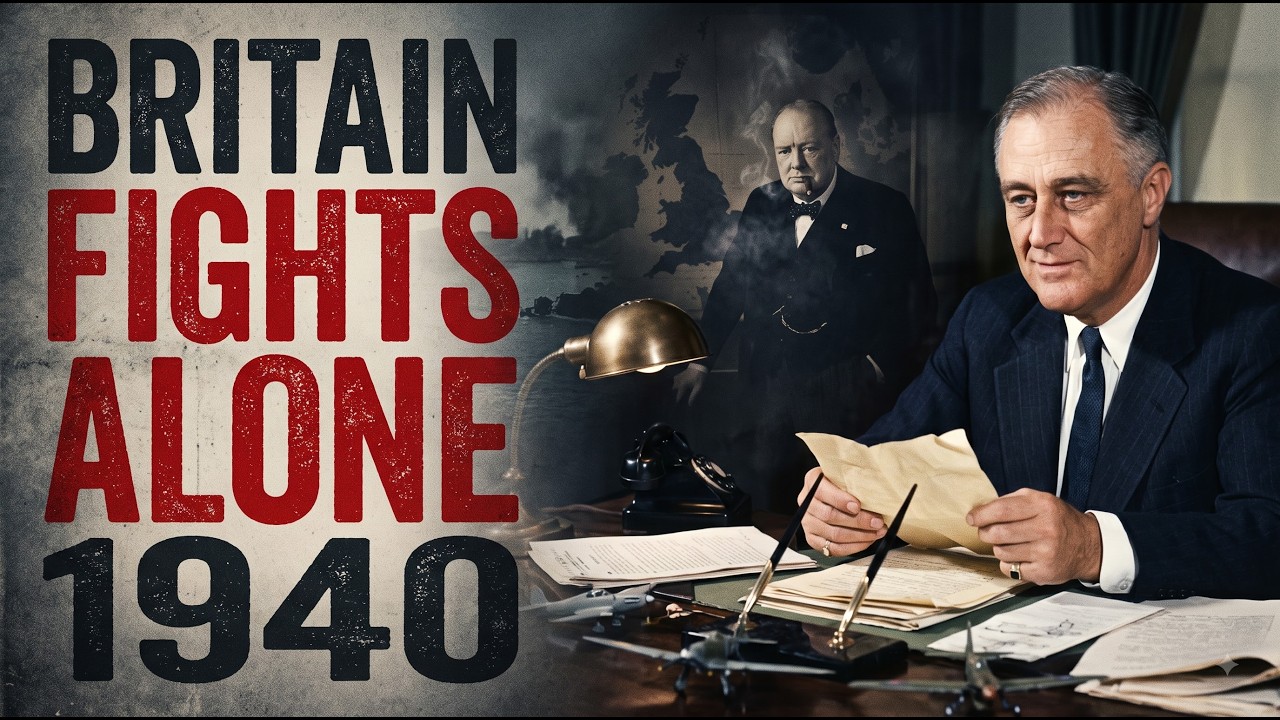
Early that same morning, the premier of France had telephoned him and said four words. “We have been defeated. ”
So Winston Churchill sat down and wrote Franklin Roosevelt a shopping list. Forty or fifty old destroyers, several hundred of the newest war planes, anti-aircraft guns, ammunition, steel.
And somewhere in that cable, between the requests, was a sentence Roosevelt could not have missed. If necessary, Churchill wrote, Britain would continue the war alone, and Britain was not afraid of that. Then came a warning. The voice and the force of the United States, he told Roosevelt, might count for nothing if they were withheld too long.
Roosevelt’s answer arrived the next day. On the destroyers, the answer was no. A step like that, the president wrote, could not be taken without Congress. And he was not certain it would be wise even to ask.
In the country he led, 93 Americans out of every hundred asked that same month whether the United States should go to war with Germany said no. His own secretary of war believed America had no business in Europe’s quarrels. His own ambassador in London was telling him that Britain was finished. And Roosevelt had not yet decided whether to run for a third term, something no president in American history had ever won.
It would take him nearly ten months, a legal opinion, a deal for old ships, a garden hose, and a bill numbered 1,776 to turn that no into a yes. He never gave a speech announcing the change. Franklin Delano Roosevelt was 58 years old in the spring of 1940. Most Americans who saw him in newsreels and photographs saw a man who projected ease and authority: the tilted cigarette holder, the wide smile, the voice that had carried them through the worst years of the Depression with warm, unhurried calm.
What they did not see, because Roosevelt had worked for years to make sure they could not see it, was the wheelchair. In 1921, at the age of 39, he had been struck down by what doctors diagnosed as polio. It took the use of his legs. He could not stand without support.
He could not walk without assistance. In public, he gripped an aide’s arm on one side and a cane or a rail on the other, swinging his braced legs forward with the controlled, deliberate effort of a man who refused to let the world see how much each step cost him. Roosevelt understood power. He understood that appearance shaped reality.
A president who looked helpless in a world convulsed by war would not be followed. So the public rarely saw him that way. The photographers cooperated. The press cooperated.
The country never fully grasped the physical reality of the man leading it. Across the ocean, Winston Churchill was 65 years old. He was not a man anyone would have described as steady. He suffered long spells of low mood that he called his black dog.
He drank steadily through the day: weak whiskey and soda, champagne at lunch. He worked at hours no ordinary man could sustain, dictating memos long after midnight and running meetings from his bed, surrounded by dispatch boxes and cigar smoke. He had spent most of the 1930s warning about Hitler while much of his own party looked away. He had been dismissed as a warmonger, a relic, an embarrassing leftover from another century.
When Neville Chamberlain came home from Munich in September 1938 and told the crowds he had brought peace for our time, Churchill waited a few days, then rose in the House of Commons and said what almost nobody wanted to hear. Britain, he said, had suffered a total and unmitigated defeat. Nobody wanted to hear it. They heard it eventually.
In the first week of May 1940, Britain’s campaign in Norway collapsed, and the House of Commons turned on Chamberlain. On May 10th, he resigned. There were two men who might have replaced him. One was Churchill.
The other was Edward Wood, Lord Halifax, the foreign secretary, who declined the job because, as a member of the House of Lords, he believed he could not lead the war effort from the wrong chamber. So that evening Churchill was summoned to Buckingham Palace, and the king asked him to form a government. Churchill would later write that he felt that night as if he were walking with destiny, and that his whole life had been a preparation for that hour. And by a grim coincidence, the hour had already begun.
At dawn that same day, German forces launched Operation Fall Gelb, the invasion of the Netherlands, Belgium, and France. It was not timed to the crisis in London. Hitler had postponed the offensive again and again through the winter. But it meant that Churchill inherited a catastrophe from the first hour of his government.
Lord Halifax, the man who might have been prime minister, now sat beside him in the five-man war cabinet. Halifax was 59, a tall, aristocratic Yorkshireman who had spent years navigating the corridors of British power with patience and precision. He was no coward. He believed in the careful management of risk.
He looked at the map of Europe in May 1940 and drew conclusions that many reasonable men might have drawn. They were not the same conclusions as Churchill’s. In Washington, Franklin Roosevelt watched the collapse of France through a fog of conflicting information. His own cabinet was a study in divided opinion.
Secretary of State Cordell Hull was 68, cautious, legal-minded, a former judge who had spent his career in the careful language of treaties. He worried about the neutrality acts. He worried about Congress. He worried about what any bold step might cost the president in an election year.
Treasury Secretary Henry Morgenthau Jr. was 49. He was a close personal friend of Roosevelt’s, and a hawk. He believed Britain had to be supported, and that the price of failing to support her would eventually be far higher than the price of helping her now.
Interior Secretary Harold Ickes was 66, sharp-tongued, fiercely interventionist, and the keeper of a habit that would prove invaluable to historians. He kept a meticulous diary. Much of what we know about the private mood of Roosevelt’s inner circle passed through Ickes’ pen. And then there was Harry Woodring, the Secretary of War: 52 years old, a former governor of Kansas, a man who believed with sincere and unshakable conviction that the United States should stay out of Europe’s wars.
The Secretary of War was an isolationist. The irony was so complete it was almost poetry. On May 16th, the day after Churchill’s cable, Roosevelt entered the chamber of the House of Representatives and addressed a joint session of Congress. The airplane, he warned, had changed the geography of danger.
The oceans no longer protected America the way they once had. He asked for hundreds of millions of dollars in emergency defense spending. And he asked for something that startled even his own military men: the capacity to build at least 50,000 warplanes a year, many times what American industry was then producing. The message to the country was unmistakable.
America was going to rearm. But Roosevelt could only go as far as the country would follow. And in the spring of 1940, the country’s feelings were complicated. The polls told the story.
In March, Gallup found that 84 percent of Americans wanted Britain and France to win. In May, two-thirds said they would prefer a candidate who would give the Allies all the help they wanted, short of sending American troops. Ninety percent wanted a bigger American military. But on May 29th, when Gallup asked whether the United States should declare war on Germany and send the army and navy to fight, the answer was 7 percent yes, 93 percent no.
Aid yes. War no. That was the line the country would tolerate. The memory behind that line was long.
More than 53,000 Americans had been killed in combat in the Great War, and tens of thousands more had died of disease. Many of them lay in French soil still. A generation of American mothers had sent their sons across the ocean and received back folded flags and silence. That grief had hardened into a national principle.
Europe’s wars were not America’s wars. Roosevelt understood this feeling. He had been president for seven years, and he had learned to read the American public the way a sailor reads weather. He feared the consequences of ignoring it.
And he could not yet say what he privately believed: that if Britain fell, America would eventually face whatever came next with no friends left. So he did what he always did. He smiled the smile that told people nothing. And he began to think.
To understand what happened in the summer of 1940, you have to understand the ground. Not metaphorically. Literally. The physical landscape, the beaches, the forests, the 21 miles of water shaped every decision that followed, shaped what was possible, shaped what was lost, and shaped in the end what could be saved.
Begin in the forest. The Ardennes is a region of dense woodland and rolling hills that stretches across Luxembourg, Belgium, and France. The trees grow thick and close together. The roads are narrow.
The terrain rises and falls in ways that make the movement of large armored formations extremely difficult. French commanders had long regarded it as a natural barrier. Marshal Pétain, the hero of the last war, had called it nearly impassable. So in the spring of 1940, the sector was held by France’s weaker, older reserve divisions.
It seemed a safe bet. The Germans did not agree. The plan was the work of General Erich von Manstein, and it was audacious. Instead of repeating the old attack through Belgium, the Germans would send their armor, seven panzer divisions, through the forest and cross the river Meuse at Sedan.
Hitler adopted it in February. And among the officers who believed it could work, and who would carry it out, was General Heinz Guderian. Guderian was 51 years old, a compact, intense officer who had spent years developing theories about the offensive use of concentrated armor. He believed in speed and shock.
He believed that if you hit hard enough and fast enough, the enemy’s mind would break before their body did. On May 10th, his XIX Panzer Corps began threading its way through the forest. Engineers worked through the nights, clearing roads and bridging streams. For three days, an armored force of historic scale moved through terrain its opponents had considered all but closed.
On May 13th, under the cover of massive air attack, Guderian’s troops crossed the Meuse at Sedan. French defenders, many of them reservists, were stunned by the bombing. French reserves moved too slowly. The breach widened by the hour.
And on May 20th, five days after Churchill’s cable, a German armored column reached the English Channel at Abbeville. The Allied armies in the north were cut off from the rest of France. Now, here is the thing about the Maginot Line that most people misremember. France had spent a fortune building a chain of interconnected fortresses along its border with Germany: concrete and steel and gun emplacements, the finest military engineering of its age.
And it was not defeated. It was bypassed. Most of its great forts were never taken by assault, and some held out until after the armistice. A few smaller positions fell, and in mid-June the Germans attacked part of the line from the rear.
But the Maginot Line had never been designed to stop an enemy who simply went around it. The most expensive defensive structure in military history stood largely intact while France collapsed around it. Now go to the sea. By the last days of May 1940, the town of Dunkirk had become the last piece of friendly ground for hundreds of thousands of men.
Dunkirk sits on the northern coast of France, about six miles from the Belgian border. In peacetime it was an industrial port. Now the British Expeditionary Force and large parts of the French army were being squeezed into a shrinking pocket around it. The beach at Dunkirk stretches for miles.
It is flat, completely flat. There is no high ground, no ridgeline, no natural feature behind which a man can take cover. The sand is pale and wide, and at low tide it extends far out into the water. The dunes are modest enough to crouch behind, not enough to protect against bombs.
This geography made the evacuation both possible and agonizing. Possible because the broad beach could hold thousands of men in patient lines. Agonizing because those same men stood exposed to German aircraft with nowhere to run. Men lay flat on the sand when the Stukas came.
They pressed themselves against nothing. They waited. The harbor itself had been wrecked by bombing, but one structure survived: the East Mole, a long, narrow breakwater reaching far out into the water. Destroyers could tie up alongside it.
Over the course of the operation, about seven out of every ten men who left Dunkirk walked out along that mole. The rest left from the beaches. For those men, the Royal Navy improvised. The call went out across England for small boats, anything that could float in shallow water: pleasure cruisers from the Thames, fishing boats from Kent and Sussex, river ferries that had spent their entire lives crossing rivers, privately owned yachts, some with their owners still at the helm.
Hundreds of civilian craft made a crossing of some 40 miles of contested sea, and in places far more, because the safer routes were longer. The operation had a name: Operation Dynamo. When it ended on June 4th, more than 338,000 British and French soldiers had been brought out. But what the army left behind tells the other half of the story.
Nearly 2,500 artillery pieces, more than 63,000 vehicles, tents and rations and ammunition: the accumulated material of a modern army abandoned on the French coast. The men came home. They came home without the tools to fight. The army had been saved and stripped at the same time.
Which brings us to the water. At its narrowest, between Dover and the French coast, the English Channel is about 21 miles wide, 34 kilometers. On a clear day, you can see the white cliffs of one country from the shore of the other. After June 22nd, 1940, when France signed an armistice with Germany, this narrow strip of water was the only thing standing between the German army and the British Isles.
Hitler knew it. Churchill knew it. And Roosevelt, studying his maps in Washington, knew it too. The channel could be crossed.
History had proven that. But it required control of the air above it. Without air superiority, an invasion fleet would be destroyed before it reached the far shore. That is why the air campaign that was coming, the Battle of Britain, was not simply a battle for territory.
It was a battle for the meaning of those 21 miles. If Germany won the skies above the channel, the water became a road. If Britain held the air, the water remained a wall. Now go to Whitehall.
Beneath the government buildings of central London lay a complex of reinforced rooms that would become known as the Cabinet War Rooms. They were readied in the last days of peace, in August 1939, to let the British government function even if the streets above were destroyed. There were no windows. Ventilation systems hummed day and night.
Electric lights burned around the clock. It is tempting to imagine the great decisions of May 1940 being made there. They were not. The crisis of late May took place above ground, in ordinary rooms with daylight at the windows.
The War Rooms became the government’s working heart later, once the bombs began to fall in the autumn. The War Cabinet would meet there more than a hundred times before the war was over. But the contrast is worth holding in your mind anyway. Ordinary life above.
Below, a government preparing to survive. Now cross the Atlantic. About 3,700 miles separate London from Washington. In 1940, the most sensitive conversations between the two capitals traveled in coded cables.
Every word had to be chosen before it was sent. There was no tone of voice, no face, only text. Roosevelt received his picture of the war through that medium, imperfectly, filtered through the judgment of the men who sent it. He had intelligence reports, he had advisers, and he had an ambassador in London.
The ambassador was a man named Joseph Kennedy. There were really two wars being fought in the summer and autumn of 1940. One was fought with tanks and aircraft and ships, on the beaches of northern France and in the skies above the channel. The other was fought in rooms: in a cabinet chamber in London, where five men argued about the nature of national survival; in a White House study, where one man read contradictory reports and tried to calculate the future; in the marble corridors of the United States Senate, where men made speeches about American boys who had not yet been asked to die.
Both wars mattered, and they were connected in ways that neither side could fully see at the time. Begin in London. Between May 26th and May 28th, 1940, Churchill’s War Cabinet met nine times. Nine meetings in three days.
The five men at the table were the inner circle of British power. Churchill himself. Lord Halifax, the foreign secretary. Neville Chamberlain, the former prime minister, who remained as Lord President of the Council.
And Clement Attlee and Arthur Greenwood, the two Labour leaders who represented the other half of the wartime coalition. The news from France was relentless. Belgium was on the verge of capitulating. The British army was compressed into a shrinking perimeter around Dunkirk, and no one knew how many men could be brought out.
And the French government was pressing London to try something desperate: ask Benito Mussolini to broker talks with Hitler. Italy had not yet entered the war. Mussolini was watching from the sidelines, calculating his moment. Halifax took the French suggestion seriously, and he argued for it with the calm of a man who had spent his career in diplomacy.
Britain, he said, should at least find out what terms Hitler might offer, before the army was lost, before the cities were bombed, before Britain had nothing left to bargain with. He was careful about the word. Not surrender. A settlement.
An exploration. His logic was not the logic of a coward. He was a chess player, counting pieces. And in fairness, some historians have argued ever since that Halifax was right to insist the question be debated properly.
Churchill’s position was not as simple as legend makes it. On the first day, he admitted that if Britain’s independence could be guaranteed, even at the price of giving up places like Malta and Gibraltar, he would consider it. But he doubted Hitler would ever offer such terms. And as the hours went on, his objections hardened.
Any negotiation, he argued, would begin from the premise that Germany had won. Every term that followed would reflect that. Nations that went down fighting could rise again. Nations that surrendered tamely were finished.
For three days, the argument went back and forth. It was not a clean duel between a hero and a defeatist. Chamberlain, ill and tired, was the man whose support Churchill most needed. Without the backing of the Conservative Party’s former leader, Churchill’s position as prime minister was fragile.
And Chamberlain would be dead before the year was out. On the afternoon of May 28th, at the eighth meeting, Halifax pressed his case again. And Churchill did something unusual. He adjourned the meeting and walked to his room at the House of Commons, where some 25 ministers from outside the War Cabinet were waiting.
He told them the situation. He did not soften it. The army was at Dunkirk. France was failing.
Then he told them what he thought. What happened next is recorded in the diaries of men who were there. They cheered. Ministers came around the table to slap him on the back.
Churchill is said to have told them that if the long story of Britain was to end, it should end only when each of them lay choking in his own blood upon the ground. Historians still debate how much he told them about the arguments going on in the War Cabinet. Some believe he said little about the proposal to approach Italy. What is certain is that he returned to the cabinet room with the unmistakable backing of the whole government.
At the ninth meeting that evening, Chamberlain and the two Labour leaders joined Churchill in rejecting the approach to Mussolini. Halifax gave way. He remained in the government. Britain had chosen.
A week later, on June 4th, Churchill stood in the House of Commons and told the country about Dunkirk. He promised they would fight on the beaches, in the fields, in the streets, in the hills. And he ended with a sentence aimed far beyond Westminster. Even if the island itself were subjugated, he said, the Empire beyond the seas would carry on the struggle until, in God’s good time, the New World stepped forth to rescue the Old.
The New World was listening. Italy entered the war on Germany’s side on June 10th, 1940. That same evening, Roosevelt traveled to the University of Virginia in Charlottesville to give a commencement speech. He abandoned the careful language of neutrality.
“On this tenth day of June,” he said, “the hand that held the dagger has struck it into the back of its neighbor. ” And then he made a promise. The United States, he said, would extend to the opponents of force the material resources of this nation, and would speed up the use of those resources at home. Four days later, German troops marched into Paris.
On June 22nd, France signed an armistice. Britain stood alone. In the middle of that crisis, Roosevelt made a quieter move. On June 20th, two days before the French armistice, he announced that he was replacing his isolationist Secretary of War, Harry Woodring, with Henry Stimson, a Republican who had served as Secretary of State under Herbert Hoover.
And he named another Republican, the Chicago publisher Frank Knox, to lead the Navy. It was in part a political stroke. In an election year, Roosevelt was bringing the opposition into his government. But it was also a signal.
The men now running America’s army and navy believed Britain should be helped. Now turn back to the question that had to be answered. Was Britain going to survive? Roosevelt had two sources of information, and they did not agree.
Joseph Kennedy was 51 years old. He had arrived in London as Roosevelt’s ambassador in the spring of 1938. A wealthy, opinionated man with a talent for making enemies. Some who knew Roosevelt believed he had sent Kennedy abroad in part to keep a powerful, unpredictable political figure at a safe distance.
Kennedy was convinced in the summer of 1940 that Britain was finished. His reports to Washington were urgent and pessimistic. Britain would not hold out. Any help America sent might be wasted.
And privately he said so to anyone who would listen. Then there was the other channel. Since September 1939, Roosevelt and Churchill had exchanged private messages. Churchill signed them “Former Naval Person,” a reference to his earlier years as First Lord of the Admiralty.
But this correspondence was not entirely secret. It passed through the American Embassy, through Kennedy’s own communications room. And in May 1940, just days after Churchill became prime minister, a young American code clerk named Tyler Kent was arrested in London. Kent had been copying embassy documents, including the Churchill-Roosevelt messages.
Kennedy agreed to waive his diplomatic immunity so that British authorities could prosecute him. The leak was sealed. But it was a reminder of how fragile that line of trust really was. Roosevelt could not know with certainty which man was right.
He could not travel to London. He was working from paper, from words transmitted across 3,700 miles. And he had to judge. So he did what a careful politician does.
He checked. In July, at the suggestion of his new Navy Secretary, Roosevelt sent a personal envoy to London: William Donovan, a Medal of Honor winner from the last war, a New York lawyer, and a Republican. Donovan spent weeks traveling through Britain, meeting officials, military officers, and ministers. When he came home in early August, he reported that Britain could hold if it was given the means.
It was the opposite of what Kennedy had been telling Washington. Roosevelt did not need to say who he believed. The decisions that followed said it for him. But belief was not the same as action.
The law still stood. America had changed its rules in 1939. The old arms embargo had been repealed, and Britain could now buy weapons in the United States, but only for cash, and only if British ships carried them home. And Britain was running out of cash.
Loans were blocked by an older law, the Johnson Act, which barred credit to countries that had not repaid their debts from the last war. And there was a second obstacle. In late June 1940, Congress passed an amendment that forbade the Army or Navy from giving away military equipment unless the chief of the service certified that it was not essential to the nation’s defense. Churchill had been asking about destroyers since his very first cable.
He asked again in June. He asked again in July. The Royal Navy had lost many escort ships in Norway and at Dunkirk. The convoy routes that carried food and fuel to the British Isles needed protection.
German submarines were already taking a heavy toll. The American Navy had dozens of aging destroyers left over from the last war, many of them sitting idle in port. They were not modern. But they could float, and they could fight.
Roosevelt put the legal problem to his attorney general, Robert Jackson. Jackson studied it, and in late August he gave the president an opinion. The destroyers could be transferred without a vote of Congress if the Chief of Naval Operations certified that they were no longer essential to American defense, and if America received something in return that strengthened its security. That something, Roosevelt realized, was geography.
Britain controlled islands that lay along the sea approaches to the Western Hemisphere. If Britain would lease bases on those islands to the United States, then the exchange could be presented not as aid to a belligerent but as a hard-headed bargain that made America safer. The deal was signed on September 2nd, 1940. Fifty old destroyers went to Britain.
In return, America received 99-year leases on eight bases: Newfoundland, Bermuda, the Bahamas, Jamaica, St. Lucia, Antigua, Trinidad, and British Guiana. Two of them, Newfoundland and Bermuda, were granted outright, without any destroyers in exchange. Churchill was uneasy.
He did not like seeing the bases described as payment, as if Britain were purchasing its own rescue. But he needed the ships, and he accepted the terms. Britain also gave an assurance that its fleet would never be surrendered, which Churchill had already said in public. The first destroyers were handed over at Halifax, Nova Scotia.
A week later, isolationists in Congress denounced the agreement as a step toward war. They were not entirely wrong about what it represented. But fifty destroyers were nowhere near enough. Britain needed everything: aircraft, tanks, ammunition, fuel, food.
And as the autumn went on, the bills mounted faster than the resources to pay them. That autumn, there was an election. In July, the Democratic convention in Chicago had nominated Roosevelt for an unprecedented third term. Now, with the war raging in Europe, he campaigned against Wendell Willkie, a Republican who also supported aid to Britain.
And as the campaign grew heated, Roosevelt made a promise in Boston on October 30th. He told a crowd of voters, “Your boys are not going to be sent into any foreign wars. ” Critics would remember that sentence for the rest of his life. On November 5th, he won a third term, carrying 38 of the 48 states.
By then, Joseph Kennedy was on his way out of London. He had gone home that autumn, and in November a newspaper interview quoted him saying that democracy was finished in England. His time as ambassador ended soon afterward. And by December, Churchill could no longer avoid telling Roosevelt the truth.
His letter, dated December 7th, was long and carefully drafted. It laid out Britain’s finances without drama, with the precision of an accountant and the gravity of a man asking for something he could not repay. Britain, Churchill wrote, was approaching the end of its ability to pay for American goods. Orders placed with American factories ran into the billions.
If the flow of supplies stopped, Britain’s ability to keep fighting could collapse. The letter reached Roosevelt on December 9th, while he was cruising the Caribbean aboard the heavy cruiser USS Tuscaloosa. He was inspecting the new bases acquired in the destroyer deal. Officially, he was on a holiday.
He was not on holiday. He read Churchill’s letter slowly. Then he read it again. By the account of the man at his side, he sat on the deck for two days, staring out at the sea, saying little of substance to anyone.
The man at his side was Harry Hopkins: 50 years old, chronically ill, one of the few people in Roosevelt’s circle who heard what the president actually thought. The precise conversation was never recorded. But when the two days were over, Roosevelt had an answer. On December 17th, back in Washington, Roosevelt held a press conference.
Reporters crowded in, expecting an announcement about loans or the neutrality law. Instead, Roosevelt told a story. Suppose, he said, your neighbor’s house catches fire, and you have a garden hose. You do not say to him, “My hose cost fifteen dollars.
You must pay me fifteen dollars before I let you use it. ” You lend him the hose, and when the fire is out, you get your hose back. If it has been damaged, he replaces it. Britain was the neighbor.
Hitler was the fire. And the hose was American weapons and ships and supplies. What Roosevelt wanted, he said, was to get rid of the silly, foolish old dollar sign. Twelve days later, on December 29th, he took the idea to the country in a fireside chat.
America, he said, must be the great arsenal of democracy. And on January 6th, 1941, in his State of the Union address, he spoke of four freedoms that the world must someday enjoy: freedom of speech, freedom of worship, freedom from want, and freedom from fear. Four days after that, the plan became a bill. House leaders gave it a number chosen with care: H.
R. 1776, the year of American independence. Nobody was meant to miss the point. The legislation would let the president lend or lease war materials to any country whose defense he judged vital to America’s own.
Britain would not pay cash. Now, after the war, the hose would be returned or replaced. The isolationists understood exactly what was happening. Senator Burton Wheeler of Montana, a Democrat and one of the most prominent opponents of intervention, went on the radio and declared that Lend-Lease would “plow under every fourth American boy.
”
Two days later, a reporter asked Roosevelt about it. The president answered with fury. He called the statement untruthful and dastardly. He called it the rottenest thing said in public life in his generation.
The rage was real. It was also useful. By answering so sharply, Roosevelt changed the terms of the debate. Voting against Lend-Lease now meant standing alongside a man the president had denounced in public.
That was a harder vote to cast. Behind the scenes, Roosevelt worked patiently. He called in political debts. He shaped the language of the bill.
He brought hesitant members along, one conversation at a time. And in January, a different kind of messenger crossed the Atlantic. Harry Hopkins flew to London as Roosevelt’s personal representative. At a dinner in Scotland, he quoted from the Book of Ruth: “Whither thou goest, I will go.
” And he told Churchill privately that Roosevelt was determined the two countries would win the war together. Together. It was a remarkable word to hear in January 1941 from a country that was still officially at peace. Around the same time, Wendell Willkie, the man Roosevelt had just defeated, arrived in London carrying a message from the president.
It was a few lines from a poem by Longfellow about a ship of state sailing on through the storm. Churchill read it aloud to his cabinet. The debate in Congress went on for weeks. Isolationists warned that Lend-Lease was the last step before American boys were sent to die in European trenches.
Interventionists answered that supplying Britain was the surest way to avoid that outcome. The fear on both sides was real. Roosevelt let it run. He understood something about the public that other politicians missed.
The country needed to feel it had reached a conclusion on its own. The most durable decisions were the ones that felt like consensus rather than command. And by early 1941, the public was moving. In January, Gallup asked Americans whether the government should lend or lease war materials to Britain.
Sixty-eight percent said yes. On February 8th, 1941, the House of Representatives voted on Lend-Lease. The result was 260 in favor, 165 opposed. The vote ran largely along party lines.
The next evening, Churchill went on the radio. He did not mention the bill by name, but he spoke directly across the Atlantic. “Put your confidence in us,” he said. “Give us the tools and we will finish the job.
”
On March 8th, the Senate passed the bill, 60 to 31. The Senate had made some changes, so the House had to vote once more. On March 11th, it did: 317 to 71. Roosevelt signed Lend-Lease into law that same day.
He did not deliver a triumphant speech. He did not claim victory over the isolationists. And almost at once, he went to work. Within minutes of signing, he ordered war materials rushed to Britain and to Greece.
And he announced that he would ask Congress for the largest peacetime appropriation in American history, some $7 billion, to pay for it. He did not say that the United States had just become, in everything but name, Britain’s arsenal. He did not say that the step he had just taken made American involvement in the war more likely. He did not need to.
Everybody understood. Churchill would later call Lend-Lease the most unsordid act in the history of any nation. And in London, the question that had hung over everything since May, would America stand with Britain or watch from a careful distance, had been answered. Not with a declaration of war.
Not with troops. But with ships and guns and food delivered across the ocean on credit. But even Lend-Lease was not the final step. History kept moving forward, past any clean resolution.
Germany’s U-boats were conducting an unrestricted campaign against the Atlantic convoys. Soon they were sinking hundreds of thousands of tons of shipping every month. Britain lived by those convoys. Everything that sustained the country, food, oil, weapons, crossed the Atlantic in those ships.
Every convoy that went down was a wound. And so in the months that followed, the American Navy edged closer to the fight. Roosevelt extended the zone of ocean that American ships patrolled further and further east. In July, American troops took over the defense of Iceland.
American aircraft reported the positions of German submarines to the Royal Navy. In August, Churchill and Roosevelt met face to face for the first time as leaders of their countries. They met aboard warships in a bay off Newfoundland and issued a joint statement of principles that became known as the Atlantic Charter. And back in Washington, the country was still deeply divided.
That same month, Congress voted on whether to extend the draft, which was due to expire. The House approved the extension by a single vote. A single vote, four months before Pearl Harbor. On September 4th, a German submarine fired torpedoes at the American destroyer USS Greer.
The torpedoes missed. A week later, Roosevelt told the nation that when German or Italian warships entered waters American defense required, they did so at their own peril. He had ordered the Navy to shoot first. The newspapers called it shoot-on-sight.
On October 17th, 1941, the USS Kearny, an American destroyer, went to the aid of a British convoy under attack southwest of Iceland. A German torpedo struck her. The ship did not sink. But 11 American sailors were killed, and 22 were wounded.
Eleven men. American men. Dead in a war that had not been declared. Ten days later, on Navy Day, Roosevelt spoke to the nation by radio.
“The shooting,” he said, “has started. ”
Four days after that, on October 31st, another American destroyer, the USS Reuben James, was struck by a torpedo and went down. One hundred men were killed. Only 44 survived.
That was the Atlantic in the autumn of 1941. An American Navy escorting British convoys. German submarines firing on American ships. A war undeclared in everything but name.
Then came December 7th, when Japan attacked Pearl Harbor. Congress declared war on Japan the next day. Four days after that, on December 11th, Germany and Italy declared war on the United States. It was Hitler’s own decision, and the United States answered in kind that same day.
The question that Churchill had put to Roosevelt in a cable in May 1940 had been answered. In the end, not by Roosevelt. But by Tokyo and Berlin. Now consider what became of the men whose choices had brought this moment about.
Lord Halifax never became the villain that the popular story requires him to be. After the sudden death of the British ambassador in Washington in December 1940, Churchill sent Halifax across the Atlantic to replace him, and moved Anthony Eden back to the Foreign Office. Halifax spent the war in Washington, working with an administration committed to the partnership he had once, for three tense days in May, been willing to test. History is almost never simple enough to sort cleanly into heroes and failures.
Joseph Kennedy’s time in London ended at the close of 1940. He had been wrong about Britain. The relationship between him and Roosevelt did not recover. He returned to private life, to his businesses, to his family.
His son, John F. Kennedy, was 23 years old that autumn. In 1941, the younger Kennedy joined the United States Navy. He served in the Pacific commanding a patrol torpedo boat.
He survived the war. He entered politics. He became the 35th president of the United States. The man who would one day stand in Berlin and declare himself a citizen of that divided city, who would spend his brief presidency defending the bond between America and free Europe, was the son of the man who had warned Roosevelt that Britain would lose.
History has a sense of proportion that no writer would dare to invent. Winston Churchill led Britain through the war he had refused to negotiate away. He made serious mistakes along the way. He was not a saint and not a symbol.
He was a man of enormous courage and large blind spots. And he held his country together when it had to be held together. The British people voted him out of office in July 1945, with the war against Japan still unfinished. Not because they did not respect him, but because the qualities that win a war are not always the ones a country wants in peace.
He lived to the age of 90. He saw the world the war had made. Franklin Roosevelt did not. On April 12th, 1945, Roosevelt was at Warm Springs, Georgia, a place he had returned to for years, where the warm waters had eased his paralyzed legs, where he could rest in the Georgia sun in a way that was impossible in Washington.
He was sitting in a chair, having his portrait painted, when he collapsed. He died within hours. In the days before he died, American troops had begun to uncover the Nazi camps. Germany surrendered on May 8th, 1945, 26 days later.
Franklin Roosevelt did not live to see the German army lay down its weapons. He did not see the flags raised in the cities that had been occupied. He did not see the end of the war he had spent five years preparing for. He died in a chair in Georgia, less than four weeks before the end.
So what did Roosevelt say when he heard that Britain would fight on alone? On May 16th, 1940, the day after Churchill’s cable, he said, “No. Not the destroyers. Not yet.
Not without Congress. ”
And then, over ten months, he said yes. Not in a speech. Not in a declaration.
But in a series of steps. He said it with fifty old destroyers for 99-year leases on eight bases. He said it with a press conference about a garden hose. He said it with a bill numbered 1,776.
And he said it in the autumn of 1941, through the deaths of American sailors on the Kearny and the Reuben James, who gave their lives in a war before anyone in Washington was prepared to call it one. It is fair to ask what Roosevelt was really doing. Historians still argue about it. He had promised the voters in Boston that their sons would not be sent to foreign wars.
His critics said he was less than candid. His defenders said he was leading a reluctant country, one step at a time, to a place it was not yet ready to name. What is clear is what he had decided. He had not decided to take America into the war.
He had decided that Britain must not fall for want of American help. The proof came in January 1941, when Harry Hopkins, standing in London, told Churchill that the president was determined that the two nations would win the war together. And the words came in public 11 months later. Two days after Pearl Harbor, in a radio address to the nation, Roosevelt said the sentence that had been waiting for him all along: “We are going to win the war, and we are going to win the peace that follows.
”
We. Not you. Not they.
We.
