In a Mayfair drawing room in the autumn of 1865, a twenty-eight-year-old woman sat with a letter she had not yet decided whether to answer. It had come from her younger sister, who had entered the Community of St. John the Baptist at Clewer eighteen months before and who now signed herself by a name their mother refused to say aloud. Downstairs, a curate had been invited to tea.
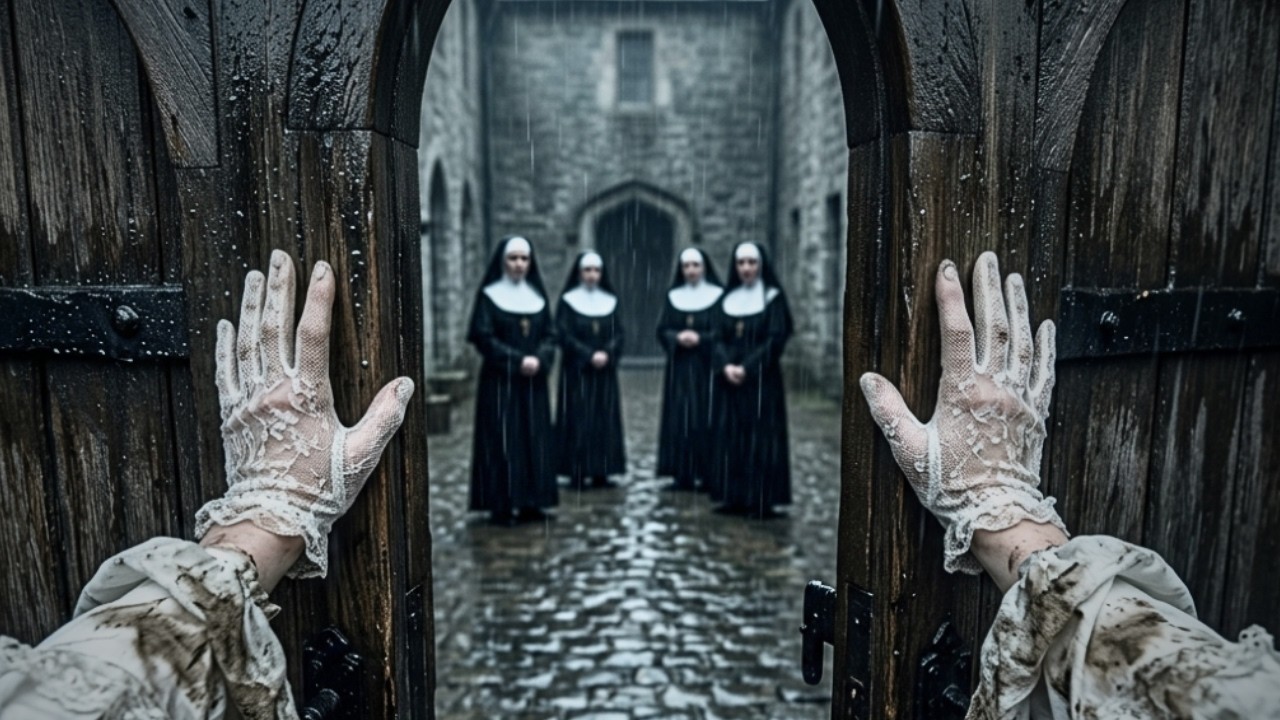
Her mother believed she was finally weakening. She was not. She was considering the gate. Every story told about a Victorian woman ends at one of two doors.
She marries, and the law erases her. She refuses, and the household swallows her whole. Both are real. Both have been told a thousand times.
There was a third door, and what thousands of women found on the other side of it horrified their families more than any bad marriage ever could. To understand why thousands of women would choose a convent over a husband, you first have to understand what a husband actually was in Victorian law—not romantically, not sentimentally, but structurally. The doctrine was called coverture, and it had been inherited from centuries of English common law. Under coverture, a woman who married ceased, in any meaningful legal sense, to exist.
Her property became her husband’s. Her wages became her husband’s. Any inheritance she received, any savings carried into the marriage, any money pressed into her hand on her wedding morning—all of it passed at the altar into a man’s ownership. She could not sign a contract in her own name.
She could not sue, and she could not be sued except through him. If he beat her, the law was almost entirely indifferent. If he spent her money, the law called the money his. She had, in the eyes of English common law, no separate existence to defend.
The Married Women’s Property Act of 1870 would begin to chip at this, and the Act of 1882 would go further. But for most of the century, the arithmetic was clean. Marriage meant legal erasure. The other door was the one the neighborhood pointed at: the unmarried daughter.
She kept her legal personhood, technically. She could inherit. She could, in narrow circumstances, hold a business. But she lived inside a household that did not pay her, and she performed the labor of that household as a kind of permanent debt repayment for the offense of not having found a husband.
She managed the accounts. She nursed her parents through their last illnesses. She wrote the correspondence and oversaw the cook and accompanied her father on errands he did not need accompaniment on—all for no wages, because the idea of paying a daughter for domestic service would have struck the household as absurd. The era had a vocabulary for her, and none of it was kind.
*Spinster*, originally a job description—a woman who spun thread for a living—had curdled by mid-century into something closer to an insult. The *redundant woman*. The *surplus woman*. One widely read social commentator in the 1860s described the unmarried woman as a burden on the state, a figure of pitiable uselessness, as though her existence itself was a clerical error society had failed to correct.
The demographic data behind that language was real. The 1851 census counted roughly 405,000 more women than men in England and Wales. By 1871 the gap had widened. The causes were not mysterious.
Men emigrated to the colonies in enormous numbers. Men died in mines and mills and in the casualty rolls of empire. Women, then as now, lived longer. Several hundred thousand English women were, by simple subtraction, never going to marry, because there were not enough Englishmen left in the country to marry them.
The reasonable response to that arithmetic would have been to reconsider the assumption that a woman’s only adult role was wifehood. Victorian society did not do that. It treated the surplus woman as a logistical problem to be solved by removal. Organizations with names like the Female Middle Class Emigration Society spent the latter half of the century shipping respectable unmarried women to Australia, to New Zealand, to Canada, on the theory that the colonial sex ratio ran the other way and a husband might still be obtainable on a different continent.
The women who took those passages were not always treated kindly when they arrived. Many landed in something close to servitude, their respectability turning out to be a currency that did not travel well across an ocean. Those who stayed behind in England faced the slow version of the same problem. The household tolerated them, used them, did not pay them, did not consult them, and did not, when the time came, leave them anything they could comfortably live on.
They were the aunt in the spare bedroom. They were the cousin who came for the wedding. They were, as the periodicals kept reminding their readers, a figure of pity—useful in small ways, embarrassing in the larger arithmetic of a family balance sheet. This was the trap, and it was unusually airtight.
Marriage erased you. Refusing it consumed you slowly over decades in the houses of people who never quite stopped reminding you of the favor. There was no third option, because a respectable English woman did not work, did not live alone, did not own herself, and did not have anywhere to go that anyone would call respectable. That had been true for three hundred years.
And then, in the 1840s, in Oxford of all places, a door that had not existed in England since the reign of Henry VIII opened a crack. A clergyman’s daughter took private vows in a borrowed chapel. A handful of other Englishwomen quietly followed her into the same vows. Within a generation, thousands more had walked through behind them, and respectable English society lost its mind over what they had decided to do with their lives.
The reason there had been no door in three hundred years was Henry VIII. Between 1536 and 1541, Henry dissolved more than eight hundred religious houses across England, Wales, and Ireland in a project his commissioners managed at a peak rate of around fifty monasteries a month. The official justification was reform. The actual outcome was the largest single transfer of property in English history, with monastic land and movable wealth funneled into the crown and then, at extraordinary speed, into the hands of the gentry families who would shape England for the next two centuries.
The story is usually told as a story about Henry—about the break with Rome, about a king who needed an heir and a divorce and a balance sheet. All of that is true. But for the women living inside those buildings, the dissolution meant something narrower and harder. It meant the only institution that had ever offered an Englishwoman an alternative to marriage was being demolished around her, brick by brick, with no plan whatsoever for what came next.
Monks could, in principle, transfer into the new Church of England. They could become parish priests, chaplains, schoolmasters, apothecaries. Nuns had no equivalent route. The new church did not have nuns.
The pensions paid to former religious women were modest at the moment of settlement and never adjusted afterward, and within a generation most of them were worth almost nothing. The Act of Six Articles in 1539 prohibited former monks and nuns from marrying, which meant the women turned out of those houses could not return to religious life, could not take up clerical office, and could not legally marry. The exit hatch had not just been closed. It had been bricked over with a thoroughness that left almost no women’s institutional life behind.
That was the silence the nineteenth century inherited—three hundred years of it. The crack appeared in Oxford. From the early 1830s, a group of Oxford clergy, including Edward Bouverie Pusey, John Henry Newman, and John Keble, began publishing a series of tracts arguing that the Church of England had drifted too far from its Catholic inheritance and needed to recover its sacramental, liturgical, and devotional roots. The movement was theological in motive, controversial in reception, and almost entirely male in its leadership.
But one of its consequences—intended or not—was the revival of religious orders for English women. The first woman through the door was Marian Rebecca Hughes. On the morning of Trinity Sunday, the 6th of June 1841, in the chapel of Dr. Pusey’s house in Oxford, she took private vows of poverty, chastity, and obedience under Pusey’s direction, and afterward received communion from Newman.
She was the first woman to take religious vows in the Church of England since the Reformation. She would later go on to found and lead the Community of the Holy and Undivided Trinity in Oxford, a sisterhood that ran schools, an orphanage, and a home for governesses. Almost nothing in her appearance that morning announced the rupture she represented—plain black, a borrowed prayer book—which was rather the point. The point was that it had happened at all.
Pusey founded the first formal sisterhood four years later, in 1845, near Regent’s Park in London, in a row of houses on what was called Park Village West. The community was small, austerely run, and immediately controversial. It was also followed with remarkable speed by others. In 1848, Priscilla Lydia Sellon founded the Devonport Sisters of Mercy in Plymouth, where she sent her sisters into the cholera wards in the sailors’ slums.
In 1851 came the Community of St. John the Baptist at Clewer, near Windsor, focused on women rescued from prostitution and destitution. The same year, the Community of All Saints was founded in London. The Community of St.
Mary the Virgin opened at Wantage in Berkshire. The Society of St. Margaret was founded at East Grinstead in Sussex in 1855. By the end of the century there were dozens of Anglican sisterhoods scattered across the English map.
Catholic women’s orders were rising in parallel. The Catholic Relief Act of 1829 had ended most of the legal disabilities on Catholic worship in Britain, and in 1850 Pope Pius IX restored the formal Catholic hierarchy in England—an event the Protestant press greeted as the “papal aggression” and the rest of the country greeted with a panic that lasted years. Catholic religious houses for women, some imported from the continent, some founded by English converts, expanded rapidly through the second half of the century. By 1900, taking Anglican and Catholic communities together, the religious life for women in Britain numbered in the dozens of houses, with somewhere on the order of several thousand professed sisters between them.
The exact figures are debated. The order of magnitude is not. The sight of a veiled Englishwoman walking through Oxford or Plymouth or London in 1845 was, to most of the public, as foreign as a Roman legionary. Within forty years there were hundreds of them, and the country, which had told itself for three centuries that this could not happen in England, discovered that it had happened in England, that nothing it could legally do would stop it, and that the women walking through that door had no intention of going back.
Return to the drawing room. It is now the autumn of 1865, and the woman by the window is twenty-eight years old, the second daughter of a solicitor of moderate means in Mayfair. Call her Clara, because the records do not give her name, and because there were, by the 1860s, a great many women answering to it. Her younger sister has been at Clewer for eighteen months.
The first letter came three weeks after she left, written in a hand Clara almost recognized, signed by a name that was not the name their parents had given her. Clara’s mother read it once, folded it, and placed it in a drawer that did not subsequently open. Clara took it out of that drawer when her mother was at evening prayers, read it twice, and put it back. She has done the same with each of the letters that followed, of which there are now eleven.
Downstairs in the front parlor, a curate is taking tea with her mother. He is the third proposal in two years, the second of them from a clergyman. Her mother believes she is at last softening. She is not.
She is sitting at her writing desk with a sheet of note paper, the cap removed from the inkstand, the pen across the blotter, and she has been sitting like this for nearly an hour. Consider what she would be walking away from, on the days when her mother believes she is finally being sensible. Her father’s house, with its polished knockers and freshly whitened steps. The accounts of the household, which she has kept since she was twenty-three, when her mother’s eyes began to fail at the close columns and the cook’s monthly figures began to require somebody other than her father to reconcile.
The correspondence with relatives in Suffolk and Lincolnshire and the Cape, which her mother dictates and Clara writes. The chaperoning, the nursing, the slow daily unpaid administration of a household that uses her exactly as it would use a clerk, and which would be entirely thrown into disorder if she stopped. She is not a particularly devout woman. That part of the story—the part periodicals like to print about the daughters of Mayfair who become nuns—does not quite apply.
She attends church on Sundays as anyone attends church on Sundays in this part of London in this year of the world. She reads the lessons placed in front of her. She does not, as far as she can tell, have what her sister’s letters describe as a vocation. What she has is a calculation, and the calculation does not get smaller no matter how many times she runs it.
If she accepts the curate, she will be a clergy wife in a parish the curate has not yet been promised, on an income that has not yet been fixed, in a house chosen by a bishop, bearing children at intervals dictated by biology, with her property and her wages and her legal voice absorbed into a man she knows only well enough to be uncertain about. If she refuses the curate, she will remain in this house, perform this work, and watch her father’s hair go entirely white over the next fifteen years, after which one of her brothers will inherit the house, and she will move into the spare bedroom of whoever has space for her. If she goes to Clewer, she will lose her family by inches and gain something she cannot at the moment fully describe. What the periodicals say about Clewer is mostly hysterical.
Veiled Englishwomen processing through respectable streets. Mother superiors with the keys to their own institutions. Suspicions of Rome, of confession, of secret discipline behind locked doors. Members of Parliament asking publicly whether the law might compel the inspection of convents.
The atmosphere around Anglican sisterhoods in the 1860s is not merely uncomfortable. It is, in certain drawing rooms, openly hostile. Clara’s father is an English solicitor in Mayfair. He has spent his career drawing up settlements and conveyances and last wills for people who do not lose their daughters to Rome.
Were she to enter Clewer, he would not throw her out. He would do something quieter and more permanent. He would not speak of her in mixed company. Her name would be folded into the drawer that already contains her sister’s first letter, and the drawer would remain shut.
Her mother would weep—weeping of a quality the household has not heard before, because the household has not yet lost a second daughter to the same thing. She knows all of this and is sitting at the desk anyway. A few minutes after half past four, she lifts the pen, writes a single page in a hand steadier than her hand has been all week, folds the page in three, addresses the envelope to her sister at Clewer, and seals it. No one will read what it says.
What it says is between her and her sister and the institution that has been waiting for both of them. What was waiting on the other side of that gate was nothing like what her mother feared. For the women who walked through it, it was the freest life their century would ever offer them. Walk through the gate.
Inside, in the year 1865 at Clewer, or at All Saints in Margaret Street, or at the Devonport Mother House in Plymouth, the first thing you would notice is how organized everything is. The day begins at five or half past five with the first office set in chapel in the half dark, the stalls filled with women in black habits and white guimpes, the responses traveling around the choir in a rhythm that has not been heard in an English religious community for three hundred years. Breakfast is taken in silence in a refectory while a sister reads aloud from a devotional book or a chapter of scripture. Work begins at seven.
The work is whatever the community has taken on—which, by the 1860s, means schools, orphanages, refuges, dispensaries, and increasingly hospitals. So far, none of this sounds like freedom. It sounds on its face like the opposite. Up at five, dressed alike, eating in silence, working all day, vows of poverty and chastity and obedience, the spare bed in the bare cell, the rule that governs everything.
A woman who walked from a Mayfair drawing room into this room would have been forgiven for asking in her first week what exactly she had traded away her trousseau to obtain. What she had obtained was a thing that did not otherwise exist for an English woman in 1865. The vow of obedience was made to God and to a mother superior. It was not made to a father.
It was not made to a brother. It was not made, most importantly, to a husband. Inside the walls of a sisterhood, a woman could work publicly, hold property in common with other women, sign on behalf of her community, manage an institution, supervise paid staff, and conduct her daily life without the legal or domestic permission of any man at all. Her bishop could visit.
Her chaplain heard confessions. But her work, her schedule, her rule of life, and her decisions about her own community ran through a chain of authority that was at every link female. This needs to be said carefully, because the women who walked through that gate were not making a political statement. The religious motive predominated in the revival itself, and the women who became sisters became sisters first and foremost because they believed in what they were doing.
Their letters say so. Their journals say so. The way they spoke about their work says so. The autonomy was real, but the autonomy was not the point.
It was the architecture that made the point possible. And the architecture was extraordinary. A mother superior in 1865 ran a job description that did not otherwise exist for a Victorian woman. She commanded a community of professed sisters, novices, and lay sisters, sometimes numbering more than a hundred.
She controlled the order’s property, its accounts, its investments, and its contracts. She negotiated with bishops, with benefactors, with builders, with magistrates, with the boards of the institutions her order ran. She hired and dismissed paid staff. She signed leases.
She admitted novices, dismissed the unsuitable, and decided who was sent where. She was, in plain commercial terms, the chief executive of an enterprise that often employed dozens of people and operated across multiple buildings. Set that beside a married English woman in the same year. The married woman could not legally sign a contract for a bolt of cloth without her husband’s consent.
The mother superior in the next street could be signing the lease on a hospital wing. The career ladder inside a sisterhood was also a real thing, and it has to be described that way, because the alternatives outside the walls had no ladder at all. A woman entered as a postulant and was tested. She was then clothed as a novice in a junior habit for one to three years.
If she persevered, and if the community accepted her, she made her vows and became a professed sister. From there she might be appointed to offices—subprioress, novice mistress, infirmarian, bursar, school mistress, sister in charge of a particular work. And at the top, in many communities, the mother superior was elected by the professed sisters themselves for a defined term, by ballot. There is a quiet repeating pattern in the early Anglican sisterhoods: a bishop, a chaplain, or a founding clergyman tries to override a mother superior on the running of her own community; the mother superior pushes back, writes letters, holds her ground.
Sometimes she wins outright, and sometimes the matter ends in formal separation, the community moving out of one bishop’s jurisdiction and into the protection of another. What does not happen, in case after case, is the mother superior quietly doing what the clergyman tells her to do. The women running these houses behaved like the executives they were. The thing this gave them in the end was continuity.
A married woman’s life pivoted on her husband. A sister’s life pivoted on her community. When a bishop changed, the community endured. When a benefactor died, the community endured.
The institution outlasted the men who tried to control it. That was the whole point, and it was a point Victorian England had not previously been required to consider. In the entire century, this was the only career in which a woman could legitimately rise to command her own house. The mistake outside observers kept making was that women in habits did not work.
They worked harder than almost anyone else in Victorian England. Most of the new sisterhoods, both Anglican and Catholic, were active orders, not contemplative ones. They prayed, kept the offices, lived under rule, wore the habit—but the day was built around external labor, and the labor was the kind no one else was particularly eager to do. They ran schools for poor children.
They ran orphanages. They ran refuges for women rescued from the streets and reformatories for women coming out of prison. They ran soup kitchens, dispensaries, district nursing rounds in the worst neighborhoods of the industrial cities. They took on hospitals when there were no nurses, and they took on hospitals when there were no doctors who would go where they went.
The case study is Priscilla Lydia Sellon. Sellon founded the Devonport Sisters of Mercy in Plymouth in 1848 at the request of the Bishop of Exeter, who wanted somebody—anybody—to address the slums of the dockyard parishes. The dockyard parishes were notorious. Plymouth and the adjoining towns of Devonport and Stonehouse housed sailors, their families, the families of dead sailors, the children of dead sailors, prostitution, drink, cholera, and a public health record that read like a warning label.
Sellon was the daughter of a naval officer. She was twenty-seven. She arrived with a small group of women, set up a community house, and started work. By 1849, within a year of arrival, her sisters were running schools, an industrial school, a soup kitchen, a sailors’ home, an orphanage, and a refuge for women coming out of prostitution.
By 1850, when the cholera epidemic swept through Plymouth that autumn, her sisters went into the wards alongside whatever doctors could be persuaded to stay. They did not leave. The Bishop of Exeter wrote afterward that the work the sisters did during the epidemic had been, in his judgment, beyond praise. Then the country saw what they could do.
In October 1854, in response to the public scandal over the conditions of British soldiers in the Crimea, the war minister authorized Florence Nightingale to lead a party of nurses to the military hospital at Scutari. Among the women who went with her in that first contingent and the parties that followed were sisters from Sellon’s community. While the parliamentary debate in London argued over whether respectable English women could be permitted near a military hospital at all, sisters from Devonport were already on the wards working under Nightingale, doing the work that ended up substantially redefining the public idea of nursing in the country. When they came home, they did not stop.
In 1866, a cholera epidemic hit the East End of London. Sellon herself traveled up and set up a cholera hospital in a warehouse on the spot. Her sisters nursed the patients. Many of those they treated survived—in a year and a neighborhood where survival was not the prevailing outcome.
In 1870, smallpox broke out around Ascot, where the community had a priory house. They ran tents on the priory grounds and nursed smallpox patients through the season. The mortality figures from the camps suggest the sisters did better with what they had than most municipal authorities did with more. Their reach extended further than the British coast.
By the 1860s, an Anglican sisterhood was operating a school in the Sandwich Islands, in Honolulu, working in partnership with the Anglican mission established under the patronage of the Hawaiian royal family. English women in habits running a school several thousand miles from England, employed by no man, accountable to a mother superior in Devonshire. Set the comparison plainly. In 1865, a married English woman could not legally sign a contract for a piano without her husband’s consent.
In the same year, in the same country, a Sister of Mercy was running a smallpox ward. In the same year, a mother superior in Plymouth was deciding which of her sisters would be sent across an ocean to teach in a Pacific kingdom. The class composition of these communities is also worth pausing on. The sisterhoods drew from across English society.
The choir sisters—the professed sisters who said the full office and held the senior offices—were predominantly drawn from clergy households, the daughters of vicars and rectors, and from the gentlewomen of moderate to comfortable means whose marriages had not materialized. The lay sisters, who did the heavier domestic labor, were drawn from working backgrounds. The communities were not socially flat—no Victorian institution was—but they were one of the very few places in the country where a vicar’s daughter and a former mill worker shared a refectory, held offices, and could in principle vote for the same mother superior. The people walking past the slum mission saw the veils and assumed seclusion.
What they were actually walking past was an institution doing the work the state had not yet decided was its job, staffed by women whose mothers could not have legally signed for a bolt of cloth, and who now signed for hospital wards in their own hands. The country lost its mind. That is not hyperbole. From the late 1840s through the 1870s, the rise of religious sisterhoods in England triggered one of the most sustained moral panics of the Victorian century, played out across the periodical press, the floor of Parliament, the pulpits of evangelical churches, and on the actual streets outside actual buildings where actual women were living quietly and trying to run schools.
The cultural temperature has to be understood first. Anti-Catholicism was not a fringe Victorian attitude. It was the default Protestant respectability of an empire that had spent three centuries defining itself against Rome. The 1850s pushed the temperature higher than it had been in living memory.
The Catholic hierarchy in England was formally restored by the Pope in 1850. *The Times* called it the Papal Aggression. The Prime Minister, Lord John Russell, wrote a public letter denouncing it. There were torch-lit processions burning effigies of the Pope on the fifth of November in towns that had not bothered with that particular ritual in decades.
Into the middle of this combustible national mood walked the Anglican sisterhoods, which to large parts of the Protestant public looked exactly like the Roman thing they had just been told to fear. The Oxford Movement was already under suspicion. Newman had converted to Rome in 1845, taking a string of public Anglican figures with him in the years that followed, and the Evangelical press treated the entire High Church revival as a slow-motion betrayal of the English Reformation. The sisterhoods were the part of that revival you could actually see.
A veiled Englishwoman in Margaret Street or Plymouth or Oxford was, to a great many Englishmen, the visible evidence that something had gone catastrophically wrong inside their own established church. The literary genre that grew up around this fear is its own subject. The escaped-nun narrative had crossed the Atlantic from America in the 1830s, where Maria Monk’s *Awful Disclosures of the Hotel Dieu Nunnery*, published in 1836, had sold enormous numbers of copies on the claim that Montreal convents hid grave misconduct and imprisoned women in cells under the chapel. The book was a fabrication.
The fabrication did not stop it being reprinted in cheap British editions for the rest of the century. By the 1860s, English publishers were producing their own versions. Pamphlets with titles built around exposure, confession, secrecy, and rescue sold from railway stalls alongside sensation novels. They were not journalism.
They were a genre, and the genre had a guaranteed readership. The political response followed the literary one. From the 1850s onward, organized campaigns demanded that Parliament grant the legal right to inspect convents, both Catholic and Anglican, on the theory that women were being held in them against their will. Petitions circulated.
Bills were introduced. The most persistent of the parliamentary campaigners, Charles Newdegate, member for North Warwickshire, brought the question forward repeatedly across two decades, securing a select committee in 1870 to examine the conventual and monastic institutions of the United Kingdom. The committee produced reports. The reports produced no scandals.
The inspection legislation was not enacted. The campaign continued anyway. Outside the chamber, the temperature was hotter. Anglican churches associated with the ritualist revival—the side of the church the sisterhoods were aligned with—were repeatedly targeted by protesters.
Services were disrupted. Vestments and ornaments were destroyed. Clergy of these churches faced ecclesiastical prosecution under the Public Worship Regulation Act of 1874, and several were imprisoned for refusing to abandon their liturgical practices. The atmosphere around any building that contained a veiled woman could turn ugly with very little warning.
And then there was the household. A daughter announcing that she intended to enter a sisterhood, particularly an Anglican one, could rupture a Victorian family more completely than a refused engagement. Refusing an engagement was a familiar disappointment, with familiar names attached and familiar conversations to be had at familiar dinner tables. Entering a sisterhood was something else.
It was a public declaration that the daughter would not be reabsorbed into the household, and would not be marrying anyone—and that she had also, in the eyes of her Protestant parents, walked partway toward Rome. Mothers wrote to the newspapers about daughters they considered lost. Fathers cut allowances. Brothers stopped speaking.
The records of the early Anglican sisterhoods are full of women whose families treated their profession as a kind of bereavement, complete with the rituals of mourning. But here is the detail that punctures the entire rescue narrative. When the inspections were eventually conducted—formally or informally, when the bishops visited, when the parliamentary committees took evidence, when the journalists were finally let inside—what they found was not a row of women waiting to be set free. They found women who did not want to leave.
The mother superiors fought to keep their houses open. The novices stayed. The escaped-nun pamphlets sold in the tens of thousands. The actual escape attempts, the ones the campaigners had built their case on, were vanishingly rare.
A century of evidence later, the verdict is uncomplicated. The women on the inside knew what they had. The public on the outside did not. The panic in the end was not about cells, but about the freedom of the women inside, and the country’s slow realization that they did not want rescuing.
None of this means the convent was a paradise. That has to be said plainly, because the version of the story in which a woman walked through the gate and discovered a feminist utopia behind it is no truer than the version in which she walked through and discovered a prison. The actual life inside an Anglican or Catholic sisterhood in the 1860s was hard, regimented, and unforgiving of women who had romanticized it from the outside. Set out the cost honestly.
The vows were vows. Obedience was made to a mother superior who could be a remarkable executive or a difficult human being, and sometimes was both in the same hour. The hierarchy was rigid. The schedule was relentless.
The physical labor was real, particularly in the active orders, which placed their sisters into cholera wards, smallpox tents, slum tenements, and the kind of nursing situations that had killed several of them before the year was out. The cells were spare. The clothing was uniform. The personal property of an entering sister was surrendered to the community, and her contact with her family was constrained by the rule and by the prioritization of the community’s work over her own private life.
And here is the harder part: a sister who came to dislike her community, who found her vocation had been a misreading, who could not get along with her mother superior, who began ten years in to want something else, had almost nowhere to go. She could be dispensed from her vows in theory. The process was slow, often painful, and frequently ended with a woman in her late thirties or forties leaving the only world she had known as an adult and reentering a society that had moved on without her. The exit from the convent, when it was needed, was no kinder than the exit from a bad marriage.
It was simply rarer, because the women who entered tended to have looked at the alternatives more carefully than brides typically had time to. So the balance line has to read both ways. For thousands of Victorian women, the sisterhood was the freest, most purposeful, most autonomous life their century would let them have. For some others, it became a different kind of confinement, chosen for reasons that did not survive the first decade of living it.
Both statements are true at the same time. Now to the contrast, which has to be drawn with care, because the public conversation has often blurred two phenomena that were not the same thing. Alongside the sisterhoods, particularly in the Catholic tradition and most heavily in Ireland, religious orders operated institutions known as Magdalene asylums or Magdalene laundries. These were places where women considered fallen—women who had had children outside marriage, women suspected of prostitution, women who had simply become inconvenient to a family—were sent to perform unpaid laundry labor, often for long periods, and often with very limited freedom to leave.
The most heavily documented abuses, the ones that have produced state apologies and major inquiries in our own century, are largely Irish, and the worst of the practices extended deep into the twentieth century, well beyond the Victorian era. Specific Victorian British equivalents existed in smaller numbers, and the historical record on those is less complete, and in places contested. The line between the two phenomena must be drawn, because they are different, and the difference matters. The women in this story walked toward the gate.
The Magdalene women were walked through it. The first was a vocation undertaken by women with options who chose this one out of a real and recognized set. The second was, in many cases, a sentence handed down by families and parish authorities to women who had no options at all. Both groups, from a distance, wore something that looked like a habit.
Up close, they were opposite worlds. The first found inside the walls more authority than Victorian society would otherwise grant a woman. The second found, behind the same kind of walls, less freedom than Victorian society granted almost anyone else. Return, then, to the women this story is actually about.
Across England, across the second half of the nineteenth century, thousands of them entered religious life. They came from clergy houses and gentry drawing rooms and working backgrounds. They came because they believed in what they were doing, and they stayed because what they were doing turned out to be, by the standards of their century, an extraordinary form of work. The surplus woman the periodicals had described as a clerical error of the population census walked into the only institution in her country that wanted exactly what she had to give.
She did not enter the sisterhood because marriage had failed her. She entered it because the sisterhood was the freest and most powerful life on the menu, and she had read the menu carefully. The careful reading of the menu was the part the periodicals could never quite bring themselves to print. The records, when you read them now, are quieter than the panic that surrounded them.
The sisterhoods that had survived the Victorian backlash simply continued. Clewer kept its house running into the twentieth century. All Saints kept its house running. The Society of St.
Margaret at East Grinstead, the Community of St. Mary the Virgin at Wantage, the Devonport order Sellon had built from the dockyard parishes outward—all of them outlasted the campaigners who had spent decades trying to inspect them out of existence. They did so without much commentary. The women who had been treated as scandals while they were young settled into a long middle age inside the institutions they had built, and the country that had screamed at them in the 1860s stopped paying attention to them by the 1890s.
That is its own kind of victory. The panic burned out. The work continued. When the nursing profession was formalized, the templates were the ones the sisters had already proved.
When women’s higher education began to open in the 1870s and 1880s, several of the early principals had passed through religious communities first. When secular institutions for the care of the destitute were eventually built, they were copying in their architecture and their daily structure the houses the sisterhoods had spent forty years modeling. History gave the credit elsewhere—to philanthropists, to reformers, to ministries of state, to royal commissions, and to the gentlemen who chaired them. The women in habits had done the work first, and the work had passed quietly into the secular institutions that followed them, which is the version of this story Victorian England would have found the most unbearable of all.
Clara is now Sister Francis. She has been at Clewer eleven years. She runs the laundry, the ledger, and a small schoolroom for the children of the women the community shelters. Her younger sister, two corridors away, holds an office in the same house.
Her elder sister in Mayfair, married fourteen years, has buried two children and writes letters that say nothing of it. Her father has stopped speaking her name in mixed company. Her mother, on her deathbed, will say she lost a daughter to Rome. Neither will ever say the thing that is also true.
She became, in the only Victorian institution that allowed it, a woman with her own work, her own community, her own name. They told the century the convent was a prison. They were looking the whole time at the only door in Victorian England that opened outward.
