The Junkers Ju 52 of the Belgian airline Sabena had been climbing through the cold November sky for barely an hour when the weather closed in. On board were nine people, and among them a woman eight months pregnant, her husband, and their two young sons, on their way to London. As the aircraft approached the North Sea, a thick fog swallowed the coastline. The pilot held to the flight plan, refusing to turn back, and began his descent toward Ostend’s Steene airport.
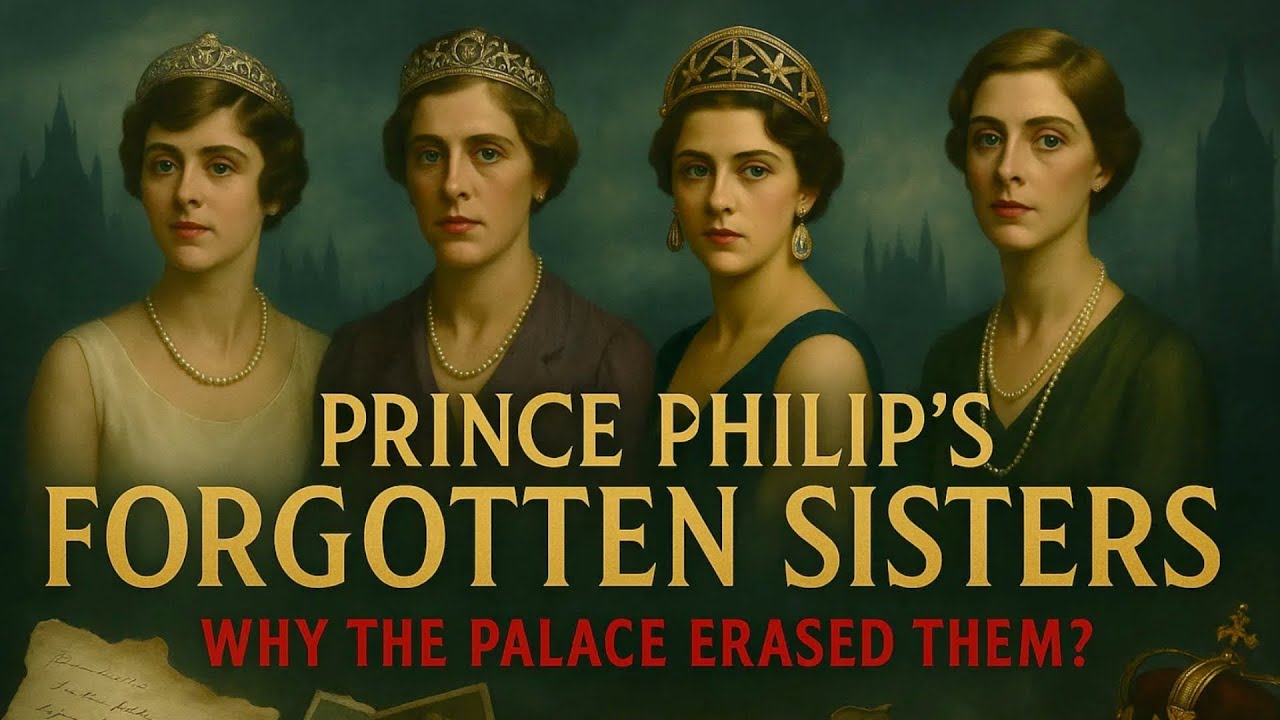
Then came a factory chimney, unseen in the murk, and everything ended in fire. The last passenger to be pulled from the wreckage, they said, was a newborn infant. Cecilia, Hereditary Grand Duchess of Hesse, had given birth mid-flight, and the baby had died along with its mother, its father, and its two brothers within seconds of the impact. Cecilia had been born at Tatoi Palace near Athens on 22 June 1911, the third daughter of Prince Andrew of Greece and Denmark and Princess Alice of Battenberg.
On 10 July she was baptized, with King George V of the United Kingdom, Grand Duke Ernest Louis of Hesse, Prince Nicholas of Greece and Denmark, and Grand Duchess Vera Constantinovna of Russia standing as her godparents. Her maternal grandmother, the Dowager Marchioness of Milford Haven, considered her the prettiest of the four daughters of Andrew and Alice. In the summer of 1928 Cecilia made her debut in the United Kingdom at the age of seventeen, attending her first ball at the Earl and Countess of Ellesmere’s Bridgewater House, then taking part in Cowes week before King George V invited her to stay a few days at Balmoral. Her two elder sisters were still unmarried, something not unconnected to the relative poverty of their parents, but the family had not surrendered hope of finding a good match.
Her aunt Louise, now Princess of Sweden, had designs on Crown Prince Frederick of Denmark, but the plan came to nothing. It was finally from Germany that a suitor arrived. Cecilia had known her Hessian cousins since childhood, meeting Princes George Donatus and Louis for the first time in 1919, while her family lived in exile in Switzerland. By 1929 the friendship with George Donatus had become a romance, and in early 1930, when she was just eighteen and he twenty-three, the two were unofficially engaged.
Almost simultaneously her younger sister Sophie became engaged to another member of the House of Hesse, Prince Christoph. The two sisters prepared for their weddings together. In the spring of 1930 they went to London to obtain new clothes, then returned to Paris to assemble their trousseaus and buy wedding dresses. Sophie and Christoph married first, on 15 December 1930 at Schloss Kronberg in Kronberg im Taunus.
Cecilia and George Donatus followed on 2 February 1931 in the Neues Palais in Darmstadt. The foreign guests were surprised by the warmth of their welcome: the population had dethroned Grand Duke Ernest Louis in 1918, and the visitors had expected a far colder reception. Instead, the people gathered in droves to cheer their former princely family. The couple were married in a double religious ceremony, both Orthodox and Lutheran, with some fifty guests from across Europe in attendance.
Cecilia’s mother was absent, still hospitalized in Switzerland. In the years that followed, politics intruded on the family. Christoph of Hesse, Cecilia’s brother-in-law, joined the Nazi party in 1931 and the SS in 1932. The princes of Hesse themselves long kept their distance from the far right, for Grand Duke Ernest Louis had no sympathy for Hitler’s ideas.
That changed in May 1937, when George Donatus and Louis, the two sons of the former sovereign, joined the Nazi party, and Cecilia followed her husband’s example at the same time. By then she was pregnant again. On 16 November 1937, Cecilia and her family drove to Frankfurt to board a Sabena airliner bound for London, with a scheduled stopover in Ostend to pick up two more passengers. The little group comprised Cecilia, eight months pregnant, George Donatus, their six-year-old son Ludwig, their four-year-old son Alexander, and the Dowager Grand Duchess Eleonore, George’s mother.
They were accompanied by Baron Joachim von Riedesel and Alice Hahn. Cecilia hated flying, her nephew Prince Philip later recalled, and she always dressed in black when she traveled by air. The flight began under normal conditions, but as the aircraft neared the North Sea the fog rolled in. In poor visibility the pilot continued and attempted to land at Ostend.
During the approach the Junkers struck the chimney of a factory. A wing and an engine were torn away. The plane crashed against a roof, was thrown several meters further, and caught fire. All aboard died instantly, including the newborn child whom Cecilia appeared to have delivered during the flight.
Prince Philip, then sixteen, was particularly close to his aunt. Years later he described being called into his headmaster’s study at Gordonstoun and told of her death as one of the worst moments of his life. He wrote: “I have the very clearest recollection of the profound shock with which I heard the news of the crash and the death of my sister and her family. ”
The funeral took place in Darmstadt on 23 November 1937.
It drew a mass gathering, but it also served as a pretext for a large deployment of soldiers in Nazi uniform. Photographs show the grieving Prince Philip flanked by relatives, one clad in a brown shirt, another in full SS regalia. Sophie, the fourth of the five children of Andrew and Alice, had spent a happy childhood. In 1927, at the age of thirteen, she met a distant cousin, Prince Philip of Hesse-Cassel, and shortly afterwards two of his brothers, the twins Christoph and Richard, at the manor of Hemmelmark, home of her great-aunt Princess Irene of Hesse and by Rhine.
Despite being thirteen years their junior, the German princes soon attempted to court her, and it was Christoph who won her attention. Their romance ended in an engagement, officially celebrated when Sophie turned sixteen in 1930. They married at Schloss Kronberg and in a church in the city on 15 December 1930, in two ceremonies, one Orthodox at Friedrichshof Castle, the other Lutheran. After the honeymoon, the couple moved into an apartment in Berlin’s Schöneberg quarter.
Christoph, who had worked for a long time in the Maybach car factory in Friedrichshafen, had just been hired as a broker by the Victoria Insurance Company. In October 1930, Prince August Wilhelm of Prussia, son of Kaiser Wilhelm II, introduced Christoph to the politician Hermann Göring. The two men quickly formed an intimate relationship. Under Göring’s influence, Christoph and his wife met Adolf Hitler, who deceived them with his charm and apparent modesty.
Christoph joined the Nazi party secretly in 1931 and publicly in 1933, and entered the SS in February 1932. His older brother Philip had joined the party as early as 1930, and their other brothers Wolfgang and Richard followed in 1932. Their parents, Frederick Charles, Landgrave of Hesse, and Princess Margaret, joined in May 1938. Unlike her sisters Cecilia and Margarita, who joined the party with their husbands in 1937, Sophie never became a member of the Nazi party.
Like her sisters-in-law, she did join the National Socialist Women’s League in 1938. Sophie had long shown enthusiasm for Nazi Germany. She maintained friendly relations with Emmy Sonnemann and was one of the guests of honor at her marriage to Hermann Göring in April 1935, at which Hitler acted as a witness. The Nazis also brought financial improvement: in 1933 Christoph was appointed personal adviser to Paul Körner, state secretary in the Prussian state ministry, and two years later Göring placed him in charge of the Forschungsamt, an intelligence service responsible for spying on the telecommunications of the Reich.
Meanwhile, the couple’s family grew with the births of Christina, Dorothea, Karl, and Rainer. The naming of their eldest son made their allegiance explicit: the child received, among his names, that of Adolf, in tribute to the Führer. Christoph warned Sophie to beware of prying ears and to speak politics only with her sisters and cousins. Though he probably distanced himself from the SS after 1934, he remained a staunch supporter of the regime.
On 7 October 1943 he died in a plane crash in the Apennine Mountains near Forlì, under circumstances that were never fully clarified. A few weeks later, in November 1943, Sophie and her mother-in-law received a visit from Oberführer Siegfried Taubert, sent by Heinrich Himmler to discreetly spy on the family. Aware of their vulnerability, the two women refrained from voicing any doubts about the conditions of Christoph’s death. Widowed and mother of five, Sophie grew close to Prince George William of Hanover, son of Ernest Augustus, Duke of Brunswick, and brother of Frederica, Queen of the Hellenes.
Their engagement was celebrated in January 1946, with the wedding planned for April. Sophie sought permission from the American authorities to use the jewelry she had left in Friedrichshof and wished to wear at the ceremony. After obtaining the necessary permit, she and her mother-in-law went to the castle, expecting to find the pieces that Prince Wolfgang had hidden in the cellar in 1943. To their dismay, the jewels were gone, and an investigation was opened.
It was established that on 5 November 1945 Captain Kathleen Nash, Major David Watson, and Colonel Jack Durant had discovered the jewels, whose value was estimated at two million at the time, and had stolen them in February 1946. Brought to justice, the three American soldiers were found guilty, but only some of the pieces were recovered intact; the rest had been dismantled to be sold more easily in Switzerland. The American government then procrastinated for years over returning the remainder, which was not handed back until 1 August 1951. In the end, the family recovered roughly ten percent of the stolen jewelry.
The marriage of Sophie and George William therefore took on a simpler form than expected. It was organized at Salem Castle, property of Berthold, Margrave of Baden, husband of Sophie’s sister Theodora. The occasion reunited Sophie with her brother Philip, whom she had not seen since 1937; he arrived from England with his arms laden with food and gifts. After George William completed his law studies at the University of Göttingen in 1948, his brother-in-law Berthold approached him about taking over the management of the Salem Castle School, closed since the war.
George William and Sophie settled in a large house provided by the Margrave, and Sophie’s children were educated at the school. Their financial situation remained precarious for a long time, improving only gradually from 1950, when Sophie received a small inheritance from her maternal grandmother, the Dowager Marchioness of Milford Haven. Sophie spent her last months in a nursing home in Salem, where she died on 24 November 2001, survived by her husband, seven children, fourteen grandchildren, and fourteen great-grandchildren. Her funeral was held at Schloss Wolfsgarten in the presence of many members of the aristocracy, and she was buried in the cemetery of St.
Martin’s Church in Salem, joined by her second husband in 2006. Margarita, the eldest of the five children, also spent a happy childhood divided between Athens and Corfu, but in her youth she witnessed the Balkan Wars, followed by the First World War and the Greco-Turkish War. For her family these conflicts had dramatic consequences, leading to exile in Switzerland, then France, and the United Kingdom. During exile, the family depended on the generosity of foreign relatives, particularly Princess George of Greece and Denmark, who offered them accommodation at Sloane, and Lady Louis Mountbatten, who supported them financially.
In 1930, at twenty-five, Margarita met Gottfried, hereditary prince of Hohenlohe-Langenburg, a distant cousin who, like her, descended from Queen Victoria. The house of Hohenlohe had been mediatized at the beginning of the nineteenth century, and Gottfried was heir to a fortune of castles, farmland, and forests. The two fell in love and married on 20 April 1931 at Langenburg Castle, in a double Lutheran and Orthodox ceremony. It was a large family reunion, though Margarita’s mother was again absent.
Among the guests were the Dowager Queen Marie of Romania and Grand Duchess Victoria Feodorovna of Russia, aunts of the groom, as well as Prince George of Greece and Denmark and Louise, Crown Princess of Sweden, uncle and aunt of the bride. After the wedding, the couple settled at Weikersheim Castle, not far from Langenburg. After a stillbirth in 1933, Margarita gave birth to three children: Kraft, Beatrix, and Georg Andreas. Concerned about her mother’s fate, Margarita visited Alice several times in the sanatorium at Klingen.
Their reunions were often emotional, but Alice was angry with her relatives for having her placed in an asylum and, once released in 1933, made known her wish to stay away from her family. Four years passed before she ended her voluntary exile; the reconciliation with her children came in 1937, and Margarita saw her mother for the first time that July. When she was not caring for her relatives, Margarita devoted herself to charitable works that soon earned her the admiration of the inhabitants of the former principality. On 1 May 1937, at the same time as her husband, she joined the Nazi party.
Thereafter the couple used their family connections to promote the rapprochement between the Nazi regime and the United Kingdom. Gottfried, enlisted in the Wehrmacht, took part in the Anschluss of 1938. The outbreak of the Second World War hit Margarita hard, as her family found itself divided. While her husband and her brothers-in-law, Prince Christoph of Hesse and Berthold, Margrave of Baden, served in the German ranks, her brother Philip fought in the British Royal Navy.
With Germany’s defeat and occupation, the former princely families faced new upheavals. Margarita and her family found themselves in the American zone, so their lives were not under threat. But the revelation of the Wehrmacht’s war crimes and its role in the Holocaust, brought to light during the Nuremberg trials, had serious effects on the relationship between the Hohenlohe-Langenburgs and their foreign relatives. Prince Philip, for his part, found himself unable to invite his sisters to his marriage to Princess Elizabeth because of the anti-German sentiment prevailing in Britain after the war.
Margarita, Theodora, and Sophie considered their exclusion wrong and hurtful, and felt snubbed when they realized that their cousins, the Queen Mother of Romania and the Duchess of Aosta, had been invited despite their countries having been allies of the Nazi regime. In March 1948, Margarita and her three elder children were invited to Athens by Princess Alice, who paid for the trip with the pension that the Countess Mountbatten of Burma continued to send her. Invited by King Paul and Queen Frederica to stay at the royal palace, Margarita was delighted to be home. The Greek royal family was not the only one to seek a reunion: in 1950 Margarita was permitted to return to the United Kingdom for the funeral of her grandmother, the Dowager Marchioness of Milford Haven.
A few months later she was chosen as one of the godmothers of her niece, Princess Anne. And in 1953 she, her sisters, their husbands, and some of their children were invited to the coronation of Elizabeth II. Satisfied not to have been sidelined again, Margarita nonetheless noted with sadness her brother Philip’s anxiety about his new status as Prince Consort. She died on 24 April 1981 in a clinic at Bad Wiessee, Bavaria, six days after her seventy-sixth birthday, attended by her brother, the Duke of Edinburgh.
She was buried at Langenburg beside her husband. Theodora, the second of the five children, had also enjoyed a happy childhood between Athens and Corfu. In June 1931 she became engaged to Berthold, Margrave of Baden, son of the last chancellor of the German Empire and titular Grand Duke of Baden. Since November 1929 Berthold had managed a substantial fortune.
A cultured man, he lived at Salem, where his father, with the help of his secretary Kurt Hahn, had founded a school in 1920. On 17 August 1931 Theodora and Berthold married at the Neues Schloss in Baden-Baden, in a double Lutheran and Orthodox ceremony, another large family reunion at which the bride’s mother was absent. The newlyweds honeymooned in Capri, then settled at Salem Castle, a former Cistercian abbey turned princely residence after its secularization in 1803. They had three children: Margarita, Maximilian, and Ludwig.
Theodora visited her mother in the sanatorium at Klingen several times, but Alice did not always receive her warmly. Aware that her brother Philip had been living a chaotic existence since their mother’s placement in the sanatorium, Theodora arranged for him to attend school at Salem and to live with her and her husband in 1933. The rise of Nazism in Germany, however, led her to reverse the decision, and she sent him back to the United Kingdom, where he enrolled at Gordonstoun in 1934. While several relatives joined the Nazi party, including Theodora’s sisters Cecilia and Margarita, as well as Berthold’s sister Marie Alexandra, the Margrave and Margravine of Baden tried to keep their distance from the regime.
The war brought its share of tragedies. In October 1943, the husband of Theodora’s sister Sophie died in a plane crash over the Apennine Mountains. A few months later, in January 1944, Marie Alexandra, Berthold’s only sister, was killed in an attack by the United States Army Air Forces during an air raid on Frankfurt am Main. In December 1944, Theodora’s father, Prince Andrew, died in Monaco without having seen his children again.
These losses left Theodora profoundly affected, and she went through a period of depression. At the end of the 1940s she began to suffer from heart problems, and over time her health deteriorated. She appeared very diminished at the wedding of Prince Juan Carlos and Princess Sophia in 1962. Her health alternated between periods when she had the greatest difficulty speaking or walking and times when she felt absolutely well.
Unable to anticipate her seizures, she always had to move with a cane. Forced to have all her teeth pulled out, she acquired a strange smile her mother struggled to get used to. While Theodora’s health declined, Berthold suffered a fatal heart attack while driving with their son Ludwig on 27 October 1963. Theodora, on vacation in Italy, hurried home.
Her last years were affected by the establishment of the regime of the colonels in Greece and the departure into exile of King Constantine II and his family. Hospitalized in the clinic of Dr. — she died shortly after, the last of the four sisters to see the century out in its final decades, her own death coming quietly, away from the crowds that had once gathered to watch her sisters marry.
