By the spring of 1781, the American Revolution was nearly spent. Six years of war had drained the Continental Army. Men were starving, pay was long overdue, and morale had collapsed. George Washington’s camp near New York City was thick with weary resolve, while British troops under General Sir Henry Clinton held the city firmly.
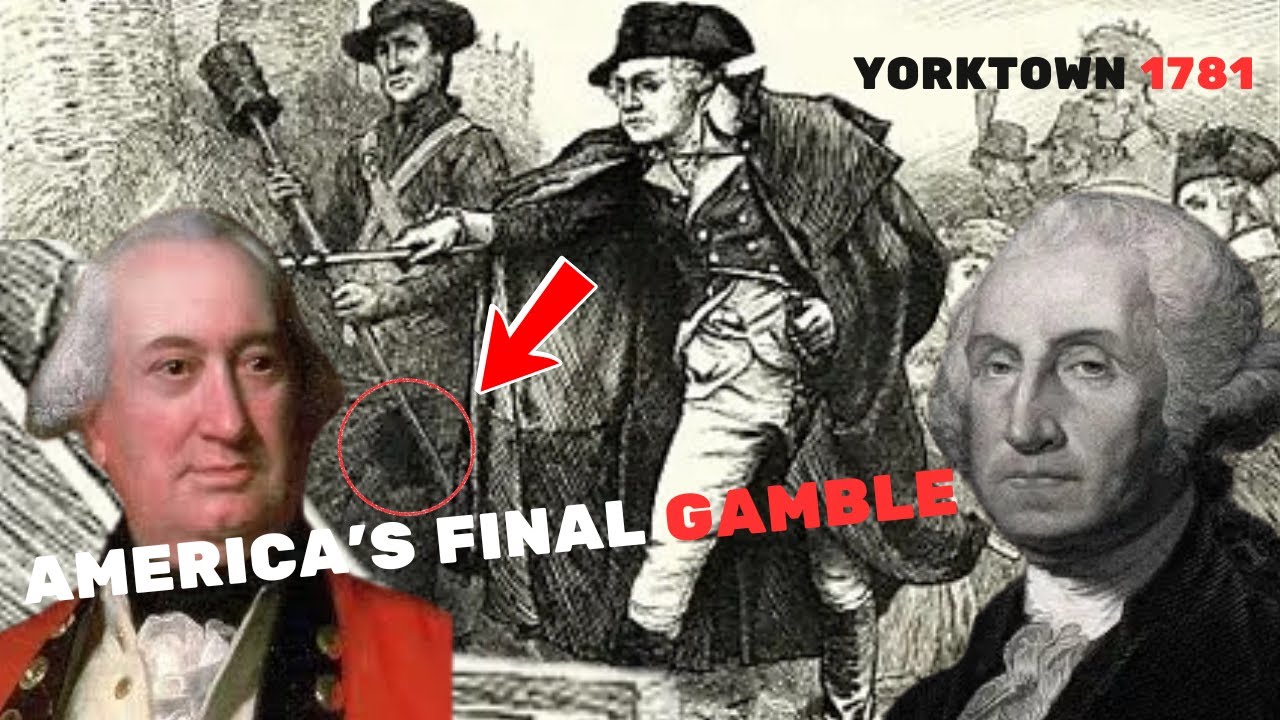
Washington stood at a crossroads. He could risk everything on a bold assault to reclaim New York, but the city was heavily fortified and packed with hardened British soldiers. A direct attack could be devastating, and failure meant catastrophe. Then a new opportunity emerged.
Word arrived that France, America’s crucial ally, was considering deploying a powerful naval fleet under Admiral de Grasse. A joint land and sea offensive between French and American forces could potentially trap a major British force elsewhere. The question was where. Yorktown, Virginia, a smaller port further south, presented a tantalizing target.
Recent troop movements suggested that Lord Cornwallis was concentrating his army there. If a lightning strike could be supported by French naval superiority, Yorktown might become the decisive moment of the war. In late August, Admiral de Grasse’s fleet of twenty-nine warships appeared off the Virginia coast, blocking Cornwallis and his forces within Yorktown. The news raced north to Washington’s camp, lifting spirits long dulled by war.
With cautious hope, Washington acted. In a massive logistical effort, he led over 12,000 American and French troops on a 700-mile march from New York to Yorktown, the largest troop movement of the Revolutionary War. Cloaked in secrecy, it was an all-or-nothing gamble for American liberty. As preparations for the siege began, Washington ordered the Marquis de Lafayette and his Continental forces to keep Cornwallis confined to the Yorktown Peninsula while merging with 4,000 French troops under the command of the Comte de Rochambeau.
At the same time, French naval forces rushed to secure control of the Chesapeake Bay. Cornwallis had been using Yorktown as a base to resupply his army of 9,000 men. Expecting reinforcements from the Royal Navy, he fortified the town with redoubts on its outskirts while stationing most of his troops inside. With assistance from French engineers, American and French troops began constructing parallel trenches to position their artillery within striking range.
By October 9th, they were close enough. Artillery fire commenced at five o’clock in the evening, with Washington personally firing the first shot. Legend says it smashed through a table where British officers were dining. The Franco-American bombardment began to dismantle the British defenses.
Washington ordered non-stop fire through the night, preventing any repairs. As the siege tightened, British positions crumbled under relentless assault. A German soldier’s account offers a harrowing view. On the 10th of October, his camp moved into the earthworks due to the enemy’s heavy fire.
Bombs of one hundred to two hundred pounds rained down. No one was safe from cannonballs inside or outside the city. Townspeople fled with their belongings, and many were gravely wounded or killed. Limbs were torn off.
Even ships in the harbor took damage, and shots flew across the river to Gloucester. Trapped inside the tightening allied siege, Cornwallis grew desperate. His only hope was help from across the Chesapeake. He sent urgent messages to British commander-in-chief Sir Henry Clinton in New York, requesting aid.
But Clinton hesitated. Enjoying the comforts of New York society, he feared a counterattack and was reluctant to challenge the powerful French fleet now controlling the bay. Cornwallis proposed a diversionary assault near New York to draw Washington away from Yorktown, but Clinton, unsure and cautious, declined. Eventually he did dispatch a fleet, though far smaller than Cornwallis hoped.
Before it arrived, the British fleet clashed with de Grasse’s French ships in the Battle of the Capes. The result was a costly stalemate, but it was enough for the French to retain control of the Chesapeake, sealing Cornwallis’s fate. On October 14th, under a moonless sky, Washington prepared a final assault. He ordered his men to keep their muskets unloaded until inside enemy lines to maintain silence and surprise.
The assault would be carried out with bayonets only. At 6:30 in the evening, American troops surged forward with axes, hacking through British defenses. Someone shouted, “Rush on, boys. The fort’s ours!
” The British threw hand grenades, but they were largely ineffective. American soldiers climbed over one another’s shoulders to breach the walls. As distances closed, muskets became spears. A fierce and intimate battle erupted.
Bayonets met swords in brutal combat. Cries of pain and clashing steel filled the air. Washington, watching the carnage, knew that each casualty was a heartbreaking sacrifice. But he also knew that the freedom of an entire nation depended on this fight.
The next night, Cornwallis launched a counterattack. At dawn on October 15th, he sent 350 British troops under Colonel Robert Abercrombie to sabotage allied cannons. They succeeded in disabling a few, but by morning all were repaired. In a final act of desperation, Cornwallis attempted to evacuate across the York River to Gloucester Point, hoping to break out.
One wave made it, but a violent storm wrecked the second trip, ending the escape. With his fortifications reduced to rubble and surrounded by unrelenting fire, Cornwallis had no choice. On the morning of October 17th, a drummer emerged from Yorktown, followed by an officer carrying a white handkerchief. The shelling stopped.
The officer was blindfolded and escorted to the allied lines. Cornwallis requested the traditional honors of war, to surrender with flags flying, bayonets fixed, and music playing. Washington denied the request, citing how the British had denied those same honors to the Americans at Charleston. Cornwallis, claiming illness, refused to attend the ceremony.
Instead, Brigadier General Charles O’Hara presented the sword of surrender first to Rochambeau, who declined, then to Washington, who also refused, gesturing instead to Major General Benjamin Lincoln. On October 19th, the British army marched out of Yorktown to lay down their arms. Their band played “The World Turned Upside Down. ” Humiliation hung heavy as British soldiers marched between French and American lines, making eye contact only with the French.
Lafayette noticed. With a crisp command, he ordered his band to strike up “Yankee Doodle. ” Cheers erupted from the Americans. At last, the British turned to face them, not as rebels, but as equals.
General Clinton’s fleet arrived five days too late. When news of the surrender reached London on November 25th, Prime Minister Lord North reportedly exclaimed, “Oh God, it is all over. It is all over. ” The Treaty of Paris was signed soon after, formally recognizing American independence and ending the war.
Thanks to resilience, brilliant leadership, and aid from French allies, the United States secured a stunning victory over the world’s most powerful empire. While July 4th, 1776, marks the day America declared independence, October 19th, 1781, at Yorktown is the day the dream became real. The cannons fell silent, but the struggle did not fully end. Independence came, yet slavery endured, women were still voiceless, and land was taken from others who had never seen a musket but lost everything just the same.
What began as a desperate gamble undertaken by farmers, shopkeepers, and statesmen ended with the mighty British Empire humbled and a new nation born from fire and defiance. The American Revolution wasn’t won in a single battle, but Yorktown made it undeniable.
