The griddle had been running since before dawn, and by the time the first men wandered in off the midnight watch, the smell of it was already drifting across the snack bar. A 19-year-old airman could walk in with a quarter in his pocket and walk out full. That was the promise of the PX in 1968, and it held up just about everywhere the flag flew, from a base in Germany to Okinawa to the middle of Vietnam. Most people picture military food as gray mess hall trays and cans of mystery meat.
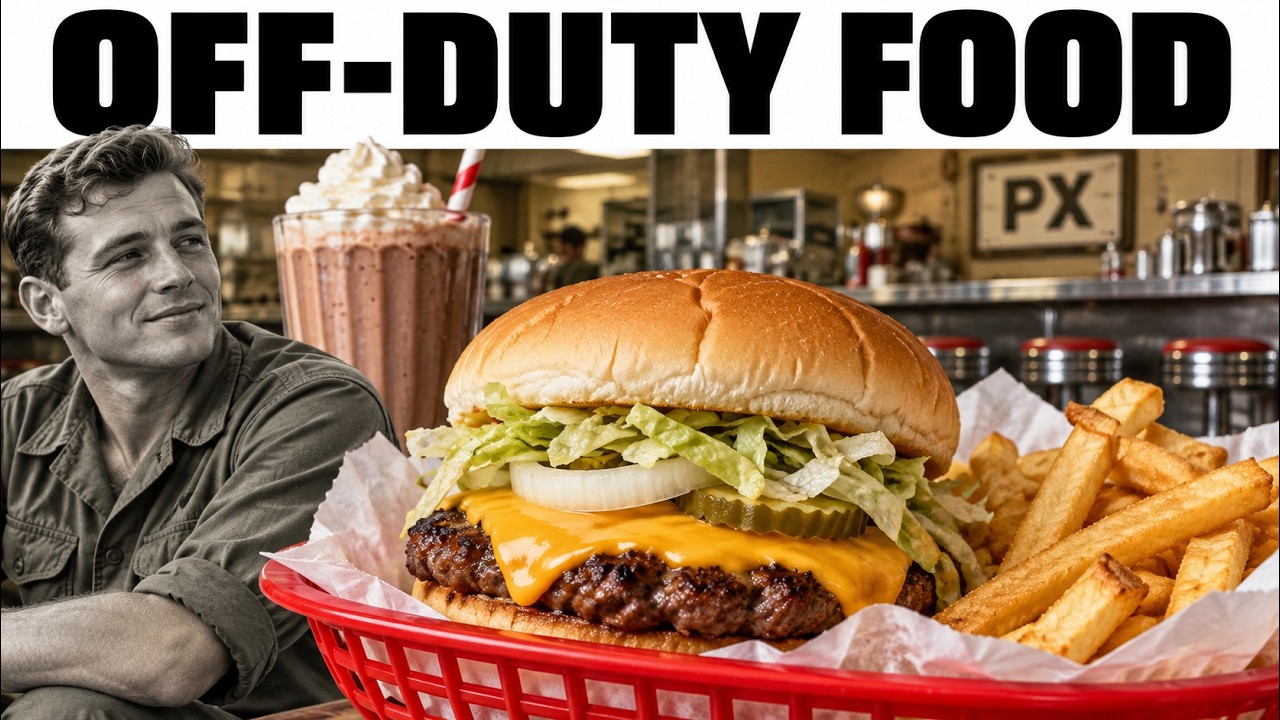
The truth tasted a whole lot better, at least if you knew where to look. The snack bar in the back of the PX, with its griddle and its fountain and its jukebox, was the closest thing to a hometown diner that a lot of these men would see for a year or more. It was not just a store. It was a piece of America transplanted to wherever the flag happened to be flying, and the food it sold was home by the dime.
Before dawn, before the flag went up, before anyone had a right to feel human, there was the coffee. Thick, bitter, poured from a stainless urn that had been running since 4:00 a. m. , served in a heavy white mug for a nickel.
Next to it sat the plain cake donut, the kind with the crackled top that shattered when you bit it. A dime got you both. Men coming off the midnight watch or heading into a 12-hour shift lived on this combination, dunking the donut until it went soft, then eating it fast before it fell apart in the coffee. The PX coffee was famously terrible and famously necessary.
It was not about flavor. It was about the warmth of a mug in cold hands at an hour when the whole world was still dark. Every serviceman who ever pulled a night shift remembers that first swallow. It tasted like the day beginning, whether you wanted it to or not.
Once the day was officially underway, the crown jewel of the snack bar counter came out. The PX cheeseburger was a hand-pressed patty slapped onto a flat top griddle that had not been scraped clean since the Eisenhower administration, with a slice of American cheese laid on in the last 30 seconds so it melted into the corners. All of it stacked on a soft white bun with mustard, a pickle, and a limp ring of raw onion. Thirty-five cents, tax-free.
On a stateside base, the PX burger cost half what the diner in town charged, and it came without the stares that a young man in uniform sometimes got downtown. The cook was usually a local hire or another enlisted man working a side detail, and he knew exactly how you liked it because he made 200 a day. The smell of that griddle was the smell of payday, of a break in the routine, a feeling like being a regular American kid again for 15 minutes. Men who ate a thousand of these still say nothing since has ever tasted quite the same.
When a plain hot dog was not enough to fill a working man, the counterman ladled a scoop of thin, greasy, cumin-heavy chili right over the top, then buried the whole thing under a fistful of shredded cheese and diced onion. Twenty cents. The chili came from a number 10 can and simmered on the back of the flat top all day, getting deeper and darker the longer it sat. It ran everywhere.
It soaked the bun into a soft mush by the third bite and dripped down your wrist if you were not careful, which no one ever was. You ate it standing up, elbows out, over a paper tray, and it filled you completely. For a soldier with $2 to last until Friday, a chili dog and a Coke was a complete meal that left change in his pocket. For the man who missed his mother and would never say so out loud, there was the grilled cheese and soup.
Two slices of white bread, a slab of butter on the griddle, two pieces of American cheese pressed flat until the outside went golden and the inside pulled into strings when you tore it in half. Beside it, a bowl of tomato soup made from a can and a little milk, still steaming. A quarter for the whole thing. There was nothing sophisticated about it.
That was the entire point. In a life full of orders shouted at 5:00 in the morning and a mess hall that served the same rotation on the same days forever, the grilled cheese was small and warm and familiar. It tasted like being 9 years old and home sick from school. Men who could not admit to being homesick ordered it anyway, dunked the corners in the soup, and felt something loosen in their chest for a few minutes.
The french fries came out of a deep fryer that ran on the same oil for a week, which is exactly why they tasted so good. Crisp, salty, a little too dark at the edges. But the real order, the one that separated the veterans from the new arrivals, was to have them smothered. The counterman would dump a boat of fries onto a tray, spoon chili over the whole pile, and blanket it in cheese that half melted from the heat below.
A quarter. You ate them with a plastic fork until the fork gave out, then with your fingers. This was not a side dish. For a lot of men on a tight budget, a tray of chili cheese fries was dinner, eaten in the corner booth while somebody fed dimes into the jukebox.
Nobody counted calories in 1969, and nobody had a reason to. Every good PX snack bar had a soda fountain and a man behind it who could work the machines. The malted milkshake was his masterpiece. Real ice cream, cold milk, chocolate syrup, and a heaping spoon of malt powder, all of it spun on a green spindle mixer until it climbed the sides of the metal cup.
He poured it into a glass and handed you the cup, too, because there was always more than fit. Thirty cents. The malt gave it that toasty, almost nutty depth that a plain milkshake never had, and it was so thick the straw stood up on its own. For a young man far from the drugstore counter back home where he used to take a girl on Friday nights, that malt was a direct line back to a life he had left behind.
You nursed it slow to make it last. Long before the military, the MoonPie and RC Cola had been the working man’s combination, and it followed a whole generation of Southern boys onto the base. A MoonPie, two round graham cookies with a marshmallow center dipped in chocolate, and a tall cold RC Cola to wash it down, cost about a dime for the pair. Men from Alabama and Georgia and Tennessee grew up on this exact thing at the country store, and finding it stocked on the PX shelf so far from home was a small miracle.
You could carry both in your pockets out to the field, eat the MoonPie in three bites during a break and drink the RC warm if you had to. The chocolate melted in the heat and got everywhere, and nobody cared. For a homesick Southerner, that packaged pie was a piece of the front porch he had grown up on. By the register at every PX in the world lived the Slim Jim.
Long, thin, dark red, shrink-wrapped in cellophane, a smoked meat stick with a snap and a spicy, salty, faintly sour bite that you could feel in your back teeth. A nickel a piece. What made it perfect for military life was that it never spoiled, never needed refrigeration, and fit in a shirt pocket, a boot, or a rucksack. Men bought them by the handful and stashed them everywhere because you never knew when the chow line would fail you or the mission would run long.
You tore the wrapper with your teeth and gnawed it slow to make it last. Every barracks foot locker in the 1960s had a few rolling around in the bottom. Even simpler was the Vienna sausage, sold in a flat tin with a pull ring for about a dime. A short stack of pale little sausages packed in gelatinous broth.
You peeled back the lid, drained the jelly if you were particular, and ate them one at a time on the point of a pocketknife or a plastic fork, or just your fingers. Some men laid them across saltine crackers. Some ate them cold standing at their locker at midnight when the snack bar was closed and hunger woke them up. Servicemen stockpiled them the way squirrels stockpiled acorns, because a tin that never went bad was insurance against a hungry night.
Nobody bragged about it, but a can of Viennas and a sleeve of crackers had ended a lot of empty stomachs before lights out. In a cellophane bag by the door, light as air and loud as a firecracker, were the pork rinds. Fried pieces of pig skin puffed up crisp and dusted with salt, sometimes with a hot barbecue coating that stained your fingers orange. A dime a bag.
They had no nutrition to speak of and filled you up on nothing, which made them perfect for stretching the hours between meals. Southern boys had grown up on cracklings, the homemade version, and the store-bought PX rinds were close enough to feel familiar. You passed the bag around the barracks during a card game, and it was empty before anyone had a decent hand. The crunch was the whole appeal, that first shattering bite that echoed off the walls.
Cheap, salty, and gone in 5 minutes, the pork rind was pure barracks entertainment as much as it was food. The Navy and Marine Corps had an old word for candy: pogey bait. The PX had a wall of it. Necco wafers in their paper tube, chalky and pastel and strangely addictive.
Squares of chocolate, rolls of Life Savers, bags of hard candy. A nickel here, a dime there. Men bought pogey bait by the fistful, some to eat and some to carry, because sugar was morale you could put in your pocket. On a long detail or a night watch, a piece of hard candy tucked in your cheek was a small rebellion against the boredom and the misery.
Necco wafers in particular had been marching with American servicemen since before the war, tough enough to survive a rucksack in the jungle. It was childish, and every hard man on the base knew it, and every hard man on the base kept a stash anyway. When a base was lucky enough to have a soft serve machine, that machine ran non-stop. The counterman pulled the lever and a spiral of vanilla or chocolate curled down into the cone, and for a dime you carried a little piece of childhood back to your bunk.
In the crushing heat of a summer afternoon or in the wet heat of Southeast Asia, where nothing ever cooled off, a soft-serve cone was almost more relief than food. It melted faster than you could eat it, running down over your knuckles, and you chased the drips around the cone in a losing race. Men wrote home about the ice cream because in a letter full of things a young soldier could not say, ice cream was safe. It was a way of telling your mother that things were all right, that you had eaten something sweet, that there was still a scrap of ordinary joy in a place she worried about.
The celebration food, the thing you ordered when you got promoted or got paid, was the banana split. A split banana in a long boat, three scoops of ice cream down the middle, chocolate and strawberry and pineapple sauce, a shake of nuts, and a cherry on top if the counterman was feeling generous. Fifty cents, which was real money at the PX, enough that you had to want it. Two men would sometimes split a split, sitting across the booth with two spoons, working from opposite ends.
In a life measured out in rations and regulations and standard portions, a banana split was excess on purpose. It was the counterman’s way of saying, tonight, you are not a serial number. Tonight, you are a customer, and the customer gets the cherry. For the survival food of the barracks, the field, and the long ride in the back of a truck to somewhere miserable, there were the peanut butter and cheese crackers.
Six little orange crackers sandwiched with peanut butter or a bright, fake cheese, sealed in a cellophane pack by the register. A nickel. They kept forever, took a beating in a pocket without falling apart, and had enough salt and fat to actually quiet a hungry stomach. Men bought them in stacks and stuffed them into every bag they owned.
When the mess hall was closed and the snack bar was closed and you were stuck somewhere with nothing, a pack of cheese crackers was the difference between an empty night and a tolerable one. Half the appeal was the salty peanut cracker crumbs that fell into your lap. Humble, cheap, and indestructible, they were the unsung workhorse of military snacking. Every serviceman knew cream chipped beef on toast, thin slices of dried salted beef stirred into a thick white gravy and poured over toast, by a name that cannot be printed politely.
The snack bar version was a little kinder than the mess hall’s, made with real butter and a slug of black pepper, but it was the same idea. A quarter got you two slices drowned in gravy, heavy and filling and hot. Men complained about it constantly and ate it constantly, which is the truest sign of military food. On a cold morning, it stuck to your ribs and carried you clear to lunch.
Every veteran of the era has a strong opinion about it, and half of them cook it in their own kitchens to this day, gravy and all. They complain the whole time they make it, then they eat two servings. Ground beef simmered in a sweet and tangy tomato sauce, spooned onto a soft hamburger bun that immediately began to surrender under the weight of it, made the sloppy Joe. The PX version came out of a big pot on the back of the griddle and cost a quarter.
There was no dignified way to eat one. The filling slid out the back, the bun came apart in your hands, and you ended up wearing part of it. Men ate them fast and often because a sloppy Joe was cheap, hot, and satisfying in a way that a plain sandwich never was. It was the taste of a school cafeteria and a church basement supper, the flavor of every group meal a young man had eaten before he ever put on the uniform.
A hot dog jammed on a stick, dipped in cornmeal batter, and dropped into the deep fryer came out golden and crackling as a corn dog. Fifteen cents. You squeezed a line of yellow mustard down the length of it and ate it walking, which was the whole appeal because you did not have to sit down or use a plate or a fork. The batter went crisp on the outside and stayed a little cakey underneath, and the frankfurter inside snapped when you bit it.
Corn dogs came off the fryer in batches, and there was always a small crowd waiting for the next round. It was carnival food, fair food, boardwalk food, and finding it at the base snack bar was a reminder of every good summer a young man had ever had. By the mid-1960s, pizza was sweeping across America, and the base snack bars were not going to be left behind. It was nothing like what came later.
A thin crust, a smear of sweetish red sauce, a blanket of that same American-style mozzarella, maybe some pepperoni curled up into little grease cups. A slice cost around a quarter, or you could go in with three other guys on a whole pie. For a lot of these men, it was the first pizza they ever tasted, because pizza had not yet reached every small town in the country. They came off the base having grown up on meat and potatoes and went home hooked on this new thing from the snack bar.
A whole pizza and a pitcher of soda made a Friday night in the barracks feel like a party. Here is something worth stopping on. A lot of these men were teenagers, 18, 19, 20 years old, pulled out of high school hallways and small town jobs and dropped into a life of orders and discipline and, for many of them, real danger. The snack bar was the one place on the whole base where they got to be young again.
The jukebox played the songs from home. The fountain made the malts they used to buy at the drugstore. The counter served the burgers and the fries and the banana splits that tasted like the ordinary life they had traded away. For the price of a few dimes, a scared kid could sit in a booth and feel for an hour like nothing had changed.
That is why these foods mattered so much, and why grown men remember them with tears in their eyes 50 years later. It was never really about the chili dog. It was about who you got to be while you ate it. Two scoops of vanilla ice cream dropped into a tall glass, then root beer poured over the top until it erupted into a tan foam that climbed over the rim and spilled down the sides, made the root beer float.
Twenty cents. You got a straw and a long spoon, and the trick was to alternate a sip of the cold fizzy root beer through the straw, then a spoonful of the ice cream going soft and slushy where it met the soda. Every base fountain made them, and on a hot day nothing else came close. Men who could not have a beer, or had had too many already, could always have a float, and there was no shame in a grown soldier nursing one in the corner.
The little box with the sailor boy on the front held Cracker Jack, caramel-coated popcorn and peanuts with a cheap prize buried somewhere inside. A dime. Men bought it as much for the digging as for the eating, tipping the box to fish out the paper-wrapped surprise before they had eaten a single kernel. The prize was always junk, a tiny plastic toy or a paper decoder or a temporary tattoo, and it always got passed around the barracks and laughed at.
But the caramel corn itself was good, sticky and sweet, and it lasted longer than most snacks because you could only eat so much of it at once. A box of it in the barracks was a small piece of a normal life, and the useless prize inside was a reason to smile in a place that did not give you many. From the shelf came the little cans with the paper wrappers, potted meat and deviled ham. A spreadable, salty, faintly spiced paste that you smeared thick on saltine crackers, a dime a can.
It required no cooking, no refrigeration, and no equipment beyond a knife and a box of crackers. For a man in the barracks after hours or out in the field with a strip-down kit, a can of potted meat and a sleeve of saltines was a full meal assembled on the top of a foot locker. The deviled ham had a little kick to it that made it the favorite, and men doctored it with hot sauce if they had any. A flat can with a key on the bottom, twisted to roll back the lid, held sardines packed tight in oil or mustard sauce.
Fifteen cents. Men laid them out on crackers or ate them straight from the tin over the trash can so the oil would not drip on the floor. Sardines were an old soldier’s secret, dense with protein and fat, small enough to carry anywhere, good until the end of time. An older sergeant would eat a tin for lunch and swear it was the reason he could still outrun the young ones.
The smell cleared out a barracks room, and nobody who ate them cared. When a man had a hot plate in the barracks, which he was not supposed to have and always did, the fried bologna sandwich became possible. A thick slice of bologna bought by the roll at the PX, notched at the edges so it would not curl, laid in a hot pan until it blistered and browned and swelled up in the middle like a little dome. Then onto white bread with mustard, maybe a slice of that pale processed cheese melting on top.
It cost almost nothing, and it tasted like a hundred bucks at midnight when the snack bar was long closed and everyone was hungry. Men smuggled the hot plates and the bologna and the bread back to the barracks and fried up sandwiches in defiance of every regulation, and the smell of frying bologna would fill the whole hallway and draw a line of hungry men to the door. It was contraband cooking shared out slice by slice, and it built more friendships than any training exercise ever did. Dried, salted, smoked strips of beef in a wax paper bag made beef jerky, tough as leather and twice as satisfying to chew.
A quarter for a good-sized bag. Jerky was the ultimate carry food, indestructible, endlessly shelf stable, and packed with the kind of salt and protein that a working man burned through fast. It went into rucksacks and cargo pockets and glove boxes, and it stayed good long after everything else had spoiled in the heat. You gnawed it slow, working a single strip for 10 or 15 minutes, pulling the flavor out of it a little at a time.
On a long detail with no chow in sight, jerky was the thing that kept your stomach quiet and your mind off the misery. Men shared strips the way they shared cigarettes, one to a buddy without being asked, because a shared bag of jerky in a hard hour was a small kindness that meant more than it looked. In the end, the most important thing the PX ever sold was not a meal at all. It was a bottle of Coke pulled dripping from the cooler, so cold it hurt your teeth, the glass sweating in the heat.
A dime. Coca-Cola had followed American servicemen to every corner of the earth, and the company made sure that wherever a young man in uniform stood, that familiar bottle stood with him. In the wet heat of Vietnam, in the cold of a German winter, in the middle of nowhere on a dusty stateside base, that first swallow of cold Coke was home in a bottle. It tasted exactly like the drink he had bought after school, at the ball game, on a first date, in the life he had left behind.
Men who could not have described what they missed could point to that bottle and say, that is what I am fighting to get back to. It was cheap, and it was small, and it was everywhere, and it carried more comfort than anything else on the base. A cold Coca-Cola was the whole country reaching out and handing a scared kid a piece of home, and every man who took that bottle knew exactly what it meant.
