On the night of July 28, 1981, as a billion people continued to relive the “wedding of the century” in their minds, Diana Spencer sat alone in a suite at Broadlands. She was nineteen. Her marriage had lasted precisely eight hours. Somewhere in that grand estate, her new husband was on the phone with another woman.
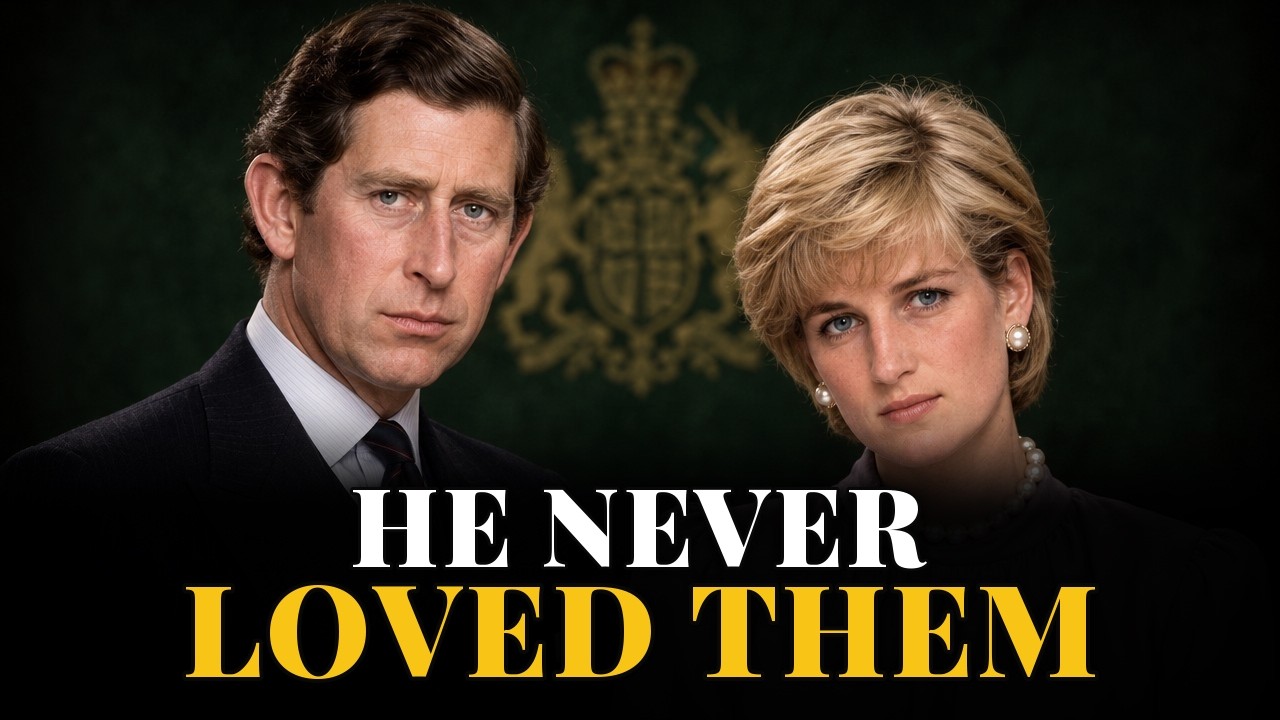
The very woman whose photograph Diana had discovered in his diary three weeks before the wedding. The same woman whose initials were engraved on the gold bracelet Charles had sent by courier two days before he walked down the aisle. What Diana did not realize, straining to hear the muffled sound of his voice through the walls, was that this call was not a farewell. It was a vow.
The woman on the other end of that line would stay present, in one form or another, in every corner of Diana’s marriage for the next fifteen years. And that marriage did not merely make Diana unhappy; it convinced her—as she told her voice coach Peter Settelen, in recordings now held by the Metropolitan Police—that her husband had never wanted her at all. That she had been, in her own words, like a lamb led to the slaughter. But here is what history seldom examines.
Diana was not the first woman devastated by her closeness to Charles. She was the third. Before her came Camilla Shand, who loved him at twenty-three and was cast aside when the palace judged her unsuitable. And before Camilla there was a woman the public has almost entirely forgotten: Lady Jane Wellesley, the duke’s daughter who fled the relationship, convinced that Charles would never be permitted to love anyone at all.
Three women, three decades. And at the center of it all, a man who would one day become king, trained from boyhood to suppress every genuine feeling he had. The question is not whether Charles hurt the women who loved him. The letters, the diaries, the sworn testimonies make that clear.
The question is whether a man raised to believe his heart belonged to the crown could have done anything else. Charles Philip Arthur George was born on November 14, 1948, at Buckingham Palace. The first son of a princess who would become queen four years later and a naval officer who rejected almost everything about the life awaiting him. From the moment of his birth, Charles was less a child than a constitutional instrument.
He was heir to the throne before he could walk. What that meant in practice was a childhood defined by absence. Elizabeth was twenty-two when he was born, and within months she was traveling again. Malta, then Africa, then a Commonwealth tour lasting nearly six months.
The Queen Mother later admitted, in correspondence preserved in the Royal Archives, that Charles spent most of his first five years with the nannies rather than with his parents. His father, Prince Philip, believed that masculine strength could only be forged through deprivation. When Charles was eight, Philip sent him to Cheam School. When he was thirteen, Philip sent him to Gordonstoun in Scotland, the same harsh institution that had shaped Philip himself.
Charles hated it. He was bullied without mercy. The boys called him weak. The teachers offered no protection.
Protocol forbade coddling the future king. In a letter to a relative, Charles described Gordonstoun as a prison sentence. He begged to be withdrawn from the school. Philip refused.
Elizabeth deferred to Philip’s opinion. And so Charles learned, before he was old enough to shave, the lesson that would define every relationship in his adult life. His feelings did not matter. Duty came first.
The crown came first. His heart was merely a nuisance to be managed, not honored. By the time he left Gordonstoun at eighteen, he had become what biographer Jonathan Dimbleby later described as emotionally dependent on approval, yet convinced he would never receive it. In other words, he was primed to fail at love.
The first woman to discover this was Lady Jane Wellesley, daughter of the eighth Duke of Wellington. They met in the early 1970s, when Charles was in his mid-twenties and beginning what the press would later call the search for a bride. Jane was beautiful, intelligent, and aristocratic to the core. Exactly the type the palace approved of.
By 1973, the tabloids were treating their wedding as a certainty. But Jane understood something that took Diana another decade to learn. She was being tested, not courted. Charles was under immense pressure from Lord Mountbatten, his great-uncle and closest confidant, who wrote him letters—now published—setting out explicit criteria for a royal bride.
She must be young. She must be a virgin, or at least discreet. She must be Protestant. Her identity must be entirely subsumed by the institution.
Jane Wellesley read those expectations and withdrew. In a rare interview years later, she said simply: “I wasn’t ready to be just a royal breeding machine.” She realized that Charles was not choosing a wife. He was filling a vacancy, and she refused the role before the institution could swallow her.
She was lucky. The next woman was not. Camilla Shand met Charles at a polo match in Windsor in 1971. She was twenty-three.
He was twenty-two. The attraction was immediate. Camilla was spontaneous, bold, and playful in a way utterly different from Charles. She made him laugh.
She did not treat him as a future king. She treated him as a nervous young man who needed permission to relax. Within months, they were lovers. Charles opened up to her with a candor he had never shown anyone.
But Camilla had a past, a serious previous relationship with Andrew Parker Bowles, a cavalry officer from a prominent Catholic family. And in the eyes of Lord Mountbatten and the palace establishment, that past was grounds for exclusion. She was not a virgin. She was not malleable.
She was not, in the language of the institution, suitable. Mountbatten wrote to Charles urging him to end the affair and to live his life before settling down with a suitable bride. Charles obeyed. In 1973, while Charles was on duty aboard the frigate Minerva, Camilla married Andrew Parker Bowles.
Charles received the news on board the ship. Officers who served with him later recalled that he was devastated, but he said nothing. He did what he had been trained to do. He suppressed his feelings, hid them, and carried on with his duty.
Years later, Camilla told friends, as recorded in the work of her biographer Penny Junor, that she had waited for him, that she expected him to fight for her, to defy his family. But he did not. She married Andrew because Charles had given her no reason to wait. But she never stopped loving him.
And he, in spite of all that came afterward, never stopped loving her. That incomplete story would shadow the lives of three people for the following twenty years. What the public could never grasp about Charles, and what the tabloids deliberately hid, was that he was neither foolish, idle, nor simply born to privilege. In truth, he was among the most intellectually engaged members of the modern royal family.
While other royals showed up at garden parties and steered clear of controversy, Charles was quietly assembling a structure of influence that operated almost wholly beyond public scrutiny. In 1976, he established the Prince’s Trust with £7,400 he had received as a severance payment from the Royal Navy, a sum worth roughly £55,000 in today’s money. The trust would go on to help over a million young people. He was championing organic farming, sustainable architecture, and interfaith dialogue decades before those causes became fashionable.
He penned detailed letters to ministers, later known as the “black spider” memos, which were released after a legal battle lasting a decade, contesting government policy on matters ranging from grammar schools to alternative medicine. Civil servants grumbled that he was meddling in affairs that were none of his concern. Historians today acknowledge that he was frequently ahead of his time. Yet this competence was paired with an almost complete inability to handle intimate relationships.
He could run a charity, redesign a village, and lecture government ministers. But he could not tell a woman he loved her with a sincerity that made her believe him. The discipline that made him effective in public life made him disastrous in private life. He had been raised to believe that emotion was weakness, that vulnerability was failure, and that love was something that happened alongside duty, never instead of it.
And so he treated marriage the way he treated everything else: as an obligation to be carried out according to protocol. The search for a bride began in earnest after Mountbatten was assassinated by the IRA in August 1979. Mountbatten was the nearest thing Charles had to a loving father figure, and his death left Charles adrift. Within months, the palace was pressing him to settle down.
He was thirty-one. The line of succession demanded an heir, so he turned his attention to Lady Diana Spencer, the eighteen-year-old daughter of Earl Spencer, a family with deep ties to the Windsors. Diana was young, a virgin, Protestant, and aristocratic. She satisfied every requirement on Mountbatten’s list.
But she was also, in 1980, a teenager with almost no experience of life. She had left school at sixteen without finishing her secondary qualifications. She was working part-time as a nursery assistant in Pimlico. She had met Charles only a handful of times, and yet within a year she would become the fiancée of the future King of England.
The courtship amounted to only about thirteen meetings. Diana later described it, in her recorded sessions with Settelen, as a whirlwind in which she had no say. Meanwhile, Charles was still calling Camilla, consulting her on personal matters such as Diana’s suitability. On the night before the engagement was announced, Diana cried.
She had come across a bracelet Charles had ordered for Camilla, engraved with the letters F and G, Fred and Gladys, their private nicknames for each other. When Diana confronted him, Charles brushed aside her concerns. He told her: “There’s nothing to worry about. The relationship is over.
” Diana believed him. The wedding took place on July 29, 1981, at St. Paul’s Cathedral. Seven hundred and fifty million people watched the live broadcast.
Diana wore a dress with a twenty-five-foot train. The Archbishop of Canterbury described it as something out of a fairy tale. But behind the pageantry, the marriage was already collapsing. On the honeymoon aboard the royal yacht Britannia, Diana discovered that Charles had brought photographs of Camilla with him.
He wore cufflinks Camilla had given him. He wrote to her daily. When Diana confronted him, he turned cold toward her. He dismissed her distress as mere melodrama.
By the time they returned to Balmoral, Diana was showing early signs of bulimia, bingeing and vomiting several times a day. The palace did nothing. The pattern of infidelity continued but went unacknowledged. Charles resumed his relationship with Camilla within five years of the marriage.
Some sources, including Andrew Morton’s book based on Diana’s own testimony, suggest it never fully stopped. Camilla was present in the background of their lives: late-night phone calls, weekends at country houses, a parallel relationship conducted in plain sight. Diana described Camilla as a third party in the marriage. She told Settelen that she once confronted Camilla at a party in 1989, saying: “I know what’s going on between you and Charles, and I just want you to know that I know.
” Diana claimed Camilla replied calmly: “You’ve got everything you ever wanted. You’ve got all the men in the world falling in love with you. What more do you want? ” Diana answered: “I want my husband.
“
Diana spent a decade trying to make her marriage work, and another decade hearing hints and declarations that her suffering was the problem. She developed coping mechanisms that bordered on self-destruction. Her bulimia worsened. She engaged in self-harm.
She underwent therapy with a rotating cast of therapists whose notes remain sealed. The palace considered her unstable, a source of embarrassment to be managed rather than a person deserving of support. Yet she outshone her husband at every public appearance. When they visited Australia in 1983, the crowds wanted Diana, not Charles.
When they toured Italy, the cameras followed her. Charles’s resentment grew. Diana later said he told her: “You were made to be a wife, not a star. “
What the official narrative omitted was the scale of Charles’s continued duplicity.
He maintained his relationship with Camilla throughout Diana’s pregnancies, throughout her struggles with mental illness, and throughout her repeated attempts to reach him. In 1992, Andrew Morton’s book “Diana: Her True Story” revealed the reality of the marriage to the public for the first time. Charles’s camp dismissed the book as exaggerated. Three years later, he admitted on national television in an interview with Jonathan Dimbleby that he had been unfaithful.
He noted that the question was whether adultery was compatible with duty. The myth that formed around Diana in the 1990s was powerful, but it was sometimes misleading. The tabloid narrative portrayed her as an innocent victim and Charles as a seasoned villain. The reality was more complex.
Diana herself had affairs with her bodyguard Barry Mannakee, with James Hewitt, and with others. She could be manipulative, as former staff testified in later legal proceedings. She used the press as a weapon, leaking stories and arranging photo opportunities. But the fundamental imbalance of power was real.
Diana was nineteen when she married a thirty-two-year-old man who was still in love with another woman. She entered the relationship with no preparation, no institutional support, and no honest information about what she was agreeing to. Charles, meanwhile, received training, advice, and protection from the most sophisticated public relations operation in the world. When the marriage failed, Diana bore the blame in palace circles.
They called her hysterical, difficult, mentally unhinged. The “Squidgygate” tapes—clandestine recordings of Diana’s phone calls with James Gilbey—were handed to the press to shame her. The “Camillagate” tapes, equally intimate recordings of Charles and Camilla, were brushed off by the establishment as an unlucky breach of privacy. The double standard was hardly subtle.
Diana bore the cost. The separation came in December 1992. The divorce was wrapped up in August 1996. She came away with roughly £17 million, along with £400,000 a year—an enormous figure by ordinary reckoning, though a modest one by royal reckoning.
She surrendered the title of Her Royal Highness. Most of her official duties were taken from her. Yet she walked out of the ruins holding something Charles could never lay claim to: moral authority. Her “Panorama” interview with Martin Bashir in November 1995 drew close to 23 million viewers in Britain alone.
She talked frankly about Charles’s involvement with Camilla, about her battle with bulimia, and about the times she tried to take her own life. She gave the world her famous line: “There were three of us in this marriage, so it was a bit crowded.” The interview wrecked Charles’s public image and exposed what the palace had long kept hidden: Diana understood exactly what had been done to her. On August 31, 1997, she died in a car crash in the Pont de l’Alma tunnel in Paris.
She was thirty-six. The driver, Henri Paul, was drunk. The paparazzi pursuing the car carried part of the blame. But the mourning that swept the world was not simply about how the accident happened.
It was about what Diana stood for: a woman devoured by an institution and then discarded once she grew inconvenient. At the funeral, her brother, Earl Spencer, gave a speech that read as an indictment of the royal family. He said: “She didn’t need a royal title to continue to generate her particular brand of magic.” The meaning was plain.
The Windsors had failed her. Which leaves the question: did Charles hate these women, or did he simply never learn how to love them? The documentary record points to something more complicated—and possibly more damning. The letters Charles sent Camilla while married to Diana, some of which came out in legal proceedings and press investigations, show a man capable of profound emotional expression—but only toward one person.
He wrote to Camilla with a tenderness, longing, and openness he never gave Diana. The letters Diana wrote back, sealed or destroyed, known only through secondhand accounts, chronicled her longing to reach a husband who had already handed his heart to another woman. Royal biographer Penny Junor contends, in her 2017 book, that Charles was not cruel but emotionally stunted. A man who loved Camilla from the beginning and never wavered, yet lacked the nerve to fight for her when it counted.
Tina Brown, in “The Palace Papers,” argues the opposite: Charles was complicit in a system that treated women as tools. Camilla was discarded once she became undesirable. Diana was selected because she was useful. Both were meant to set aside their own needs in service of the institution.
The honest answer is that the surviving documents cannot establish whether Charles grasped the harm he inflicted. What they do establish is that he inflicted it, and that the institution around him backed him at every turn. The sealed files in the Royal Archives, including Charles’s private diaries from the 1980s, might shed more light. For now, those files stay sealed.
Charles married Camilla in April 2005, almost fifty-five years after they first met. Diana had been gone for eight years. The ceremony was civil, not religious. It marked the first time since Henry V that a divorced person had married an heir to the throne.
The Queen stayed away from the ceremony, though she showed up for the blessing afterward. By royal standards, the event was restrained. A quiet admission that the love story which destroyed Diana had at last won official sanction. Charles became king on September 8, 2022, at seventy-three.
Camilla became Queen Consort. The same institution that once judged her unfit had now set her beside the throne. And Diana—the teenage girl picked because she fit a checklist, told her feelings were nothing but melodrama, dead at thirty-six in a foreign tunnel—became in death the most famous woman of her generation. The fairy tale, as it turned out, was never about love.
It was about duty. And duty, as Charles’s women discovered, shows no mercy.
