A single horseman comes over the ridge. He is not old, and he is not cautious. He rides the way he does everything, as if the world owes him an audience. Long hair spills out from under his hat, gold curls bouncing against a red cravat that no other officer in the Union Army would dare wear into enemy lines.
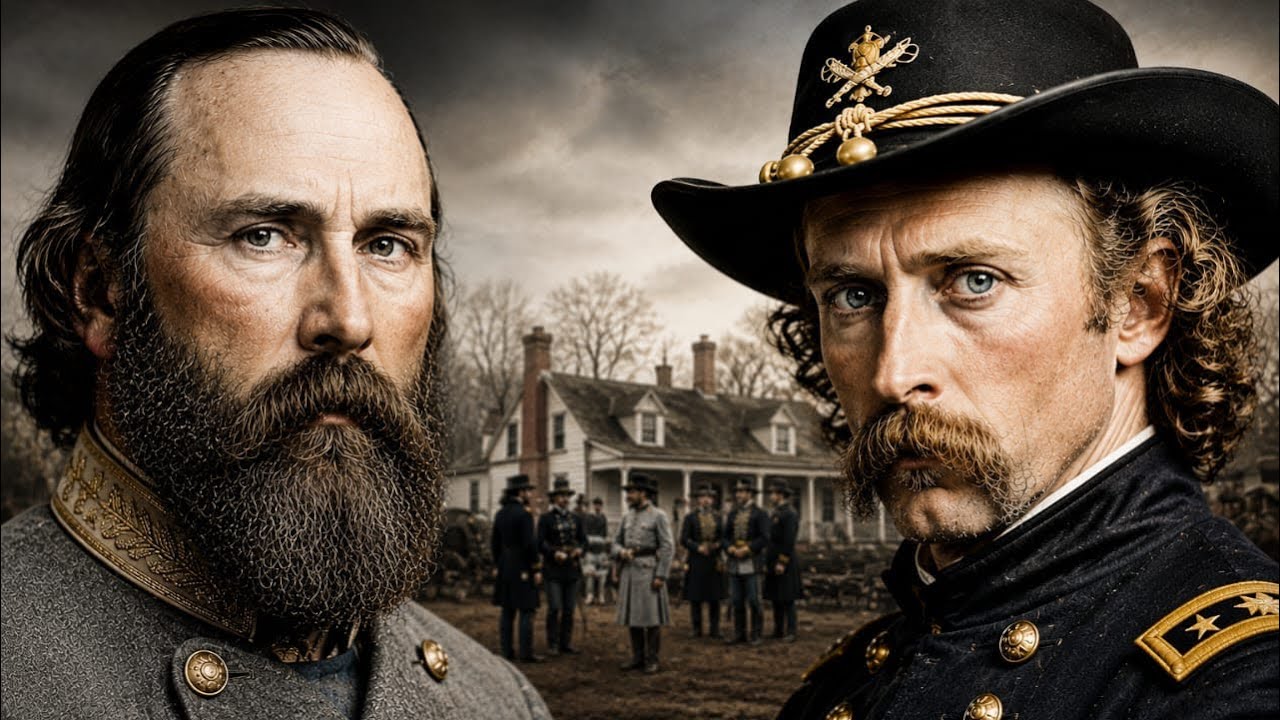
Behind him, a white flag hangs limp in the windless morning air. It is April 9th, 1865. In a few hours this war will be over. Robert E.
Lee is already drafting the words that will end it. But the man riding toward the Confederate lines right now does not know that. Or maybe he does not care. His name is George Armstrong Custer, and he is about to do something almost nobody remembers today, because the man on the other side of that meeting made sure it never happened.
He rides up to a Confederate officer, reins in his horse, and says the words he has been waiting four years to say. “In the name of General Sheridan, I demand the unconditional surrender of this army. ”
The man he is saying it to is not Robert E. Lee.
It is James Longstreet, Lee’s most trusted general, a man who has buried friends, watched his own children die of illness in the same terrible week, and fought through four years of a war that has cost him almost everything. And Longstreet is not in the mood for theater. What Longstreet says back to Custer in the next sixty seconds will humiliate him in front of his own staff. It will not appear in Custer’s official report.
It will not appear in the songs written about him, or the paintings, or the legend his wife spends the next fifty-seven years building. It survives, barely, in the memoirs of the men who watched it happen. To understand why he did it, and why it almost worked, we have to go back four days, to the moment Robert E. Lee’s army stopped retreating and started dying.
On April 2nd, 1865, the Confederacy’s capital caught fire, not from Union shells but from its own defenders. As Lee’s army abandoned the trenches around Petersburg and Richmond, Confederate soldiers set the tobacco warehouses ablaze rather than let the cotton and supplies fall into Union hands. The fire spread faster than anyone planned. By morning, entire blocks of the city that had anchored the Confederacy for four years were ash.
Robert E. Lee was not there to see it burn. He was already forty miles away, moving west with what remained of the Army of Northern Virginia, roughly 55,000 men, though nobody could say the number with confidence anymore. Desertion was bleeding the army faster than any battle.
Men who had marched into Pennsylvania in 1863 were now slipping away in the dark, walking home to farms that might not exist anymore. Lee had one plan left, and it depended on speed. If he could reach the town of Danville, or push further to link up with Confederate forces under Joseph Johnston in North Carolina, the war could continue. It was not victory.
It was not even close to victory. But it was survival, and after four years, survival had become its own kind of goal. Standing in his way was a Union army that outnumbered him more than two to one, commanded by a general who had finally, after years of costly failures by his predecessors, found the one strategy that actually worked against Lee: refuse to stop. Ulysses S.
Grant did not care about winning individual battles anymore. He cared about ending the war, and he understood something his predecessors never fully grasped, that Lee’s army, however brilliant its commander, could not survive a fight it could not disengage from. So Grant’s cavalry, under Philip Sheridan, was ordered to do one thing: get ahead of Lee. Not behind him, not beside him, in front of him, cutting off every road, every rail line, every hope of resupply until the Army of Northern Virginia had nowhere left to walk.
Riding at the front of that cavalry, as he almost always did, was a twenty-five-year-old major general named George Armstrong Custer. But first, Lee’s army had to survive something much worse than a bluff. It had to survive Sailor’s Creek. By April 6th, Lee’s retreat had turned into something closer to a rout.
The army was strung out for miles along muddy Virginia roads, its wagon trains tangled, its units separated by hours instead of minutes. Sheridan’s cavalry, Custer’s division among them, struck the vulnerable rear of the column near a stream called Sailor’s Creek. What followed was not a battle in the way Gettysburg or Antietam had been battles. It was closer to a slaughter.
Nearly a quarter of Lee’s remaining army, somewhere close to 7,700 men, was killed, wounded, or captured in a single afternoon. Among the prisoners were eight Confederate generals, including Lee’s own son, Custis Lee, and Richard Ewell. When word of the disaster reached Lee that evening, he reportedly looked out over the shattered remnants of his army streaming past and asked a question that has echoed through Civil War history ever since. “My God, has the army dissolved?
” It very nearly had. Sailor’s Creek matters to this story for a reason that has nothing to do with tactics. It matters because of what it did to the psychology of both armies in the seventy-two hours that followed. For Confederate soldiers, for James Longstreet watching his friends captured and his columns disintegrate, Sailor’s Creek was proof that the end was close, and that every remaining decision carried weight far beyond the battlefield.
Surrender was no longer an abstract possibility. It was becoming inevitable, and men like Longstreet knew it. For the Union cavalry, for Custer, Sailor’s Creek was something else entirely. It was validation.
It was proof that aggression worked, that riding hard and striking first paid off in prisoners and captured flags and headlines. Custer’s division had been in the thick of it. He would later claim, with his usual appetite for credit, that his men alone had captured more Confederate battle flags in the campaign’s final week than any other unit in the army. He was not entirely wrong.
He was just never entirely modest about it, either. Two days after Sailor’s Creek, that appetite for glory was about to be fed one more time, at a railway depot that would give Custer the single greatest triumph of his career, and, in his own mind, all the justification he needed for what he tried to do the very next morning. To understand why Custer rode up to Longstreet believing he had the right to demand a surrender, we need to understand exactly who Custer was, and how a man who graduated last in his class at West Point became at twenty-five one of the most famous soldiers in America. In June of 1861, George Armstrong Custer graduated from West Point dead last in his class.
Thirty-four cadets, he finished thirty-fourth. His record was littered with demerits for dueling, for practical jokes, for what one commandant called a near total inability to take military discipline seriously. By any reasonable measure, the United States Army was inheriting a problem officer, not a future general. Then the war started, and something strange happened.
The very recklessness that had nearly gotten Custer expelled from West Point turned out to be exactly what a desperate, casualty-hungry Union cavalry needed. He volunteered for dangerous reconnaissance missions other officers avoided. He led charges from the front instead of directing them from behind. And in June of 1863, barely two years after graduating last in his class, Custer was promoted directly from captain to brigadier general, skipping every rank in between, at just twenty-three years old.
He became, almost overnight, the youngest general in the United States Army. The press loved him instantly. Reporters nicknamed him the boy general. His long, curled hair, his custom black velvet uniform trimmed in gold, his flair for the theatrical, all of it made for irresistible copy in a war that desperately needed heroes the public could recognize by sight.
At Gettysburg, his cavalry brigade helped blunt J. E. B. Stuart’s attack on the Union rear, a genuinely important, genuinely brave contribution.
But everything about Custer’s career would eventually be overshadowed by how it ended eleven years later at a river in Montana. Here is what mattered on the morning of April 9th, 1865. Custer had spent nearly four years learning that boldness got rewarded. Every time he rode further, pushed harder, and claimed more credit than a cautious officer would have dared, the army promoted him for it.
By the time he reached Appomattox Station on April 8th, Custer had every reason to believe that audacity was simply how the war worked. Ride fast, strike first, ask forgiveness if anyone even asked for it at all. That night he was about to prove himself right one more time, and it would be the single best-earned triumph of his career. The man he was about to try to bully into surrendering the next morning had earned his reputation the opposite way.
If Custer’s rise was a headline, James Longstreet’s was an argument. Robert E. Lee called him “my old warhorse. ” Not a glamorous nickname, but a deeply respected one.
Where Custer sought the spotlight, Longstreet distrusted it. He was methodical almost to a fault, a general who preferred defensive ground and careful preparation over dramatic gestures. Lee relied on him precisely because he did not need applause to do his job well. But Longstreet’s war had already cost him more than most men could bear before Appomattox ever arrived.
In January of 1862, before most of the war’s famous battles had even been fought, scarlet fever tore through his household in Richmond. In the span of roughly one week, Longstreet buried three of his children. He was never quite the same afterward, by most accounts of the men who served under him. The careful, almost joyless discipline that defined his generalship deepened.
Then came Gettysburg, and with it a controversy that would follow Longstreet for the rest of his life and long after his death. On the second and third days of that battle, Longstreet argued against Lee’s plan for a direct assault on the Union center, a position history remembers as Pickett’s Charge. Lee overruled him. The attack failed catastrophically.
And in the postwar decades, as former Confederates searched for someone to blame for the South’s greatest defeat, Longstreet became the target of choice, accused by former colleagues of having sabotaged the attack through insufficient effort, particularly after he made the politically unpopular choice to work with the Reconstruction government and support black suffrage. The Lost Cause campaign against Longstreet became one of the most deliberate reputation assassinations in American history. On the afternoon of April 8th, Custer’s cavalry division rode into a small railway stop called Appomattox Station and found exactly what Lee’s army needed most, sitting almost undefended. Four supply trains loaded with rations for Lee’s starving soldiers had been waiting at the station.
This was the last hope of resupply for an army that had been surviving on parched corn and whatever scraps could be scavenged from the countryside for days. If those trains reached Lee’s column, his men would eat. If they did not, starvation would finish what Grant’s army had not already accomplished. Custer got there first.
His cavalry overwhelmed the light Confederate guard, captured the trains, and then pushed further, driving off Confederate artillery positioned nearby and capturing dozens of cannon in the process. It was, by any honest measure, one of the most consequential single actions of the entire campaign, a strike that did not just win a skirmish but effectively sealed Lee’s fate. Without those supplies, and with Union infantry now closing in from the east, the Army of Northern Virginia had nowhere left to run and nothing left to eat. That night, Confederate command held one final council of war.
Lee’s remaining generals debated whether to attempt one more breakout, a desperate cavalry and infantry assault at dawn aimed at punching through the Union cavalry screen before Union infantry could arrive in force to seal the gap completely. It was a real plan, not a fantasy. If it worked, some fraction of the army might escape west and continue fighting. At first light on April 9th, Confederate General John B.
Gordon launched that attack. For a brief, chaotic hour, it actually looked like it might succeed. Gordon’s men pushed back the thin Union cavalry line blocking their path, and then the horizon behind that cavalry line filled with blue infantry, rank after rank of Union soldiers who had marched through the night to arrive exactly in time. Gordon sent Lee a message that ended any remaining illusion.
His men could not break through, not without the rest of the army coming up in full support, and there was not time for that. Lee received the news, absorbed it, and said the words that closed four years of war. “Then there is nothing left for me to do but go and see General Grant, and I would rather die a thousand deaths. ”
The surrender was now a matter of hours, not days.
But nobody had told George Custer that his part in this story was already finished. Word of Lee’s decision moved through the Confederate lines before it reached the Union ones, because it was a Confederate officer, not a Union one, who first raised the white flag. Captain Robert Sims rode out from Gordon’s shattered lines carrying a truce flag. One account says it was nothing more elaborate than a white dish towel or napkin tied to a stick, whatever could be found in the chaos of a collapsing army.
He carried a message from Lee requesting a suspension of hostilities to allow time to arrange the surrender through proper channels with Grant. This detail matters, because it changes how we should read everything that happens next. The truce that stopped the fighting on the morning of April 9th was not the surrender itself. It was an informal, fragile pause negotiated on the spot by relatively junior officers, without any of the senior commanders present to formalize it.
Grant and Lee had exchanged letters over the preceding two days discussing surrender terms in principle, but nothing was signed. Nothing was final. The war, technically, was still happening. Sheridan agreed to the truce, but with real hesitation.
He suspected, not unreasonably, that Lee might be using the pause simply to buy time for another escape attempt. Custer’s cavalry division, positioned at the front of the Union line, was ordered to hold in place and await further instructions while the senior generals sorted out what came next. And this is exactly the moment where Custer decided he was not going to wait. No order authorized what he did next.
Not from Sheridan, not from Grant. Custer had just delivered the single most decisive tactical strike of the entire campaign at Appomattox Station the day before, and standing in the fragile quiet of an unofficial truce, watching Confederate officers ride back and forth across the lines, he made a decision that had nothing to do with orders and everything to do with the man he had spent four years becoming. He decided to ride into the Confederate lines himself, alone, except for a single orderly, and demand, in person, that someone surrender to him. He picked James Longstreet.
What happened next survives in only one place: the memory of the men on the Confederate side of that meeting. There is no Union account. Custer’s own official report jumps straight from the capture of the supply trains to the general truce without a single word about riding into Longstreet’s lines. Whatever happened in that field, Custer chose not to write it down, or someone later decided it should not be part of the record.
What we have instead comes from James Longstreet’s memoir, published decades later in 1896, and from the recollections of Confederate staff officers standing nearby. It is, by definition, a one-sided account told by the men Custer tried to intimidate, about the moment he failed to intimidate them. This is not neutral history. It is the story as remembered by the side that won the argument.
Custer rode up under a flag of truce, dismounted, and approached Longstreet directly. He did not waste time on courtesy. According to Longstreet’s account, Custer announced himself and delivered his demand almost immediately. “In the name of General Sheridan, I demand the unconditional surrender of this army.
”
Longstreet’s reply was immediate, and it was designed to put a twenty-five-year-old cavalry general back in his place without raising his voice. He told Custer plainly that he was not in command of the Army of Northern Virginia. That decision belonged to Lee alone. And even if he were in command, Longstreet added, he had no intention of surrendering anything on the authority of a message relayed secondhand through Sheridan.
If Sheridan wanted to negotiate a surrender, Longstreet said, he could come and discuss it himself. Custer, by most accounts, did not back down easily. That was never really in his nature. He pressed further, reportedly claiming that he and Sheridan answered to nobody, not even Grant, on matters like this, and warning that if Longstreet refused, the fighting would resume and his men would be destroyed.
It was at this point that Longstreet’s patience ran out entirely. He told Custer, according to the account left by his staff, that his ignorance of proper military procedure would not protect him if he tried anything of the sort. He reminded the young general that a truce was already in effect, that both sides were bound by it, and that continuing to make demands he had no authority to make would not be treated kindly if hostilities did resume. Then he dismissed him, and sent him back the way he came.
One version of the story, passed down by a Confederate officer who witnessed the exchange, adds a final detail that has never made it into the popular Custer legend: that the boy general, so recently the hero of Appomattox Station, had to ask for an escort to find his way safely back through Confederate lines, and left, in the words of the witness, with his tail between his legs. We cannot verify that final image with certainty. It comes from a hostile witness decades after the fact, in a memoir written by men with every motivation to remember Custer unfavorably. But the core of the story, the demand, the rebuke, the dismissal, is corroborated across multiple Confederate sources, and conspicuously absent from anything Custer himself chose to write down.
Whatever exactly was said in that field, one thing is not in dispute. It changed nothing. While Custer was riding back from his failed confrontation, humiliated or not, the actual surrender of Lee’s army was already happening somewhere else entirely, in a conversation Custer had no part of, between two men whose names would be remembered for it, and his would not. That afternoon, April 9th, 1865, Robert E.
Lee rode to the small village of Appomattox Court House to meet Ulysses S. Grant at the home of a local merchant named Wilmer McLean. Custer was not there. The two commanding generals met in McLean’s front parlor.
Grant, characteristically informal, arrived in a mud-spattered private’s blouse with no sword. Lee arrived in his finest dress uniform, sword at his side. A small, deliberate act of dignity in the face of surrender. Grant’s terms were, by the standards of the time, remarkably generous.
Confederate soldiers would be paroled rather than imprisoned. Officers could keep their sidearms and personal horses, and any soldier who claimed a horse or mule as his own could keep it for the spring planting. Lee accepted. The two men signed the documents.
The war, for all practical purposes, was over. Custer’s confrontation with Longstreet had accomplished precisely nothing toward this outcome. The surrender he tried to claim credit for demanding was negotiated and signed by men he had not spoken to, using terms he had no hand in shaping, in a meeting he was not invited to. It was not strategy.
It was not necessity. Grant and Lee were already exchanging letters about surrender terms before Custer ever rode toward Longstreet’s lines. The actual machinery of the war’s end was already turning entirely without him. His demand to Longstreet was not a contribution to that process.
It was a young general trying to insert himself into history a few hours before history was going to happen with or without him. And it fits a pattern that runs through Custer’s entire career, one that becomes impossible to ignore once you know where to look for it. A few hours after Longstreet sent him away, George Custer did something that tells you almost everything you need to know about how he processed the day. He bought a table.
Specifically, the small pine table in the McLean parlor, the one on which Grant had written out the terms of surrender, was purchased afterward by Union officers as a memento of the historic occasion. Custer acquired it and sent it home as a gift to his wife, Elizabeth “Libby” Custer, along with a note that framed his role in the day’s events in the most flattering light imaginable. He had, after all, captured the supply trains that sealed Lee’s fate. That much was entirely true, and entirely his.
The confrontation with Longstreet, the part where he had been sent away empty-handed, simply was not mentioned. Libby kept that table, and kept building on stories like it, for the rest of her life. George Custer died eleven years later at the Little Bighorn, and Elizabeth Custer spent the next fifty-seven years, she lived until 1933, writing books, giving lectures, and shaping public memory to ensure her husband was remembered as a gallant hero rather than the officer who died leading roughly 250 men into a catastrophic and arguably avoidable defeat. It worked.
For most of the twentieth century, Custer’s Last Stand was taught as tragic heroism, not reckless overreach. So which version of April 9th, 1865 is the true one? The Custer who captured the trains and helped seal the most consequential surrender in American history, or the Custer who tried to claim a surrender that was never his to take, and got sent home by a general who had buried three children and lost an argument about Gettysburg that would follow him to his grave. The honest answer is both.
That is what makes this story worth telling, instead of simplifying.
