The man who made the Nazi Party financially possible was never a public face of the regime. While Hitler gave speeches, while Himmler built the SS, while Goebbels filled the airwaves, Franz Xaver Schwarz sat in a Munich office and kept the books. For twenty years, as the treasurer of the Nazi Party, every mark that passed through the movement crossed his desk first. Every rally was paid for, every newspaper funded, every brown shirt purchased, every bullet and every train to the camps accounted for through the financial machine he built.
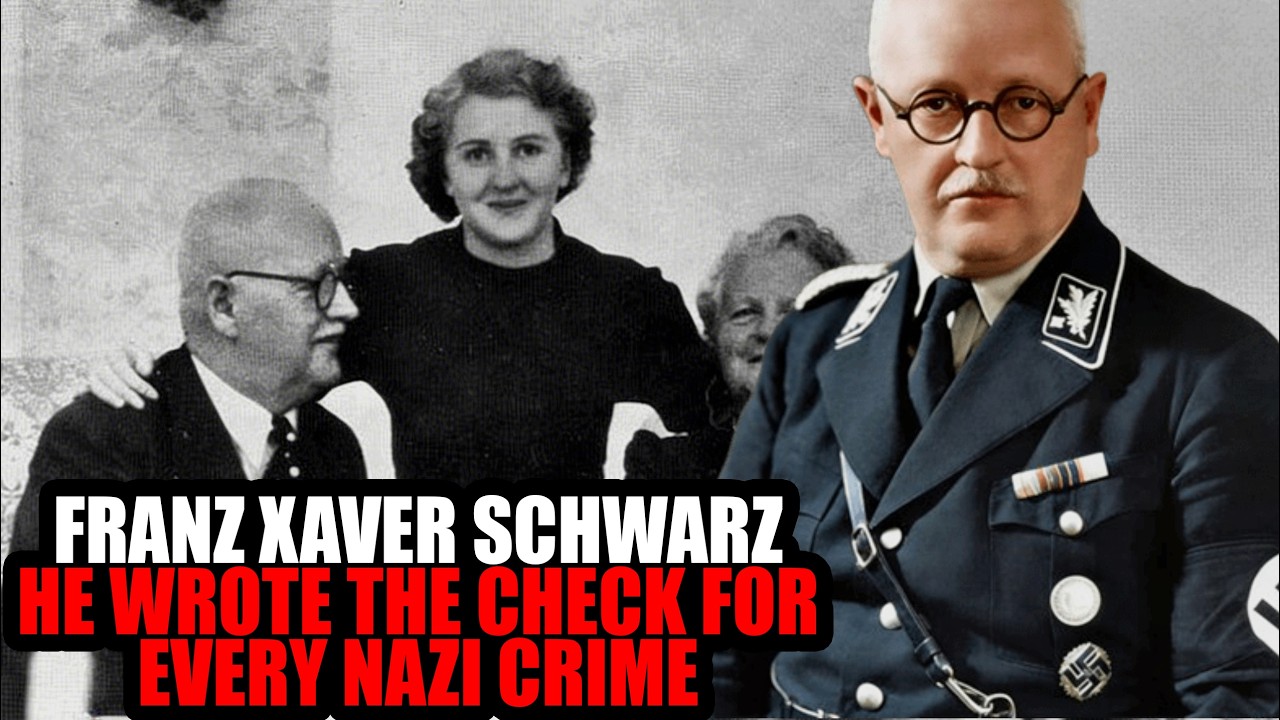
Without that machine, without the man who managed it with quiet precision, none of it would have functioned. Schwarz was born on November 27th, 1875, in Günzburg, Bavaria, into a working-class family. He trained as a clerk and rose through Munich’s municipal administration, eventually handling financial matters for the city. He was methodical, precise, and found genuine satisfaction in balanced accounts.
In ordinary times, he would have retired as a respected local official and been forgotten. But Germany in the early 1920s was anything but ordinary. The First World War had ended in humiliation, the Versailles Treaty had stripped the country of territory and pride, and hyperinflation was destroying the economy. At its peak in 1923, a single loaf of bread cost billions of marks.
People burned currency for heat because it was cheaper than wood. Savings became worthless paper in a matter of months. Into this chaos came radical movements offering simple answers. In Munich, a failed Austrian painter was building a movement around grievance and promised restoration.
Schwarz joined the Nazi Party in 1922, at age forty-six. He was not a young fanatic swept up in revolutionary excitement, but a middle-aged municipal clerk who made a deliberate choice. The historical record offers no clear window into his personal reasons. What is known is that he brought his skills with him, and the party recognized what it had.
In 1925, Adolf Hitler appointed him Reich Treasurer. He would hold that position for the next twenty years, longer without interruption than any other senior Nazi official. Not Himmler, not Goebbels, not Göring. Schwarz outlasted them all through purges and power struggles because no one wanted to touch the man who controlled the money.
When Schwarz took over, the Nazi Party was not just struggling. It was broke. The Beer Hall Putsch of 1923 had been a disaster. Hitler had been imprisoned, the party briefly banned, and what remained was a disorganized collection of believers with no money and no infrastructure.
Schwarz changed that. Methodically, without drama, he built a financial organization from nothing. He created a dues structure that worked, established financial controls that prevented the casual theft plaguing most political organizations of the era, and tracked every pfennig with obsessive precision. As the party grew, the financial machine grew with it.
By the late 1920s, donations flowed from German industrialists and businessmen who saw the movement as a bulwark against communism. Schwarz managed those relationships, kept the books in a way that gave donors confidence, and ensured the money flowed where it was needed. This mattered more than it may sound. Political movements collapse not only because their ideology fails but because they run out of money.
Rallies cost money. Newspapers cost money. Organizers, speakers, and security cost money. The SA, the paramilitary Brownshirts, cost enormous sums to equip and maintain.
Without functioning financial infrastructure, the Nazi Party would have been just another failed radical movement in the Weimar graveyard. Schwarz built that infrastructure and made the machine work. On January 30th, 1933, Hitler became Chancellor of Germany. The party that had been broke and disorganized eight years earlier was now the government of a major European power.
Most senior Nazis rushed for ministries and visible authority. Schwarz stayed in his Munich office and kept doing what he had always done. His reward came in different form. In 1933, he was made an SS-Obergruppenführer, a rank equivalent to full general.
He was given honorary titles, and more importantly, he was given resources. The Nazi Party was no longer a movement scraping together membership dues. It was the state, and the resources of Germany were available to support it. What Schwarz built between 1933 and 1945 was unprecedented.
Party finances became intertwined with the state in ways deliberately complex and difficult to untangle. Party funds and state funds flowed together. The distinction between party property and national property was deliberately blurred, and Schwarz exploited that blurring with sophisticated precision. The party collected dues from millions of members, accepted contributions from businesses that understood the political benefits of generosity, received state funds, and managed enormous property holdings.
It spent on a scale matching its ambitions. Every massive Nazi rally, the theatrical productions involving hundreds of thousands of people, was funded through Schwarz’s office. So were every propaganda publication, the administrative apparatus running parallel to the state, and the SS itself, which grew from a small bodyguard into a massive military and police organization with its own economic empire. The Waffen SS divisions, the concentration camp system, the machinery of the Final Solution, all of it had financial dimensions.
All of it required money, logistics, and administration, and Schwarz sat at the center of that financial web. What makes Schwarz genuinely disturbing is that he was not an ideological fanatic in the way Himmler or Goebbels were. He was not driven by burning hatred or a messianic vision of racial purity. He was a bureaucrat, a financial professional who applied his skills to whatever organization he worked for with the same efficiency he had brought to Munich city administration decades earlier.
He knew what the money was being used for. He knew about the concentration camps, the mass executions, the death camps in Poland. The SS’s financial operations ran through his awareness. He was a senior figure at the very top of the Nazi hierarchy for twenty years.
There was no plausible ignorance available to him. And he kept the books. He kept the accounts balanced. He kept the machine funded and running.
That is what makes the quiet men more frightening than the fanatics. Himmler believed. Goebbels believed. Their crimes came wrapped in terrible conviction.
Schwarz apparently just did his job. The Holocaust was a line item. The war was an expense to be managed. The deaths of millions were, from his perspective in that Munich office, simply costs to be accounted for.
As Germany collapsed in 1944 and 1945, Schwarz faced a problem any good treasurer would recognize: the assets needed protection, and the records needed management. Twenty years of financial documentation, the complete paper trail of Nazi party finances, donations, expenditures, property holdings, and relationships with German industry, sat in files the approaching Allied armies would eventually find. Some records were destroyed. What exactly was preserved and what was burned in the final chaos remains a question historians are still working through.
Schwarz himself did not escape. He was captured by American forces in 1945. His postwar fate was as quiet as his wartime role. Denazification tribunals classified him as a major offender, the highest category reserved for the most senior and culpable figures of the regime.
He was sentenced to prison, and his assets were confiscated. But he never faced a major war crimes trial. He was nearly seventy when the war ended, and his health deteriorated in custody. Franz Xaver Schwarz died on December 2nd, 1947, in an internment camp in Regensburg.
He was seventy-two. He died before any serious legal reckoning with his specific role could be completed. History barely noticed, which was, in a way, the most fitting ending for him. He did not design the death camps.
He did not order the mass executions. He did not build the ideology that justified them. But every atrocity in history has people like Schwarz behind it. The people who do not pull triggers but make sure the organization that pulls triggers is properly funded and administered.
The people who apply professional competence to monstrous ends without engaging directly with the monstrousness. The people who keep the machine running while telling themselves, if they tell themselves anything at all, that they are just doing their job. The Holocaust required believers and fanatics, men like Himmler and Heydrich driven by ideology to build the machinery of mass murder. But it also required the machine to be funded.
It required the accounts to balance. It required someone to make sure that when the SS needed money, it had money, that when the party needed resources, they were available, that the financial infrastructure supporting twenty years of Nazi rule was solid and functional and impossible to collapse. That was Franz Xaver Schwarz, the man nobody remembers, the man who wrote the check for all of it.
