A man sat alone in a small house in Philadelphia, bent over a crude table in the lamplight, his quill moving slowly across an open ledger. Outside, gas lamps cast halos into a gray mist that clung to the wet cobblestone streets, and nothing about the facades suggested the war being waged inside these walls. The air here was heavy with oil, smoke, and damp garments. Behind a door in the adjoining room, bodies huddled in blankets stretched on the floor, men and women and sometimes children who had traveled for days, even weeks, to reach this haven, sleeping in a half-slumber, roused by the slightest creak of wood, for every sound could signal the arrival of slave catchers.
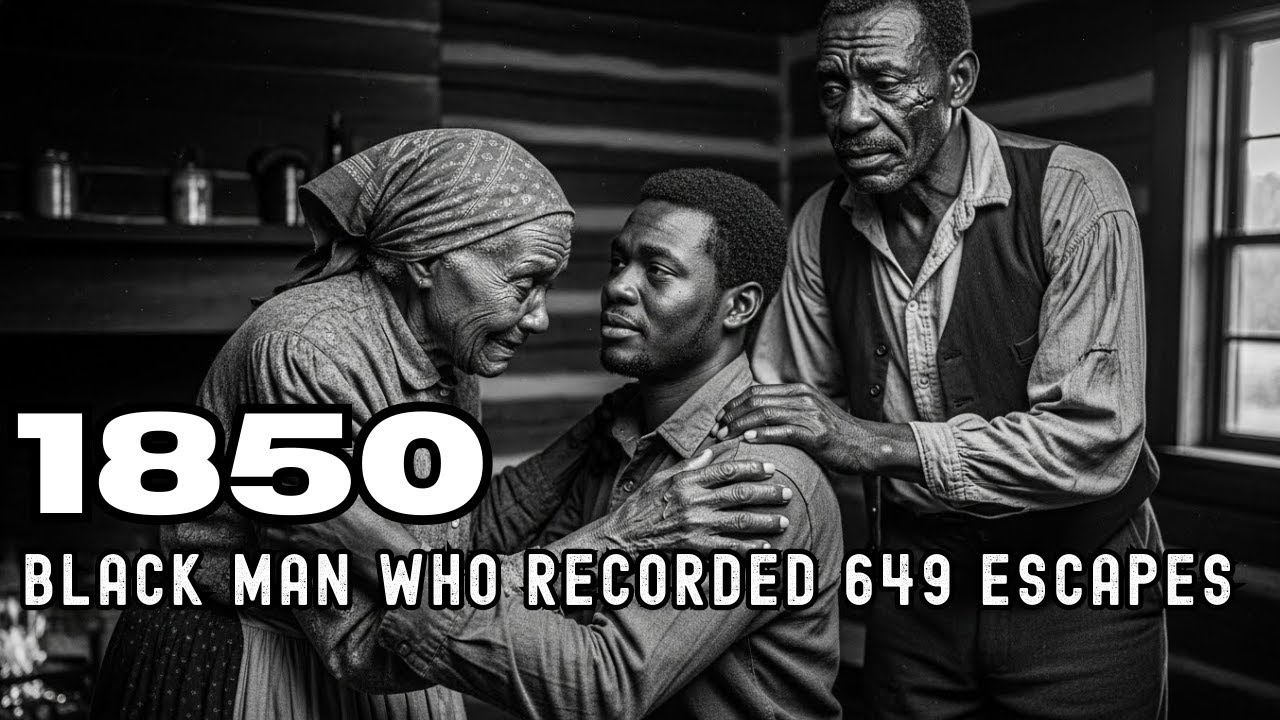
The man’s name was William Still, a free black man born in the North, yet forever marked by the slavery that had run through his own family line. The ledger before him gathered the traces that the law sought to erase. A date. A name, or an assumed name.
An approximate age. A place of origin in Virginia, Maryland, Carolina. A proprietor, often identified by his cruelty or his wealth. A brief note on the method of escape, the boat secretly boarded, the freight car, the night road through swamps, diligently encoded in a firm, disciplined hand.
This was not merely material assistance, a warm meal, a dry coat, an address for the next stage of the journey. William Still was building something both more fragile and more enduring. He was building a memory. Where slavery functioned by severing ties, by selling children far from mothers, by erasing origins, he sat at his table and stubbornly reassembled the fragments.
Every line he inscribed carried peril. Since the Fugitive Slave Act of 1850, the law permitted the pursuit of runaways even into the northern states, allowing the arrest and prosecution of those who aided them. Keeping detailed records of fugitives, of their hosts, of the routes employed, was to offer, in the event of a raid, an arsenal of evidence to the enemy. But Still pressed on, for he knew that without these notes, the night would swallow all.
A discreet knock came at the door. Three soft taps separated by a long silence, a pre-arranged signal. Two shivering figures entered with eyes lowered, as if raising them might betray them. The door closed, then barred.
Few words were spoken. Water, bread, a seat. Then the same gentle but firm injunction: rest, wait. The accounting would come later, when the escapees could articulate more than their need for sleep.
Still posed simple questions, almost administrative, yet each one opened an abyss. Whence do you come? What were you called there? Have you been separated from your family?
Do you know where they were sent? He listened, memorized, then committed the fragments to paper. Over the years, this ledger would record at least 649 flights to freedom. 649 stories that official history would have preferred never to read.
This obsession had its roots far from Philadelphia, in a cabin in Shamong, New Jersey, in the early 1820s, where William was born to Levan and Charity Still. To their white neighbors they were merely black laborers, but before Shamong they had known Maryland, a plantation, endless days in the sun, the permanent threat of being sold. They had fled north to freedom, but it was not a family departure. Some of their children remained behind, sold, dispersed further south.
Names whispered in the night. Faces one tried to imprint in memory before time erased them. William was born into this void. He observed his mother’s silences when she paused mid-sentence, a memory seizing her throat.
He caught his father’s gaze lost in the distance, as if beyond the New Jersey trees he still searched for the lines of a Maryland plantation. There were no books in the cabin, no archives, no official documents where the lives of Levan and Charity were inscribed. What served as civil status was the spoken word, memory, the fragile thread of repeated narratives. Very early, William developed an almost obsessive attention to names, the given names of lost siblings recited like a litany.
In the woods, his father showed him the discrete paths, the barely visible tracks, how to listen to a changing silence. Even in the North, the idea of escape remained present. William understood that the difference between him and those brothers and sisters somewhere in the south lay in a few decisions, a few miles, a few chances. Nothing reassuring.
He intuited something that would never leave him: what is not written can be denied. What is not recorded can be erased. His mother’s tales of children sold, his father’s memories of the plantation, all floated like smoke that time threatened to dissipate. Memory, to survive, would need paper.
Years passed. He grew amidst field labor and odd jobs, and he encountered other black families bearing the same invisible scars, murmuring the same names of vanished kin. This fertile ground of pain would make him a man of detail, of secrecy, of record-keeping, one who knew how to listen without interrupting, to distinguish one name from another. He had unknowingly forged a mission.
Where masters counted slaves as livestock, reduced lives to numbers, erased given names in favor of figures, he intimately vowed to do the opposite, to restore names, origins, connections. In 1844, William Still arrived in Philadelphia, a nobody, a young black man accustomed to hard labor, seeking work. He did a bit of everything, handling goods, small tasks, poorly paid services. But the city had networks operating on the fringes of official circuits, black churches, abolitionist circles where slavery was spoken of as a crime.
In 1847, his trajectory shifted. He was hired as a simple clerk at the Pennsylvania Anti-Slavery Society, entrusted with tasks usually reserved for those whose voice was deemed not to matter: tidying, sorting, copying letters. But this subordinate post exposed him to flows of information few people saw in their entirety. Letters from the South accounting abuses, threats, imminent sales.
Correspondence from northern sympathizers sending a few dollars, internal notes alluding to the passage of fugitives, possible hiding places, routes to be improved. William was the silent guardian of this circulating paper. One day he was asked for more than copying. A group of men arrived, breathless, nervous, poorly dressed, and were ushered hastily into a meeting room.
He was handed a pail of water, bread, some clothes. He was told they had traveled, a word uttered with particular caution, for here it often meant fled slavery. He was sent to fetch a doctor, to transmit a coded message. He obeyed without asking unnecessary questions.
Gradually, this clandestine work occupied more of his days and nights. He was asked to welcome fugitives, to direct them to safe boarding houses, to watch the surroundings when meetings took place. His discretion was noted. Within the society, he became an essential cog in an illegal mechanism.
In these years, William learned to distrust every uniform, every insistent gaze upon a black man who didn’t seem from around here. In contact with fugitives, he discovered the awful reality that pamphlets could not contain: the marks of the whip, the stories of torn families, mutilations, auctions. He knew that behind every argument lay flesh, a face, a given name. When he read a letter describing a sale of slaves, he saw not a matter of principle, but the repetition of his own parents’ tragedy.
He began to be designated, without fanfare, as a trusted person for arrivals. He became that face the escapees met on the threshold of the city. In August 1850, William Still sat at his table, quill in hand, when he was informed of a man’s arrival. A black man, like so many from the South, presenting himself as Pete Freedman, a name of freedom appended to a past of slavery.
He bore the classic marks of a long clandestine journey: fatigue, worn clothes, suspicion in his gaze. Still began to question him as he did all arrivals. Age. Last place of residence.
Master’s name. States traversed. Then came the question Still always posed almost mechanically yet with particular attention: what do you know of your parents? What were their names?
Most often the answers came broken, fragmentary. But this time, the words that fell on the table held nothing abstract for him. Pete uttered his mother’s name: Charity. He spoke of a father named Levan.
He recounted an escape north years prior, and children left behind, sold further south. Time stood still. For Pete, these were merely elements of his own family puzzle. For William, these words were blades.
Charity. Levan. Names he had heard all his life, pronounced by his own mother and father in the New Jersey cabin. In his mind, two narratives began to superimpose.
The dates corresponded. The places coincided. The details resonated with troubling precision. Still did not rush to conclusion, for he knew slavery repeated the same scenarios in hundreds of families.
He continued to ask questions, pressing for details of places, circumstances, nicknames. As Pete spoke, the invisible wall between interrogator and interrogated fractured. William recognized in the fragments details his mother had spoken of years earlier, the way she had been forced to leave children behind, the way she repeated certain names. He no longer had before him just another case for the vigilance committee’s registers.
He had before him the unimaginable possibility that this fugitive was his own brother. William did not erupt. He had long since learned to master his reactions. But when finally he posed the question that left no room for ambiguity, the boundary broke.
Two adult men discovered they were bound by blood after being separated by the cold logic of property and sale. What for years had been a repeated pain in childhood tales was suddenly embodied in a weary man seated across the table. The file Still was compiling transformed before his eyes into something dizzying, no longer merely a document attesting to the cruelty of a system, but a possible instrument of repair, a bridge between lives believed irreparably separated. That day, the clandestine archivist discovered that behind every record there might be a mother searching for a son, a sister hoping for a brother.
In this intimate shock, a resolution crystallized. Until then, William had already written with care. After the encounter with Pete, the act of recording took on another dimension. It became a sacred duty, not only to denounce, but to connect.
From that moment, every fugitive who crossed the office door was potentially a brother, a sister, a relative of someone who somewhere still repeated names in the night. To comprehend William Still’s role, one must imagine the escape route as a machine, fragile and makeshift, yet of vital precision. It was nothing like a true railway, no tracks, no tickets, no timetables. But in the shadows there were correspondences, delays, passage times.
At the center of this clandestine network, Philadelphia functioned as a node, a tipping point between the slaveholding South and the uncertain North. Fugitives arrived there from the swamps of Maryland, the farms of Delaware, the plantations of Virginia, advancing by night, guided by conniving slaves, supportive free Black people, a few white individuals determined to defy the law. At the end of these journeys, one name occurred like a promise: Philadelphia. Here, William Still was one of the major components of an organization called the vigilance committee, whose official mission was to support individuals threatened by slavery, and whose real mission was to welcome, hide, feed, equip, and orient beings whom the law treated as stolen property.
The archives of this committee depict a complex web: names of correspondents, addresses, mentions of Wilmington, New York, Boston, Montreal, Toronto. There is the trace of Thomas Garrett in Wilmington, Delaware, the stubborn Quaker who helped hundreds of fugitives cross a decisive stage. There are references to delays in New Jersey, allies in New York, contacts in Canada ready to receive those too far gone to be recaptured. Each person had a role.
Some provided clothing. Others gave money for train or boat tickets. Still offered a room for a night, an attic, a cellar. William Still stood at the intersection of these actions, the one who received information, distributed it, organized it.
The city was no longer a mere urban backdrop. It was a coded map. Such a street led to an abolitionist lawyer, another to a station watched by slave catchers. A fugitive arriving in Philadelphia could not remain long in one place.
They were moved from house to house, their appearance changed, sometimes given a new name. But all this work unfolded under the threat of the Fugitive Slave Act, which extended the manhunt to all northern states, compelled local authorities to aid in the capture of runaways, and punished those who lent assistance. The slightest error in coordination could lead to arrest, deportation, or death. Still had to juggle contradictory information, rumors of raids, reports of patrols.
Sometimes it was necessary to hasten a departure, to abandon a trail, to move a group in the dead of night. The network was far from infallible. Escapes failed. Informers betrayed.
Slave catchers intercepted groups. For William, each failure was a brutal reminder that this mechanism remained exposed to the violence of a state that protected property rights over human beings. In this context, recording itineraries and names might seem insane. But for Still, this documentation was a necessity.
It allowed him to track flows, adjust routes, identify dangerous places. It also allowed him later to narrate, to refuse that the Underground Railroad be reduced to a few heroic legends that rendered invisible the mass of anonymous individuals who risked their lives within it. He knew that if one day slavery was to be judged on the scale of history, someone would need to be able to say: here is how the oppressed eluded this system. William Still’s registers were not official archives bearing seals and stamps.
They were illegal, clandestine archives traced by lamplight in a house where every knock could announce the interruption of armed law. To write for him was an act of defiance. Upon his table lay ledgers, loose sheets, letters. Each page was a battlefield.
At the top, an approximate date. Below, a name or an alias, because many fugitives could not afford to expose their true identity. Then the origin, the state, the county, sometimes the plantation, followed by the name of an owner who, in the economy of slavery, was worth more than they. Still noted details most free men would deem insignificant: a scar, a nickname, a manner of pronouncing a certain word, the name of the ship on which one was forcibly embarked.
All that might one day serve to establish a truth against official lies. Here, the mention of a woman who walked for weeks, a child on her hip, fleeing dogs. There, the story of a man hidden in a crate like Henry Box Brown. Further on, notes on couples whom flight separated.
The shadow of the law hovered above every word. Since the Fugitive Slave Act, slavers could storm northern cities, arrest even free black men, and send them back south. If Still’s house was searched, his ledgers could be used as evidence not only against him, but against those he had helped, against the families who had opened their doors, against the captains who had accepted a passenger without questions. He knew this.
Yet he wrote. Some names were abbreviated. Some addresses were coded. The ledgers were hidden, moved, fragmented.
Sometimes, when pressure grew too intense, he reluctantly destroyed papers so as not to deliver allies to the enemy. Each burnt sheet was a victory against the law and a defeat against oblivion. The dilemma was permanent: where to draw the line between protecting the living and saving memory? William Still walked this tenuous line.
He concealed. He masked. But he did not give up. In these registries, one also finds remarks that defy mere statistics: very intelligent, remarkable courage, cruelly treated, sold away from his wife, left two children behind.
These indications inscribed these men and women into a humanity that the system denied. Where sales advertisements presented bodies as commodities, Still insisted on what made them persons. Line after line, he constructed a patient, implacable indictment. Among these hundreds of encoded stories, some remained famous, almost legendary.
Henry Box Brown, for example, whose name already spoke of his own metamorphosis. In 1849, he had himself nailed inside a crude wooden box barely larger than his crouched body. On the lid, innocuous inscriptions: this side up, handled with care. He was flipped, bumped, shaken, spending over twenty hours confined, almost without air, in the crushing darkness.
When the crate arrived in Philadelphia, abolitionists opened it, and a body unfolded, trembling, drenched in sweat, half dead. Henry emerged as from a coffin. For William Still, who inscribed his passage in his notes, Henry was not just the man in the box. He was a fugitive among others, with an age, an origin, an owner, a trajectory.
Still took the time to record what this flight revealed about slavery: that one had to transform into an object to reclaim one’s humanity. A few years later, another file bore the names of Ellen and William Craft from Georgia. Ellen was fair-skinned, so fair that with the right clothes and posture she could pass for white. William was dark, and in the eyes of the masters, his natural place was that of a servant.
Ellen disguised herself as a sickly young white planter, with bandages to conceal the lack of a beard, spectacles to hide her eyes, a scarf, and a wounded arm to avoid having to sign documents. William played the role of the devoted servant. They traveled the South in first class, on trains and steamboats, right under the noses of those who would have claimed their bodies as property. Philadelphia was one of the stops on their journey.
In Still’s notes, their passage is soberly indicated, a few sentences, a few mentions. Alongside these stories that would make headlines in abolitionist newspapers, there were dozens, hundreds of unspectacular narratives. A woman who seized the opportunity of a market crowd to slip away. A man who followed the direction of a star.
An adolescent who climbed onto the back of a cart and clung on until exhaustion. Some had mutilated scars from previous escape attempts, missing fingers, lash marks, lacerated backs. Still noted what he could, knowing that behind every line there lay a depth of suffering no ledger could entirely contain. He did not reduce these men and women to objects of compassion.
He treated them as protagonists, recording their decisions, their courage, their inventions. But he also did not forget the near misses, those who almost got caught at a train station, unmasked by a detail, saved at the last moment. What remains in his registers are not detailed portraits, but precious sketches: a name, a place, a use, a journey, a fragment of a sentence. It is little in the face of the immensity of what was lived.
Yet it is infinitely more than what the slaveholding order wished to leave behind. Between 1850 and 1855, the Still family’s address on Delhi Street in Philadelphia appeared on no map as a place of particular note. It was a modest house, aligned among others, a front room, a back room, an upper floor, a basement. Nothing spectacular.
But every square inch was requisitioned. By day, the house played its role as a respectable facade. One heard ordinary sounds, dishes clanking, footsteps, children’s voices. At night, silhouettes arrived in small groups, a soft knock in a discrete code, the door closing even faster, the curtains drawn a little tighter, voices whispering.
The fugitives slept on the floor, on straw pallets, sometimes on a chair. They ate at the family table with the awkwardness of those unsure if they had the right. They borrowed clothes from the Stills, a coat, a shirt, a cap, anything that might make them less recognizable on their way north. The Still children grew up in this invisible theater.
They quickly learned not to ask too many questions, to accept that a stranger might sometimes sleep in their place, that certain names were not repeated outdoors. To be a child in this house was to play amidst whispers, to see adults blanch at a knock a little too loud, to grow accustomed to sudden heavy silence when someone lingered in the street. The neighbors, for their part, did not all hold the same position. Some saw without seeing, looking away out of indifference, prudence, or silent sympathy.
Others were more suspicious, watching, dropping remarks, asking questions that were never entirely innocent. For William himself, this house was a natural extension of his office. The boundary between his work and his private life dissolved. This double life was not without cost.
There was fatigue, shortened nights, abrupt awakenings. There was the very real fear of a raid, of a denunciation. There was the permanent tension between the necessity to help and material limitations. One could not indefinitely cram people into a small house without attracting attention.
Yet at the heart of this fragility, something stronger was built. In this modest abode, strangers shared a meal with the Still family. Maps were drawn on the table, such a city where one could find work, such a village in Canada where one was no longer anyone’s property. Sometimes fugitives would return years later as free men and women to visit the house that had welcomed them in the night.
They walked differently now. For the house, these returns were inverted ghosts, specters of fear transformed into calmed presences. Delhi Street became for William a physical extension of his commitment, a commitment that did not stop at words. It was there, in this discrete space, that the struggle against slavery took, night after night, an intimate and dangerous form.
In 1855, slavery would for once leave the shadows on the docks of Philadelphia and reveal itself openly. At the center of this collision between law and conscience was a name: Jane Johnson, a black woman enslaved in transit, a mother who, setting foot on Pennsylvania soil, understood that the boundary between servitude and freedom lay in a few steps and a decision. Jane belonged to John Hill Wheeler, a diplomat and slave owner who was traveling south with her and her two sons. According to southern law, she was property.
According to Pennsylvania law, she walked on soil that did not legally recognize slavery. Information circulated that an enslaved woman passing through Philadelphia wished to remain. William Still and Passmore Williamson, a white activist, were alerted. On the dock near the boat, Jane declared before witnesses that she wished to remain in Pennsylvania, that she did not want to return with Wheeler.
Still and Williamson did not merely protest. They acted. They took Jane and her children, helped her leave the boat, and bought her out of Wheeler’s immediate reach. This act alone concentrated all the illegality of the Underground Railroad.
In the diplomat’s eyes, Jane had not freed herself. She had been stolen from him. The matter escalated in the press, in the courts, in politics. Passmore Williamson was arrested, accused of having prevented an owner from exercising his right over his human property.
Before the court, he insisted Jane had expressed her desire to stay, and his insistence earned him imprisonment for contempt of court. He became, despite himself, a figure of abolitionist martyrdom. William Still found himself in an even more perilous position, a committed black man who could expect no leniency. He was summoned, questioned, forced to testify, weighing every word, saying enough to defend Jane and Williamson without offering the authorities means to destroy the network.
In the courtroom, usual roles were reversed. Wheeler’s lawyers spoke of property with a coldness that shocked the North. The defense tried to make it heard that Jane was not an object, but a person who had expressed a clear will. Still testified with cold rigor, measuring each sentence, refusing to open the door too wide to the behind-the-scenes of his actions.
The Jane Johnson affair revealed for all to see the fracture between the legal and the legitimate. It showed that the Underground Railroad was not just a network of anonymous escapes lost in the night. It could at times erupt into daylight, into the heat of institutions, forcing the country to confront what it usually preferred to suppress. For William Still, this episode confirmed that the boundary between his discrete work and the public political arena was porous.
Jane Johnson’s name would occupy a special place in the long list of names he would later inscribe. As the 1860s approached, the air of Philadelphia changed, yet remained the same. Newspapers spoke even more loudly of secession, of broken compromises, of territories declaring themselves free or slaveholding. For William Still, reading these news with the hundreds of names recorded in his ledgers in mind, it was the premonition that the system he fought night after night was nearing its breaking point.
Yet the clandestine work did not cease. Letters still arrived from Wilmington, from Baltimore. Fugitives still came. Then Lincoln’s election, southern states slamming the door on the Union, one after another.
In 1861, Fort Sumter fell, and what had been a crisis became open war. On paper, the Underground Railroad could have ceased then. But as long as slavery existed, men and women continued to flee. Their destination was no longer merely the distant North or Canada.
It was now the Union lines. They were called contrabands, seized property from the enemy in military parlance, beings who had decided to make war a beach in their own words. This new form of flight, massive and disorderly, transformed the nature of the struggle. Some traditional routes closed; others opened.
During these years, Still’s role oscillated between continuity and metamorphosis. He continued to welcome fugitives, to guide them. But with the war, surveillance became even more intrusive. Raids, searches, arbitrary arrests multiplied.
His ledgers were now doubly threatened: if they fell into hostile hands, they could still be used to prosecute fugitives and allies; in the chaos of war, they risked being destroyed, lost, carried away by a house fire or an office seizure. So Still resolved to action. He hid things even more deeply. He separated batches of documents.
He sometimes entrusted a few papers to safe hands outside the city. And in some cases, he destroyed lists, letters, overly compromising indications. Each burnt sheet was a wound. But he knew that memory, to exist, needed living beings.
A name encoded in a ledger held weight only if it could be pronounced, heard, recognized later. In 1863, Lincoln signed the Emancipation Proclamation, declaring slaves in rebellious states free. For Still, it was an ambiguous moment. It offered a clearly named horizon, abolition as the declared goal of the war.
But it came after years during which men and women had risked their lives to seize alone the freedom that federal law now half-recognized. The fugitives who arrived in Philadelphia after 1863 did not always resemble those who came before. Some had fought in Union ranks or worked for its armies. Others brought news of a disintegrating South, plantations abandoned, masters fled.
Amidst this upheaval, a question haunted Still: what would remain after the war of what he had recorded? Would the country, in rebuilding itself, accept these narratives that stated slavery was a machine for breaking bodies and bonds, or would it prefer to bury these testimonies under discourses of reconciliation which demanded the forgetting of seams in exchange for peace? He felt that these were pivotal years. He was caught in a constant tension: to continue acting, and to prepare in the shadows the memory of that action.
He did not write then with a clear plan for a future book. He had no contract, no publisher’s promise, no assurance that what he kept would survive the impending chaos. But he knew two things. First, that the total destruction of his papers would be a victory offered to the enemy, for slavery, even if abolished, could thus invent its image as an attenuated institution for lack of written evidence.
Second, that the complete preservation of those papers without prudence could cost lives. So he made decisions, often in urgency, sometimes in solitude. Here a ledger was protected, concealed, preserved. There a document was burned, reduced to ashes.
He composed, piece by piece, a mutilated but surviving archive. When the war finally ended in 1865, slavery was officially abolished. But the question for William Still was not merely, is slavery over? It was also, what will be done with what we have lived?
The temptation in an exhausted country was great to plead for oblivion. Against this discourse, his ledgers acquired new value. They became barriers against the sweetened narratives that would be attempted. After the war, William Still did not remain fixed in the role of night conspirator.
He became a respected businessman in Philadelphia, investing, founding a coal company, participating in the economic life of a modernizing city. For a segment of white society, he became the convenient example of the respectable black man of the post-war era. But in his house, in drawers and chests, his ledgers and journals watched. It was his children, they say, who insisted.
A new generation, born or grown adult without having directly known slavery, discerned behind their father’s respectability the profound depth of an untold story. They pressed him: he must write. These stories must emerge from the drawers. William hesitated.
Some of the names these documents contained belonged to fugitives whose fate was unknown, to conductors who had taken risks, to accomplices who might still be living. Even if slavery was abolished, hatred was not. And then there was the weariness. But another fear gnawed at him deeper: that of erasure.
He already saw taking shape in public discourse an acceptable narrative of enslavement, talk of regional differences, of tragic misunderstandings. He understood that if the direct victims did not speak, their history would be written by others, watered down, sanitized. So he set to work. It was no longer the breathless work of escape nights.
It was a slow, methodical, almost stubborn labor. He read his registers, reconstituted files from scattered notes, copied, corrected, added details when memory allowed. He searched for letters, testimonies, reports received from Canada, from those who had rebuilt their lives and who sometimes kept their word by writing to him. In 1872, the book appeared: The Underground Railroad Records.
The title said it all, records, not fables. Still gathered approximately 649 fugitive narratives, each with precise data: name, age, origin, owner, means of escape, destination. He did not write it to flatter the consciences of the North. On the contrary, he constantly reminded that even in free states, the law hunted fugitives.
Nor did he write it to ease white abolitionists. He refused to let the central role of the slaves themselves be forgotten. With this volume, he transformed a clandestine archive into a public monument. What formerly had to be hidden was now offered to the view of all.
In 1876, at the Centennial Exposition in Philadelphia, celebrated one hundred years of the Declaration of Independence, Still’s book was presented as a testimony of what the young nation had endured. In this grand celebration of proclaimed freedom, it silently recalled that for most of that celebrated century, millions of human beings had lived in chains under the same flag. Then, like so many things, it slipped into the shadows. The country retreated into a poisoned compromise, allowing the South to regain mastery of its way of life at the cost of sidelining black rights.
Still’s book remained, but it was no longer central. It survived in libraries, in historical society collections, in homes where the memory of relatives who had traveled those routes was still preserved. It was not until the twentieth century, when historians, particularly black scholars, decided to reconstruct the history of slavery from the perspective of the oppressed, that it was rediscovered for what it truly was: a vital source, a unique archive produced by a black man who had been at the heart of the network. William Still died in 1902.
The news at the time did not shake the country. A few black newspapers in Philadelphia paid him homage, recalled his role in abolitionist struggles, praised the respected businessman and the persistent defender of civil rights. For the white world, he was often just one name among others. He was buried.
Speeches were made. Memories circulated. Some elders still vaguely remembered the house on Delhi Street, the silhouettes entering at nightfall, the muffled sounds of footsteps on the stairs. Then time began its work.
The city changed. Memories dwindled to anecdotes, then dissolved. But while human voices faded, the papers remained. The notebooks, the lists, the letters, the thick book published in 1872 slowly left the drawers to join libraries, archives, historical societies.
In these cold rooms, documents were arranged in cardboard boxes, labelled, inventoried. Still’s ledgers were no longer dangerous objects to be hidden from police raids. They became funds, collections. For decades, few people came to consult them.
Then another generation arrived. Black historians, researchers, writers refused to be content with official history. They wanted to hear the fugitives, the survivors. They delved into archives with a new hunger, and sooner or later, their hands encountered William Still’s papers.
It was understood that his registries were unique, notes taken closest to the events by a man entrusted with stories not loudly shared. It was discovered that thanks to him, otherwise invisible trajectories could be followed, dispersed families reconstituted. Today, in reading rooms where these papers rest, when a researcher stumbles upon a name that overlaps another, upon two fragments that suddenly interlock, upon the tenuous trace of a reconstitutable family, William Still’s obsession finds a belated echo. Descendants of slaves who seek to trace their origins, who open books and encounter a familiar name in a Still register, receive a fragment of what had been torn from them: a date, a place, a given name.
Not enough to fully mend the wound, but enough to say, you were not born of nothingness. There was before you someone whom they tried to erase, and whose name remained on this page. William Still’s archive was never a cold, neutral collection. It is an act of resistance, a refusal to accept that a country’s archives should solely belong to the dominant.
It proves that a man, armed with a table, a quill, a lamp, and a fragile trust granted by those who passed through his door, could construct a counternarrative powerful enough to survive death, centuries, and attempts at erasure. Without these pages, only a few legends would remain of the Underground Railroad. With them emerged the 649 flights to freedom, and the countless others they hint at, a procession of steps in the night, each with its weight, its fear, its hope, its cunning.
The image that remains is of a black man in a small brick house in Philadelphia, bent over a ledger, surrounded by damp coats and whispers, his quill moving across the page, choosing to write nonetheless, so that a century later, perhaps two centuries later, someone somewhere might open a book, read a line, a name, a date, and understand that these steps in the night were not lost sounds, but blows struck against the darkness.
