On the morning of November 8th, 1965, a hairdresser pushed open the door of a third-floor bedroom in Manhattan and stepped into a scene that the world would later write off as an accident. There, in a bed she was known to despise, in a room she hadn’t slept in for years, lay Dorothy Kilgallen—the journalist whose name was known across the country, admired for her biting style and far-reaching influence. Her body was cold. Her appearance was flawless.
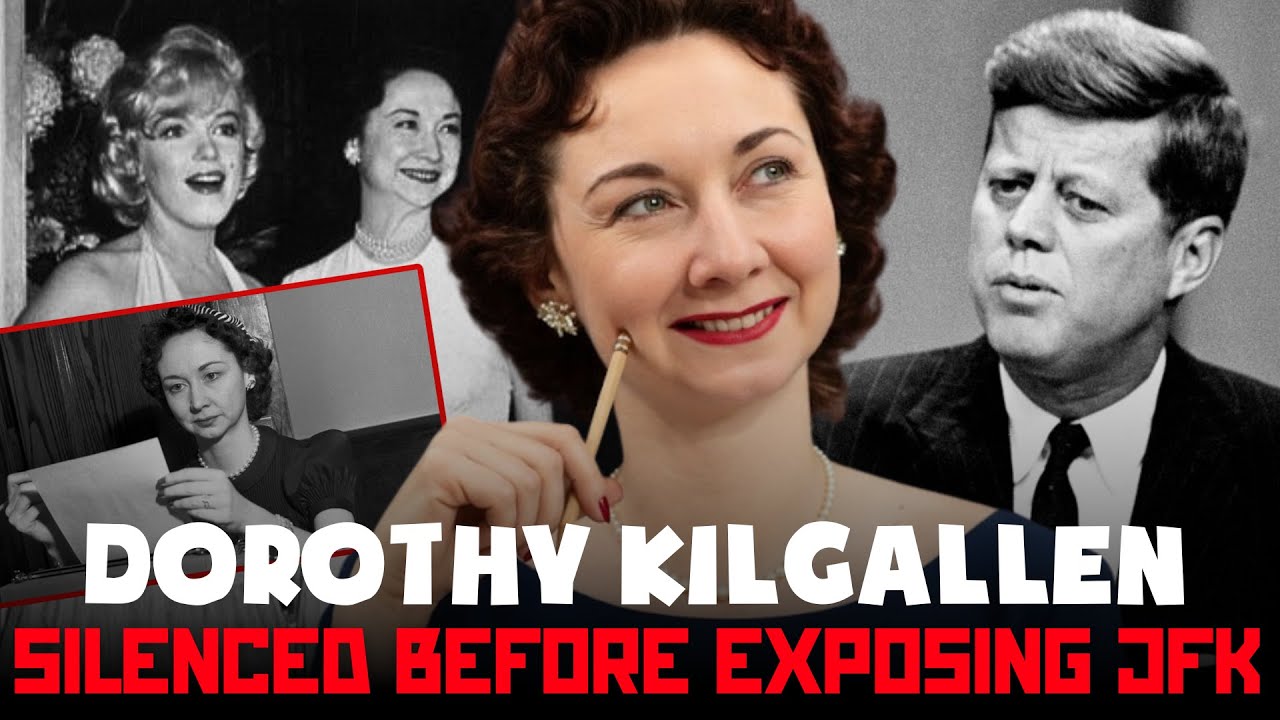
Her makeup was fully applied, and her signature false eyelashes were still fixed to her stiffening eyelids, as though she were posed for a photo shoot. Yet the most unsettling detail wasn’t the body itself. It was what had vanished. A set of investigative notes connected to the JFK assassination—material she reportedly called her insurance policy—was never found.
This is more than the tale of a celebrity’s tragic end. It is the account of a reporter whose investigation was cut short before she could finish her work. Long before she became the voice of Broadway or the fearsome questioner on What’s My Line?, she was only a young girl watching her father pack a suitcase.
James Kilgallen was more than a journalist. He stood among the legends of the Hearst Empire, a reporter who covered the biggest crime stories of the Prohibition years. He was a man who carried the smell of tobacco, printer’s ink, and the harsh truths of the twentieth century. To Dorothy, he was far more than a father.
He was a deity. And within the Kilgallen home, affection was never gentle. Affection meant a byline. Affection meant getting to the story first.
Dorothy May Kilgallen was born in Chicago in 1913, arriving in a world where women in journalism confronted steep social barriers. She never matched the conventional beauty ideals of her day. In an age that expected women to serve as decorative ornaments, Dorothy was plain. Her chin receded too far, her eyes sat a little too wide apart, and her build was small and jittery.
When she studied her reflection, she saw what the world would later point out with cruelty. A face perhaps suited to radio, but surely not to the glamorous high society she longed to conquer. Yet biology need not dictate destiny when you have enough fury behind you. Early on, Dorothy resolved that if she couldn’t be the prettiest woman in the room, she would be the cleverest.
If she couldn’t charm men with her eyelashes, she would charm them with her adjectives. She had no wish to be looked at. She wanted to be heard. The family relocated to New York, the pulsing center of the media universe, and Dorothy enrolled at the College of New Rochelle.
For a Catholic girl from a respectable family, this was a proper path. She was meant to graduate, wed a suitable lawyer, and raise children in Westchester—but the ink running through her veins burned too hot. At seventeen, she quit. She had no interest in studying history.
She wanted to write its first draft. She landed a job at the New York Evening Journal. It was 1931. The newsroom was a smoky cavern of shouting men and clattering typewriters—a place of aggression driven by whiskey and adrenaline.
A teenage girl walking into that newsroom met deep doubt and open hostility. The men mocked her. They called her Jimmy’s little girl. They handed her the soft assignments: flower shows, charity luncheons, certain she would quit or marry the first copy boy who smiled her way.
They misjudged her. Dorothy refused to write fluff. She wrote with accuracy and an unusually keen critical eye. She went after her stories with a ferocity that rattled the old hands.
She had inherited her father’s instinct for the jugular, yet she possessed something he lacked: a woman’s eye for the devastating detail. She noticed the shoes the murderer wore. She noticed the shaking hands of the crooked politician. She flipped the sob sister stereotype—the female reporter sent to weep over tragedies—completely on its head.
She never wept. She dissected. By the mid-1930s, she had fought her way off the society pages and onto the front page. But she remained merely a reporter.
She wanted to be a star. The chance to rise above her profession arrived in 1936 by way of a publicity stunt that sounded like a fever dream out of Jules Verne: three reporters, one race around the globe using only commercial transportation. It was the golden age of aviation, yet flying remained dangerous, rattling, and vomit-inducing. The New York Evening Journal picked Dorothy as its champion.
She was twenty-three years old. She was set against two veteran male journalists, Leo Kieran and H. R. Ekins.
The rules were straightforward: whoever circled the earth and returned to New York first would win. When Dorothy climbed aboard the Hindenburg—yes, the doomed airship, at the time the pinnacle of luxury—to start the opening leg of the race, she carried more than a suitcase. She carried the hopes of every working woman in America. The press erupted.
They christened her the modern Nellie Bly. The race was a punishing, terrifying ordeal. She flew in planes barely more than canvas and wood, navigating storms over the South China Sea. She ate sand in Baghdad and skirted political turmoil in Italy.
She slept in hangars and wrote her columns on her knees, filing dispatches that millions read. For twenty-four days, the world held its breath. People followed her position on maps pinned to their walls. Was she in India?
Was she in Manila? She didn’t win the race, but the event cemented her national reputation. When she landed back in New York, she was no longer Jimmy’s daughter. She was Dorothy Kilgallen.
Hollywood came calling. They produced a movie loosely inspired by her adventure, Fly Away Baby. She wrote a best-selling book about the race, Girl Around the World. She had tasted fame: the flashbulbs, the cheering crowds, the adoration.
And she discovered she enjoyed the taste. It was sweet, and it quieted the insecurity that still whispered to her when she removed her makeup at night. But fame is a ravenous beast. It must be fed every day.
The thrill of the race died down, and Dorothy needed a new mountain to conquer. She found it not in the sky but on Broadway. In 1938, she was handed the keys to the kingdom: the Voice of Broadway column. To grasp the power of a gossip columnist in the mid-twentieth century, you must remember that social media did not exist.
There was no Instagram, no Twitter, no TMZ. There was only the morning paper. The columnists—Walter Winchell, Louella Parsons, Hedda Hopper, and Dorothy Kilgallen—were the guardians of reputation. They determined who belonged and who did not.
A single mention could transform a struggling actor into a star, or a blind item could shatter a marriage. Dorothy slipped into the role of Broadway’s queen with frightening ease. She wasn’t merely reporting on the social scene; she was shaping it. She set up her headquarters at the Stork Club, the most exclusive nightclub in the world, at Table 50.
It turned into her personal court. Night after night she made her entrance in couture, every strand of hair in place, diamonds catching the dim light. She would settle in with champagne or a vodka tonic, and the world came to her. Press agents would glide up and slip notes onto her table.
Actors would drop by to show respect, afraid that if they skipped it they’d wake to something ugly in print the next morning. She honed a voice all her own—distinct, sharp, witty, frequently vicious. She kept a list: those she favored and those she ruined. End up on Dorothy’s bad side, and you simply didn’t work in New York.
She was famous for feuds with anyone she judged short on class or talent. Yet under the cruelty ran a strict code. She adored talent. She adored class.
A snob she was, certainly—but a snob with taste. It was during this climb that she crossed paths with Richard Kollmar. Dick, as everyone called him, was a handsome, charming, faintly disreputable actor and singer. He had played Boston Blackie on the radio.
He was the sort of man who filled out a tuxedo and knew how to choose a wine. In many ways he was Dorothy’s male mirror: driven, drawn to the nightlife, and fiercely attentive to appearances. They wed in 1940. For New York society, it was the wedding of the year.
To the public it looked like a fairy tale. The influential columnist and the dashing actor turned into a brand. Together they launched a radio program, Breakfast with Dorothy and Dick, broadcast from their vast apartment at 520 Park Avenue. The show foreshadowed reality TV.
Every morning millions of listeners tuned in to hear Dorothy and Dick chat over coffee about the plays they’d seen, the people they’d met, and their children’s charming mischief. It was a flawlessly produced illusion. The canary chirping in the background was genuine, but the happiness was frequently scripted. Listeners pictured a perfect domestic idyll: Dorothy in a silk robe, Dick reading the paper, the children playing quietly.
What they didn’t see were the hangovers. They didn’t see the separate bedrooms. They didn’t see the widening gap between a wife whose star was climbing into the stratosphere and a husband whose career was sliding into mediocrity. Richard Kollmar loved Dorothy, but living in her shadow was a constant struggle.
He turned into Mr. Kilgallen. As Dorothy’s power swelled, Dick withdrew into the bottle. But in the 1940s, alcoholism was not a subject anyone discussed.
Marital strife was not a subject anyone discussed either. You fastened on your pearls, you switched on the microphone, and you performed. “Good morning, darling,” Dorothy would say into the mic, her voice crisp and bright. “Good morning, sweetie,” Dick would answer, his voice smooth as velvet.
And the audience devoured it. They purchased the products Dorothy endorsed. They copied her style. They believed in the Kilgallen myth because they needed to believe that somewhere in a Manhattan penthouse, life was perfect.
Yet Dorothy was bored. The gossip column paid well. The radio show was a hit. But her mind was too sharp to spend itself on hemlines and debutantes.
The girl reporter who had raced around the globe was still alive inside the society matron, pacing the cage of her celebrity. She missed the blood. She missed the stakes. Then came the murder.
Dorothy had never let go of her crime-reporting roots, but through the late 1940s and 1950s she raised it to an art form. When a sensational trial seized the nation, the Hearst Papers didn’t dispatch a crime-beat reporter. They sent Dorothy. Seeing Dorothy Kilgallen in a courtroom was jarring, almost perverse.
She would pull up in a limousine and step out in white gloves and a hat by Lilly Daché, as though headed to a garden party. She would take her place in the press box and open a gold compact to check her powder. The other reporters—gritty men in rumpled suits—would roll their eyes. Here comes the Duchess, they would sneer.
But once the testimony started, the compact snapped shut. Dorothy would draw out a notebook and pen, and the socialite disappeared. Her eyes, those wide, intelligent eyes, missed nothing. She studied the jury.
She studied the defendant’s hands. She caught contradictions in the prosecutor’s opening statement that the men overlooked. Her crime coverage set her apart from everyone else. She didn’t merely report the facts.
She dissected the psychology. She approached a murder trial like a play, weighing the motives, the casting, the performance of the lawyers. And because she was famous, she had access. Judges invited her into their chambers.
Defense attorneys leaked strategies to her over dinner. She was on her way to becoming the most powerful woman in American media. She had the housewife’s ear through her radio show, the celebrity’s fear through her column, and the intellectual’s respect through her crime reporting. But the last jewel in her crown—the vehicle that would carry her from famous in New York to famous in every living room in America—came in 1950, when CBS launched What’s My Line?
a parlor game in which a panel of celebrities tried to guess a guest’s occupation. They brought on Arlene Francis, the warm, bubbly actress. They brought on Bennett Cerf, the genial publisher. And they brought on Dorothy Kilgallen.
If Arlene Francis was the heart of the show, Dorothy was the brain. From the very first episode, she divided the audience. She didn’t play for laughs; she played to win. She took the game seriously.
She would narrow her eyes, tilt her head, and fire a rapid succession of questions that took apart the guest’s mystery with surgical precision. “Do you deal in a service or a product? Is it made of metal? Is it bigger than a bread box?
” She was brilliant. She was often the one to crack the hardest cases. But her brilliance had a cold edge. Viewers wrote letters.
They called her the ice queen. They said she was arrogant. They said she didn’t smile enough. It was the classic double standard.
A man who was smart and aggressive was a leader. A woman who was smart and aggressive was a problem. Dorothy read the letters. They stung.
The insecurity of the little girl with the receding chin came surging back. She tried to soften her image. She wore more expensive gowns. She piled on the jewelry.
She tried to smile more. But she couldn’t dumb herself down. It wasn’t in her DNA. Instead, she leaned into the persona.
She became the woman you love to hate, or the woman you secretly admired for refusing to be dim. She became a national icon. Every Sunday night at 10:30, America tuned in to see what Dorothy was wearing and who she would outsmart. By the mid-1950s, Dorothy Kilgallen stood at the zenith.
She was earning a fortune. She had the townhouse, the limousine, the fame. She walked through New York as if the pavement belonged to her. But high altitude makes the air thin.
The strain of keeping up appearances was enormous. Behind closed doors, the supposedly flawless marriage to Dick Kollmar was falling apart. Dick was drinking to excess, vanishing for days at a time, and carrying on affairs that left Dorothy humiliated. She, in turn, leaned on her own crutches: a vodka tonic to begin the evening, a sleeping pill to close it out, then two pills, then three.
She was running a race faster than the one around the world. She was balancing the column, the radio show, the TV show, the crime reporting, the husband, the children. She was terrified to stop, because stopping might force her to confront the emptiness at the heart of her life. And she was terrified of losing her edge.
She watched younger reporters climbing up behind her. She watched the world shifting. She had to prove again and again that she was still the best, still the sharpest. That craving to prove herself, that addiction to the scoop, would in time carry her to a courtroom in Cleveland, Ohio, in 1954.
It was there, while covering the trial of Dr. Sam Sheppard, that Dorothy would get her first real taste of investigative journalism’s power. She would come to see that she could do more than simply report the news. She could reshape it.
It was an exhilarating realization. It was a perilous one. Dr. Sam Sheppard was a handsome, well-off osteopath charged with beating his pregnant wife to death in their suburban Cleveland home.
The press dubbed it the trial of the century. It had all the ingredients: sex, violence, a shadowy intruder, and a community hungry for blood. The local papers had already found Sheppard guilty in the court of public opinion before a single juror was seated. By the time Dorothy reached Cleveland, the mood was as poisonous as a lynch mob’s.
The judge, Edward Blythin, was catering to the crowd. The prosecutor was showboating. The other reporters were busy penning colorful accounts of the bushy-haired intruder defense as though it were a punchline. Dorothy wasn’t laughing.
She sat in the front row, her pen racing across her notepad. While her male colleagues drank with the prosecutors at the neighborhood bar, Dorothy was poring over the forensic evidence. She studied the blood spatter pattern. She studied the timeline.
And she studied the judge. She saw something that offended her sense of justice: a railroad job. In a move that stunned the legal establishment, Dorothy broke ranks. She wrote a searing column that did more than report the trial—it assailed the judge’s conduct.
She famously reported that during a recess, Judge Blythin had leaned toward her and whispered, “It’s an open and shut case. He is guilty as hell. ” For a sitting judge to say such a thing to a reporter before the verdict had been reached was a devastating ethical breach. Dorothy put it in print.
She didn’t care that she was making an enemy of the Ohio judiciary. She didn’t care that the public wanted Sheppard to burn. She cared that the system was broken. Her coverage of the Sheppard trial was a turning point.
It proved that Dorothy Kilgallen was no mere mouthpiece for the establishment. She was a watchdog. When the guilty verdict came down, she was among the lone voices calling it a miscarriage of justice. That triumph of insight fed her ego, but it also fed her hunger for danger.
Dorothy started to understand that her fame was a weapon. She could cast a light into dark corners, and the cockroaches would scatter. But casting light draws attention, and not all of it is friendly. In the late 1950s, Dorothy picked a fight with the one man in America more powerful than the president: Frank Sinatra.
The feud started, as such things often do, in print. Dorothy, the self-appointed guardian of class, found Sinatra’s boorish conduct, his brawling, and his open ties to mobsters repellent. She wrote about it. She brought up his connections to Lucky Luciano.
She criticized the way he treated women. Sinatra, a man whose ego was as brittle as it was vast, exploded. He didn’t merely dislike Dorothy; he despised her. He came at her in the most personal, vicious ways he could devise.
At his concerts, he would halt the music to launch into rants against her. He mocked her appearance. He called her “the chinless wonder. ” He told audiences that she spent her time chasing parked cars.
It was a public bullying campaign that would have broken a lesser woman. Picture the most famous singer in the world, the idol of millions, standing on a Las Vegas stage and urging the crowd to laugh at your looks. Dorothy’s response was chillingly composed. She didn’t cry.
She didn’t sue. She simply sharpened her typewriter keys. She kept reporting on him, treating him not as a god but as a subject. When friends urged her to back off, warning that Sinatra had friends who broke kneecaps for a living, Dorothy would merely sip her drink and offer a thin, icy smile.
“I’m not afraid of an Italian singer,” she would say. “I’m Dorothy Kilgallen. ”
But the bravado was a shield. Inside the townhouse on East 68th Street, the pressure was building.
The woman who fearlessly took on the mob and the judicial system was slowly losing the fight with her own chemistry. By 1960, Dorothy’s life had become a chemical equation that was growing impossible to balance. To wake up and face the punishing schedule—the radio show at 8:00 a. m.
, the column deadline at 2:00 p. m. , the TV taping at 7:00 p. m.
, the Stork Club until 2:00 a. m. —she needed help. The doctors, the trusted men in white coats, were glad to provide it.
They prescribed Dexedrine to lift her up. They prescribed Seconal to bring her down. It was the Valley of the Dolls cocktail, the standard diet of the overworked celebrity. Dorothy didn’t consider herself an addict.
Junkies were people in alleys. She was a professional. She was merely taking medicine to do her job. But the cracks were beginning to show on What’s My Line?.
There were nights when her words came out slightly slurred, when her razor-sharp questions landed a beat too late. Her husband was no help. He had withdrawn into an alcoholic fog, passing his days at his own art gallery, drifting ever further from the dynamo he had married. They lived separate lives beneath the same roof.
Dorothy took lovers: younger men, thrilling men. One of them was Johnny Ray, the emotional cry singer who was deaf in one ear and openly bisexual. It was a scandalous, improbable romance—Dorothy, the queen of society, and Johnny Ray, the weeping pop star. But in him she found a vulnerability that mirrored her own.
They were both performers imprisoned in the spotlight, lonely in a room full of people. Yet despite the turmoil at home, Dorothy’s professional star climbed even higher. With the dawn of the 1960s came a fresh energy, a fresh glamour, and a fresh president. Dorothy knew John F.
Kennedy. Their paths crossed constantly. She had penned admiring profiles of him. Her small son, Kerry, was so taken with the president that he wrote him letters.
In Dorothy’s eyes, the Kennedys embodied the American dream: wealthy, handsome, influential, and Catholic. They were Washington’s answer to the Kilgallens. She was a fixture at the White House. She counted the press secretary, Pierre Salinger, among her acquaintances.
She felt a personal tie to the administration. For one bright, fleeting stretch, the world seemed to be falling into step with Dorothy’s notion of how life ought to be: clever, stylish people at the helm, with her on hand to record it all. On August 3rd, 1962, she ran a story that showed her sources reached the very highest levels. Her column hinted that Marilyn Monroe stood at the brink of a breakdown, or perhaps something even darker.
Two days later, Marilyn was gone. Dorothy was the first to argue that the accepted account of Marilyn’s suicide didn’t hold together. If she truly meant to end her life, Dorothy reasoned, why choose a moment when her hair was due for a touch-up? It was the kind of detail only a woman—and a painstaking one like Dorothy—would catch.
Marilyn was a perfectionist. She would never leave behind a body with dark roots showing. It was an early glimmer of the investigative drive that was to come. Dorothy felt the powerful pulling strings somewhere in the shadows.
She felt that the tidy official stories of the 1960s were growing into thin coverings over uglier realities. Yet nothing could have readied her for Friday, November 22nd, 1963. Dorothy was in the salon of the townhouse, perhaps reviewing notes for her column. It was midday in New York.
Across the city, teletype machines in newsrooms abruptly started to chatter. Five bells. The signal for a bulletin of devastating significance. Dallas.
The president had been shot. The world lurched off its axis. Like everyone else, Dorothy stayed fixed to the television, taking in the grainy images, hearing Walter Cronkite’s voice crack. She watched as the death was confirmed.
She watched Lyndon Johnson take the oath aboard the plane. She watched Jackie Kennedy’s blood-spattered suit. But while the country mourned, Dorothy’s mind did what it always did. It started to work.
It started to hunt for the loose thread. Lee Harvey Oswald’s arrest came too quickly. The story fit together too cleanly. A lone madman, a communist sympathizer, a drifter armed with a $12 rifle.
Then came Sunday. Dorothy was watching live television when Jack Ruby—a man she recognized, a name she knew from the edges of her mob reporting—emerged from the crowd in the Dallas police basement and jammed a gun into Oswald’s belly. The patsy silenced. Dorothy rose from her chair in the living room.
She knew, with a cold certainty, that this was no random burst of patriotic fury. Mobsters don’t kill out of patriotism. They kill for business. They kill to keep people quiet.
While the rest of the press rushed out biographies of Jack Ruby, the anguished nightclub owner, Dorothy sat down at her typewriter. A cold anger climbed in her chest. They were lying. They were lying to the American people, and they were lying to her.
That week she wrote a column that sounded a jarring note amid the chorus of national mourning. While others offered tributes, Dorothy asked hard questions. “The case is closed, they say,” she wrote. “Lee Harvey Oswald is dead, but dead men tell no tales, and neither do dead patsies.
“
She started working the phones. She rang her contacts in the legal world. She rang her sources in the underworld. She started posing the dangerous questions.
Who allowed Ruby into the basement? Why had the security been pulled back? What did Oswald know? Her friends began to notice a shift in her.
The grief was real, of course—she had admired JFK—but beneath the grief lay a hunter’s concentration. The ice queen of What’s My Line? had found the ultimate puzzle. She told her producer, Bob Bach, “This isn’t just a murder.
” She was said to have told a colleague that she believed larger forces were at work. Right then she resolved that she wouldn’t merely read the Warren Report when it appeared. She would fact-check it. She would start her own investigation.
She would draw on her money, her fame, and her formidable intellect to uncover the truth about who killed the president. It was the boldest choice of her career. It was the choice that would shape her legacy. And as the winter of 1963 gave way to the spring of 1964, it grew clear that Dorothy Kilgallen had just marked herself as a target.
She was no longer merely taking on Frank Sinatra or a crooked judge in Ohio. She was taking on powerful institutions during a stretch of fierce political tension. The game show panelist was about to play the most perilous game of all. Dallas, Texas, in early 1964 was not a city.
It was an open wound. The disgrace of being the place where the president was murdered clung to the humidity like a poisonous fog. Into this climate of defensive hostility stepped Dorothy Kilgallen. She did not blend in.
Among a sea of Stetson hats, bolo ties, and stern-faced Texas lawmen, Dorothy seemed a creature from another world. She wore her white gloves. She wore her pearls. She arrived with the same regal detachment she carried into the Stork Club.
But her luggage held more than couture. It held a skepticism so corrosive it could cut through steel. She was there to cover the trial of Jack Ruby, the man who had shot Lee Harvey Oswald on live television. To the rest of the press corps, the trial was a formality.
Ruby was plainly guilty. The whole world had watched him pull the trigger. The only question was whether he would get the chair or the noose. His defense attorney, the showy Melvin Belli, was pressing for an insanity plea, casting Ruby as a patriotic simpleton who had snapped.
Dorothy wasn’t convinced. Seated in the cramped, smoke-choked courtroom, she studied Jack Ruby. She didn’t see a madman. She saw a frightened man.
She saw a man who looked as though he were waiting for a rescue that would never arrive. She observed in her columns that Ruby lacked the glazed stare of the insane. He had the hyper-alert look of a mobster who knows he’s the loose end. He looks, she wrote, like a man who has been double-crossed.
While other reporters drank whiskey at the Dallas Press Club and reworked the official handouts, Dorothy worked the margins. She met lawyers in diners. She talked with the bailiffs. She used her fame as a skeleton key.
Everyone wanted to meet the lady from What’s My Line?, and she turned that curiosity into information. She began publishing columns that made the Washington establishment sweat. She mocked the security lapses that had let Ruby reach Oswald.
She challenged the official timeline. Then she delivered a bombshell that showed she wasn’t merely guessing. She had contacts deep within the government’s upper ranks. In August 1964, months before the Warren Commission was set to publish its findings, Dorothy Kilgallen ran the classified testimony of Jack Ruby.
It was a shocking violation of national security. The Warren Commission, chaired by Chief Justice Earl Warren and including future President Gerald Ford, was working in complete secrecy. They were assembling the sanctioned version of the lone gunman story. They were afraid of leaks.
And there was Dorothy Kilgallen, the gossip columnist, printing the confidential transcripts on the front page of the New York Journal-American. The leak showed that Ruby had pleaded with the commission to bring him to Washington. He told them, “Earl, I want to tell the truth, but I can’t tell it here.” He was afraid for his life in Dallas.
He suggested there was a conspiracy. And the commission, according to the transcript, essentially instructed him to stay silent. They had no interest in hearing it. They left him in Dallas.
Dorothy’s headline blared betrayal. She revealed to the world that the government had no interest in the truth. What they wanted was a tidy conclusion. The FBI was enraged.
J. Edgar Hoover, a man who made his career collecting secrets, was beside himself that a society woman had gotten the better of his agents. They started a file on her. They started tracking her movements.
But Dorothy paid no attention to Hoover. Her focus was on Jack Ruby. She understood that the transcript was only the appetizer. The main course was locked away in a cell at the Dallas County Jail.
She had to speak with him alone. It was an impossible ask. Jack Ruby was the most heavily guarded prisoner in the country. He was surrounded by deputies who resented the northern press.
His lawyers controlled access. But Dorothy had a knack for making impossible things happen. She won over Judge Joe B. Brown.
She worked on Ruby’s lawyers, making the case that she was the only one telling his side of the story, that he wasn’t insane, he was a patsy. She played to Ruby’s own vanity. And somehow, the door opened. In March 1964, during a recess in the trial, Dorothy Kilgallen was given a private audience with Jack Ruby.
The specifics of that meeting are the holy grail of assassination researchers. No tape recorders were permitted, no other reporters—only Dorothy, Jack Ruby, and a nervous guard by the door, though some accounts indicate she even managed to get the guard to step back beyond earshot. They talked for roughly thirty minutes. Picture the scene.
The cramped, suffocating room. The odor of stale cigarette smoke and industrial cleaner. Jack Ruby, perspiring, his eyes flitting around the room, seated across from Dorothy Kilgallen in her flawless suit. What did he tell her?
He didn’t have much time. He knew he was a dead man walking. If there was a conspiracy—if the mob, or the CIA, or some rogue faction had used him to silence Oswald—this was his only opportunity to get it on record with someone who wouldn’t suppress it. When Dorothy came out of that room, the shift in her bearing was visible.
She wasn’t triumphant. She wasn’t beaming like a reporter who had just landed the scoop of a lifetime. She looked terrified. Witnesses said she was pale.
Her hands were trembling. She walked past the other reporters without a word, holding her notepad against her chest as though it held a live grenade. Later, she would tell her close friend and makeup artist, Mark Sinclair, “He told me the truth, Mark. He told me everything.
” She never revealed to Sinclair exactly what “everything” meant. But she told him enough to make clear that the official story was a fairy tale. She hinted that Ruby and Oswald knew each other. She hinted at a meeting in a motel.
She hinted that the assassination was a coordinated hit, a professional job, and that Ruby had been forced to clean up the mess to protect his own family. “I’m going to break this case wide open,” she told her attorney. “But I have to be careful. I have to verify every single word.
Because if I print this and I’m wrong about even a comma, they will destroy me.”
She went back to New York, but she didn’t leave Dallas behind. She carried the darkness with her. The months after the Ruby interview were a strange twilight time for Dorothy.
To the public, she was still the glittering star. She appeared on What’s My Line? every Sunday, cracking jokes, guessing professions. She attended the galas.
She wrote her column. But privately, she was constructing a fortress. She started to compile the file. It was a thick manila folder, sometimes described as a collection of folders, that she kept with her at all times.
She never let it out of her sight. When she slept, it sat on the nightstand. When she traveled, she carried it. She told her friends, “This is my insurance policy.
“
She stopped trusting the telephone. She was convinced—probably correctly—that the FBI or other agencies were tapping her line. She would hear clicks. She would hear odd echoes.
She started using payphones for sensitive calls. She started speaking in code. Her drinking increased. The medicine to sleep became a necessity, not a luxury.
The weight of the secret was crushing her. She was carrying the burden of a dead president and a crumbling democracy in her handbag. And she was lonely. Her marriage to Richard Kollmar was effectively over.
He was a ghost in his own house, lost in a fog of alcohol. He didn’t want to hear about the assassination. He told her to drop it. He told her it was dangerous.
“You’re playing with fire, Dorothy,” he warned. “I don’t care,” she snapped. “Someone has to tell the truth.”
She found comfort in her work and in a new plan.
She decided a newspaper column wasn’t enough. The story was too big. She needed to write a book. A book that would be the In Cold Blood of the assassination.
A definitive, unassailable account that would name names. She titled the project Murder One. In late 1964 and throughout 1965, Dorothy became a woman possessed. She traveled to New Orleans.
She was investigating the edges of the map, looking into the shadowy figures that would later be pursued by Jim Garrison: men like David Ferrie and Guy Banister. She was connecting the dots between the mob, the intelligence community, and the Dallas police. She told friends she was planning a second trip to Dallas. She needed to see Ruby one more time.
She needed to confirm the final piece of the puzzle. “I’m going to bust this thing wide open,” she told her hairdresser. “It’s going to be the biggest story of the century.”
But the “they” she feared were watching.
The FBI files on her were growing. J. Edgar Hoover had scribbled notes in the margins of memos about her, calling her a nuisance. But was she just a nuisance, or was she a threat?
A nuisance irritates. A threat endangers. With her millions of readers and her prime-time television audience, Dorothy Kilgallen stood alone among American journalists in her power to persuade the public to embrace a conspiracy theory. If she appeared on What’s My Line?
and told twenty million viewers that the government had lied, they would take her at her word. That made her the most dangerous woman in America. As the autumn of 1965 drew near, Dorothy appeared to be running against a clock only she could hear. She was frantic.
She was worn out. She confided to friends that she feared for her own life and for the lives of her children. “If I die,” she told a friend over drinks at P. J.
Clarke’s, “don’t let them tell you it was an accident.”
She purchased a gun, a .38 caliber pistol. She had no idea how to fire it, but she kept it in the house.
The pressure had climbed to a boiling point. She had the notes. She had the interview. She had the timeline.
She was prepared to write the final chapter of Murder One. Yet history has a habit of stepping in just when the truth is about to be revealed. On the evening of November 7th, 1965, Dorothy slipped into a black chiffon dress. She put on her diamonds.
She pinned a camellia in her hair. She studied herself in the mirror and applied her television face. She had a show to do. What’s My Line?
was live. She could not be late. She stepped out of her townhouse and into the waiting limousine. She carried the file with her.
She was forever working. As the car eased away from the curb and headed toward the CBS studios, Dorothy Kilgallen gazed out at the lights of New York City. She had no way of knowing she was seeing them for the last time. She had no way of knowing the clock had already run out.
The investigation had ended. The silencing was about to start. Sunday, November 7th, 1965, broke gray and cold over New York City. The sort of autumn day when the wind tears down the avenues and makes the brownstone windows rattle.
For Dorothy Kilgallen, it was simply another day of work. Yet the tension coming off her was unmistakable. She passed the afternoon getting ready for What’s My Line?. This was her ritual, her arena.
However chaotic her private life, however heavily the assassination file pressed on her mind, once the cameras rolled she had to be flawless. She chose a gown: black and white, elegant, with a plunging neckline that showed off her diamonds. She sat an hour before her vanity putting on the mask: the powder, the liner, the false eyelashes that were her signature. Yet under the mask, fear vibrated like a taut wire.
She had told her friend, the cameraman on the show, “I’m close. I’m so close to blowing this wide open.” She was not referring to a game show. She was referring to Dallas.
She reached the CBS studios on West 53rd Street. Backstage the mood was ordinary, but Dorothy was manic. She chain-smoked; her hands, normally steady, trembled faintly. And yet when the announcer’s voice thundered, “And here is Dorothy Kilgallen,” she strode out and found her mark with a queen’s grace.
Watch the tape of that last broadcast and you see a haunting piece of history. She is vivid. She is quick. She identifies the mystery guest, Glenn Ford, with her familiar deductive brilliance.
She smiles. She waves. Nothing hints at a woman on the verge of death. It is a masterclass in compartmentalization.
After the show, the cast and crew did what they always did. They headed to P. J. Clarke’s.
P. J. Clarke’s was an institution: a saloon with sawdust on the floor and the finest burgers in Manhattan. Dorothy had a booth of her own.
She sat there with her producer, Bob Bach, nursing a vodka tonic. They discussed the show. They discussed gossip. Then the night veered into the shadows.
Witnesses later said Dorothy was joined by a mystery man. He was never definitively identified. Some described him as a younger man, maybe a press agent she knew. Others murmured that he was “the out-of-towner” she had spoken of to friends, a source from New Orleans or Dallas who had come to deliver the last piece of evidence for her book.
They bent together in the booth. Dorothy looked intense. She was not laughing. She was listening.
Around 2:00 a.m., she left the bar. She did not head home right away.
There are holes in the timeline here. Missing minutes that might hold the key to the mystery. Did she stop at another bar, the Regency Hotel lounge? Did she meet someone in a car?
What is certain is that she reached her townhouse on East 68th Street sometime in the dead of night. The house was a limestone fortress, five stories high. Her husband, Richard Kollmar, was asleep in his room. Her children were asleep on the upper floors.
Dorothy let herself in. The heavy door clicked shut. She was safe. Or so she believed.
What took place inside that house between 3:00 a.m. and 9:00 a.m.
on November 8th, 1965, is a black box that has never been opened. Ordinarily, Dorothy’s routine was rigid. She would go to her bedroom on the fifth floor, a room done in her favorite colors, a sanctuary where she felt secure. She would remove her dress.
She would carefully take off her makeup. She would slip into her pajamas. She would read awhile, then sleep. But on this night, the script was rewritten by an invisible hand.
At about 9:30 a.m., Mark Sinclair, her hairdresser and closest confidant, let himself in with his key. He had a standing appointment to do her hair for a column photo shoot.
He called her name. Silence. He went up to the fifth floor. The bed was empty.
Unmade, but empty. Puzzled, he went down to the third floor. This floor held the master bedroom, a room Dorothy famously detested. It was part of the suite she had once shared with Richard before their marriage crumbled into separate wings.
She had not slept in that room for years. But the door stood open. Sinclair walked in, and the air struck him first. It was freezing.
The air conditioner was roaring at full power, turning the room into a meat locker. And there she was. Dorothy Kilgallen was sitting up in the middle of the large bed. She was not slumped over.
She was propped against pillows, almost as though she were posing. She wore a blue matching peignoir and robe. But something was off. Her face.
She was still wearing her makeup: the foundation, the lipstick, and the false eyelashes. One sat slightly askew, but they were there. Sinclair froze. He knew Dorothy.
He understood her vanity, and he understood her routines. Dorothy Kilgallen would never have gone to bed with her makeup still on. She was known to say she liked to wash the city off her face before turning in. Seeing her this way was as unsettling as coming upon a soldier in full uniform sitting in a bathtub.
A book rested on her lap: The Honey Badger, by Robert Ruark. It was open. But Dorothy wasn’t reading it. Her reading glasses—which she needed for anything, let alone a book in poor light—were nowhere near the bed.
They turned up later across the room, on a dresser. And there was one last detail that chilled him. Sinclair and Dorothy had talked about The Honey Badger weeks before. She had told him she’d finished it and hadn’t cared for it.
So why was she reading it again, in the dark, without her glasses, in a room she despised? Sinclair touched her hand. It was cold. Stiff.
He didn’t scream. He didn’t run. He scanned the room. He was searching for one thing.
The file. The folder she carried with her everywhere. The folder holding the Jack Ruby notes. The folder holding the interviews from New Orleans.
The folder she called her insurance policy. It was gone. Her purse was still there. Her jewelry was still there.
But the papers were gone. Sinclair backed out of the room. He didn’t call the police right away. He called a friend.
Then he called Joseph Tonahill, Jack Ruby’s lawyer in Dallas. “She’s dead, Joe,” he whispered. “And the file is gone.”
By the time the police finally showed up, the scene had already been compromised.
No one treated it as a crime scene. They treated it as a celebrity tragedy. “Another pill popper,” the cops muttered. They saw the empty pill bottles on the nightstand—bottles that Sinclair later claimed were arranged too neatly, like props on a set.
Dr. James Luke, the medical examiner, arrived. He made a quick assessment. No signs of struggle.
No blood. Just a dead woman in a bed. He ruled it a likely accidental overdose. But the toxicology report, which came later, screamed for justice.
Dorothy died from a combination of alcohol and barbiturates. Seconal was found—her prescription. But Tuinal was found as well. Tuinal was a powerful sedative, a knockout drop.
Dorothy had no prescription for Tuinal. Richard didn’t have one either. Where did it come from? Even darker were the needle marks noted on her arm in the autopsy addendum.
The police dismissed them as vitamin shots. But Sinclair insisted Dorothy was terrified of needles. She didn’t take shots. So who injected her, and was she conscious when they did it?
The medical examiner originally typed “circumstances undetermined” on the death certificate—the classification for suspicious deaths. But days later, a line was drawn through it, and “accidental” was typed in. Why? Who made the call?
Meanwhile, the house on 68th Street was being scrubbed of secrets. Richard Kollmar, Dorothy’s husband, wandered the halls in a daze. He seemed strangely incurious about how his wife had died. He didn’t demand an autopsy.
He didn’t hire a private investigator. He just wanted it over. Neighbors reported seeing men in suits—not police—leaving the house that morning carrying boxes. Were they securing her papers?
Were they the “they” she had feared? The press, her own tribe, betrayed her. Instead of investigating the strange death of their queen, they buried her with faint praise and salacious rumors. They painted a picture of a depressed alcoholic woman who took one too many pills.
They made her sound pathetic. It was the perfect cover story. Who would believe a conspiracy when accidental overdose was so much easier to print? But the missing file—that was the smoking gun.
If Dorothy was just a crazy lady with wild theories, why steal her notes? You only steal evidence if it’s dangerous. Dorothy Kilgallen died because she broke the cardinal rule of journalism in the 1960s. She didn’t just report the news; she tried to solve it.
She stepped out of her lane. She thought her fame would protect her. She thought she was untouchable. But in that freezing room on the third floor, staged like a doll in a macabre diorama, she learned the final lesson.
The truth is not a shield. It’s a target. As her body was wheeled out of the townhouse, past the flashing lights of the photographers she used to command, the era of the girl reporter ended. The funeral of Dorothy Kilgallen was a masterpiece of theater, a final production staged for a woman who had lived her entire life in the public eye.
On November 11th, 1965, thousands of people lined the streets outside St. Vincent Ferrer Church on Lexington Avenue. It was the same church where she had married Richard Kollmar twenty-five years earlier in a blaze of flashbulbs and optimism. Now, the flashbulbs popped for a casket.
Inside, the pews were filled with the royalty of the American century. Ed Sullivan was there. The cast of What’s My Line? sat in the front row looking like orphans.
Bennett Cerf, her sparring partner on the panel, wept openly. Politicians, actors, and fashion designers rubbed shoulders with grim-faced policemen and weeping secretaries. It was a state funeral for the Queen of New York. But amid the incense and the Gregorian chants, there was a current of unease.
The people in that room knew Dorothy. They knew she wasn’t just a tragic celebrity who slipped up with pills. They knew she was a fighter. They knew about the file.
And they knew about her fear. Yet as the coffin was carried out to the hearse, a collective amnesia seemed to descend upon the congregation. It was a survival mechanism. In 1965, you didn’t ask questions about dead reporters who investigated the government.
You bowed your head. You said, “What a tragedy.” And you went back to work. The burial at Gate of Heaven Cemetery in Westchester was the final curtain.
But the story didn’t end in the grave. It rotted in the aftermath. In the weeks following her death, the dismantling of Dorothy Kilgallen’s legacy began. It was swift, brutal, and seemingly coordinated.
The narrative hardened immediately. She was a neurotic, pill-popping alcoholic who had lost her grip on reality. Her obsession with the JFK assassination was framed not as investigative journalism but as a symptom of her mental decline. Poor Dorothy, the whispers went at the Stork Club.
She just couldn’t handle the pressure. The file—the Murder One manuscript, the notes from the Jack Ruby interview, the evidence from New Orleans—was never officially found. Richard Kollmar, her husband, claimed he burned some papers that were personal, but he remained vague. He was a broken man living in a haze of grief and liquor in that cavernous townhouse.
He died just over five years later, in 1971, reportedly of an overdose in his sleep. Another tidy ending. Another silence. The FBI closed its file on Dorothy Kilgallen.
J. Edgar Hoover, who had once scribbled angry notes in the margins of her columns, likely breathed a sigh of relief. The nuisance was gone. For decades, Dorothy disappeared.
She was boiled down to a trivia answer: who was that woman with the prominent chin on the old game show? Her pioneering reporting on crime was forgotten. Her dash around the globe became a mere footnote. Her lonely campaign against the Warren Commission was scrubbed from the history books.
She was flattened into a caricature: the severe, unsmiling woman draped in diamonds who posed hard questions on television. But the truth is a stubborn ghost. It doesn’t vacate the house simply because you switch off the lights. Through the 1970s and 80s, as Watergate tore apart Americans’ trust in their government, a fresh generation of researchers started looking back at the JFK assassination.
They began tugging at the loose threads Dorothy had spotted a decade before. They discovered she had been right. They discovered Jack Ruby did have ties to the mob. They discovered the FBI did suppress evidence.
They discovered the lone gunman theory was riddled with holes. And as they combed through the archives, Dorothy’s name kept surfacing. They found the FBI memos tracking her movements. They found letters from ordinary citizens pleading with her to keep digging.
They came to see that this gossip columnist was in fact the only mainstream journalist in 1964 who was actually doing her job. The mystery man—the person she met at P. J. Clarke’s on her last night—became an object of intense scrutiny.
Theories multiplied. Was he a CIA asset? A mafia fixer? A source she trusted who turned on her?
We may never learn his name, but his shadow hangs heavy over her final hours. And the toxicology report, once buried in bureaucratic paperwork, was reexamined. The presence of Tuinal, the drug she didn’t take, and the needle marks on the arm of a woman who hated needles, pointed modern forensic pathologists toward only one conclusion. Some contemporary researchers contend that the overdose may not have been accidental, though no official investigation has confirmed foul play.
Dorothy Kilgallen wasn’t a victim of her own vices. She was a casualty of war. Her death later became one of the most debated journalist deaths tied to the JFK assassination. Her death delivered a chilling message to the press corps: this far and no further.
It worked. For years, the mainstream media kept its distance from the conspiracy, leaving it to the fringe. But Dorothy’s vindication, though it arrived too late to save her, is absolute. She proved that a woman could step into the darkest rooms—the execution chambers, the mob trials, the secret interrogations—and not flinch.
She proved that you could wear a Balenciaga gown and still be the toughest person in the room. She shattered journalism’s glass ceiling not by asking politely, but by kicking it down with a high heel. Her life was a testament to the power of curiosity. Her death was a testament to the danger of the truth.
Today, if you watch the old kinescopes of What’s My Line?, you see a woman who looks like she knows a secret. She sits there poised and elegant, watching the world with those intelligent, slightly sad eyes. She is forever frozen in black and white.
The smartest woman in the room, waiting for the rest of us to catch up. The file is gone. The townhouse has been sold and renovated. The Stork Club is a memory.
But the question Dorothy Kilgallen asked—the question that likely got her killed—still hangs in the air, unanswered and terrifying. Who really runs the show? Picture the room on the fifth floor of the townhouse late on a rainy Tuesday in November, decades after she left it. The air is still.
The dust motes dance in the light from the street lamps outside. In the corner there is a desk. On the desk sits a typewriter, a heavy mechanical beast, the kind that requires force to make a mark. It is silent now.
The ribbon is dry. But if you listen closely, you can almost hear the echo of the keys. Clack, clack, clack. Fast and rhythmic, like a heartbeat.
You can smell the faint scent of jasmine gardenia perfume and cigarette smoke. You can feel the presence of a woman pacing the floor, holding a glass of vodka, her mind racing faster than the teletype machines. She is organizing the papers. She is connecting the dots.
She is smiling that thin, dangerous smile, because she knows she has them. She has the story. She sits down. She rolls a fresh sheet of paper into the carriage.
She types the headline. The keys strike the paper. The ink stains the fiber. The truth is recorded.
And then the door opens. The draft from the hallway chills the room. The typing stops. The paper is ripped from the carriage.
The light goes out. But the words—you cannot kill words once they have been thought. You can burn the paper. You can silence the author.
You can bury the file. But the questions she raised continued to resonate long after her death. And somewhere in the static of history, Dorothy Kilgallen is still broadcasting.
She is still waiting for us to listen.
