The autumn of 1888 in Cedar Ridge, a small coal-mining community in western Pennsylvania, brought an unusual chill. In mid-October, an advertisement appeared in the local Weekly Gazette, offering fine winter garments at reasonable prices, signed simply “Sé Moravec. ” Most locals understood this referred to Cordelia Moravec, a Czech widow who had settled there three years earlier after her husband’s death in a mining accident near Pittsburgh. The quality of her work was extraordinary.
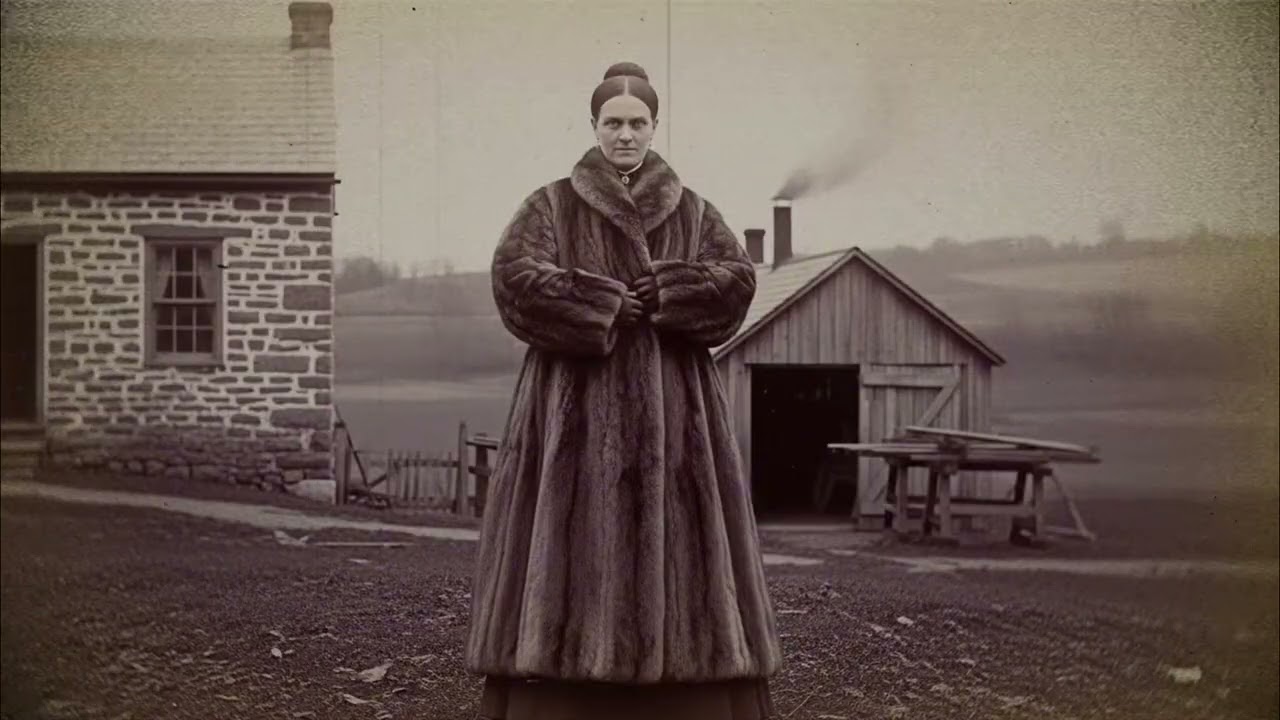
Customers of her workshop, located in a modest stone cottage near Miller’s Bridge, returned with coats made from a fur so soft it felt like rabbit, yet so warm it seemed to generate its own heat. No one could identify the animal. The material shifted from deep brown to nearly black depending on the light, and the garments required no layering even in bitter cold. But something disturbed the community.
Reverend Ezekiel Witmore, writing to his sister on November 2nd, noted that Mrs. Moravec insisted on private fittings lasting over two hours with each customer. Those who visited her cottage emerged subdued, changed in a way he found unnatural. Others noticed the same pattern.
Customers became withdrawn, avoided community gatherings, and displayed an obsessive attachment to their new coats, wearing them constantly, even inside and to bed. Barnabas Hutchkins, a practical farmer known for his work ethic, purchased a coat on October 20th. His wife Temperance recorded in her diary that he scarcely removed the garment after bringing it home. By November, he had grown distant and silent.
Every Wednesday evening, he walked to Mrs. Moravec’s cottage and spent three hours there. Temperance wrote that she feared the widow had some hold over him. The pattern repeated across the community.
Isidora Fleming, wife of the bank president, bought a coat and began refusing social invitations. Cornelius Blackwater, the county’s largest landowner, acquired a coat for his wife and within a month had lost considerable weight and taken to walking alone along the riverbank in the coldest hours of night. Dr. Sylvanus Heath, the only physician in the area, noticed troubling symptoms among his patients who owned the garments.
They reported improved circulation and decreased sensitivity to cold, which he initially attributed to the quality of the coats. But other symptoms made no sense. Several developed an aversion to meat. Others became sensitive to bright light and requested evening appointments.
Most concerning, patients began visiting Mrs. Moravec’s cottage far more frequently than maintenance could justify, offering vague explanations about garment care. In December, Jeremiah Caldwell, proprietor of the general store, approached Mrs. Moravec to discuss stocking her products.
He was received cordially, but her manner was strange. She whispered even when they were alone and seemed aware of sounds he could not detect. When he asked about her suppliers, she claimed family methods inherited from the old country, then became evasive. Through a partially open doorway, Caldwell glimpsed the rear workshop, filled with large vats.
The air carried a smell he recognized from the rendering facility near the slaughterhouse in Pittsburgh. She closed the door quickly, saying the materials were sensitive to exposure. By January 1889, the customers of Mrs. Moravec’s workshop had become an insular group.
More disturbing were the nighttime episodes. Temperance Hutchkins found her husband standing motionless in their yard facing the direction of the Moravec cottage, despite the cold. Other families reported the same. Spouses were found in gardens, fields, or along the river path leading toward her property, perfectly still, oblivious to weather, and with no memory of leaving their homes.
The breakthrough came in February 1889 through a traveling merchant named Moritz Steinberg, who traded exotic goods throughout the eastern states. When shown a sample of Mrs. Moravec’s work, he examined it with great care and declared it unlike anything he had ever encountered. The texture suggested fur from a large mammal, but the hair structure was inconsistent with any known species.
Most disturbing was his observation that the material appeared to retain cellular activity when exposed to body heat. Steinberg concluded that the material was not animal fur at all, but processed human hair, treated through some unknown method to imitate fur. Jeremiah Caldwell took Steinberg’s assessment to Constable Cyrus Wittmann, a retired Army sergeant with fifteen years of practical law enforcement experience. Wittmann was skeptical, but agreed to investigate discreetly.
He reviewed missing person reports from surrounding communities and attempted to verify Mrs. Moravec’s background. The records revealed troubling inconsistencies. The mining company that employed her deceased husband had no documentation of her or of death benefits paid to his widow.
Immigration records showed no entry matching her description. And most disturbingly, similar operations had appeared in other isolated rural communities throughout the 1880s. In each case, a woman matching her general description established a textile workshop specializing in unusual fur garments, operated for several years, attracted a devoted customer base displaying similar behavioral changes, then vanished without notice. Each community also reported a slight increase in missing persons during her operation.
On March 15th, 1889, Wittmann arrived at the cottage, framing his visit as a routine business licensing check. She admitted him to the front workshop, which appeared perfectly normal. But when he requested access to the rear area, she became agitated, claiming dangerous chemicals required careful handling. When he insisted, she reluctantly allowed him in, accompanying him closely.
The rear workshop defied his expectations. It was an elaborate laboratory filled with glass containers, measuring instruments, and apparatus resembling medical equipment. The sweet odor was strong here, emanating from sealed jars of chemical solutions. Diagrams on the walls depicted anatomical studies of human hair growth patterns and processing methods, requiring knowledge far beyond that of a simple garment maker.
The most disturbing discovery came in the storage area. Large wooden containers held enormous quantities of hair in various stages of processing, enough to require harvesting from hundreds of sources. The characteristics matched human hair in all observable aspects, and many bundles showed no signs of deterioration, suggesting recent removal from their sources. Beneath the workshop floor, Wittmann discovered a hidden compartment containing detailed customer records that went far beyond commercial interest.
They included physical descriptions, personal habits, family relationships, and daily schedules. Maps of the region marked secluded locations along the river, in wooded areas, and near abandoned mining sites—locations cross-referenced to individual customers. Mrs. Moravec had been systematically tracking her customers and their access to isolated areas.
A journal written in an unidentified language contained sketches depicting human figures in various states, processes involving systematic harvesting of hair, and methods for disposing of remains. The clinical precision suggested extensive experience. Wittmann immediately contacted authorities in Pittsburgh and Philadelphia. When investigators arrived three days later, Mrs.
Moravec was gone. She had vanished during the night, taking portable equipment and materials, leaving behind only the built-in apparatus too large to move. Beneath the cottage, investigators found a disposal system leading to an underground chamber connected to the river through drainage channels. Chemical analysis of the residues confirmed the presence of human remains, processed so thoroughly through acid-based decomposition that individual identification was impossible.
Estimates suggested materials from dozens of sources had been processed during Mrs. Moravec’s residence. Yet local missing person reports accounted for only a fraction of that number. Testing of fabric samples revealed traces of compounds capable of inducing trance-like states, reducing awareness, and creating compulsive behaviors, including unconscious movement toward specific locations.
The midnight wanderings had not been random. Mrs. Moravec had been using her customers as unknowing accomplices, conditioning them to walk to predetermined locations where they could be harvested without resistance. The gradual isolation of customers from the community had been deliberate, reducing the likelihood their absences would be noticed.
Recovery was prolonged. Dr. Heath documented that individuals continued to experience compulsive behaviors for weeks after ceasing to wear the garments. Some never fully recovered their previous personalities, showing permanent changes in sleep, appetite, and social interaction.
Several required permanent medical supervision. Coordination with authorities in other states uncovered a trail of similar businesses spanning nearly a decade, always following the same pattern of establishment, operation, and sudden abandonment. The total scope suggested hundreds of victims across multiple communities. Mrs.
Moravec was never apprehended. Her appearance was so poorly documented that even regular customers could provide only vague descriptions. She appeared to possess extensive knowledge of criminal investigation methods, and no records matched her description in immigration documents, educational institutions, or professional organizations. The case officially remained open until 1954, though active investigation ceased after 1892.
The cottage was demolished in 1890, and the site declared unsuitable for construction due to chemical contamination. The psychological impact on Cedar Ridge persisted for decades. Many families relocated. Those who stayed found that community trust had been permanently shattered.
Dr. Heath continued treating former customers until his retirement in 1912, and his detailed records contributed to early understanding of what would later be recognized as post-traumatic stress disorder. Jeremiah Caldwell, whose inquiries had exposed the case, suffered persistent nightmares and eventually sold his store and moved to Ohio. Constable Wittmann resigned six months after Mrs.
Moravec’s disappearance, stating that the case had revealed criminal possibilities he was not equipped to handle. He spent the rest of his life as a farmer. In 1965, documents found in an abandoned building in Pittsburgh appeared related to her activities, containing chemical formulas and references to other locations. The papers had deteriorated severely, and what could be recovered provided no new leads.
The method Mrs. Moravec employed was never fully understood. The combination of human hair treatment, psychological manipulation compounds, and textile processing represented a level of scientific sophistication that challenged the understanding of the period. She had demonstrated expertise in chemistry, psychology, anatomy, and criminal methodology suggesting formal training far beyond her assumed background.
Whether she operated alone or as part of a larger organization was never determined. The community of Cedar Ridge never returned to its former self. By the 1920s it had become little more than scattered farms, and the original town center had largely disappeared. The river path used by conditioned customers became known locally as the Widow’s Trail and was avoided for decades.
The case became local folklore, a cautionary tale about trusting strangers who offered goods too remarkable to be authentic. As rural communities modernized and became better connected, the isolation that had enabled such an operation became increasingly rare. More than a century later, the full scope of Mrs. Moravec’s activities remains unknown.
Her success depended not on elaborate technology or large-scale organization, but on the trust of rural communities and the isolation that allowed terrible secrets to remain hidden for far too long.






