In the autumn of 1898, fog settled over the hollows of Wise County, Virginia, carrying secrets too heavy to fade. The Ashworth estate stood alone in the remote Appalachian hills—a three-story mansion of local limestone and imported hardwood, overlooking the Clinch River below. Built in a neo-Gothic style that seemed to belong to another world entirely, it was the home of Cordelia Ashworth, the sole resident following the death of her husband, Silas, in the winter of 1897. The county death record attributed his passing to pneumonia, a common ailment in those damp mountains.
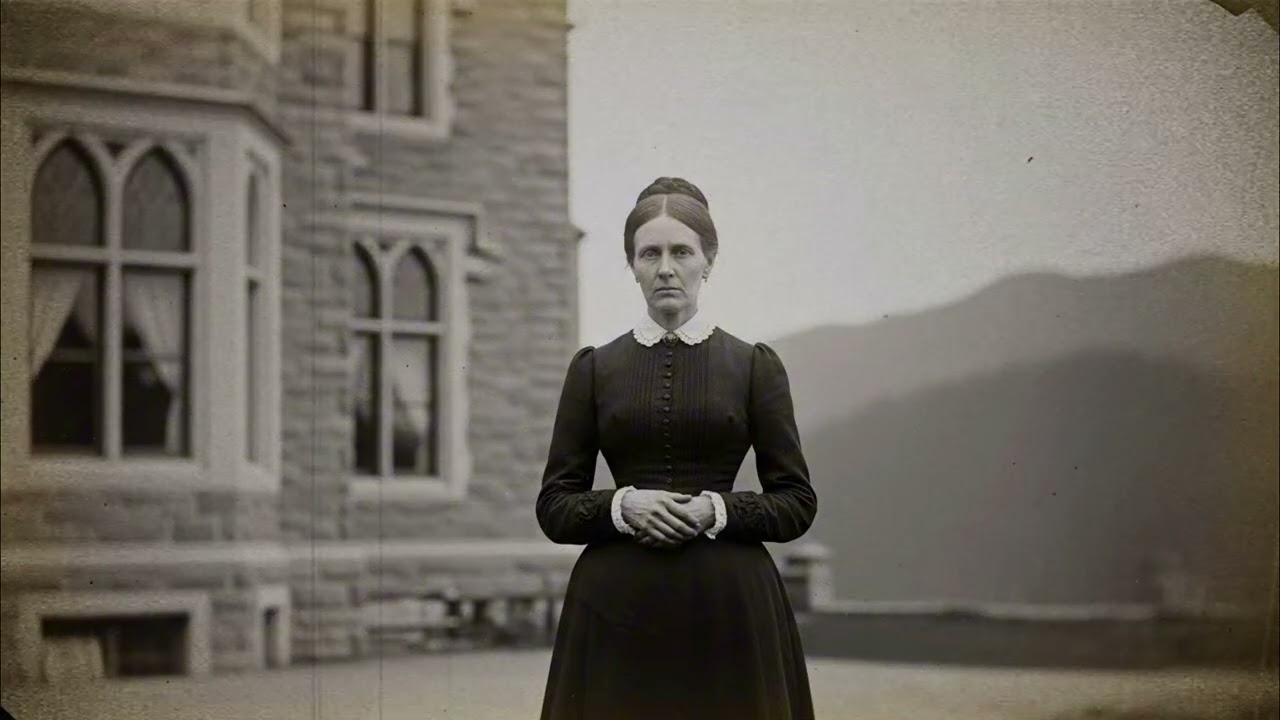
Silas was fifty-three years old, and by local estimates, he had left behind a fortune of some fifty thousand dollars—a sum that could have purchased half the county in those days. But the fortune came with an unusual inheritance arrangement. Cordelia was required to remain on the property for at least five years after her husband’s death. Any attempt to sell or transfer the land would result in the entire estate reverting to an unnamed trust in Philadelphia.
The lawyers who drafted the documents said they had never encountered such restrictive terms—conditions designed to confine the beneficiary rather than protect the assets. When Silas purchased the land in 1885, he had acquired nearly three thousand acres of mountainous terrain. Unlike most speculators of the era, he built his mansion not near the valuable coal deposits but at the highest point of his property, where views extended thirty miles in any direction. Local contractors who worked on the construction recalled his unusual specifications: walls twice as thick as custom required, windows oriented to specific compass directions, and a basement extending twenty feet below ground level, carved directly into the natural rock.
The builder kept detailed records, noting that the excavation work was more suited to a mine than a residential foundation. A complex ventilation system was installed to maintain constant temperature and humidity in the underground chambers—environmental control that was unprecedented in residential construction of the age. The marriage between Silas and Cordelia took place in 1889. Cordelia Margrave had come from Richmond to work as a governess for a prominent judge’s family.
She was educated, spoke French and German, and had a deep interest in botany and natural history. Her botanical expeditions through the mountain forests were well known, and it was during these solitary excursions that she sometimes met Silas in remote locations. Their courtship was largely hidden from view. The wedding was modest, attended mainly by the judge’s family, with no representatives from Silas’s side—a circumstance that invited speculation about a past he never explained.
Servants who worked at the estate observed that the couple inhabited separate rooms. Cordelia often disappeared for days on long, solitary walks through the mountain trails, especially after 1895, when Silas’s health began to decline in ways his doctor found difficult to diagnose. Symptoms included gradual weight loss, disorientation, and what the physician’s notes described as compulsive behaviors related to collecting and preserving natural specimens. In the months following Silas’s death, Cordelia’s behavior grew increasingly concerning.
She dismissed most of the household staff, keeping only an elderly housekeeper named Patience Crawley, who lived in a small cottage on the grounds. The housekeeper reported that her mistress spent long hours in the basement, often emerging with dirt under her nails and stains on her clothing that resembled clay. The basement had always been Silas’s private domain, where servants were directed never to go unless under his direct supervision. The doctor who had treated Silas, Nathaniel Grayson, continued to check on Cordelia as was customary for widows of wealthy families.
During a visit in July 1898, he noticed she had lost significant weight and showed signs of chronic sleep deprivation. More concerning was her insistence that she had discovered letters among Silas’s papers containing evidence of a conspiracy and criminal activity related to his death. She claimed the letters were written in code or a foreign language, accompanied by detailed anatomical drawings. She demanded the doctor examine Silas’s grave for signs of tampering.
When he suggested that grief and isolation might be affecting her judgment, she grew hostile and refused his suggestion that she move to town for better care. The doctor’s next scheduled visit in August did not proceed normally. He found the main gates locked with a handwritten sign stating that Mrs. Ashworth was not receiving visitors due to a serious illness requiring complete isolation.
Concerned for her safety, the doctor approached the property via a mountain trail he knew from his own botanical interests. What he saw from hidden positions in the surrounding forest would haunt him for the rest of his life. He observed lights moving through the basement windows during daylight hours, accompanied by rhythmic pounding sounds like someone breaking rock with heavy tools. The noise continued for hours at a time.
More alarming were his observations of Cordelia in the formal gardens. In the hours before dawn, using lantern light, she appeared to be burying objects in carefully measured locations marked by small wooden stakes. His medical training allowed him to recognize that some of the objects appeared organic in nature—possibly tissue samples or other biological material. The systematic character of her work suggested organization rather than random or psychotic behavior.
The doctor contacted the local Presbyterian minister, Cornelius Wade, who had performed the Ashworths’ wedding ceremony and had known both of them since their arrival in the county. After hearing the doctor’s account, the minister agreed that intervention was justified. They arrived at the property on a foggy morning in early September, prepared to use their medical and pastoral authority to gain entry. The estate showed clear signs of severe neglect.
The formal gardens Cordelia had once maintained were overgrown. Outbuildings had been dismantled for materials. Most striking were the numerous excavations scattered across the grounds—pits roughly three feet square, ranging from one to four feet deep, many refilled but clearly disturbed. The pattern suggested systematic digging conducted over an extended period.
The housekeeper received them at the servant’s entrance. The men were shocked by her appearance—she had lost considerable weight and displayed nervous behavior, repeatedly glancing toward the interior of the house. She initially tried to turn them away, saying her mistress was ill and had given strict instructions not to receive visitors. But the minister insisted on his pastoral right to check on a member of his congregation.
Reluctantly, she led them inside. The interior of the mansion had been transformed. Furniture had been moved away from walls to create large open spaces. Expensive rugs, textiles, and decorative objects had been removed entirely.
Most disturbing were the signs of extensive excavation conducted inside the house itself. Sections of hardwood flooring had been carefully removed, with holes dug through the subflooring to reach the soil beneath the foundation. The holes were uniform in size and spacing, suggesting they had been created according to a pre-existing plan. Specialized equipment visible in several rooms appeared designed for archaeological or geological excavation rather than conventional construction or repair.
When asked where Cordelia was, the housekeeper gestured toward the stairs leading to the basement and explained that her mistress spent most of her time caring for “the collection. ” When the doctor asked directly whether she felt safe remaining in the house, she looked around in panic before whispering that she could not leave until the work was finished. The minister called down to Cordelia, identifying himself and the doctor. After several minutes, they heard footsteps ascending from below, accompanied by the sound of something heavy being dragged across a stone floor.
When she emerged, both men were horrified by her appearance. She had become almost skeletal. Her clothing was stained with clay, rust, and what appeared to be various chemicals. Her hands were severely damaged from manual labor, covered with cuts and scratches in various stages of healing, her broken nails filled with what looked like dirt and organic material.
More alarming than her physical condition was her mental state. She greeted the men warmly, as if their visit was entirely expected and welcome, showing no awareness that her appearance or the condition of the house might cause concern. She spoke with great enthusiasm about her project and invited them to inspect her work. She talked at length about preserving Silas’s legacy and ensuring “the collection” was completed before winter, using technical terminology related to preservation and classification.
But her explanations were often disjointed. She agreed to show them the basement laboratory where she claimed to be continuing research that Silas had begun years earlier. The descent revealed chambers significantly modified since the original construction. Multiple rooms had been carved into the mountain rock behind the original foundation, connected by narrow passageways extending in several directions from the main chamber.
The walls were lined with wooden shelves made from materials apparently reclaimed from dismantled outbuildings. On these shelves stood hundreds of glass containers of varying sizes, from small specimen jars to large preservation vessels capable of holding objects several feet in length. Each container held what appeared to be organic specimens preserved in a clear fluid. Cordelia explained that Silas had been a collector of natural curiosities, and she was continuing his work by cataloguing and preserving the specimens he had gathered during his extensive travels through the Appalachians.
She showed them handwritten records in which each specimen was numbered, dated, and described in detail, including source information, collection methods, and preservation techniques. The early entries appeared to be in Silas’s hand; the more recent ones were clearly Cordelia’s. The doctor examined several specimens closely, using his medical training to assess their nature. He was disturbed to discover that many of the preserved items appeared to be of human origin—tissues, organs, and bone samples that showed characteristics suggesting they had been obtained from multiple individuals.
Cordelia explained that Silas had developed relationships with medical professionals and undertakers throughout the region who supplied him with specimens from individuals who had died of unusual diseases or displayed rare physical characteristics. She assured them that all specimens had been obtained through legal agreements with families grateful for their deceased relatives’ contribution to scientific knowledge. But the doctor’s professional experience allowed him to recognize several aspects of the collection that did not align with her explanation. Many of the preserved tissues appeared remarkably fresh, suggesting they had been obtained recently rather than collected during Silas’s lifetime.
The preservation techniques were more sophisticated than what was available to most small-town undertakers or physicians. Most concerning was the apparent systematic nature of the collection—rather than random opportunities to acquire interesting specimens, the material seemed to have been gathered according to a deliberate plan focused on specific types of tissue and organs. When the doctor gently raised concerns about the freshness of some specimens, Cordelia’s behavior changed dramatically. The welcoming woman transformed into someone agitated and defensive, insisting the doctor was not qualified to assess the age or condition of preserved specimens.
She demanded to know the purpose of his questions and accused him of trying to interfere with important scientific work. As she became more disturbed, she made statements that revealed the extent of her psychological decline. She claimed that Silas continued to provide guidance on the work through letters he left in their bedroom each night—communications that enabled her to understand which specimens were still needed to complete the collection. When the minister offered prayer and suggested she might benefit from returning to the church community, she refused with increasing hostility, insisting that religious concerns were irrelevant to her work.
As they prepared to leave, Cordelia described her work as divided into distinct phases, with the current collection representing only an initial stage of a larger project that would culminate in what she called “the process of union. ” When the minister asked for clarification, she explained that her ultimate goal was to achieve a form of communication with Silas that would allow them to continue their scientific partnership beyond the constraints of physical death. She believed that by studying human consciousness stored in various tissues and organs and preserving them carefully, she could develop techniques to maintain communication with the dead and achieve immortality that would allow their research to continue indefinitely. Both visitors left convinced that Cordelia was suffering from a severe mental breakdown.
They agreed that her case required professional intervention. But the legal challenges were significant. As a widow with substantial financial resources and no known relatives in the region, Cordelia had the legal right to manage her own affairs. Her strange behavior, while deeply concerning, did not necessarily constitute grounds for forced commitment to a mental institution.
The doctor was particularly concerned about the specimens they had seen. His medical training allowed him to recognize that many of the preserved materials were of human origin and appeared much more recent than Cordelia’s explanations suggested. The systematic nature of the collection and the sophisticated preservation techniques raised serious questions about how the specimens had been obtained and whether her activities involved criminal behavior in addition to mental illness. The minister shared these concerns, but he was also worried about the housekeeper, whose fearful behavior and statement that she could not leave until the work was finished suggested she might be under some form of coercion.
They agreed to contact the county sheriff. On October 15, 1898, Sheriff Josiah Brennan arrived at the Ashworth estate with two deputies and the county clerk, intending to conduct a preliminary investigation. What they found suggested the situation was more serious than anyone had anticipated. The main gates of the property were open, unusual given Cordelia’s recent pattern of strict privacy, but the estate appeared completely deserted.
No smoke rose from the chimneys despite the cold autumn weather. There were no signs of household activity. When the officials called out, they received no response. The house itself was empty, with all exterior doors unlocked.
Personal belongings were scattered throughout the rooms, and several areas showed evidence of recent disturbance, as if someone had been searching through furniture and storage areas. The housekeeper was nowhere to be found, and her cottage showed signs of hasty departure. There was no note explaining her absence, and none of the neighboring families had any idea where she had gone. The basement laboratory was still largely intact, but many of the specimen containers had been removed or destroyed.
Broken glass littered the carved chambers, and the smell of preservation fluid was overpowering. Most of the detailed records and scientific equipment had been moved as well, though scattered papers amid the debris indicated the documentation had been comprehensive and highly organized. A thorough search of the grounds revealed multiple burial sites in the gardens and wooded areas of the property. The excavations proved inconclusive—while the pattern of digging indicated systematic burial of objects over an extended period, most of the graves contained animal remains or decomposed organic material too far gone for identification.
Cordelia’s personal belongings were still in her bedroom: clothing in wardrobes, jewelry in boxes, and significant amounts of cash in an open safe. This evidence suggested her departure had been sudden and unplanned, but it provided no clues as to her destination. The search for Cordelia Ashworth continued throughout the winter of 1898 and 1899, involving law enforcement from multiple jurisdictions and volunteer search teams organized by local residents. Despite exhaustive efforts covering hundreds of square miles of mountainous terrain, no trace of her was ever found.
The official investigation ultimately concluded that she had likely suffered a complete nervous breakdown, either taking her own life in the remote wilderness or fleeing the region entirely under an assumed identity. The legal complications surrounding the estate proved as complex as the search for its missing owner. Lawyers attempting to execute the inheritance provisions discovered that the Philadelphia trust named in Silas’s will could not be located despite extensive searches of legal and financial records. Most of the banks listed as holding Ashworth assets had no record of accounts under that name, and several of the financial institutions mentioned in the estate documents did not appear to exist at all.
The apparent wealth of the Ashworth family had been largely illusory, constructed through forged documents that created the impression of prosperity without real assets. The coal mine investments and land holdings that supposedly formed the basis of the inheritance were either nonexistent or grossly overvalued. The Ashworth estate was eventually declared abandoned and placed under county administration pending settlement of inheritance disputes. The basement laboratory was permanently sealed with concrete to prevent unauthorized entry, and the main house was boarded up.
The property remained without practical value due to the legal complications, and no buyer ever emerged. Local residents largely avoided the estate in the years following Cordelia’s disappearance, and stories about the widow’s laboratory began to circulate in the community, though the details were often distorted in the retelling, with supernatural elements added that bore little relation to the documented facts of the case. The mystery of Cordelia Ashworth’s fate might have remained just another example of tragedy befalling isolated mountain families were it not for discoveries made by researchers more than six decades later. In 1962, Dr.
Ambrose Fairweather, a historian specializing in nineteenth-century Appalachian settlement patterns, became interested in the Ashworth case while researching land ownership records. His initial research gradually revealed inconsistencies in the official account of the family’s background. Bank records showed that while Silas had indeed owned some mining rights and land, the liquid assets that supposedly formed most of the inheritance were entirely fictitious. Hospital records from the period revealed something even more troubling.
Dr. Grayson had been documenting alarming symptoms in Silas for months before his death—observations completely contradictory to the pneumonia diagnosis on the official death certificate. The doctor’s private notes described progressive neurological decline accompanied by paranoid delusions focused on beliefs about external forces altering his body and consciousness. Most concerning were the doctor’s notes about Silas’s obsession with preserving evidence of these alleged changes through the systematic collection and study of human tissue.
The historian’s investigation into missing persons reports from the period revealed a disturbing pattern. Between 1890 and 1898, at least twelve people had disappeared from the Wise County area under circumstances the local authorities attributed to mountain travel hazards or the transient nature of the mining workforce. But analysis of these disappearances revealed common factors suggesting a more sinister explanation. Most of the missing had been traveling alone, were not well known in the local community, and had been seen in the vicinity of the Ashworth estate shortly before their disappearance.
Many had suffered from illnesses or physical abnormalities that would have made them interesting from a medical research perspective. The most significant breakthrough came through the discovery of sealed court records from 1899 that had not been available to previous researchers. These documents revealed that the official investigation into Cordelia’s disappearance had uncovered evidence far more disturbing than had been reported to the public at the time. The sealed records described the discovery of additional rooms in the basement complex that authorities had missed during the initial search.
These rooms were carefully hidden behind false walls and appeared to contain a fully equipped surgical facility, including operating tables, anesthesia equipment, and a wide range of medical instruments far beyond what was available to legitimate physicians in that remote mountain region. More horrifying was the discovery of written, detailed records documenting systematic medical experiments conducted on living human beings over a period of several years. These records, written in the handwriting of both Silas and Cordelia, described procedures designed to study how consciousness could be preserved in human tissues and organs. The experiments involved the systematic removal and preservation of body parts from individuals who were reportedly kept alive throughout significant portions of this process.
The documents revealed that Silas and Cordelia had developed an elaborate theoretical framework based on the belief that human consciousness could be preserved in preserved tissue if the preservation process was conducted while the person was still alive. Their goal was to create a form of immortality that would allow continued existence and communication after the death of the physical body through careful preservation of vital organs and neural tissue. The records indicated that they had been conducting these experiments on kidnapped travelers and passersby for years, exploiting the isolated mountain location to avoid discovery while developing preservation techniques and studying the results. The systematic nature of the operation and the sophisticated equipment used suggested this was not the work of isolated madness but an organized research program with specific scientific objectives.
The historian faced a difficult ethical decision regarding how to handle his findings. The evidence he had uncovered relied primarily on documents that had remained sealed for legal reasons and on sources that other researchers might question. Publishing his research would likely cause significant distress to the families of the missing and might damage his professional reputation if the evidence proved insufficient to support his conclusions. He chose to prepare his findings in the form of a limited academic paper that focused primarily on the social and economic factors that made Appalachia vulnerable to predatory behavior during the late nineteenth century.
In 1964, the historian received correspondence from a retired railroad supervisor whose grandfather had worked as a surveying assistant in the region during the 1890s. The grandfather’s diary, preserved by the family for over seven decades, contained multiple references to the Ashworth estate and described encounters with both Silas and Cordelia. According to the surveyor’s detailed account, the Ashworths were known throughout the region as collectors of medical specimens who had established an extensive network of contacts that provided them with information about individuals suffering from unusual diseases or physical abnormalities. This network included undertakers, physicians, and traveling merchants who were paid to identify potential subjects and facilitate their transport to the mountain estate.
The diary also revealed that Silas employed several assistants who roamed the mountains to identify and acquire specimens for his collection. These individuals often posed as medical specialists offering free treatment for interesting cases, gaining the trust of potential subjects before arranging their transport to the estate. The surveyor’s account included detailed descriptions of a meeting with Cordelia during the summer of 1898, months before her disappearance. According to this account, Cordelia approached the surveyor with an offer to purchase his maps and geographic documents, claiming she needed detailed information about remote mountain areas for a research expedition.
During their conversation, she spoke at length about her belief that the Appalachian mountains contained unique geological properties that could enhance the preservation of human consciousness after death. The surveyor refused her offers and noted in his diary that Cordelia’s behavior was so disturbing that he decided to avoid the Ashworth estate during his future travels through the region. His final entries about the family, dated October 1898, mentioned reports from other travelers that smoke had been observed rising from the estate grounds for several consecutive nights, accompanied by odors that local residents described as resembling burned organic material. Further correspondence revealed that the family also possessed photographs taken during surveying expeditions throughout the region during the 1890s.
These photographs provided visual documentation of many details that had previously existed only in written accounts. Most disturbing were photographs taken of both Silas and Cordelia engaged in what appeared to be field research activities, accompanied by unidentified assistants carrying equipment resembling medical and surgical instruments. One photograph taken in 1896 showed Silas and two assistants working at what appeared to be an excavation site several miles from the main estate. The three individuals were positioned around a rectangular hole approximately eight feet long and four feet wide—dimensions that corresponded closely to the size of a human grave.
The equipment visible in the photograph included tools that appeared designed for anatomical work rather than any legitimate scientific or archaeological research. Another photograph, taken inside the basement laboratory while Silas was still alive, showed the collection room in its early stages with approximately twenty specimen containers arranged on wooden shelves. Many of the containers were visible in sufficient detail to confirm they contained preserved human tissues and organs. The photographs convinced the historian that the scale of the Ashworth operation was far larger than anyone had previously suspected.
The evidence suggested that Silas had been conducting systematic human experimentation for years before his death, and that Cordelia had not only continued this work but had significantly expanded it during her period of isolation following his death. But the historian’s investigation took an unexpected turn when he began experiencing personal difficulties that appeared connected to his research into the case. Beginning in early 1967, he reported to colleagues that he was suffering from frequent nightmares related to his work and had developed what he described as an obsessive interest in preservation techniques and anatomical research. More concerning were reports from his research assistant that he had begun conducting unusual experiments in his university laboratory, working late at night on projects involving the preservation of organic tissue in ways that seemed to have no connection to his historical research.
When questioned about these activities, he claimed he was simply testing theories about preservation techniques that had emerged from his study of the Ashworth case. In the spring of 1968, while preparing to present his findings at a conference of Appalachian historians, he died of what was officially described as a fatal heart attack at his home. The circumstances surrounding his death raised questions that were never satisfactorily answered. His research materials related to the Ashworth case appeared to have been destroyed in a fire that broke out in his home office on the same night he died, and several of his colleagues noted that his behavior in the weeks preceding his death had become increasingly erratic and suspicious.
In the decades following the historian’s death, the Ashworth property underwent gradual development as economic pressures made mountain land more valuable for residential and commercial purposes. The foundations of the original house remain visible to hikers who venture into the backcountry, but the basement chambers were permanently sealed during redevelopment work in the 1970s. The mountain community that once surrounded the estate has largely dispersed, with residents moving to urban areas in search of better economic opportunities. The few elderly residents who remain occasionally share memories of the widow’s experiences, but these accounts have become distorted over time and are usually dismissed as folklore rather than historical fact.
The official county records of the Ashworth case remain available to researchers, but they present only the basic facts of Cordelia’s disappearance and the discovery of the basement laboratory. The more detailed evidence uncovered by the historian was never incorporated into the official narrative, and most historians who encounter references to the case assume it represents nothing more than a tragic example of mental illness and social isolation in postwar mountain communities. Yet something remains deeply unsettling about the remote mountain site where the Ashworth estate once stood. Hikers who venture into the area often report an inexplicable feeling of unease, as if the landscape itself retains some memory of the activities that once occurred there.
The springs that feed the streams descending from the Ashworth property have an unusual mineral content that gives the water a distinctive metallic taste, and the wildlife patterns in the area display anomalies that local naturalists have been unable to satisfactorily explain. Those familiar with the historical case sometimes wonder whether Cordelia Ashworth achieved the immortality she sought through her horrific experiments—not in the literal sense she imagined, but through the way certain secrets become inseparable from the places that gave birth to them, creating disturbances that persist long after the original events have passed into history. The mountain keeps its secrets well, as mountains always have. But sometimes, in the fog that still rises from the valleys of Wise County on autumn mornings, some claim to glimpse a figure moving among the trees near the grounds of the old mansion—a figure carrying something carefully in both hands, as if continuing a work that requires infinite patience and absolute precision.
Whether these visions represent anything more than mental suggestion and local legend is impossible to determine. But the fact that they continue to be reported more than a century after Cordelia’s disappearance suggests that some stories refuse to end simply because their protagonists have faded from the physical world.
