The number she spoke aloud was twenty pounds. She stood in the middle of a circle of native leaders in a camp somewhere in the forests of central Massachusetts, in the spring of 1676. They had called her before them. She sat down on the ground, the way she had learned to sit among them.
They told her to stand up. And then, with something close to a smile, they told her who they were. “We are the General Court,” they said, using the same name the English used for the government in Boston. And they asked her how much her husband would pay to get her back.
She had a terrible problem. Her home had been burned to the ground. Everything her family owned was gone. If she named too small a sum, they might decide she was not worth the trouble of keeping alive.
If she named too large a one, her husband would never be able to raise it. So she guessed. “Twenty pounds,” she said. And then, quickly, she asked them to take less.
They would not. They sent a letter to Boston that said, “For twenty pounds, she would be redeemed. ”
Her name was Mary Rowlandson. She was the wife of a Puritan minister, about thirty-nine years old.
And by the time she stood up in that circle and set her own price, she had been a captive for more than two months. She had been shot. She had carried her six-year-old daughter in her arms for nine days while the child died. She had been separated from her other two children and did not know whether she would ever see them again.
She had eaten horse hooves and horse liver to stay alive. And she had sewn a shirt for the son of the most feared enemy in New England—a little boy whose fate, a few months later, would turn out to be every bit as heartbreaking as her own. Six years after that circle in the forest, Mary Rowlandson published a book about what happened to her. It became one of the most widely read books in colonial America.
It is still read in schools today. And almost nobody who reads it finishes the story. To understand why Mary Rowlandson’s town was burning in February 1676, it is necessary to go back one year, to a man the English called King Philip. His real name was Metacom.
He was the son of Massasoit, the great sachem, or leader, of the Wampanoag people. Massasoit was the man who had welcomed the Pilgrims at Plymouth in 1621 and kept the peace with them for forty years. The English gave his son an English name, Philip. They also later called him a king, although no such word existed in his language.
By the time Metacom became sachem in 1662, the world his father had known was disappearing. Waves of English settlers had spread across New England. They cleared forests, fenced land, and let their cattle and pigs wander into native cornfields. They bought land, sometimes fairly, often not.
They put native people on trial in English courts under English law. Disease had already killed a huge share of the native population before the Pilgrims ever arrived, and the losses kept coming. Metacom’s older brother, Wamsutta, had been summoned by the English for questioning, fell ill while in their custody, and died soon after. Many Wampanoag believed he had been poisoned.
In 1675, a Christian Wampanoag who had warned the English about Metacom was found dead under the ice of a pond. Plymouth Colony arrested three Wampanoag men, tried them, and hanged them. That was the spark. In June 1675, the war began.
It spread fast. The Wampanoag were joined by the Nipmuc of central Massachusetts, and eventually by the powerful Narragansett of Rhode Island. Town after town on the English frontier was attacked and burned. And the English answered with a blow of their own.
In December 1675, in the middle of winter, a colonial army marched into a fortified Narragansett village hidden in a great swamp in Rhode Island and set it on fire. Hundreds of Narragansett were killed, many of them women, children, and old people burned in their homes. It became known as the Great Swamp Fight. Two months later, the Narragansett came to Lancaster.
Mary White had been born in England around 1637. She came to New England as a child, and when she was about nineteen, she married the minister of a small frontier town in central Massachusetts called Lancaster. His name was Joseph Rowlandson. For twenty years, she lived the life of a Puritan minister’s wife, running a household, going to services, raising children.
By 1676, three of their children were living: Joseph, about thirteen; Mary, about ten; and the youngest, Sarah, six years and five months old. Lancaster sat about thirty-five miles west of Boston, on the edge of Nipmuc country. As the war spread through the winter, the town lived in fear, and in early February 1676, word reached Lancaster that an attack was coming. So Joseph Rowlandson rode to Boston to beg the colony’s leaders to send soldiers to protect his town.
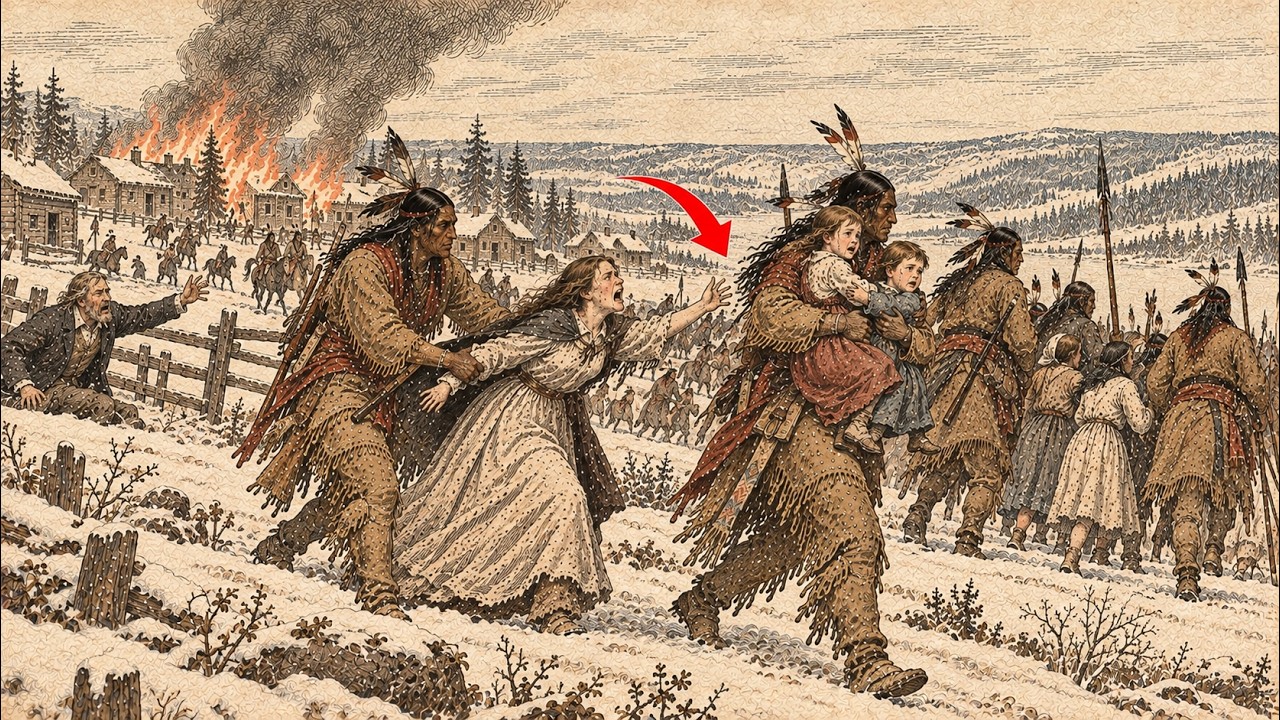
He was still away when the attack came. On the morning of February 10, 1676, at sunrise, several hundred warriors—Narragansett, Wampanoag, and Nipmuc—fell on Lancaster. The Rowlandsons’ house was one of the town’s garrison houses, a fortified home where neighbors gathered for protection. When the attack began, thirty-seven people crowded inside.
Mary, her three children, her sisters and their families, and neighbors. Mary’s own words survive. She called it the dolefulest day that ever mine eyes saw. The house stood on the edge of a hill.
Warriors took cover behind the hill, in the barn, behind anything they could find, and fired at the house. She wrote that the bullets seemed to fly like hail. For about two hours, the people inside held out. Then the attackers set the house on fire with flax and hemp from the barn.
Someone put the fire out. They set it again, and this time it took. Now the people inside had a choice. Stay and burn, or go out the door into the guns.
Mary took her children and went to the door. The shooting was so heavy that they were driven back. But the fire kept growing behind them, and at last she wrote, “Out we must go. ”
As they came out, her brother-in-law, already wounded, fell dead.
And a single bullet went through Mary’s side, and through the body and hand of the little girl in her arms, Sarah. Mary’s nephew William had his leg broken and was killed where he fell. Her eldest sister, still inside the house, saw her own son dead and Mary wounded, and cried out, “Lord, let me die with them. ” Moments later, she was shot and fell dead across the threshold.
Then hands seized Mary, pulling her one way and her children another. “Come go along with us,” the warriors told her. She said they would kill her. They answered that if she came willingly, they would not hurt her.
Of the thirty-seven people in that house, she wrote, only one escaped both death and captivity. Twelve were killed. Mary Rowlandson walked out of the burning town of Lancaster as a captive, wounded, with her dying daughter in her arms. Her son and her older daughter had been taken by different men.
She did not know where they were. That first night, the captors camped on a hill a mile or so from the town, in an empty English house. Mary asked if she could stay inside. One of the warriors answered her with a question she never forgot: “What?
Will you love Englishmen still? ” That night, she wrote, the warriors celebrated with dancing and shouting, roasting cattle, sheep, and pigs taken from the town. She called it the dolorous night that ever her eyes saw. From then on, the war party kept moving.
Mary later divided her captivity into twenty removes, every time the camp packed up and moved somewhere new—westward, then north, then back again, across rivers, through snow, through forests and swamps, sometimes with soldiers chasing them. And through all of the first removes, she carried Sarah. Mother and daughter were both wounded. They had almost no food.
At first, Mary was put on a horse with Sarah in her lap, and the horse stumbled and threw them both. In the cold and snow, the wounds grew worse. They came to a native town called Wenimesset, near what is now New Braintree, Massachusetts. And there, Mary sat on the ground with her daughter, waiting.
From time to time, native men would come by and tell her that her master was going to kill her child. One, then another, then a third. “Thus nine days I sat upon my knees,” she wrote, “with my babe in my lap, till my flesh was raw again. ”
At last, as Sarah grew close to death, Mary was told to take her out of the wigwam to another one.
She thought it was because her captors did not want to watch. And about two hours into the night of February 18, she wrote, “My sweet babe, like a lamb, departed this life. ” Sarah was six years and five months old. She had lived nine days after the bullet, with nothing, Mary wrote, but a little cold water.
Mary lay down beside her daughter’s body for the rest of the night. Before the war, she said, she could not bear to be in a room where someone had died. Now she lay down beside her dead child, side by side, all night. And she admitted something that a Puritan minister’s wife almost never would have written: that it was only by the goodness of God that she did not use “wicked and violent means to end my own miserable life.
”
In the morning, she was taken back to her master’s wigwam. She tried to carry Sarah’s body with her, and they would not let her. When she went back to look for her daughter, they showed her a patch of newly dug earth on a hill. They had buried her.
“There I left that child in the wilderness,” she wrote. Her other daughter, ten-year-old Mary, was in the same town in another wigwam. She had been taken at the door by a Christian native man, and then, her mother learned, sold to someone else for a gun. When the girl saw her mother, she began to cry.
Her captors were angry at the tears, and drove the mother away. Mary could not even comfort her. “I had one child dead,” she wrote. “Another in the wilderness, I knew not where.
The third they would not let me come near to. ”
Then one day, as she walked back and forth in grief, her son appeared. Joseph, about thirteen. He was being held by a smaller band about six miles away, and had been allowed to visit.
With tears in his eyes, he asked if his sister Sarah was dead, and he told his mother not to worry about him. Over the next weeks, Mary saw her children only now and then, when their captors happened to camp near each other. Sometimes she had to beg to be allowed to visit. Sometimes she was refused.
They didn’t just take her children—they scattered them. Then she spent the next two months never knowing, from one day to the next, whether any of them were still alive. Mary had been sold to a Narragansett sachem named Quinnapin, and Quinnapin’s household included a woman who would become the most vivid figure in Mary’s book. But before that woman fully enters the story, there are two things that kept Mary Rowlandson alive.
The first was a book. A few days after Sarah’s death, a warrior came back from an English town his war party had raided. He had a Bible in his basket. He asked her if she wanted it.
She asked if he would let her read it. He said, “Yes. ” For the rest of her captivity, that Bible went everywhere with her. She called it her guide by day and her pillow by night.
The second thing was her hands. Mary could sew and knit. And in a camp where English cloth and clothing were valuable, that was a skill worth trading. She knitted stockings, she made shirts, she sewed caps, and for every piece of work she was paid in food.
A piece of bear meat, a quart of peas, a handful of groundnuts. Food was everything. Her captors were often starving, too. The war had wrecked their cornfields and driven them from their homes.
Mary described eating things she would never have imagined touching before. Groundnuts, old bones, horse hooves. Once she saw a man with a basket of horse liver and asked him for a piece. He looked at her in surprise.
What, he said, “Can you eat horse liver? ” She could. She did. Before it was even properly cooked, she ate it with the blood running down her mouth and said it tasted savory to her.
The minister’s wife from Lancaster was learning to survive the way her captors survived. Quinnapin had three wives. One of them was the woman who would decide how Mary lived for most of her captivity. Her name was Weetamoo, and she was not just a wife—she was a sachem in her own right, the leader of the Pocasset, a Wampanoag community.
She had once been married to Metacom’s brother, Wamsutta, the one who died after English questioning. She was related to Metacom by marriage, and she was his ally and friend. Historians believe she may have been the most powerful woman among all the native nations in that war. Mary did not like her, and the feeling seems to have been mutual.
“A severe and proud dame she was,” Mary wrote. Weetamoo spent as much time every day dressing herself, Mary complained, as any of the gentry of the land—powdering her hair, painting her face, wearing necklaces, jewels in her ears, bracelets on her hands. When she was dressed, she made belts of wampum and beads. Look closely at that description and notice what Mary is really seeing: a woman of rank, a leader, someone who dressed as a queen dressed because that is what she was.
Mary was used to seeing that kind of authority in English ladies. She was not prepared to see it in a native woman who was now her mistress. The two women clashed again and again. When Mary served Quinnapin and Weetamoo a meal of peas and bear in the same dish, Weetamoo refused to eat it, insulted.
Once, when Mary complained that her load was too heavy, Weetamoo slapped her across the face. And then one night something happened that changes how everything else in this story reads. Weetamoo’s baby was sick, and that night the baby died. Mary was sent out of the wigwam.
The next day the child was buried, and every morning and evening afterward people came to mourn with Weetamoo, crying and wailing with her in grief. Mary Rowlandson, who had held her own dying daughter in her lap for nine days only a few weeks before, wrote that she could not much condole with them. She even noted that the baby’s death had one benefit: there was more room in the wigwam. Not long after, Weetamoo came back from burying a child, found Mary sitting and reading her Bible, snatched it out of her hands, and threw it out the door.
Mary ran out, picked it up, put it in her pocket, and never let her see it again. Two mothers. Each had just buried a child. Each was living in the middle of a war that had taken almost everything.
And neither one in that wigwam could find a single word of comfort for the other. And yet Mary also wrote that when another older wife of Quinnapin’s treated her kindly and offered to let her stay in her wigwam, Weetamoo sent a maid to call her back. Mary understood why. Weetamoo was afraid of losing not only Mary’s work, but the ransom money, too.
To Weetamoo, Mary was a servant and a valuable piece of property in a war that was going badly for her people. To Mary, Weetamoo was a proud and cruel mistress. Both women had lost almost everything. Neither of them in that wigwam could see the other one clearly.
Somewhere along the removes, in a camp near the Connecticut River, Mary was brought before the man whose name the whole war carried: Metacom, King Philip. He was not what she expected. Philip asked her to make a shirt for his little boy. She did, and he paid her for it—one shilling.
She offered the coin to her master, Quinnapin, and he told her to keep it. So she used it to buy a piece of horse meat. Later, Philip asked her to make a cap for his son. This time, he invited her to dinner.
He gave her a pancake about the size of two fingers, made of parched wheat fried in bear grease. She wrote that she had never tasted anything more pleasant in her life. Philip also offered her a pipe of tobacco. She took it.
She had once smoked, she admitted, and had given it up. Now, in the middle of the wilderness, she was tempted again. So picture the scene. The English minister’s wife, whose town had been burned and whose daughter had been shot, sitting in the camp of the man the English called the leader of all their enemies, eating a small pancake he gave her as thanks for sewing a shirt for his son.
A little boy, about nine years old, wearing a shirt sewn by an English captive. He is the last person this story will follow. By April 1676, the war was turning. The English were organizing more effectively.
Native food supplies were collapsing. Some native communities were starting to think about peace. And the colony’s leaders in Boston began trying to ransom the captives. They sent letters into the forest with two Christian native men known to the English as Tom Dublet and Peter Conway.
They were praying Indians—native people who had converted to Christianity and lived in Christian towns. The war had been brutal for them, too. In the winter, the colony had rounded up many praying Indians and confined them on Deer Island in Boston Harbor, where many died of cold and hunger. Some of them were now risking their lives to carry messages between the two sides.
When Tom and Peter arrived in the camp with a letter from the council, Mary took them by the hands and burst into tears. For a moment, she could not speak. Then she asked about her husband and her friends. They told her that everyone was well, but melancholy.
And then came the council in the circle. The leaders calling themselves the General Court. And Mary setting her own price: twenty pounds. Her husband did not have twenty pounds.
Everything he owned had burned in Lancaster, so the money was raised by friends and sympathizers in Boston. A Concord man named John Hoar went out into the forest to deliver it and bring her home. When he arrived, some of Mary’s captors were suspicious and threatening. But on the evening before her release, they held a great dance.
Quinnapin and Weetamoo danced in their finest clothes, Mary wrote. Weetamoo in a coat of cloth, with stockings and garters hung with shillings, and her face painted red. On May 2, 1676, at a large granite outcrop near what is now Princeton, Massachusetts, Mary Rowlandson was handed over. Today that stone is called Redemption Rock.
She had been a captive for eleven weeks and five days. She had been moved twenty times. She had traveled, by most estimates, about 150 miles. Mary was free.
Her children were still out there. She and her husband stayed in Charlestown, then Boston, living on the kindness of friends. Weeks went by with only rumors. They heard one report that the children were in one place, then another.
Then, while riding north, they met a man on the road who told them that their son Joseph had been brought into the New Hampshire frontier, along with Mary’s nephew. Joseph was ransomed for seven pounds, paid by people who lived in the area. The nephew for four. That same night, word came that their daughter Mary had come in at Providence, Rhode Island.
She had not been ransomed at all. She had been walking with a native band, carrying a basket on her back, when the group moved ahead and left her behind with one native woman. The two of them walked for three days with nothing to eat but water and wild berries, and at last they came into Providence, where the English took the girl in. The Indians, Mary wrote, had often said she would never get her daughter back for less than twenty pounds.
But now God had brought her back for free. By the summer of 1676, Mary Rowlandson had her husband, her son, and her daughter. Sarah was still on a hill in Wenimesset, in a grave her mother never saw again. What came next is not in Mary’s book.
By the time it happened, she was safe in Boston. At the beginning of August 1676, an English ranger company under Captain Benjamin Church surprised a band of Wampanoag in the forest. Metacom escaped, but among the prisoners they took were his wife, Wootonekanuske, and her son, about nine years old. One more connection ties all of this together: Wootonekanuske was Weetamoo’s younger sister.
The little boy Mary had sewn a shirt for was Weetamoo’s nephew. A few days later, around August 6, Weetamoo herself, with the English closing in on the last of her people, tried to escape across the Taunton River on a makeshift raft and drowned. The English found her body on the shore. They cut off her head and set it on a pole in the town of Taunton.
One old account says that when native prisoners in the town saw it, they broke into terrible, heart-rending lamentation. Her husband, Quinnapin, Mary’s master, was captured that same month, tried by the English, and executed in Newport, Rhode Island. On August 12, 1676, Metacom was cornered in a swamp near his home at Mount Hope, in what is now Bristol, Rhode Island. He was shot by a native man named John Alderman, who was fighting on the English side.
His body was cut into quarters and hung in the trees. One of his hands was given to the man who shot him. His head was carried to Plymouth and set on a pole, where it stayed for more than twenty years. And his wife and his son?
For months, Plymouth officials and ministers debated what should be done with a nine-year-old boy whose father had led a war against them. Some argued that a child should pay for his father’s crimes. In the end, they did not kill him. They sold him.
He and his mother were shipped off as slaves, by most accounts, to the West Indies. People on the island of Bermuda have a tradition that the mother and son were brought there, and that their descendants still live on the island today. Nobody knows for certain. There is no written record of what happened to either of them after they were sold.
The little boy whose shirt Mary Rowlandson had sewn in exchange for one shilling. He was not alone. Historians estimate the English sold several hundred native captives into slavery during and after the war. Many of them were shipped to the Caribbean and the Atlantic islands.
Women, children, men who had surrendered, families who had nothing to do with the fighting. Mary’s children were ransomed one by one—for seven pounds, for four pounds, and for nothing at all. Philip’s son was sold. Joseph Rowlandson became minister of a church in Wethersfield, Connecticut.
He died in 1678, just two years after his wife came home. The next year, Mary remarried to a man named Samuel Talcott and took his name. For centuries, historians thought she had died around the time of her husband’s death. Only in the twentieth century did researchers discover that she had lived on as Mary Talcott until January 5, 1711.
She was around seventy-three. In 1682, six years after her captivity, her book was published. Its title was The Sovereignty and Goodness of God. In England, it was sold as a true history of the captivity and restoration of Mrs.
Mary Rowlandson. It was an immediate sensation. Several editions came out in its first year alone. Copies were read until they literally fell apart, which is why so few of the earliest printings survived.
It became the model for the whole genre of American captivity narratives, and it is still taught in classrooms today. To her Puritan readers, it was a story about God testing a faithful woman and rescuing her. To modern readers, it is also something else: one of the few places where Weetamoo, Quinnapin, and Metacom are seen up close through the eyes of someone who lived in their camps. Most of what we know about Weetamoo, the most powerful woman of the war, comes from the book of the captive who disliked her.
Weigh what those eleven weeks cost on both sides. For Mary Rowlandson: a burned home, a wound in her side, a sister, a brother-in-law, a nephew, and other relatives killed in a single morning, a six-year-old daughter who died in her arms after nine days and was buried on a hill she never saw again, two children scattered through the forest for months, and twenty pounds raised by strangers. For the people who held her: a war that killed, by many estimates, a far larger share of the native population of New England than of the English. Villages burned, cornfields destroyed, families starving on groundnuts and horse hooves.
A queen drowned and beheaded. A sachem shot, his body quartered and displayed. Hundreds sold into slavery overseas, a nine-year-old boy among them. King Philip’s War was, for its size, one of the deadliest wars in all of American history.
And it is mostly remembered through one woman’s book. The heartbreaking truth about Mary Rowlandson is not that she suffered. She did, terribly, and her book makes you feel every step of it. It is that this war was full of mothers losing children, and almost none of them could see each other’s grief.
Mary held Sarah for nine days and buried her on a hill. A few weeks later, she watched Weetamoo bury her own baby and felt nothing but relief at the extra room. Weetamoo, mourning her child, threw Mary’s Bible into the dirt. Both women were broken.
Neither could look across that wigwam and see a mother. And in the end, only one of them got her children back. Mary Rowlandson lost Sarah, and that grief never left her. But Joseph came home.
Mary came home. She sat by a fire again, read her Bible in a house, and wrote her story down for the world. Metacom’s wife lost her husband, her home, her people, and her freedom. And her son, the boy in the shirt sewn by an English captive, was sent across the ocean as a slave.
No one wrote down his name. No one ransomed him. Nobody knows what became of him. They didn’t just take Mary Rowlandson’s children.
In a war like that, both sides took children. One side’s children were bought back with pounds and shillings. The other side’s were sold. Near the end of her book, Mary Rowlandson wrote something that has nothing to do with Puritan sermons and everything to do with what happened to her.
“I can remember the time,” she wrote, “when I used to sleep quietly without workings in my thoughts whole nights together. But now it is otherwise with me. ” When everyone else is asleep, her thoughts went back to the war, to being in the middle of thousands of enemies with nothing but death in front of her. “When others are sleeping,” she wrote, “mine eyes are weeping.
”
Somewhere across an ocean, a boy who had once worn a shirt she made was growing up as someone else’s property. He would have had his own nights like that. No one ever wrote them down.
