In the darkness between two stations on a Southern Express Company line in November 1888, a train began to slow. The express agent inside the car heard the change in the locomotive’s rhythm and knew what it meant: something on the track had forced the engineer’s hand. He was on his feet before the train stopped, because he had heard enough depositions from colleagues over the preceding two years to understand that a train halting in the dark between stations in Alabama deserved his full attention. The door came open.
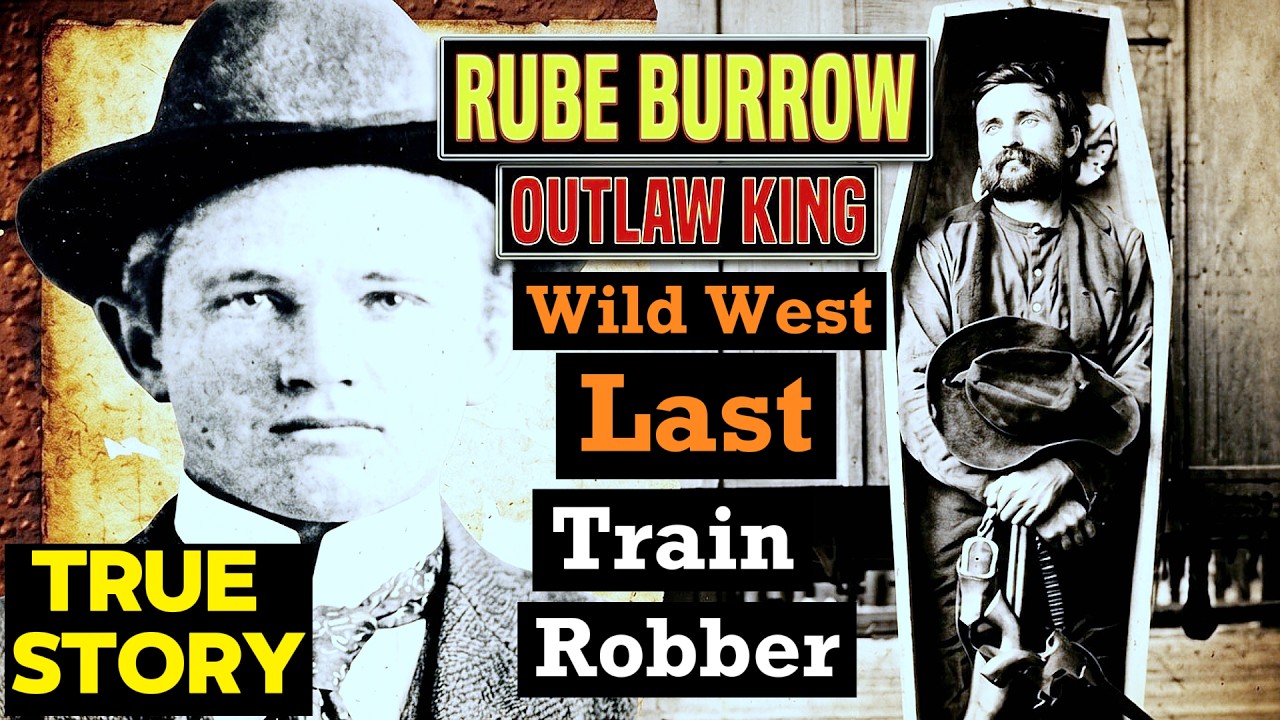
A man stepped in from the night, unhurried, rifle raised, the lamp catching the face that wanted posters had been trying to reproduce for two years and never quite capturing. Rube Burrows, thirty-four years old, of Lamar County, Alabama. Former farmer. Current fugitive.
The most wanted man in the American South. He looked at the agent, and what witnesses across multiple robberies consistently described as a conversational calm came through. “Open the safe. Put the money in the bag.
Nobody has to have a bad night. ” The agent opened the safe. Later, giving his deposition, the agent struggled to articulate what had most unsettled him. It was not the rifle, though the rifle was held with the steadiness of a man who had been holding them since he was old enough to walk behind a plow.
It was not the demands, which were straightforward and unambiguous. It was the calm. Not a desperate man running out of options, but a man who had made a decision about how to live and was living it with the specific competence that practice produces. The Pinkerton National Detective Agency had been building a file on that calm for two years.
Two years of depositions from express agents describing the same quality in the same terms. Two years of informant reports from Alabama and Mississippi communities where Burrows’s roots ran deep enough that the agency’s attempts to cultivate a network that would produce his location had produced only frustration. He had not started as the most wanted man in the American South. He had started as a farmer in Stephenville, Texas, with a wife and children, trying to make the arithmetic of agricultural life in the 1880s work.
He had moved from Alabama to Texas in the late 1870s with the same hope that moved tens of thousands of young southern men west: that the problem was location rather than condition. The ground in Texas was different. The results were not sufficiently different. In December 1886, Rube Burrows and his brother Jim robbed a Texas and Pacific train near Bellevue, Texas.
They had guns and a plan assembled from the specific knowledge of a man who had watched how the railroads moved their money. The yield was three hundred dollars. Less than a year’s income for a working farmer. More than a month’s income for a railroad worker.
Enough to make the calculation that produced the robbery look reasonable from the vantage point of men who had been making unreasonable calculations about agricultural income for long enough. That three hundred dollars was the price of everything that followed. What followed was a career. Not the improvised, desperate, one-robbery-at-a-time career of the opportunistic criminal.
A methodical, geographically strategic, operationally consistent career of express car robbery, moving through the southern rail network with the planning of someone who had studied the system and understood it well enough to choose his locations, timing, and escape routes with the attention that planning deserves when the consequence of inadequate planning is capture. Jim was taken in December 1887 in Montgomery, Alabama. Pinkerton agents moved through the network of people who knew the Burrows family until they found the node that produced the location. Jim died in prison in 1888.
Tuberculosis. Quiet. Final. Rube kept working.
Partners came and were taken or disappeared or proved insufficiently reliable for the demands of extended fugitive existence in a region where the faces on the wanted posters belonged to men whose families still lived in the surrounding counties. He worked alone when he had to. He robbed the Louisville and Nashville Railroad. He robbed the Mobile and Ohio line.
He robbed the Southern Express Company enough times that its investigators had developed a file on him thick enough to constitute a substantial document of what it looked like to pursue a man with conviction and patience and considerable institutional resources and consistently fail to close the distance. The press made him famous. Not with his cooperation. Burrows did not appear to cultivate his own legend with the self-consciousness that certain frontier outlaws brought to the project of their own mythology.
The press made him famous because the railroad companies were unpopular, and the rural South had a long tradition of measuring its feelings about unpopular institutions through its response to the people who robbed them. Burrows was providing the kind of consistent, competent, unapprehended robbery that the tradition rewarded with the affection communities reserve for a man doing what many of them had felt like doing and getting away with it. He was reportedly philosophical about it. He told associates that he intended to continue until he was caught or killed and held no preference between the two outcomes.
The newspapers made the statement sound like bravado. The men who heard him say it described it differently: a man who had calculated his options honestly and arrived at a genuine conclusion. He had been running for three years, lost his brother and his partnerships and any realistic possibility of the ordinary life he had been trying to build before December 1886. He had looked at what remained available to him and made a clear-eyed assessment of where it ended.
He was right about where it ended. He was just not right about when. October 7, 1890. Linden, Alabama, in Marengo County.
A small town used by men moving through the surrounding countryside as a supply and social node. A place to purchase what rural existence required and to be seen by people who understood what seeing you in Linden in October 1890 might be worth to the right party. Burrows was recognized. The recognition produced the response that recognition of a man carrying a reward on his head produces in people who understand the arithmetic of reward money against the arithmetic of agricultural income in rural Alabama.
A man named Jesse Hildreth was involved in the confrontation that followed. The accounts of exactly what happened and in what sequence carry the inconsistencies that accounts always carry when the people providing them have interests in what the record will say. What every account agrees on is this: Rube Burrows was shot and killed in Linden, Alabama, on October 7, 1890. He was thirty-six years old.
Four years and ten months after the Bellevue robbery. Roughly three thousand dollars in express company money after Bellevue. One brother dead in prison. The Pinkerton file closed.
The most wanted man in the American South returned to the Alabama ground that had first produced him, in a county not far from his own. The express agents who gave their depositions across the years of his career consistently returned to the same detail when investigators asked them to describe the man. The calm. The specific, working, professional calm of a man at work on something he had decided to do and was doing with the competence that decision and practice together produce.
Every one of them agreed it was the most unsettling thing about the encounter. Not the rifle. Not the demands. Not the darkness outside the car windows or the distance from any help.
The calm. Because the calm said something that the wanted posters and the newspaper coverage and the comparisons to Jesse James had all been circling without quite landing on: the man they were dealing with was not desperate, not impulsive, not driven by the wild-eyed frenzy that the outlaw tradition had taught them to expect. He had chosen this deliberately, methodically, with full awareness of what the choice cost and what it offered and where it ended. He had chosen it, and he had worked it with the calm of a man at peace with his choice.
The ground at Linden received a man who had been exactly what the calm suggested he was. And the express cars of the American South ran a little quieter after that, for a while.
