She walked into the Gestapo headquarters at Digne, a town in the south of France, and asked to see the officer in charge. She carried no weapon and no papers to prove anything. All she had was a story. Look at her hands—they are perfectly steady.
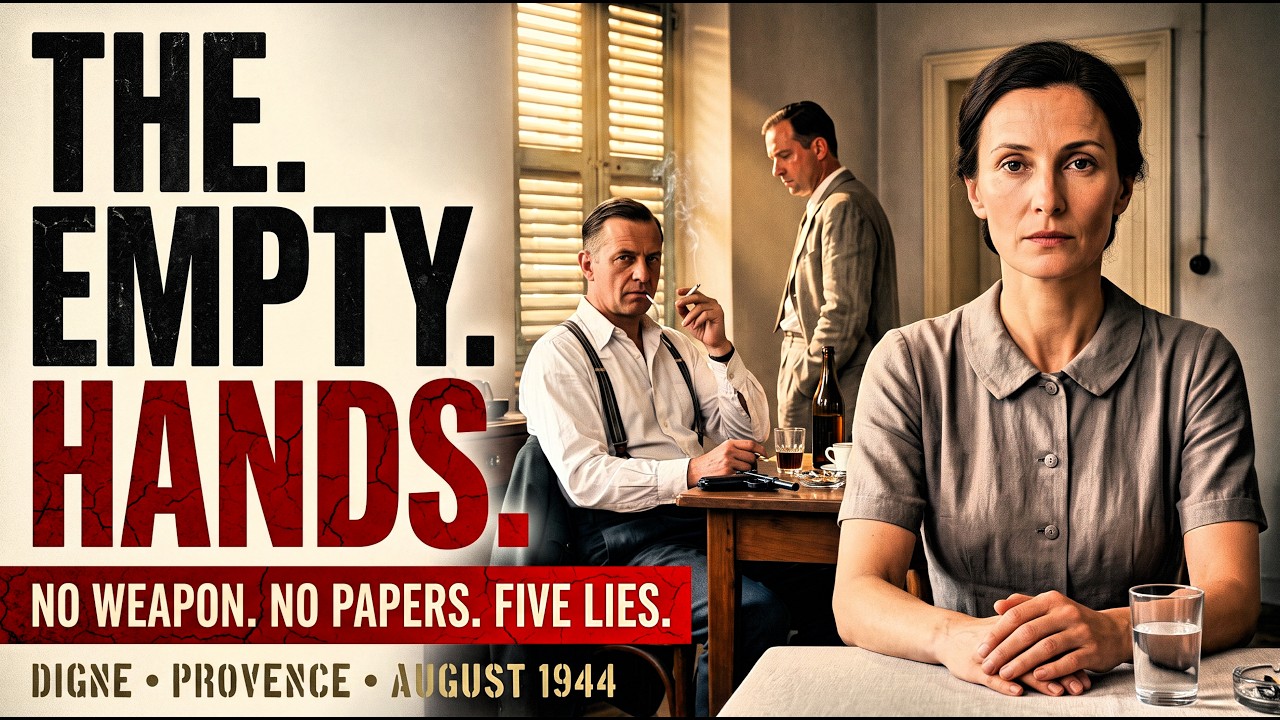
Three days earlier, on the thirteenth of August 1944, the head of her network had been stopped at a checkpoint with two other agents. He was a British officer the Gestapo had been hunting for two years. His papers were nearly perfect. Nearly.
The three men now sat in the nearby prison, condemned to death for espionage, the firing squad a mere formality with a date attached. She already knew where they were. She had found out by walking along the prison walls, humming an old American song over and over until a voice from the other side began to hum it back. Now she stood before the enemy, about to tell them a great, reckless story that could end only two ways: either they believed her, or she would join the men she had come for.
Her real name was Krystyna Skarbek. The British called her Christine Granville. This is the true story of the greatest bluff of the secret war. Before sitting down at that table with her, before the first card was played, you must know who she was, because a bluff only works as well as the player behind it.
And a great player is not made in a day. She was thirty-six that summer. Born in Warsaw in the spring of 1908, in a country that did not officially exist. Poland was still divided among three empires.
Her father, Count Jerzy Skarbek, was a Catholic aristocrat with a distinguished name and a modest fortune. Her mother, Stefania Goldfeder, was Jewish, the daughter of a Warsaw banking family. The marriage scandalized half the city and financed the other half. They named the girl Maria Krystyna Janina.
The Skarbek name carried odd resonances. One ancestor had been godfather to Frederic Chopin. Fryderyk Skarbek had been a prison-reform advocate in the nineteenth century and had designed the great walls of Warsaw’s Pawiak prison himself. That fact would return to her life later, in the cruellest way imaginable.
She grew up between the city and her father’s country estate. She learned to ride astride, like a boy, to her mother’s displeasure. She learned to shoot. She knew the forests, the winters, the mountains.
Every year the family went south to Zakopane in the Tatra mountains, where she learned to ski the way farm children in other countries learn to walk. By her teens she could outski most of the men in the region. This would matter. In the 1920s the fortune dissolved.
The gold that backed it shrank, then vanished, and with it the country estate. The family moved to a Warsaw apartment, and the Count died in 1930, leaving the Countess and the girl nearly alone. Krystyna took a job at a Fiat car agency to pay her share of the rent. She was twenty-two.
She hated the work and sickened from the fumes. Then two things happened, one small, one enormous. The small thing was that doctors at a clinic misread the X-rays of her chest. They saw shadows on her lungs and diagnosed tuberculosis.
She did not have tuberculosis. Her father had died of it, and the doctors, thinking of him, saw the disease where it was not. They told her gently that she might not live long. The agency’s insurance company paid her a settlement and advised her to live in the open air.
So she went to the mountains. The enormous thing, which the doctors never knew they were doing, was that they gave her, for free, a medical term she would one day use against a Gestapo officer to save her life. Keep that detail close. She would use it before the night was out.
In the mountains she skied and climbed, and made friends with the smugglers who worked the passes between southern Poland and Slovakia. Those men knew every fold of the Tatras. They knew which shepherds could be trusted, which mountain huts had stoves and which had only walls, which trails the border patrols took in fresh snow and which they avoided. She listened.
She remembered. She married once, briefly, without complications. Then in 1938 she married a diplomat and adventurer named Jerzy Giżycki, who had lived in the American West and panned for gold, and who knew how to be quiet and useful. He was appointed Polish consul general in Ethiopia, and she went with him.
She was in Addis Ababa when Hitler crossed the border into her country. That was the first of September 1939. She and her husband took a boat, then a train, then another boat, and reached London through France. She entered London a stateless refugee, thirty-one years old, without work or plan.
Within six weeks she was in a room with a British intelligence officer, offering to walk back into occupied Europe. Her plan was simple, which made it sound a little mad. She would go to Budapest, still neutral. From there she would cross the Tatra mountains on foot and skis in winter, guided by a Polish Olympic skier, carrying British propaganda and money into occupied Poland.
She would bring intelligence back. She would use the same passes she had walked as a girl. She knew the huts, the shepherds, the smugglers. The officer across the table was named Frederick Voight.
He had been a Manchester Guardian correspondent, then an intelligence liaison, and he had known her slightly before the war. He listened to her plan, wrote it down, passed it up. Others read it. Nobody quite believed it.
Nobody quite refused it either. By the twenty-first of December 1939 she was in Budapest. At that moment she was, technically, the first British woman agent sent into the field in the Second World War. SOE did not exist yet—it would not be created for another seven months.
She would one day become its longest-serving woman. In Budapest she met a one-legged Polish cavalry officer named Andrzej Kowerski. He would become her partner, her lover, her friend, the man she would reach for all her life. He had lost his leg in a hunting accident before the war, but it had not slowed him.
He was already smuggling people and documents across the Hungarian border. They worked together in secret. Her marriage to Giżycki effectively ended from that moment, though she would not divorce him for years. She found her Olympic skier.
She persuaded him. They went to the mountains. The first crossing came in the winter of 1939, early 1940. The snow was deep.
She wore a fur coat entirely wrong for the journey. She was freezing. It worked. She reached Warsaw.
She went to her mother’s apartment and begged her to come out with her. Her mother refused. She was teaching French to local children and would not leave them, and would not leave Poland, and that was that. Krystyna came back.
She went in again. She crossed again. Between December of that year and April of 1940 she made roughly four crossings. She carried microfilm sewn into the lining of her gloves.
She carried wireless codes on tissue paper. She carried money. She came back with information and letters, and sometimes with fugitives on the border. Once, a Slovak patrol detained her and Kowerski, and she talked them out of it with sheer force of personality and a story about lost lovers.
Her mother never came out. In January 1942 Stefania Goldfeder Skarbek was arrested in Warsaw for being Jewish. She was taken to Pawiak prison, the prison her husband’s older relative had helped design, and she was killed there. Krystyna did not learn the details until later, and she carried the weight of that failed crossing for the rest of her life, the crossing where she had gone in and her mother had refused to come out.
It was one of the reasons she would later fight so hard for other people’s families. In January 1941, before her mother’s arrest, the Gestapo arrested Krystyna and Kowerski in Budapest. They were held for interrogation. Krystyna was questioned for hours, and here the old shadows on the X-ray of her chest came back to save her.
She bit hard on the inside of her cheek until she tasted her own blood. Then, in front of the investigator, she began to cough. She coughed so hard she vomited dark red blood into a handkerchief, then gasped and coughed again. In a faint voice she told them she had tuberculosis, that she had been ill for years.
Some of them had seen the shadows on a real X-ray she had shown them earlier. She had the vocabulary. She had the papers, somewhere. She had the accent.
She had the blood. They were terrified of tuberculosis in that small room. They let her go. Kowerski came out with her on another pretext.
Quietly, methodically, they escaped Hungary together, hidden in the boot of the British ambassador’s Chrysler. They came out through Yugoslavia and Turkey, and finally reached Cairo in May 1941. Then her war stopped for nearly three years. This is the part of her story that is rarely told because it is not glorious.
She was too Polish for the British. She was too female for a war that in 1941 still wanted its women behind typewriters. She was too outspoken, too foreign, too obviously more competent than the men who were supposed to command her. Whispers went around Cairo that she might be a double agent, that she was too well travelled, that her papers were too clean, that she must be working for someone else, because otherwise the story of crossing four times on skis seemed like exaggeration.
She was formally stood down from active operations in June 1941, kept on the books on a token salary. She was forced to wait in Cairo, Palestine, Egypt, on the edge of a war that would not use her. She waited three years. Then in the spring of 1944, a woman she had never met was arrested in France.
Her name was Cecily Lefort, an SOE agent working with the Jockey network in the mountains and towns east of the Rhône. She was captured, brutally interrogated, and sent to a camp from which she never returned. Suddenly the network was missing its courier. The head of the network, a tall, very quiet British officer of Belgian descent who hated what fascism had done to human decency, was still in the field, but he was working cut off from his best people, and he desperately needed a new woman on the ground.
SOE looked down its list. Its eyes finally landed on the file marked “Skarbek. ” They flew her from Cairo to Algiers. They put her through an intensive training course.
They gave her a secret French identity, Pauline Armand, and a network alias, Jacqueline. In the early hours of the seventh of July 1944, a British aircraft flew low over a field at Veynes, in the mountains southwest of Grenoble, and Krystyna Skarbek jumped. She landed hard, and stood in a French meadow at four in the morning. This was the start of her real war, the one she had been waiting for since the summer of 1941.
She had thirty-nine days ahead of her. Nobody watching her land knew that. Thirty-nine days between that drop and the moment she would walk into a Gestapo office empty-handed and sit down across from a man with the power to have her shot. She used those thirty-nine days to the full.
The Jockey network was Camats’s creation, one of SOE’s greatest achievements in France. Francis Cammaerts, codename Roger, was a thirty-two-year-old Englishman, the son of a Belgian poet and an English actress. He had started the war as a pacifist and a schoolteacher. His younger brother was killed flying for the RAF.
After that, something in him changed quietly and permanently, and he joined SOE and asked for their hardest job. They gave him south-east France. For two years he had built one of the largest resistance networks in the country, stretching from the Mediterranean coast to the Alps and the Italian border. He worked by never sleeping in the same place twice.
He worked by trusting almost no one. He worked by a principled refusal to keep written records that could endanger anyone under torture. His operational security was legendary. His name had been on the Gestapo’s list for two full years, and they still did not have a good photograph of him.
He was very tall, conspicuously tall among the French farmers. He had learned to walk with his shoulders slumped and his head slightly tilted, because when he stood at his full height he looked like a signpost. He met his new courier at a farm in Veynes. He was impressed by her, as almost everyone was.
Her face was bright, her voice low when she was thinking, and she spoke French, English, Polish, and enough Italian to argue with a border guard. She began work. Through July and August she rode a motorcycle through mountains her handlers had never seen. She met fighters on both sides of the Italian border and linked them together: French maquisards on one side, Italian partisans on the other, so they could attack German columns from both flanks in the same passes.
She carried wireless messages between cells that did not know each other’s locations. She climbed hills. She slept in barns. She lost weight.
She really did lose weight. Among the things historians still find astonishing, she walked alone up to a fort at Larche, a strategic pass on the Italian border held by a garrison that included, among others, sixty-three Polish conscripts. These were men of her own country, forced by German racial classification to wear German uniforms and stand guard over a French mountain pass they did not care about, for a cause they hated. She stood outside their perimeter and talked to them in Polish through the barbed wire at night.
She told them who she was. She told them what was coming. She told them exactly what to do when the signal came. How they would sabotage the fort from inside and slip away to the maquis without their officers shooting them.
Six days later, when a small combined SOE and maquis force approached that garrison, the fort fell almost without a fight. The German commander surrendered, and Krystyna Skarbek, without firing a shot, talked her way through a mountain pass with her voice. That is the woman we need to see clearly before we return to the checkpoint. That is the central figure.
She spent thirty-nine days building trust, sleeping rough, weaving networks with her own hands, taking a fort by talking through a fence at night. She is not a frightened girl. She is not a novelist’s spy. She is a mature professional who has entered occupied Europe six or seven times by now, on skis and by parachute.
She is at the peak of her powers. That is why, on the eleventh of August 1944, when Cammaerts made the single operational mistake of his war, she was the one who would have to fix it. Here is what happened. Cammaerts had received a large sum of French banknotes for operations.
He needed it to pay couriers, safe-house keepers, printers, doctors, garage workers. He was preparing for the Allied landing he now knew was imminent, and he was doing what every successful network leader does before an invasion. He was making sure his men had money. He divided the money between himself and the two men travelling with him.
That single decision saved his signature but exposed his identity. The first man was Xan Fielding. Fielding was an SOE agent with legendary experience in Crete, where he had spent years disguised as a Cretan shepherd. He was clever, sharp, tough, and English to the bone.
He spoke French with a southern French peasant accent. His papers said he was a black-market trader from the coast. The second man was Christian Sorensen, a French officer who had come to work with Cammaerts. His papers were prepared with equal care.
The three got into a car. They drove toward Digne, on the edge of town, on a narrow road lined with olive trees. They reached a German checkpoint. It was not supposed to be there.
Extra patrols had thickened across the region as the Germans prepared for an invasion they knew was coming from somewhere, though they could not yet say where. This was one of them. They were pulled out of the car. Their papers were examined.
Fielding, in his cover role, denied knowing the other two. Sorensen kept his mouth carefully shut. Cammaerts leaned against the car and looked at his immense height with the bored air of a man with nothing to hide. There was a young German civilian helping the soldiers process the paperwork.
He was not a soldier. He was a bureaucrat. He was thorough. He did not just check the identity documents.
He checked the personal effects. He counted the money in each man’s wallet. He noticed something. He held the three thick wads up in the summer light, looked at the serial numbers, and saw, with the eye of a man who works with paper all day, that the notes in all three wallets were from the same batch.
Consecutive numbers, consecutive prefixes, the same brand-new notes, freshly issued, split three ways. Three strangers on a country road, their wallets full of consecutive notes. There was a long silence. The young civilian looked at the sergeant.
The sergeant looked at the three men. Then they were taken. They were taken to Digne, where they were put in the local prison, a small ugly stone building on a street called Boulevard Gassendi, near the town centre. They were interrogated separately and roughly.
To explain the money they told the story they had been trained to tell in such a situation: they were black-market traders, the notes had come from one crooked banker, they barely knew each other. In short, small-time criminals. The Gestapo did not know who they had, not yet. They did not know the tall Englishman slouching in the prison cellar was Roger, the network chief they had hunted for two years.
They did not know Fielding was one of SOE’s most successful agents. They did not know Sorensen was a serving French officer. They did not know. But they suspected.
Three strangers with consecutive notes on a road linking a known resistance zone to the Riviera coast, an area Allied intelligence was clearly interested in: that was not a coincidence any Gestapo investigator would ignore in August 1944. They knew something was moving. They knew Allied ships were waiting somewhere. They knew the invasion was coming, and soon, and perhaps exactly here.
The commanding officer made his decision quickly. Three suspected agents in the middle of a genuine security crisis, with no time to break them through lengthy interrogation. Shoot them. Do it publicly.
Send a message to the region that the Gestapo still controlled Digne. The three men were told in their small cellar rooms that they had been sentenced. They were told they would be executed on the twenty-third of August. Then they were left to think about it.
Krystyna learned of the arrest very quickly. The news reached her through contacts in the region. She had gone up to the Larche area dealing with the aftermath of the fort operation. She dropped everything.
On her way down from the mountain she stopped only once. An Allied military mission of ten men had just parachuted into the region as part of the preparations for the coming landings, and they had no local liaison officer. She met them at a farm. She told them, without waiting for any objection, that in Cammaerts’s absence she was the operational head of the sector.
She organised transport for them. She briefed them. Then she took to the road alone and headed for Digne. She tried the obvious thing first.
She went to the French resistance leaders in the surrounding hills and asked them to storm the prison. The prison was small. The garrison was thin. They could do it quickly, before reinforcements arrived.
Get the men out. The maquis leaders looked at each other and refused. There were good reasons. Their orders before the coming landings were to preserve their forces for the general uprising, not to burn them in a single operation in a town.
There would be reprisals against civilians. The prison sat in the middle of a town full of transient German soldiers. It was a losing tactical bet. They liked her.
They respected her. But they refused. She did not argue. There was no time to argue.
She turned and walked out, thinking like a card player. If the maquis would not take the prison from outside, she thought, then it had to be taken from inside. That meant someone inside had to open the doors. That meant someone inside had to decide, within the next few days, that opening the doors was better for him than keeping them shut.
She got on a bicycle. She hated bicycles. She had told her friends more than once that she hated the bicycle more than any other form of transport. Something about the wobble, the vulnerability, the fact that a woman on a bicycle in occupied France was a perfect shape for anyone with a rifle to notice.
She hated it. She got on one anyway. She cycled forty kilometres to Digne. Imagine it.
It is August. The southern Provençal sun is heavy. The road is dusty, the hills thick with heat, the cicadas screaming, the asphalt between towns softening slightly under the tyres. She is traversing countryside still officially under German control.
There are patrols. There are collaborators in every village. She carries nothing that could help her, because she has no money to carry anything. She rides for hours.
She reaches Digne dusty and sweating, inconspicuous. She looks like a housewife who went to market and lost track of time. She finds the prison. It is on a public street.
Its walls are hot stone, six metres high, with narrow windows near the top where light comes in, and if you are outside you can sometimes hear sounds coming out of it. She circles its perimeter once, lazily, noting every element of the garrison. Then she circles again. Then she does something that was in no training manual, something that would have occurred to no one but her.
She begins to hum quietly as she walks. She chooses the song carefully. It is not a Polish song. It is not a French song.
It is an American blues. An old, sad, jaunty song about a murder on the streets of St. Louis. It is called “Frankie and Johnny.
” It is about a woman named Frankie who shoots her man Johnny for cheating on her. It has a slow, unmistakable walking rhythm. And its tune, if you know it, cannot be mistaken for any other. She had sung it with Cammaerts in a safe house one evening earlier that summer.
They had traded verses. It was a silly, private thing between them. Both knew every word. She walked slowly along the wall.
She hummed. Then she began to sing, softly. The real words. “Frankie and Johnny were lovers.
Oh lordy, how they could love. They swore to be true to each other. True as the stars above. ”
She walked along the wall.
Nothing. She circled again. Nothing. She circled a third time.
Then she heard a voice from somewhere up above behind the stone, from a narrow window she could not see. A man’s voice, faint and cracked, unsure of its pitch, but the tune and the words were right. “Frankie went down to the corner saloon, called for a bottle of beer. ”
Cammaerts.
Alive. In that prison. And he had just told her so, risking his life, because he trusted her enough to know that if there was a Polish woman humming “Frankie and Johnny” outside his prison wall, help had arrived. She did not stop.
She kept walking. She kept humming. She noted which window. She noted which corner of the building.
She noted the guard at the door. She circled the building once more, killing time. Then she left. She held one card in her hand.
She knew he was alive. She needed more cards, fast. She spent the next day collecting them. She walked the town.
She quietly learned that the Gestapo unit in Digne ran on a certain rhythm. Its administration moved through a liaison officer working between the French prefecture and the Germans. His name was Albert Schenk. He was Alsatian, which meant he had been born in the disputed border region between France and Germany, and could privately claim to belong to either or both, depending on which uniform was in the street.
He was a middleman by nature. He was not the officer with power. He was the gate. Behind the gate, she learned, was a man named Max Waem.
Waem was a Belgian from Flanders. He was a Gestapo officer, uniformed, armed, real. He was the one with the power to sign a release. He was the one who would unlock the cell door.
Two players, then, on the other side of her table. A nervous middleman and a hard man with a pen. She thought about it all night. She thought about it the way any card player who has ever bluffed for serious money thinks.
What story could she tell that these two men, at this particular moment of the war, could not afford to disbelieve? What story would each of them, for his own reasons, want to be true? She saw it. She saw the whole hand.
In the early morning of the fifteenth of August 1944, Allied forces began landing on the beaches of the French Riviera. Operation Dragoon. American infantry, French troops, tanks, gliders landing inland. The invasion of southern France had begun.
The coast would be liberated within days, the Germans inland cut off, the towns changing hands, and every man in a Gestapo uniform between Marseille and the Alps would know it before noon. She did not know exactly when the news would reach Digne. But she knew it would reach Digne that day. And she knew that the moment it arrived, the mood of every German officer in the town would shift, by a small, permanent, irreversible degree.
She waited for the news. Then she went to Albert Schenk. Watch her hands. She walks toward the building where the liaison officer’s office sits.
She is plainly dressed. She carries no weapon. Nothing at all. No wireless, no codebook, no briefcase.
She has five cards in her mind. She will play them in order, and she will play them slowly, and she will make Schenk, and then Waem, sit with her at that table for as long as it takes. Schenk sees her. She asks to speak to him privately.
He agrees. That is his first mistake, though he does not yet know he is making it. He agrees because she is a young, well-dressed woman with a quiet voice asking for a private conversation, and because he has been at his desk all morning, and the day is hot, and she does not look dangerous, and because he is Alsatian, which means he is used to exchanging simple pleasantries across a language barrier. She sits.
She takes a breath. She plays the first card. She tells him her name is Pauline. She tells him that her husband is one of the three men in the nearby prison.
She tells him she loves him. She tells him she is here to ask quietly, as the wife of a reasonable man, for the situation to be handled reasonably. The wife card. Schenk relaxes slightly.
He is not facing a soldier. He is facing a woman with a personal grievance, something he has heard before and knows how to handle. He tells her he cannot discuss the case. He tells her the men are spies, unfortunately.
He tells her it is out of his hands. She listens. She lets him finish. Then she turns the second card.
She tells him her situation is actually more complicated than that of an ordinary wife. She apologises. She says she must be honest, given the gravity of the situation. She tells him, quietly, that she is a British agent.
She tells him that she is the niece of General Bernard Montgomery. Schenk blinks. She tells him this is not bravado and not a threat, merely a fact he should have clearly in mind when he decides what to do next. She tells him she was sent to the region personally to work with her husband’s network, that London knows where she is at all times, that she is here in Digne today, now, sitting in front of him of her own free will, because the moment is urgent and the usual channels are far too slow.
None of this is true. She is not related to Field Marshal Bernard Montgomery. She is not Cammaerts’s wife. But everything about her manner—quiet, apologetic, as though the truth is causing her some embarrassment—matches the way an aristocratic English lady of that class breaks bad news across a table.
She has spent five years among SOE officers and British diplomats. She has the accent. She has the vocabulary. There was that English quality in her manner, the quality of a person delivering a serious truth politely so that no one feels embarrassed.
Schenk sits back. Something has changed. It is not that he believes her completely. It is that he cannot, at this moment, afford to disbelieve her.
She turns the third card. She tells him about the landings. Quietly she tells him the Allies have come ashore on the Riviera beaches that morning. She tells him he can, if he doubts her, call anyone he likes and confirm it.
She tells him that within days, perhaps hours, American columns will be moving north through the Rhône valley, French forces will be moving east along the coastal plain, and that it is very possible that units of both armies will be walking into Digne on foot. She tells him that general staffs on both sides are working on the assumption that the town will change hands within a week. She tells him this the way you tell someone about the weather. The invasion card.
Schenk does not doubt this one. He has already heard the first rumblings. Couriers have been coming to his office all morning with fragments, and the town outside his window is alive with the news. The invasion is real.
That card, at least, is real. She leaves it on the table for a moment. She lets him look at it. Then she turns the fourth card.
She tells him, gently, what happens in French towns when the Germans leave. She does not need to say much here, because he knows. Everyone knows. In the weeks since the Normandy landings in June, the liberated towns of northern France had seen a wave of settling of accounts.
Collaborators were dragged from their houses. Women who had slept with Germans had their heads shaved in the town square. Mayors who had signed the wrong orders were shot in ditches. Middlemen from the prefecture were beaten in their own offices.
Some of it was rough justice by the resistance committees. Some of it was simple mob violence. It was happening, town after town, as the front advanced. She tells him this is what will happen in Digne, too, within days.
She does not say it nastily. She says it as a foregone conclusion. Then she tells him what she is prepared to do about it. She tells him she can, at this moment, if he acts reasonably, guarantee his personal safety.
She tells him she has the influence with the incoming Allied forces and the local French resistance leadership to name German officials who behaved decently at the end and should be spared. She tells him she is prepared to name him. She tells him she is prepared, if necessary, to stand between him and a firing squad in the street outside this building. The mob card.
Schenk now understands that he is bound to the chair. She has not raised her voice. She has not threatened him. She has told him, in the gentlest possible tone, that his life will be in her hands within a week.
She does not press. She waits. Finally he tells her he does not have the authority to release the three men. He is telling the truth.
Only Max Waem can do that. She says, of course. She says she quite understands. She says she would be most grateful if he could introduce her to Waem at a time convenient to him, in a private place.
She says she is not asking to be brought to the prison. She is not asking for anything official. She is asking for one negotiator to have a conversation with another negotiator. Schenk sits for a long moment.
Then he agrees. He arranges the meeting for four o’clock that afternoon in his apartment. A neutral place. Not the prison.
Not the Gestapo office. His upstairs flat, with the curtains half drawn and, on paper, no witnesses. She thanks him. She rises.
She leaves. She has revealed nothing. She has obtained a meeting with the real decision-maker, and she has gained an ally, or at least a very frightened man, on the way to him. She has three hours.
She uses them. She goes to a safe transmitter. She sends a message to London, to SOE headquarters in Baker Street. She tells them what she is about to try.
She tells them the price. She asks them to deliver it in cash to a place she will specify within twenty-four hours. She names two million francs. Two million francs in 1944 was a colossal sum.
Not a bribe you hand over at lunch. A life-changing number. She is thought to have chosen it with great care, the same care she used for the song. Too small, and it would not outweigh the Gestapo’s institutional interest in shooting suspected agents.
Too large, and it would be absurd, and she would lose her credibility along with the money. Two million was exactly enough to matter. The message reached London. It was received.
Somewhere in a room in Baker Street, an officer read it, looked at it, and did not laugh, because he had been reading her file for five years and knew she did not exaggerate. He signed off on it. Orders were given. A parachute drop was arranged.
She returned to the apartment. Four o’clock. She climbed the stairs. She knocked.
Schenk opened the door. He looked worse than he had in the morning, and he was sweating. He introduced her to the second man. Max Waem was not a caricature.
He was not a screaming officer. He was a middle-aged Belgian in civilian clothes, with a pistol on the side table and a cigarette, and cold, dead eyes. He spoke quietly. He was educated.
He offered her a seat. He did not offer her a drink. He watched her the way a wolf watches a smaller animal enter a room the wolf is sitting in. She sat.
She played her hand again, whole. She was Cammaerts’s wife, a British agent, and the niece of Bernard Montgomery. The Allies had landed at dawn. American columns were already moving.
The Germans would be out of Digne within days. When they were gone, the town would settle accounts, and the accounting would not be gentle. She was in a position to guarantee the safety of German officers who acted reasonably in their final hours. She had come in person to make that offer.
And as a sign of good faith, she was prepared to arrange the immediate delivery of a substantial cash sum to any officer who helped her secure the release of the three prisoners currently held in the nearby jail. She named the amount: two million francs, in cash, dropped by parachute within twenty-four hours. She left the table to Waem. Waem did not answer immediately.
Waem was not a fool. He knew, sitting across from her, that this woman was either telling the complete truth or was the greatest liar he had ever met, and he could not tell which. He asked questions. She answered.
Every answer was calm and short. She gave him no more than he asked. She did not overpromise. She did not fill his silence.
He watched her hands. They were steady. They argued and negotiated for three hours. He tested her.
He tried to trip her up on the geography of southern England, on network details, on the supposed relationship between her alleged uncle Montgomery and her supposed British handlers. She parried. She did not pretend to be English. She did not claim to know what she did not know.
When he asked a question a real agent would not answer, she did not answer it. When he asked a question a real niece of Montgomery would know, she said something reasonable and moved the conversation on. About halfway through those three hours, the mood in the room shifted. Waem slowly realised that even if she was lying about half of what she said, she was telling the truth about the invasion.
She was telling the truth about the reprisals to come. And most dangerously for him, she was telling the truth about her willingness to name him personally, one way or another, when the tanks came down the street. He had entered the room as the man with absolute power, three prisoners in a cell. He was now, mid-conversation, a man calculating in real time how long he had before French army irregulars dragged Belgian collaborators out into the square.
At the right moment she added one small, quiet detail. She remarked that Cammaerts personally would remember any officer who helped secure his release. She remarked that such an officer could in fact expect a British passport to come out of the rubble. She did not press it.
She left it on the table. The last hour of the conversation was no longer a threat. It was a negotiation. Waem asked about the money.
She confirmed it. She told him it would be dropped in a field he specified, at a time he specified, within twenty-four hours. She told him he could send a representative to witness the drop and collect the cash himself. She told him she was not asking for his trust, only for a testable arrangement.
He agreed to the arrangement. The three men would be released, temporarily, but not officially. Officially, they were being transferred. Waem would drive them out of Digne himself, in a Gestapo car, past checkpoints and guards, using his own pass to secure the road.
No one would have to produce any papers. And no one would notice, for a few crucial hours, that three men condemned to death had simply left the prison. She agreed to the arrangement. She stood.
She thanked him. She left. She now had about three hours to arrange the parachute drop of two million francs in cash from London into a field somewhere in the mountains of southern France before the transfer could be completed. She did it.
She contacted the wireless operator. She confirmed the field. She confirmed the time. In the early hours of the next morning a British aircraft flew low over a valley she knew, and cargo containers came out of its belly, and a maquis group on the ground below collected them by lantern light, and Waem’s representative was there with the notes.
He counted them. He nodded. He went back. Then, at midday on the seventeenth of August 1944, about three hours before the scheduled execution, the door of Digne prison opened.
Three men were brought up from the cellars. They were not told at first why they were being moved. They were ordered into a car. Cammaerts, with his immense height, folded himself into the back seat.
Fielding sat beside him. Sorensen sat opposite. The doors shut. Max Waem himself was behind the wheel.
Waem drove them out of Digne. He took them through the German checkpoints on the edge of town, using his own Gestapo pass to wave them through. The guards saluted. They moved into open country.
They kept driving. At a pre-arranged spot outside the town, on an empty road with fields on both sides, the car stopped. The three prisoners were told to get out. They got out.
Krystyna Skarbek was standing by the roadside. Cammaerts looked at her. He did not, at that moment, know what to say. He was out.
He was alive. He was standing in a French field at dusk in August, his long shadow stretching behind him. And the woman in front of him, with five cards in her hand, had played what seemed impossible. Her memoir does not do justice to that moment, because she never wrote one.
Others wrote about her later, in fragments. What she appears to have done, on that road, at that moment, was to give him a brief, simple smile, and then say quietly that they had an appointment somewhere, and start walking. That was the retreat. That was the moment the enemy pushed his chips across the table and stood up from the game.
There is a small secret to that night, and it deserves to be told: Waem, after driving them out, did not return to his old life. There was no old life to return to. Within days the Allies were in the town. Schenk, the Alsatian liaison officer who had opened his apartment door to her that morning, did not survive the street reprisals.
He was killed by his own side, or by the French, or by both, and the stories do not agree, and it hardly matters. He had gambled at the last moment, and it was too late. Waem, who had driven the prisoners out with his own hands, survived. He was arrested at the end of the war, tried, and his testimony—that he had released the three men—was taken into account.
Nothing exonerated him, but he survived. The men were safe. Cammaerts went back to work almost immediately. The landings had begun three days earlier.
The war was raging across southern France, and he had a vast network to bring out of the shadows and into the fight. He did it, and did it brilliantly. He lived to a great age. He returned to teaching.
He died in England in 2006. He never forgot the woman who had circled the prison wall singing “Frankie and Johnny” until he sang it back. Fielding wrote about her later. He wrote about her the way you write about a person you know you can never repay.
Sorensen did not speak much. He went back to the war. One sentence deserves mention before we reach the end, a sentence that has been hovering quietly over this story from the beginning. Francis Cammaerts, the man Krystyna Skarbek saved in August of that year, was a man who had once been saved by another woman’s silence.
Odette Sansom, arrested in a hotel in the Alps two years earlier, had known his name and his cover under the worst torture the Gestapo could devise, and she had not spoken. Cammaerts survived 1942 because of Odette Sansom’s silence. He survived August 1944 because of Krystyna Skarbek’s voice. Two women.
Two hands. One life. Krystyna lived her own afterwards, through the final months of the war. She rode horses.
She met with fighters. She kept her network active. She saw Digne liberated. She saw Paris liberated.
In the summer of 1945 she was summoned to London. The war was over. She was, by any measure, one of Britain’s most successful field agents of the war. She had crossed the Tatras on skis in 1940.
She had faked tuberculosis with her own blood in 1941. She had walked through a mountain pass by talking through wire in July 1944. She had bluffed the Gestapo out of three lives in August 1944. The British government did what governments do.
They gave her the George Medal, the highest civilian award for gallantry, and made her an Officer of the Order of the British Empire. The French government gave her the Croix de Guerre. She wore a chest full of medals that would have impressed even generals. Then, within weeks, they gave her a discharge paper and a small gratuity.
They told her her services were no longer required. She was thirty-seven. She had finally become a British citizen, naturalised in 1946, but she was not a British citizen of much use to a country busy trying to forget the war and put its men back into their jobs. Kowerski was out of work too.
The Polish government in exile was winding down. Their old world was gone, and the new world had no place for either of them. She tried Cairo, then Nairobi, then London. She worked as a telephone operator, a shop assistant, a waitress.
Finally she found steadier work as a stewardess on passenger ships, on the routes between Britain and South Africa, cleaning the cabins of passengers who would never have believed her if she had told them. On one of those ships, another steward began to notice her. His name was Dennis Muldowney. He was kind to her at first, and defended her against other crew members who thought her medals were fake.
She became briefly involved with him. She soon realised she had made a mistake. She tried to end it. He would not let it end.
On the night of the fifteenth of June 1952, in the front hall of the Shelbourne Hotel in Kensington, London, Dennis Muldowney stabbed Krystyna Skarbek once, in the heart, with a knife he had brought for her. She was forty-four. One sentence, and it is the only one this account will give him. The woman who walked into the Gestapo headquarters at Digne with nothing but a story, and walked out with three lives in her pocket, was killed for love in the hall of a hotel seven years after her war had ended.
Watch her hands one last time. Watch them in the drawing rooms of Warsaw, holding the reins of a horse she was not supposed to ride. Watch them in the Tatras in 1940, opening the lining of her gloves to check the microfilm was still dry. Watch them in Budapest in 1941, folding the bloodied handkerchief so the Gestapo investigator would see the stain.
Watch them in the meadow at Veynes in July 1944, unbuckling her parachute harness at four in the morning. Watch them on the handlebars of a bicycle she hated, riding forty kilometres in the August heat with empty pockets. Watch them beside a stone prison wall, steady on both sides of her. Watch them folded carefully in her lap in an Alsatian man’s apartment, while a Belgian Gestapo officer with a pistol on the side table tried to decide whether she was the greatest liar he had ever met, or exactly what she claimed to be.
Watch them push five cards across the table, one after another: the wife, the niece, the invasion, the mob, the money. Watch them take the pot. She rests today in a small London cemetery under both her names: Skarbek in the Polish spelling, Granville in the English. Andrzej Kowerski, the one-legged Polish cavalry officer who had loved her on and off since Budapest in 1939, buried nothing beside her when he died decades later, except a small handful of Warsaw soil he had carried in an envelope for exactly that purpose.
Muldowney was hanged at Pentonville Prison on the thirtieth of September 1952. He stated that the murder was the ultimate act of possession. Of course, he never possessed her. No one ever possessed her in the way he wanted.
That was another game he lost. If you had walked past Digne prison in the afternoon of the fifteenth of August 1944, you might have seen a woman in a plain dress walking along the base of the stone wall. She would not have looked remarkable. Perhaps a market seller, a woman who had lost track of time.
You might have heard her humming, if you were close enough. The tune would have meant nothing to you. An old American song from a St. Louis barroom, about a woman who shot her man for cheating.
You would not have known that humming saved lives. Three lives, in fact. You would not have known that in a room one hundred yards away, an Alsatian liaison officer was about to open the door, and a Belgian Gestapo officer was about to sit down across from the greatest bluff of the secret war. And the woman walking into that meeting carried nothing in her hands, nothing in her pockets, nothing on her body that could help her except everything she was.
Her real name was Krystyna Skarbek. The British called her Christine Granville. Watch her hands. They are steady.
They will always be steady. That is who she was. This is the woman who walked into the Gestapo headquarters at Digne, in the south of France, and asked to see the officer in charge. This is the woman who walked out with three lives in her pocket.
An hour of daylight left in the day, and five cards folded quietly into a pack, as if none of it had ever happened.
