On April 11, 1945, the crew of the USS Missouri looked down at the mangled body of the Japanese pilot who had just crashed his Zero into their battleship. As they stood in the smoke and wreckage, still in the heat of battle, the sailors made a grim assumption. The body should be thrown overboard. They asked their captain for confirmation, expecting a simple yes.
The answer they received was not what they expected. Captain William C. Callahan, the commanding officer of the USS Missouri, looked at the fallen aviator and saw something else entirely. Regardless of the side this man had fought for, he was still a fellow soldier and deserved to be treated as such.
Instead of ordering the body cast into the sea, Callahan gave a different command: take the pilot below and prepare his body for burial. It was a moment of humanity in a war defined by its brutality, and it would be remembered for decades to come. By 1944, the South Pacific had become one of the most critical battlefields in the world. The Imperial Japanese Navy was fighting desperately to hold back the American forces closing in from all directions.
Through the spring and summer of that year, massive engagements unfolded across the region, involving hundreds of ships and claiming thousands of casualties on every side. The fighting was relentless, and everything was at stake for the nations involved. When the decisive battles of that spring and summer ended, the Allies emerged victorious. The Japanese were running out of time, out of men, and out of resources.
As the tide of war shifted unmistakably in favor of the Americans, Japan made a fateful decision. They would bring out one last secret weapon: the kamikaze. On October 24, 1944, during the Battle of Leyte Gulf, this desperate new tactic was implemented for the first time. Built on the Japanese cultural values of loyalty to country, honor for family, and devotion to the emperor, these suicide attacks were unlike anything the Americans had ever faced.
The results would be devastating. Japanese commanders created units composed entirely of kamikaze pilots, trained exclusively for one purpose: to crash their aircraft directly into enemy ships. More often than not, these were young and inexperienced aviators, usually less than twenty-two years old. One of these fearless young men was Setsuzo Ishino, a nineteen-year-old from Okayama Prefecture.
He was assigned to the Kamikaze Special Attack Corps, Fifth Kinmu Squadron. Although he knew his fate was death, he accepted his role with honor and spent the coming months training to fly his plane straight into an enemy vessel. His final flight would take place during the Battle of Okinawa in April 1945. This bloody clash was the last major battle of World War II.
The Americans wanted the island as a forward base for their eventual invasion of Japan. The Japanese understood what was at stake and recognized that Okinawa was one of the first pieces of true Japanese soil the Americans were trying to take. They were prepared to give everything to hold it. While the primary fighting for Okinawa raged on the island itself, a serious conflict simultaneously erupted in the waters nearby.
The United States Navy had stationed a great number of ships in the area, supporting the ground forces with shelling, air support, food, and medical supplies. Among the most famous of these vessels was the battleship USS Missouri, one of the premier warships in the world at the time. Nicknamed Mighty Mo, she would see heavy attacks in the coming months. The attacks at Okinawa did not come by shells or bombs.
They came by kamikazes. In these months, the Japanese assembled the greatest force of suicide bombers ever gathered and unleashed them upon American sailors patrolling the waters in a final effort to push the Americans away from mainland Japan. Over the three months the Battle of Okinawa raged, the Japanese sent more than one thousand kamikaze aircraft against American targets. The results were catastrophic: thirteen American destroyers and fifteen amphibious ships were sunk, multiple aircraft carriers were seriously damaged, and thousands of sailors lost their lives.
But within this mass onslaught of suicide bombers raining down on the US Navy, one story stands apart. On April 11, 1945, sixteen special kamikaze attack pilots took off from the Japanese air base at Kanoya. Among them was Setsuzo Ishino. In the days before the attack, he had written a final letter to his family.
At just nineteen years old, he addressed his mother:
Dear mother, at last the day has come when the final flower will bloom. I will go smiling. Please do not say anything since all is for the country. The day when we meet next will be under the splendid flowers at Yasukuni Shrine.
Please say that I did well and smile without crying. I am praying for everyone’s good health forever and ever. Take care. He finished the letter with a poem:
Today’s mission is something I have long awaited.
All that’s left for me now is to crash straight on into some enemy aircraft carrier. April 6th, 1945. Setsuzo. Five days after writing that farewell, Ishino and the rest of his unit took off.
They flew A6M Zeros loaded with high explosives, setting a heading for the US fleet off Okinawa. Every pilot knew exactly what targets they were looking for. Reconnaissance planes had provided in-depth photographs of the ships present. But before they could strike, they had to survive the most effective kamikaze defense yet deployed: the F4U Corsair.
Recently sent to the front lines and flown by both the Navy and the Marines, the Corsair had proven to be the best defense against the suicide bombers. Ships could only open fire on Japanese planes once they were within range, but fighters could cut the bombers off before they reached their targets. Since the kamikaze aircraft never carried defensive gunners and rarely used escorts, they were often sitting ducks, easily picked off. There was no better proof of this than Jeremiah O’Keeffe, a famous Corsair pilot who shot down five kamikazes in a single mission in this very same month at Okinawa.
But on April 11, 1945, the battle was still early, and the defensive tactics were still being perfected. The Corsairs were not able to intercept the sixteen kamikazes from Kanoya in time. It would instead fall to the anti-aircraft crews of the US Navy. The American sailors opened fire the moment the Japanese aircraft came into range.
The kamikaze pilots, trained for this exact scenario, split up into pairs and headed for their designated targets. For this mission, Flight Petty Officer Setsuzo Ishino was paired with another Flight Petty Officer, Kinichi Ishii. The two special attack fighters quickly located their target: the mighty battleship USS Missouri. The combat reports from the Missouri record the battle in chronological detail.
At 1355, the air defense alert was sounded. At 1425, air defenses opened up, and multiple hits were confirmed. Then came the report at 1440: thirteen bogies reported splashed by fleet. Three or more bandits still closing on formation very quickly.
Of the flight of sixteen kamikazes, only three survived the pounding of American anti-aircraft fire. One of those three was Setsuzo Ishino. Another was his wingman. But as they continued at a few thousand yards out, the Zero flown by Kinichi Ishii was shot down and crashed into the water.
Ishino barreled onward, straight at the American battleship. According to the combat report, at 1442 the USS Missouri commenced firing on a low-flying Zero coming directly in on the starboard quarter, bearing 150 degrees at a distance of 7,000 yards and an altitude of 100 feet. Every gun on the Missouri was firing, giving everything they had to take out this final Zero that had miraculously made it through their barrage of flak and machine gun fire. At 4,000 yards, Ishino’s plane took a hit and began smoking.
He appeared to lose altitude and nearly splashed into the water, but he regained control and resumed his course. The gunners on the Missouri stood their ground and continued to pour fire into the Zero as it clearly struggled to maintain flight. A few seconds later, still amazingly in the air, the Zero bore straight upon the ship and struck the USS Missouri. The report noted that at 1443, the left wing of a Zero struck the Missouri bare inches below the main deck.
The ship was sprayed with parts of the plane. The aircraft’s starboard wing was thrown forward to the first superstructure level, frame 102, inboard of 5-inch mount number three. Gasoline and fire resulted at that point, and the mutilated body of the pilot landed on the main deck. A photograph, actually taken by a cook onboard the Missouri, captured the moment right before impact.
The plane was just feet away from the ship, and the defensive gunner crews were still actively firing away. Upon impact, the plane broke apart and was catapulted onto the deck, pieces of debris flying in every direction. The damage control crews rushed to extinguish the fires. Within a few minutes, the flames were under control and put out.
Fortunately for the Americans, none of their crew had been hurt or injured in the attack, and the damage to the Missouri was not serious. Then came the grim discovery. As the crew looked over the wreckage scattered about the deck, they found the mangled body of the pilot, Setsuzo Ishino. Still in the heat of battle, the hands on deck assumed the body should be thrown overboard.
They asked their captain for confirmation. Captain Callahan instead ordered the ship’s medical personnel to take the pilot below and prepare his body for burial. The crew followed the order immediately. The body was sent to sick bay, and preparations were made.
Later that night, the following day’s plan of the day went out from the captain. It included a note:
The funeral service to be conducted at 0900 for the Japanese pilot is not a religious service, but is strictly a military service of a burial by military courtesy. Below that sat the schedule of the event, complete with a bugler, a three-volley fire, and a hand salute. The plan also included an encasing of the colors.
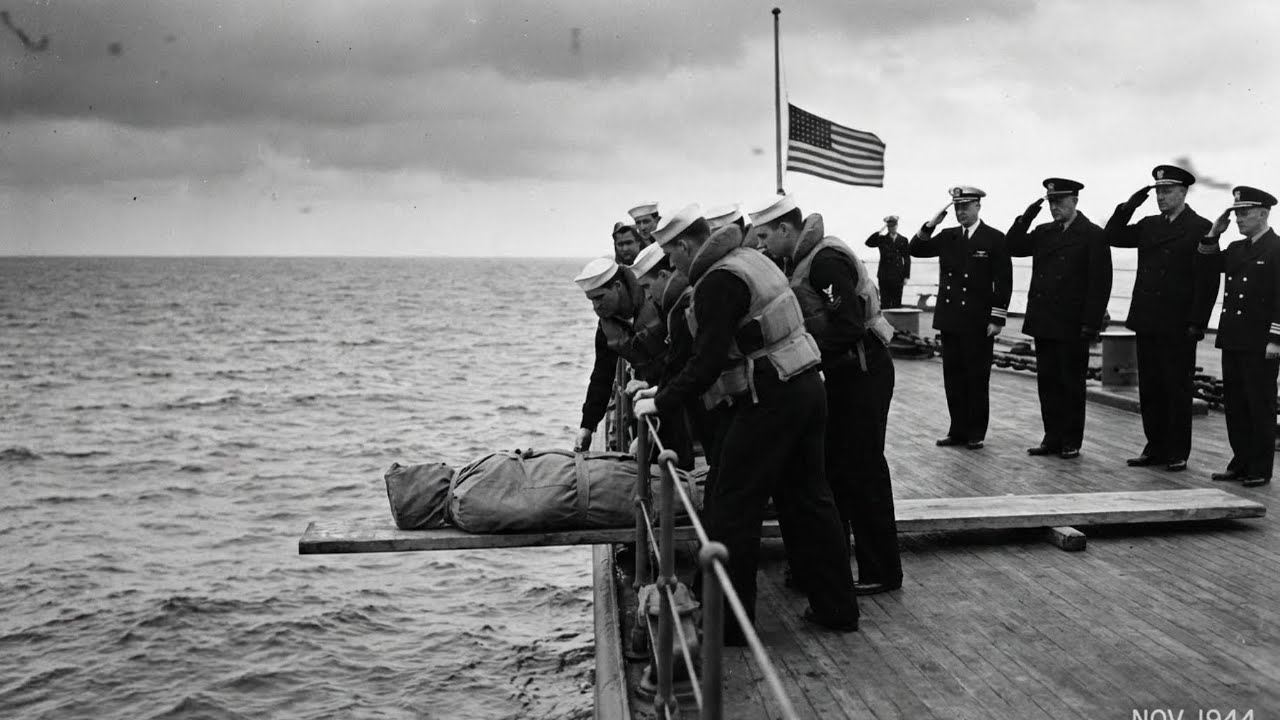
But the crew knew it would be inappropriate to drape the pilot in the Stars and Stripes. So the night before, they took the time to sew together a Japanese flag, so that the deceased pilot, who had just wished death upon them, would have an adequate burial. The following morning, the plan proceeded as scheduled. The body was brought up, and taps were played over the bugle.
Senior Chaplain Roland Faulk stepped forward and simply said, We commit his body to the deep. The burial detail tipped the body and canvas into the sea, where it disappeared into the depths below. The Missouri continued on her course, and the burial detail gathered and folded the Japanese flag. Five months later, after the atomic bombs were dropped, the official surrender of Imperial Japan would take place on the deck of the USS Missouri, just feet away from where the kamikaze had struck.
The Missouri served for many more years. In 1998, she was donated and became a floating museum in Pearl Harbor, moored next to the USS Arizona, the two ships symbolizing the start and finish of World War II for the United States. On April 11, 2001, more than fifty years after that moving incident, family members of three Japanese pilots gathered aboard the Missouri, along with the family of former commanding officer Captain William Callahan, to honor his courage and compassion in recognizing their common humanity.
Today, if you visit the USS Missouri, you can still see the damage from Setsuzo Ishino’s point of impact on the side of the mighty battleship.
