In the spring of 1859, in the low, wooded bottomlands of Independence County, Arkansas, a traveling preacher named Elias Whitmore stopped at the farm of a family called Lacefield and asked for water. The wife, Hetty Lacefield, told him he was welcome to drink from the well, but that under no circumstances was he to go near the springhouse behind the yard. She said it not as a warning but as a rule she had repeated for years. Whitmore left that evening with a bad feeling he could not name.
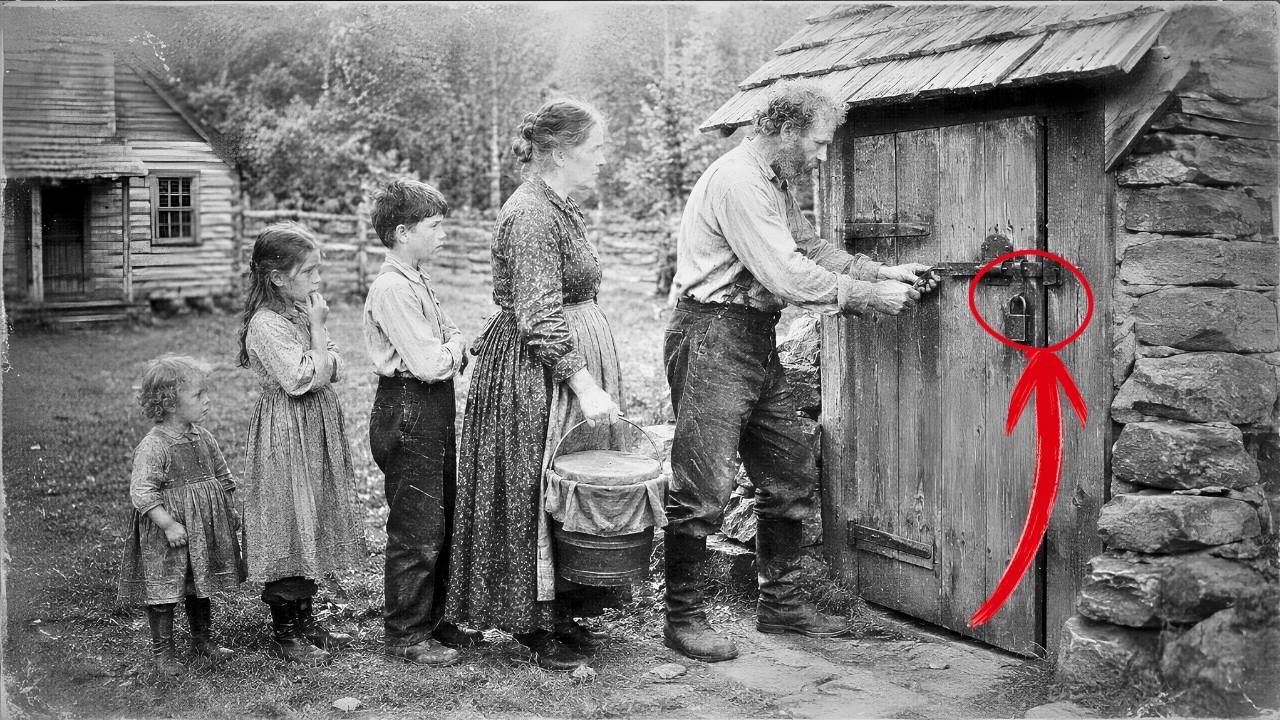
Six weeks later, when the county sheriff finally pried up the floorboards inside that springhouse, he understood what she had been protecting and what she had been feeding. The Lacefields had lived on that land for seven years. They were quiet, churchgoing people, respected by their neighbors. They raised goats.
They grew corn. Every evening at dusk, without exception, one of them carried a covered bucket across the yard, opened the springhouse door, stayed inside for exactly eleven minutes, then came out and locked it again. Nobody in the county knew what was inside that springhouse. Nobody asked.
And by the time anyone thought to ask, four people had already disappeared and the Lacefield family was gone. They left behind their diary. They left behind the household ledger. And they left something else inside that springhouse, something the sheriff refused for the rest of his life to describe in writing.
Josiah Lacefield had brought his family from western Tennessee to Independence County in the fall of 1852. He was thirty-four, married to Hetty, with three children and a fourth on the way. He traded a smaller plot outside Jackson for eighty acres of lowland bounded on the north by a spring-fed creek and on the south by wooded hills the locals called Coffin Hill, for reasons no one cared to explain to a newcomer. The land had belonged to a man named Redmond Coil, who drowned in his own well two winters earlier.
The farm sat empty for nineteen months before Josiah bought it from the widow at a price the county registrar found unusually low. The registrar noted that the widow refused to walk the property line with the buyer. She signed the deed in town and left that same afternoon. The springhouse was already standing when the Lacefields arrived, about forty feet behind where they later built their cabin.
It was a low stone-and-timber structure built directly over the spring, with cold water running through a channel cut in the floor. That was ordinary for the region. What was not ordinary was the door. It was oak, three inches thick, banded with iron, and fitted with a lock on the outside, not a latch but a keyed lock.
Josiah’s eldest son, Ephraim, age eleven at the time of the move, later told a teacher in Missouri that his father spent the first week on the farm doing nothing but sitting inside the springhouse with the door closed. Hetty brought him his meals. He came out only to sleep. On the eighth day he emerged, gathered the family in the yard, and told them the rules.
There were three, and they were to be obeyed without discussion for as long as the family lived on that land. No one was to enter the springhouse without permission from Josiah or Hetty. No one was to enter after full dark. And no one, under any circumstances, was to speak of what was inside to any visitor, neighbor, or stranger passing on the road.
For the first two years, the family adjusted to these rules as farm children adjust to any household requirement. Ephraim carried water. His younger sister Anna, age nine, gathered eggs. The middle son, Caleb, age seven, helped with the goats.
The baby, Ruth, was born in April 1853. By all accounts they were a hardworking family. Hetty made preserves. Josiah traded corn and salt pork at the settlement store six miles east.
They attended services twice a month at a small Methodist church in Cushman. Their neighbors were the Ballard family to the west and the Merrick family to the north across the creek. Ansel Ballard, a widower with two grown sons, later gave a statement to the county sheriff that became part of the sealed file. He said that during the seven years the Lacefields lived on that land, he never once saw the springhouse door open in daylight.
He said he had supper in their kitchen on four separate occasions, and each time Hetty grew visibly anxious as the sun began to set, rose from the table, told him it was time for him to leave, and walked him to his horse herself. Ballard also said something else, which the sheriff underlined twice in his notes. In 1856, during a spring flood, the creek overflowed and pushed a wall of debris toward the back of the Lacefields’ spring. Ballard rode over to offer help clearing it.
Josiah refused. He refused with an insistence Ballard found strange at the time and unforgettable in hindsight. The water was fine, Josiah said. The water was always fine.
But the door had to stay shut. Hetty Lacefield kept a household ledger, as was common for a farmer’s wife of the period. She recorded eggs collected, jars canned, yards of cloth woven, pounds of butter churned. She recorded weather.
She recorded illnesses. She recorded dates of goat breeding and kidding. The ledger was found on the table when the sheriff arrived in June 1859, open to the last page she had written in. The sheriff took the ledger as evidence, and the county clerk later copied it.
Parts of that copy still exist in the appendix to the Independence County records. Beginning on page 47, Hetty started recording a second daily entry. It appeared every day without fail, at the bottom of the page, always the same three words followed by a number. The words were: springhouse feeding share.
The number began at one and stayed at one for eleven months. Then in October 1853 it changed to two. By 1855 it was four. By 1857, six.
In the final entry, dated May 18, 1859, the number was nine. The ledger did not explain what the share was or what was being fed, but compared with her other entries, a pattern emerged that the county clerk noted in the margin. The days the shares increased were almost always within a week of a livestock loss. A goat missing.
A pig found dead in the barn with no visible wound. A calf that strayed and never returned. Hetty recorded these losses flatly, the way any farmer would. But each time a loss occurred, the springhouse share went up, and it never went down.
There is also a note written in a different hand in the margin of page 82. It is in Josiah’s handwriting, which the clerk verified by matching it to the signature on the deed. It says only this: “It is growing. God forgive us.
It is growing. ”
The winter of 1858 was the coldest recorded in northern Arkansas in the nineteenth century. The White River froze hard enough for wagons to cross. Livestock died in the fields.
The Merrick family across the creek lost half their cattle in one week in January. On the night of February 2, their youngest son, a nine-year-old boy named Thomas, disappeared. Thomas had been sent to check a line of traps his father had set along the creek bank below the Lacefield property. He left right after breakfast.
He did not come home. His father, Aaron Merrick, gathered a search party of six men from surrounding farms. They walked the creek for three days. They found his rabbit-skin cap on the ice about two hundred yards before the Lacefield springhouse.
They found nothing else. Aaron Merrick later told the sheriff that on the second day of the search he walked onto the Lacefield property to ask if anyone had seen the boy. Josiah met him at the yard fence. Josiah did not invite him in.
Josiah did not offer to help with the search. He stood at the fence with his hands in his coat pockets and told Aaron Merrick that he had not seen the boy, that he would not join the search, and that Aaron should go home to his wife. Aaron said Hetty stood in the cabin doorway watching the conversation. He said she was holding an empty bucket.
He said her eyes kept moving toward the springhouse, then back to him, then to the springhouse again. He said he knew then that something was wrong. But he was a neighbor and Josiah was a neighbor, and this was not the kind of country where you accused a man of anything without proof. So he went home.
Thomas Merrick’s body was never found. In Hetty’s ledger, under the entry for February 3, 1858, the share number rose from six to seven. Over the next ten months, three more people disappeared from the valley. A drifter named Wilkes, last seen at the Cushman settlement store buying tobacco.
A grown daughter of a widow named Cordelia Vine, walking home from a quilting bee at dusk. And a hired hand named Peter Two Feathers, a Cherokee laborer working on the Ballard farm, sent to the Lacefields to borrow a scythe. None of them were full residents in the strict sense. None had large families pressing for an investigation.
The county sheriff at the time, a man named Josiah Crenshaw, noted each disappearance in his journal but did not connect them. Not yet. What broke the case open was Anna Lacefield, the eldest daughter, now fifteen. In early May 1859 she walked six miles alone to the meeting house in Cushman and told the Methodist minister, a man called Reverend Boaz Ketring, that she needed to confess something.
She would not tell him inside the church. She wanted to tell him outside, in the sun, where she could see the road in both directions. She told him her father had built a false floor inside the springhouse. Under the false floor was a pit dug into the earth, nearly as deep as a well but wider.
Something lived in that pit. She did not know what it was. She had never seen it clearly, only glimpses when the lantern swung or when the bucket was lowered. She said it had a smell.
The smell had soaked into the walls. The springhouse walls began to sweat even in the coldest weather, and the water running through the floor channel had, in the last six months, begun to run warm. The reverend did not go to the sheriff that day. He went the next morning.
He said later he had spent the night on his knees. Sheriff Crenshaw did not raise a posse immediately. He was a cautious man, and Anna Lacefield was fifteen, and the accusation was so strange he was not sure how to weigh it. What he did was ride to the Lacefield property alone on the morning of May 29, 1859, in full daylight, unannounced.
He wanted to see the springhouse with his own eyes. He did not get to see it. He reached the yard fence. Josiah Lacefield met him there, holding a rifle loose at his side.
It was not aimed and not raised, but it was visible. Behind him, at the cabin door, stood Hetty with her hand on the shoulder of the youngest child, Ruth, now six. Crenshaw was direct. He told Josiah a report had been made.
He told him he needed to inspect the springhouse. Josiah told him, quietly, that he would not allow it. That Crenshaw could return with a search warrant if he wanted. That he would not allow anyone into that building without written authorization from a judge.
And that any man who tried to break down that door would be shot on the property line. Crenshaw rode back to Cushman, then to the county seat at Batesville. He obtained a search warrant on June 3. He gathered a party of nine men, including Reverend Ketring, Ansel Ballard, and Aaron Merrick, whose son had never been found.
They returned to the Lacefield property on the morning of June 7. The cabin was empty. The stove was cold. The animals had been turned loose from their pens.
There were no wagon tracks leading away, which meant the family had left on foot days before. On the kitchen table, Hetty’s ledger lay open to the entry for June 3. It was the final entry. The share number was nine.
Beneath it, in Josiah’s hand, was a single line: “We can no longer feed it enough. God have mercy on whoever opens this door. ”
The springhouse door was locked. Crenshaw broke it with an axe.
Nine men entered the yard behind him. Only four followed him inside the springhouse. The other five would not go past the threshold. What they saw at first was ordinary.
Stone walls, the water channel, shelves for milk pans and butter jars. The air smelled like wet copper and something else none of them could name. It was a warm smell. The false floor was as Anna had described, planks laid over a frame, nailed down but not sealed tightly.
Crenshaw and Ansel Ballard pried up the planks while the other two men held lanterns. Beneath the planks was a pit, about six feet wide, dug straight into the limestone. It was deeper than any of them could measure with the light they had. Aaron Merrick lowered a lantern tied to a rope.
The rope went down forty feet before the lantern settled on something. According to the only written statement any of the four men gave, what the lantern rested on was not the bottom of the pit. It was a pile. A pile of what the sheriff, in the sealed report filed June 9, described only as “material.
” He would not use another word. Reverend Ketring, in a private letter to his bishop found decades later in the parish archive, described it as the accumulated deposit of seven years of offerings. Ansel Ballard never spoke of it aloud again. Aaron Merrick found what he had been looking for.
He found a rabbit-skin cap. He climbed out of the springhouse, walked to his horse, and rode home. He did not attend the rest of the investigation. The pit was filled with quicklime and sealed that same afternoon on Crenshaw’s order.
The springhouse was burned to its foundations the next day. The stones were pushed into the creek. The Lacefield cabin was left standing but never inhabited, and by 1871 it had collapsed. The land was absorbed into the Ballard holdings and left unreclaimed.
The Lacefields were never found. Reports of sightings of a family matching their description surfaced in Texas in 1861, in Indian Territory in 1864, and in New Mexico as late as 1873. None were confirmed. Sheriff Crenshaw kept the file closed in his office safe for the remainder of his term.
When he retired in 1878, he handed the file to his successor with one instruction. Never open it. Never read it. Keep it and forget it.
Neither happened. One detail from the sealed report was finally disclosed by Crenshaw’s successor decades later in 1894, when a historian from Little Rock named Everett Marlow was granted limited access to the Independence County archives for a book he was writing on frontier crimes. Marlow never published the book. He died of a stroke in 1896 and donated his notes to a private library in Fayetteville, where they remained until catalogued in the 1960s.
In those notes, there is a single sentence attributed to Crenshaw, spoken in his old age and recorded by Marlow verbatim. Crenshaw said: “The pit did not end at the bottom. It continued deeper. We closed only what we could reach.
The property is still there. The valley is still there. The creek still runs, and it is still warm in one particular stretch, about forty feet from where the springhouse stood, in a place where there is no logical reason for the water to be anything but cold. ”
The Ballard heirs sold the land in 1922 to a timber company.
The company cut the hills but left the valley untouched, and when the site manager was asked why in a 1938 interview, he said only that the men refused to go in. The Lacefields fed something for seven years. They fed it goats, they fed it pigs, and ultimately, according to Anna’s confession and the pattern of the ledger, they fed it people. The question that was never answered, the question Reverend Ketring wrote about in his private letter to his bishop, was not what the family was feeding.
It was what the previous owner, Redmond Coil, had fed it before them. And what the man before Coil had fed it. And how far back the feeding schedule really went. Because the springhouse was already there when the Lacefields arrived.
And the lock was already on the door. And someone, at some point in the history of that valley, had dug that pit. Someone had dug it deep. And someone, for reasons still not understood, had decided it needed to be fed.
The valley has a new owner now. The new owner is not from Arkansas. The new owner has been asking questions in the county records annex. Questions about the Coil transaction.
Questions about the exact location of the original stone foundation. And in the county records annex, someone has been reviewing Hetty’s ledger once a month, always on the same day of the month, always on the second Tuesday, for the past two years. Whatever the Lacefields fed in that valley did not die when they left. It was only waiting.
And there is someone now preparing to feed it again.
