# The Cables That Hold
October 1962. A trolley wheel—the size of a truck tire—moves across the Narrows at six hundred feet per minute, carrying a single loop of steel wire from Brooklyn to Staten Island, two hundred thirty-six feet above the harbor tide. Men watch from the catwalks. They have watched this same pass hundreds of times.
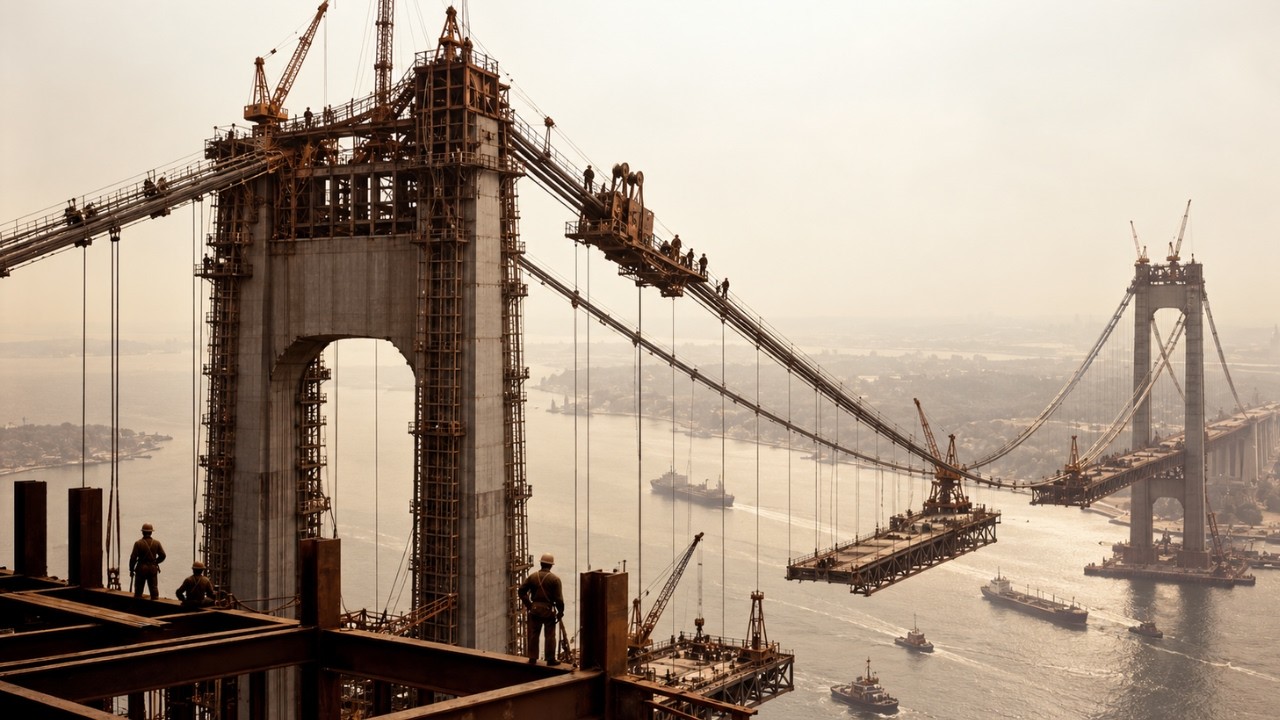
They know how the wire should look, how it should sag, where it should settle in relation to a precisely calculated reference line. What they cannot see is what is inside the wire itself. And in this project, that unseen reality will become the most consequential fact of all. Four million cars cross the Verrazzano-Narrows Bridge every year.
The four main cables—each one thicker than a subway car—hold the entire structure aloft. Each cable contains twenty-six thousand individual steel wires, wound together in a configuration so tightly packed that the finished cylinder feels almost solid to the touch. But to understand what holds the bridge up, you have to understand how those wires got there in the first place. The answer is not that you manufacture a cable in one piece.
No factory on earth could produce a single continuous cable of that length, and no ship could transport it even if one existed. You spin it, wire by wire, in place. The problem of spinning those wires begins with a man named John A. Roebling.
In 1869, Roebling designed the Brooklyn Bridge, the first major suspension bridge to use steel wire cables spun in place using a method he had developed. His son Washington carried the project forward after John died of tetanus from a ferry accident, and the Brooklyn Bridge opened in 1883. The technique the Roeblings perfected—air spinning—remained essentially unchanged for nearly a century. When the Verrazzano’s chief engineer, Othmar Ammann, began planning the bridge in the late 1950s, he specified the same method.
Ammann was eighty-three years old when work began on the Verrazzano in 1959. He had already designed the George Washington Bridge, the Bayonne Bridge, and the Triborough Bridge. The Verrazzano would be his last and his largest. It would have the longest suspension span in the world at the time—4,260 feet between the towers—and it would carry twelve lanes of traffic on two decks.
It was, by any measure, an extraordinary structure. And its main cables would require more than one hundred thousand individual wires, each one placed by hand in a series of passes that would take nearly two years to complete. The principle behind air spinning is almost comically simple. You run a trolley wheel back and forth across the span on a continuous loop of rope, and each pass lays down one loop of wire.
Do that thirteen thousand times, and you have a cable. But before any wire can be spun, the work platform has to exist. Workers first stretched temporary footbridges from anchorage to anchorage: long, swaying platforms made of wire rope and wooden planks, suspended between the towers and anchored in the massive concrete blocks on each shore. These catwalks became the workspace for the entire spinning operation.
They moved with the harbor wind. They had no covering. Men walked along them, adjusting wires, checking sag measurements, performing the same movements day after day in conditions no modern safety standard would permit. There were no fall-arrest systems in the way we understand them today.
A slip meant a fall, and at two hundred thirty-six feet above the tidal water, a fall was usually fatal. Several men died during construction, most of them during the catwalk and spinning phases. The trolley itself ran on a haul rope that formed a continuous loop between the two anchorages. Engines on each side drove the loop at roughly six hundred feet per minute.
The trolley carried a loop of wire from one anchorage, over the tower saddles, to the opposite anchorage, where the loop was lifted off and placed in a strand shoe—a grooved piece of steel that locked the wire in place permanently. One pass, two strands of wire laid down, then the trolley returned carrying another loop. Simple. Direct.
The problem is sag. A wire spanning 4,260 feet does not hang in a straight line. It follows a catenary curve, dropping under its own weight, and the depth of that drop changes with temperature, with wind, and with the tension applied at the anchorages. Each wire had to sag within a fraction of an inch of a precalculated reference line, or the final strands would not align, and the cable would not achieve uniform tension under load.
Surveyor teams stationed on the towers and at mid-span measured every wire against that reference using optical instruments. When a wire hung too loose or too tight, workers adjusted its length at the anchorage before the next pass began. On hot days, the wire expanded and sagged deeper. On cold days, it contracted.
The spinning operation sometimes stopped entirely when conditions made accurate measurement impossible. When enough wires accumulated, they were bound into strands: groups of parallel wires wrapped lightly with soft wire at intervals to keep the bundle together. The Verrazzano’s cables used 428 strands per cable. The workers spun them one after another, day after day, in all weather, until all 428 were in place.
Once every strand was positioned, a hydraulic squeezing machine traveled along the cable, compacting the roughly circular mass of parallel bundles into a dense, tight cylinder. This is where the cable’s geometry becomes permanent. After compaction, a wrapping machine—powered by compressed air, running on its own track along the cable—wound a continuous outer wire spirally around the surface. Workers guided it, inspected the wrapping, and applied corrosion inhibitor into the gaps.
When the wrapping was finished, the cable was sealed. Nothing inside could be seen, reached, or adjusted ever again. That fact is exactly where the construction record becomes murky. During the spinning operation, a batch of wire from one manufacturer was found, after installation, to have lower tensile strength than the specifications required.
Not dramatically lower, but the cable design assumed every wire would meet its rated strength. A wire that fell short reduced the safety margin the engineers had calculated. And the affected wire was already inside the cable—compacted, wrapped, sealed. There was no practical way to identify which strands had used wire from the defective batch.
There was no way to locate the individual wires once they were bundled together. And there was no way to remove them without dismantling the entire cable, which would mean undoing months of work on a bridge already under intense public scrutiny. The engineers reviewed the margin. Suspension cable designs carry deliberately large safety factors because engineers know that real construction involves variation in materials, gaps in inspection, and in-service loads that models can only estimate.
The analysis showed that the defective wire made up a small enough percentage of the total that the cables retained adequate strength—less than the original margin, but not to a dangerous level. The decision was made to accept the cables as built, increase monitoring, and document the event fully. The bridge opened on schedule. The public was not prominently informed.
The wire defect remained inside the cable. It is still there. The lower deck—part of the bridge’s design from the beginning, planned as a two-level structure—opened in 1969. Under full traffic load, the towers move perceptibly toward each other, pulled by the weight of the cables and the deck.
In summer heat, the roadway drops noticeably as the steel expands and the cables lengthen. These are not failures. They are designed, calculated behaviors, visible evidence that the structure is working as intended. The main cables, the towers, and the anchorages are original.
The suspender ropes—the vertical hangers that connect the cable to the deck—have been inspected, treated, and replaced where necessary. The deck has been rehabilitated. What the crew spun across the Narrows in 1962 and 1963 still carries the load. Air spinning remains the standard method for long-main-span suspension cables.
What changed after the Verrazzano was the machinery around it. Faster haul speeds, improved sag monitoring, better compaction equipment, and more rigorous inspection before the wrapping seals the interior. Later bridges used multiple spinning wheels on parallel loops simultaneously. The time required to strand a comparable cable dropped significantly.
But the underlying logic—wire after wire, accumulating into a structural unit that spans open water—remains the same as when the Roeblings used it at Brooklyn in 1869. Drive your car across the Verrazzano today. The cables are above you, tightly wrapped, sloping upward toward the towers. Inside that outer sheath, behind the corrosion-inhibiting compound and the compacted parallel bundles, lie more than twenty-six thousand wires placed individually, one loop per crossing, by men on catwalks in the harbor wind.
Some of those wires are weaker than they were supposed to be. They have held the bridge for more than sixty years.
