The slap cracked through the Blue Lantern Social Club like something breaking that could not be put back together. Forty people saw Lenny Briggs’ open palm connect with Bumpy Johnson’s cheek. A woman near the bar covered her mouth. Someone outside the window stepped backward.
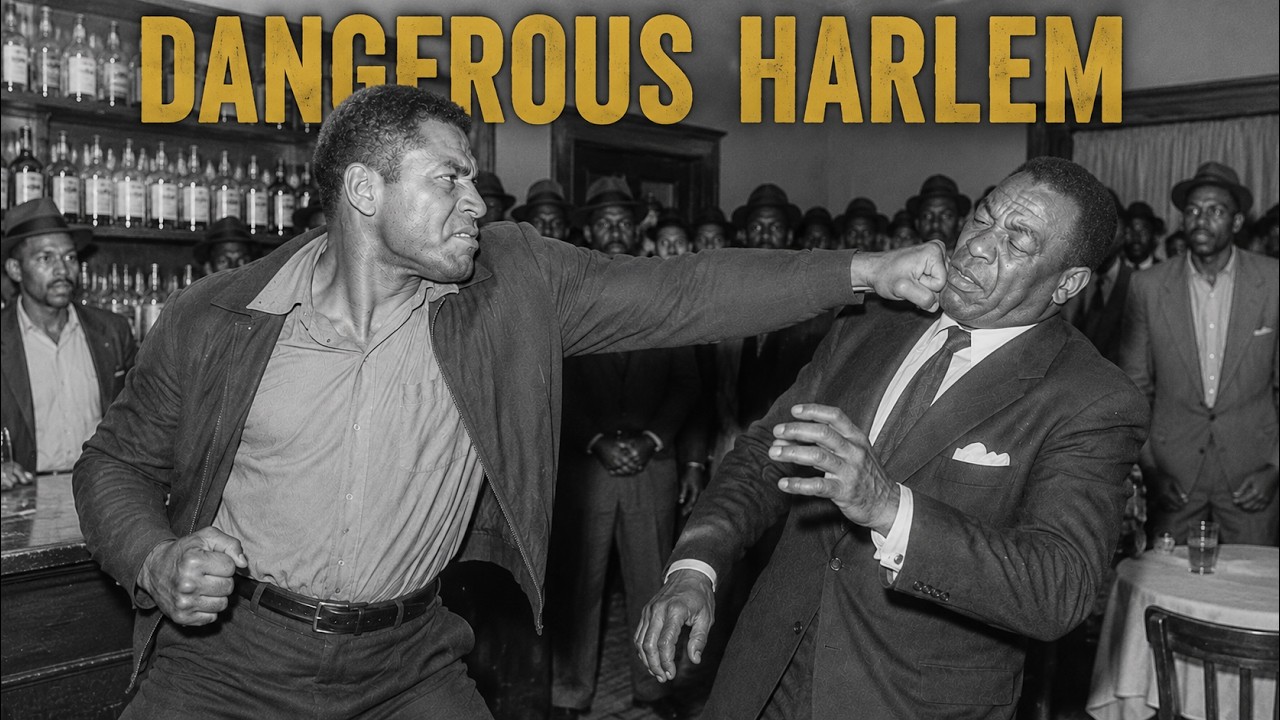
Bumpy’s head turned sharply, one shoe shifted half an inch, and then he was still. Lenny Briggs had come to the Blue Lantern on West 139th Street to make Bumpy Johnson pay for 1953. Three years he had carried the arithmetic of what was taken from him. His career.
His father. His name. The man who lost remembers the date, Lenny had told Calvin Marrow earlier that night, and he had spent three years remembering his. What Lenny did not know, as the red mark spread across Bumpy Johnson’s cheek and Arthur Knox and Benny Hail moved from the walls, was that the slap was only the beginning of the truth.
And the truth was about to rearrange everything he thought he knew. It had started with a bell. Not a gun, not handcuffs. A bell at a neighborhood gym in 1948, when Lenny was seventeen.
Too tall, too angry, too willing to swing. A trainer named Nate Cullen taught him the first rule: hands come back. Nate slapped him every time his left stayed low. Hands come back again.
Hands come back. Years later, Lenny understood boxing better. Everything good came back. Hands, breath, balance.
Everything except time. By 1953, promoters were beginning to call. Then police came instead. Witnesses, statements, names connected to Bumpy Johnson, a judge, a sentence.
The bell stopped. Nobody had ever explained why Bumpy Johnson was standing inside that courtroom. Lenny had supplied the explanation himself. He had been guilty of things.
Lenny never pretended otherwise. He had run with men who liked quick money. He had taken money that wasn’t his. He had hit men outside a boxing ring.
He had known they were Italian. He had even laughed about it. At twenty-two, knowing a man’s nationality felt like knowing his power. It wasn’t.
A flag tells you where somebody comes from. It doesn’t tell you who answers his telephone. The men he robbed with Curtis Veil, Ronnie Pike, and Darnell Fitch had storefronts and cash, and they thought young black boys from Harlem would be afraid to cross them. Lenny hadn’t been afraid.
Fear had seemed like a weakness belonging to smaller men. Then the arrest came. His friends scattered. Statements appeared.
Names from Bumpy’s side helped put Lenny away. That was the part he remembered best, because hatred likes clean lines. Complicated facts make poor enemies. Inside, his father visited, thinner than before, a cough he tried to hide.
Lenny pressed his hand to the glass. I’ll fix this. His father had smiled. Fix yourself first.
At the time, Lenny thought it was disappointment. Then the illness worsened. Letters became shorter. Visits stopped.
By the time the final message reached him through the slow machinery of prison, there was nothing left to fix. His father was dead. Lenny sat in his bunk all night. Grief needs somewhere to go.
By morning, it had found Bumpy Johnson. Tonight at the Blue Lantern, Bumpy had walked into the room through the front door, no convoy, no performance. Three men in one car. A man who needs everybody to see his power usually doesn’t have enough of it.
The room opened around him. Bumpy saw Calvin first, swollen mouth, damaged jacket, protecting his ribs. Then Morris. Then the overturned chair and broken glass.
Then Lenny, who had waited three years for this moment and found, when it arrived, that he had nothing prepared. I hear you, Bumpy said when Lenny finished his accounting of lost years. I remember more than you think. The slap came after.
And when it landed, Bumpy had not fallen, had not stumbled, had not shouted. He had looked directly into Lenny’s eyes and said, You said everything. Then he removed his jacket, folded it, handed it to Calvin. He told Arthur and Benny to move, and the two men went to work with a precision that Lenny, even through the pain of the beating, recognized as deliberate.
They hit his chest. His ribs. His shoulders. His thighs.
They never touched his fingers, his wrists, his elbows. A boxer’s hands, protected through a beating ordered by the man Lenny blamed for destroying his boxing career. When it was over, Bumpy cleared the room, sat across from Lenny in an undamaged chair on the broken floor, and began to talk. Not the story Lenny had come to hear.
The one before it. You thought those made you important, Bumpy said, pointing at Lenny’s hands. You thought because you could hurt their men, they had to respect you. You thought because nobody stopped you the first time, nobody could stop you the second.
There had been a second and a third time. Bumpy knew. Of course he knew. You knew they were Italian, Bumpy said.
But you didn’t know what that meant. You weren’t fighting neighborhood bookmakers. You were touching money connected to Lucky Luciano’s people. Lenny had heard the name then.
Everyone had. But hearing a name and understanding its reach were different things. At twenty-two, he had confused the two. The questions came harder than the fists.
Did you ever ask why men connected to me suddenly helped police put a young boxer in prison? Lenny had spent three years asking who. Asking how. Asking what it cost him.
He had never actually asked why. Hatred hates that question. Why creates doors. The door opened slowly.
Lenny learned that after the fourth robbery, men started asking where he slept. Men above the men he hit. Men connected to Luciano’s network. They were looking for his routines.
His fights. His apartment. Eventually, his father. They needed him to find you, Bumpy said.
That word reached somewhere deeper than the punches. Lenny’s father had been sick, coughing, already weak, and men could have appeared at his door because of something Lenny had done. The name was Walter Briggs. Fifty-four years old.
A mechanic’s hands. Thin from illness. He came to Bumpy Johnson without an appointment in that September of 1953, waited downstairs nearly forty minutes, and entered with his hat in both hands. Not begging.
Not yet. My boy made a mistake, Walter said. Your boy made four, Bumpy answered. Walter accepted the correction.
That mattered. Men asking favors usually begin by lying about the size of the problem. Walter didn’t. He asked what was going to happen to Lenny.
Bumpy told him the truth. The Italians weren’t looking for repayment anymore. They were looking for certainty. Death provided certainty.
Bumpy needed another method. The conversation that followed changed the shape of three lives. Bumpy offered to send Lenny away. Walter shook his head.
He’ll come back. Because he thinks leaving means losing. Then he needs a door he can’t open. Bumpy told him prison was a hard door.
Walter said hard was better than permanent. The arithmetic was brutal. Police already had pieces of a case, but not enough. Weak identification.
Contradicting witnesses. No weapon recovered. Then two witnesses appeared, both connected indirectly to Bumpy’s Harlem network, and their statements made the prosecution solid. Lenny stood when he understood.
You arranged it. Yes. You knew I’d go away. Yes.
My father knew. Yes. No, Lenny said. He wouldn’t do that.
Bumpy looked at the envelope on the table and answered. He wanted a living son more than he wanted an innocent-looking decision. His father had known prison would kill Lenny’s career. He knew about the fights lined up, the promoters calling.
He knew what boxing meant. Careers can be restarted, Bumpy said. Funerals can’t. Lenny wanted to know about the medicine.
The doctors. The money he could have made to pay for his father’s treatment. Bumpy let him finish, then told him the part that broke the hatred open. Your father didn’t die because you couldn’t box.
He was already getting worse. He knew what treatment cost. And he came to me asking how to keep you breathing after he was gone. Walter’s words had survived three years.
Now they belonged to his son. I’m already fighting something I may not beat, Walter had told Bumpy. Don’t let my boy fight something he can’t. Lenny lowered his head.
No tears. Just breath. Slow. Uneven.
He still chose your life over having you beside his bed, Bumpy said. That sentence stayed. Lenny asked why Bumpy hadn’t told him after he got out. You didn’t come asking, Bumpy answered.
I shouldn’t have had to. Maybe. But if I told you immediately who wanted you dead, what would you have done? Lenny knew.
He knew. At twenty-two, he would have gone looking. Bumpy pushed the envelope across the table. It held a letter in Walter Briggs’ handwriting, cheap paper, expensive ink.
Lenny read it slowly. His father acknowledged his son’s crimes. Acknowledged the danger. Asked Bumpy to accept whatever arrangement would keep Leonard alive.
Then the final lines, which Lenny read twice. If he hates me for choosing this, let him. Hate still needs a living man to carry it. Lenny folded the letter along its old creases.
He placed it inside his jacket, close to his chest. For three years, he had carried anger there. The pocket now had competition. What am I supposed to do now, he asked.
Bumpy looked toward Lenny’s hands. That’s your business. Then he added, 25 isn’t dead. But talent gets old faster than men.
At the door, Bumpy stopped. If you still want to fight, I know people. Real trainers. Why, Lenny asked.
Because your father bought you time. What you do with it isn’t his decision anymore. Bumpy placed a card on the table. Elias Ward.
A trainer who doesn’t care what you used to be. Go Monday. Then he said something that confused Lenny more than any other answer he had given. I don’t want anything from you.
Second chances shouldn’t come with chains. Monday came. Lenny stood outside Elias Ward’s gym at 6:48 in the morning. The card said seven.
He was early. He almost left three times. At 6:59, the door opened. Elias Ward looked him over.
Fifty years old, compact, gray sweatshirt, a face unimpressed by almost everything. Briggs, he said. You’re late. It was 6:59.
Then you wasted eleven seconds arguing. Coming? The first week contained no sparring. Lenny hated it.
Footwork, rope, bag, defense, conditioning. Again, again, again. His lungs burned. His ribs healed.
His timing returned slower than his pride wanted. Every evening he thought about quitting. Every morning he arrived. Bumpy never visited, never called, never asked Elias for reports.
A second chance watched too closely becomes another kind of ownership. Bumpy had promised a door, not supervision. Three months passed. Lenny sparred six rounds, then eight, then ten.
He lost weight, not strength. Anger left his punches first. One afternoon, Calvin Marrow entered the gym. His lip had healed months earlier.
No Bumpy, no Arthur, no crowd. Lenny removed his gloves and walked over. I was wrong to put you in it, Lenny said. Calvin studied him.
Yeah. You any good? Working on it. Then work, Calvin said, and left.
The account closed quietly. Most important ones do. By month five, Elias made a telephone call. Not to Bumpy.
To a promoter. A small fight, eight rounds, no headline, an opponent with a winning record. Lenny accepted before Elias finished explaining. The night before the fight, Lenny took his father’s letter from the drawer, read it, then placed it beside the fight contract.
Two papers again. Past and future. This time they did not fight each other. Six months after the night at the Blue Lantern, Bumpy rode through Harlem in the back of a sedan.
At a corner, workers had pasted new posters onto a brick wall. Music, a dance, a political meeting, then boxing. One name near the center caught his eye. Leonard Briggs.
Eight rounds. Saturday night. St. Nicholas Arena.
Benny noticed where Bumpy was looking. Well, he said. Kid made it. You want to stop?
Bumpy looked at the poster. A worker brushed paste over one corner of Leonard Briggs’ name. No, he said. The car moved.
The poster slid past the window and disappeared behind them. That Saturday, the bell rang. Lenny stood in his corner, lights above him, crowd beyond the ropes. Elias leaned close.
No proving anything. You’re here to box. At the other end of the ring, his opponent bounced on his feet. Young.
Hungry. Strong. Lenny looked toward the crowd once. No Bumpy.
He hadn’t expected him. This was not Bumpy’s fight. Not Walter’s. Not Luciano’s.
Not the prison’s. His. The referee called them forward. Touch gloves.
Back to corners. Lenny rolled his shoulders. His hands rose. Three years ago, he had believed strength meant nobody could force him backward.
Now he knew better. Strength was knowing when backward was the only direction that kept you alive long enough to move forward again. The bell rang. Lenny stepped out, hands high.
Across Harlem, Bumpy’s car crossed the same intersection at the same hour. He did not ask for the result. Not yet. The city would tell him eventually.
Cities always do. Harlem continued. So did Leonard Briggs.
