At dusk on February 17, 1944, two American battleships opened fire from more than twenty miles away, across an empty sea, at a target no human eye could see. The shells that arced through the sky were aimed by a machine that needed no visual contact, and the only man who could see the incoming fire was a Japanese destroyer captain who had never trained for anything like it. His name was Setsuji Maria, and his ship was the Nowaki, a Kagero-class destroyer that had survived Midway, had crawled home from Guadalcanal, and now found itself running for its life from the most advanced naval fire control system ever built. The story of that chase did not begin at sea.
It began in a nearly empty harbor. Truk Lagoon, the great Japanese naval base in the central Pacific, had been called the Gibraltar of the Pacific, an invulnerable stronghold where the Combined Fleet planned its campaigns. By early 1944, American advances through the Marshall Islands made it clear that Truk would be next. Admiral Mineichi Koga, who had inherited command of the Combined Fleet after Yamamoto’s death, ordered the fleet to withdraw westward in early February.
Battleships, carriers, and heavy cruisers sailed for Palau and the Philippines. What remained at Truk was a skeleton: a few old ships, auxiliaries, transports waiting for escort, and a handful of destroyers assigned to get the stragglers out before the Americans arrived. The Nowaki was one of those destroyers. Just before dawn on February 17, a small convoy slipped out of the lagoon through the northern passage.
The armed merchant cruiser Akagi Maru carried supplies and personnel. The light cruiser Katori, an old training ship pressed into service, served as command vessel. Two destroyers, the Maikaze and the Nowaki, escorted them, with a small minesweeper following behind. Their orders were simple: proceed northeast at best speed, reach Yokosuka, and stop for nothing.
Maria had commanded the Nowaki for barely eight weeks. He was a professional destroyer officer, a graduate of the naval academy, hardened in the bitter nights around the Solomon Islands. He knew his ship and his crew well, and he knew the convoy was too slow. The Katori could barely manage eighteen knots, the Akagi Maru less.
In open water, if the Americans found them, the destroyers could not protect the larger ships. They were found that morning. American carrier aircraft, from Yorktown, Intrepid, Bunker Hill, and Cowpens, hit the convoy with systematic violence. The Akagi Maru took three bombs and was soon abandoned and sinking.
The Katori took a torpedo amidships, and though she stayed afloat, her engines flooded and her speed bled away. By the time American surface ships appeared on the western horizon, the old cruiser was nearly dead in the water. The surface force was Task Group 50. 9, led by Vice Admiral Raymond Spruance, commander of the Fifth Fleet.
Spruance had won Midway through cold calculation. His nickname was “Electric Brain” because he did the math in his head and was rarely wrong. On this morning, he had done something unusual: he left his flagship to command a surface sweep from the battleship New Jersey. He wanted to see what the new Iowa-class battleships could do.
Riding beside New Jersey was the USS Iowa herself, the lead ship of the class: 860 feet long, 57,000 tons, thirty-three knots. Her captain was John L. McCrea, fifty-three years old, a Naval Academy graduate who had previously served as President Roosevelt’s naval aide. The Iowa carried nine sixteen-inch guns, each barrel longer than a city bus.
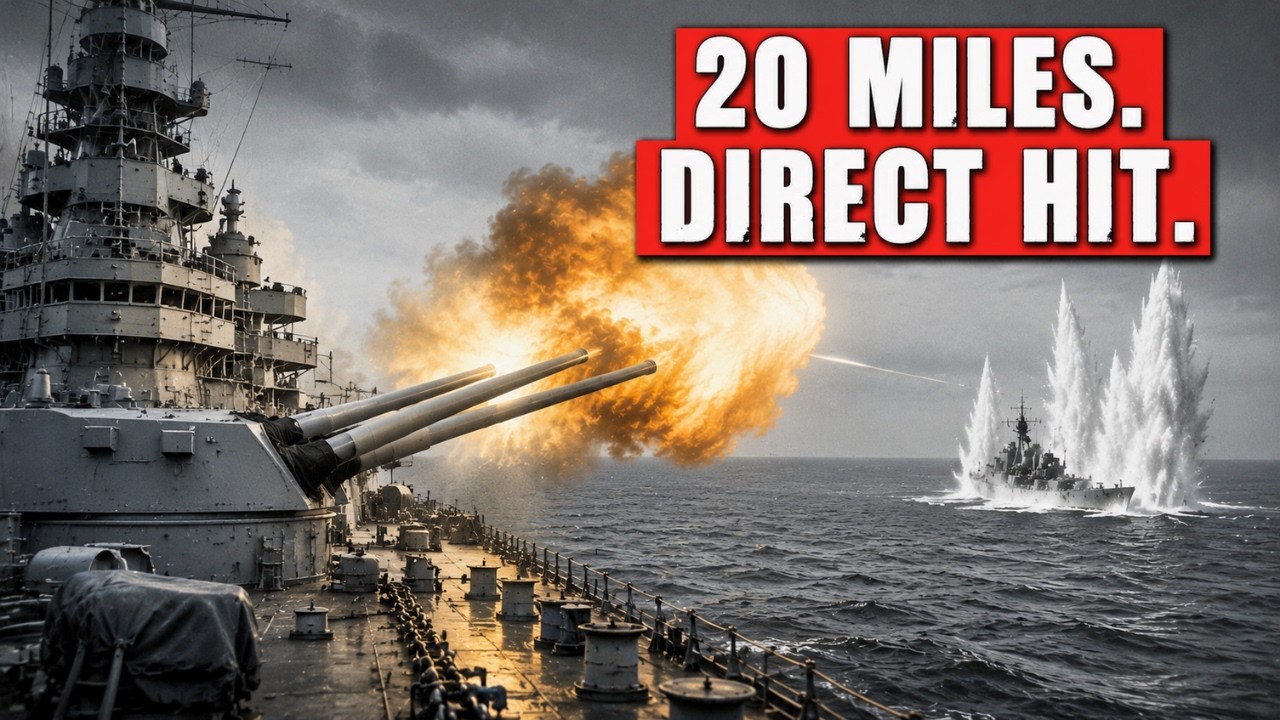
Each shell weighed 2,700 pounds. The guns could hurl those shells more than twenty miles, but they did not aim by eye. They aimed by radar, the Mark 8 fire control system, linked to an analog computer the size of a large desk. The system tracked the target through mist and rain and darkness, calculated its course and speed, factored the wind at altitude, the temperature of the barrels, and even the rotation of the Earth itself.
The turrets followed the computer’s instructions automatically, like obedient hounds. The guns could hit what no one could see. The Iowa dealt with the Katori first, closing to 14,500 yards and opening fire. The first salvo of nine shells, 24,300 pounds of steel, tore through the thin cruiser plating as if it were paper.
Captain Tamakiyo Oda remained on his bridge and went down with his ship. Most of his crew went with him. No one was rescued. Nearby, the Maikaze was sunk by American cruisers and destroyers with all hands.
The minesweeper Shonan Maru was finished off. Four ships lost in less than two hours. One remained. The Nowaki had already fled.
Maria saw the aircraft coming, saw the ships burning, and made the only decision his instinct allowed. He ran. He pushed his engines to maximum and turned northeast, opening the distance. For a short time, it seemed to work.
Then the two silhouettes appeared on the horizon behind him. Iowa and New Jersey had finished the Katori and now turned north at 32. 5 knots, faster than any battleship had ever pursued an enemy. Their target was a single destroyer that could barely see them.
Maria ordered smoke. Black clouds poured from his funnel, joined by chemically generated smoke from the stern. He began weaving, five degrees to starboard, five degrees to port, changing course by instinct and twenty years of accumulated experience. He knew that if he held any course for more than half a minute, he was dead.
The Americans opened fire from 35,000 yards, just over twenty miles, the longest range at which an American battleship had ever engaged an enemy warship. The first salvo straddled the Nowaki, with shells landing on both sides of the ship, the traditional mark of true range. Water columns rose higher than the destroyer’s masts and collapsed across her decks. But Maria could see the muzzle flashes at the horizon, low yellow-white blinks in the gloom.
Every time they fired, he had roughly ninety seconds to be somewhere else. And he used them. The modern fire control system calculated where the Nowaki would be in ninety seconds. The oldest fire control system in the world, a man on an open bridge, ensured she would be somewhere else.
For more than an hour, two of the most powerful warships ever built fired their main batteries at one Japanese destroyer and hit her once, and that hit was a near thing. A high-capacity shell from New Jersey exploded close alongside and opened a crack in her hull below the waterline, flooding a small compartment. The chief engineer reported the damage. Maria acknowledged it and did not change course.
The history books sometimes describe this as a storm of fire, a cage of water columns that enveloped the destroyer from start to finish. The reality was quieter and stranger. Shells arced and fell and missed, again and again. Then the sun began to set, low and golden, straight into the eyes of the American spotters.
The radar still worked, the computer still worked, but the men trying to correct the fall of shot could no longer see where the shells landed. At 39,000 yards, the range meant that tiny angular errors translated into misses of a hundred yards or more. The Nowaki still weaved. The Nowaki still floated.
On the bridge of New Jersey, Spruance made a professional decision. The range was opening, the light was failing, and the fuel expenditure had become unreasonable. He ordered the firing stopped. The great battleships broke off the chase.
Their turrets trained fore and aft, and the last echoes of the day’s artillery rolled across the darkening sea. A lone Japanese destroyer, hit at extreme range in the most extraordinary display of naval gunnery the Americans had ever managed, had survived against every calculation the machines had made. Maria did not celebrate. He kept his course northeast through the night, listening for the engines that would mean the pursuit had resumed.
It never did. On February 24, seven days later, the Nowaki entered Yokosuka. Her hull was patched, her paint fouled with salt and soot. In his small cabin, Maria wrote a report that would circulate through every senior office in the Imperial Japanese Navy.
He described a pursuit at distances his instruments could not measure, shells arriving from beyond the visible horizon, a level of American gunnery his doctrine had not prepared him for. He did not say the words, but his readers understood: something had happened that no amount of training or better optics could answer. The Americans had built a machine that could shoot beyond human sight. The Imperial Japanese Navy had not built that machine, and the gap was not something two years of war could close.
By summer 1944, the decisive fleet battle Japan had planned since the Russo-Japanese War finally came. It was the Battle of the Philippine Sea, and it was not a gunnery duel at all. American pilots called it the Mariana Turkey Shoot. Nearly four hundred Japanese aircraft were shot down, three carriers were sunk, and the last trained pilots of the Imperial Navy were exhausted.
Yamato and Musashi, the greatest battleships ever built, spent that battle sailing in formation with no target to shoot at. Then came October, the Battle of Leyte Gulf, the largest naval engagement in history. The Nowaki was there, repaired and back in the fight. Maria still commanded her.
On the morning of October 25, off Samar, the Nowaki found herself at the heart of one of the most famous actions in American naval history. The Japanese center force stumbled into a group of American escort carriers and destroyers, and the Nowaki fought her part. She fired torpedoes at the escort carriers. She helped finish off the destroyer USS Johnston.
Then Admiral Kurita broke off the action and ordered his fleet to withdraw. As the Japanese ships retreated north, the heavy cruiser Chikuma was found dead in the water. The Nowaki was ordered alongside. She took off survivors, then put torpedoes into the hulk and sent her down.
She turned northwest and began the long journey home. She never made it. The next morning, October 26, three American light cruisers and a screen of destroyers intercepted the Nowaki about sixty-five miles south-southeast of Legazpi on the coast of Luzon. The American cruisers opened fire.
The Nowaki’s engines were destroyed, and she stopped dead in the water, burning. The destroyer USS Owen closed in and finished her with torpedoes. The ship went down with all hands. Captain Setsuji Maria was aboard, promoted to captain eleven days earlier and promoted posthumously to rear admiral afterward, though the notification never reached him.
He went to the bottom of the Pacific with every man who had escaped the guns of Iowa in February, and with the Chikuma survivors he had just rescued. One sailor from Chikuma, a man named Hayashi, was cast adrift and washed ashore alive. He was the only witness left. The lucky ship had finally run out of luck.
There is one more truth that history recorded quietly. In all four years of the war, the Iowa and her three sister ships, New Jersey, Missouri, and Wisconsin, carrying thirty-six sixteen-inch guns between them, never fired those guns at an enemy warship. Not once. The chase of the Nowaki and the sinking of the old training cruiser Katori before it were the closest any Iowa-class battleship ever came to the kind of surface battle they were built for.
Their great adversaries, Yamato, Musashi, and Nagato, were sunk by submarines, carrier aircraft, and older American warships. The finest battleships the United States ever built spent the war bombarding coastlines, escorting carriers, and once, chasing a destroyer they could not sink. The revolution those empty atolls announced was real. The radar worked.
The computer worked. The system did everything its engineers promised. But the ships carrying it never got the fight they were designed for. History passed them by before they could prove themselves in the ways their builders imagined.
On the morning of September 2, 1945, in Tokyo Bay, a small folding table was placed on the deck of the USS Missouri, the newest and strongest of the Iowa class. Japanese officials came aboard in formal dress, signed the surrender documents, and ended the war beneath nine sixteen-inch guns that had never fired at another battleship in anger. The choice of that ship for that moment was deliberate. The age of great gun duels was over, and the ships that once would have decided such a war had become unnecessary because of the very technology they carried.
Radar. Analog computers. Aircraft. Submarines.
The huge machines of an industrial war fought on a scale no admiral of Togo’s generation could have imagined. The crew of the Nowaki, if any of them had lived to see it, would have understood. They sensed the change first, on a misty February afternoon, running for their lives from two shapes on the horizon they could barely see. They felt the old world of naval warfare, the world of eyes and optics and human skill, passing into history.
Not with a great battle, not with a decisive stroke, but with a long patient stream of 2,700-pound shells falling from the sky at a small ship that could not shoot back. Every shell missed, and it did not matter, because the point was that the shells arrived at all. From beyond the horizon. From a machine that needed no eyes to find its target.
The Nowaki survived that afternoon. But it was only a delay. Eight months later, she was at the bottom of the Pacific, with her captain and her crew beside her. The Iowa still floats today, moored at a pier in San Pedro, California, her great guns trained fore and aft, her fire control tower silent.
Tourists climb her ladders and try to imagine what she was like when she was young and fast and hunting. The Nowaki lies far deeper, in water too deep to reach. Her crew is still with her.
The sea does not forget them, and neither should anyone who hears this story.






