In the autumn of 1913, in the valley of the Coquihalla River, forty miles east of Hope in British Columbia, a survey party working for the Kettle Valley Railway stood at the edge of a gorge and looked down at the ground where the main line was supposed to go. The valley below them was a cut carved through the granite of the Cascade Mountains. In places it was sixty feet wide. In other places, less.
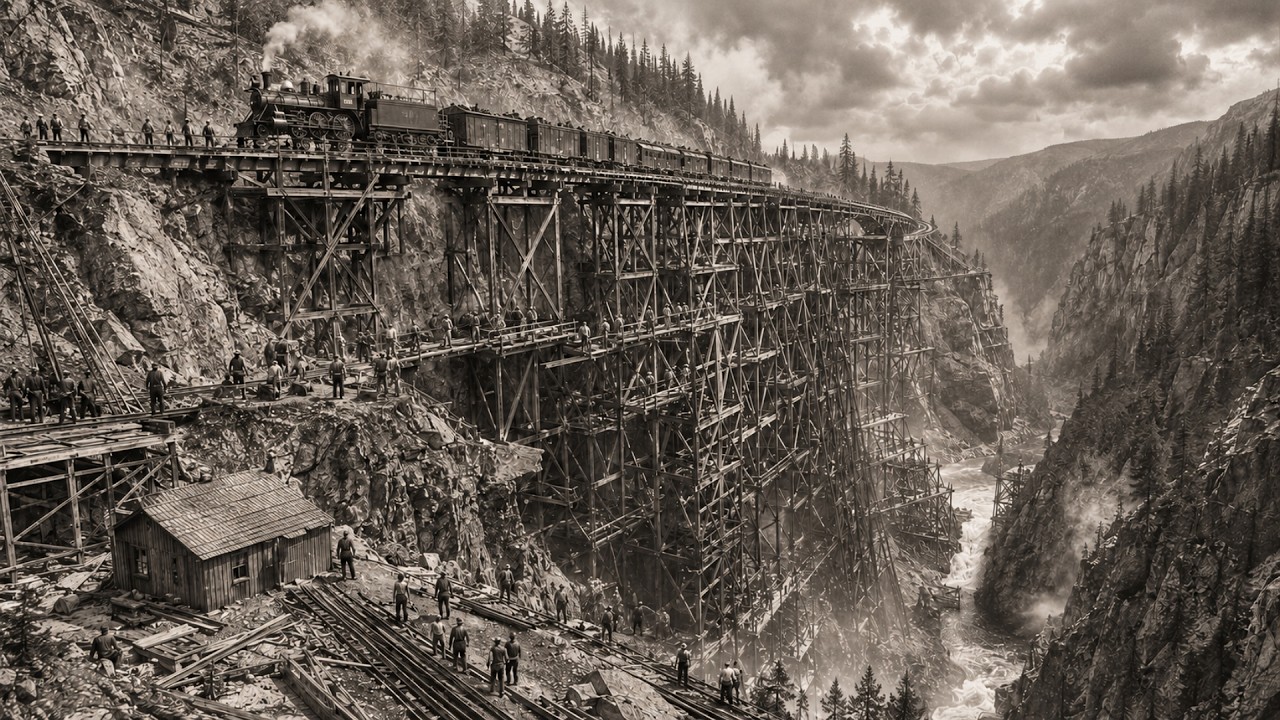
The Coquihalla River filled the bottom of the valley completely. The walls rose two hundred feet on either side, and in the sections where the survey line ran, those walls were vertical. There was no ledge. There was no flat ground along the river.
There was no surface route through the valley that a railway could use. The man who had drawn the survey line knew this before the party stood there and saw it. He had known it since the first time he climbed down to the river and walked the bottom of the gorge. The problem of the valley was not something that could be solved on the surface.
It was a problem that could only be solved by going through the rock. The survey located five tunnel portals in the granite walls and connected them on paper with timber bridges across the river at the points where the valley widened enough for construction. The man who drew that line was Andrew McCulloch. He was forty-nine years old, born in Almonte, Ontario, in 1864, the son of Scottish immigrants who had settled in the Ottawa Valley.
He joined the Canadian Pacific Railway survey service in the 1880s and spent more than twenty years laying out railway routes through the mountains of British Columbia. By 1910, when the CPR commissioned him to route the Kettle Valley Railway through the southern interior of the province, he had seen most of the difficult terrain in the province’s mountain systems. He had never seen terrain like the Coquihalla Valley. He was a precise, methodical man, according to the accounts of the engineers who worked under him.
He kept detailed field notebooks. He began a habit, starting with the Kettle Valley surveys, of naming stations and tunnel bores after characters from Shakespeare, because he carried a volume of the complete works in his survey kit during those years. The practice began as a private system for organizing field markers and stuck as the official names when the line was built. The four tunnels that pierce the main section of the Coquihalla Valley were named Othello, Iago, Romeo, and Juliet.
Those names are still carved above the tunnel portals today. What those names do not tell you is the price that was paid to put those portals there. The Kettle Valley Railway existed because of copper, silver, and coal. The Kootenay region in the southeastern corner of British Columbia had been producing ore since the early 1890s.
The mines at Rossland and Trail, the coal mines along the Crowsnest Pass, the concentrators and smelters built to process what the mountains yielded—all of it needed rail access to the coast. The Canadian Pacific main line ran far to the north, through Fraser Canyon and over Rogers Pass. Getting Kootenay ore to the smelters and ports on the coast meant routing it south through American territory, across the border, and then back north on American rails to American ports. The CPR was paying American freight charges on Canadian products.
It had been doing so since the mining districts opened. The Kettle Valley Railway was incorporated in 1901 as a CPR subsidiary with the task of building an all-Canadian link between the Kootenay region and the coast at Vancouver. The route McCulloch laid out ran west from Midway in Boundary Country, through Princeton, over the Cascades at Coquihalla Pass, and down to Hope on the Fraser River, where it met the CPR main line for the final run to the coast. The total length of the route was roughly 290 miles.
Of those 290 miles, the 82 miles of the Coquihalla Division from the summit station at Brookmere down to Hope included the valley section. The valley section was the reason the rest of the route took so long to build. A mountain valley in the Cascade Range is not merely a scenic inconvenience for a railway. It is a geological problem with specific mechanical properties.
The Coquihalla River had been cutting its way through the granite of the Cascades for a length of time that made forty-three years of railway operation look like an afternoon. The river cuts because it carries water of sufficient volume and velocity to erode the rock beneath it. The valley walls are what is left after the river removed everything else. They are granite because granite is what the river could not move.
They are vertical because the river cuts downward faster than it cuts sideways, and the walls on both sides never had the chance to lean toward the channel. What this means for a railway survey is that the valley walls are the hardest material in the surrounding terrain and provide nothing to build on. Cutting a surface line into a vertical granite valley wall requires drilling and blasting the wall to turn it into a rock shelf. In the parts of the Coquihalla Valley where the walls provided enough rock mass for surface excavation, McCulloch used surface cuts.
In the parts where the walls were too narrow and too steep, he used tunnels. Five times, the valley narrowed to the point that there was no choice but to bore straight through. The engineering principle was the same one John Edward Schweitzer had applied at Kicking Horse seven years earlier. If the terrain does not give you the distance you need on the surface, you get the distance from underground.
The length of the bore is what determines the grade. The grade inside a tunnel is whatever you design it to be, regardless of the surface geometry that makes the task impossible outside. Two numbers make the scale of the problem in the Coquihalla Valley real. The total length of the five tunnels through the valley section was roughly 1,200 feet of excavation done in solid granite.
The entire valley section, including the surface cuts and the bridges over the river, amounted to just over one mile of completed railway. That one mile took three years and more than 600 men. The construction contract for the Coquihalla Division was awarded in 1913. The workforce assembled for the valley section came mostly from the Italian immigrant communities of the interior mountain towns of Hope, Princeton, and Merritt.
Italian immigration to British Columbia had followed the construction booms of the previous three decades. The men who came from Veneto, Friuli, and Calabria to work for the CPR in the 1880s and 1890s had stayed and settled in the mountain towns, forming the labor networks that drew the next generation of construction contracts. The contractor reached them through labor agents working in those communities and through direct word-of-mouth networks that spread through the boarding houses and company stores of the mountain division settlements. The ordinary laborer on the Coquihalla valley section earned $1.
75 a day. A skilled rock driller earned $2. 25. A shift boss running a crew of twelve to fifteen men at a tunnel face earned between $3.
50 and $4. 00. These wages were the standard rate for a CPR mountain division hard-rock construction job in British Columbia in 1913. They had not changed substantially since the Kicking Horse spiral tunnel work seven years earlier.
The same daily wage was paid to the men who worked the Coquihalla faces as was paid to the men who drilled Cathedral Mountain and Mount Ogden. The problem the Coquihalla crews faced was not comparable. By 1913, compressed-air drills had replaced the double-handed manual drill at most major tunnel faces in North American railway construction. The air drill was an air piston mounted on a steel column, with a drill steel fixed to the piston head, driven into the rock face by compressed air pumped through a hose from a surface compressor set up outside the tunnel.
One air drill operator could drill a hole in a fraction of the time it took a two-man crew using a hand hammer in similar rock. A tunnel face crew running three or four air drills at once could complete an entire blast pattern in the time a hand-drilling crew of the previous decade would have spent on a single hole. The air drill did not solve the problem of broken rock. The walls of the Coquihalla Valley are granite in essence, but that granite is not homogeneous.
The tectonic forces that uplifted the Cascade Range created fault zones through the granite mass, and the contact boundaries between Cascade granite and the volcanic formations above it created zones where the rock is fractured and cannot be trusted to behave like solid granite. A drill hole in broken rock does not hold its walls. The drill steel deflects inside the fault. The hole collapses before it can be loaded with explosives.
Blasting in broken ground does not produce a clean break. It produces a shattered face that the tunnel roof cannot support on its own. After a blast in broken ground, the tunnel roof must be timbered immediately or it comes down on top of the muck the blast just made. A tunnel timbering frame in the 1913 era was square-cut 8-by-10-inch timbers set by hand in a space still full of blast smoke, rock dust, and the sharp chemical smell of spent powder, inside a tunnel whose roof was literally in the act of falling.
The men setting those timbers at the Coquihalla faces had a limited window between the clearing of the blast smoke and the start of the rock movement. They worked in that window in air that completely obscured vision. The valley also presented an access problem unmatched by the CPR’s earlier mountain tunnel projects. At Kicking Horse, the tunnel portals of Cathedral Mountain and Mount Ogden were located on steep but accessible mountain terrain.
Men and equipment could be staged at tunnel portal levels. Work could begin as soon as an access road was cleared. In the Coquihalla Valley, the tunnel portal sites in several sections were located on valley walls that could only be reached by rappelling from the rim or by building access structures from within the valley itself. The first work at several faces was building the access route that would allow drilling operations to begin.
In at least one section, a drilling crew was lowered by ropes from the valley rim to reach the rock face where the tunnel had to start. This was a specific kind of problem. It was not a standard line item in the construction ledgers of 1913. The connecting bridges over the Coquihalla River between the tunnel portals required construction in a valley where the river occupied the entire floor and the walls offered no room for conventional bridge-building operations.
The timbers for the bridges were hauled by wagon from Hope along a road that ended at the mouth of the canyon. Beyond that point, everything needed for construction in the valley—timbers, equipment, blasting powder, drill steel, compressed-air hose, food, and ore cars on temporary tracks inside the tunnels—had to be moved to its location using whatever means were available: ropes, pulleys, and organized human effort under a foreman’s direction. The river made none of these tasks easier. The Coquihalla basin receives more than 100 inches of precipitation annually in its upper elevations, most of it as snow during the winter months.
The snowpack that builds over the valley through October, November, and December feeds the river starting in April, coinciding with Pacific storm systems that move inland after the worst of winter breaks. The Coquihalla River in May is not the same river as in August. A bridge pier built in August 1914, when the river was low and the valley floor was accessible, is a pier that will face the May 1915 flood without having been designed for it. The construction crews worked in the valley section through two full winters and two spring flood seasons.
They built while the river below them was actively demonstrating that this ground was no place for a railway line. The rate of advance at the Coquihalla tunnel faces using air drills on solid rock was roughly five to six feet of finished tunnel per working day per face. In the fractured sections, where every blast required immediate timbering before mucking could begin, the rate dropped. The total length of the five tunnels required continuous advance across all faces in conditions ranging from solid granite to broken rock at the contact zones, down to sections where water seepage from the river above made drill holes unreliable.
The five tunnels, the bridges between them, and the surface cuts through the Coquihalla Valley were completed by the summer of 1916. The entire Coquihalla Branch was opened for commercial service on July 31, 1916. The first train crossed the completed branch line through the valley tunnels in high summer, the dry season, when the river at the base of the bridges was a fraction of its spring volume. The valley was cold in the tunnel sections and warm in the open cuts.
The bridge timbers were new. The tunnel portals smelled of freshly cut rock inside them. The construction of those tunnels generated the same atmosphere that the Kicking Horse tunnels had seven years earlier. Crystalline silica dust from drilling granite does not become safe just because the drill is powered by compressed air.
An air drill advancing at three times the speed of a hand drill generates three times the fine rock dust per shift. The men running the drills in the Coquihalla excavations in 1914 and 1915 inhaled granite dust in an environment whose ventilation depended entirely on what the partially bored tunnel allowed. In the later stages of the longer excavations, that was very little. The disease those men were contracting had not yet been named.
The medical profession did not formally classify silicosis as a distinct occupational condition until 1930. In 1914 and 1915, the men who had it described shortness of breath on exertion and a tightness in the chest. The company medical records described the deaths resulting from it as respiratory failure. The chief medical officer of the CPR mountain division filed quarterly reports covering the construction period of the Kettle Valley Railway.
Those reports record deaths at the Coquihalla Valley works. The consolidated construction register for the Coquihalla Division, the register that gives individual names, ages, and causes of death in the same format as the Kicking Horse register, exists in the CPR archives in Montreal. The portion of that register covering construction deaths on the valley section has not yet been located in a form the researcher was able to access at the time of recording. What the quarterly medical reports provide is a categorical summary: blasting accidents, rock falls, and respiratory causes.
That summary covers the years 1913 through 1916. It records deaths in each category. It does not give names in that summary document. The names are in the detailed records that lie behind the summary, and those detailed records are what remains missing.
Men died driving those tunnels through the walls of the Coquihalla Valley. Their names are in a register somewhere that has not yet been reached. The men who can be named in this story are the engineer who designed the tunnels and the river that destroyed the railway that ran through them, because those are the names the surviving records make findable. The men who held the drill steels against the granite in 1914 and 1915 are in archives that are harder to access.
That is not an accident. It is a consistent pattern across every project in this series. The Kettle Valley Railway operated the Coquihalla Division for forty-three years. The operating history of those forty-three years is the record of a railway maintaining infrastructure in terrain that never stopped trying to remove it.
The five tunnel bores through the valley walls had been cut into granite. Granite does not wash away. The tunnel portals McCulloch fixed in the valley walls in 1913 would last as long as anyone wanted to keep them open. The timber bridges between the portals were another matter.
A timber bridge over a mountain river in the British Columbia Cascades is a structure in permanent negotiation with the river beneath it. In high water, the river carries logs, rocks, and debris at a speed that turns a log into a weapon. The bridge piers assembled by the construction crews in the valley in 1914 and 1915 were the structures that received that challenge every spring for four decades. The CPR’s Coquihalla Division maintenance crews assessed the valley structures after every spring flood season.
In most years, the solution was minor repairs. In other years, it required more. The pattern was established in the first spring of operation and continued through both world wars, through the years when Kootenay mining traffic was enough to justify the maintenance cost, and the years when it was not. In November 1935, a storm system moving in from the Pacific dumped continuous rain on Cascade snowpack that had not yet fully formed for winter.
The Coquihalla River rose to a level it had not reached since the railway opened. The river destroyed the bridge structures in the valley section and threw debris across the track at multiple points outside the canyon. The CPR committed to rebuilding. Engineering crews assessed the damage, and the division was reopened after months of repair work.
The company had answered the river. The river waited. The same exchange repeated through the 1940s. Flood assessment, repair, reopening.
The Okanagan fruit traffic and the remnants of Kootenay mine tonnage moved through the division. The economic viability was marginal but defensible. In November 1959, the river stopped waiting. A Pacific storm brought rain to the Coquihalla basin in quantities that combined with early-winter snow to produce a flood unlike anything the watercourse had seen in the recorded history of the railway.
The Coquihalla River rose through the valley past the high-water marks of every previous flood, swept away the bridge structures, and took out eleven miles of the Coquihalla Division. When the flood receded, eleven miles of track and supporting infrastructure required rebuilding from the ground up. The five tunnel portals were intact. The granite had not moved.
Everything else in those eleven miles was gone or damaged beyond the cost of economic repair. CPR engineering management weighed the cost of reconstruction against the projected traffic for the division and the maintenance burden the valley had demonstrated over forty years of operation. The calculations were not in favor of rebuilding. The recommendation was to abandon the Coquihalla Division.
The CPR accepted the recommendation. The last train ran on the Coquihalla Division on January 12, 1961. The rails were pulled. The remains of the timber bridges were left to the weather and to the river.
The five tunnel portals were left open because closing a portal in granite serves no purpose the granite has not already served. The valley returned to the state it was in before McCulloch’s survey party stood on the rim in 1913 and looked at the problem they had been sent to solve, except that there were now five holes through the walls that the river, the weather, and the intervening four decades had declined to close. McCulloch did not live to see the abandonment. He died in Kelowna in 1946 at the age of eighty-two.
The engineering community recorded his death that year and credited him with locating the Coquihalla Valley route, the most technically demanding railway survey in the history of southern British Columbia, along with the Shakespearean names, the part most people remember if they remember anything at all. The tunnels are his most visited legacy. The Coquihalla Valley tunnel section is now Coquihalla Valley Regional Park. The access road from Hope ends at the canyon mouth.
A walking trail follows the old railway grade into the valley through the four remaining tunnels, across a deck built over the river, and out the far end where the grade curves upward toward Brookmere. Hundreds of thousands of people walk this trail annually. Inside the Othello Tunnel, the longest of the four remaining valley tunnels, the pattern of blast holes from the drilling of 1913 and 1914 is visible on the walls at eye level. The holes are larger than the double-handed manual drill holes of the pre-compressed-air era at Cathedral Mountain and Mount Ogden.
The spacing is different. The compressed-air drilling technology of 1913 left a different signature than the hand drilling of 1907, but the method behind that signature is the same. Drill the pattern, load the holes, light the fuses, clear the site, wait for the smoke to clear, muck out the broken rock, advance the temporary track, and drill the pattern again. The interpretive sign at the start of the canyon trail gives the tunnel dimensions.
It mentions McCulloch’s name and the Shakespearean names, with a note on why he chose them. It gives the construction dates and the date of abandonment. It does not give the names of any of the men who drilled the holes visible in the walls behind the reader. Those names are recorded in a register that has not yet been reached, and the sign gives no indication that they existed.
What remains, standing in the Othello Tunnel, is the air drill operator who worked that face in February 1915. He stood at the working end of a tunnel driven a few hundred feet into the valley wall. The air hose ran back through the tunnel to the compressor outside. The drill was rigged in place.
Rock dust came off the face every time the piston drove forward. He breathed it because the work paid $2. 25 a day, and he needed that money. He came back the next shift and breathed it again.
He came from Udine or Vicenza or Catanzaro, from the same provinces that had sent men to the Kicking Horse tunnels eight years before him, and to the Fraser Valley construction twenty years before that. He came because the CPR mountain division paid wages, and the Italian immigrant communities of the interior towns were the network through which a man in Merritt or Princeton heard that the Coquihalla project was hiring. His name reached the Coquihalla Valley through that network. His name is in the construction records behind the quarterly summary.
The river still runs at the base of the canyon. In November, when the Pacific storm systems move inland and the snowpack begins to build over Coquihalla Pass, the Coquihalla River moves the same way it moved in November 1959. You can stand on the walking deck over the river inside the canyon and hear it below you. The water is the same water.
The rock is the same rock. The tunnel portals cut by the drilling crews in 1913, 1914, and 1915 are still open in that rock. And the blast holes those men drilled are still in the walls, at the level where they held the drill steel against the granite and let the compressed air do the rest. The railway is gone.
The river still runs. The tunnels are still there.
