The woman lying on the rack in Toledo had no idea what crime she was being tortured to admit. That was precisely the design. Elvira del Campo, wife of Alonso de Moya, a scribe of the city, had been denounced by witnesses who had dined at her table and labored in her household. The accusations gathered against her amounted to two habits: she refused to eat pork, and she donned clean linen on Saturdays.
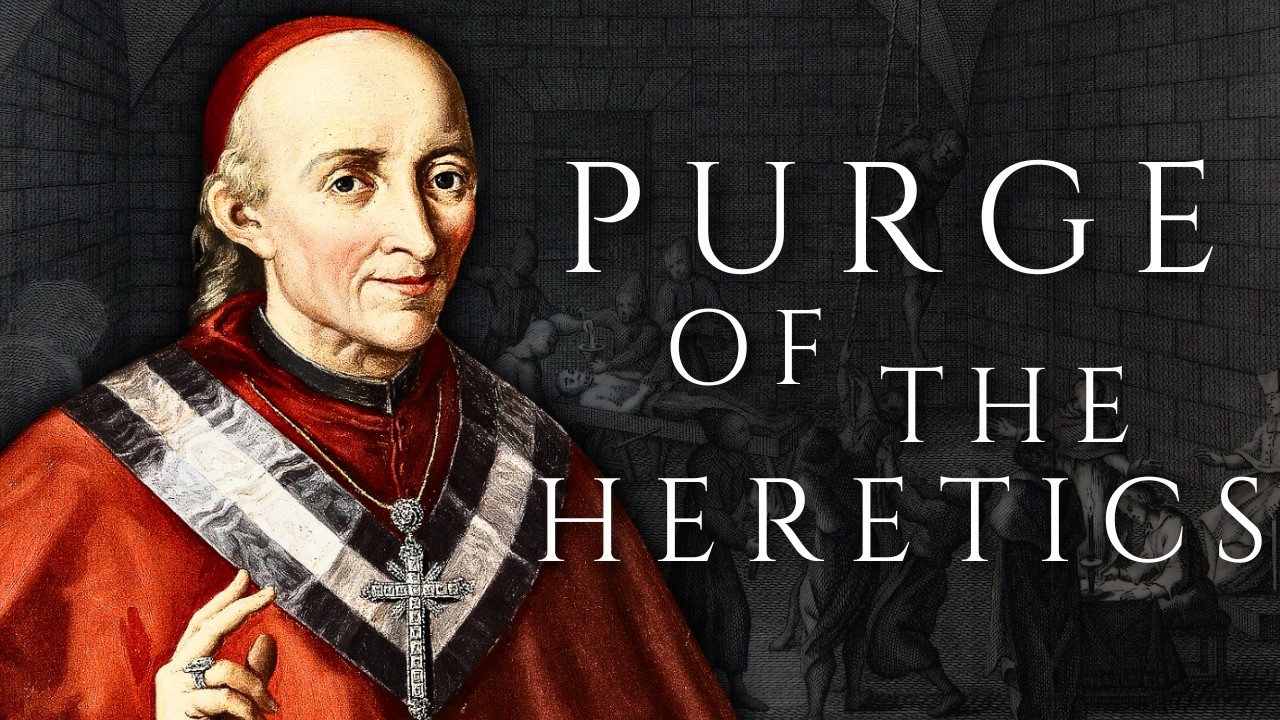
That was the entire charge. Two customs, sworn to by people she was never allowed to face, served as the legally sufficient mark of a secret Jew. When the accusation was at last laid before her, she freely conceded the habits. She simply rejected the meaning attached to them.
She did not eat pork, she explained, because it sickened her; she had been that way from childhood. As for the linen, she changed it because it was clean and agreeable, not on account of any law of Moses. With that reply, she stepped straight into the deepest snare of inquisitorial law, the matter of intention. The acts themselves were established and admitted.
What stayed uncertain was the interior of her mind. The tribunal’s answer was to vote her to the torture, in the formal wording, on intention: to inflict bodily pain upon a woman in order to determine the motive behind her laundering. Before anything commenced, the formal protestation was read aloud. The prisoner was cautioned that should she die during the torture, or suffer broken bones, or loss of blood, or mutilation, the blame and the sin would rest upon her alone for refusing to speak the truth, and not upon the tribunal.
They made the victim legally answerable in advance for whatever they were about to inflict upon her body. Then she was ordered to be stripped. For a respectable woman of sixteenth-century Spain, standing naked in a cellar before a room of clergymen and officials was already a violation so profound that the transcripts show prisoners pleading during the disrobing before anyone had touched them. Elvira did.
The record has her crying out as the garments were removed. “Señores, I have done all that is said of me, and I bear false witness against myself, for I do not want to see myself in such trouble. Please God, I have done nothing.”
She was offering a confession and taking it back in the same breath, imploring them to accept a guilty plea she was at the same moment telling them was a lie.
The session opened with the cords. The potro was the workhorse of the Spanish tribunals, a trestle frame on which the prisoner was bound with ropes wound about the limbs, each rope drawn tighter by twisting a stick, a garrot turn after turn, until the cords cut through skin and into muscle. The transcript counts the turns. One cord on the arms twisted, and the admonition was repeated: “Tell the truth.”
She said she had nothing to tell. Another turn. She screamed. The notary recorded that she screamed.
Then the words began spilling out, as the notary set them down. “Tell me what you want, for I don’t know what to say. Loosen me, señores, and tell me what I have to say. I do not know what I have done.
Oh Lord, have mercy on me, a sinner.” More turns. “I did not eat pork, for it made me sick. I have done everything.
Loosen me, and I will tell the truth.” They loosened nothing. She was asked to state what she had done, and she replied, “What am I wanted to tell? I did it, and I have confessed.
Señor, remind me of what I have to say, for I don’t know it.” A woman begging her torturers to name the crime so she could confess to it. The tribunal refused, because a prompted confession was procedurally worthless. The entire point was that she had to produce, from her own mouth, unprompted, a confession matching evidence she had never seen.
She said her arms were breaking. She asked why they would not tell her what to say. She said, again and again, that she had done it, whatever it was, that she was a sinner, that they should name the thing and she would swear to it. Then they moved her to the water.
The apparatus for the toca was a sloped trestle, sometimes called the escalera, the ladder, with sharpened rungs pressing into the back. The prisoner was bound onto it, head downward. An iron band across the forehead, an iron prong forcing the jaws apart. A strip of linen, the toca itself, was pushed into the mouth and down into the throat, and then water was poured from a jar holding a little over a quart, soaking down the cloth, so that the prisoner swallowed and inhaled and drowned by degrees on dry land.
The tribunals measured the severity of a session in jars. Elvira’s session, by the tribunal’s own standards, was recorded as mild. She was given only a single jar. Somewhere in the middle of it, she was asked once more to state plainly what she had done.
“Señores,” she asked, “why will you not tell me what I have to say?” And shortly after, “I said that I did not want to eat it,” meaning the pork. The session was, in the record’s own word, suspended. Four days later, they brought her back down.
The manuals and the medical men of the tribunals understood something about the human body that the four-day gap deliberately exploited. Torn muscle and bruised tissue stiffen. A limb that has been corded and released is far more sensitive on the fourth day than on the first. The second session was legally the same session as the first, a continuation, so the rule permitting only one application of torture remained pristine in the file.
The transcript of the second session is shorter. Confronted with the trestle and the cords again on a body four days into its bruising, Elvira del Campo broke. She confessed to Judaism, to having observed the law of Moses in her heart, the intention they had been mining for. Within twenty-four hours, by rule, the confession had to be ratified.
The prisoner, back in a normal room away from the instruments, was asked to confirm freely what she had said under torture. Prisoners who revoked faced the obvious problem: a revoked confession put the file back where it started, and the session, legally, had merely been suspended. Almost everyone ratified. Elvira ratified.
She appeared at an auto-da-fé, was formally reconciled to the church, had her property confiscated, and was sentenced to the San Benito and a term of imprisonment. Her children inherited nothing except the name on the sack that went up on a church wall in Toledo. A 19th-century historian, Henry Charles Lea, a sober man not given to editorializing, described the recording of her case as passionless and business-like, and singled out this transcript out of the thousands he had handled as almost unbearable. That church wall, and the painted sack, were the finish line of a process far older than Toledo.
The tale begins roughly three and a half centuries before Elvira’s rack, in the Languedoc, in the south of what is today France. By the late 1100s, Rome regarded the region as infected. The people who worried Rome called themselves good Christians. History calls them Cathars.
Their beliefs went approximately like this: the physical world is evil. A good God created the realm of spirit, and a dark power created everything you can touch, your own body included. The Catholic Church, with its gold and land and bishops living like princes, was a fraud constructed by the dark power to hold souls imprisoned in matter. The movement had a spiritual elite known as the perfecti, men and women who had received a laying on of hands and afterward lived on almost nothing.
Ordinary believers lived normal lives and hoped to receive the laying on of hands on their deathbeds. The perfecti were visibly, publicly holier than the local Catholic clergy, and the region’s nobility tolerated them, protected them, and in many cases were related to them. Rome escalated in stages. In 1184, Pope Lucius III issued a decree ordering bishops to actively hunt for heretics in their dioceses.
In 1215, the Fourth Lateran Council tightened the machinery. But the event that turned paperwork into fire came in January 1208, when a papal legate named Pierre de Castelnau was murdered on the banks of the Rhone. The killer was presumed to be a man of the Count of Toulouse, Raymond VI. Pope Innocent III responded by declaring a crusade against Christians, or people who at least considered themselves Christians, in the middle of Europe.
Knights from the north of France came south in the summer of 1209 in enormous numbers. The first major town in their path was Béziers. On the 22nd of July, 1209, the town refused to hand over its heretics. The Catholic majority inside the walls declined to surrender their neighbors.
The assault came fast, and the town died in an afternoon. The Papal Legate traveling with the army, a Cistercian Abbot named Arnaud Amalric, wrote a report to Pope Innocent shortly afterward. His letter survives. “Our men,” he told the Pope, “spared no one, regardless of rank or sex or age, and put to the sword almost 20,000 people.
” The tone is triumph. The town was then burned, and Amalric described the divine vengeance as marvelous. You have probably heard the famous line attached to Béziers: “Kill them all. God will know his own.
” It does not appear in Amalric’s letter or in any eyewitness account. It shows up about a decade later in a book of moral stories compiled by a German monk named Caesarius of Heisterbach, who was careful to write that Amalric is reported to have said it. What needs no hedge is the letter. Whatever Amalric said in the moment, he told the Pope in writing that his army had killed nearly everyone in a town, sorted no one, and framed it as a miracle.
People had crowded into the churches as the sack began. The Church of Mary Magdalene was full of them. The building was set alight, or its occupants were cut down inside it, and either way, nobody walked out. The number 20,000 is probably inflated, but archaeology and every written source agree that Béziers, on that day, essentially stopped existing as a community.
Word traveled ahead of the army. Carcassonne, the next great fortress town, held out for a couple of weeks in the August heat until the water gave out, then surrendered on terms that give you a picture by themselves. The entire population was allowed to leave alive and required to leave everything. The town behind them was handed over intact to the army’s new military commander, Simon de Montfort, a minor lord from near Paris.
Ferociously pious, ferociously capable, and about to become the most feared man in the south for the next nine years. De Montfort’s war settled into sieges, and the sieges settled into a pattern. In the early summer of 1210, he surrounded Minerve, a village on a rock spur where two river gorges meet. His engineers built a catapult the soldiers nicknamed Malvoisine, the bad neighbor, and pounded the path to the village’s one weakness, a covered well at the base of the cliff, until nobody could reach water.
When the town surrendered, the fighting men and ordinary residents were spared. Inside, though, were about 140 Cathar perfecti. They were offered their lives if they would convert. Contemporary accounts say a huge fire was built in the valley, and the perfecti walked into it on their own.
A chronicler of the crusade wrote that only three women recanted and were pulled out. The rest, something like 140 people, burned in that gorge over the space of an afternoon. It was the first of the great mass burnings of the war, and it set the precedent that the fire, not the sword, was the proper end for a heretic. The following spring at Lavaur, the pattern got worse.
The town fell in May of 1211 after a hard siege. Eighty knights who had defended the walls were sentenced to hang, and when the gallows collapsed under the first man, de Montfort had the rest put to the sword instead, apparently out of impatience. The lady of the town, Geralda de Laurac, was handed to the soldiers, thrown down a well, and buried under stones thrown in after her. Then somewhere between three and four hundred Cathar perfecti and believers were burned together in a meadow outside the walls, the largest single burning of the entire crusade.
A chronicler on the crusader side recorded the event in a phrase that has stuck to it ever since: the crusaders burned them with immense joy. The war went on like that, back and forth, for another two decades, through the death of de Montfort, killed at the siege of Toulouse in 1218 when a stone from a catapult reportedly operated by the women and girls of the town struck him in the head, through treaties, relapses, and a slow grinding French royal takeover of the whole region. But military force had a limitation. You can burn a town.
You cannot besiege an idea. Believers went quiet, went underground, met at night, and the perfecti kept moving from farmhouse to farmhouse under cover of darkness. Killing heretics at scale had failed to kill heresy. What came next was designed to succeed where the army hadn’t.
Between 1231 and 1233, Pope Gregory IX began appointing full-time professional heresy investigators answering directly to Rome, bypassing the local bishops who had proven either too lazy, too compromised, or too closely related to the suspects to do the job. He staffed the new office mostly from the Dominicans. The Latin word for an investigator is inquisitor. The procedure they ran was an inquisitio, an inquiry.
No one in that era would have described the Inquisition as a single institution. Through most of the Middle Ages it was a legal process plus a loose collection of appointed individuals. Yet those individuals worked from the same manuals, followed the same techniques, and shared a common grasp of the mission: to make it impossible to conceal heresy. The first wave drew a distinctive kind of recruit.
Conrad of Marburg had built his name in Germany as confessor and spiritual guide to Elizabeth of Hungary, later Saint Elizabeth, a woman renowned for her generosity to the poor. Even measured against the customs of the day, the way he handled her was savage. He cut her off from her children, struck her, and by some reports had her flogged for disobedience. She was dead at 24, utterly spent.
Then in 1231 Gregory installed him as the first papal inquisitor in the German territories, and Conrad set to work armed with a theory. Concealed within the population were clandestine devil-worshippers who kissed toads and summoned demonic forms to midnight assemblies. His approach was built on speed. A denunciation from anyone, no matter how it was come by, sufficed.
The accused could either confess and give up their associates, or burn. A trial might open and close within a single day. He traveled the Rhineland circuit on a mule with assistants trailing behind, and his own contemporaries, churchmen rather than doubters, called his courts monstrous; one chronicler noted that he burned the innocent and the guilty without distinction. Conrad then made the error of accusing a count of belonging to the conspiracy.
The count insisted on a proper hearing before bishops, was exonerated, and not long after, on the 30th of July, 1233, Conrad was set upon on the road near Marburg and cut down together with his companion. The Pope grieved for him as a martyr. Germany, tellingly, showed no eagerness to appoint a successor. France would produce a comparable figure with an even murkier background.
Robert le Bougre, Robert the Bulgarian, the nickname being an insult meaning roughly Robert the heretic, since he was a convert who had supposedly spent years living among the Cathars before he joined the Dominicans, was made an inquisitor in northern France around 1233. Converts who hunt their former fellow believers tend to be effective, and Robert was ruinous because he understood the signals, the catchphrases, the network. He also, according to the accounts that have come down to us, hardly troubled himself with procedure. His crowning act came on the 29th of May 1239 at a spot called Montaimé in Champagne, where a heretical community had endured for generations.
Robert showed up and in roughly one week, a single week for the whole business of investigation, trial, and sentencing of an entire community, he had condemned some 180 people. They were burned together on one day in a single gigantic fire on the hillside before the Count of Champagne and a crowd of nobles and prelates assembled as though for a celebration. A monastic chronicler noted the number and the date and moved on. Robert’s career ultimately fell apart amid complaints about his methods.
The church quietly set him aside, and one tradition holds that he finished his days in prison. Down in the south, the final act of the Cathar war was drawing near, and it played out on a mountain. Montségur rests atop a limestone crag in the foothills of the Pyrenees, higher than the clouds. By the 1240s it had grown into the unofficial capital of what survived of the Cathar church, housing a garrison of soldiers and a community of perfecti, among them bishops of the faith.
After Cathar sympathizers tied to the fortress murdered a group of inquisitors in their beds at Avignonet in 1242, the French crown resolved that Montségur had to be finished. The siege dragged on for about ten months through a winter in the mountains, with supplies hauled up the cliff paths at night, until Basque mercenaries climbed a rock face the defenders had judged impossible and seized an outwork. The garrison negotiated a surrender containing an odd fifteen-day truce, and the terms were the customary ones. Soldiers go free, believers who recant go free, perfecti who refuse to recant burn.
Across those fifteen days, a number of the ordinary defenders, soldiers and their wives, people who were at liberty to walk away, requested the consolamentum. With the fire already visible in their future, they chose to convert into the very category that ensured their death. On the 16th of March, 1244, somewhere between 210 and 215 people were led down the mountain path. A palisade had been erected in the field at the foot and filled with pyre wood.
They were penned together inside the fence of stakes and burned as a mass. The meadow below the mountain is still known as the Prat dels Cremats, the field of the burned. On the night before the burning, a handful of perfecti were lowered on ropes down the sheer cliff of the mountain, carrying off the church’s remaining treasure and writings, and disappeared into the caves of the Sabarthez. Treasure seekers have been digging that countryside ever since.
Catharism outlived Montségur by a few generations, in hiding, but as a public faith with a home it perished in that field. Eight years afterward, the legal structure caught up with the practice. In 1252, Pope Innocent IV issued a bull titled Ad extirpanda. Among its clauses, it formally sanctioned the use of torture to wring confessions from accused heretics.
Torture was not a papal invention, but this document drew it inside the church’s own procedure, with conditions attached. The torture was to fall short of death or the loss of a limb. It was to be administered only once. It was meant to be employed only where the evidence was already compelling.
Those restrictions sound nearly humane until you observe how each one fared in practice. Only once turned into a fiction almost at once through a bit of legal cleverness. A torture session that finished without a confession was never recorded as finished. It had simply been paused, and a paused session could be resumed on another day, and a resumption, in legal terms, was still the first session.
A man could be tortured on Monday, Thursday, and the Tuesday after, and the record would show a single ongoing application of torture. As for the ban on bloodshed and mutilation, the methods that grew standard were chosen specifically to satisfy it on a technicality. Ropes, water, and stretching destroy people on the inside while leaving the outside more or less presentable. And in 1256, Pope Alexander IV supplied the final convenience.
Inquisitors were granted the power to absolve one another for any irregularities committed in the course of the work. If something went wrong in the chamber, if a session went too far, if a prisoner died, the inquisitor could be cleansed of it by the colleague seated across from him. The man who shows you what the mature system looked like is Bernard Gui, inquisitor of Toulouse from 1307 to 1323. Gui wrote the profession’s great handbook, a manual setting out how to interrogate each sect.
The ledger of verdicts that survives from his tenure spans his whole period in office, more than 630 rulings in all. Around 42 or 43 of those condemned were delivered up to be burned alive. Some 69 further verdicts were handed down against the deceased, their bodies ordered exhumed from consecrated soil, hauled through the streets and set alight, in some cases many decades after they had been buried. Still hundreds more were consigned to prison.
Yet the registers were a weapon whose effect long outlived any single verdict. Gui’s files were indexed, cross-referenced, sorted by family and by village, so a man interrogated in 1320 could be faced with his own grandmother’s confession from 1270. Your family’s dossier never shut. The people of the Languedoc learned to live as if anything spoken before any witness might one day be committed to paper, because it might.
A text from this period turned into the trade’s bible. In 1376 the Inquisitor General of Aragon, Nicholas Eymerich, put together the Directorium Inquisitorum, a full operating manual that remained in service for three centuries. Eymerich is candid to a disarming degree. He grumbles that torture is an unreliable instrument, observing that the feeble will admit to anything and the sturdy will endure anything, and then he goes on to explain how to employ it regardless.
He gives a chapter to the verbal ruses heretics use under interrogation, and a companion chapter of ruses for the interrogator. Pretend to hold evidence you lack. Rifle through documents as if the file already holds everything. Feign sympathy.
Have a colleague act the part of the kindly visitor. Offer mercy, while privately meaning the mercy owed to the church or the state rather than to the prisoner. Place an informer among the inmates. Every one of those tactics shows up in practice in the transcripts centuries afterward.
And when the Directorium was reissued in Rome in 1578, a canon lawyer by the name of Francisco Peña provided a commentary, and in it he set down a line that historians of the institution quote more than any other. We must bear in mind, Peña counseled his colleagues, that the true purpose of the trial and the death sentence is not the salvation of the accused’s soul but the securing of the public good and the terrorizing of the people. Punishment as instruction, the stake as a teaching device. The medieval form of this machine wore the Cathars away into nothing across roughly a century, and then, its original quarry gone, fell comparatively silent through most of Europe.
The tale might nearly stop there, a bleak medieval chapter. Instead, in the late 1400s the entire apparatus was taken up, rebuilt, and wired into the strength of a modern centralizing state. To see it, we cross the Pyrenees. Medieval Spain had held the biggest Jewish population in Europe, communities settled on the peninsula since Roman days.
That world shattered in the summer of 1391, with anti-Jewish riots that started in Seville and spread from city to city. For months crowds ransacked the Jewish quarters, killing thousands and putting the survivors to a choice at sword point: baptism or death. Vast numbers chose baptism. Across the following decades more came after them, until by the middle of the 1400s Spain held hundreds of thousands of conversos, new Christians.
Some took wholeheartedly to the new faith. Some converted in name alone while keeping the old observances behind closed doors. Most likely dwelled somewhere in the hazy middle. And crucially, conversos, being legally Christian, could now do everything the law had forbidden Jews to do.
They moved into the town councils, the cathedral chapters, the universities, the royal service, and they wed into the nobility, and they flourished, and the old Christian population watched them flourish and grasped for a new species of hatred, since the old religious hatred no longer strictly applied to baptized Catholics. The new variety fastened on blood. In 1449, amid a tax revolt in Toledo, the city government issued a decree known as the Sentencia Estatuto, excluding anyone of Jewish descent from holding any office in the city, no matter how sincere their faith or how many generations had passed since the conversion. The Pope condemned it within months.
The notion outlasted his objection by roughly 400 years. Picture Spain in the 1470s: an enormous, resented converso population, a widespread conviction that many of them were secret Jews mocking the sacraments, and two fresh monarchs, Ferdinand of Aragon and Isabella of Castile, who had just waged a civil war for the throne and wanted their hastily assembled kingdoms unified, orderly and beyond question Catholic. In 1478, at their bidding, the Pope issued a bull permitting them to set up an Inquisition in Castile. And a single change made the Spanish version unique in history.
This Inquisition would be named by the crown, operated under the crown, financed by the confiscated property of those it condemned, with that property flowing into the royal treasury. Rome had forged the weapon. Spain carried the weapon home and aimed it. The first tribunal opened for business in Seville, and the dread arrived before the inquisitors had finished unpacking.
Thousands of conversos simply abandoned the city at the news. The tribunal answered by declaring that flight was itself proof of guilt. On the 6th of February, 1481, Seville staged the first auto-da-fé of the Spanish Inquisition, and six men and women were burned alive. Within days there were more.
Seville erected a permanent burning platform beyond the walls, a stone stage called the quemadero, with four great statues at its corners. A permanent fixture, funded and constructed on the premise that the burning of citizens was now a part of civic life, like a market or a fountain. The most meticulous modern archival research indicates that up to roughly 1530 the Spanish tribunals put to death somewhere near 2,000 people, the vast majority of them conversos accused of secretly practicing Judaism. That opening half century accounts for more than three quarters of all the people the Spanish Inquisition would ever kill.
In Ciudad Real, a small city, the visiting tribunal held an auto on the 23rd of February, 1484, at which 30 people were burned alive in one day, together with 40 effigies of the dead and the fugitive. If a suspect died in prison before sentencing, or died peacefully years before ever being accused, or fled abroad, the tribunal did not regard the case as finished. A life-sized figure was fashioned, dressed in the penitential garment, and the figure was formally sentenced and burned in the person’s stead. The heirs still forfeited the inheritance, since a posthumous conviction voided the estate retroactively.
Escape, even escape by dying, was not acknowledged. Presiding over the system as it expanded was the man whose name turned into a byword for the entire enterprise, Tomás de Torquemada, Dominican friar, confessor to Queen Isabella, named the first Inquisitor General. Several early sources report that Torquemada himself sprang from a family with converso blood a couple of generations back. He was austere, tireless, incorruptible where money was concerned, and utterly convinced.
In 1484 he issued the instructions that standardized procedure across every tribunal, and in article 15, when torture may be applied. Where the evidence amounts to half proof, the accused may be put to the question. Half proof. One witness instead of two, or strong suspicion without confession.
Throughout Torquemada’s fifteen-year tenure, the machinery operated at its most intense, and even people of that era found it hard to stomach. In Zaragoza in 1485, conversos genuinely did kill an inquisitor, Pedro de Arbués, striking him down at midnight as he knelt in prayer inside the cathedral. Beneath his robes he wore a chain mail shirt and a steel skullcap, so his attackers went for his throat. The ensuing manhunt shattered the converso elite of Aragon.
The assassins met gruesome ends, and Arbués was made a martyr and in time a saint. A single murder secured the tribunal a hundred years of momentum. Then 1492 arrived, along with the decision that remade the peninsula. In January, Granada, the final Muslim kingdom in Spain, capitulated.
In March, the monarchs put their names to the Alhambra decree. Every Jew in Castile and Aragon who had not converted was given until the end of July to accept baptism or abandon the kingdoms forever under threat of death, carrying away no gold or minted coin. The decree itself contends that the presence of observant Jews lured the conversos back toward their ancestral faith. Thus the Inquisition’s project of purifying the new Christians demanded the removal of the old community altogether.
Figures for how many people departed into exile that summer vary enormously, from 40,000 up to roughly 200,000. A parish priest by the name of Andrés Bernáldez, hardly a friend to the Jews, recorded the exodus in his chronicle. Households parted with whatever could not be carried for any price offered in the frenzy of a forced market. A house went for a donkey, a vineyard for a scrap of cloth.
He recounts the roads to the ports crowded with families on foot, the young bearing the old, women bearing children, some giving birth at the roadside, others dying there. The rabbis had the young people sing and beat tambourines as they marched to lift the people’s spirits. At the harbors, vessels overloaded beyond capacity, captains who collected payment and then robbed or drowned their passengers, pestilence below decks, exiles abandoned on North African shores and fleeced by bandits. Tales made the rounds of passengers slain at sea by crews who had heard the refugees had swallowed their gold coins and cut them open to look.
Communities that had dwelt in Spain for a thousand years were extinguished in one summer. Now observe how the trap snapped shut. Every Jew who converted before that deadline, instead of departing, fell at once under the Inquisition’s authority. The tribunal had no power over a professing Jew who stood outside the church.
One who had been baptized was inside and observable forever. The tribunals would sustain themselves on that population for two hundred years. How did it function in practice, from the standpoint of a person snared within it? Stage by stage, the procedure is where the cruelty resided.
The flames draw the eye, but burnings were uncommon beside this. The process engulfed tens of thousands of people, and it was designed to produce the greatest possible terror at each stage while keeping the records spotless. It typically opened with a sermon. When a tribunal reached a district, the inquisitors issued what was known as an Edict of Grace, and later an Edict of Faith.
The town gathered in the church, attendance all but mandatory, and heard a detailed catalogue of heresies. Anyone guilty of the listed practices had a window, usually thirty or forty days, to step forward willingly and confess. Confess inside that window, and you would be reconciled leniently, spared the stake and the confiscation. One condition: a confession counted as full and sincere only if you also named everyone else.
A confession that shielded your circle was by definition incomplete, and an incomplete confession was worse than none at all. Then, once the period of grace lapsed, the same edict obligated every good Christian, on pain of excommunication and prosecution, to denounce anyone they suspected, not knew. Suspected. A community that had heard that sermon walked out of the church changed.
Every servant was now a possible informant with a legal obligation. Every grudge had a place to be deposited. Once the file grew thick enough, the tribunal issued an arrest order, and the arrest itself was engineered for terror. The familiars, lay agents of the Holy Office, came for people after dark.
A knock, a warrant, and a person departed their home and vanished from the world into the cárceles secretas, the secret prisons. Incommunicado, utterly. No visitors, no letters, no messages in or out. Families were told nothing.
Not the charge, not the whereabouts, at times not even a confirmation of custody. At the instant of arrest, the prisoner’s possessions were catalogued down to the spoons and seized, held by the tribunal. The expense of the prisoner’s food and the wages of the jailers and the costs of the trial were drawn from the sequestered estate. You paid for your own imprisonment.
A lengthy trial could devour a family’s whole fortune before any verdict was reached, so that even a man acquitted might return after four years to find his children begging and his business vanished. If the verdict went the opposite way, confiscation was complete and retroactive. Because heresy was reckoned from the moment of the first offense, not the conviction, every sale, dowry, and gift the condemned had made over the intervening decades could be annulled and reclaimed. Purchase a vineyard in good faith from a man who fifteen years afterward was posthumously convicted, and the tribunal could seize the vineyard from you.
Conducting business with a converso became a financial hazard in its own right. Within the prison, time was a weapon. Months routinely elapsed before a prisoner learned why he was held there. One modern historian determined the Inquisition’s cells were frequently better maintained than the royal prisons, and prisoners of the secular courts sometimes blasphemed deliberately to be transferred into inquisitorial custody, where at least the food came.
What did the harm in those cells was the silence. When the hearings at last commenced, they began with a stroke of sheer psychological brilliance. The prisoner was brought before the inquisitors, made to swear on the cross, and invited to confess. “Confess what?
” he would ask. That, they would not reveal. “Examine your conscience,” they would say, “and confess the sins that brought you here, for surely a man knows his own offenses.” The tribunal never disclosed the charge.
You were forced to guess it. An innocent man now had to scour his whole life for the crime, aware that guessing wrong was ruinous in either direction. Confess to something they did not hold, and you had handed them a fresh crime. Deny everything while they possessed solid testimony, and you were an impenitent heretic resting on his guilt, and impenitence was precisely the quality that kindled the fires.
Prisoners shattered themselves against this. In time, a formal accusation was published, assembled from testimony whose sources stayed hidden. The witnesses were never identified. Their statements were altered before the accused saw them, shorn of any date, place, or detail that might betray who had spoken.
You had no way to face the person who accused you. A defense advocate was appointed from a roster the tribunal itself approved, and his formal obligation, once he felt certain of your guilt, ran toward the court rather than toward you. Your two usable instruments were tachas and abonos. You could hand in a roster of everyone you could summon to mind who bore you hatred, with the reasons, in the hope of blindly striking a concealed witness.
And you could summon witnesses to your character. Prisoners sat in their cells drawing up lists of their own enemies. Children turned in parents. Wives turned in husbands.
Anyone arrested and awaiting torture purchased leniency with names, and the names closest at hand, the people you had actually watched light candles or pass up pork, were your own kin. Full reconciliation demanded completeness. Protecting your mother canceled your confession. The tribunal termed this the discovery of complices.
Accomplices. That is the word the files use for your family. And through all of it, at every hearing, in a corner of every room, the notary was present. Everything was written down.
Questions, answers, dodges, silences recorded as silences, and in the torture chamber, screams recorded as screams. The Holy Office kept records more rigorously than any other institution in early modern Europe. And its archives, millions of pages strong, are why we can stand in a particular basement in Toledo on particular dates in 1568 beside Elvira del Campo. Place Elvira’s file next to that of another woman from the same archive, Marina González of Ciudad Real, a generation before.
Marina had confessed freely under an edict of grace back in the 1480s, been reconciled, and returned to her life. And reconciliation was offered only once. Years afterward, she was denounced again, the same familiar markers, the clean linen, the avoided pork, now escalated into relapse. And a relapsed heretic was by definition past all mercy.
She was tortured with the water jars. She was condemned, and she went to the fire. What separated a sack on a wall from a stake was, in the end, timing. The sentence itself was pronounced at the ceremony everyone has heard of, the auto-da-fé, the act of faith, a public rite in which justice was carried out as worship.
Strictly speaking, nobody was burned at an auto-da-fé. The auto was the religious ceremony, the procession, the mass, the sermon, the solemn public reading of every sentence. The church put no one to death. Its formula for the condemned was that they were relaxed to the secular arm, handed over, released, relaxed, one of history’s great obscene euphemisms, accompanied by an official request that the civil authorities show them mercy and avoid the shedding of blood.
Everyone involved in the transaction understood that without shedding of blood meant fire. The state carried out the killing at a separate location, typically beyond the walls, at the quemadero. To witness a great auto at full scale, stand in the Plaza Mayor of Madrid on the 30th of June, 1680. The event was in part a celebration.
The young king, Charles II, had lately wed a French princess, and the capital’s tribunal staged a lavish auto in honor of the marriage, a wedding gift made up of 118 prisoners. The evening before, the green cross procession moved through Madrid by torchlight. The day itself started before dawn and lasted roughly fourteen hours. The prisoners were led out in meticulous order of mounting gravity along streets crammed with what contemporaries put at 50,000 onlookers.
First came the effigies on green poles, some paired with small trunks painted with flames and holding exhumed bones. Then the penitents in ascending order of ruin. And at the back, the relajados, those bound for the fire in black San Benitos painted with flames and devils, wearing the coroza, the tall pasteboard cone painted to match. On the scaffold, the sentences were chanted one after another, and with 118 cases, that consumed the whole day.
The king sat through every moment. At one point, the Inquisitor General climbed to the royal box, and Charles, sovereign of half the world, swore a formal oath on the cross to defend the Holy Office and denounce its enemies. The tribunal placed the oath in the king’s mouth. Of the 118, 104 stood accused as Judaizers, most of them of Portuguese origin.
Dozens were reconciled with prison, galleys, or the lash. 22 burned in effigy. Eight burned as corpses or bones. And 18 or 19 living human beings were condemned to the fire.
When the ceremony at last ended at nightfall, the relajados were loaded onto donkeys and taken out the gate to the brasero, a raised platform sixty feet square. A condemned prisoner who confessed and kissed the cross, even at the stake itself, received the mercy of the garrote, and the fire consumed a corpse. A prisoner who refused burned alive. Del Olmo and the other accounts from Madrid that night record both outcomes.
Most accepted the crucifix in the end. A few refused, and among the refusals, the accounts single out one man who, as the flames rose, was seen to be still moving in the fire for a long while. Burning a living human being is slow work. 50,000 people carried that home from the wedding celebration.
The accounts also note food vendors. Most sentences handed down at an auto fell short of death and were designed to grind instead. Scourging was routine, and the files show 200 lashes given to women in their 60s and 70s. The galleys were slower, a term at the oar chained to a rowing bench, understood by everyone who pronounced it as a death sentence paid in installments.
So-called perpetual prison generally eased after a few years into a marked liberty. And that marked liberty was a quiet sentence of its own. A reconciled penitent stepped out into civil death. Shut out from public office, from the professions, from bearing arms, from riding a horse, from wearing silk, gold, or jewels.
And the same prohibitions fell upon their children and, for men, their grandchildren, none of whom had been convicted of anything. Then the San Benito went up on the parish wall, and the announcement became permanent. After the auto, each penitent’s San Benito, painted with their name, their crime, and their punishment, was hung in their home parish by regulation, permanently. An instruction from 1561 set out the purpose in plain administrative language: the garments were to hang in the churches where the condemned had lived, so that the infamy of the heretics and their descendants would be remembered forever.
Sextons and notaries were tasked with renewing the fading garments. Inventories were taken to ensure none had quietly vanished, because families did try to make them vanish, and being caught removing your grandfather’s San Benito was itself an offense against the Holy Office. The hanging sack fed straight into the purity of blood machinery. Through the 1500s, those statutes spread through Spanish institutions, cathedral chapters, the military orders, the elite colleges, town councils, in the end even some guilds, each demanding proof that a candidate carried no Jewish or Muslim ancestry and no inquisitorial stain anywhere in the family tree.
Candidates submitted to genealogical inquiries into their own backgrounds, known as probanzas, complete with sworn testimony and archival digging. And there was one thing a probanza could never withstand: an ancestor’s name posted on a parish wall. Those sacks hung there, in practice, as a public family-tree register of the condemned. Men were turned away from religious orders because of a great-great-grandmother.
Families hired forgers to scrub their lineages clean. On Majorca, where the sacks hung longest and the community was tightest, fifteen surnames belonging to the condemned of the 1600s hardened into a permanent hereditary caste, the Xuetes, marrying only among themselves since no one else would have them, and still meeting with refusals of marriage and social shunning within the lifetimes of people living today. The formal blood-purity rules for Spanish military and government positions were struck down by decree in the 1860s and 1870. A legal edifice born in a 1449 tax riot outlived the Inquisition itself and had to be pulled apart while railways were going up.
The autos were shipped out wholesale to the empire. And it is in Mexico that the archives preserve the most complete family tragedy the institution ever set down, a tale spanning sixty years and two generations, with a written voice at its heart because one of the victims left behind his autobiography. He composed it in secret in handwriting so tiny it strains modern eyes, in a book the size of a deck of cards, and the sole reason it survives is that his persecutors filed it away as evidence. The Carvajals arrived in Mexico as a success story.
Luis de Carvajal y de la Cueva, known as the elder, was a Portuguese-born conquistador and slaver turned governor, who in 1579 secured a royal contract to conquer and settle an enormous territory in northern Mexico, the new kingdom of León. He received the rare privilege of recruiting settlers without the usual proof of clean blood. So he packed his ships with his own extended family, more than a hundred people, and a great many of them were secret Jews. The governor himself was a sincere Catholic.
He evidently knew what his relatives were and turned a blind eye, and that blind eye is what ruined him. In 1589, the Mexican tribunal arrested the family, and the governor was convicted not of Judaizing but of hiding it. Deprived of his governorship and sentenced to exile, he died in a cell before he could serve the term. The tribunal would spend the next sixty years working through the people he had brought across.
Francisca’s son Luis, the governor’s nephew and namesake, was in his early twenties at the time of the first arrest. We have him from two sides: the tribunal’s transcripts of him and his own secret memoir, written in a microscopic hand in notebooks that fit in a palm, the earliest known Jewish writing composed in the Americas. In it he calls himself Joseph Lumbroso, Joseph the enlightened, and describes circumcising himself in a ravine with a pair of worn scissors, a boy alone in a canyon in northern Mexico operating on himself with shears in obedience to a verse in Genesis, and he sets it down as the proudest day of his life. The first trial in 1589 and 90 swept up Luis, his mother, and several of his sisters.
His mother Francisca was tortured. He was not, that first time, but he was forced to watch what the process did to her. At the auto of 1590, the family appeared in San Benitos and were reconciled, with prison terms and perpetual habits. Luis served part of his sentence as a scribe and teacher at a college where the friars grew fond of him and gave him free run of a library full of scripture.
The irony went unnoticed by all. The Holy Office had sentenced a hungry young crypto-Jew to several years inside a building full of Hebrew learning. His faith emerged from reconciliation hotter than it had entered. The family took up their observances again, more cautiously now, fasting in caves, praying behind locked doors.
And Luis kept his little chronicle of all of it. Every page of it was, under the law he lived beneath, a death warrant in his own hand. They came back for the family in 1595. A denunciation from inside the wider community, from a man the family trusted, brought the whole network down.
Luis in one cell, his mother and sisters in others, none of them aware of what the rest had said. Luis at first confessed nothing, then admitted his own guilt but shielded everyone else. From his cell, he tried to keep the family together by smuggled signals. Messages to his sisters hidden in fruit.
A pear with a note where the core should be. Verses sung loudly enough to carry through walls. Coded reassurances passed along by a sympathetic fellow prisoner who was, naturally, reporting everything. In February of 1596, they took him to the chamber.
The cords went on, and he screamed the same universal sentences, that he would say whatever they wanted, that they should tell him what to say. Then, turn by turn, he broke in the precise way the procedure was built to produce. Completeness was the requirement. Across the sessions that followed, Luis de Carvajal gave the tribunal over 120 names.
His mother, every sister, cousins, friends, associates throughout New Spain. As a relapsed heretic, already reconciled once, he stood legally beyond mercy, and so did his mother and three of his sisters. Other prisoners later testified they heard him at night, and at one point he tried to destroy himself by jumping from a window during the proceedings, and survived, broken, to be nursed back to health for execution. The auto came on the 8th of December 1596 in the great plaza of Mexico City.
Luis walked in the procession with his mother Francisca and his sisters Isabel, Catalina, and Leonor, all in the painted San Benitos, all condemned to relaxation. He accepted the crucifix, and so did his mother and sisters, and they were granted the garrote, strangled at the stake one after another, a family in a row, and then the fires were lit beneath the bodies. He was about 30. A fourth sister, Mariana, was not burned that day because her mind had given way during the family’s destruction, and even this tribunal hesitated briefly at burning the insane.
They waited. In 1601, judged recovered enough to be held responsible, Mariana de Carvajal was burned. Then in the 1640s, the politics shifted. Portugal rose in revolt against the Spanish crown, and every Portuguese converso in the empire became a suspected traitor twice over.
The Mexican tribunal launched the sweep known as the great conspiracy trials. Hundreds of arrests. It all drained toward the 11th of April 1649, and the ceremony remembered as the grand auto-da-fé, the largest ever staged in the Americas. 109 cases, tens of thousands of spectators.
In the end, 13 flesh-and-blood people stood free to move, together with dozens of effigies and chests of disinterred bones. 12 of those 13 embraced the cross and were strangled. The thirteenth was Tomás Treviño de Sobremonte, a merchant past his mid-fifties, born in Old Castile, reconciled once already back in the 1620s, which meant this second conviction was automatically a death sentence. What distinguishes him is that he quit feigning.
The priest who attended him in his final hours later testified that Treviño professed himself a Jew and was determined to live and die under the law of Moses. On the day itself, he spurned the crucifix during the procession, spurned it again at the stake, and entered the flames alive and unrepentant, alone among the 13. Mexican lore hands him a parting shot hurled at the executioners as the kindling took: “Throw on more wood, wretches. It’s my money that pays for it.
” Follow that quotation to its source, and it leads not to the trial record but to a narrative poem composed by a Mexican poet some two centuries afterward. The essential facts require no legend. The dossier itself reveals a man offered, right up to the final moment, an easier death in return for a single kiss on an object, and he refused. And in that same morning’s procession, walking among the condemned, was a woman of roughly 67 named Ana de León Carvajal.
Anica. The small girl reconciled back in the 1590s. The final one of Francisca’s children seized in the great sweep. 53 years after she had watched her family burn as a child, the tribunal finished its reckoning with the house of Carvajal.
She accepted the cross and was strangled before burning. No family in the records of the Holy Office anywhere on Earth was devoured so utterly across so many years. Lima ran the South American branch, and its archive preserves the one prisoner who could arguably outlast the entire system in stubbornness. Francisco Maldonado de Silva was a surgeon in Chile, born around 1592, the son of a converso physician who had himself been penanced by the tribunal.
At 18, by his own telling, he questioned his father about a book he had come across, and the father instructed him in the faith of his forebears. He, too, circumcised himself alone with scissors. The denunciation, when it arrived in 1626, came from within the walls of his own household. He took his devoutly Catholic sister into his confidence, hoping to win her over, and she went to the Holy Office.
When the familiars arrived for him, he stated plainly what he was. Then he passed nearly 13 years in the secret cells of Lima. He would not swear his oaths upon the cross. He argued with relays of theologians, the file notes more than a dozen formal disputations, and he stood firm through every one, quoting scripture from memory.
He fasted so harshly that his jailers feared he would die, and he survived. He won two fellow prisoners over through the wall. And in the darkness of his cell across the years, he made books. He hoarded scraps of paper, stitched them into gatherings with thread pulled from his own rags, whittled a pen from a chicken bone left on his plate, brewed ink from kitchen charcoal, and covered hundreds of tiny pages with defenses of his faith, signing them as Heli, the Nazarene, unworthy servant of the God of Israel.
He went to the stake at Lima’s great auto of January 1639, burned alive, unrecanted, and the tribunal hung his handmade books about his neck so they would burn alongside him. Back across the ocean, the Spanish tribunal blundered into a panic of another kind, and then, almost alone in this entire story, someone within the machinery applied the brake. The scene is the Basque Country, near a village named Zugarramurdi, where a network of caves opens from a hillside. In 1608, a young woman called Maria de Ximildegui returned to the area after several years working in France, and she carried a story with her.
Over the border, she claimed, she had attended the witches’ sabbath, and there she had seen neighbors from this side of the mountains. She named a village wife, Maria de Yureteguia, as a fellow attendee. The accused woman denied it. The accuser described the gatherings in such persuasive detail that the village believed her, and Maria de Yureteguia, pressed by her own family, collapsed and confessed to being a witch, and at once named others.
Within weeks, the village was engulfed. Confessions told of the akelarre, the Sabbath, held in the meadow beside the cave, the devil presiding from a black chair with a face beneath his tail, banquets of exhumed corpses, toads dressed in tiny garments, poisonous powders ground from the brains of dead men. Village children began reporting that witches carried them to the cave by night. Two of the accused elderly women died from the treatment their own neighbors applied to force confessions.
Word traveled down the mountain roads to the tribunal at Logroño. What made the panic lethal was the coincidence of the border, for on the French side a royal judge named Pierre de Lancre was conducting a full-scale witch hunt through the Basque province of Labourd. Refugees from his campaign poured south across the passes. The Logroño tribunal arrested a first batch from Zugarramurdi, and the confessions in custody grew ever richer, until the investigation held some 300 names.
An epidemic swept the crowded cells as they waited, and more than a dozen of the accused died in prison, among them an old woman from Rentería named Maria de Zozaia, whose death before sentencing resolved nothing for her, since the tribunal dealt with escape by dying exactly as it always had. The auto-da-fé at Logroño stretched over two days, the 7th and 8th of November, 1610, and drew a crowd that contemporary accounts place at around 30,000. 53 penitents in all, of whom about 30 were witchcraft cases. 18 who had confessed were reconciled and spared.
11 had refused to confess or had retracted, and for them the stage was furnished with a gallows load of effigies beside the living. Six actual people were burned alive at Logroño as witches, ordinary country folk, most of them elderly. Five more were burned in effigy, Maria de Zozaia’s among them. The published account of the auto became a best-seller, carrying the Sabbath template across Spain, so that within months fresh witch accusations were springing up in villages that had never produced one before.
One of the three inquisitors on that tribunal had voted against the executions, and his name deserves to be far better known than it is. Alonso de Salazar Frías, the junior of the three, a canon lawyer in his forties. When the Supreme Council in Madrid, itself uneasy, ordered a fresh visitation of the region with an edict of grace, Salazar took the assignment. He spent the better part of a year, 1611, on the roads of Navarre, and what he conducted was, in effect, an audit of a mass delusion.
He heard the confessions of close to 1,800 individuals, the great majority of them children and teenagers. He went back to people who had confessed to witchcraft and allowed them to take it back without danger, and hundreds did just that, explaining that they had confessed under blows from their own relatives or simply to make the questioning stop. He arranged for midwives to examine young women who said they had been carried off to the Sabbath, and the examinations found them physically unmarked. He gathered jars of the supposed flying ointments and demonic powders, had them tried out on animals, and observed nothing at all take place.
He compared testimonies against one another and discovered accusers who put the same individual at Sabbaths in two different places on a single night. Not one single proof had he turned up, nor even the faintest hint from which to conclude that any act of witchcraft had truly happened. And then came the line that historians of the witch craze quote more than any other: no witches and no bewitched existed in a village, he wrote, until people started talking and writing about them. The sermons that announced the crime were producing the crime.
Publicity was the germ of the disease. In 1614 the Suprema came around to Salazar’s position, issuing fresh instructions that took up his recommendations almost in their entirety. Confessions of witchcraft were to be met with methodical doubt. Testimony from children was to be discounted.
The Sanbenitos from Logroño were not to be displayed in the churches. Spain, the country of the Inquisition, in effect ceased executing witches from that moment on, generations before the courts of Germany, France, Scotland and New England did the same. Yet the very council that accepted Salazar’s demonstration that torture and pressure breed false confessions carried on burning Judaizers convicted on confessions wrung out by torture and pressure for another hundred and fifty years. Both sets of papers rested in the same archive.
Portugal had its own variation on all of this. The story starts with the exiles of 1492, when tens of thousands of Jews driven out of Spain that summer made their way west into Portugal, paying an entrance fee for what they were assured was a haven. Five years afterward the Portuguese king, bargaining over a Spanish marriage, consented to expel them as well, and then, reckoning that he would sooner hold on to their skills and their taxes than lose them, picked a different brutality: conversion on a mass scale, by force. In 1497 the Jews of Portugal were, in effect, baptized as an entire population, in scenes that included children being torn from their parents and hauled to the font.
Portugal therefore acquired overnight an immense new Christian population that, unlike many Spanish conversos, had never chosen conversion even in name. Lisbon showed what it made of them in April of 1506. An argument in a church flared into a massacre that went on for days. Mobs, some of them led by friars, swept through the city, hauling new Christian men, women and children out of their homes, killing them in the streets and burning the bodies, and at times the living, on pyres raised in the Rossio Square.
The king, to his credit, put the ringleaders to death. Thirty years later, in 1536, the crown formally set up a Portuguese Inquisition all the same, and its overwhelming business was those same forcibly converted families and their descendants. Somewhere around a thousand people or more went into Portuguese fires over those centuries, out of tens of thousands tried. The flight of new Christian merchant families out of Portugal into Spain, Amsterdam, Bordeaux, Hamburg and the Ottoman lands kept the Spanish tribunals stocked with victims and kept Europe stocked with a Sephardic diaspora whose descendants account for a good share of early modern banking, medicine and philosophy.
Spinoza’s family were refugees from the Portuguese Inquisition. So was Portugal’s most popular comic playwright of the 1730s, António José da Silva, a Lisbon lawyer whose puppet operas filled the theaters. Arrested along with his family as a Judaizer, he had already been tortured and reconciled once, and you know what a second arrest meant. He was garroted and burned at a Lisbon auto in October of 1739.
Portugal carried the institution eastward. In 1560 a tribunal of the Holy Office opened in Goa, the capital of Portuguese India, with authority over Portuguese Asia and East Africa, and by reputation, vouched for by Portuguese sources as well as foreign ones, it was the most dreaded branch of the whole system. Around the tribunal grew an entire legal ecosystem of coercion, bans on Hindu ceremonies, temples destroyed by the hundreds, and a law under which orphaned Hindu children could be seized by the state and brought up Catholic, with orphan defined loosely enough that a living mother did not necessarily rule you out. Its trial records were almost entirely wiped out when the tribunal was at last abolished, a deliberate bonfire of the archive in the early 1800s.
What lists survive point to something on the order of 16,000 trials between 1560 and the end. For this tribunal we happen to have something better than statistics: a full-length account from the inside, written by a prisoner who came out alive. Charles Dellon was a young French physician, a Catholic in his early twenties, working in the Portuguese enclave of Daman in 1673, when he fell into a quarrel with the local governor. There was, of course, a woman both men were interested in, and he made the further mistake of saying what he thought in company.
Skepticism about the veneration of images, some doubts about how baptism was actually practiced, remarks about the Inquisition itself. A denunciation followed. He was sent down the coast to Goa and handed over to the big house. His book, published in France in 1687, walks you through the building room by room.
The cells were small, laid out along corridors built for watching, and the regime within was silence enforced absolutely. Prisoners were not permitted to speak, to sing, to pray out loud, even to weep where they could be heard. He came to know the prison’s geography by its sounds. He describes the interrogations, forever circling, forever urging him to confess without ever naming a charge.
He describes a despair so complete that he tried to kill himself in his cell, was bled and tended by the tribunal’s physicians, and grasped that he was being mended for the ceremony. In January of 1676, after more than two years inside, Dellon walked in a Goa auto-da-fé wearing a San Benito among a couple of hundred penitents. His sentence: property confiscated, five years at the galleys. He served part of it in Portugal, where French connections and plain luck at last pried him free, and he went home and recalled everything in order, with names, and put it into print.
For the next century, whenever Europeans argued about the Inquisition, Dellon’s little book was on the table. Voltaire drew on it. Italy, in the meantime, had revived its own version of the office. In 1542 Pope Paul III reorganized the old papal Inquisition into a permanent central congregation in Rome, a standing committee of cardinals overseeing tribunals throughout the Italian states.
Set beside Spain, it put far fewer people to death—somewhere above 1,000 executions over its many centuries—and its particular obsession came to be books and ideas. Domenico Scandella, known as Menocchio, was a miller in a hill village of Friuli, born in 1532, a talkative, sociable, quarrelsome man, father of 11, at one time village mayor, who had taught himself to read and had laid hands on perhaps a dozen books. From that heap, and from his own restless turning of it over, he assembled a private cosmology. And he shared it with everyone.
His notions, as the trial transcripts keep them, have no match anywhere in the centuries of records. At the start, he told his questioners, everything was chaos, and the elements churned together into a mass, the way cheese takes shape in milk. And in that cheese worms appeared, as worms do appear in cheese. And those worms were the angels.
And the strongest of the worms was God. Creation as fermentation. Christ, he held, was a good man and a prophet and nothing beyond that. That every person might be saved within their own law, Turk and Jew alike.
A priest with whom he had quarreled turned him in, and in 1583 and 84 Menocchio stood trial and answered questions with a fatal eagerness. At one moment he observed that he had long wished for precisely this opportunity to explain himself to important churchmen. Condemned as a heresiarch, he received prison and served two years before release on strict conditions: the penitential garment, confinement to the village, silence. The silence lasted a while.
It could not last. He was a man composed of talk. In 1599, old and worn down, he was arrested a second time, and a relapsed heresiarch had but one way out. The last interrogations were conducted under torture.
An old miller on the rope was asked to name accomplices, and the record shows him surrendering no one, maintaining that the heresies were his own invention. Rome itself took an interest, and the order for his death is tied to the personal attention of the chief inquisitor of that era, Cardinal Bellarmine. Menocchio was burned at the stake in 1599. Four hundred years afterward, a historian named Carlo Ginzburg came upon the transcripts and wrote the book that made the miller famous, The Cheese and the Worms.
The chief inquisitor whose attention reached down to crush a village miller was at the same time that year occupied with a larger catch in a Roman cell. Giordano Bruno had been in the Holy Office’s keeping for seven years. A Dominican friar from Nola, brilliant and impossible, he had fled his monastery around 1576 ahead of heresy proceedings and spent a decade and a half as a wandering celebrity philosopher, publishing a vision of the universe that still strikes like vertigo: an infinite cosmos, no center, no edge, the stars other suns, circled by other Earths, carrying, he was ready to say, other inhabitants. Copernicus had rearranged the solar system.
Bruno dissolved the container. In 1591 he accepted an invitation home to Venice from a young patrician named Giovanni Mocenigo, who wanted private lessons in the art of memory. The lessons disappointed. The relationship soured.
In May of 1592, Mocenigo locked his house guest in an attic and called in the Inquisition, handing over a dossier of everything Bruno had said beneath his roof. Venice’s tribunal treated him gently at first, and Bruno maneuvered. Then Rome demanded extradition, and the gates of the Roman Holy Office shut on him in 1593. They kept him seven years.
Bruno conceding on scraps, then reclaiming ground, insisting to the end that his infinite universe was sound philosophy and no heresy. Bellarmine drew up the final list of propositions. Bruno refused the full retraction. On the 8th of February, 1600, kneeling before the assembled cardinals, he heard himself declared an impenitent, pertinacious heretic, stripped of every clerical grade, and relaxed to the secular arm.
A witness, himself a Catholic, records the sentence that has trailed the Inquisition ever since. Bruno got up from his knees and told his judges, “Perhaps you pronounce this sentence against me with greater fear than I receive it.” Nine days he waited. On the morning of the 17th of February, 1600, he was taken from the prison to the Campo de Fiori, the field of flowers.
His tongue was imprisoned, in the wording of the confraternity whose duty was to comfort the condemned, a gag, by some accounts run through with an iron spike. And at the very end, when the crucifix was raised before his face above the kindled wood, he turned his head aside. He was burned alive, and his ashes went into the Tiber. In 1889, over the Vatican’s protest, the city of Rome set up a statue of him on that exact spot, deliberately facing toward the Vatican.
Rome’s cells in those years held one more philosopher. Tommaso Campanella, another Dominican, had been arrested in 1599 for his part in a genuinely real conspiracy, a planned uprising in Calabria against Spanish rule. Rebellion meant death, and heresy charges came along with it, so Campanella took the one legal loophole on offer. The insane could not be executed for heresy.
So he went mad, on purpose, and stayed mad for years through every test. The authorities suspected the performance from the outset, and the procedure for testing feigned madness was torture. In June of 1601 they gave him the Veglia, the waking, a specialty that joined the strappado to a seat of sharpened wood. The prisoner, arms wrenched in the ropes, could ease the shoulder agony only by settling his weight onto the spikes.
Campanella’s session ran about 40 hours. He raved, babbled nonsense, held the character without a crack, and at the close of it the tribunal wrote down, in effect, that the madness must be genuine, since no one could have endured that willingly. He had beaten the manual with its own logic. He spent the next 27 years in prison, sane as a judge the whole time, and filled them with books.
Galileo’s own clash with the Holy Office is the most famous trial in the history of science, and its physical facts are almost mild. Summoned to Rome in 1633 over his dialogue on the two world systems, he was housed in comfortable apartments, never chained, never touched. What the record does contain is the examination under threat of torture, the standard escalation, shown the possibility, with the Pope himself directing that it go no further than the threat. A man of 69, with half the courts of Europe watching, and the tribunal’s file against him reaching back to 1616, to a warning delivered personally by Bellarmine, the same hand on Bruno’s file and Menocchio’s.
Bruno’s fire was living memory in the city where Galileo was being questioned. He abjured, on his knees, in the white shirt of a penitent. The tribunal gave him house arrest for life, and he went blind in his villa outside Florence, still working, dictating to students, and died there in 1642. Descartes in Holland heard the news and pulled his own book on the world from publication, unprinted.
The system’s best work was always the work it was never called upon to perform. Turn back the clock to Spain in the 1550s. To their real astonishment, the Spanish tribunals had uncovered Protestants in their own midst. Modest gatherings of Lutheran-inclined believers had taken shape in Seville and Valladolid, a few hundred souls in all, monks, nuns, noblewomen, and a renowned court preacher by the name of Agustín de Cazalla among them.
When the network was broken open in 1557 and 58, the state responded as if it had uncovered gunpowder beneath the throne. The aged emperor Charles V pressed for heresy to be handled as sedition and put down without the customary mercies. At Valladolid in May of 1559, in front of the regent and the court, 14 of those condemned were sent to the stake. One man walked past the mercy.
Antonio Herrezuelo, a lawyer from the town of Toro in his thirties, had admitted his Lutheran faith immediately upon arrest and never wavered from it. At the stake he rejected the crucifix, so he burned alive, and since he would not cease professing while he still had breath, he went to the fire gagged. An account handed down through the historians of the trial records that one of the guards was so disturbed by the man’s composure in the flames that he ran him through with his halberd. And Herrezuelo’s execution is only half of his story.
His wife, Leonor de Cisneros, was in the same procession, about 23, arrested alongside him, and in fear of the fire she had recanted, accepted reconciliation, and taken the San Benito and the prison term. The accounts say that as her husband passed her on the way to the stake, he looked at her once and said nothing. Some years afterward, Leonor de Cisneros walked into the tribunal and revoked her recantation. The inquisitors spent months on her.
In September of 1568, at Valladolid, nine years after her husband, she was burned alive on the same ground, unrecanting. The second great Valladolid auto, in October 1559, was honored by the new king himself, Philip II. Among the condemned was an Italian-born nobleman, Carlos de Seso, and the chroniclers report that as he passed the royal box he called out to ask how the king could allow his servant to be treated so. To which Philip is said to have replied that if his own son were as wicked as de Seso, he would carry the wood to burn him himself.
What cannot be disputed is that the king watched de Seso burn alive that afternoon, gagged, and that within a few years the Protestant circles of Spain had ceased to exist. Seville’s autos in that same purge produced a story that even the tribunals’ own aftermath couldn’t tidy. María de Bohorques, 21 years old, learned in Latin and scripture, went to the stake at the great auto of September 1559, and the accounts describe her arguing theology with the friars assigned to convert her until they gagged her. Under torture she had been pressed for names, and among the fragments extracted was that her half-sister, Juana, knew of her beliefs and had not denounced her.
Juana de Bohorques was a married noblewoman, heavily pregnant when the familiars came for her. She gave birth in the secret prison. The tribunal took the baby from her on the eighth day. About a week after that, her body barely knitted from the delivery, she was put to the cords, and the account that carried her story to Europe, written by Protestant exiles, describes a session savage even by the chamber’s standards, the ropes cutting to the bone, blood coming from her mouth, and internal injuries she did not recover from.
She died in her cell days later. The tribunal then reviewed the file and declared her innocent posthumously of everything. The same decade demonstrated that no altitude protected you. In August of 1559, the Inquisition arrested the Archbishop of Toledo, Bartolomé de Carranza, the primate of all Spain, the highest churchman in the kingdom.
Familiars took the Archbishop from his bed at dawn, and he stayed in confinement for very nearly 17 years. The end in 1576 was a compromise so exquisitely inquisitorial that it serves as a summary of the whole legal culture. Not guilty of heresy, but made to abjure a list of suspicions of error, mildly penanced, and released. He died 16 days later.
One more Spanish population belongs in this ledger. The Muslims of Spain had been promised their religion in the surrender of Granada in 1492, and the promise held for about seven years before mass forced baptisms began, creating the Moriscos, hundreds of thousands of new Christians who were, even more transparently than the conversos, nothing of the sort. The Inquisition inherited them as clientele, and Morisco cases flooded the tribunals through the second half of the 1500s. The charges map the reach all by themselves.
Trials for refusing wine and pork, for couscous, for bathing. Regular washing was so associated with Islamic ritual that cleanliness itself functioned as evidence. For dying with henna, for singing the old songs at weddings, for owning a paper with Arabic writing on it. An entire texture of ordinary life criminalized.
After a brutal Morisco revolt in the mountains south of Granada in the 1560s was put down, the crown’s patience curdled into something colder. Between 1609 and 1614, Spain simply expelled the Moriscos altogether, on the order of 300,000 people marched to the ports and shipped mostly to North Africa, where chroniclers record thousands robbed and killed on the beaches. Morisco children under a certain age could be retained in Spain, taken from their parents at the docks to be raised Christian. Spain thus closed the circle it had opened in 1492.
Within 120 years, the peninsula that had been the most religiously plural corner of Western Europe for eight centuries had amputated all three of its faiths but one. Now for the question everybody eventually asks about all of this: how many people did the Inquisition actually kill? Before the numbers, one more inquisitor, the man who showed what the system produced when quality control failed completely. Diego Rodríguez Lucero took over the tribunal of Córdoba in 1499, and within a few years he had converted it into an engine of pure fabrication.
Witnesses were tortured into inventing synagogue meetings that never occurred. Prisoners were coached to recite the same script about secret sermons and prophesying. One auto in December of 1504 sent scores to the fire in a single day, with estimates for his tenure running past 120 burned. He arrested members of the household of the saintly old archbishop of Granada and tried to build a case that the most respected churchman in Andalusia was running a secret synagogue.
Only after Queen Isabella died, after years of appeals, and finally, in 1506, an armed revolt did the gentry and townspeople of Córdoba take the Alcázar by force, force open the cells, and set the prisoners free. A commission in time concluded that the charges had been fabricated, the trials void, and the dead innocent. Lucero was dismissed and settled into a comfortable canonry, dying in his own bed. No one was ever punished for the hundred-plus human beings burned on evidence that the Inquisition’s own review pronounced fictitious.
For roughly 200 years, the loudest answer to the numbers question came from the institution’s enemies, and it was vast. The single most influential figure was published in 1817 by Juan Antonio Llorente, a priest who had in fact served as a secretary of the Inquisition and then turned against it. His count for Spain alone: close to 32,000 burned in person, another 17 or 18,000 in effigy, some 290,000 otherwise penanced. Then scholars began actually counting, file by file.
From the 1540s on, the Spanish tribunals forwarded annual case summaries to the Supreme Council, and those reports survive in quantity. In the 1970s and ’80s, two historians, Gustav Henningsen and Jaime Contreras, tabulated them: roughly 44,674 trials between 1540 and 1700 throughout the whole empire. Of those, about 826 people were executed in person and 778 in effigy. Fewer than two percent of verdicts ended at the stake.
Factor in the early period, the dreadful 1480s through the 1520s, when the great majority of the killing took place, and the working estimates most specialists now use place the Spanish Inquisition’s full body count somewhere in the low thousands across three and a half centuries, with figures like 3,000 to 5,000 appearing most often. Portugal contributes its thousand or more. Rome contributes its thousand or more. By comparison, the secular and Protestant courts of Europe killed somewhere between 40,000 and 60,000 accused witches in a fraction of that time, and single massacres like St.
Bartholomew’s Day in France consumed more lives in a week than the Spanish tribunals took in their worst decade. None of that comparison is offered to shrink what the archives describe: an institution that killed thousands, tortured tens of thousands, imprisoned and ruined hundreds of thousands, marked their descendants for centuries, and did it all so slowly and procedurally that the total climbed for 350 years without any single year looking like an atrocity. A mob kills more people faster. A mob also exhausts itself.
This never wore out. The gap between the legend’s numbers and the archive’s numbers has a history of its own. In 1567, a book emerged from Heidelberg under the name Reginaldus Goncalvus Montanus, almost certainly a pseudonym for one or more Spanish Protestant exiles, setting out the Holy Office’s methods for a European readership. It became the foundation of the Inquisition’s international image.
Place Montanus beside the actual trial records, and the procedure he describes holds up remarkably well. The exaggerations accumulate at the edges. Later centuries did the inflating in any case, and by the 1800s the popular Inquisition had collected a museum’s worth of properties the files don’t show. The spiked cabinet shaped like a woman that folds shut on its victim: the paper trail on the famous one begins around 1793, when a German scholar described such a device, and the celebrated example sat in museums until an Allied bomb destroyed it at Nuremberg in 1944.
Nothing of the kind appears in any inquisitorial record anywhere. The little pear-shaped implement said to expand hideously inside the body turns up in collector’s catalogs in the 1800s. Set those objects beside what the notarized records actually contain: session after session, rope, water, a pulley, a trestle, a jar, a torturer on salary, a doctor on call, a clerk writing down the screams. The reality was cheaper than the props, quieter than the props, and worse than the props, because the props are fiction you can walk away from.
And Elvira del Campo is not. Which brings us back to that island church where we began, because the sacks on the walls of Palma de Mallorca have a specific catastrophe behind them. Mallorca’s converso community, the ancestors of the Xuetes, had survived quietly for generations. In 1688, frightened by a fresh round of investigations, several dozen of them attempted the only exit left and boarded an English ship by night to flee the island.
The weather turned. The ship couldn’t clear the harbor. The passengers were spotted, and the attempted flight, flight as the tribunals had held since Seville, was itself proof. The trials ran three years.
In 1691, over a series of autos on the island, some three dozen people were relaxed in person, most accepting the garrote at the end. Three did not. Rafael Valls, the spiritual anchor of the community, and two siblings, Rafael Benito Terongi and his sister Catalina, refused conversion at the stake and burned alive. A Jesuit named Francisco Garau, who watched from the good seats, published a triumphant account of the ceremonies.
He called the book The Triumphant Faith, and in it he described with satisfaction how the fat of Valls’s body caught and how the man burned, in Garau’s phrase, like something at a roast, splitting open in the heat, and how young Catalina screamed in the fire that she was burning, as though, Garau notes with something like a sneer, that were news. That pamphlet was reprinted on the island for two centuries. The fifteen surnames of the condemned stayed on the sacks in the church of Santo Domingo, renewed and legible into the 1820s. And the descendants stayed a shunned caste into the 20th century.
When the Balearic Parliament and Jewish organizations held ceremonies of apology and remembrance for the burnings, the year on the programs was 2011. After Mallorca, the fires grew rarer, though one last convulsion was still coming. In the 1720s, the Spanish tribunals ran a final coordinated campaign against surviving crypto-Jewish families. Hundreds of trials in a decade, and several dozen more human beings went to the stakes in the last mass burnings on Spanish soil.
Then the 18th century settled over Spain, and the Holy Office aged into a censorship bureau with a dungeon attached. The stakes themselves nearly went cold. Nearly. In August of 1781 in Seville, the tribunal that had opened the whole Spanish story three centuries earlier closed the burning chapter of it with one of the saddest files in the entire archive.
María de los Dolores López was a blind woman in her mid-thirties, a beata, one of the freelance holy women of the era who claimed visions and conversations with heaven. Her claims curdled into a charge of demonic pact. Blind and alone against the last inquisitorial tribunal in Europe still willing to kill, she was garroted before the fire, and her body burned on the Seville meadow where the quemadero’s foundations had stood since 1481. The institution’s first fire and its last one in the same city, 300 years apart, and the final person it burned was a blind woman whose visions would, in another century, have gotten her a doctor instead of a stake.
It took another fifty years and an invading army to finish off the institution itself. Once Napoleon’s troops seized Madrid, his brother Joseph signed a decree in December 1808 that abolished the Inquisition. The free Spanish parliament at Cádiz arrived at the same verdict from the reverse angle and voted the Holy Office out of existence in 1813. Then Ferdinand VII returned from captivity, ripped up the constitution, and brought the Inquisition back along with the rest of the old regime.
A revolution in 1820 abolished it for the third time, and in that round crowds in Madrid and Barcelona stormed the tribunal palaces to release the prisoners of conscience held inside, and the scenes let everyone down. The mobs broke into the notorious secret prisons expecting hollow-eyed throngs and discovered a few bewildered inmates and room upon room of paper. When Ferdinand regained absolute power in 1823, he somehow never managed to formally restore the Holy Office. But he allowed something that was almost worse for being smaller: local Juntas de Fe, boards of faith, diocesan committees that kept the old trade running at retail.
And one of them, in Valencia, generated the final file of the whole story. Cayetano Ripoll was a schoolmaster, born around 1778, a quiet man by every account that survives. As a young soldier he had been captured in the war against Napoleon and spent years as a prisoner in France. And he came home changed in the most dangerous manner available to a man of his time and place.
He had done some thinking. In France he had come across deism, the lean belief in a creator God, reached through reason, with no churches and no dogma. Back in Valencia, he took a post teaching children in a small school. He taught them honesty and charity and the existence of God, while quietly leaving out the rest.
He did not take his pupils to mass. He was heard to replace the customary praise of the sacrament with the words “Praise be to God.” Someone, inevitably, denounced him. This was 1824, and the Junta de Fe of Valencia took up the case and kept the schoolmaster in prison for nearly two years.
He never recanted. He believed in God. He did not believe the rest, and he would not claim otherwise to save his life. On the 26th of July, 1826, while London had gas lighting and steam presses, Cayetano Ripoll was taken out and hanged in Valencia.
Spanish law no longer allowed burning a man for heresy, and the old rule held that a heretic’s remains belong to the fire, so the authorities resolved the contradiction with a piece of theater that remains the institution’s true final signature. His body was placed inside a barrel, and on the barrel they painted flames. Painted flames. A schoolteacher whose crime was believing in God slightly too simply.
His reported last words: “I die reconciled to God and to man.” The execution scandalized Europe. Eight years later, on the 15th of July, 1834, the regent María Christina signed the decree that abolished the Spanish Inquisition finally and completely, 356 years after the bull of 1478. Portugal had shut down its version in 1821.
Goa’s big house had been closed and its archive burned. The Roman Holy Office survives to this day as a Vatican department. The aftermath scattered in every direction. The archives of the Spanish tribunals met the fate of all suddenly worthless empires of paper.
Some collections were carted to Madrid and preserved. Some were looted, and some, this is documented, were sold off by weight as scrap, so that in certain Spanish towns in the 1800s, shopkeepers wrapped fish and cheese in torture transcripts. What survived, though, survived spectacularly. In 1998, the Vatican opened the Roman Holy Office’s archives to researchers.
And in the year 2000, John Paul II stood in St. Peter’s and asked forgiveness for the use of violence in the service of truth. Spain passed a law in 2015 offering citizenship to the descendants of the Jews expelled in 1492, and tens of thousands of families applied, some of them still speaking Ladino, some of them producing for the cameras the iron keys to houses in Toledo and Seville that their ancestors locked behind them in the summer of the expulsion and carried through five centuries of exile. And in the Toledo archive, in its folder, the transcript of Elvira del Campo is still there.
You can request it. Scholars handle it with cotton gloves. The paper has gone brown at the edges, and the ink has faded to the color of dried blood. And partway down the page, in a clerk’s disciplined hand, unchanged in 450 years, a woman is asking the men around her to please tell her what she has to say.
The men are four and a half centuries dead. The institution is dead. The question is still sitting there on the page, unanswered.
And it was written by the Inquisition’s own employee, on the Inquisition’s own paper, at the Inquisition’s own request.
