In the spring of 1855, in a townhouse in Bloomsbury, a thirty-one-year-old woman locked her bedroom door from the inside and sat on the edge of her bed in the dark. The first cramp had come an hour before. The bleeding had started shortly after. She had not yet spoken to her husband.
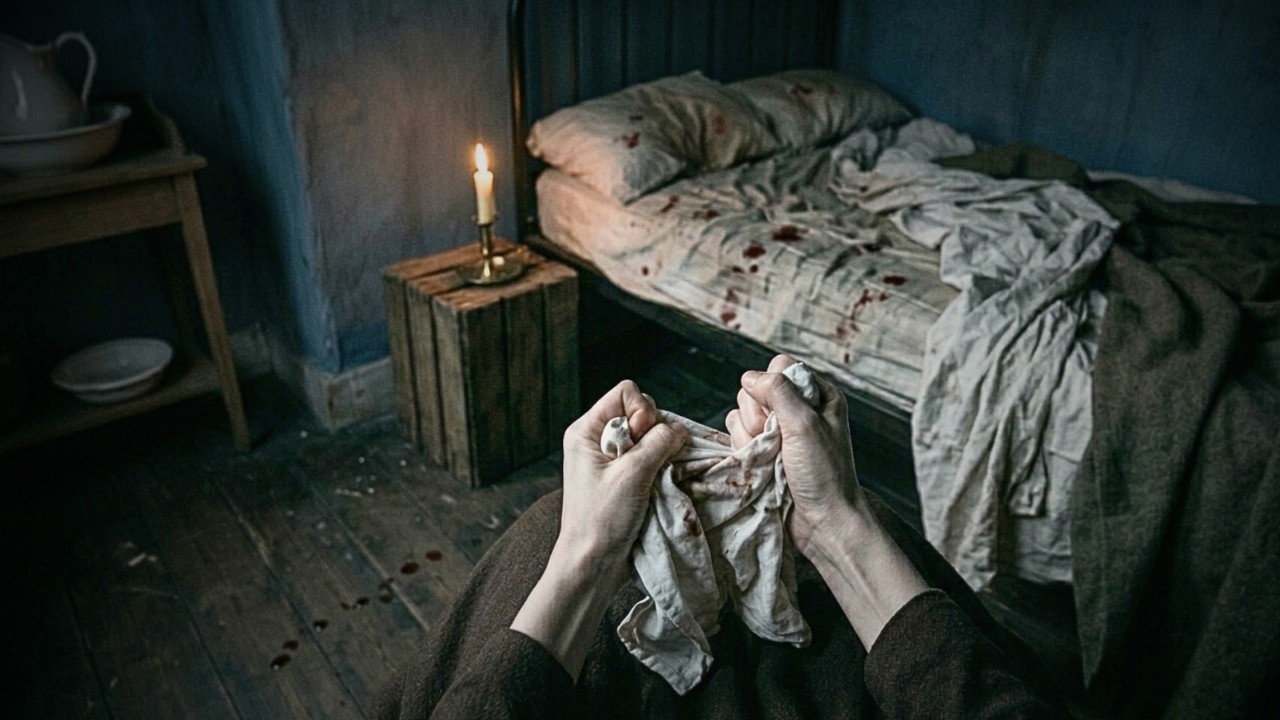
She had not yet rung for her maid. The doctor would not be summoned for another six hours, and in many Victorian households in nearly identical circumstances, he was never summoned at all. Britain in 1855 had the largest empire on Earth, gas-lit drawing rooms, sentimental novels about motherhood, and a medical establishment with no agreed name for what was happening to her, no anesthetic she could request, and no language polite enough to describe her condition aloud. Miscarriage was, by any honest accounting, one of the defining medical experiences of a Victorian woman’s life.
Modern obstetric estimates suggest that between 15 and 20 percent of clinically recognized pregnancies end in loss. In 1855, with poor nutrition, unrecognized infections, untreated chronic illnesses, and no prenatal care of any meaningful kind, the actual figure was almost certainly higher. The recorded figure was much lower, because the vast majority of these events were never recorded at all. They occurred in bedrooms.
They were managed by women. They left no entry in the parish register and no line in the family Bible. The setting itself is worth picturing precisely. A middle-class bedroom in a London townhouse in 1855 was a heavy-layered space: floor-length curtains of damask or heavy wool, a four-poster bed whose hangings could be drawn closed, gas lamps turned low because higher flames consumed more fuel and produced more soot on the wallpaper, a washstand with a porcelain basin and a pitcher of water the housemaid had filled that morning.
A locked door, because privacy in a Victorian household meant physical exclusion. There was no concept of personal space without a key. The first signs of a miscarriage were usually cramping similar to, but more intense than, menstrual pain, followed by bleeding. The woman experiencing it had in most cases been told almost nothing about her own reproductive anatomy.
Formal sex education for women of any class was considered improper. Mothers passed along fragments of practical information on the eve of a daughter’s wedding, often delivered in tears and euphemisms. Some women approached marriage genuinely unaware of how conception occurred. Many had no clear understanding of the difference between a heavy menstrual period and an early pregnancy loss until well after the event was over.
Who was in the room at the moment of crisis depended entirely on the household. In most cases, the answer was no one. The woman herself first. A lady’s maid summoned by the bell pull, if there was one.
A mother or sister, if she lived nearby and could be sent for without arousing comment. A trusted female neighbor in rural households. The midwife, if one was retained and could be reached. The husband was almost never present at the actual moment.
He waited in another room, or more commonly was at his office, his club, his parish duties, or his estate, entirely unaware that anything had happened. Sometimes for hours. Occasionally for the full duration of the crisis. This was not negligence on his part.
It was structure. The Victorian doctrine of feminine delicacy held that gynecological events were not appropriate matters for male attention, even from a husband. A woman who summoned her husband to her bedside during a miscarriage was making an unusual request, and she would be expected to apologize for the imposition once it was over. The cultural script for the male role during a female medical crisis was to wait elsewhere, to receive a brief and discreet report afterwards from a senior female relative or the housekeeper, and to refrain from asking questions about the details.
The household responded with a choreography refined over generations. The maid carried hot water up the back staircase, instructed to say nothing to the other servants about why. The housekeeper turned away visiting cards at the front door with the phrase, “The mistress is indisposed and not receiving today. ” Children were dispatched to relatives or kept on the upper floors with strict instructions to remain quiet.
The laundry maid was told that certain linens would need to be soaked and discarded rather than washed in the usual rotation. Each of these small adjustments was understood by everyone in the house. None of them required the actual word miscarriage to be spoken aloud. The woman herself, meanwhile, was expected to manage her pain with a composure the household manuals of the period explicitly recommended.
Crying out was undignified. Calling repeatedly for assistance was demanding. The ideal patient, according to the etiquette of the era, suffered with patience and gratitude, thanked the women attending her, and apologized for the trouble she was causing. The most common medical crisis in a Victorian woman’s life was also the one she was least permitted to name.
And the silence was not only modesty. It was also a calculation about money, about reputation, and about how dangerous the alternative could be. Summoning a doctor in 1855 was a decision with consequences that went well beyond the cost of the visit. The cost itself was the first calculation.
A general practitioner in London charged anywhere from two shillings and sixpence to a full guinea for a single house call, depending on the neighborhood, the time of day, and whether the doctor needed to be roused at night. A guinea was twenty-one shillings. For a working-class family in which the man of the house earned around fifteen shillings a week, summoning a doctor for what was widely understood as a private female complaint could consume more than a week of wages. For a middle-class family with a household income of two or three hundred pounds a year, the fee was manageable in itself.
The bill was not the problem. The visit was. Because the doctor entering the house meant the event had been acknowledged. He would be seen arriving by the neighbors, by the tradesmen at the area door, by the servants of the houses on either side.
Domestic staff communicated across households constantly. A doctor’s carriage at the door for an hour at midday produced gossip within twenty-four hours. Victorian middle-class society ran on reputation, and reputation was managed by controlling what could be seen and what could be said. Summoning the doctor moved a private crisis into the visible record of the street.
Inside the household, the request itself was difficult to make. A woman experiencing serious bleeding had to communicate that fact to her husband, or to a senior female relative, in language the Victorian conduct manuals did not provide. There was no polite phrase for “I am hemorrhaging. ” Women resorted to general terms — “feeling unwell,” “an indisposition requiring rest” — that often understated the danger they were in.
Husbands, untrained in recognizing the signs and culturally discouraged from inquiring closely, sometimes did not understand the urgency until the situation had become critical. The medical reality of those delays was understood by physicians of the period, even if it was not transmitted clearly to families. By 1855, the dangers following a miscarriage were well documented in the medical press. Hemorrhage, when bleeding failed to slow on its own, could become life-threatening within hours.
Retained tissue, when the uterus did not fully empty, was a known cause of subsequent infection. And puerperal fever, the catastrophic bacterial infection of the reproductive tract, killed women in numbers that were already alarming the medical establishment. Sir James Young Simpson, the Edinburgh obstetrician who had introduced chloroform to childbirth in 1847, was publishing regularly on these complications throughout the 1850s. The information existed.
It simply did not reach most households until the situation had passed the point of easy intervention. When the doctor did finally arrive, his training in women’s reproductive medicine was often limited. The medical schools of the period offered comparatively little instruction in gynecology and obstetrics, and the practical experience available to male students was constrained by the same modesty conventions that governed the rest of society. Many qualified physicians had completed their training having performed few internal examinations on living female patients.
The first British medical school to admit women, the London School of Medicine for Women, would not open until 1874. In 1855, the doctor at the bedside was, with near certainty, a man examining a body he had been culturally trained not to look at directly. The examination reflected this training. The patient remained fully covered.
The doctor worked beneath the sheet by touch, with his face turned away or his eyes fixed on the ceiling. Some physicians considered it improper to ask the patient direct questions about her symptoms, and instead addressed their questions to the senior woman in the room — the patient’s mother, sister, or the midwife. The doctor’s diagnostic information was therefore filtered through a chain of female intermediaries who themselves had been instructed all their lives not to speak about these matters precisely. The medical journals of the era used a particular phrase for cases in which a woman died from delayed treatment of a miscarriage.
They called it neglected miscarriage. The phrase placed the responsibility for the delay on the patient and her family, rather than on the structural conditions that had made delay almost inevitable. The Lancet, the Medical Times and Gazette, and the British Medical Journal published case after case in which a woman of previously good health died of sepsis or hemorrhage some days after the initial bleeding had begun. The cause in nearly every report was the same: by the time the doctor arrived, it was too late to do anything except attempt to control the consequences.
When the doctor didn’t come, someone else did. And in most Victorian households, that someone was already in the building. The cast assembling in the bedroom was almost entirely female. The patient first.
Her mother, if the mother lived close enough to be sent for without producing comment in the street. An older married sister, if one was available, because married women were considered the appropriate companions for these events in a way that unmarried sisters were not. A trusted female neighbor, frequently the wife of a clergyman or another respectable household, summoned discreetly through a maid. The midwife, if the family had retained one or could reach one quickly.
And the household servants, pressed into a kind of emergency medical service for which they had received no formal training and which they were expected never to mention afterwards. The midwife herself occupied an awkward position in the medical landscape of 1855. Midwifery in Britain at this date was almost entirely unregulated. There was no standardized training, no formal qualification, no register, no enforced code of practice.
The Midwives Act, which would finally establish a register of qualified practitioners in England and Wales, was not passed until 1902, nearly half a century later. The midwife at the bedside in 1855 had learned her craft from another midwife, who had learned it from the woman before her. Her knowledge was practical, accumulated, sometimes excellent and sometimes dangerous, transmitted entirely outside the formal medical profession that was simultaneously trying to discredit her. The sensory texture of the room is worth picturing precisely.
A small fire in the grate kept low to avoid attracting attention from the street. The gas lamps turned down. A basin of hot water on the washstand, refilled at intervals by the housemaid who carried it up the back staircase rather than the main one. A stack of clean cloths and torn linen on a side table, prepared by the lady’s maid that morning under instructions that did not specify the actual purpose.
A small bottle of laudanum on the bedside table. The midwife’s bag, if she had arrived, opened on a chair. Whispered conversation in the hallway between the housekeeper and the master of the house, who had been told only that the mistress was unwell. The smell of carbolic perhaps, if anyone in the household had read the medical journals carefully enough to know that disinfection mattered.
The servants saw everything and were expected to remember nothing. The relationship between a Victorian mistress and her lady’s maid was unusually intimate by the standards of the period. The maid dressed her employer, washed her, brushed her hair, handled her undergarments, and knew the exact rhythm of her menstrual cycle from the laundry calendar. There was no aspect of her mistress’s body that the lady’s maid did not know.
And the contract of her employment required her to act at all times as though she knew nothing at all. Mrs. Beeton’s Book of Household Management, which would be published in installments beginning in 1859 and as a complete volume in 1861, gave explicit instructions on this point. The good servant was discreet, observant, silent.
The good housekeeper trained her staff to recognize the signs of a mistress’s indisposition and to manage the household around it without comment. A maid who gossiped about her employer’s miscarriage faced dismissal without a character reference, which in the domestic service economy of the period effectively ended her ability to find further work in a respectable household. The architecture of the Victorian house itself supported the secrecy. Middle-class and upper-class townhouses were designed with two parallel circulation systems.
The family used the main staircase, the front hall, the formal reception rooms. The servants used the back staircase, the kitchen passage, the basement, and the attic. The two systems intersected only at controlled points. The same architectural feature that hid the working class from the dining room also hid the medical crisis from the rest of the household.
Children were sent to upstairs nurseries with instructions to remain quiet. Tradesmen at the area door were told the mistress was not at home. Visiting cards were turned away with practiced phrases. The official position of the house was that nothing was happening.
What developed inside the bedroom was a parallel medical tradition conducted entirely by women, transmitted entirely through speech and demonstration, recorded almost nowhere. What one woman learned during her own miscarriage, she passed to her daughters and her servants. The midwife taught the next midwife. The mother instructed the daughter on the evening of her wedding.
This female chain of knowledge had nothing to do with the formal medical profession and could not be cited in any textbook, because the formal medical profession had nothing better to offer most of the time. But silence was not only practical. It was also moral. And Victorian morality made the body of a miscarrying woman into a problem.
Coventry Patmore published a poem in 1854 called The Angel in the House. It was a sentimental celebration of his first wife, Emily, and it became one of the defining cultural texts of Victorian womanhood. The ideal woman it described was pure, modest, uncomplaining, devoted to her husband, sexually innocent even after marriage, and emotionally self-contained. The poem went through multiple editions over the following decades and gave Victorian society a phrase it would use for the rest of the century to describe what a woman was supposed to be.
In 1855, the year after the first edition, the ideal it described was already settling into the assumptions of every respectable household in Britain. The body of a Victorian woman in this ideal was almost not a body at all. It was a moral category. Medical illustrations of the period frequently draped reproductive anatomy in classical fabric, as though even the diagrams owed a debt to decency.
Husbands frequently knew almost nothing about their wives’ menstrual cycles or the early stages of pregnancy. Some doctors avoided the word pregnant in a woman’s presence entirely, substituting phrases like “in an interesting condition,” “indisposed,” or “expecting an increase to the family. ” The biological facts of marriage were spoken of in euphemisms so consistent that the euphemisms themselves became the standard medical vocabulary. A miscarriage violated almost every requirement of this ideal at once.
It produced visible bleeding, which a respectable woman was not supposed to acknowledge. It produced audible pain, which she was supposed to bear in silence. It produced soiled linen, which the laundry maid was supposed to handle without seeing. It required intimate physical assistance, which she was supposed to find embarrassing rather than necessary.
And it carried an unavoidable acknowledgement that sex had occurred within the marriage, a fact that married women were expected to know about as little as possible and never to discuss. The vocabulary itself was a problem. Victorian English had no agreed polite term for what was happening to her. Newspapers and obituaries used phrases like “a sudden indisposition,” “a confinement that ended unfortunately,” “the loss of a hoped-for blessing.
” Medical texts used the word abortion, which at that date was a neutral clinical term meaning any pregnancy loss, induced or spontaneous. But the word already carried such moral weight in lay use that doctors generally avoided it when speaking to families. The result was that the most common medical event in a woman’s reproductive life had no name she could comfortably use, no name her husband could use, and no name her servants could use, even when all three were in the same house dealing with it at the same time. The expectation of physical composure was absolute.
Etiquette manuals of the period advised that a lady, even during severe illness, should preserve her countenance in the presence of servants. Crying out was considered a failure of refinement. Calling repeatedly for assistance was considered demanding. The ideal patient, according to the conduct literature, suffered with patience, thanked the women attending her, and apologized for the inconvenience she was causing the household.
A woman screaming during a miscarriage was, in the cultural framework of 1855, behaving badly. The asymmetry between this event and other forms of loss is one of the more striking features of Victorian domestic life. The death of a husband produced black armbands, crepe on the front door, a year of formal mourning, social calls of condolence, sermons in the parish church, and an elaborate vocabulary of grief that society had spent decades refining. The death of a child after birth produced a smaller version of the same infrastructure, modified for the age of the deceased.
A miscarriage produced an instruction from the housekeeper to the laundry maid about which linens to discard. The cultural infrastructure for one form of loss was elaborate. The infrastructure for the other did not exist. Queen Victoria herself, who would give birth nine times between 1840 and 1857, experienced at least one miscarriage during her reproductive years.
The court records refer to it, when they refer to it at all, as a brief indisposition. The queen of the empire could not have her loss named in the public record. The duchess in her country house could not have hers named. The vicar’s wife in her parsonage could not.
The shopkeeper’s wife in her room above the shop could not. The silence ran the full length of the social ladder, and it ran the full length of the woman’s life. And when something could not be named, it also could not be treated properly. The remedies that filled the gap ranged from useless to actively dangerous.
Almost every middle-class home in 1855 contained a domestic medicine cabinet. Its contents were assembled from the local chemist, from family recipes copied into the housekeeper’s book, from patent medicines advertised in the back pages of magazines, and from herbal remedies inherited through generations of female practice. The cabinet was the first line of treatment for almost every household illness. And during a miscarriage, it was often the only line of treatment available before the doctor arrived, or after he had come and gone.
Laudanum was the most common item in it. Laudanum was a solution of opium dissolved in alcohol, sold openly in chemist shops without prescription until the Pharmacy Act of 1868 began to regulate it. A bottle cost a few pence. It was given for headaches, for teething infants, for coughs, for menstrual cramps, and for the pain of a miscarriage.
A woman in real agony might be given laudanum drops in a glass of sherry by her mother or her midwife. The dose was guessed rather than measured. Some women received too little to help. Some received enough to suppress their breathing.
Deaths from accidental laudanum overdose in women of reproductive age are documented throughout the 1850s, and the line between a therapeutic dose and a fatal one was narrow enough that experienced practitioners sometimes crossed it without realizing. Ergot of rye was the next item. Ergot is a fungus that grows on rye grain, and it produces compounds that cause the uterus to contract. Midwives and some doctors used it to encourage the expulsion of retained tissue or to slow heavy bleeding by contracting the uterine muscle.
The pharmacology was real. The dosing was not standardized. A preparation made from one batch of rye could be many times stronger than a preparation made from another. Too much ergot caused vasoconstriction severe enough to produce gangrene of the fingers and toes, a condition with the historical name of Saint Anthony’s fire.
The herbal cabinet contained other agents whose effects were less clinically understood. Pennyroyal, tansy, savin, and rue were all traditional remedies believed to promote menstrual flow. They appeared in household recipe books across the period. Pennyroyal in the doses required to have any meaningful effect was toxic to the liver, and deaths from pennyroyal poisoning are recorded in the medical literature throughout the Victorian era.
Savin, the dried tops of a juniper species, was so well known as a dangerous remedy that its presence in the home was sometimes cited as evidence in coroner’s inquests. Bed rest was the simplest prescription, and not always a safe one. Some Victorian physicians prescribed prolonged bed rest combined with what they called a depleting diet, meaning restricted food and water, on the theory that reducing the patient’s overall vigor would slow the bleeding. The actual effect on a woman who was already losing blood and fluid was the opposite of helpful.
Some patients deteriorated under treatment that would today be recognized as a textbook case of how not to manage hemorrhage. Bloodletting was declining by 1855, but had not yet disappeared. Doctors who still subscribed to the older humoral theories occasionally drew blood from women they judged to have a plethoric constitution, meaning too much blood in the system. A woman who had just lost significant blood being further bled by her doctor was not in this period a hypothetical case.
It is recorded in medical memoirs of the era as something senior physicians had personally witnessed in their training. The cleanliness problem ran underneath all of this. Chloroform anesthesia had been introduced into childbirth in 1847 by Sir James Young Simpson in Edinburgh, and Queen Victoria herself had accepted it for the birth of Prince Leopold in 1853, an event that did a great deal to make obstetric anesthesia respectable. But the work of Joseph Lister on antiseptic surgery would not be published until 1867.
In 1855, the connection between handwashing and infection was understood by a small number of researchers and almost no practicing doctors. Ignaz Semmelweis had demonstrated the link in Vienna in the 1840s and had been broadly ignored. Doctors in 1855 routinely moved from one patient to the next, from the dissecting room to the bedside, from a corpse to a laboring woman, without washing their hands. Puerperal fever, the bacterial infection of the reproductive tract now recognized as sepsis, killed women in numbers that the medical profession found alarming but could not yet explain.
The remedies were not always useless. Some of them simply killed slowly enough that the cause of death could be attributed to the original illness. And if she survived the bleeding, the infection, the laudanum, and the doctor’s unwashed hands, she was not done, because the next danger was social. The legal context shaped everything that happened in the bedroom and everything that was said about it afterwards.
The Offences Against the Person Act of 1861, which would consolidate and tighten the existing law six years after our setting, built directly on Lord Ellenborough’s Act of 1803 and the 1837 amendments. By 1855, the deliberate procurement of a miscarriage was already a serious criminal offense punishable by transportation or long terms of penal servitude. The law made no real distinction between a remedy taken to bring on a delayed period and a remedy taken to end a known pregnancy. Both fell, in principle, under the same statute.
And every spontaneous miscarriage existed in the shadow of that statute. The practical effect was that a miscarriage in 1855 could trigger questions. Sometimes the questions were gentle; sometimes they were not. Had the woman lifted something she shouldn’t have?
Had she taken a fall deliberately or carelessly? Had she been seen visiting an unfamiliar chemist? Had she consulted anyone outside the household? In ordinary middle-class households, these questions were usually internal, asked by the mother-in-law or whispered among the women of the family.
In coroner’s inquests, when a woman had died, the same questions were asked formally and on the record. The class dimension was unmistakable. Middle-class women were generally given the benefit of the doubt, because suspicion itself was considered undignified and because their social position protected them from formal inquiry. The doctor signed the death certificate.
The clergyman conducted the funeral. The family record showed an indisposition. Working-class women, and particularly unmarried ones, faced an entirely different level of scrutiny. Coroners’ inquests in the 1850s and 1860s into the deaths of poor women following miscarriage sometimes resulted in criminal charges against the woman, the midwife, or an alleged abortionist.
The records of these inquests, preserved in county archives across England, show the same patterns repeating with grim consistency. The religious dimension added another layer. The Church of England and the Catholic Church both treated miscarriage with theological ambiguity, and the resolution of that ambiguity was left largely to the individual parish priest. Was the lost child to be considered baptized?
Could it be buried in consecrated ground? Some parishes refused burial entirely. Others permitted unmarked graves in the unconsecrated section of the churchyard, the same section used for stillbirths, suicides, and the unbaptized. The grieving mother might be told, in tones varying from genuinely compassionate to severely judgmental, that she should examine her conscience for what she might have done to displease God.
The marriage dimension was its own pressure. A miscarriage was, in the framework of the period, a failure of the wife’s central function. Husbands responded according to their temperaments. Some wrote tender private letters and treated their wives with care during recovery.
Others recorded the event in their diaries with the same brevity used for a horse going lame or a piece of property requiring repair. The diaries of Victorian men of the middle and upper classes, preserved in archives across Britain, contain both extremes. A woman who miscarried repeatedly faced cumulative pressure that could shape the entire emotional climate of her marriage, and in some cases led to medical consultations not about her body, but about whether the marriage itself was, in the religious phrase of the period, blessed. The gossip mechanics were inescapable.
The servants knew. The servants always knew. They had carried the water. They had laundered the linen.
They had turned visitors away at the door. And although their employment required absolute discretion, household staff in 1855 moved between employers over the course of their careers. A lady’s maid dismissed for any reason carried her knowledge with her to her next position. A housemaid who married carried it home to her own kitchen.
Information about a private indisposition that was supposed to remain inside one bedroom could become, within a few months, a quietly known fact across an entire neighborhood, discussed in the same hushed tones used for any embarrassing illness. Isabella Beeton, who would later publish the most influential household manual of the Victorian age, experienced at least two recorded miscarriages during her marriage to Samuel Beeton, in addition to losing two of her four liveborn children in infancy. The pattern of her reproductive life — the conceptions, the losses, the brief survivals — was almost completely absent from her own published work, which presented a vision of domestic order and feminine competence that her own body had repeatedly failed to deliver. Her readers knew her as the authority on the perfect household.
They did not know what the perfect household had cost her. Whatever happened in the bedroom, whatever happened in the parlor afterwards, the world expected one thing of her next. The expectation was that she would get up. The physical recovery from a miscarriage at, say, twelve to sixteen weeks involved continued bleeding for one to three weeks, profound fatigue from blood loss, the risk of secondary infection that might emerge days after the initial event, and, if the pregnancy had been advanced enough to begin breast changes, the disrupted onset of lactation that produced its own painful complications.
There was no established medical protocol for postpartum recovery from miscarriage in 1855. Household norms expected her back on her feet within days. The class divide shaped the timeline. A working-class woman returned to laundry, cooking, factory shifts, or domestic service within a few days, because the family could not afford any other arrangement.
The bucket of water she had been carrying before the miscarriage was back in her hands almost immediately afterwards. A middle-class woman returned to managing her household, supervising her servants, and receiving morning callers within a week or two. Only women of substantial wealth could afford weeks of bed rest, and even they were expected to resume social duties within a month at the outside. Prolonged convalescence required money, attentive servants, and a husband willing to absorb the disruption.
Most households did not possess all three. The marital expectation followed close behind. There was no Victorian custom comparable to a modern grieving interval. The resumption of marital relations after a miscarriage was not discussed in any household manual, but it was understood within the marriage itself to occur as soon as the husband wished it.
Subsequent pregnancies often followed within a few months. Some women experienced repeated miscarriages and rapid intervening pregnancies for years, with cumulative effects on their bodies and on their mental states that medical history is only now beginning to reconstruct. The mental health silence was the deepest of all the silences. The Victorians possessed a vocabulary for certain forms of female distress: hysteria, neurasthenia, melancholia, nervous exhaustion.
They did not possess a concept of perinatal grief as a distinct medical condition. A woman who could not stop weeping weeks after a miscarriage might be diagnosed with a constitutional weakness, prescribed laudanum, sent to the seaside for a change of air, or, in the worst cases, committed to a private asylum for treatment of melancholia. The records of the Lunacy Commissions of the 1850s and 1860s include cases of women admitted for what was described as melancholia following confinement, a category that almost certainly absorbed a great deal of postpartum and post-miscarriage depression that today would be recognized and treated differently. The official record kept its own silence.
Most Victorian miscarriages left no documentary trace. They appeared in no parish baptismal register, on no headstone, in no published obituary, in no genealogy compiled by later descendants. Historians working on Victorian family demography have estimated that the documented miscarriage rate in this period represents perhaps one in ten of the actual events. The other nine were absorbed into the silence of the household and disappeared from the family record entirely.
Isabella Beeton returns at the end of this story because her life contained almost every element it has described. She experienced at least two miscarriages. She lost her first child at three months old and her third at two months. She kept writing, kept editing her husband’s magazines, kept producing the manual that would define Victorian domestic competence for a century.
In February 1865, she died at the age of twenty-eight from puerperal fever contracted after the birth of her fourth child. The infection that killed her was, in 1865, still being passed between patients by the unwashed hands of doctors who did not yet accept what Joseph Lister was about to prove. She wrote the most read household book in English. The defining medical experiences of her own body appeared in none of its pages.
The numbers, taken together, make the scale visible. The average completed family size in mid-Victorian Britain was around five to six children. The average woman of childbearing age experienced roughly one to two miscarriages over her reproductive years, and many experienced more. Across the population of Britain in the 1850s, this produced millions of individual events, each conducted in private, each absorbed by the household, each left out of the official record.
The cultural infrastructure that handled a husband’s death over the course of a year handled a miscarriage in an afternoon, and a load of laundry. That was the system she lived under. Not silence as an absence of words, but silence as a structure, designed and maintained at every level of society, from the bedroom to the parish register. Return to the bedroom in Bloomsbury.
The bleeding has slowed. The doctor came late, or did not come at all. The maid has changed the linen and burned what could not be saved. The husband has been told, in the careful phrase the household uses for such things, that the mistress is indisposed.
By next week, the event will not be spoken of again. The laudanum bottle goes back into the cabinet. The parish register records no birth and no death. The diary, if her husband keeps one, notes a brief illness and the weather.
She lost a child. She nearly lost her life. She lost months of health she would never recover. And she was expected to lose all of it quietly, because the alternative was a kind of existence Victorian Britain had no place for.
They called it nothing at all.
