The deed was recorded for ten dollars. Ten dollars paid by a son to his father for a house and the hillside it stood on. It had taken close to two years to build, and it had cost more than three million. That is not a rounded estimate.
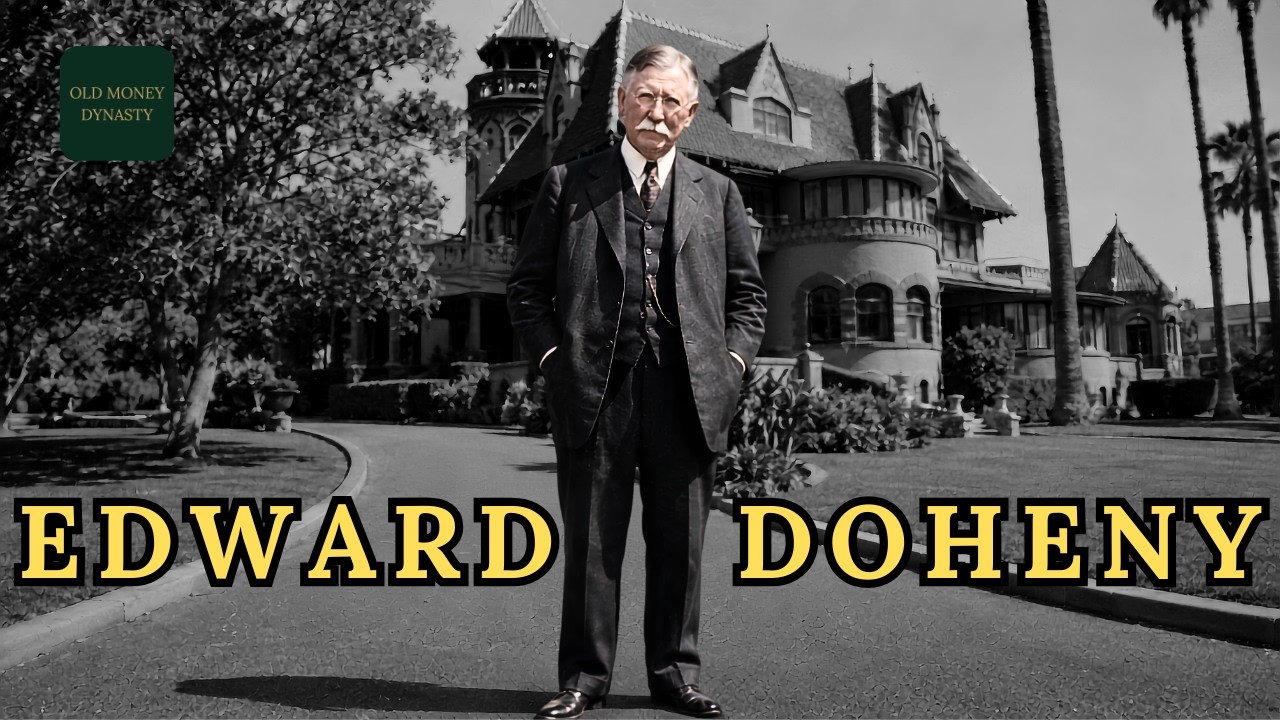
The construction accounts survive, and they record what the work cost down to the cent. The family moved in during the autumn of 1928. There were seven of them: a husband and wife and their five children. Five months later, on the night of February 16th, 1929, two men were found dead in a ground floor guest bedroom.
One was the son who had signed for the house. The other had worked beside him for sixteen years and carried his own key to the front door. The district attorney drove up to the property himself. Within about a day, the case was closed.
There was no coroner’s inquest, and the story was gone from the newspapers inside thirty-six hours. What holds the attention is never the question of what happened inside that room. It is the quiet that came afterwards. A city had spent two years watching this family raise what was reported to be the costliest private residence in California.
It stopped asking about the death of their heir almost at once. This is a story about a house more than a shooting. It is about the money that bought the stone and about what that money had already cost before anyone carried a suitcase through the door. The man who signed the checks was seventy years old when he gave his son the land.
He had been born to Irish immigrants in a small Wisconsin town. He reached Los Angeles in 1891 with nothing to his name and no particular reason to think that would change. Everything between those two facts is the story. Ground was broken on February 15th, 1927.
Two months earlier, in a federal courtroom in Washington, the man paying for the work had been acquitted of criminal conspiracy. That is only a date for now, but it is worth holding on to because it tells you what sort of year this family was having when the digging started. The land had come first. In 1926, the father made his son a gift of a parcel on the ridge, something over twelve acres with a view that ran the length of the city.
The house was what went on top of it. The site was a slope above Beverly Hills that had carried cattle and scrub and not much else. Below it, the city was still filling in. Above it, there was nothing at all.
The architect was Gordon Kaufmann, a Londoner who had been practicing in California since 1914. The contractor was the Walker Company of San Francisco. The gardens went to Paul Thiene, who cut formal terraces into the hillside and fed them with brooks and a lake. Kaufmann would later design the Los Angeles Times building, and he would give Hoover Dam its finished face.
This house came before both of them, and it is what made his reputation. What he drew was not a California house. It was English Tudor revival, steep, gabled and gray, and it was engineered like a public building. Under the stone sits a frame of steel reinforced concrete.
The facing is Indiana limestone. The roof is Welsh slate carried across an ocean and a continent to sit on a hill above Los Angeles. The finished house measured 46,054 square feet. It held 55 livable rooms, 67 once the service spaces were counted.
Work on the estate as a whole ran close to three years. The construction records put the cost of the entire estate at $3,166,578. 12. The house itself came to $1,238,378.
76. In today’s money, the estate figure is somewhere close to sixty million dollars. Set those two figures beside each other, and something odd falls out of them. The building took less than half the money.
Everything around the building took the rest. Going through construction accounts from this period, it is hard to find another case where the building was the cheaper half of the job. Inside, the oak was carved rather than milled, from the banisters at the entrance to the rafters overhead. The main hall was floored in black and white marble.
Above the living room ran a balcony so that musicians could play without taking up the room. There were seven chimneys. Each was designed and executed by a different craftsman. No two matched, and almost nobody would ever be in a position to compare them.
Off the kitchen, the pantry had been built around a wall safe, large enough to take the household’s gold and silver service. The east wing gave two entire floors to the staff. Fifteen people lived in the house permanently. The servants outnumbered the family they served by better than two to one.
The bedrooms ran along the second floor. The master suite took the west wing. It came with a sitting room and two bathrooms, a dressing room, and a room set aside for massage. In the north wing, where two of the sons slept, a circular staircase climbed to a floor built for nothing but amusement: a cinema, a billiard room, and a bar tucked out of sight of it.
At the far end, a bowling alley made by Brunswick. Every room facing south looked out over the whole basin. From the towers downtown to the water at Santa Monica. Outside, the estate kept going.
Stables and kennels, tennis courts, a greenhouse and a swimming pool with its own pavilion. A gate house down at the road and a fire station on the grounds, which suggests how little this household expected to rely on the city below. Thiene’s gardens held a lake and brooks that came down through the terraces into falls, on a dry hillside in Southern California where water is the one thing nobody has. That was the loudest thing the estate said about its owners.
The gray of the stone gave the place its name: Greystone. And then, with the work finished, Edward Doheny signed it away. The transfer covered the house and the ranch land under it, something close to 400 acres of Beverly Hills hillside. The price entered on the transfer was ten dollars.
A ten-dollar deed is an ordinary legal instrument. It is what you use when a thing is being given rather than sold, and the law still wants a figure in the box. But the figure sits in the county record all the same: three million dollars of steel and stone and imported slate handed from a father to his only son for the price of a good dinner. Hugh Plunkett arrived in Los Angeles in 1912 at seventeen with his family and no particular prospects.
He found work at a service station pumping fuel and repairing whatever came in off the road. The station belonged to a Santa Fe railway executive named Smith. Among the cars that came in for work were the ones belonging to the Doheny family. That is how the two of them met: a mechanic underneath a car, and the only son of the richest man in Los Angeles standing on the other side of it.
Edward Doheny Jr. had been born in November of 1893 into a household that was still climbing. By the time he was old enough to notice, the climbing was over. Everyone called him Ned.
He went to the University of Southern California, took a business degree, and finished in 1916. He stayed attached to the place for the rest of his life, first as an alumni officer and later as a trustee. His future had been settled before he was born. He would take the company when his father stepped back, and until then he would learn it from the inside.
Ned liked Hugh, and he hired him. First to drive, and then to handle whatever needed handling. Then the geometry of it got stranger. Smith, who owned the service station, had a daughter named Lucy, and Ned married her.
The record disagrees on the year, some sources saying 1913 and others the summer of 1914, but the effect is the same either way. Hugh had gone from working for Lucy’s father to working for Lucy’s husband. When the country entered the war, the two of them enlisted on the same day. They did not fight the same war.
Ned went in as a lieutenant. Hugh went in as a machinist’s mate on a submarine chaser, which was a small wooden boat and a job below decks. Same recruiting office, same morning. Two entirely different experiences of the Atlantic.
They both came home. Hugh moved up from driver to confidential secretary, a position of considerable trust in a family like that one, and of no visible authority at all. He dealt with the things Ned did not want dealt with by anyone else. The salary mattered to him.
Hugh supported his parents out of that job, and he paid for his younger brother to study engineering at the same university Ned had attended. He lived with his family in a small house on Dalton Avenue, south of downtown, a long way from the addresses he drove to. He married in 1916. There were no children, and the marriage came apart toward the end of the twenties.
Somewhere in those years, Ned and Lucy had their youngest son, and they named him Timothy Hugh. Families of that size and that visibility do not usually name a child after the man who drives the car. Whatever the arrangement between these two households had become, it was no longer simply employment. By the middle of the twenties, Hugh had been inside that household for more than a decade.
He did not knock at the door of a Doheny house. He let himself in. Late in 1921, Ned went to a bank and withdrew $100,000 in cash. That was the better part of two million dollars in today’s money, carried in a black bag.
The two of them took a train east across the country to Washington. At the Wardman Park Hotel, they were shown up to a suite, and Ned handed the bag to Albert Fall. Fall was at that time the Secretary of the Interior of the United States. Fall took it, and in return he gave Ned a promissory note, a piece of paper stating that the money was a loan and would be paid back.
An errand like that could have gone to a lawyer. It could have gone to a bank officer or to any of the men his father kept on salary for exactly this kind of work. It went instead to his son and to the man who drove his son. We do not know what either of these men understood about that errand while they were carrying it out.
What we know is what they did. Then they went home. Ned went back to a vice presidency and a house full of children. Hugh went back to Dalton Avenue.
For two years, nothing came of it. Then a senator from Montana started asking where the Interior Department had been getting its money. The bag came up out of the dark, and it stayed up for the rest of both their lives. For most of that winter, Hugh Plunkett was in pain.
His gums were infected and his teeth were abscessed. Through the early weeks of 1929, a dentist pulled them one at a time, and each extraction left him worse than the one before. The reaction was physical: muscle spasms, hours in which he could not govern his own body. It would pass, and then the next tooth would come out, and it would begin again.
He was staying at Greystone while it went on. The teeth are the part of this story that almost nobody mentions. A man in that condition does not sleep. Hugh was taking barbiturates to get through the nights, and by that winter he was taking more of them than any doctor should have been writing for.
He had already had one breakdown. His marriage had ended the year before, and there was a court date coming. Hugh Plunkett had carried a bag of cash to a cabinet secretary, and the federal government now wanted him under oath about it. Lucy Doheny’s own secretary described him in that period as having gone morose, with the coming trial constantly on his mind.
Ned was exposed too. A grand jury had indicted him alongside his father back in 1924, and the matter still was not finished. But the two of them faced it from opposite ends. Ned had the family lawyers and the family money behind him.
Hugh had a salary and a room in somebody else’s house. There was also a proposal on the table. According to accounts that came out of both families afterwards, the Dohenys had been pressing Hugh to commit himself to a sanatorium. Consider what that arrangement would have accomplished.
A man held in an institution is a man who does not appear in a courtroom. Whatever lay behind the suggestion, that is the effect it would have had. So by the middle of February, this is where he stood. Ill, sleepless, and taking more every night to stay that way.
Divorced the year before. A criminal proceeding ahead of him. And the family he had served since he was a boy encouraging him to have himself declared unfit. One thing belongs on the record here, because the account that followed leaned hard the other way.
Plunkett’s nephew always maintained that Ned was the unstable one of the two. Ned’s own grandson later said the same. Two families, two generations, and they agreed with each other. Saturday, the 16th of February.
That afternoon, Ned telephoned the family physician, Dr. Fishbaugh, and asked him to come up to the house. Fishbaugh came. At some point after that, Hugh left.
He came back that night. A guard on the property saw him at the garage going through the closet where the family kept its guns. The guard did not stop him. Then Hugh went up to the house and did what he had always done.
He let himself in. Ned met him and walked him along to the ground floor guest bedrooms. There were two of them side by side off a short corridor at the east end. One was the room Hugh used when he stayed over.
The other was Ned’s. Above them were the bedrooms of five children, and beyond them the wing where fifteen members of staff lived. The two men talked. Nobody has ever recorded what was said.
Then Ned picked up the telephone and called Dr. Fishbaugh a second time. That made two calls to the same physician in about nine hours. Whatever was happening inside the house that day, the family was still treating it as a medical problem and not as anything else.
Fishbaugh arrived at around 11:00. He and Lucy started down the corridor toward the guest rooms. Before they reached them, the bedroom door came open. Hugh was standing in it.
He saw the two of them, shouted at them to stay back, and shut the door. They heard a shot. That is where the reliable account stops. Everything after it comes from people who had reasons of their own.
Nobody telephoned the police for about three hours. Both men were dead. The house was full of people. There were telephones in it, and a physician already standing in the corridor.
And the Beverly Hills Police Station was a short drive down the hill. Three hours passed. When the call finally went out, the man who came was not a duty sergeant. Buron Fitts, the elected district attorney of Los Angeles County, drove up to Greystone himself.
District attorneys do not attend crime scenes. They receive files afterwards. Fitts attended this one, and he brought his investigators with him. Among them was a young man named Leslie White.
It was the first homicide in the history of Beverly Hills. Within about twenty-four hours, the case was finished. The conclusion Fitts announced was that Hugh Plunkett had shot Ned Doheny after being refused a raise and had then shot himself. The motive has never stood up.
A man does not spend sixteen years inside a family and then kill its heir over a wage dispute. Not a man who enlisted beside him and came home to work for him. That is not a motive. It is a sentence that closes a file.
In the same month, according to both families, that household had been urging him toward a sanatorium. The official finding asked the public to believe he had killed over wages instead. Set the timetable out plainly. A death of enormous public interest occurred late on a Saturday night, and by Monday it was legally settled and journalistically finished.
There was no coroner’s inquest. In California in 1929, an inquest was the ordinary mechanism for a violent death. It was also the one procedure that would have put witnesses on the record under oath. It did not happen.
The newspapers ran it hard for a day and a half and then stopped. Los Angeles had several competing dailies at the time, all of them hungry, and the wealthiest family in the city had just lost its heir. The story simply went away. The explanation that circulated among reporters afterwards was that the father was not a man you went after.
Seven years later, Leslie White published a book about his years as an investigator. In it, he wrote that the scene at Greystone had been altered before the police were allowed to see it, and that the weapon carried no fingerprints at all. The two families said their own things quietly for decades. Plunkett’s relatives maintained that no real investigation had ever been permitted.
On the other side, a woman who married into the Doheny family described what had been understood there: the doctor was called before the police, and the doctor did not tell the police everything. The funerals kept the two men apart the way the city always had. Hugh’s service was held at a mortuary on Washington Boulevard, a few streets from where his parents lived. Ned’s was not.
Then there is the question of where they were put. The Dohenys were among the most visible Catholic families in California. Estelle Doheny gave to the church on a scale that would eventually make her a papal countess. There was a Doheny room waiting at the Calvary Mausoleum.
Ned was not placed in it. He was buried at Forest Lawn in Glendale, which is not a Catholic cemetery. The rule in 1929 was not complicated. A man who died by his own hand did not go into consecrated ground.
Hugh Plunkett was buried on the same hillside a few rows down the slope. That is a strange arrangement by any reading of it. The official finding was that one of these men had murdered the other. They were laid in the same cemetery in sight of one another by the family of the man who was supposed to be the victim.
Rome sent something as well. A marble canopy taken from the Basilica of Santa Sabina, reported to be more than 1,500 years old, arrived as a gift of sympathy from Pope Pius XI. It was set over Ned’s grave in a cemetery his church would not have chosen for him. And inside the house, one smaller thing was quietly settled.
Ned and Lucy’s youngest son had been given the middle name Hugh, after the man who drove the car and carried the bag and let himself in without knocking. Lucy had it changed. To understand what a family was protecting in 1929, you have to go back about fifty years to a silver camp. Kingston, New Mexico lasted about ten years.
Silver was found in the Black Range in 1882. Within a couple of seasons, the place held a few thousand people, a newspaper, and an opera house. By local account, it also carried something like twenty-two saloons. A camp like Kingston was not a town in any settled sense.
It was a temporary arrangement between a mineral and several thousand people. And when the mineral stopped paying, the arrangement ended. Three men who happened to be in it went on to matter a great deal to the United States, and all three of them were broke at the time. The first was Edward Doheny.
His father had come out of Tipperary during the famine and gone to sea whaling off Labrador before settling in Wisconsin. His mother was a school teacher from Newfoundland. They raised him in Fond du Lac, where he was the best student in his class and finished school at fifteen as valedictorian. A few months after that, his father died, and any straight path he might have had died with him.
He went west at seventeen with the United States Geological Survey and spent years in the field, first in Kansas and afterwards in the Black Hills and the Arizona territory. Those years taught him to read ground, which is a genuine skill and was for a long time the only asset he owned. The census taker found him in Prescott, Arizona in 1880. Under occupation, it says painter.
That may be the single most useful fact about Edward Doheny. At twenty-three, he was painting other people’s houses for wages. He reached the Black Range not long after and worked claims there like everybody else. It was high country at the end of a road that went nowhere in particular.
He had gone into the field in 1873 at seventeen, and twenty years later he was still looking. Most men give up somewhere in the middle of a run like that. Most men did. The second man was Charles Canfield, a prospector off the same circuit.
The two of them fell in together the way men do in a camp where everyone is chasing the same thing. Then in 1886, Canfield took a lease on a mine near Kingston called the Comstock, and he asked Doheny to come in with him. Doheny said no. Canfield worked it and walked out of New Mexico with $110,000 in cash, which is well over three million in today’s money.
Doheny stayed where he was and went back to whatever work he could find. The third was Albert Fall. Fall was younger, a Kentuckian who had come west in his early twenties. He tried prospecting and he tried a good deal else besides before he read law and passed the bar in New Mexico.
He would sit in the territorial legislature. Later he became one of the first two senators the new state of New Mexico sent to Washington, and eventually he ran the Department of the Interior. In the 1880s, he was simply another man in Kingston with nothing. Doheny married there.
Carrie Luella Wilkins became his wife on the 7th of August 1883. Whatever she had understood she was agreeing to, what she got was a decade of following a man who could not find anything. They had a daughter and called her Eileen. Then they moved on, because there was nothing left in the Black Range worth staying for.
What finally emptied the camp was Washington. In 1893, the federal government stopped buying silver at a guaranteed price. The metal fell, and the mining towns of the Black Range drained out within a few years. All three men were long gone by then.
Here is what that camp produced. Two of them end up in this story. One would take a seat in the United States Senate and then a chair at the cabinet table. The other would pay for a house above Beverly Hills that cost more than three million dollars to build.
The third put up the stake that made it possible. Kingston is still on the map. The last time anybody counted, a few dozen people lived in it. Edward Doheny went to Los Angeles because Charles Canfield had done well there.
By the time he arrived in the spring of 1891, that was no longer true. A land boom had run through Southern California in the late eighties and then collapsed, and Canfield had put his silver money into it. The city held about 50,000 people and a great many ruined men, and Canfield was one of them. The two of them went prospecting in San Diego County and found nothing there either.
By the following year, Doheny could not pay for his room in a boarding house on the edge of downtown. Then he saw a wagon. The wagon was carrying brea, which is simply the Spanish word for tar. It was the local name for the black material that seeped up out of the ground west of the city.
People dug it out of the pits and sold it for roofing. It was a nuisance with a small commercial use. Doheny knew what he was looking at. He asked the driver where it had come from, and then he went and looked for himself.
What he understood, and what almost nobody else in Los Angeles had thought about, was that tar sitting at the surface usually means oil underneath it. He went to Canfield for money. Canfield, in debt himself, found $400, well over $10,000 in today’s terms and very likely more than he could afford. They leased a lot near the corner of Glendale Boulevard and Second Street.
Then they dug. There was no rig and no machinery of any kind. Two men with hand tools and a windlass to haul the dirt up in a bucket. The shaft was about six feet by four.
They went down through dirt and then into tar, one bucket at a time. At around 155 feet, the gas coming off the bottom of the hole made it impossible to keep working down there. So Doheny went and cut down a eucalyptus tree. He sharpened the trunk, hung it in the shaft, and used it to pound out the rest of the hole.
Somewhere near 225 feet, it came in. A man who had failed at everything he ever attempted got there in the end with a sharpened tree. The well produced around forty barrels a day. Against what came later, that is nothing at all.
Against Edward Doheny’s life up to that point, it was the first thing that had ever worked. What happened next redrew the map of Los Angeles. Within five years, there were hundreds of wells inside the city limits. Not in an oil field out beyond the edge of town, but in the city, on residential streets packed so tightly that the derricks nearly touched.
Householders leased their own front gardens. Wooden towers went up between the houses. The streets ran black, and the smell of it settled over whole neighborhoods. By the middle of the decade, the field was reportedly producing more than half the oil in California.
The city eventually had to legislate against the drilling. By then, it had already done its work. Los Angeles had stopped being a farm town. And in December of 1892, while that first well was still new, the Dohenys lost their daughter.
Eileen was seven. She had had rheumatic fever, and it had damaged her heart. They had carried that child out of New Mexico and across two territories, and she died in the first months of the money. Eleven months later, they had a son, and they gave him his father’s name.
What the money did to that marriage is not recorded anywhere. What is recorded is the sequence. They divorced in 1899, and the boy went to his father. Carrie had lost the custody case.
She died the year after the divorce. Within months, Doheny married again. Carrie Estelle Betz was a telephone operator nearly twenty years younger than he was, and the ceremony was held in a private railroad car in August of 1900. Carrie Luella was there for every year he had nothing.
She was gone before any of it turned into houses. The Los Angeles wells made Edward Doheny rich. That is not what matters. In 1900, he was approached by a railway man.
The Mexican Central Railway was burning imported coal and wanted a fuel it could buy at home, and it wanted somebody to go and find out whether Mexico had any. Doheny went. He hired a Mexican geologist named Ezequiel Ordóñez, whose reading of the ground along the Gulf Coast was better than anything the Americans had brought with them. In 1911, near a place called El Ébano, west of Tampico, they brought in the first commercially useful oil well in Mexico.
Then almost nothing happened for years. The crude was heavy and thick, and there was hardly anybody in Mexico to sell it to. Doheny had opened a field with no market attached to it. He put something like six million dollars of his own money into keeping it alive, which is well over 200 million in today’s terms.
For most of a decade, it gave very little back. He solved it the way he solved most things, by finding people who needed to burn something. The heavy crude went to the railways as fuel oil, and what was left over went into road surfacing. In 1905, he took properties further south near Tuxpan in the state of Veracruz and formed the Huasteca Petroleum Company.
That is where the scale changed. In September of 1910, a well called Juan Casiano number 7 came in at something like 60,000 barrels a day. Over its working life, it produced more than 80 million barrels. That same year, the Mexican Revolution began.
For the next decade, Doheny ran an industrial operation inside a country at war with itself. The fields were held by armed men on his own payroll. Pipelines were cut and repaired and cut again. The port at Tampico was fought over more than once.
By 1914, he had a refinery on the coast and a pipeline feeding it. By the end of 1919, he controlled well over a million acres of Mexican oil land. And in February of 1916, on a hill called Cerro Azul, a crew working under a man named Herbert Wylie drilled the fourth well on the lease. It is reported to have thrown oil 598 feet into the air.
Men working sixteen miles away at Casiano heard it come in. Oil fell out of the sky across a radius of something like two miles. Cerro Azul number four is reported to have produced 260,000 barrels in a single day. Across fourteen years, it gave up more than 57 million.
The Los Angeles well that started all of this made forty. That same year, he pulled the whole thing together into a holding company called Pan American Petroleum and Transport. Within a few years, it was reportedly the largest oil company in the United States. Mexico by then was producing more oil than any country in the world except this one.
Then the ground shifted under him, and not geologically. In 1917, Mexico wrote a new constitution. Article 27 placed everything beneath the surface of the country in the ownership of the Mexican nation. Foreign companies had bought land.
Under the new reading, they had not bought what lay underneath it. The largest part of Edward Doheny’s fortune had just been made conditional on the politics of a country he did not vote in. Which is one reason a private citizen in California came to care a very great deal about who sat in the American cabinet, and about what that person thought of Mexico. Albert Fall, as it happened, had strong opinions about Mexico.
In April of 1925, Doheny sold almost everything he held outside California to Standard Oil of Indiana. Four hundred dollars borrowed from a man who had none to spare had paid for a hole in the ground off Second Street. Twenty-four years after that, Edward Doheny was worth somewhere around one hundred million dollars, which is well past a billion and a half in today’s money. Almost none of it had come out of California.
He did not build himself a mansion. He bought one, and then over the following decades he bought the ones around it. Chester Place was a private street just south of downtown Los Angeles, laid out in 1885 by a judge named Charles Silent and named after his son. There was a gate at the entrance and a booth for a man to sit in.
Thirteen large houses went up along it, set in a block of parkland. It is generally called the first gated community in the city. Number eight was designed by Theodore Eisen and Sumner Hunt for a mining engineer called Oliver Posey, and it was finished in 1899. Posey and his wife moved in and stayed about a year.
On the 24th of October 1900, Edward Doheny bought it from them for $120,000 in cash, something over four million in today’s money. The furniture was included in the price. Twenty-two rooms, around 24,000 square feet. A stone chateau with Gothic and Moorish and Mission elements pulled into one building, which sounds like it should be a mess and somehow is not.
It is said to have held the first private elevator in Los Angeles. The room people remember is the Pompeian room, a domed sun room off the back of the house. The dome is Tiffany glass, iridescent, twenty-four feet across. Marble columns stand under it, and the floor is laid in a geometric pattern of Tuscan marble.
When the earthquake of 1933 shook the house and did real damage to it, that room came through untouched. So far, this is only a rich man’s house, and Los Angeles had others. Then it turns into something else. The Dohenys did not stop at number eight.
Over the following decades they bought the houses beside it and then the ones past those, until they held most of the street. By the end there were nine of them. Buying a fine house is taste. Buying the houses on either side of it and then the ones beyond those looks like something other than taste.
What he was assembling was not a property portfolio. It was a perimeter. By 1924, he needed one. A man under federal indictment does not enjoy the walk from his own front door to his car.
Estelle ran it. Her husband spent years of his life in Mexico, and the work at Chester Place carried on without him under his wife’s direction. Something was being built or altered at that address for most of the six decades the family lived there. In 1913, they added a conservatory designed by Alfred Rosenheim, about 200 feet of glass put up to hold palms and orchids.
There was a pool inside it. The house drew the kind of guests the address implied. Cardinals came. So reportedly did a young English prince who would later spend less than a year as king.
Then the fashionable part of Los Angeles moved on without them. Money went west and north, out to Pasadena and afterwards to Beverly Hills, and the great houses of West Adams began changing hands and coming down. The Dohenys stayed. They had a wall around them, and they stayed behind it.
By the end of his life, the street he had spent decades buying sat in a part of town that wealth had left. The house he built for his son says the same thing. Up on a hill outside the city, behind its own gate, at the end of its own drive. He had been living that way for twenty-five years already.
And somewhere on the Chester Place grounds, according to accounts from the period, there stood a small hut. During the years when the Teapot Dome investigation was closing around him, Edward Doheny would sit in it with his attorney, Henry O. Melvin, working through what was coming. That is the last part of his life laid out in one back garden: a man who had bought an entire street to keep the world at a distance, spending the worst years he ever had in a hut at the bottom of it.
The United States Navy had converted from coal to oil. And a navy that runs on oil needs oil it can count on. So the government set fields aside: Elk Hills in California, Teapot Dome in Wyoming. The policy was to leave the oil where it was in the ground against the day a war required it.
The Navy Department held them. That was the arrangement, and it was the arrangement for a reason. In 1921, under the new Harding administration, the reserves were transferred out of the Navy and into the Department of the Interior. That single move is the whole scandal.
Once Interior held the fields, one man had the authority to lease them, and that man was Albert Fall. In 1922, Fall leased Teapot Dome to Harry Sinclair. He leased 32,000 acres at Elk Hills to Doheny’s company. There was no competitive bidding on either.
Doheny also took a contract to build oil storage for the Navy at Pearl Harbor, paid for in Navy crude. The cash had reached Fall’s hotel suite the previous autumn. A senator from Wyoming asked how the Wyoming lease had happened. A senator from Montana named Thomas Walsh took the question and would not put it down.
On the 24th of January 1924, Edward Doheny sat in front of the Committee on Public Lands and told them about the money. His account was simple. It had been a loan. The borrower was a man he had known since they were both young and broke in New Mexico.
It had nothing to do with any lease. The sum, he told the committee, was of no real consequence to a man in his position. There was a note to prove it. Fall had signed one, and Doheny still held it, torn.
In June, the grand jury handed down indictments. In 1927, the Supreme Court threw out both leases unanimously. Justice Pierce Butler wrote that Fall had favored these two men so far that he could not have served the United States loyally. The court’s word for him was faithless.
But the criminal side had already gone the other way. In December of 1926, a Washington jury acquitted Doheny and Fall of conspiring to defraud the government. Doheny’s defense was run by Frank Hogan, who was reportedly paid a million dollars for it, something like eighteen million in today’s money. Doheny took the train home to Los Angeles and was met at the station by a welcoming committee of the city’s most important men.
Two months after that, they broke ground on a hill above Beverly Hills. In October of 1929, Albert Fall went on trial for accepting the bribe. He came into the courtroom in a wheelchair, frail and short of breath. His defense was run by Frank Hogan.
The same attorney who had cleared the man accused of paying the money now represented the man accused of taking it. The jury convicted him and recommended mercy. Judge William Hitz gave him a year in prison and a fine of $100,000, which was the exact sum he had taken. In March of 1930, the same judge tried Edward Doheny for giving Fall that money.
A different jury heard substantially the same evidence. It acquitted him. That pair of verdicts is difficult to hold in the head at the same time. One man went to prison for accepting a bribe that in law nobody was ever convicted of offering him.
And between those two verdicts, in February of 1929, the son who had carried the bag was dead, and so was the man who had gone with him. Fall exhausted his appeals. The court of appeals upheld the conviction. The Supreme Court refused to hear it, and Herbert Hoover turned down every petition for a pardon.
On the 18th of July 1931, he was taken by ambulance to the penitentiary at Santa Fe. He went to prison in the state where the three of them had met. He served nine months. He never paid the fine.
There was nothing left to take it out of. What there had been, Edward Doheny had already taken. He held the mortgage on Fall’s New Mexico ranch, and he foreclosed on it. Estelle Doheny had a house built at Ojai in under six weeks.
She hired Wallace Neff, a Pasadena architect with a serious reputation, and crews worked through the nights until it was finished. Nine thousand square feet done in about the time it takes to lay a foundation. She needed her husband out of Los Angeles. He did not come back from February of 1929.
Not properly. He withdrew from the company and from most of public life, and over the following years he became first a recluse and then an invalid. What he did keep doing was giving things away, and all of them carried the same name. In 1932 he gave the University of Southern California $1.
1 million for a library, something over twenty-five million in today’s money. It was called the Edward Doheny Jr. Memorial Library after his son. The family gave coastal land at Dana Point to the state of California.
It became a public beach, and it carried Ned’s name too. A man who had spent forty years putting his own name on companies spent his last years putting his son’s name on buildings. He died on the 8th of September 1935 at seventy-nine. The funeral was at St.
Vincent de Paul, the church the family had paid for. He was placed in the Doheny room at the Calvary Mausoleum, the one his son had not been put in. That same year, Estelle went through his papers. She burned hundreds of letters and business documents.
The written remains of his life went into that fire. Nobody knows what was in them. That is what a fire is for. It is still not possible to say what Edward Doheny thought about any of it.
The person who knew burned the evidence. What survives of him is other people’s paper: court transcripts, newspaper columns, company records, the recollections of men who worked for him, and the memories of families who had reason to remember it their own way. And buildings. Mostly what survives of him is buildings.
His name is on a state beach and on a university library. It is on an eye institute and on a drive that runs down out of Beverly Hills. Estelle outlived him by twenty-three years. She was made a papal countess in 1939.
In 1944, she lost her sight, and she put money behind the eye research institute that still carries the family name. When she died in 1958, she left Chester Place to a Catholic women’s college, which is why the house is still standing and still open. Greystone took longer to settle. Lucy remarried, to a man named Lee Batson, and she stayed in the house until 1955.
Then the family let it go. She outlived her first husband by more than sixty years. The ranch land around it went to a developer named Paul Trousdale, who cut it into lots. That hillside is Trousdale Estates now, and it has been expensive ground ever since.
The house itself, with about eighteen acres, went to Henry Crown of Chicago for something near a million and a half dollars. Crown never lived in it. He rented it out to film studios and left it otherwise empty. And in 1963 he moved to have it demolished.
In 1965, the city of Beverly Hills bought it instead for about $1. 3 million, roughly thirteen million today. The city did not buy it because of the limestone or the seven chimneys or the marble in the hall. It bought it because the site sits high, and a high site holds water pressure.
There is a reservoir under that ground now, nineteen million gallons of it, and it is still the largest the city has. The grounds opened to the public in September of 1971. Five years after that, the house went on to the National Register of Historic Places. A house that had cost more than three million dollars to build was saved in the end by the Municipal Water Department.
The city leased the property to the American Film Institute for a dollar a year, and the institute held it from 1965 until 1982. A young director named David Lynch worked out of the stables there for four years, making his first feature. Since then, the place has hardly been off a screen: The Big Lebowski, Spider-Man, The Witches of Eastwick. When a production needs a rich man’s house, it comes to Greystone.
The staircase in the main hall has been photographed so often that people recognize it without knowing where it is. In 2007, a film called There Will Be Blood came up the hill. Its central character is an oil man named Daniel Plainview, and he was built in part out of Edward Doheny. Both men came from Fond du Lac in Wisconsin.
Both worked for the Geological Survey in Kansas, and both went from mining into oil. Its last scene is set in a bowling alley. Greystone had one, down the circular stair in the north wing, and by then it had been shut up and forgotten for decades. The production found it, restored it, and shot there.
So the violent ending of a film about a fictional Edward Doheny was filmed in the recreation wing of the real one’s house. And the line everybody remembers from it was taken out of the transcripts of the 1924 hearings, the ones that broke him. If there is a lesson in any of this, none has been found, and anyone who says they have found one should be regarded with suspicion. What is missing is easier to state.
There was no inquest. There is no sworn testimony from anyone who was inside that house on the 16th of February. The letters and the business papers went into a fire in 1935, and the woman who lit it took whatever she knew with her when she died. Estelle’s Gutenberg Bible sold in 1987 for $5.
4 million, and it stood as a record for a printed book for more than twenty years. Her husband’s own words are not for sale, because there are none. The house is open. The grounds are a public park now, and they cost nothing to walk in.
The rest of the time the place is rented out for weddings and film crews. The two guest bedrooms are on the ground floor at the east end. Most people who go there have no idea.






