The telephone rang in the middle of the night. Frances Shand Kidd answered it in her farmhouse on the remote Scottish island of Seil, and the voice on the other end told her that her daughter was dead. Diana, Princess of Wales, had been killed in a car crash in a Paris tunnel hours earlier. Frances was sixty-one years old, and she had not been speaking to her daughter for months.
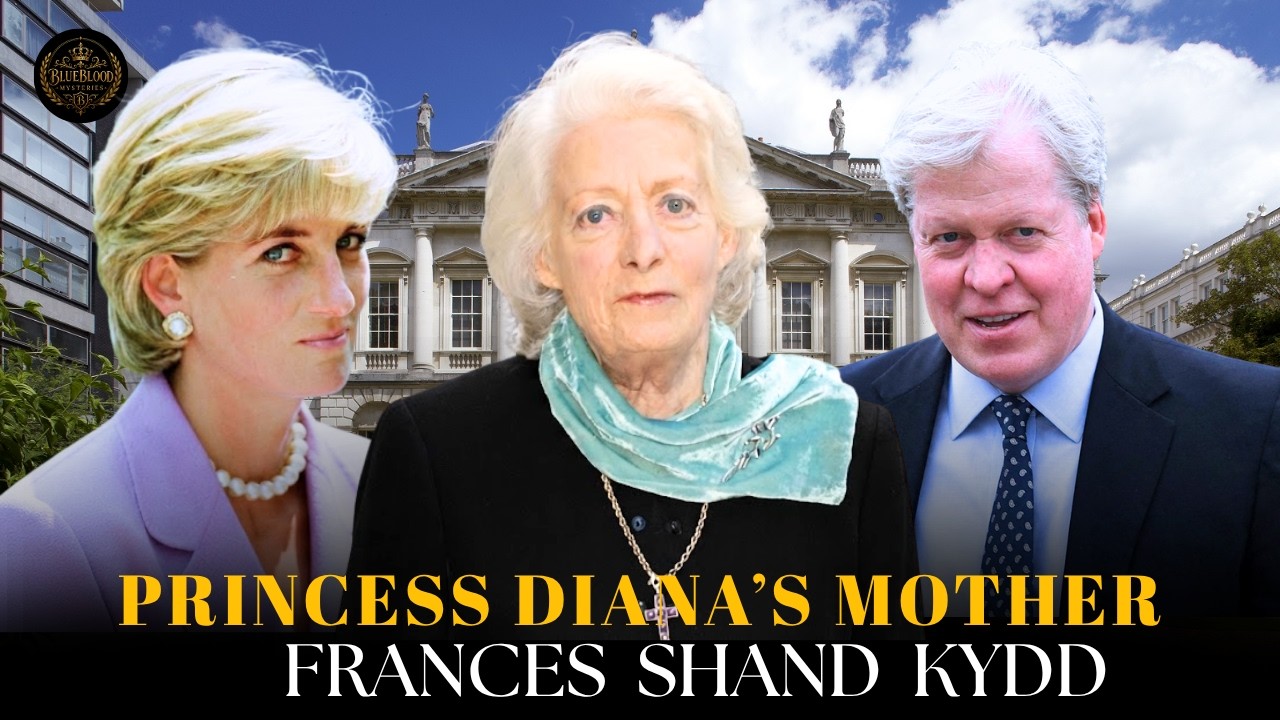
There would be no reconciliation now, no final conversation to mend a rift that had opened just that spring. The friends who knew her said afterwards that Frances was haunted by one particular fact: there had been no time left to make things right. It is the kind of ending that makes you want to go back to the beginning, because the beginning gives no hint of it. Frances Shand Kidd came into the world on the twentieth of January 1936 at Park House, on the Sandringham royal estate, in the same hours that King George V lay dying a short distance away.
It has long been said that Queen Mary learned of the newborn’s arrival while the old king was taking his final breaths. Birth and death arriving together under one roof, while the aristocracy watched closely, as it always did. It reads now like a headline for the rest of Frances’s life. Her parents were Maurice Roche, the fourth Baron Fermoy, a close friend of the royal family, and his wife Ruth, Lady Fermoy, a prominent society figure who would later become, for decades, a close friend and lady-in-waiting to the Queen Mother.
Frances grew up literally inside the royal orbit, raised at Park House with an older sister and a younger brother. She was educated first by a governess, then at a convent school, where she excelled, becoming head girl and captain of the games teams. She was a genuinely gifted athlete, good enough at tennis to qualify for a national championship and a real chance at Wimbledon, until an attack of appendicitis cost her that opportunity. By every account of her childhood, Frances was bright and sporty, raised exactly as aristocratic girls of her generation were raised, for one purpose only: a prestigious marriage.
It is worth noting what that upbringing did not include. There was no serious discussion in Frances’s world of a career, a job, or any source of income or independent identity. Her intelligence and athletic talent were treated as attractive accomplishments, not foundations for an adult life of her own choosing. Which meant that when her marriage eventually collapsed, she had no independent footing to stand on, only her personal abilities.
That single purpose was achieved early. In 1952, at just sixteen, Frances met John Spencer, known as Johnny, Viscount Althorp. He was twelve years her senior, had served as an equerry to King George VI and to the young princess who would soon become Queen Elizabeth II, and stood next in line to become the eighth Earl Spencer. On paper, it was a dazzling match, uniting two families already bound by generations of royal service.
The courtship was brief, the engagement announced in early 1954, and on the first of June of that year the couple married in Westminster Abbey, with the Queen, Prince Philip, the Queen Mother, and Princess Margaret among the guests. Frances was eighteen, the youngest bride to marry at the abbey altar in the entire twentieth century. The photographs show a radiant teenager in an ivory silk dress beside a viscount in his thirties beneath the abbey’s arched ceiling. To everyone watching, it looked like the opening scene of a fairy tale.
There is an uncomfortable symmetry worth noting, one the family itself lived twice. A teenage aristocratic bride dazzling the public at a huge cathedral wedding, entering an arranged marriage based on dynastic expectations as much as genuine partnership, only to discover, after the cameras left, a husband far harder to live with than the fairy tale had suggested. That was Frances’s own story in 1954. It was also, with the names changed, nearly her daughter’s story in 1981.
It did not take long for the fairy tale to show its cracks. According to later accounts, including that of royal historian Tina Brown, Johnny Spencer, behind his public charm, drank heavily and had a controlling, sometimes abusive temper. And he made clear, almost immediately, that what he wanted from his young wife, above all else, was a son. That single demand would come to dominate the entire marriage.
The couple settled first in the countryside while Johnny completed a course in agriculture, then at Park House on the Sandringham estate, the very estate where Frances herself had been born. There, under the weight of aristocratic expectation, the pressure to produce a male heir became, for all practical purposes, relentless. In 1955, the nineteen-year-old Frances gave birth to her first child, a daughter, Sarah. Two years later came a second daughter, Jane.
Both girls were healthy and loved, but they represented, to Johnny Spencer and the wider Spencer family, a disappointment that could not be voiced in polite company but was palpable everywhere anyway. According to Tina Brown’s later account of the marriage, Frances endured six pregnancies over nine years, of which only four came to term, a detail suggesting at least two additional miscarriages or lost pregnancies on top of the losses already publicly known. The number deserves a pause, because it means that behind the two surviving daughters and the children who would come later, there was a private history of repeated loss that Frances carried largely in silence, inside a marriage that gave her little room to grieve any of it. The worst of those losses came in January of 1960.
By this point Frances had given birth twice and endured at least one earlier loss. She was twenty-three, raising two small daughters, living inside a family where her husband’s acceptance was explicitly tied to whether her next child would be born with the correct anatomy. It is worth noting that there was nothing medically sound in this pressure, even by the standards of the time. What it reflected instead was a family culture in which a wife’s body was treated as a dynastic instrument rather than her own.
Frances, pregnant for the third time, went into labor and gave birth to a son, John, Viscount Althorp, on the twelfth of the month. For a few hours, it must have seemed the entire purpose of the marriage had finally been achieved. The baby lived only ten hours before dying, almost certainly from a severe congenital defect. What happened next is the detail that has clung to Frances’s story ever since, repeated in biography after biography.
Johnny Spencer did not allow her to see the child. The baby’s body was taken away. The nursery door was closed. And Frances, still physically weakened from the birth itself, begged in vain, simply for a glimpse of her son’s face.
She later described the experience in words that have been quoted for decades: the baby was taken from her, she never saw his face, neither in life nor in death, and no one in the family ever spoke of it again. It is a hard thing to absorb, a young mother denied the most basic rites of grief inside a family that treated the death of her child not as a tragedy but as a frustrating obstacle on the way to securing the Spencer inheritance. Consider what that particular cruelty actually required. Someone had to give the order to remove the body.
Someone had to lock the nursery door. Someone had to decide that a grieving mother, still physically recovering from childbirth, should not be allowed into a room in her own home. None of that happens by accident. None of it happens without a family built on the idea that a woman’s grief matters less than the family’s reputation for composure.
Frances was not yet twenty-four, and she had already lived through an enormous amount of scrutiny, loss, and institutional coldness that leaves permanent scars on most people. Still, the pressure to produce a male heir did not stop. In July of 1961, Frances gave birth to a fourth child, another daughter. This was Diana, the future Princess of Wales.
Inside the Spencer family, her arrival was met, according to several accounts, with open disappointment rather than celebration. The couple reportedly had not chosen a name for a girl in advance, and the infant remained unnamed for about a week, as if the family itself was not prepared for the possibility of another daughter. Worse, a harsh tone of blame prevailed among the older generation, with whispers wondering what was wrong with the mother for failing again to produce a boy. Frances’s own mother, Ruth, Lady Fermoy, is said to have urged her to undergo a series of invasive gynecological examinations at Harley Street, in pursuit of a medical explanation for a pattern that the medical science of the era should already have recognized had nothing to do with her at all.
By any modern standard, it was scientific nonsense and personal insult in equal measure, a young woman subjected to intimate medical procedures because an aristocratic family could not accept that daughters were all she could provide. Finally, in May of 1964, Frances gave birth to a healthy son, Charles Edward Maurice Spencer, the future ninth Earl Spencer. Johnny had his heir at last. On the surface, the Spencer line now looked secure.
Four living children, the title preserved for another generation. Beneath that surface, the marriage itself had accumulated years of damage that no single birth could repair. Charles Spencer himself reflected, decades later, on that period of his parents’ marriage, describing it as a truly awful time, and stating plainly that he believed the pressure to produce an heir was likely the root cause of their divorce, because, in his words, he did not think his parents ever fully recovered from it. By the mid-1960s, Frances was the mother of four children, still in her late twenties, outwardly possessing everything any aristocratic wife could wish for, and privately living in profound unhappiness.
By the testimony of many, Johnny’s heavy drinking and controlling temperament made the home a genuinely difficult place to live, and he resented his wife having any independent life outside her duties as mother and hostess. It was into this unhappiness that Peter Shand Kidd entered her life. He was a wealthy businessman, heir to a wallpaper fortune, already married, and by most accounts warm, attentive, and willing to treat Frances as his equal, rather than as a role she was expected to perform. By 1966 the relationship had deepened into a full affair.
In 1967, at thirty-one, Frances made the decision that would define her public reputation for decades to come. She left Johnny Spencer for Peter Shand Kidd. In the social world she had grown up in, this was almost unbelievable. Aristocratic wives of her generation were expected to endure unhappy marriages in silence, not abandon them and leave.
The press seized on the story immediately, and the tabloids reached for an old social term from the 1920s to describe her: the bolter, a woman who runs away from her marriage for another man. Overnight, Frances went from society darling to social outcast. Doors closed against her in high society, and most painfully of all, her mother turned on her. Ruth, Lady Fermoy, close friend of the Queen Mother and devoted guardian of conservative aristocratic values, viewed her daughter’s affair as unforgivable shame.
When Johnny Spencer filed for divorce on grounds of adultery, Lady Fermoy sided publicly with her son-in-law. During the resulting divorce proceedings, Frances’s mother testified against her in court, strengthening the argument that Frances was an unfit mother. It is one of the most shocking betrayals in this entire story: a mother choosing the appearance of aristocratic honor over her own daughter at the moment her daughter needed her most. The divorce was finalized in April of 1969, with Frances formally condemned for adultery.
She had already left the family home two years earlier to live with Peter. Peter’s own wife had named Frances as co-respondent in her divorce petition, meaning the details were fully public even before the Spencer case reached its conclusion. The press treated a mother leaving four young children, then aged between five and fourteen, as a genuine scandal. And the court, heavily influenced by the conventions of the age and by the testimony of Lady Fermoy herself, granted full custody of all four children to Johnny Spencer.
Frances did not merely lose her marriage. She lost her children too, granted only limited, carefully restricted visiting rights, rights that Johnny made deliberately difficult to exercise, according to several accounts. It is impossible to overstate the human cost of that custody decision. Diana herself, only seven at the time, later described one of her clearest childhood memories: watching her mother’s car disappear down the long driveway at Park House after one of those visits, puzzled about why her mother simply did not come back to the house with them.
Decades later, as an adult, Charles Spencer delivered his own blunt verdict on those years, describing their father as a quiet, constant source of love, while suggesting that their mother, in his words, was not cut out for motherhood, being in love with someone else. It is a harsh judgment, and it is worth acknowledging two truths at once. That a child’s pain at feeling abandoned is entirely real and deserves to be taken seriously, and that the legal and social machinery of Britain in the 1960s gave an unhappy aristocratic wife almost no way to leave a difficult marriage without losing her children in the process. Both truths can be true at the same time, and together they describe something closer to tragedy than to simple villainy on either side.
It is worth adding that the family courts of that era were not merely neutral toward mothers who left their marriages. They were effectively designed against them. Adultery, in the language of the law itself, marked the woman as the guilty party, and the guilty party, by the unwritten conventions of the time, was rarely entrusted with the daily care of the children, regardless of how the father himself had behaved throughout the marriage. Frances was not an unusual victim of this system.
She was, in a sense, a fairly typical one, which is itself an indictment of the system. One month after the divorce was finalized, on the second of May 1969, Frances married Peter Shand Kidd in a small civil ceremony, a world away from the grandeur of Westminster Abbey fifteen years earlier. No royal guests this time, no society pages breathlessly covering the details of the wedding dress. The woman who had once been a headline-making bride at eighteen was now, in the eyes of many in her former social circle, an outcast.
The rift with her mother never healed. She and Ruth, Lady Fermoy, remained estranged for the rest of Lady Fermoy’s life, the courtroom betrayal never fully forgiven on either side. Instead of fighting to regain her place in a world that had entirely rejected her, Frances chose a much quieter life. In 1972, she and Peter bought a large farm on the remote island of Seil, off Scotland’s west coast, connected to the mainland by a small stone bridge the locals call the Bridge over the Atlantic.
There, in a white-painted farmhouse surrounded by green pastures and grey coastline, Frances built an entirely different kind of life. She opened a small gift shop selling local crafts, walked the island’s lanes with her dog, took up fishing seriously, and swapped designer clothes for tweed and Wellington boots. By every account, she integrated genuinely into the island’s close-knit community, known to her neighbors simply as Mrs. Shand Kidd, a private but friendly figure who helped with church fundraisers and learned the Gaelic names of the surrounding hills.
For the first time in years, according to those who knew her, Frances found something close to real peace. That peace, in the eyes of most who knew her, was genuine and not just a performance for strangers. She was not merely enduring exile on Seil. She seemed actually to prefer it to the life she had left behind.
Visitors and neighbors who came to know her over the following decades consistently described a woman who had made her conscious decision about what truly mattered to her, a woman who did not spend her years on the island secretly longing for the aristocratic world that had cast her out. Meanwhile, her children grew up in a very different world. Johnny inherited the title Earl Spencer in 1975, and the family moved from the rented Park House to Althorp, the vast Spencer family estate in Northamptonshire, thirteen thousand acres of parkland surrounding a mansion hung with centuries of family portraits. Diana and her siblings grew up inside that history, in a house from which their mother was largely absent.
Contact during those years often consisted of holiday visits and letters, frequently tense and emotionally charged. Diana herself would later recall how hard it was to say goodbye to her mother after each brief visit, a recurring wound that some biographers have linked directly to the deep fear of abandonment she carried into her adult life. Slowly, over the following years, some of the damage began to heal. By the late 1970s, as her daughters reached adulthood, Frances rebuilt genuinely warmer relationships with Sarah and Jane, and even with Diana, who had been a small child when Frances first left, a bond forming during her teenage years that was imperfect but real.
It would be a mistake to see this gradual thaw as a complete, orderly reconciliation. The years of separation left real and permanent damage, and the relationships Frances rebuilt with her children in adulthood were, by most accounts, genuinely affectionate but also genuinely guarded, permanently shaped by the fact that so much of their actual childhood had passed without her in it. In 1980, Frances was invited to Balmoral to celebrate Diana’s engagement to Prince Charles, a clear signal that whatever the history between them, she remained unmistakably Diana’s mother. On the twenty-ninth of July 1981, Diana married Prince Charles at St.
Paul’s Cathedral and became, overnight, the Princess of Wales. For Frances, watching her twenty-year-old daughter walk down the cathedral aisle must have carried an almost surreal weight. Barely a dozen years after being branded an adulteress and an unfit mother in an open court, she sat inside one of the most watched ceremonies in modern history as the mother of the bride. Whatever lingering judgments that old scandal still carried were utterly eclipsed, on that day at least, by her daughter’s own radiance.
It did not take long, however, for the press to remember exactly who Diana’s mother was. The old label, the bolter, resurfaced from newspaper archives, and photographers began making the long journey to Scotland, hoping for a glimpse of the Princess of Wales’s notorious mother. For her part, Frances largely maintained the reticence she had spent more than a decade building, refusing interviews and staying out of the spotlight even at the wedding itself. But being Diana’s mother meant the spotlight would never entirely leave her alone again.
Throughout the 1980s, Frances appeared at sporadic events in Diana’s world: visits to Kensington Palace, family holidays, including one well-known photograph from the Caribbean showing her in sunglasses on a beach with William and Harry. In that one image she looks less like a member of the extended royal circle than an ordinary grandmother. But mostly she watched her daughter’s increasingly complicated public life unfold from a distance, on television in Scotland, watching the cracks appear in Diana’s marriage, the relentless press pursuit, the private struggles with bulimia and isolation that only became fully public later. Having survived her own version of tabloid persecution years earlier, Frances was said to understand that particular pressure with genuine, hard-won sympathy.
Those unwanted lights eventually cost Frances her second marriage too. By the late 1980s, the constant media attention on the Spencer family and the royal family had become an exhausting, unrelenting presence in Peter Shand Kidd’s private life. A man who had married Frances expecting to leave aristocratic drama far behind found himself permanently cast as the stepfather of the most famous woman in the world. Frances later admitted plainly that she had come to be known simply as Diana’s mother rather than as Peter’s wife, and that the pressure eventually became more than he could bear.
In June of 1988, after nearly nineteen years of marriage, Peter left Frances for another woman. The irony was not lost on the press, which noted with obvious pleasure that the woman once branded a bolter had now herself been abandoned. But this time, public sympathies tilted more toward Frances. She was no longer simply a controversial figure.
She had become, at this point, someone deserving of sympathy: a woman in her early fifties facing a second divorce. Her own happiness, arguably, had been destroyed by the very fame that had once made her relevant again. In the years that followed, Frances turned toward an entirely different foundation. In 1994, at fifty-eight, she converted to Roman Catholicism, a genuine break with the Anglican tradition that both the Spencer and Fermoy families had followed for generations.
The conversion came shortly after the breakdown of her second marriage, and it is difficult not to see the two events as connected. Having now lost the two greatest romantic relationships of her adult life, the first to aristocracy and the second to the fame that had briefly restored her public standing, Frances seemed to turn toward a faith that offered her something neither marriage could: a framework for understanding her past that did not require anyone else’s forgiveness to be complete. Those who knew her believed the faith’s emphasis on forgiveness and redemption resonated deeply with a woman who had spent decades carrying public guilt over choices she had made in her thirties. The close-knit Catholic community around her home in Argyll welcomed her warmly.
But even in her chosen isolation, Frances could not entirely escape her daughter’s turbulent public life. Through the mid-1990s, as Diana’s marriage to Prince Charles unraveled into separation and divorce, and as Diana herself gave her sensational Panorama interview, revealing her unhappiness inside the royal family, Frances watched with visible distress. Raised in a generation that believed strongly in keeping private matters private, she reportedly disapproved of her daughter’s growing willingness to discuss royal family problems openly with the press. It was a genuine point of tension between two women who had once been drawn together by their shared experience of unhappy marriage.
There is a particular sadness in this reversal. The thing that had once brought mother and daughter together, two women who had lived through marriages that looked glamorous from the outside and bleak from within, had by the mid-1990s become itself the reason they drifted apart. Each had reached a completely different conclusion about what to do with that kind of pain. That tension reached a breaking point in early 1997.
Frances gave an interview to a small magazine connected to a prayer house fundraiser, in which she criticized both Diana and Charles for making the difficulties of their marriage public, noting that some things should stay within the family. She also expressed her long-suppressed frustration at the media’s massive intrusion into all their lives, sharply wondering whether anyone had considered that Diana was her daughter too. When the interview was published that spring, Diana was said to be furious, seeing her mother’s comments as a betrayal and, given Frances’s own past, somewhat hypocritical. The rift that followed was swift and genuinely serious.
Letters Frances wrote to Diana that summer were said to come back unopened, and friends of the princess noticed she had stopped talking about her mother entirely. By the summer of 1997, mother and daughter were, by most accounts, simply not speaking. Then came the thirty-first of August 1997. Diana died in a car crash in a Paris tunnel, and Frances learned the news by telephone in the middle of the night at her home in Scotland.
There would be no reconciliation now, no final conversation to repair the rift that had opened only months before. Friends said later that Frances was haunted specifically by the fact that there was no time left to make things right. She remained composed but clearly shattered throughout the period of public mourning, attending the funeral at Westminster Abbey quietly, away from the lights that fell instead on Charles Spencer’s moving eulogy and on the sight of young William and Harry walking behind their mother’s coffin. She later spoke with genuine and moving sympathy about the family of Henri Paul, the driver who died alongside Diana, saying their grief was in some ways the most painful of all.
In the aftermath, something like reconciliation finally arrived. Too late for Frances and Diana, but meaningful nonetheless. Diana’s will named Frances as one of the executors with a specific responsibility relating to the upbringing of William and Harry, a gesture indicating that despite everything, a real and lasting trust had remained beneath the surface of the estrangement in the final years. It is one of the most quietly affecting facts in this entire story.
Diana did not amend that clause after the argument that spring. Whatever she felt in the midst of that rift, the formal legal expression of her trust in her mother, written earlier and left unchanged, remained exactly in its accustomed place. The years that followed were not without further difficulties. Frances was called to give testimony in various official inquiries into Diana’s death.
In a widely reported incident in 2000, Mohamed Al Fayed, father of Dodi Al Fayed, confronted her aggressively in public outside a hearing, angry that she would not endorse his belief that Diana had been murdered. Frances refused to be drawn into a public confrontation. In 2002, she also expressed displeasure when the initial designs for Diana’s public memorial were unveiled without anyone bothering to ask her opinion, as she put it. A small but genuine reminder that Frances, even in the memorialization of her own daughter, often found herself an outsider looking into a story that was unquestionably hers as well.
It is worth asking why that particular exclusion hurt so much. Frances was not merely an incidental observer of Diana’s life denied a courtesy. She was the woman who carried her, raised her through her first years, and remained, however far the distance across the intervening decades, her mother in every sense the word holds. Excluding her from the planning of a memorial to her own child was not merely an administrative oversight.
It was a final, perfectly symbolic repetition of a pattern that had defined Frances’s adult relationship with the institutions surrounding her daughter: present by blood, absent from the official record. That same year carried its own small, ugly coda. In October of 2002, Frances traveled south from Scotland to give testimony at the trial of Paul Burrell, Diana’s former butler, accused of stealing items from the princess’s estate. While she was away from home testifying, burglars broke into her house on the island of Seil and took her jewelry.
A petty, opportunistic crime, but it nonetheless confirmed how exposed her carefully protected private life had become, simply because of the name she carried. By the early 2000s, Frances’s public appearances were rare, and her health was declining. She developed a tremor later diagnosed as Parkinson’s disease, and in the following years it was discovered she also had brain cancer. The lively, athletic young woman who had once nearly played at Wimbledon spent her final months in increasing frailty, her speech and movement affected.
Yet by all accounts, she faced it with the same quiet resilience that had helped her through so much earlier difficulty. Frances Shand Kidd died at her home on the island of Seil on the third of June 2004, at sixty-eight, after a long illness. The announcement of her death carried the same quiet dignity she had spent more than three decades cultivating on that island. There was no grand royal statement, no flags lowered over Buckingham Palace, nothing resembling the global outpouring that had followed her daughter’s death seven years earlier.
A brief notice went out on the news wires, and a woman who had once been among the most scandal-touched aristocrats in Britain passed away entirely without fanfare, exactly as she seemed to have wanted. Her funeral was held on the tenth of June at St. Columba’s Cathedral in Oban, a deliberately modest Catholic service rather than a grand public spectacle, attended by about six hundred people from the local community and her family. Both her grandsons traveled to attend.
William, then twenty-one, gave a reading during the service, and his voice was said to have cracked with emotion in the middle of it. Harry, nineteen, returned specially from his gap year in Africa to be there. Prince Charles did not attend, having a prior commitment to represent the royal family at the funeral of former President Ronald Reagan in Washington that same week. Charles Spencer, speaking later, acknowledged that Diana’s marriage and fame had unquestionably reshaped his mother’s quiet life.
But he said plainly that, in the end, they remained close. That is, in its own way, the most generous verdict anyone close to this story has offered about Frances publicly. It was not an erasure of years of estrangement, nor a sentimental rewriting of a genuinely difficult relationship, but a simple acknowledgment that whatever fame had cost her, something real had endured beneath it. Consider, finally, the full and more complicated picture of this woman’s life, beyond what the tabloids reduced her to.
Frances Shand Kidd was, at various points across her sixty-eight years: a teenage bride married in Westminster Abbey; a young mother forced through six pregnancies in pursuit of a son; a woman denied the right to see her dying infant; a wife publicly humiliated in court by her own mother; a mother stripped of custody of her children under laws that stood entirely against her; a social outcast who rebuilt her life from nothing on a remote Scottish island; the mother of the most photographed woman in the world; and finally, a woman who lost her daughter in sudden, tragic death while they were not even speaking to one another. None of those individual facts explains her entirely. Together they describe a life defined not by the simple villain role the press assigned her in 1967, but by the exhausting, daily human work of surviving one genuine disaster after another, decade after decade, and somehow finding a measure of peace at the end. One final detail deserves recording because it belongs to her alone, and not to Diana’s story.
Her second husband, Peter Shand Kidd, outlived her by less than two years, dying in March 2006. And in a strange and sad echo of the losses this family had known before, Peter’s eldest son from his first marriage, the novelist Adam Shand Kidd, had died in Cambodia only weeks before Frances herself passed in the summer of 2004. A quiet, private grief unfolding inside the Shand Kidd family at almost the same moment the public was mourning Frances only as Diana’s mother.
