In the spring of 1834, a stonecutter on the south bank of the Patapsco River drove a steel wedge into a line of drilled holes and split a block of gray granite from the face of a hill overlooking a river valley he had not known existed before his work led him there. The block weighed roughly eight hundred pounds, and he had repeated the same motion since before sunrise. He would repeat it again until the daylight failed. The hill above him was a quarry.
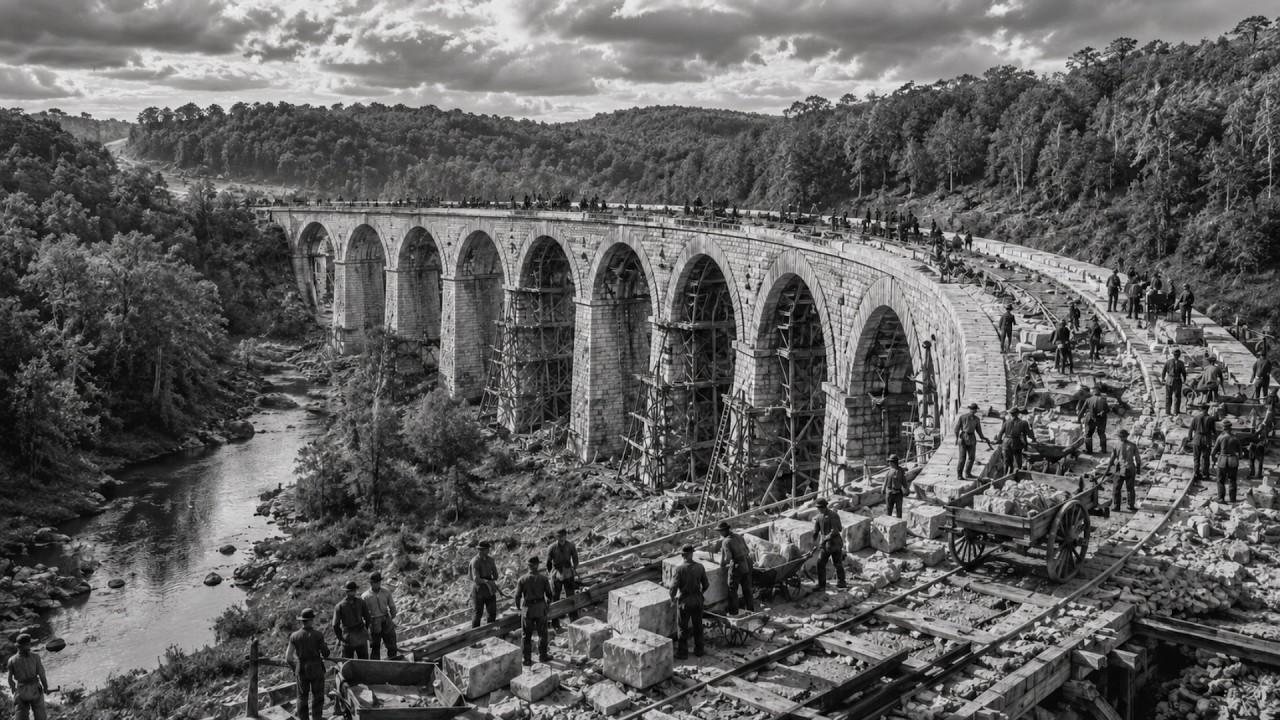
The valley below was a construction site. He was cutting the very stone that would go into the very arch he could see rising beneath his feet. The structure taking shape in the Patapsco River valley in the spring of 1834 had been designed by a twenty-seven-year-old man who had never built a bridge of this size. The railroad company funding the project had been in financial difficulty since the day it was founded, and it had spent the previous two decades arguing with the state of Maryland over its right to build the line it was trying to create.
The technique the young engineer had specified, a curved stone arch bridge 612 feet long and 66 feet high above the river, had never been built in the United States for railroad purposes. It had barely been built for any other purpose. The stone that stonecutter split from the hill in the spring of 1834 is still in the arch today. Thomas Viaduct is still in service.
Freight trains cross it several times a day, at speeds and loads the engineer who designed it and the stonecutter who built it could not have imagined in 1834. The structure absorbs those loads without any visible response. It has been absorbing increasing loads for 189 years. This is the story of how the Baltimore and Ohio Railroad built Thomas Viaduct across the Patapsco River at Relay, Maryland, in 1835.
It is the story of the oldest multi-arched stone railroad bridge in the United States still in active service. It is the story of a twenty-seven-year-old engineer who designed something that has not needed rebuilding in nearly two centuries. It is the story of the Irish immigrant laborers and enslaved Black men who cut the stone, built the piers, and raised the arches in a Maryland river valley, while the railroad company paying them tried to avoid bankruptcy. The engineer’s name is recorded in the National Register of Historic Places listing for the structure.
The workers’ names exist in the payroll records of the Baltimore and Ohio Railroad, in whatever condition those records have survived the years. To understand why the Baltimore and Ohio Railroad had to cross the Patapsco River at Relay in 1835, you have to understand what that railroad was, what it was trying to achieve, and why it mattered that it get there first. The Baltimore and Ohio Railroad was chartered by the state of Maryland in 1827. Its founders were Baltimore merchants and civic leaders who had realized that the opening of the Erie Canal in 1825 had permanently redirected the interior western trade toward New York.
The Erie Canal connected the Hudson River at Albany to Lake Erie at Buffalo over 363 miles across upstate New York, and the plan had worked. Goods from the Ohio Valley, previously carried down the Mississippi to New Orleans or overland by wagon to Philadelphia and Baltimore, now flowed east through the canal to New York instead. New York’s commercial position, already strong, became dominant. Baltimore’s position, already challenged, became imperiled.
Philadelphia had recognized the same threat and begun building the Main Line of Public Works, a combination of canals, inclined planes, and railroad sections across Pennsylvania toward Pittsburgh. The competition for western trade was a race among Atlantic ports, and Baltimore was losing. The solution Baltimore’s merchants chose was a railroad, not a canal. The mountains of Maryland and western Virginia were too steep for a canal that could compete with the Erie.
A railroad could climb grades water could not, and it could operate in winter when canals froze. A railroad running from Baltimore to the Ohio River at Wheeling, Virginia, now West Virginia, a distance of roughly 379 miles across terrain no American railroad had yet attempted. The B&O was not America’s first railroad. Several earlier lines had existed as mine and quarry railroads.
But the B&O was the first common-carrier railroad in the United States, the first built to carry passengers and freight commercially over a long distance using the best available technology. In 1827, the best available railroad technology was still being invented. The B&O began construction before reliable locomotives existed, before the track standards that would govern American railroads for the next century had been set, and before anyone in the United States had built a railroad across mountains. The route running south and west from Baltimore followed the Patapsco River valley for the first part of the line.
The Patapsco runs southwest from the city through a series of narrow valleys cut into the granite and gneiss of Maryland’s Piedmont before widening toward the Chesapeake Bay. The terrain along the north bank of the Patapsco was suitable for a railroad in the first miles. The valley walls rose sharply on both sides, limiting route options, but the grade along the river was acceptable. About nine miles southwest of Baltimore, near a small settlement called Relay, the Patapsco turned and the terrain on the north bank became impassable.
The valley wall on the north side rose to a rocky face no locomotive of the 1830s could climb. The route on the south bank was available if the railroad could cross the river. The crossing required a structure 612 feet long spanning the valley from north bank to south bank at a height of up to 66 feet above the river. This crossing was not optional.
There was no other route the railroad could take at that point in the valley. The structure had to be built or the railroad stopped at Relay. The man the Baltimore and Ohio Railroad assigned to solve the Relay problem was Benjamin Henry Latrobe II. He was born in Philadelphia in 1806.
His father, Benjamin Henry Latrobe, was the architect who designed the United States Capitol after the British burned it, along with the Baltimore Cathedral and the Bank of Pennsylvania, and who died of yellow fever in New Orleans in 1820 when his son was fourteen. The younger Latrobe trained as a surveyor and civil engineer in the years after his father’s death, working on canal surveys and road-building projects in Maryland and Virginia before joining the engineering staff of the Baltimore and Ohio Railroad in the early 1830s. He was twenty-seven when the railroad gave him the Relay problem. The design he produced during the winter of 1832 and spring of 1833 was a stone bridge of eight elliptical arches.
Each arch spanned 58 feet of open air between pier faces. Each arch rose 22 feet above its spring line, the point where the curved arch surface begins to separate from the top of the pier. The piers carrying the arches were 20 feet thick at their base, tapering slightly toward the top, with pointed cutwaters projecting from the upstream face to deflect the seasonal flow of the Patapsco around the pier bases. The total height from riverbed to rail surface at the top of the structure was 66 feet.
The total length was 612 feet. The structure was not straight. The terrain of the Patapsco valley at Relay required the railroad line to curve as it moved from the north-bank approach to continue along the south bank. The bridge followed that curve.
It was built on a horizontal curve of 4 degrees, the sharpest curve ever asked of a stone railroad bridge in the United States up to that time. It was in fact the first curved stone railroad bridge in America, because no curved stone railroad bridge had ever been built here before. The decision to build in stone rather than timber was an economic one that seemed straightforward from a sound perspective. A wooden bridge across the Patapsco at the required height would be cheaper and faster to build.
But a wooden bridge carrying steam locomotives across a crossing 66 feet high would require constant fire-watching with every train, intensive maintenance against rot and weather, and complete rebuilding within 20 years, in a cycle that would repeat as long as the railroad operated. A stone arch bridge built to specification would carry any load the railroad put on it for longer than anyone in 1833 could confidently predict. The financial officers of the Baltimore and Ohio Railroad were not operating from a position of wealth, but they could calculate the difference between a structure built once and a structure built four times, and they approved the stone design. Latrobe was 27 years old.
He had built small stone culverts and minor bridges on previous projects. But he had never built anything on this scale. He had never built anything on a horizontal curve. No one in the United States had ever built a stone railroad bridge on a horizontal curve, because the problem had never needed solving here before.
He drew the plans and submitted them. The railroad approved the plans. The contract went to a construction company. Work began.
The material Latrobe specified was the granite and gneiss underlying the Patapsco valley walls at the construction site. Pennsylvania blue stone splits cleanly along its natural bedding planes. Maryland Piedmont granite does not. It is a rougher, harder rock, more resistant to wedge and drill, with a crystalline composition that offers no clean, predictable fracture planes like bedded sedimentary stone.
The men working in the quarries above Relay were splitting a material that resisted them. The technique was the same one stonecutters had used since Roman building crews spanned the aqueducts of Gaul. A line of drilled holes along the intended fracture face, made with a steel drill and a striking hammer, traded between two men. One man holds the drill and turns it.
Another swings the hammer in a calibrated rhythm to keep the drill cutting without jamming. Into each hole a set of three steel pieces is placed: two thin side pieces called feathers and a central piece called a plug. The feathers and plug are driven in sequence, each blow driving a little deeper than the last. The accumulated pressure spread across the rock face until the stone split along the line the driller had chosen.
At Relay, drilling into granite took longer than it does in softer rock. The fractures were less predictable. The blocks extracted from the face were rougher and required more time in the dressing yard before reaching final dimensions. A pier course block had to be dressed square on four sides, top, bottom, and both faces, to sit flat on the course below it and carry what was above without rocking.
The arch stone, the wedge-shaped stone forming the arch ring, required the correct wedge angle on its two inclined faces. When set into the arch over the wooden centering, its inclined faces pressed against the arch stones on both sides. If the angle was off by even a fraction, the contact between adjacent stones would not be complete. Stresses would concentrate at those points in the arch.
The arch would eventually crack at those points. It would fail at those points under the loads of 189 years of freight trains. The correct wedge angle was specified in Latrobe’s drawings. The stonecutters in the dressing yard translated those drawings into cut stone using steel chisels and wooden mallets.
A supervisor in the yard checked the work against the specified dimensions before the stones were moved to the erection crews. A block that failed inspection went back for reworking. Reworking meant lost time. Time was money the Baltimore and Ohio Railroad could not afford to waste.
The dressing yard at the Relay construction site worked through both construction years without pause. Every stone that went into Thomas Viaduct passed through that yard. Every arch stone was cut, inspected, and accepted there before being hoisted to the centering above. The men who built Thomas Viaduct came from two groups on which Maryland’s construction economy of the early 1830s relied for heavy labor.
The first was Irish immigrants. Irish men had been arriving in Baltimore and other Atlantic ports in increasing numbers since the 1820s, pushed out of Ireland by agricultural unrest and the economic contraction that followed the Napoleonic Wars, and pulled to America by the wages that canal and road projects paid to men willing to swing picks and move stone. Canal projects of the 1820s, such as the Chesapeake and Ohio Canal, the Chesapeake and Delaware Canal, and the Philadelphia and Columbia Railroad, employed tens of thousands of Irish laborers on piece-rate or daily wages across the mid-Atlantic region. These men formed a mobile workforce that followed projects across state lines, from canal jobs to railroads and ports, carrying quarrying and masonry skills in their hands and, in their networks, knowledge of where the next contracts were.
The Baltimore and Ohio Railroad drew on this class of workers to build Thomas Viaduct and the rest of its early construction. The Irish laborers who built sections of the railroad bed, the tunnels, and the stone structures along the first segments of the line were men who had learned their trade in Ireland or on the American canal projects that preceded the railroad work. They were not a community in the sense of settled residents at fixed addresses. They were a labor force that moved with the construction economy of the mid-Atlantic states in the 1830s, living in camps near the work sites and moving on as the work moved.
The second group was enslaved Black men. Maryland in 1835 was a slave state. Maryland’s labor markets in the early 1830s included the hiring out of enslaved men by their owners to work on major construction projects. This practice was common throughout the Upper South.
A slaveholder contracted with a construction company to supply a set number of men for a set period at a wage that went to the slaveholder. The construction company got labor at a fixed contract rate. The enslaved men took direction from the construction foreman, endured the harsh working conditions and injury risks associated with breaking granite and lifting stone at heights above a running river, and received no wages. The wages went to the man who owned them.
The Baltimore and Ohio Railroad’s payroll records from the Thomas Viaduct construction period reflect Maryland’s 1835 labor structure. Irish laborers appear in the records by name, with their daily or weekly wages recorded beside each name. The enslaved men appear as items paid to their owners, with the cost of their labor recorded as a sum of money paid to a third party. The men who did the work appear in the records as a lump cost.
They do not appear as individuals. Their names are not listed in those entries. This is not an exception in the Thomas Viaduct records. It is the general structure of the historical records of enslaved labor in the antebellum construction economy.
The practice of recording the owner’s name, the price, and the number of men, while leaving the men themselves unnamed, was not an oversight. It was the accounting custom of that system. The total size of the workforce at peak construction has not been precisely determined in publicly available accounts. Large construction projects of the 1830s typically employed several hundred men at peak activity.
Quarry crews, stonecutters, masons, carpenters building the centering and scaffolding, laborers moving materials around the site, wagon drivers hauling stone from the quarry to the construction area, and general labor keeping a large construction site running. Thomas Viaduct was the largest stone railroad structure built in the United States up to that time. The workforce required to build it in a limited period was very large. The construction site at Relay was not a place workers commuted to daily from Baltimore.
The distance was acceptable by the standards of a later age with better roads. By 1830s standards, the site was remote enough that a large part of the workforce lived on it or in its immediate vicinity for the duration of their time on the project. The housing the construction company provided its workforce in the 1830s was what construction companies provided in that era. Temporary structures adequate to keep the men on site and able to work, not designed for comfort in the heat of a Maryland summer or the cold of its winter.
A Maryland summer in the Patapsco valley is heat that builds in the surrounding hills and settles into the river valley, where the river’s humidity keeps the relative humidity above 80 percent through July and August, and the air temperature in the valley reaches the mid-90s Fahrenheit in the afternoon. The men working in the quarry worked under direct sun on exposed rock faces that absorbed the heat of a Maryland summer and radiated it back from the stone surface. The men working atop the rising piers worked 40 and 50 feet above the river with no artificial shade, the sun reflecting off the granite around them. The river below offered no relief, because getting to it and back consumed time the foremen were not willing to allow.
A Maryland winter in the Patapsco valley is the other condition to be faced. January temperatures fall below freezing. The Patapsco freezes along its edges in cold winters, its center running fast and dark between shelves of ice. Hydraulic cement mortar does not set properly at freezing temperatures.
Masonry construction in sustained freezing conditions requires protecting new work from frost. Covering the fresh stone, building fires in the work area, or work stops until conditions allow resumption. The construction seasons at Relay were governed from both ends by the weather. What was built was completed in the time windows the Patapsco valley climate allowed.
The foundations of the Thomas Viaduct piers, set in the river, required isolating the foundation area from the river long enough to cut the base, build the pier foundation above flood level, and allow the construction materials to dry before removing the isolation. The method was the cofferdam, a temporary wooden barrier driven into the riverbed, tight enough to resist the flow of water to allow work inside. In 1834, cofferdams were built of wooden piles and planks sealed with caulking to prevent leakage. The river was not fully held back.
Water leaked through the timbers continuously. The men worked inside the cofferdam in standing water, pumping it with hand pumps and horse-powered pumps at maximum speed, aware that the Patapsco was pressing on the timbers from the other side with more force than the wood could bear indefinitely. The Patapsco at Relay in its normal seasonal state is a moderate mountain stream. In flood, after sustained rainfall in the upper watershed, which in Maryland can rise quickly and substantially, it becomes a different river entirely.
The Patapsco in flood moves fast and carries debris, exerting hydraulic force on anything standing in its channel. A cofferdam adequate for normal flow was not necessarily adequate for a flood. The season for building the river pier foundations was the dry season, when the Patapsco was low and the cofferdams could handle the seepage. When the river rose, the foundation crews came out of the cofferdams and waited.
This waiting was not among the obligations of the Baltimore and Ohio Railroad’s bonds, which contained no weather clauses. Above the foundations, the pier shafts rose in dressed granite blocks set in natural hydraulic cement. The hydraulic cement came from the Rosendale formations of Ulster County, New York, the same source that supplied the Starrucca Viaduct 15 years later, and the same source that supplied the Erie Canal construction of the 1820s. It set under water.
It gained compressive strength over its early years of drying. For piers whose bases sat in a running river, that was not an option but a required specification. Ordinary lime mortar dissolved in running water. Hydraulic cement held.
The pier shafts rose 44 feet above the normal river level before the arch spring lines began. The men laying the upper pier courses worked on wooden platforms suspended and anchored from the face of the pier, platforms cantilevered out from the rising wall, reached by ladders from the platforms below, with nothing between the platform edge and the Patapsco 40 feet down. The granite blocks reaching that height were lifted by wooden derricks anchored at the top of each pier as it rose. A gin derrick is a wooden mast with a boom attached to a system of pulleys, powered from the ground by a horse gin, a horizontal wheel turned by horses walking in a circle, the motion transmitted by rope to the lifting system above.
A four-horse gin derrick in the 1830s could lift roughly 1,500 to 2,000 pounds to working height. The men on the working platforms received the swinging blocks as they arrived and set them into the course being built. An 800-pound block of granite, swinging on a hemp rope from a wooden derrick over a river 40 feet below, is not a stable load. The men guiding those blocks into place knew this well.
The records do not tell us how many of them learned this the hard way. A man who lost his footing on that platform in the summer of 1834 fell onto the rocks of the Patapsco or into its water. The rocks in the Relay area are very close to the surface. A fall from 60 feet onto exposed rock needs no explanation.
A fall into the water from 66 feet is not much better. The death records of the Thomas Viaduct project are not comprehensive in any publicly available form. The labor law requirements governing the documentation of construction deaths in 1830s Maryland were not what they would be in later eras. What the records show is that the work was completed to specification.
What they do not show, in most cases, is the human cost paid to complete it. The centering for each of the eight arches was a timber frame holding the arch stones in place during construction, before the keystone locked them in compression and before the mortar had set enough to transfer the arch’s weight to the piers. A stone arch has no structural strength until the keystone is placed and the mortar has gained enough compressive capacity. Before that, the arch stones are unkeyed wedge stones arranged in a curve over a timber frame carrying their entire weight.
The centering for the Thomas Viaduct arches spanned 58 feet between pier faces and rose 22 feet to the underside of the arch crown. Each centering frame carried roughly 200 to 300 tons of granite while the arch was being built over it. The timber for the centering was cut from local forests and fabricated by bridge carpenters who worked alongside the masons throughout the construction. This centering was also an investment.
Timber of the size and quality required for frames spanning 58 feet was not cheap in the 1830s. The railroad’s financial situation meant the centering was designed to be reused, dismantled from one arch, moved to the next opening, and re-erected for the next arch. The carpenters who built, dismantled, and re-erected the centering across the eight spans of Thomas Viaduct did this work eight times in sequence from one end of the valley to the other. Striking the centering was the critical test moment for each arch.
When the carpenter crew knocked out the wedges from the centering supports and allowed the frame to lower away from the underside of the arch, the arch carried its own weight for the first time. An arch built correctly held. An arch built incorrectly, with wedge stones cut to the wrong geometry, or mortar not yet dry, or piers that had settled unevenly, would crack, or in the worst case, collapse. Latrobe’s geometry was correct.
The mortar had fully dried. The piers had been built to carry the loads. When the centering was struck on each of the eight arches of Thomas Viaduct in succession, and each arch carried its weight without damage, the men who had set those stones knew what they had built would stand. The records do not show whether this knowledge changed their daily wages.
The curvature of Thomas Viaduct is the feature that makes it structurally unique in the history of American railroad construction. A straight stone bridge carries its loads in the vertical plane of the arch. The thrust of the arch at its base is directed outward along the axis of the structure and resisted by the mass of the piers. The geometry is symmetrical, and the forces are predictable.
A curved bridge introduces lateral forces a straight bridge does not have to bear. A train moving around a horizontal curve on an elevated structure generates centrifugal force directed outward from the center of the curve. The curvature of the arch itself generates lateral thrust not present in straight alignment. The difference between the inside and outside of the curve, if the bearing capacity of the foundations is not uniform across the full width of the structure, can produce uneven settlement carrying the curved arch asymmetrically.
No American engineer had solved these problems in a stone railroad bridge in 1833, because the problem had never before been presented to an American engineer in this form. Latrobe solved it by making the piers wide enough and the abutment walls thick enough to absorb the lateral forces of the curve within the masonry mass, without need for external buttressing or separate structural elements. The piers of Thomas Viaduct are 20 feet thick at their base. That is thicker than a pier carrying the same vertical load on a straight alignment would need.
That extra thickness is the solution to the curve problem. Engineers who examined Thomas Viaduct in later decades confirmed that Latrobe’s proportions were adequate for the loads the structure was asked to carry. The railroad has operated over the curve continuously since 1835. The masonry mass Latrobe specified has absorbed the lateral forces of the curve for 189 years without any structural damage attributed to the curvature.
A twenty-seven-year-old engineer, using analytical tools available in 1833, designed a structural form never built before in the United States and got the proportions right on the first attempt. The stone is still in the arch. The arch is still over the piers. The piers are still in the river.
Thomas Viaduct opened to railroad traffic in July 1835. The Baltimore and Ohio Railroad ran its first trains across the new structure in the summer of that year. The locomotives of 1835 burned wood, had modest power, and pulled a few wooden passenger cars at speeds a modern driver would consider slow for a highway. They were the heaviest and most powerful machines ever to cross the Patapsco at Relay up to that time.
They crossed without incident. The arches did not move. The piers did not settle. The hydraulic cement joints, dried through two winters and a summer, did not crack under the live loads.
Philip E. Thomas, the first president of the Baltimore and Ohio Railroad and the man after whom the structure is named, was present at or associated with the opening in the way railroad presidents are present at or associated with the completion of important structures on their lines. His name appears in the newspapers of the period. No photographs were produced of the ceremony, if a formal ceremony was held.
Photography technology did not yet exist in a form available to document construction. What the historical record reflects is the completion of the structure and the start of service. The Irish stonecutters and laborers were not present at any ceremony related to the completion. The workforce of the 1830s moved with the work.
When the contract at Relay was complete, the men moved to the next section of the Baltimore and Ohio Railroad under construction or to other projects in the region. The enslaved men who worked in the quarry and construction site returned to where their owners directed them. The foreman moved to the next job. The engineers continued work on the railroad’s expansion west.
The bridge stood in the valley and the trains began crossing it. What Thomas Viaduct has carried over the 189 years since July 1835 is a compressed history of American railroad technology. The locomotives of 1835 weighed a few tons. By the 1850s, the locomotives of the growing American railroad network weighed 15 to 20 tons.
By the 1880s, late-industrial-era freight locomotives weighed 40 tons or more. By the early twentieth century, the heavy steam freight locomotives that dominated American railroading weighed 200 tons with tender. A modern CSX freight locomotive weighs about 200 tons, and a connected freight train stretching a mile behind it imposes a moving load on the eight arches of Thomas Viaduct, loads Latrobe would not have known how to design for, and yet the arches have carried them without evident damage. The Civil War passed directly over this structure.
The Baltimore and Ohio Railroad was the strategically vital rail line connecting Washington and Baltimore to the war’s western theater across the mountains of Maryland and western Virginia. Confederate cavalry under Stonewall Jackson and Turner Ashby raided Baltimore and Ohio Railroad infrastructure throughout the early years of the war, burning bridges, destroying track, and tearing up culverts and stone structures along the line wherever they could reach. Thomas Viaduct at Relay was guarded by Union forces for parts of the conflict, a 612-foot structure rising 66 feet above the river on the main line of the most important railroad in the eastern theater, an obvious target for an enemy that understood the value of railroads to the Union war effort. The bridge was not destroyed.
Confederate cavalry operating along the Baltimore and Ohio line reached other structures within the Relay area, but never reached the bridge in a condition or with enough force to bring it down. It carried Union troop trains through the war. It carried them when the army had troops on the bridge to defend it and when it did not. In June 1972, Hurricane Agnes came ashore near the Florida Panhandle and moved north and northeast across the mid-Atlantic states, stalling over the Appalachian watershed and producing rainfall that Maryland and Pennsylvania rivers had not seen in a century of recorded measurements.
The Patapsco at Relay rose to levels that closed access roads, flooded industrial facilities on the riverbanks, and caused severe damage to railroad infrastructure along the Baltimore and Ohio main line in both directions from the bridge. The 1972 flood destroyed or severely damaged sections of the Baltimore and Ohio that had been in continuous service for over a century. At Relay, the floodwaters rose against the piers of Thomas Viaduct and then receded. The foundations laid in the bed of the Patapsco in 1834 with hydraulic cement and granite withstood a flood exceeding any hydrological event within the design assumptions of 1833.
The inspection of the stonework conducted after the flood recorded no structural damage. CSX, the railroad that acquired the B&O through successive mergers, restored service over the line while the rest of the flood damage was being repaired. The piers held because they had been set deep enough and built wide enough, and bound with mortar that had been gaining strength for 137 years by the time the flood tested it. The depth was right.
The width was right. The mortar was right. The decisions Latrobe made at twenty-seven at his drafting table in the winter of 1832 were still the right decisions through the Patapsco flood of June 1972. Thomas Viaduct was designated a National Historic Landmark in 1964, 129 years after its opening.
The designation documents the structure’s status as the oldest multi-span stone railroad bridge in the United States still in active service, and as the nation’s first curved stone railroad bridge. It records Benjamin Henry Latrobe II as the project’s accredited engineer. It records Philip Thomas as the railroad president for whom the structure is named. It records the construction dates and the dimensions of the structure.
The names of the Irish stonecutters who dressed the granite blocks to the wedge angles Latrobe specified in the dressing yard at Relay are not in the landmark designation in any form that has been publicly highlighted. The names of the men who split the granite from the quarry face, loaded the raw blocks onto sledges, and hauled them down the hill to the dressing yard are not in the designation. This is not unique to the Thomas Viaduct designation. It is the state of the historical record of America’s antebellum construction labor.
The B&O Railroad that built Thomas Viaduct no longer exists as a corporate entity. It was merged into the Chessie System in the 1970s, which merged with the Seaboard System to form CSX Transportation in 1987. CSX operates the line crossing Thomas Viaduct today. The railroad crossing the structure each week is the legal heir through several generations of corporate mergers of the railroad organized by a group of Baltimore merchants in 1827 to compete with the Erie Canal.
The archival collection of the former Baltimore and Ohio Railroad, including construction records, engineering correspondence, and financial records from the early construction period, is held by the B&O Railroad Museum in Baltimore. Whether the payroll records from the Thomas Viaduct construction period still exist in researcher-accessible form, and whether those records retain the names of individual workers below the construction-contractor level, is a question the published histories of the structure answer incompletely. The contractor’s name appears in the financial records. Supervisors appear in some engineering correspondence.
The individual stonecutters, masons, and laborers, if they appear at all, appear as lump entries under a foreman’s level. This many men, this many days, at this wage. The enslaved men appear in the payment records to their owners. In those records they are a cost of the project.
They do not appear in those records as people. If you head south from Baltimore on Interstate 95, take the Relay, Maryland exit down toward the Patapsco, you can stand on the bank and look up at Thomas Viaduct from below. Eight arches of granite cut 612 feet across the river valley, 66 feet from the water surface to the rail line at the top. The stone is the gray of old granite, weathered as stone weathers over nearly two centuries.
Slowly, silently, the surface features have opened slightly under 189 years of rain and freeze and thaw. The underlying geometry is unchanged. The mortar in the joints has been renewed in maintenance cycles over the decades, but the stone itself, the dressed granite blocks the workers cut from the hill above the construction site in 1834, is the same stone set when the structure was built. Freight trains cross the bridge several times a day.
A modern CSX freight locomotive weighs two hundred tons. The unit train stretches a full mile behind it. You can hear it from the riverbank before you see it. The sound comes from the south, deepens as the train approaches the bridge, crosses the structure in about 30 seconds at operating speed, and fades to the north.
The arches absorb the crossing as they have absorbed every crossing since July 1835, with no visible response, no perceptible movement, no crack or settlement signaling that the structure has reached its limits. The arch geometry Latrobe specified is correct. The pier proportions he calculated at twenty-seven, from the drawings on his table, are correct. The curve he designed, which no American engineer before him had designed for a stone railroad bridge, is correct.
In the center of the upstream face wall, a stone plaque identifies the structure and its construction date. The plaque records the name of the railroad and the year. It does not record the names of the workers. The National Historic Landmark plaque at the site records the engineer’s name.
It records the railroad’s name. It records the date. It does not record the names of the men who split the granite from the hill, dressed it in the yard, set it on the centering, or guided the swinging blocks into place above the river. The payroll records of the Baltimore and Ohio Railroad are in the B&O Railroad Museum in Baltimore.
The Irish laborers are in those records at the level the bookkeeping of 1834 preserved them. The enslaved men are in those records as payments made to the men who owned them. The bridge is still there. The trains still cross it.
The stone the stonecutter split from the hillside above the Patapsco in the spring of 1834 is still in the arch. It has been there for 189 years.
