The stone house sat low against the hillside, the same gray as the ridge behind it, so naturally placed that it might have grown there rather than been built. On a clear morning in the spring of 1887, a man named Jedediah Strath stood at the window of his boarding house room and looked up at it, and he asked the woman who ran the place who lived there. She set down the extra blanket she had been carrying, turned around, and said, “That’s Aldenmore’s place. ”
Then she left the room.
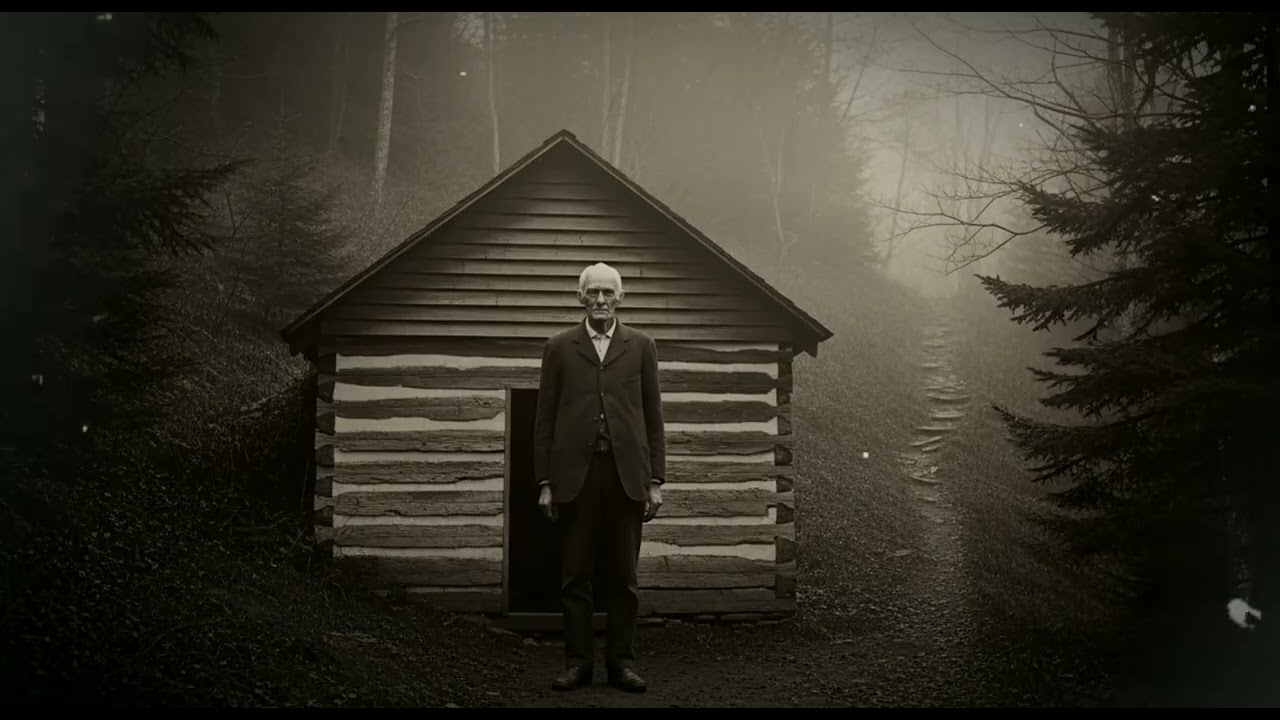
Jedediah Strath was thirty-four years old, a surveyor from Charleston sent into the mountains of western Virginia to map a parcel of land above a small valley town called Crain’s Hollow. His company believed there was coal up there, maybe iron ore, maybe both. He had come to spend two weeks taking measurements, filing a report, and leaving. He ended up staying for nearly four months.
And when he finally did leave, he left differently than he had arrived. The valley where Crain’s Hollow sat was one of the deepest in the county, so tight between the ridges that the sun dropped behind the western slope by two in the afternoon and everything below sat in cold gray shadow until morning. The locals called it getting shadowed out. People who had grown up there did not think much about it.
Visitors noticed. They noticed the way the air smelled once the shadow came, like damp stone, like something old and untouched. The town itself had perhaps 230 people that spring. A general store, a post office, a small church, and a mill that ran off a creek fed by snowmelt.
The house on the ridge belonged to a man named Corvus Aldenmore, and if you had gone into Crain’s Hollow and asked anyone about him, you would have gotten a careful answer. “He keeps to himself mostly. ” Or, “He’s been up on that ridge longer than I’ve been alive. ” What they would not have said, unless you had earned their trust, was the thing they actually felt: that Corvus Aldenmore was not a man you wanted to owe anything to.
Not a favor. Not a courtesy. Not so much as a wave from the road. Because in Crain’s Hollow there was an understanding, unspoken, never written down, that the man on the ridge collected debts the way other men collected land, and he never forgot what was owed.
Jedediah came in on a Tuesday morning in late April. The track up from the county road was narrow and steep, softened by spring rain into something that sucked at wagon wheels. His driver, a man named Orville who barely spoke, brought him as far as the bottom of the valley and refused to go further. Not couldn’t.
Wouldn’t. Jedediah paid the man, took his pack and instruments, and walked the last mile and a half into Crain’s Hollow on foot, arriving late morning while the sun was still just barely visible above the eastern ridge. He found the boarding house, which was really the rear half of the general store, three rooms and a shared privy out back, and introduced himself to the woman who ran it. Her name was Harriet Doll, a widow of fifty-one with the kind of face that had made its peace with hard things long ago.
She showed him his room without ceremony. It had a window facing west, toward the ridge. He spent his first days surveying the lower portions of the parcel, mapping creek beds and tree lines. The land was steep and dense, heavy oak and chestnut up the lower slopes, thinning to scrub pine near the ridgeline.
In the evenings he ate at Harriet’s table with the other boarder, a quiet mill worker named Aldous Fenwick, heavy-set, with thick forearms and a deliberate way of moving that suggested he had been doing the same things for so long the movements had become automatic. On the third evening, Jedediah mentioned the house on the ridge again and asked how long Aldenmore had been up there. Aldous put down his fork. He and Harriet exchanged a look, the kind that isn’t a conversation so much as a reminder.
Then Aldous said, “Longer than anyone in this town can account for. ”
That was all. On the sixth day of the survey, Jedediah was working the upper portion of the parcel when he heard footsteps. Not animal footsteps.
The measured, deliberate tread of a person moving through undergrowth. The trees were thick, but the footsteps were close, twenty or thirty feet away, moving parallel to him, matching his pace. He called out. No answer.
He kept working. The footsteps kept moving with him. After about ten minutes, they stopped. He packed up his equipment and went back down.
That night he lay awake. At some point he became aware that the window was lit differently than it had been, not moonlight, something warmer. He got up and looked out. Up on the ridge, in the stone house, a lamp was burning in a window he had never seen light in before.
The next morning Harriet put a cup of coffee in front of him and sat down across from him. She had clearly decided something overnight. “I’m going to tell you something,” she said, “and I need you to hear it as something more than talk. Corvus Aldenmore is not a man you go looking for.
If he wants something from you, he’ll find a way to let you know. If he doesn’t, you leave him be. ” She paused. “You’ve been up near that ridge.
”
It wasn’t a question. He said yes. She nodded slowly. “Don’t let him see you as curious.
Curious is an invitation. ”
He asked what that meant. She stood up, took his empty cup, and said, “It means don’t be curious. ”
On the ninth day of the survey, Jedediah was working near the creek bed that marked the northern edge of the parcel when he found the first marker.
It was a stone, not unusual in itself; the hills were full of field stone. But this one had been dressed, shaped by hand, the edges squared off, the face smooth and flat, and something had been cut into it. Not letters, not numbers. A pattern.
A series of concentric lines interrupted at irregular intervals by short perpendicular cuts, almost like a modified tally. He sketched it in his journal. The stone appeared very old, the edges re-weathered significantly since the original dressing. The bark of the chestnut tree above it, about four feet up, had been marked the same way, scarred over but still visible.
Two hundred yards further along the creek he found another. Same dressing. Same pattern. Same tree marking.
He followed the creek for another half mile before turning back. Eleven markers in total, evenly spaced, all oriented to face slightly northeast. When he showed his sketches to Aldous that evening, the mill worker looked at them for a long time, then set them down and pushed them back. “Those are old,” he said.
Jedediah asked if he had ever seen the pattern before. Aldous said not up close, which meant yes. He asked who made them. Aldous was quiet for a long moment.
Then he said, “There are things on that ridge that were there before this town, before any town. ” He said it flatly, the way you say something you have known so long it no longer seems strange. “Leave them where they are. ”
Jedediah had been in Crain’s Hollow for two weeks when Corvus Aldenmore came to town.
It was a Thursday, market day, and Jedediah was coming out of the general store when he saw him. He described the encounter in his journal with characteristic plainness. “The man I take to be Aldenmore came down from the ridge road at approximately half past ten in the morning. He came on foot.
He is old. I estimate between seventy and eighty years, though the estimate feels somehow inadequate. Tall, still straight, with long white hair worn loose past his collar. His face is deeply lined but not in the way of sickness or weakness.
He is dressed in clothes that are clean but clearly very old. The cut of his coat is decades out of fashion. He moved through the market without stopping, without speaking to anyone. But here is what I noticed.
The people around him cleared. Not dramatically, but they moved. Small adjustments, steps to the side, backs turned a particular way. It was the kind of clearance that comes not from fear exactly, but from a deep and practiced habit of avoidance.
And Aldenmore himself seemed to neither notice nor care. He bought nothing. He spoke to no one. He walked the length of the market road and back up the ridge track and was gone within twenty minutes.
”
That night he asked Harriet if that happened often. She said, “Twice a year, sometimes three. ” Then she said, “You saw him now. He knows you’re here.
”
What came next, Jedediah recorded in a journal entry he crossed out and rewrote three times. The final version said, “I do not believe in the kind of things that I am beginning to think about. ” Which was exactly the kind of thing a precise man writes when the precision starts to fail him. He should have filed his initial survey notes and gone back to Charleston.
He stayed instead. He wired his company that the initial survey had revealed complications requiring extended fieldwork. The company replied that they expected his full report within the month. He read the reply, folded it, put it in his pack, and went back up the hill.
He later described that moment, folding the wire and continuing to walk, as the one where the decision was really made. He wrote, “I have made decisions in my life that I understood at the time and I have made decisions that I only understood in retrospect. What I did in Crain’s Hollow that summer was neither. I understood it while it was happening and I chose it anyway.
I am not sure whether that makes it better or worse. ”
He started asking questions, not of Harriet or Aldous, who had made clear they were done being sources, but of others: the farmers at market, the other man at the mill, the preacher, a newcomer named Caldwell Fitch. Assembled from half sentences and careful deflections, what he learned was this. Corvus Aldenmore had been on that ridge before the town existed, before the road, before the mill, before any living person in Crain’s Hollow had been born.
The oldest members of the community, one woman in particular named Sybil Crane, said to be past ninety, had told people in their youth that Aldenmore had been old when they were young. The locals had stopped fighting with the math long ago. There were also stories about what happened to people who interfered with his land, and they were quieter than drama. A family that had tried to farm a section of the ridge in the 1850s found within two seasons that nothing would grow there.
The soil was good, deep and dark, better than the valley floor, but seeds would sprout and then, without apparent cause, stop. The family moved on. A road clearing crew in the 1870s started cutting a track up the western slope and simply stopped coming. No explanation was ever formally recorded.
The foreman, asked years later, said he had decided the route was impractical. He had not said why. And there was a longer story, pieced together from three separate conversations, about a man in the 1860s who had gone up to the ridge to speak to Aldenmore about a creek water right. He had gone up.
He had come back. He had sat in front of his house for the rest of that day and most of the next before his wife could get him inside. He resolved the creek matter by abandoning his claim entirely and never going near that side of the property again. Before that day he had been a stubborn and uncompromising man.
After it, he was neither, just quiet, just careful. Through June, Jedediah kept working, but his notes tell a different story from the official one. He had started drawing a rough map, overlaid on his survey grid, showing the locations of every marked stone he found. By the end of June he had plotted forty-seven.
The pattern they formed was not random. He could see that clearly. But he couldn’t read what it said. He wrote, “The frustration of having the data without the grammar,” and underlined it twice.
He first spoke with Aldenmore directly on a Thursday in late May. He had not planned it. He was working near the upper edge of the parcel at the tree line when a voice behind him said, “You’ve been counting my markers. ”
Aldenmore was there, twenty feet away, standing with his hands at his sides, entirely still.
Up close the lines in his face ran too deep for a man in his seventies or eighties, but his eyes were alert, sharp and dark, focused in a way that made them seem less like the eyes of an old man than the eyes of something that had learned to look like one. Jedediah said he hadn’t known whose they were. Aldenmore said, “Now you do. ”
Then, because he was a precise man and because he couldn’t help himself, Jedediah asked what they marked.
Aldenmore looked at him for a long moment. “The boundary of what’s mine. ” He said it without heat, without threat, the way you would state a property line to someone who had wandered over it by mistake. Then he looked at Jedediah’s instruments, his pack, his boots.
“You’re measuring for coal. ” Jedediah said yes. “There’s no coal here. ” Jedediah said the geological surveys suggested otherwise.
Aldenmore said, “The geological surveys are measuring the wrong thing. ” Then he turned and walked back up toward the ridge, and by the time Jedediah thought to say anything else, the gray of his coat had blended with the gray of the bark and he was gone. Jedediah wrote that evening: “I am not sure what I expected. Something more dramatic, perhaps.
Something overtly threatening or strange or impossible. Instead, I found a very old man making a property claim in the middle of the woods. And yet, I have been turning that conversation over for the past three hours and I cannot make it feel mundane. Not because of what he said.
Because of how he stood. He stood the way someone stands who has never learned the habit of unease. Never developed the reflex. As though discomfort were simply a language he had not been taught and never needed.
”
The summer deepened. He found more markers higher up, near the ridge itself, placed in patterns that made no sense as property lines and gradually began to make a different kind of sense as a map, or a record, added to gradually the way a document accumulates pages. Then he found one stone that was clearly different from the rest: smaller, the marking shallower, the dressing less precise, as though made by younger hands, or older ones, weakened. Another like it nearby.
Then another. A cluster of them, perhaps thirty in total, concentrated in a depression behind a shelf of rock on the western slope. He spent an afternoon mapping that cluster. He did not hear Aldenmore approach.
He only became aware of him when the temperature dropped, genuinely dropped, a physical shift in the air. The old man was standing at the edge of the depression, watching. Jedediah waited. “Those are older,” Aldenmore said.
Older than the count you use. He looked at the stones the way a person looks at something they know well. Then he said, “You’re the first one from outside to find this place. ” Jedediah asked if that was significant.
“It means you have a particular kind of attention. ” He paused. “That can be useful. ”
And then he said something Jedediah wrote down verbatim and underlined twice in his journal.
“Come to the house on Saturday in the morning. I’ll leave the path clear. ”
Jedediah did not go on Saturday. He spent two days going back and forth, writing arguments on both sides, and decided that visiting a man he knew next to nothing about on a ridge the entire town avoided, with no one knowing where he was going, was not the kind of decision a sensible person made.
He wrote this in his journal on Friday evening. On Saturday morning he woke before dawn. He lay there for a while. Then he got up, put on his boots, told Harriet he would be working near the upper parcel, and went up the ridge road.
The path was clear, as promised. No gate, no fence. But at a certain point, the character of the forest changed. The trees were older, the spacing more deliberate, the undergrowth thin in a way that shouldn’t have been possible, as though the ground itself had been tended.
The house, when he reached it, was exactly what it looked like from below: low and long, gray stone, mossy at the base, set against the hillside so naturally it was almost invisible from certain angles. Aldenmore was sitting outside on a flat stone that served as a step, a cup in his hand. “I thought you wouldn’t come,” he said. Jedediah said, “I almost didn’t.
”
“Good. ”
The interior was not what he expected. He had expected disorder, the clutter of a very long life. Instead the house was spare.
A single large room with a sleeping area curtained off at one end, a hearth taking up most of the north wall, and covering every other surface, shelves. Hundreds of them. Floor to ceiling on three walls. The shelves held containers, ceramic jars, wooden boxes, leather cases, rolled and tied bundles.
And alongside them, books. Some proper bound volumes, others bundles of loose pages sewn together by hand or held with cord. Many older than anything Jedediah had seen outside a museum. Aldenmore sat at a table in the center of the room and gestured at the other chair.
“This is a library,” Jedediah said, without thinking. “It’s a record. Different thing. ” Aldenmore poured water from a pitcher into two cups and pushed one across.
“A library is organized for retrieval. What I keep here is organized for sequence. ”
Jedediah asked what sequence. “What happened,” Aldenmore said.
“In the order it happened. ”
Over what period? “A long one. ”
What followed was not a dramatic revelation.
It was a long, careful conversation full of silences, the kind where both parties are testing the edges of what they are willing to say. Aldenmore talked about the ridge, about what it had been before anyone built a road up to it, a place with its own character, its own rules that predated anything European. He talked about the people who had come through, using that phrase as though he himself had never arrived or departed but had simply always been present while others moved past. He described diseases, conflicts, a particular event in the winter of 1844 he referred to only as the clearing, and declined to explain further.
He mentioned things that had been taken from the ridge, from the land, taken without understanding what they were. And he mentioned what happened when things that were taken were not returned. Jedediah asked what happens. Aldenmore said, “Things come back to collect them.
”
He said it without drama, the way you say what goes up comes down. Jedediah wrote, “I could not tell, then or now, whether he was speaking metaphorically or literally. I suspect he would consider that distinction irrelevant. ”
They met three more times that summer.
Each time Aldenmore showed him something, never explained it fully, never allowed him to copy the records directly, but showed him enough that Jedediah began to understand the outline of what the markers were for. They were a record, but not of property, not of ownership in any legal sense. They were markers of transactions. Things given.
Things taken. Things promised. Each stone represented something that had passed between the ridge and the world below it. Aldenmore had made most of them.
Some had been made by people who had understood what the ridge was and what it required. Most of those people were long dead. The ones from the recent past had mostly not understood. They had taken things, made promises they didn’t know they were making, and then found, in one way or another, that the ridge had its own accounting.
At the end of the summer, Jedediah filed an incomplete survey. He told his company the parcel was unsuitable, citing drainage issues, unstable substrate, insufficient timber. All of it true enough to be defensible. All of it cover for something he couldn’t put in a professional report.
His company was not happy. They sent a second surveyor, a man named Percival Court. Twenty-seven years old. Ambitious.
The kind of energy that comes from having never yet encountered something that stopped him. He arrived in September. He covered in four days what had taken Jedediah two weeks, because he was not stopping to look at anything that wasn’t directly relevant. He found the markers on his third day out.
He was curious about them, curious in the way of someone who had never yet paid a price for it. Jedediah tried to warn him. He told him to leave the markers where they were. He told him there were sections of the parcel better surveyed from a distance.
Court listened politely and went and did exactly what he had planned to do. In mid-September, Percival Court went up to the upper parcel and did not come back. He was found the following morning by a man from the mill. He was sitting at the base of one of the marked trees, his back against the bark, facing uphill.
Physically unharmed. But his survey instruments were carefully laid out on the ground in front of him in a row, as though placed there by someone else. His notebook was open to a blank page. He was conscious.
He could follow movement with his eyes. He did not speak. Not that day. Not for several days afterward.
When he finally did speak, he said only two things. “I didn’t know. ” And, “It’s too old. ”
He was taken back to Charleston, where he recovered physically and returned to work, but transferred to a different region and refused any further assignments in the mountains.
He never explained what he had seen. He told at least one colleague there was nothing to explain. That wasn’t entirely true, but it was as close as he could get. Jedediah stayed through October.
He met with Aldenmore twice more. On the second of those meetings, he asked the question he had been building toward all summer. He asked what Aldenmore was. Not who.
What. Aldenmore looked at him for a long time. Not with anger. Not with surprise.
With something more like consideration. Then he said, “I am the account. ”
Every transaction requires a ledger, he explained. Someone to hold it.
Someone who can’t leave. “I didn’t choose it. No one chooses it. You come to a place at the wrong moment, when the place is in need of something to hold it together, and the place chooses you.
And after enough time, you and the place become the same thing. ”
Jedediah asked if he could leave. Aldenmore said he hadn’t tried in a very long time. “For the first few decades, I thought about it often.
And then you stop thinking about the things you can’t do. Not because you’re resigned. Because the question starts to seem less interesting than the work. ”
The work was keeping the count accurate.
Making sure what’s taken is noted. Making sure what’s owed gets collected. “Most people who come here take small things. Stone, wood, water from the creek.
They don’t know what they’re doing. That’s fine. Small things can be absorbed. But when someone takes something structural, something the place uses to hold itself in balance, that has to come back one way or another.
”
Jedediah asked about the clearing, the event in 1844. “A man came up here in the summer of that year. He was a minister. He came because he had heard stories.
He was the kind of man who believed that strange things existed only to be corrected. He spent three days on this ridge. He took things he shouldn’t have taken. He made changes he had no authority to make.
He thought he was cleansing the place. ” A pause. “By winter, everyone who had come with him was gone. Not dead.
Gone. The ledger collected what was owed. ”
On his last evening in Crain’s Hollow, Jedediah went up the ridge road one final time. He did not go to the house.
He went to the cluster of markers in the depression on the western slope, the older ones, and sat there for a while. He thought about Aldenmore’s description of himself as the account, the ledger. A person reduced, or elevated, he wasn’t sure which, to a function. He thought about what it would mean to hold all of that, all that weight, all that history, and have nowhere to put it down.
He left the next morning. Harriet clasped his hand and held it for a moment. “Don’t come back,” she said. Not unkindly.
Just clearly. Aldous looked at him steadily and said, “You saw more than most. ” Jedediah did not say goodbye to Aldenmore. He had a feeling, coming down the ridge road for the last time, that Aldenmore knew he was leaving, that it had been noted, added to the count.
After he left, the survey company abandoned the Crain’s Hollow parcel entirely. No further surveys were commissioned. The mineral rights were allowed to lapse. Officially, the reason was geological unsuitability, which is what Jedediah had written.
But an internal memorandum from November of 1887, found decades later in a private collection, described the survey as a situation requiring indefinite deferment, and recommended that no company personnel be sent to the region without specific authorization from the board. No such authorization was ever issued. The company developed dozens of other sites in the region. They never went back to that ridge.
In the spring of 1891, a surveyor from a different company, working a completely separate parcel several miles to the east, filed a report that included a section of the ridge above Crain’s Hollow. His name was August Thiel. His report included a notation about an unusual concentration of dressed fieldstones along the western approach to the ridge, and the presence of a low stone structure near the ridgeline that appeared to be uninhabited. His assistants had declined to work within a certain distance of it.
In the margin of the report, in different ink, added sometime after the main body was written, was a footnote. “I am told by residents of the nearest settlement,” it read, “that the structure has been unoccupied since at least the winter of 1889. ”
If Aldenmore had been gone since then, what had happened to him? Not dead, presumably.
No grave had been found. No body. No record of departure. He was simply no longer there.
When Jedediah eventually heard about the footnote, he wrote a letter. “I keep thinking about what he said,” he wrote, “about what it means to be the account, to be the thing that holds the ledger together. If the account is gone, if the ledger has no keeper, then where does the count go? I think it doesn’t go anywhere.
I think it waits. ”
And then he wrote something he crossed out, and crossed out again, and then wrote a third time, and left. “I think it waits for the next one. ”
There is a county in the mountains of West Virginia.
The ridges come down sharp and close. The valleys between them almost never see the sun past two in the afternoon. The town at the bottom of the deepest valley is smaller than it was, has been getting smaller for decades. The mill closed.
The road was paved at some point, then largely forgotten. Up on the ridge, close enough that on clear mornings you can see the place where the tree line thins, there is a foundation. Gray stone. Mossy at the base.
And in the forest below it, if you know where to look, you can still find the markers. The dressed fieldstones with their pattern of concentric lines and short perpendicular cuts. Most of them are still there, still oriented northeast, undisturbed. The people who know what they are still know enough not to touch them.
The people who don’t know, they find after a while that they feel a need to leave them alone too. Some things teach their own rules. No one knows when Aldenmore arrived. The oldest accounts available, letters, deeds, church records from the region, go back to the 1780s, and he is already there.
Not as a new arrival. As an established presence, someone the earliest settlers had been told about by people who had been there before them. In a bundle of papers collected by a local historian in the 1920s was a single page, badly damaged at the edges, written in a hand older and less formed than the others, estimated to date to the mid-1700s. A few lines were legible.
“The elder has been on the ridge since before any man here can account for. Those who have asked him when he came say he will not answer. Those who have watched him closely say he does not change. The minister at Crain’s church says he has made his peace with the elder, which the minister’s predecessor could not do, and which cost that man considerably.
We do not ask what the elder asks in return for his peace. We have found it is better not to know the price of a thing until after you have declined to pay it. ”
Jedediah Strath lived to be sixty-seven. He returned to Charleston and continued his work, eventually becoming a senior partner at his company and retiring comfortably.
He never published anything about Crain’s Hollow. He never spoke about it professionally. But he kept his journal. He kept his sketches.
And he kept a single object he had found on his last visit to the marker cluster on the western slope. A stone, small enough to fit in a closed fist, dressed with the familiar pattern on its face. He had picked it up on impulse as he was leaving. He wrote about it once near the end of his life.
“I have kept it for thirty years,” he wrote, “and I still cannot say with certainty whether I took it or whether it was given. There is a difference. I know there is a difference. I have just never been able to determine which one applies.
Some nights I wake up at three in the morning and I go to the drawer where I keep it and I take it out and I look at it for a while. I do not know what I am waiting for. But I have not put it back. ”
After his death, the stone passed to his estate.
It was inventoried but not described specifically, just listed as one fieldstone, small. It was assumed to have no value and was likely disposed of. No record of what happened to it after the estate was settled. There is a version of this story where Corvus Aldenmore is simply a strange hermit, an eccentric old man isolated long enough to become mythological to his neighbors, who kept odd records in an odd house on an odd ridge and disappeared one winter the way old isolated men sometimes do.
That version is easier to carry. But there is another version. A version where the markers are still there. Where the count is still running.
Where the ridge above a very small, very quiet town in the mountains of West Virginia is still doing what it has been doing for how long no one can say. And where the position of count keeper is not vacant. Just not yet filled. Waiting, perhaps, for the next person who comes up that ridge with a particular kind of attention, the kind that makes a strange old man say, “That can be useful.
”
The mountains in West Virginia were old before anyone built a house on them, old before anyone cut a road into the hillside, old before anyone had words for what they were. And some of what is old in those mountains is patient, patient in the way that things are patient when they do not measure time the way we do, when a winter or a century or a generation is all approximately the same duration, when waiting is not waiting at all, but just being. Just holding the count. Just marking the ledger and keeping the balance.
And the markers on that ridge are still standing, still oriented northeast, still waiting for someone to read them correctly.
