The first images made the medical examiners doubt their own instruments. Mirin Dajo, born in the Netherlands in 1912, had submitted to their tests willingly, even eagerly, and now the X-ray plates showed what should have been impossible: a long steel blade passing clean through the center of his torso, between his heart and his spine, with no visible damage to either. The doctors watched as the object entered his body and emerged again without blood, without a wound, without a flicker of pain on his face. They ran the tests again.
The results were the same. There was no trick, no hidden mechanism, no illusion. Dajo simply allowed the steel to pass through him, and his body accepted it as if it were nothing more than air. The medical community had been skeptical when he first achieved international fame in the 1940s.
They assumed the Dutchman was a clever fraud, a stage magician with hidden tubes and false blades. But under examination, with his chest laid bare to the machines, he proved them wrong. He pierced himself with swords and large needles in front of witnesses, and the X-rays confirmed that the objects were genuinely inside him, threading through his living tissue. The examiners could not explain it.
They could only record what they saw and admit that their understanding of the human body had failed them. He was not the only one whose body defied expectation. Martin Lorello, billed as the Owlman, possessed a talent that seemed borrowed from a nightmare: he could turn his head a full 180 degrees and look directly behind him without moving the rest of his body. What looked like a supernatural gift was the product of years of training and a peculiar physical condition that allowed him to dislocate his vertebrae at will without causing himself harm.
In the variety shows and circuses where he performed, he was often the center of attention, a human curiosity who made audiences gasp by simply turning his head. Edward Mordrake had no such control over his affliction. Born into a wealthy and noble English family in the nineteenth century, he carried a second face on the back of his head. According to the accounts that would outlive him, this face could not eat or speak, but it whispered to him at night, uttering repugnant and disturbing thoughts that drove him to the edge of reason.
He sought help from doctors and spiritualists alike, desperate to rid himself of the curse, but no one could offer a solution. He sank into despair and madness and lost his life at a young age, leaving behind a legend that defied medical understanding and haunted the popular imagination. Schlitzie, born in 1901, came into the world of sideshows through a different door. His microcephaly gave him a small head and lifelong intellectual challenges, but it also gave him a career.
He was a natural performer, blessed with contagious laughter and a playful personality, and his singing, dancing, and joke-telling made him an instant hit with audiences. His fame grew when he appeared in the 1932 film *Freaks*, playing himself, and became one of the most beloved figures in the strange world he inhabited. Prince Randian, known as the Human Snake, was born in 1871 in British Guiana with no arms and no legs. From birth he faced a great obstacle, but he refused to be defined by it.
He moved with the agility of a cat and the strength of a bull, using only his torso and head. He could roll a cigarette, light it, and even shave, all with his mouth. In the freak shows of the late nineteenth and early twentieth centuries, he became a superstar, astonishing crowds who could not believe what they were watching. Annie Jones was discovered young.
Born in Virginia in 1865, she began showing signs of hypertrichosis, a condition marked by excessive hair growth, at a very early age. Her beard began to grow when she was just five years old. P. T.
Barnum, the most famous entertainment promoter of his time, found her and put her in his American Museum in New York, where she became one of the most popular attractions in the building. She was the bearded woman, and the public could not get enough of her. Pauline Musters, known as the world’s smallest woman, was born in the Netherlands in 1876. Throughout her short life she never grew beyond twenty-three inches, a stature that drew the attention of everyone who saw her.
She became a celebrity in the curiosity shows of her day, traveling the world and performing before fascinated audiences. She died in 1895, at just nineteen, of pneumonia and meningitis. Myrtle Corbin was born in 1868 and joined the freak show circuit at thirteen as the Four-Legged Girl from Texas, although she had actually been born in Tennessee. She had been born with dipygus, a rare condition that gave her an additional set of smaller legs belonging to an undeveloped parasitic twin.
The extra limbs made her a sensation, and the public flocked to see her wherever she appeared. Alice Elizabeth Doherty, known as the Werewolf Girl, was born with hypertrichosis lanuginosa, an extremely uncommon genetic condition that covered her entire body in a thick layer of soft hair called lanugo. From a young age she drew the attention of everyone around her, and her parents decided to exhibit her in curiosity shows. Her strange beauty made her a popular attraction in the circuses of the time.
Johnny Eck, born in Baltimore in 1911, came into the world without the lower half of his torso. He became an actor and circus performer known for his acrobatics and charismatic presence, but he was more than a curiosity. He was a painter, a musician, and a filmmaker, and his fame grew when he starred in *Freaks* in 1932, proving he was far more than his unusual appearance. General Tom Thumb, whose real name was Charles Stratton, was born in 1838 and stood just twenty-five inches tall.
P. T. Barnum discovered him when he was four years old, and before long he was the main attraction at the American Museum in New York City. He could sing, dance, act, and impersonate historical figures, a true one-man show.
He took his act to Europe, where he mingled with royalty, including Queen Victoria, and returned home a household name, his face appearing on everything from trading cards to teacups. Julia Pastrana, born in Mexico in 1834, became one of the most fascinating and tragic figures of the freak show world. Known as the Baboon Woman, she suffered from hypertrichosis, which covered her body in a dense layer of hair. Even after her death, her body was exploited for decades, turned into an object of profit and curiosity.
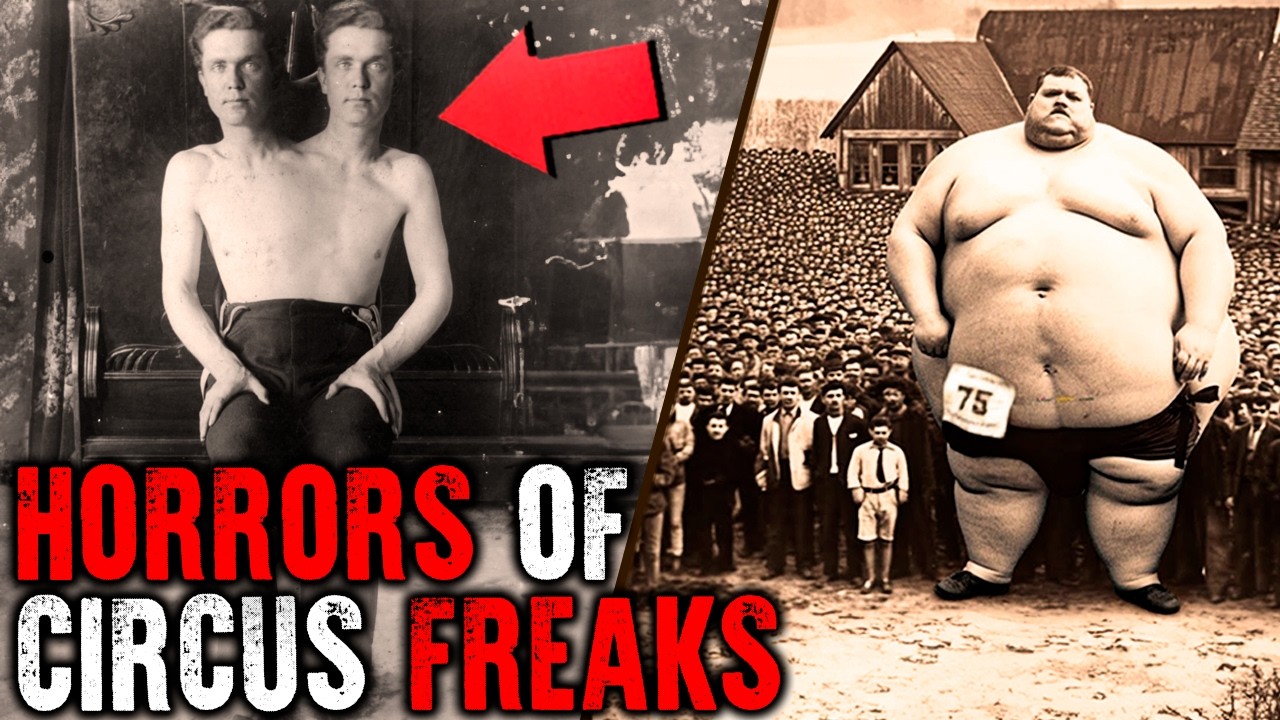
Daisy and Violet Hilton were conjoined twin sisters born on February 5, 1908, in Brighton, England. Joined at the hip and buttocks, they shared a common blood circulation but possessed separate organs. Their lives were marked by talent and by the legal and personal battles they had to fight. From an early age they were exploited by their adoptive mother, Mary Hilton, who exhibited them in circuses and fairs.
When Mary died, her daughter Edith and Edith’s husband took control, continuing to profit from the sisters. The twins trained in singing, dancing, and playing instruments, becoming talented performers on the vaudeville stage. In 1931 they sued their guardians for abuse and exploitation and finally won their freedom. From that moment they controlled their own careers and finances, appeared in films including *Freaks* and *Chained for Life*, and continued to perform for years.
Jack Earle was six feet tall before he turned ten. By thirteen he stood nearly seven foot seven, and estimates of his adult height ranged up to eight foot six. His extraordinary growth was caused by acromegalic gigantism. His height helped him in some situations and hurt him in others.
He became a Hollywood actor, appearing in films like *Hansel and Gretel* and *Jack and the Beanstalk*, until a fall from scaffolding left him seriously injured and forced him out of the industry. The Ringling Bros. and Barnum & Bailey Circus heard about his accident and offered him a one-year contract. Earle had always said he would never appear in a freak show, but he needed work, so he reluctantly signed.
Minnie, known as Cuckoo the Bird Girl, was born in 1880 in Georgia with Virchow-Seckel syndrome, also called bird-headed dwarfism. The condition gave her a small head, a beak-like nose, and a receding jaw. During performances she wore a bird-like costume with feathers and a feathered tiara, reinforcing her nickname. She performed eccentric dances and movements that mimicked a bird, swaying and moving her arms as if they were wings.
Francesco Lentini was born in 1889 in Syracuse, Sicily, with a third leg protruding from the right side of his body. He refused to let the congenital defect hold him back and instead turned it into an opportunity to entertain and educate. At eight, his family moved to Connecticut, where he quickly became a headliner at the circus and carnival shows. He liked to joke that he needed to eat fifteen percent more than other people to feed the extra leg.
During performances he jumped rope and kicked soccer balls with his third leg, astonishing everyone who watched. Lionel, born in Poland in 1890, became known as the Lion-Faced Man because of the hypertrichosis that covered his face and body in hair. At just four years old, his parents sold him to a German circus owner who saw potential in his appearance. Lionel became one of the most popular attractions in curiosity shows, often telling his life story and explaining how his condition led him into the world of sideshow entertainment.
He was a headliner for many renowned circuses, including the Barnum and Bailey Circus. George and Willie Muse were born black and albino in Virginia in the late nineteenth century. In 1899 they were kidnapped from their community, taken from their mother, Harriet Muse, and eventually hired under circumstances that would now be considered coercion and exploitation. Their unique appearance made them valuable, and they were promoted as Eko and Iko, the Martian ambassadors, and under other exotic and invented titles that distanced them from their true identities.
Despite the hardship, they became popular figures in curiosity shows and were eventually rescued by their mother, who fought a legal battle for their freedom. Isaac W. Sprague, known as the Human Skeleton, was born in East Bridgewater, Massachusetts, in 1841. At twelve he began losing weight drastically due to an unknown condition, and despite a normal diet he could not gain it back.
His skeletal appearance became his trademark, and he began his entertainment career in 1865 with P. T. Barnum’s circus. His medical condition remained a mystery, though some theories suggested an extreme form of muscle atrophy or a metabolic disorder.
La Verne Valley, better known by her stage name Charmion, was born in 1875. She performed feats of impressive physical strength, and her most famous routine involved undressing while performing acrobatics on the trapeze, a sensation in her time. She is remembered as a pioneer in the circus world. Fanny Mills, born in Ohio in the 1850s, suffered from Milroy’s disease, which caused her feet to reach extraordinary dimensions, up to twenty inches long and eight inches wide.
Advertised as the Big-Footed Woman, she attracted great curiosity and turned her condition into a career in curiosity shows, performing in circuses and dime museums. The demand for her performances skyrocketed, and she earned enough to support herself and her family. Alfred Highland, a facial contortionist, displayed his unusual talent during an exhibition in Glasgow, distorting and manipulating his face in impressive ways that entertained and intrigued his audience. Grady Stiles, better known as the Lobster Boy, was born in 1937 with ectrodactyly, which gave him claw-like hands and feet.
He began performing young, following in the footsteps of his father, who had the same condition. He became a popular figure in circuses, using his claw-like hands to perform tricks and manipulate objects in unique ways. But his life was shadowed by tragedy and controversy. He was known for abusive and violent behavior, especially when drunk.
In 1978 he was convicted of murder after shooting and killing his daughter’s fiancé on the eve of their wedding. Because of his physical condition he received a light sentence and was put on probation. In 1992 he was murdered by a hitman hired by his wife, Maria Teresa, and his son, in retaliation for years of abuse. His story is one of the darkest and most complex in the world of sideshows.
Ella Harper, known as the Camel Girl, was born in 1870 with a rare orthopedic condition called genu recurvum, which caused her knees to bend backward and allowed her to move more easily on all fours. She became a popular attraction in the 1880s, entering the world of curiosity shows at nine under the guidance of showman W. H. Harris.
Posters and advertisements promoted her as a wonder of nature. The Fat and Skinny Man, known as the Circus Boxers, were an iconic duo in early twentieth-century shows. One was extraordinarily obese, the other incredibly skinny, and their performances revolved around theatrical enactments, often humorous boxing matches between them. Grace McDaniels, known as the Mule-Faced Woman, was born in 1888 with Sturge-Weber syndrome, which caused a striking facial malformation.
In the 1930s she joined Harry Lewiston’s circus, where her unique appearance made her popular and provided support for herself and her son, Elmer. John Jennings, known as the Modern Samson, was born in 1890. His extraordinary physical strength earned him the name of the biblical strongman, and he became a popular attraction in circuses and fairs. He bent steel bars with his hands, lifted enormous weights over his head, and pulled heavy vehicles with chains attached to his body.
Pascal Poon, better known as the Two-Headed Mexican, was a Mexican railroad worker who caught the attention of a show promoter because of a large cyst or tumor on top of his head. To increase the visual appeal, a facial prosthesis was crafted to resemble a second face, complete with makeup to highlight the eyes, nose, and mouth. He traveled throughout North America, drawing large crowds to his exhibitions. Chang and Eng Bunker were the first known conjoined twins and the most famous.
They moved to the United States in 1829 and gained fame performing in circuses and fairs. Their act showed audiences how they were physically joined at the sternum, which was itself a major attraction, and they demonstrated their ability to live a relatively normal life by performing everyday tasks together, walking, running, and doing chores, showing how they coordinated their movements. Felix, born in Wisconsin in 1858, discovered early that he could stretch his skin like a rubber band and fold it back completely without even sweating. He took his show on the road, dazzling audiences in museums and impressing crowds at circuses like the Ringling Brothers.
Experts speculated that he suffered from Ehlers-Danlos syndrome, a condition of weak connective tissue that results in elastic skin and extremely loose joints. Frances O’Connor, born without arms, learned to eat, drink, write, and sew exclusively with her feet, entirely on her own. She joined the Ringling Brothers at fifteen, with her mother as her manager. Her act consisted mainly of performing routine activities that audiences found incredible: drinking wine or beer, eating a steak, or writing a letter.
If you were lucky, you could see her hold and aim a gun with her feet while pulling the trigger with her toes. In an age when social norms were rigid, especially for women, the Tattooed Woman became an iconic figure in freak and curiosity shows. Showing one’s legs was considered indecent, and the idea of a woman displaying her body covered in tattoos was unimaginable to many. It was in that time that women covered in ink became some of the most famous attractions of the era.
Pablo Noel, a circus artist in Hamburg in 1962, placed his head inside a lion’s mouth in an act of extreme domination and trust, typical of training numbers with large felines. Such performances were common in the circuses of the time, drawing crowds who came to see the risky interaction between humans and wild animals. Olga, a lion tamer, faced three male lions with only a chair and a stick in her hands. Taming lions was one of the most dangerous acts in old circuses, requiring courage and control, and while these numbers impressed the audience, they posed extreme risks to the artists.
In 1934, three acrobats decided to perform an impressive balance act on the Empire State Building in New York City. The photograph of their performance shows how common it was for artists of that time to care little about their own safety. Sonora Webster Carver became famous for her horse-diving performances, jumping with her horse from great heights into a tank of water. She continued performing even after losing her sight in an accident during one of the jumps, which made her a legend for her courage and determination.
Carl Wenda, of the famous acrobat family the Flying Wandas, crossed the Tula gorge on a tightrope in 1970. Known for his bold high-altitude balancing, he made the crossing without modern safety equipment, over 984 feet above the canyon, enchanting and frightening his audience at the same time. A circus artist posed next to a domesticated bear standing on its hind legs, wearing a decorative collar and hat typical of circus performances. Bears were trained to perform tricks and present themselves to audiences.
A member of Sir Robert Fossett’s Family Circus prepared a boxing kangaroo for the show. The kangaroo, a curious and popular attraction, was trained to fight theatrically with the artists in a simulated boxing match. Sir Robert Fossett’s circus was one of the oldest and most respected family circuses in Great Britain. A lion tamer worked with a group of large felines at the Bertram Mills touring circus.
The lions, positioned on pedestals, displayed fierce expressions while the tamer commanded them with gestures and a rod, creating a spectacle of control and tension. A polar bear performed an unusual trick, seemingly riding a motorcycle in a circus show while an artist watched and accompanied the performance. It illustrated the extreme training circus animals underwent to perform actions completely outside their natural behavior. Another trainer interacted dangerously with a huge polar bear during a performance.
The bear, standing on its hind legs, was in close proximity to the trainer, highlighting the risks involved. The strength and size of a polar bear made it one of the most dangerous creatures, and being so close without immediate protection underscored the peril. Patricia Bourne trained lions to stand on their hind legs during the annual Bertram Mills circus at Olympia in London. Training large felines to perform such tricks was a fascinating and dangerous part of circus life.
A strong woman supported a piano and a pianist on her chest, an impressive feat of strength and balance. In the circuses of the time, it was not only men who drew attention for their unusual strength; women also demonstrated impressive feats. In another photograph, a man supported a large stone block on his stomach while another man prepared to crush it with a sledgehammer. Such feats were common in circuses and strength shows, where artists demonstrated their incredible physical endurance by withstanding extreme impacts without apparent injury.
A circus artist swallowed a snake, one of the most risky and fascinating performances. The snake swallower was one of the numbers that most impressed audiences, who watched with fascination, agony, and fear. A circus artist balanced on stacked chairs atop a building, sitting on the last chair in a dangerous and precarious position, demonstrating extreme body control and concentration. Acts performed in high, exposed locations were a way to attract the audience’s attention.
A contortionist sustained himself only with his teeth in an impressive balance maneuver, demonstrating a combination of extreme flexibility and strength that fascinated audiences. Although it appeared to be a clown with a lion, the animal was actually another artist in costume. Clowns, with painted faces and funny costumes, mixed moments of high tension with comic relief, bringing laughter between the dangerous acts. A troop of artists performed an aerial ballet, a type of performance that required years of training to master the precision and strength needed to perform safely.
In New York City, a crowd gathered on the sidewalks to watch the great circus parade. Elephants with their handlers marched in a line, a common sight during these parades, which were used to announce the circus’s arrival and attract the public. The parade included artists, animals, and colorful wagons, creating an atmosphere of great anticipation. A trainer worked with a leopard, which sat on a small bench and obeyed commands, holding a rod as a direction tool.
Bengal tigers, trained by Charlie Balman, performed at the Bertram Mills circus in 1959. Balman, a renowned big cat trainer, executed breathtaking acts where tigers jumped through hoops and performed tricks that defied their natural instincts. Master of Ceremonies Billy Rer trained fleas in 1954. The flea circus was a curious attraction in the circuses of the time, with tiny insects that appeared to perform tricks like pulling miniature carts or jumping over obstacles, though it was often an illusion with objects moved by invisible threads.
An artist performed an act with a bear, both balancing on large circus balls, requiring incredible coordination and training. The bear, trained for the number, stood on the ball while the artist maintained contact and guided it. An artist sat inside a large cannon, prepared to be launched. This was one of the most dangerous and popular attractions, the human cannonball, where the artist was propelled by a spring or compressed air mechanism and flew through the air into a safety net.
A tiger sat atop an elephant with the trainer standing on the larger animal. The risk of an accident involving two large wild animals was high, as any unexpected movement could lead to an uncontrollable situation. Riders performed acrobatic numbers on horses in full motion at the Tower Circus. They had to synchronize their movements and maintain stability on galloping horses, an extremely risky task requiring great skill.
Clyde Beatty, the famous lion tamer, trained a group of lions in 1932. He was known for controlling large wild felines, often facing multiple lions and tigers at once in an arena, using a whip and a chair, the classic symbols of his profession. A seal performed at a circus using a harness while its trainer remained nearby, jumping through a hoop, a typical trick involving marine animals. Seals were trained to balance balls, jump, and interact with objects.
An artist performed a fire eating act, a common practice in circuses that required great skill. The trick involved manipulating flames with precision so they appeared to be consumed. D. Cosme performed an equestrian act at the Bertram Mills circus in London, riding two horses simultaneously while executing coordinated tricks and maneuvers.
Equestrian performances were always a central part of the circus, showcasing the harmony between rider and animal. Gargantua the Great, a famous giant gorilla presented by the Ringling Brothers and Barnum and Bailey Circus, became known for his impressive size and his tragic story. His face was scarred after a sailor threw acid on him aboard a ship coming from Africa. The incident left him with an intimidating expression, which the circus exploited as part of his attraction, making him one of the show’s biggest stars.
Dixie, an elephant from Whipsnade Zoo, displayed an impressive part of her repertoire along with her handler George Bram, holding Bram by the mouth with her own, demonstrating the high level of training and trust between them. Mr. Valencius held two of his performing animals, a dog and a fox. A female contortionist displayed her incredible flexibility, bending her body in a position that demonstrated her skill and extreme control.
A circus elephant performed an impressive trick, balancing on its front legs while supporting its weight on bottles. The photo showcased the skill and training required for such a large animal to execute the feat with precision. Trained elephants were among the most popular attractions of the time. Jacko and Bess, two mandrills, performed at the Olympia circus in London, with Jacko wearing a suit and Bess imitating a human couple.
The famous acrobat Gladys Roy, known as the Daredevil, trained her bold aerial acrobatics on top of a skyscraper in Los Angeles, balancing dangerously on the edge of the building. The extreme risk involved in her acts frequently defied gravity and human limits. The famous German strongman Eugene Sandow, on the left with another man dressed as Goliath, staged a fight with what appeared to be a bear. Sandow was widely known as the father of modern bodybuilding, and his strength and physique impressed audiences around the world.
He became an icon in strength shows, often participating in acts with other characters and dramatic settings. In a 1921 photo from Berlin, a woman brushed the teeth of a circus hippopotamus during a break between performances. The hippopotamus, another exotic attraction, kept its mouth open and cooperated with its handler. Clémentine Cléteaux, a famous bearded lady who became a celebrity in her time, suffered from hirsutism, which caused excessive hair growth.
Unlike many women with the same condition, she embraced her appearance and used it to gain notoriety, becoming an attraction at fairs and shows throughout Europe. She also owned a café in France, where she posed for photos and interacted with onlookers confidently and with dignity. JoJo, known as the Dog-Faced Boy, whose real name was Fedor Jeftichew, suffered from hypertrichosis, which caused excessive hair growth over his entire body, including his face. He was one of the standout attractions in circuses and variety shows, presented as a human curiosity.
Children watched the famous clown Lou Jacobs of the Ringling Circus apply his makeup in Tallahassee, Florida. Jacobs was one of the most iconic clowns in circus history, known for his classic look and comedic performances. An artist carried a young elephant weighing over 220 pounds on his shoulders. Another lifted three acrobats, one in each arm and another balanced on his shoulders.
Such performances were common in old circuses, highlighting extraordinary strength. Austrian acrobats performed an impressive balance maneuver, one mounted on a bicycle while supporting her partner, who hung upside down balanced by only one hand. Four artists from Hanford’s Canadian Circus posed for the camera in elaborate costumes, smiling, reflecting the circus’s joyful spirit. The Hanford circus was known for its colorful, international productions, bringing artists from different parts of the world.
A trainer worked with a camel during a circus performance in Slovenia, using a whip as a direction tool. Exotic animals like camels were often used in circus performances, showcasing their skills in choreographed numbers. Acrobatic rider Dorothy Herbert performed an impressive maneuver, hanging upside down while her horse reared on its hind legs. Known for her horse acrobatics, she was one of the main stars of circus shows and rodeos, requiring extraordinary balance, control, and confidence.
Three women worked alongside trainer Walter McLain and his elephants, mounted on the animals while they performed tricks, balancing on their hind legs. An artist performed on a structure called the crazy rat wheel, pedaling a bicycle inside a spinning wheel suspended in the air. The wheel was powered by the cyclist’s own momentum while assistants below monitored the performance. It was the early version of what would later become the famous globe of death, performed with motorcycles riding in circles inside a steel globe.
A young lion tamer named Adig posed alongside her large felines during a circus performance. The famous acrobat family the Flying Wandas perfected their tightrope walking routine, performing their challenging acrobatics at great heights without safety nets. Two acrobats performed a manual balance act, one supporting the other with one hand while the partner remained perfectly aligned upside down. Members of the Otari aerial troop performed an impressive headstand balance act on a tightrope in Sarasota, Florida, in 1930, suspended in the air using long poles to balance while a crowd of spectators watched from a nearby roof.
The Ringling Brothers and Barnum and Bailey Circus performed in the background. A contortionist named Psalm, called the Elastic Wonder of the World, balanced on top of a flower vase, showcasing stunning flexibility. A clown from Hanford’s Canadian Circus wore big pants, a common costume in circus performances, using exaggerated, colorful outfits to cause laughter and attract attention. Two young acrobats of the Leandrea group performed an impressive balance maneuver, the child on top balanced upside down on the head of the other without using hands or support.
Children who grew up in circuses often began training and performing from an early age, developing skills alongside their parents. Alexander Marshall, known as the Strong Man, lifted two women suspended on a steel bar that he held with his teeth, one of the highlights of circus performances. In a photo from 1950, a woman was lifted by an elephant named Burma, which held the head of its partner in its mouth. These risky tricks, performed without adequate safety measures, exposed both artists and animals to great danger.
During a Ringling Brothers Circus stop in 1940, trainer Walter McLain worked with his elephants, which performed tricks and balanced on pedestals. Elephants were one of the biggest attractions of old circuses, though these shows began to lose popularity in the second half of the twentieth century due to concerns about animal welfare. A group of acrobats performed an aerial formation, suspended from each other in a chain of balance and strength that defied gravity, each holding the one above them.
It showed the trust and cooperation between the artists, as well as the incredible physical ability required to support the group’s weight.
