During the mid-1840s, mud was the enemy that dictated nearly every aspect of an American farmer’s life. Beyond the largest cities, the nation’s roads were little more than cleared strips of earth, and in a land of genuine winters and genuine rain, those dirt tracks turned into rivers of fathomless slop. A wagon might sink clear to its axles; horses labored and stumbled in the grip of the mire.
A journey into town that took two hours in summer could consume an entire day during the spring thaw or the autumn downpours, or prove flatly impossible. And since the wet seasons coincided precisely with the months when crops had to be sold, the mud kept farmers poor, cutting them off from buyers and holding their harvest hostage in the barn. For generations this was accepted as the natural order of things. Then the plank road arrived.
The notion was not born in America. It had been worked out in Russia, a country blessed with the same mud and the same plentiful timber, and from there it had crossed into Canada, where roads of this sort went down near Toronto in the early 1840s. A Syracuse engineer and farmer by the name of George Geddes observed them on a visit and returned home persuaded that they were the way of the future. In 1846, a plank road was laid running north from Syracuse toward Central Square, built to carry salt away from the great salt works of central New York.
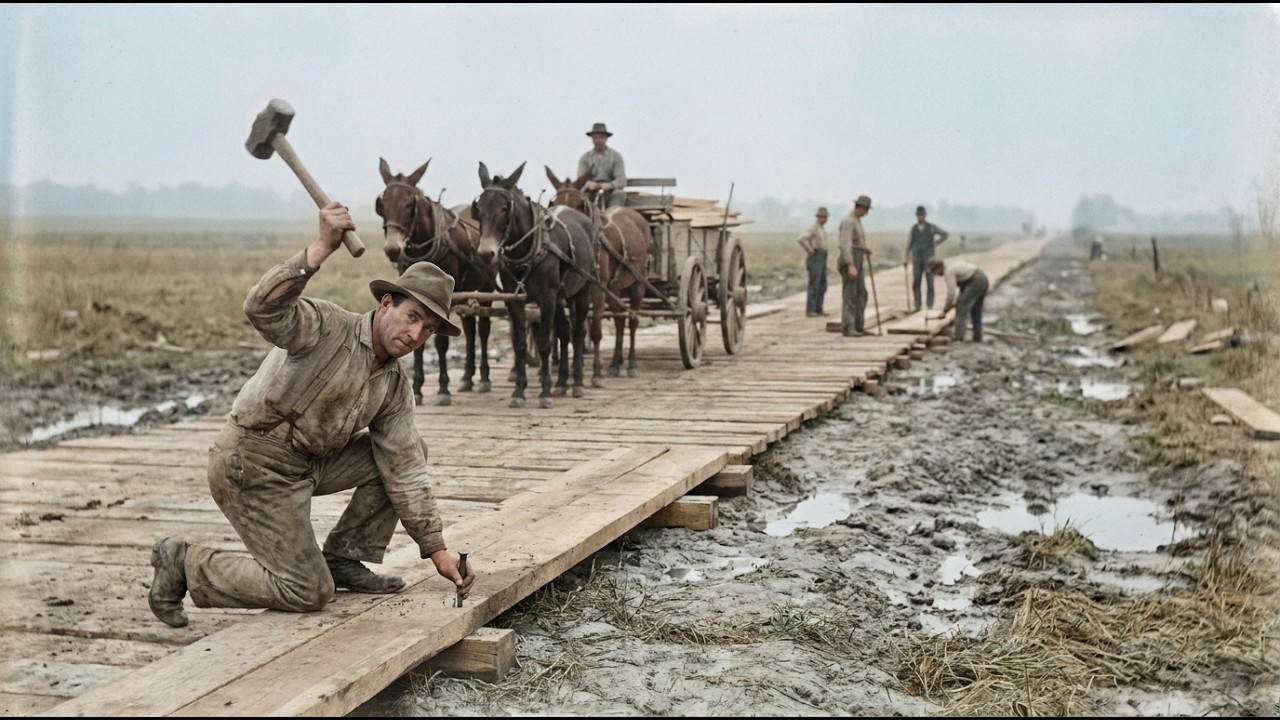
It was a narrow answer to a narrow hauling problem, and it performed so effectively and turned a profit so swiftly that Geddes wrote up the whole account and became its loudest advocate. The nation took the spark. Building a plank road meant shaping the earth into a smooth, slightly crowned bed so rainwater would drain away, then setting long timber stringers lengthwise along the bed to serve as a foundation. Over these, work crews placed heavy planks—typically eight feet long and three or four inches thick—laid crosswise, board pressed to board, creating an unbroken wooden floor.
The planked surface was generally just wide enough for one lane, around eight feet, with a graded strip of dirt running alongside. The custom was that a loaded wagon held the right to the boards, and lighter vehicles were expected to swing off onto the dirt and yield. At set intervals came turnouts where vehicles could pass one another. The finished result, when fresh, bordered on the miraculous.
Horses could haul heavy freight over a smooth, hard, quiet surface in any weather, while the dirt road running beside it lay impassable. Farmers who had spent their whole lives battling the muck rolled onto the boards and felt the entire grinding friction of the journey drop away. At the tollgate they paid a cent and a half per mile for a two-horse wagon, half a cent for a rider on horseback, while those on foot passed without charge. Travelers who begrudged the fee would slip away along rough side lanes to skirt the gate—a habit that earned its own name: shunpike, the road you took to shun the turnpike.
The word lives on as a place name to this day. The boom truly took off once New York enacted a general law that made it simple for anyone to charter a plank road company. Between 1847 and 1854, over 340 plank road companies were incorporated in that state alone. Every town craved one, and every circle of local investors craved the link to market and the toll income it seemed to guarantee.
On paper, the finances looked splendid. Tolls multiplied by dependable traffic promised generous returns. One favorably situated road, sixteen and a half miles in length and built for roughly $23,000 from thick hemlock planks, proved a resounding financial triumph and persuaded everyone that a plank road was a road straight to wealth. New York State by itself laid something like 3,500 miles of these roads—a distance sufficient to stretch from Manhattan to California.
Nationwide, the tally climbed past 10,000 miles. The roads pushed into New Jersey, southward, and westward across Ohio, Michigan, and Wisconsin. People called it the farmers’ railroad, because to a farmer mired in mud, a reliable all-weather road held nearly the promise of a railway, and it looked like something a community could genuinely afford to build for itself. No stone quarries were needed, no canal engineer, no railroad corporation.
All you needed was timber, a sawmill, and the determination to organize and lay down the boards. The whole investment calculation rested on a single figure: how many years the planks would survive. Promoters pledged seven, ten, even twelve years of steady tolls before the surface required replacement. That was the entire financial footing of the boom—and it was mistaken.
A plank road was nothing but wood laid flat on damp ground, exposed to rain, snow, and the freeze-and-thaw rhythm of a northern winter. Timber resting on wet earth decays, and the passage of iron-shod hooves and iron-rimmed wheels scuffed and hammered the surface day after day, thinning the planks and splitting the ones that rot had already weakened. Moisture beneath, weather above, and iron pounding the top meant the boards started failing within three or four years, not seven or twelve. They grew soft and splintered, giving way beneath the wheels until the once-beautiful smooth road turned into a hazard capable of laming a horse or shattering a wheel.
That one fact demolished the arithmetic entirely. A company had banked on a decade or more of toll revenue before rebuilding. Now it faced relaying the whole road at vast expense after merely a few years, long before the tolls had recovered the original construction cost. Rebuild at that pace, and upkeep devoured every cent the tolls generated and then some.
Let it decay, and the broken surface became harder to travel than the dirt road it had replaced, and the traffic and tolls withered away. Whichever path a company chose, ruin followed. No clever management could dodge it, because the trouble lay not in how the roads were run but in the physical lifespan of their material. No quantity of faith could make wood outlast wood.
Some companies attempted to relay their planks and never pulled ahead. Others tried methods to extend the life of the wood, but nothing affordable enough existed at the scale required. Many simply abandoned the boards and dissolved. Millions of dollars vanished almost in an instant.
The money drained out of communities that had little to spare—a quiet, far-reaching financial wound spreading across rural America in the 1850s, borne by farmers, shopkeepers, and small-town boosters who had sunk their own savings into the dream. The boom collapsed within a decade of its height. The great plank road craze faded so utterly that most people today have never heard of it. A few roads were capped with gravel and carried on as ordinary toll roads, quietly shedding the very feature that had made them remarkable.
Most just rotted in place, the boards decaying or being torn up until the road was bare earth once more, returned to the muck it had been meant to conquer. The lasting solution was coming from elsewhere all along: the hard, sturdy, well-drained roads of crushed stone that the Scottish engineer John McAdam had shown builders how to construct—roads that did not rot. Over the decades that followed, macadam and gravel, and in time, during the twentieth century, concrete and asphalt, solved the mud problem for good, something the plank roads had only promised briefly and imperfectly. Yet the plank roads left behind more than just their names.
Their short existence demonstrated that rural America urgently wanted and required reliable all-weather roads, and that timber was not the means to achieve them. When first the bicycle and then the automobile stirred a fresh appetite for smooth roads, that old longing returned with force and fueled the Good Roads movement that at last paved rural America permanently. In that respect, even the failure served a purpose—a crude first attempt at the paved nation now taken for granted. The men who laid those roads are the most overlooked piece of a largely overlooked chapter.
Ten thousand miles of plank road represents an astounding quantity of manual labor, and virtually none of it was done by machines. Countless trees were cut down, dragged to sawmills, and sliced into boards by sawyers pushing logs into the blades, losing fingers and hands to the equipment. Gangs of laborers leveled the beds by hand with picks and shovels and horse-drawn scrapers, carved the drainage ditches, dragged and set the heavy stringers, and laid down board after board after board mile upon mile through sun and rain. They were the same sort of nameless heavy laborers who built the canals and the railroads.
We know the name of George Geddes, the engineer who had the idea. We do not know the sawyer who cut the plank or the laborer who laid it. They built 10,000 miles of road with their hands, saw much of it rot, moved on to whatever came next, and the country forgot them completely. Yet the routes themselves very often endured.
Because a road linking two useful places tends to remain a road even after its surface changes entirely, throughout the Eastern United States and the Midwest there are streets and roads today paved in modern asphalt simply called Plank Road. Most of the people driving along them have no notion why. But a Plank Road, nine times out of ten, is precisely what it claims: the ghost of an actual plank road from the boom of the 1840s and 1850s, a route once floored with wooden boards laid by hand by forgotten men, preserving the old name long after the final plank had rotted away. The roads were real while they lasted, the effort was real, and the relief they provided, however fleeting, was real.
The planks are long gone, but beneath the name, if you know to look for it, lies the memory of the forgotten men who once floored America with wood.
